 Skip to content
South Africa does not have one universal approval that covers every Battery Energy Storage System project.
The applicable pathway depends on the project configuration, point of connection, installed power, associated generation, export or trading arrangement, environmental sensitivity and local authority requirements.
Before ordering a BESS, an EPC may need to address:
- NERSA licensing or registration questions
- Eskom or municipal grid-connection requirements
- Environmental screening or authorisation
- Water, heritage or land-use requirements
- Municipal building and civil approvals
- Fire access and emergency-response design
- Project-specific electrical acceptance
The Electricity Regulation Amendment Act 38 of 2024 came into operation on 1 January 2025. It amended South Africa’s electricity framework in areas including licences, electricity infrastructure, trading and the transmission-system operator.
The correct procurement sequence is to define the approval and connection pathway before freezing the battery, PCS and transformer architecture.
Which Authority Applies to a South African BESS Project?
Different project questions are handled through different authorities or processes.
| Project Question | Relevant Authority or Process | What the EPC Must Confirm |
|---|---|---|
| Licensing or registration | NERSA or the relevant distributor | Project classification, installed capacity and regulated activity |
| Eskom grid connection | Eskom | Connection voltage, network studies, metering and protection |
| Municipal grid connection | Licensed municipal distributor | Local application process, tariff, metering and protection requirements |
| Environmental pathway | DFFE and appointed environmental practitioner | Whether the exclusion norm applies or environmental authorisation is required |
| Watercourse impact | Department of Water and Sanitation | Whether a water-use licence or general authorisation is triggered |
| Land use and building approval | Local municipality | Zoning, foundations, access and building-plan requirements |
| Approval coordination | Energy One Stop Shop | Coordination and application facilitation across government departments |
The Energy One Stop Shop provides a single point of entry and coordinates energy-project approval processes across government. It does not eliminate the need for the relevant authority to make each required decision.
Define the BESS Configuration Before Selecting Equipment
The term “BESS project” can describe several different arrangements:
- A battery behind one industrial customer meter
- Solar PV combined with battery storage
- A stand-alone battery charged from the grid
- Backup-only storage
- A zero-export installation
- An export-capable installation
- A wheeling or electricity-trading project
- A utility-scale storage facility
- A fully off-grid microgrid
These projects should not automatically follow the same regulatory or grid-connection route.
The project basis should answer:
- Who owns and operates the BESS?
- Is there a physical grid point of connection?
- Is the customer supplied by Eskom or a municipality?
- Is the battery combined with PV or generation?
- Will electricity be exported, traded or wheeled?
- Is the connection low voltage or medium voltage?
- Will the BESS serve all loads or only critical loads?
- Will the system operate in grid-connected and islanded modes?
A statement such as “zero export required” does not answer these questions.
Zero export is an operating objective, not a complete regulatory or connection classification.
The network operator still needs to assess the PCS, protection, metering and system behaviour if the export-control signal fails.
Confirm the NERSA Registration Question
NERSA clarified in February 2026 that registration of an embedded-generation facility is determined by its grid point of connection and installed capacity, rather than simply by whether electricity is exported or consumed on site.
For embedded generation:
- For embedded generation:
- Facilities above 100kW with a grid connection register directly with NERSA.
- Embedded-generation facilities without a grid point of connection are exempt from registration.
These thresholds concern embedded generation.
They should not automatically be applied to every stand-alone, grid-charged battery project without confirming the classification with NERSA and the relevant distributor.
The network operator still needs to assess the PCS, protection, metering and system behaviour if the export-control signal fails.
Project-specific clarification is particularly important when the design includes:
- A stand-alone BESS without on-site generation
- PV and BESS behind the same meter
- Backup generators combined with storage
- Electricity export
- Wheeling
- Electricity trading
- Multiple off-takers
- A dedicated BESS connection point
The project team should prepare a short classification note containing:
- Project owner and operating entity
- Site location and coordinates
- Battery power and energy
- Associated generation capacity
- Point of connection
- Import and export intention
- Off-taker information
- Trading or wheeling arrangement
- Proposed commercial-operation date
This note does not replace regulatory advice. It ensures that the EPC, adviser, grid consultant and BESS supplier are reviewing the same project configuration.
Identify Eskom or the Correct Municipal Distributor
The proposed point of connection determines which network operator should receive the connection application.
Eskom states that projects connecting to the Eskom grid should use its application process.
Where electricity is supplied by a municipality, the applicant must contact the relevant municipal offices. Eskom also directs supplies above 1MVA and certain complex applications into its formal application process.
The first connection package should include:
- Existing single-line diagram
- Proposed single-line diagram
- Point of common coupling
- Site supply voltage
- Transformer rating and impedance
- Existing maximum demand
- Available transformer margin
- Proposed PCS rated power
- Maximum apparent power
- BESS charging power
- Import and export limits
- Active and reactive power requirements
- Metering location
- Protection philosophy
- Communication architecture
- Grid-connected and backup modes
The drawing should show whether the PCS connects:
- To the main low-voltage bus
- Through a dedicated transformer
- To a medium-voltage feeder
- Behind an existing generator
- Behind an existing PV system
- At a new point of supply
The PCS and Inverter Engineering Guide explains why battery energy alone cannot establish network compatibility.
A 1MWh battery paired with a 250kW PCS creates a different network interface from the same nominal battery energy paired with a 1MW PCS.
Check Whether the Battery Storage Exclusion Norm Applies
South Africa adopted a battery-storage exclusion norm in March 2024.
The norm allows identified battery-storage activities in areas of confirmed low or medium environmental sensitivity to proceed without prior environmental authorisation when the project meets the conditions of the norm.
It is not an automatic exemption for every industrial site.
The official environmental-management resources also provide a registration form for projects requesting registration under the battery-storage exclusion norm.
The environmental practitioner should review:
- Site coordinates
- Proposed BESS footprint
- Environmental sensitivity
- Access-road and cable routes
- Existing land use
- Vegetation clearing
- Nearby watercourses
- Stormwater design
- Construction laydown area
- Firewater arrangements
- Waste management
- Battery end-of-life handling
The project should record one of three outcomes:
| Environmental Finding | Procurement Consequence |
|---|---|
| Exclusion norm applies | Record sensitivity verification, registration and compliance conditions |
| Environmental authorisation is required | Do not freeze the final site layout before the assessment is completed |
| Further specialist review is required | Keep the footprint and equipment quantities provisional |
Environmental exclusion does not automatically resolve every other approval.
Depending on the site, the project may still need to assess water use, heritage, land use, road access, municipal services or other authorisations. The Energy One Stop Shop permitting tool lists environmental, water, road, heritage and other potential approval workstreams.
Confirm Municipal, Civil and Fire Requirements
Local requirements vary according to the municipality, site type and project scale.
The EPC should determine whether the project requires review of:
- Land-use or zoning compatibility
- Foundations and building plans
- Fire-service access
- Emergency vehicle access
- Equipment separation distances
- Stormwater drainage
- Noise
- Security and fencing
- Transformer installation
- Medium-voltage rooms
- Earthing
- Lightning protection
- Crane access
- Abnormal-load transportation
The BESS supplier can provide equipment information such as:
- Dimensions
- Equipment mass
- Maintenance clearances
- Cable-entry positions
- Cooling requirements
- Heat rejection
- Fire-system interfaces
- Lifting points
- Transport requirements
- Preliminary layout drawings
The local EPC and appointed professionals must convert those product inputs into an approvable site design.
The BESS Safety and Compliance Guide can support equipment-document review, but a product test report is not the same as approval of the South African project site.
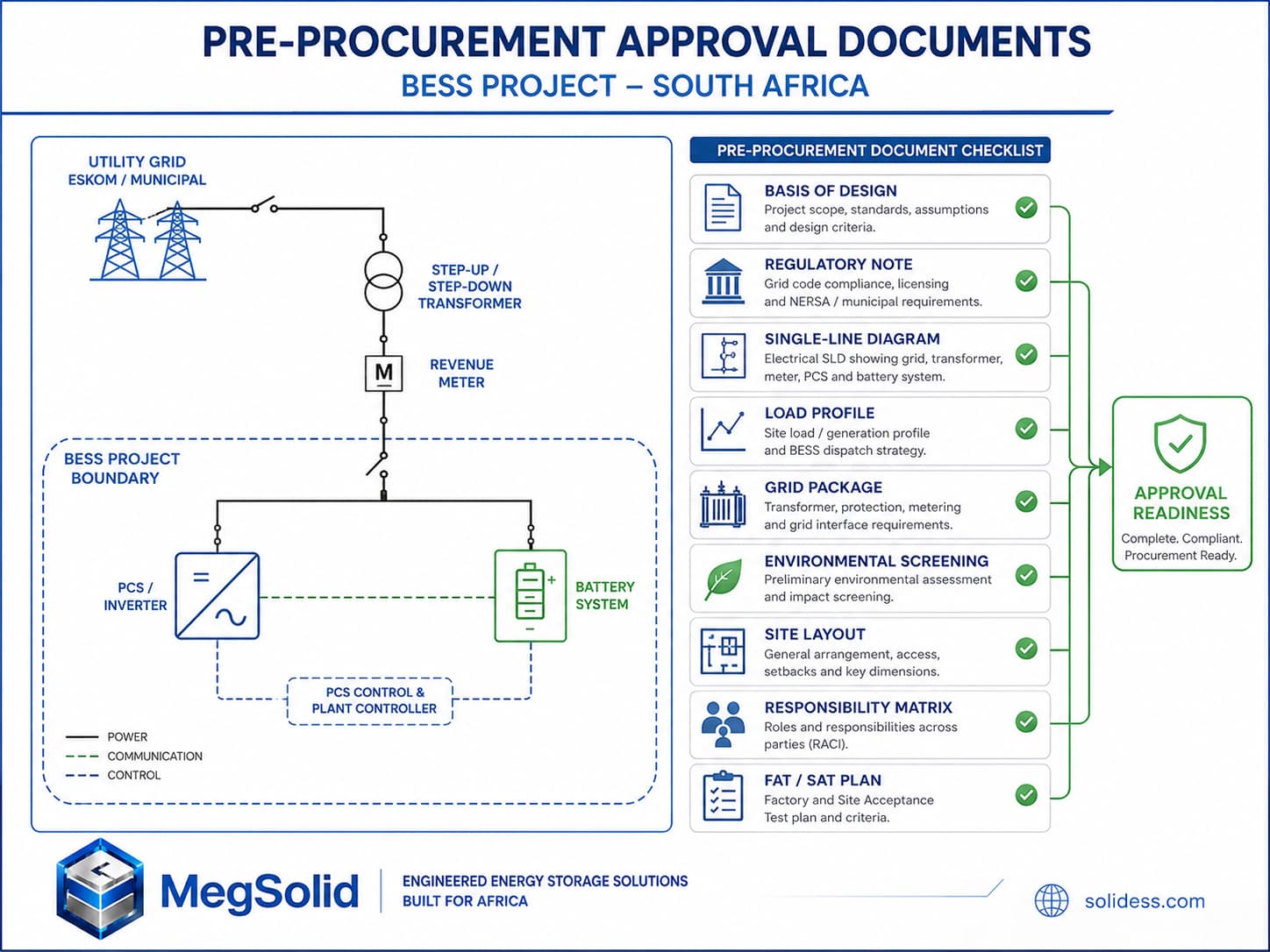
What MegSolid Reviews When an EPC Submits a Single-Line Diagram
A preliminary BESS review should not begin with a model recommendation.
MegSolid first needs to understand the electrical boundary shown on the project documents.
The review focuses on:
- The proposed PCS connection point
- Existing transformer capacity
- Site voltage
- Critical and non-critical loads
- PV and generator interfaces
- Metering location
- Import and export control points
- Required charging power
- Backup operating mode
- Communication boundaries
The main objective is to identify whether the proposed MW and MWh values are compatible with the existing electrical system.
For example, a site may request a 500kW BESS while the existing transformer has insufficient spare capacity to recharge the battery at 500kW.
The project may then require:
- Restricted charging power
- Scheduled charging
- PV-surplus charging
- A larger transformer
- A dedicated connection
- A revised PCS rating
This is why a quotation should not be finalised from battery capacity alone.
The BMS and EMS Communication Architecture should also be reviewed before freezing zero-export, generator-control or islanding logic.
Prepare an Approval-Use Document Matrix
The procurement package should show which document supports which decision.
| Document | Main User | Approval or Engineering Purpose |
|---|---|---|
| Project basis of design | Owner, EPC and advisers | Defines application, MW, MWh and operating modes |
| Regulatory classification note | NERSA, distributor or adviser | Clarifies the activity and registration question |
| Single-line diagram | Network operator and EPC | Defines connection, protection and equipment boundary |
| Load and generation profiles | EPC and supplier | Supports battery and PCS sizing |
| Grid-connection package | Eskom or municipal distributor | Supports network-impact assessment |
| Environmental screening record | Environmental practitioner | Determines the environmental pathway |
| Preliminary site layout | Municipality, civil EPC and fire reviewer | Defines footprint, access and separation |
| Responsibility matrix | Owner, EPC and supplier | Prevents missing equipment and service scope |
| FAT and SAT plan | EPC and supplier | Defines equipment and site acceptance |
The BESS RFQ Template should be issued after the connection boundary and preliminary site conditions are reasonably stable.
How Approval Findings Change the BESS Architecture
Approval screening is not separate from equipment selection.
It can directly change the proposed BESS design.
| Approval or Site Finding | Engineering Consequence |
|---|---|
| Limited transformer capacity | Restrict PCS charging and discharging power |
| Medium-voltage connection required | Add transformer, MV switchgear and protection scope |
| Zero-export condition | Define meter location, EMS response and failure logic |
| Restricted site footprint | Compare modular cabinets with containerized BESS |
| Environmental footprint restriction | Revise equipment position, cable route or access road |
| High equipment-intake temperature | Review cooling system and derating |
| Backup mode required | Define critical-load boundary and transition architecture |
| Existing generator integration | Define generator loading and reverse-power controls |
Only after these findings are known should the project move into model-level selection.
The current MegSolid product references include:
- The ESSA0100B-0215 Outdoor C&I Cabinet, listed at 100kW and 215.04kWh with LFP cells and intelligent air cooling. It must not be described as a liquid-cooled or automatically labelled hybrid solid-state model.
- The 261.24kWh Liquid-Cooled C&I System, listed with 125kVA rated AC capacity, 314Ah LFP cells and 832V nominal DC voltage. Its 90% figure is maximum system efficiency, not stated round-trip efficiency.
- The ESSC Containerized BESS Range, which includes 500kW/1.0752MWh and 1MW/2.1504MWh configurations.
These references provide possible engineering directions, not automatic project approval or product-fit guarantees.
Follow the Approval-to-Procurement Sequence
A defensible project sequence is:
- Define the application and commercial arrangement.
- Confirm the project owner and operating entity.
- Identify the point of connection.
- Identify Eskom or the relevant municipal distributor.
- Clarify the NERSA licensing or registration question.
- Submit the preliminary grid-connection package.
- Complete environmental and site screening.
- Confirm municipal and civil requirements.
- Freeze the preliminary electrical boundary.
- Issue the technical RFQ.
- Compare equivalent supplier scopes.
- Finalise FAT, SAT and commissioning requirements.
- Release the equipment order after critical assumptions are confirmed.
The BESS Factory Acceptance Test Guide should be adapted to the approved operating modes, protection settings, meter signals and communications.
Request a South Africa BESS Approval-Gap Review
Submit:
- Project location and coordinates
- Required continuous and peak power
- Required usable energy
- Required discharge duration
- Existing single-line diagram
- Supply voltage
- Transformer rating and impedance
- Import and export requirements
- PV and generator information
- Load profile
- Site temperature and altitude
- Environmental-screening status
- Known grid-application status
- Target commissioning date
MegSolid can return:
- Preliminary equipment boundary
- Missing technical-data register
- PCS and transformer questions
- Grid-interface document list
- BMS and EMS interface requirements
- Supplier and EPC responsibility boundary
- Recommended FAT and SAT inputs
Conclusion: Regulatory Screening Must Precede Equipment Commitment
South African BESS regulations cannot be reduced to one licence, one registration threshold or one environmental approval.
The required path depends on:
- What the system does
- Where it connects
- Who supplies the site
- Whether generation is included
- Whether electricity is exported or traded
- What environmental conditions apply
- What local approvals are required
The supplier should provide accurate, model-specific equipment information.
The EPC should define the electrical and site design.
The developer and appointed South African professionals should confirm the regulatory and approval path.
When these responsibilities are separated clearly, the project can move from an indicative battery quotation to an approvable, connectable and testable BESS design.
FAQ
Q1: Is there one licence that covers every South African BESS project?
Is there one licence that covers every South African BESS project?
Q2: Does every BESS project require NERSA registration?
Not necessarily. Embedded-generation registration requirements should not automatically be applied to every stand-alone battery project. The project configuration should be confirmed with NERSA and the relevant distributor.
Q3: What is the 100kW NERSA threshold?
For embedded generation with a grid point of connection, facilities of 100kW or less register with the relevant distributor, while facilities above 100kW register directly with NERSA. This clarification concerns embedded generation.
Q4: Does zero export remove the need for grid review?
No. Zero export is a control objective. The network operator may still need to assess the PCS, protection, metering and behaviour during control or communication failure.
Q5: Should an Eskom-supplied project apply through the municipality?
No. A site connected to the Eskom network should use the Eskom process. A site supplied by a municipality should contact the relevant municipal distributor.
Q6: What should be included in the initial grid-connection package?
- Existing and proposed single-line diagrams
- Point of common coupling
- Supply voltage
- Transformer rating and impedance
- PCS rated and apparent power
- Charging power
- Import and export requirements
- Metering and protection information
- Grid-connected and backup operating modes
Q7: Does the battery-storage exclusion norm apply to every industrial site?
No. The site must meet the applicable environmental-sensitivity and compliance conditions. The project may also need registration under the norm.
Q8: Is product certification the same as project approval?
No. Product certification supports equipment qualification. It does not approve the site, connection, civil design, environmental pathway or commercial arrangement.
Q9: When should the EPC issue the final BESS purchase order?
The final order should follow reasonable confirmation of the point of connection, project classification, environmental pathway, electrical architecture, equipment scope and acceptance requirements.
Q10: What information should MegSolid receive before recommending a BESS?
- Required power and usable energy
- Discharge duration
- Load profile
- Single-line diagram
- Supply voltage
- Transformer data
- Import and export requirements
- PV and generator data
- Site temperature and altitude
- Known approval status
Q11: What regulations apply to a BESS project in South Africa?
A South African BESS project may involve the Electricity Regulation Act, NERSA licensing or registration questions, Eskom or municipal connection requirements, environmental screening and site-specific municipal approvals. The exact pathway depends on the project configuration.
Q12: How do I connect a commercial BESS to the grid in South Africa?
Identify whether Eskom or a municipality operates the network, prepare the single-line diagram and transformer data, define the PCS power and operating modes, and submit the required connection information to the relevant distributor.
Q13: Can a battery storage project avoid environmental authorisation in South Africa?
Identified battery-storage activities in areas of confirmed low or medium environmental sensitivity may qualify under the battery-storage exclusion norm when all applicable conditions and registration requirements are met.
