 Skip to content
For BESS in Brazilian manufacturing industry, begin with the factory’s measured load, required AC power, operating mode, and local implementation boundary before comparing battery capacity or price. MegSolid presents commercial and industrial energy-storage categories, power-conversion equipment, and hybrid solid-state energy-storage technology. However, a factory project should proceed only when the selected configuration, contractual bill of materials (BOM), test requirements, and local EPC responsibilities are documented for the specific site.
- Define critical loads and the required operating mode before issuing an RFQ.
- Select rated and peak AC power before comparing nominal battery energy.
- Assign responsibility for PCS, controls, transformer, switchgear, installation, and commissioning.
- Request model-specific documents, certificates, warranty terms, and FAT/SAT evidence before purchase-order release.
This is an evidence-led procurement framework for manufacturing owners, EPC contractors, distributors, and engineering teams. It is not a Brazilian electrical design, tariff assessment, interconnection approval, or regulatory opinion. Information on Brazilian utility requirements, local approval pathways, certificate acceptance, and site-specific installation standards is unavailable in the current MegSolid source files and must be confirmed for the actual installation by the local EPC, relevant utility, and project stakeholders.
Define the manufacturing problem before asking for a BESS quotation
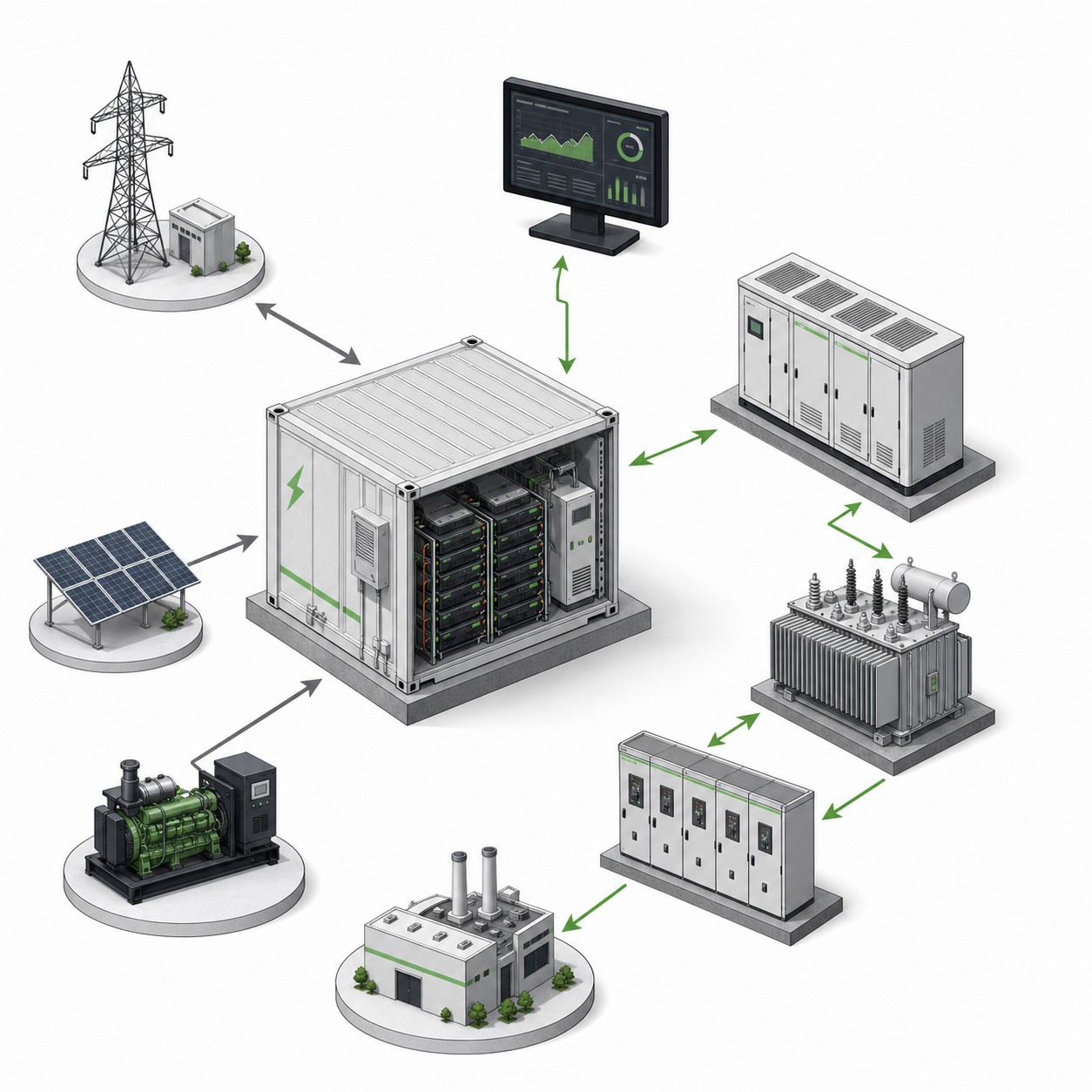
A battery energy storage system can be considered for several operating objectives, including support for selected loads, coordination with on-site generation, generator coordination, or a planned load-management strategy. These objectives are not interchangeable. Each changes the required power, energy, controls, protection arrangement, and site acceptance criteria.
Before approaching a BESS manufacturer or BESS OEM, divide the plant load into clear operating groups. The project team should identify loads that must remain energized, loads that may run for a defined period, and loads that can be shed or rescheduled. This classification creates a practical electrical boundary and prevents a quotation from being assessed solely by a nominal kWh figure.
The first data request should be the best available factory load profile, preferably in 15- or 30-minute intervals, together with known short-duration peaks and planned process changes. A single monthly consumption figure does not establish the power profile required by a C&I energy storage system. The buyer should also state whether the intended system is expected to operate with the grid, PV, a generator, a microgrid controller, or a defined critical-load panel.
MegSolid’s BESS Solutions Hub provides a starting point for reviewing the company’s energy-storage categories. Category information can help an early discussion, but it is not a substitute for a site survey, single-line diagram, load study, or project-specific design review.
Choose AC power before comparing battery energy
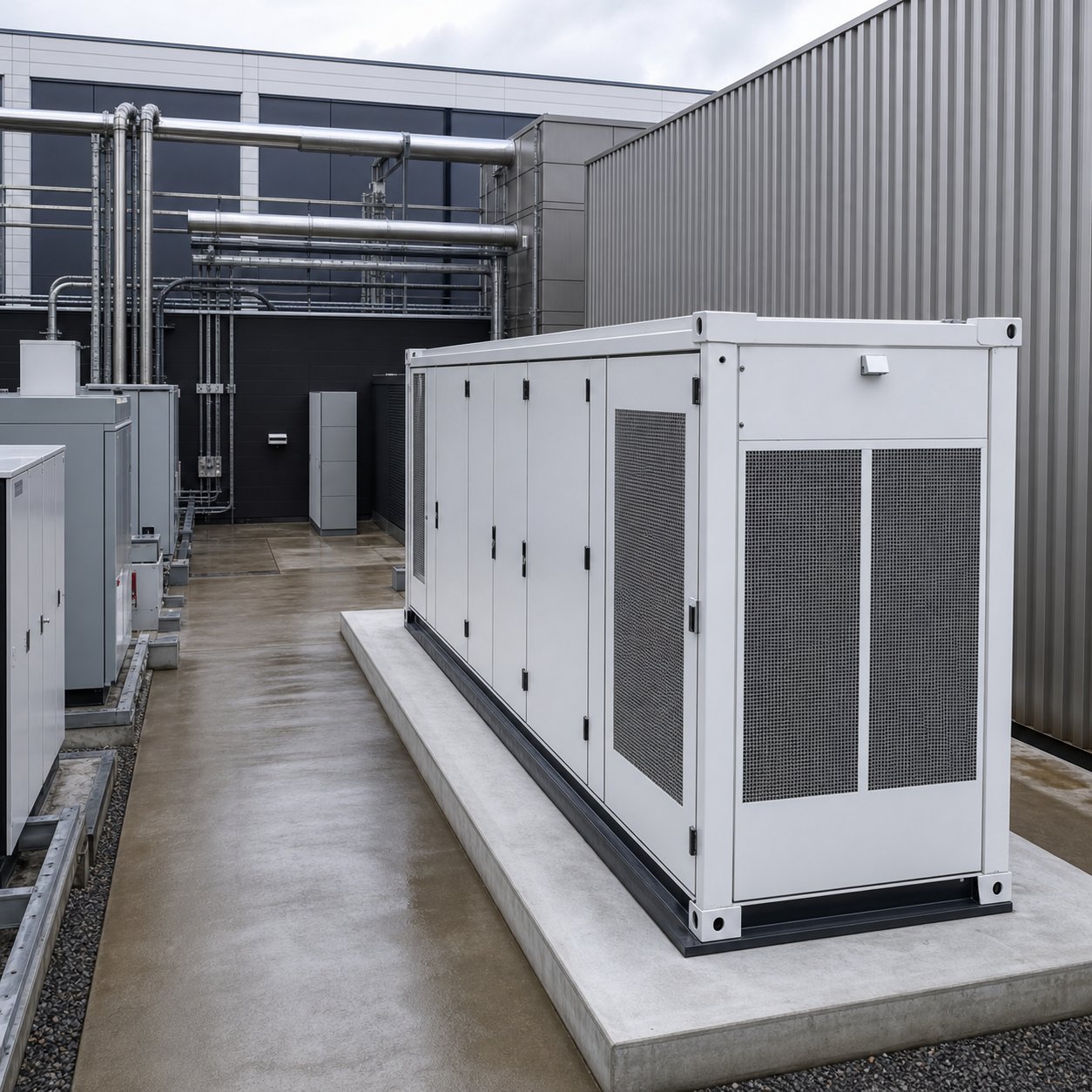
Rated and peak AC power should be the first technical comparison point. A proposal may include substantial nominal DC energy but still fail to support the required factory load if the power-conversion and AC-side arrangement are not suitable for the operating duty. The reverse can also occur: an offer may meet the power requirement but not provide the usable energy needed for the required duration.
The RFQ should state the measurement boundary for both power and energy. For example, the buyer should specify whether the requirement applies at the PCS terminals, a low-voltage board, or a defined critical-load panel. Suppliers should then state how their proposal treats auxiliary consumption, reserve state of charge, depth of discharge, conversion losses, and any end-of-life assumptions when presenting usable-energy information.
These are not minor commercial details. They are the assumptions that determine whether two quotations can be compared fairly. If one supplier provides nominal battery energy while another provides an AC-side usable-energy figure under stated conditions, the buyer should not treat the figures as equivalent.
MegSolid’s product-portfolio selection principle is to select AC power from the load and operating mode before comparing battery energy, then validate usable energy, voltage compatibility, C-rate, temperature, grid interface, transformer, protection, certificate scope, and local EPC responsibility. The C&I Solid-State Energy Storage Guide is a useful company resource for framing these project questions.
Treat “OEM battery energy storage system BESS” as a scope decision
The phrase OEM battery energy storage system BESS does not, by itself, define the delivery boundary. It may describe an integrated system supplied under a particular commercial arrangement, a system configured for an EPC or distributor, or the supply of subsystems that another party will integrate. The buyer should not assume that the OEM label includes every electrical, civil, control, documentation, or field-service obligation.
Instead, build a scope matrix that identifies every deliverable and its responsible party. The matrix should address the battery system, BMS, PCS, EMS, transformer, switchgear, metering, communications equipment, cabling interfaces, protection equipment, installation materials, civil works, commissioning, training, warranty, and service. Where an item has no assigned party, treat it as an unresolved project risk rather than an implied inclusion.
MegSolid states that it focuses on the worldwide operation and commercialization of residential, commercial and industrial, microgrid, and utility-scale energy-storage systems supported by its hybrid solid-state battery technology. This is company positioning, not proof that a particular project configuration is included in a quotation. Buyers can review About MegSolid and use Contact MegSolid to submit a technical brief for a selected project.
Match the system architecture to the site and electrical boundary
An outdoor cabinet and a containerized system are different project architectures. The appropriate option depends on the required power and duration, available footprint, access restrictions, maintenance access, electrical interfaces, transformer and switchgear arrangement, cooling approach, and the division of EPC responsibility. A responsible selection requires project data rather than a generic preference for one enclosure type.
MegSolid lists both an Outdoor Cabinet Energy Storage System and a Container Energy Storage System among its C&I categories. Their listing does not demonstrate suitability for a particular Brazilian factory. The proposal should identify the exact offered model, configuration, access requirements, electrical interfaces, foundation or mounting responsibility, and the boundaries between supplier and EPC scope.
Do not transfer specifications from a component, product family, or another system into the selected configuration. In particular, current MegSolid source material supplied for this briefing does not provide a model-specific fact sheet that supports using an energy-storage-system capacity, AC power, cooling method, battery-cell description, or efficiency figure for a factory proposal. Request the selected model’s current datasheet and quotation BOM before using any product parameter in an RFQ, technical comparison, contract, or acceptance test.
Verify battery, PCS, and controls compatibility before approving the BOM
The battery and PCS must be assessed as one operating system. Ask the supplier to identify the exact battery and PCS models, their compatible operating ranges, protection arrangement, communication interface, and responsibility for system controls. Compatibility should be demonstrated for the offered configuration rather than inferred from general category pages or nominal values.
Where an isolation transformer or dedicated conversion arrangement is proposed, it should be shown on the single-line diagram and identified in the BOM. MegSolid has a published Power Conversion System With Isolation Transformer route. Whether it is required, included, or technically appropriate for a specific factory must be determined in the site design and stated in the project offer.
Controls require the same level of definition as hardware. The technical proposal should describe intended operating states, command sources, metering points, alarms, interlocks, and load-shedding responsibility. If the factory expects coordination with PV, generators, or existing building-management controls, the communications and control boundary should be included in the design review instead of being left as an after-award assumption.
MegSolid’s Solid-State Energy Storage Systems page provides company-level context on the technology category. It should not be used in place of a model-specific electrical compatibility statement, certificate package, or project control narrative.
Make Brazilian compliance and local EPC scope contractual
Local compliance cannot be assumed from a general product statement or a generic certificate reference. The manufacturing owner should provide the intended location, grid conditions, applicable site requirements, approval pathway, and construction constraints to the local EPC and prospective supplier. The local EPC should determine and document the site-specific electrical, civil, protection, safety, installation, and commissioning responsibilities within its contracted scope.
Certificates are model-, configuration-, and market-specific. Before a certificate is relied upon for a tender, approval, shipment, or installation decision, obtain the underlying document and verify the exact model number, applicable standard, issuing body, report number, validity, and configuration coverage. A broad reference to certification should not be treated as evidence that a proposed system meets a site or market requirement.
Information on Brazilian regulatory requirements, utility-specific interconnection conditions, tariff treatment, incentives, and local certificate acceptance is unavailable in the current MegSolid source files. Buyers should obtain those requirements through the local project process and incorporate them into the technical specification, EPC scope, and supplier document schedule.
MegSolid’s Energy Storage Application Cases may provide application context. A reference or case description, however, does not establish that another project’s electrical design, approvals, operating assumptions, or acceptance criteria will apply to a new manufacturing site.
Compare quotations by evidence instead of headline capacity
A C&I energy storage system quotation becomes comparable only when each supplier answers the same engineering brief. The comparison should normalize the offered model, rated AC power, nominal and usable-energy basis, system boundary, operating assumptions, integration scope, test plan, warranty terms, exclusions, and required site work. Price should be assessed after those differences are visible.
A useful procurement rule is simple: if a value or obligation matters to the factory’s decision, require it in the proposal and trace it to the selected model, stated condition, or contractual deliverable. If the supplier cannot yet provide the information, identify it as an open item with an owner and due date rather than silently converting it into an assumption.
Use FAT and SAT to test the ordered configuration
The factory acceptance test should verify the ordered configuration against an approved protocol, not a generic product demonstration. The protocol should identify the offered model and configuration, applicable documentation, functional checks, protection checks, communications points, alarms, control states, and the evidence required for handover. Any site-dependent requirement should be clearly assigned to site acceptance testing.
The site acceptance test should address the installation-specific interfaces that cannot be fully confirmed at the factory. Depending on the defined project scope, this can include site wiring, metering, control commands, protection coordination, communications, and the agreed critical-load boundary. The responsible local EPC and supplier should agree who leads each test, who witnesses it, what data is recorded, and what constitutes acceptance.
For preliminary research, buyers can use MegSolid’s Resource Center and BESS News and Insights. These resources do not replace signed test protocols, model-specific documentation, or a project commissioning plan.
Submit an RFQ that produces a technically comparable response
A complete RFQ enables a more useful technical response and exposes interface gaps early. Send the same input package to MegSolid, the local EPC, and other candidate suppliers. Require each respondent to list assumptions, deviations, exclusions, and information still needed for final engineering.
- Factory load profile and critical-load schedule.
- Required operating modes and backup duration.
- Single-line diagram, available site voltage information, and transformer details.
- Existing PV, generator, grid, and control-system information.
- Available footprint, installation location, access limitations, and site conditions.
- Required local approvals, standards, and compliance-document expectations.
- Preferred allocation of equipment supply, installation, commissioning, training, warranty, and service.
- Required FAT, SAT, document handover, and acceptance-witness arrangements.
The supplied keyword phrase g-reic energy real estate r.e.i.c. is not identified in the current MegSolid source files as a MegSolid product, project, partner, certification, or Brazilian authority. It should not be used to define supplier scope or technical suitability unless a contracting party provides written evidence of a specific project role.
For an evidence-led next step, submit the factory load information, site single-line diagram, operating objective, and required local document list through MegSolid’s contact channel. Ask for a model-specific proposal that makes the BOM, interfaces, open items, test plan, and local EPC boundary explicit before commercial commitment.
FAQ
What should be sized first for a C&I energy storage system?
Size rated and peak AC power from the factory load profile and intended operating mode first. Then define the required duration and request a usable-energy basis at the agreed AC measurement boundary.
Why is nominal battery kWh not enough to compare BESS offers?
Nominal kWh does not establish the supported AC load, usable-energy basis, SOC window, depth-of-discharge basis, auxiliary consumption, conversion-loss treatment, or end-of-life assumptions. Suppliers should declare these conditions consistently.
What does OEM battery energy storage system BESS mean in procurement?
It can describe different supply arrangements, including an integrated system or equipment supplied for an EPC or distributor solution. Define the BOM, design responsibilities, tests, commissioning, warranty, and exclusions rather than relying on the OEM label.
Should a factory choose an outdoor cabinet or a containerized BESS?
The choice depends on required power and duration, footprint, access, electrical interfaces, maintenance access, cooling approach, and EPC scope. A site survey and project single-line diagram should inform the decision.
What PCS information should an industrial buyer request?
Request the exact PCS model, AC power basis, DC operating range, protection arrangement, transformer arrangement, grid interface, communications points, and responsibility within the system. Confirm compatibility with the offered battery configuration.
What information should be supplied before requesting a BESS quotation?
Provide the load profile, critical-load list, required duration, existing PV and generator details, single-line diagram, transformer information, site conditions, available footprint, and required compliance documents. Suppliers should identify missing inputs as open assumptions.
What should be included in a BESS FAT?
The FAT should identify the ordered configuration and verify the agreed functional, protection, communication, documentation, and traceability items under an approved protocol. Site-specific interfaces should be assigned to SAT.
Can a general certificate statement prove compliance for a Brazilian project?
No. Obtain the actual certificate or report and verify its exact model, configuration, standard, issuing body, report number, validity, and relevance to the intended market and installation.
What product data should be requested for the selected MegSolid system?
Request the current model-specific datasheet, configuration description, quotation BOM, applicable certificates, warranty terms, manuals, electrical interface information, and FAT/SAT scope. Do not use parameters from another model or product category.
Who is responsible for BESS integration at a factory?
Responsibility must be allocated in the contract. The supplier, EPC, and site owner should explicitly assign equipment supply, civil works, electrical installation, protection coordination, controls integration, commissioning, approvals, and after-sales support.
Is there a confirmed MegSolid BESS deployment in Brazilian manufacturing industry?
Information unavailable in the current MegSolid source files. A buyer should request relevant project references directly from the supplier and verify their relevance to the proposed operating mode, system configuration, and site conditions.
What should a Brazilian manufacturer confirm with its local EPC before ordering a BESS?
Confirm the site electrical design, grid-interface obligations, applicable requirements, approval process, installation method, protection coordination, commissioning plan, and acceptance responsibilities. These items are site-specific and cannot be assumed from a product page.
Is g-reic energy real estate r.e.i.c. connected to MegSolid or this procurement briefing?
No connection is identified in the current MegSolid source files. Treat the phrase as unrelated to the engineering evaluation unless a contracting party provides written evidence of a defined project role.
What does OEM battery energy storage system BESS mean in procurement?
It can describe different supply arrangements, including an integrated system or equipment supplied for an EPC or distributor solution. Define the BOM, design responsibilities, tests, commissioning, warranty, and exclusions rather than relying on the OEM label.
Can a general certificate statement prove compliance for a Brazilian project?
No. Obtain the actual certificate or report and verify its exact model, configuration, standard, issuing body, report number, validity, and relevance to the intended market and installation.
What should a Brazilian manufacturer confirm with its local EPC before ordering a BESS?
Confirm the site electrical design, grid-interface obligations, applicable requirements, approval process, installation method, protection coordination, commissioning plan, and acceptance responsibilities. These items are site-specific and cannot be assumed from a product page.
