
MegSolid sizes commercial battery storage in South Africa from the factory's operating duty, not from monthly kWh alone. The fastest route to a bankable preliminary design is to define four boundaries: the power gap in kW, the usable energy window in kWh, the EMS control priority and the AC delivery point that the EPC or energy-service provider must guarantee.

- ⚡ Power first: Size kW from the largest simultaneous load gap, peak-shaving target or critical-load step.
- ⏱️ Runtime second: Convert the required support window into usable AC kWh, then allow for operating limits and losses.
- 🧠 EMS third: Decide which objective wins when backup reserve, solar charging and peak shaving compete for the same SOC.
- 📍 Delivery point: State whether performance is measured at the battery DC terminals, PCS output, main LV board or point of common coupling.
- 📄 RFQ evidence: Give every bidder the same load data, tariff, SLD, site conditions and acceptance tests.
The Direct Answer: Size the Duty Before the Battery
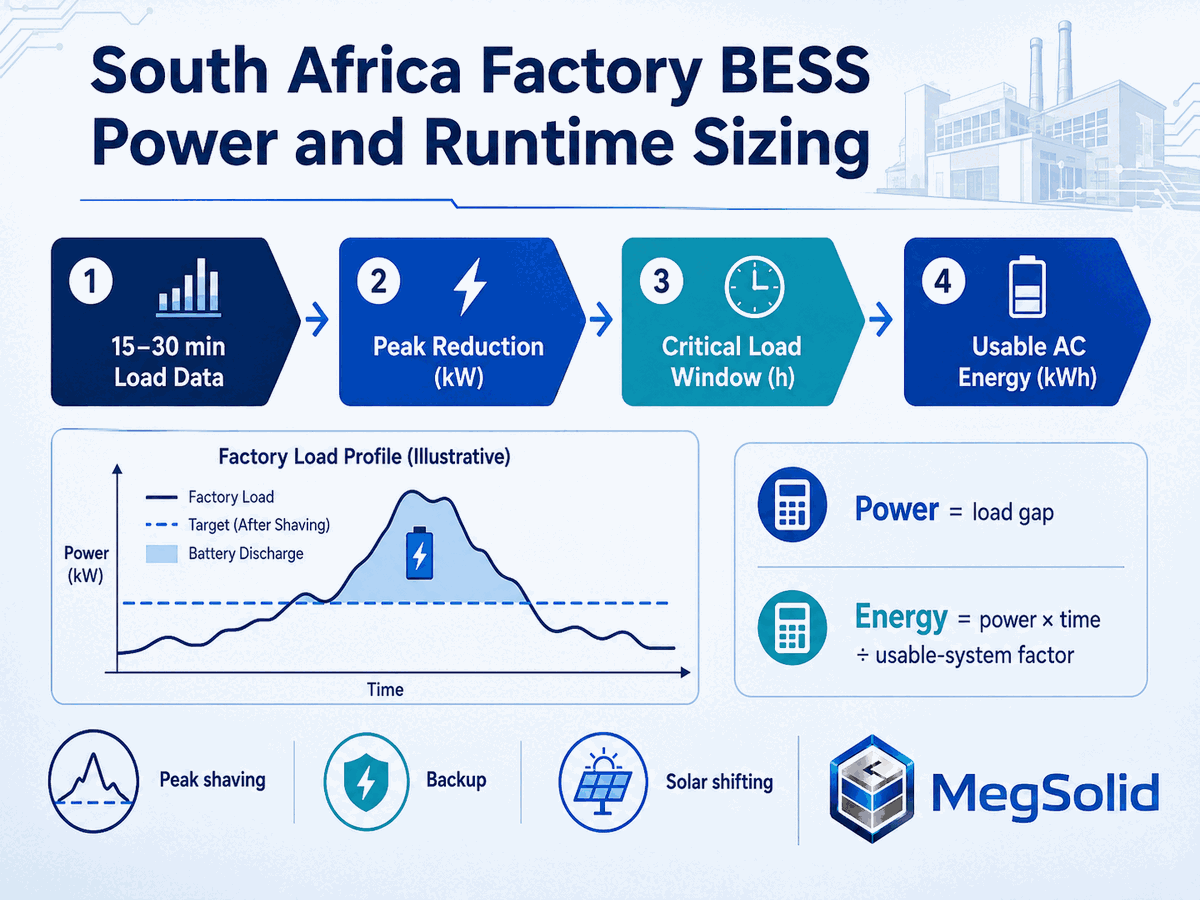
For a South African factory, use 15- or 30-minute interval data to establish the normal load profile, then obtain higher-resolution data for motor starts or rapid process steps. Required BESS power is the maximum controlled load gap. Required energy is the area under that gap for the promised operating window, adjusted to the agreed AC measurement point.
| Factory objective | Primary sizing variable | Evidence required | Common mistake |
|---|---|---|---|
| Peak shaving | kW above the import target and duration of each event | Interval load data, tariff, NMD and peak-period rules | Sizing from the single highest bill value without its duration |
| Critical-load backup | Critical kW, step loads and autonomy window | Critical-load schedule, motor data and outage sequence | Assuming the whole factory must run unchanged |
| Solar self-consumption | Surplus PV energy and later load window | PV profile, export limit and curtailment history | Matching battery kWh to PV nameplate kWp |
| Generator optimisation | Minimum generator loading and transient support | Generator ratings, controls, fuel curve and start sequence | Connecting two grid-forming sources without a control study |
| Energy-service or PPA delivery | Guaranteed power and energy at the settlement meter | Delivery window, meter rules, exclusions and remedies | Using battery nameplate energy as the contractual delivery value |
South African tariff structures are site-specific. Eskom lists urban tariffs for large industrial and commercial users, while municipal tariffs and embedded-generation rules differ by distributor. Check the applicable 2026/27 schedule on the Eskom tariffs and charges page and confirm the factory's actual bill before assigning savings to a BESS.
Step 1: Separate the Factory Load Into Three Layers
A useful factory load model is not one flat average. Separate the production-critical loads that must remain energised, the deferrable loads that can be sequenced, and the short transient loads that may determine PCS overload or generator interaction. This separation often reduces the backup requirement without weakening operational resilience.
- 🏭 Production-critical: Controls, essential process equipment, refrigeration, safety systems, communications and approved production lines.
- 🔀 Sequenceable: Compressors, pumps, HVAC stages, chargers and non-critical lines that can restart in controlled steps.
- 📈 Transient: Motor inrush, welders, presses, elevators and other loads whose short peak may exceed the interval-data average.
- 🚫 Excluded: Loads deliberately shed during an outage or tariff-control event.
If motor starting is material, do not solve it by adding battery energy alone. Check PCS overload capability, voltage dip, reactive power, transformer impedance and the restart sequence. The large-motor BESS engineering guide explains why a kWh-only quotation can fail at commissioning.
Step 2: Calculate Power, Runtime and Nominal Energy
For peak shaving, preliminary power equals the highest load above the chosen grid-import limit. For backup, it equals the simultaneous critical load after approved load shedding and sequencing. Use the larger requirement when one PCS must support both modes, then test transients separately.
| Calculation | Preliminary formula | What must be fixed in the RFQ |
|---|---|---|
| Peak-shaving power | Maximum site load − grid-import target | Meter point, averaging interval and target schedule |
| Backup power | Sum of simultaneous critical loads | Load-shed sequence, starting events and power factor |
| Usable AC energy | Required AC power × support duration | Whether load varies across the window |
| Nominal battery energy | Usable AC energy ÷ usable-system factor | Permitted DOD, conversion loss, auxiliaries, ageing and reserve |
Illustrative Factory Calculation
Assume a factory wants to limit grid import by 90 kW for 1.5 hours. The load-side requirement is 135 kWh. If the preliminary usable-system factor is 0.80, the screening value is 168.75 kWh nominal. The 0.80 is a project assumption—not a MegSolid product specification—and must be replaced by the selected configuration's permitted DOD, expected losses, reserve and warranty conditions.
That screening result puts a 100 kW / 215.04 kWh class cabinet into the first technical review, but it does not complete the design. The 100 kW / 215 kWh outdoor BESS selection guide should be used to check the AC interface, operating window, environment and control boundary. If peak shaving and backup reserve are required on the same day, the EMS must prevent one service from consuming the energy promised to the other.
Step 3: Turn the EMS Into an Operating Contract
An EMS is not valuable merely because it has a dashboard. It must make repeatable decisions at the point of common coupling while respecting battery, PCS, grid, generator and process constraints. State the priority order, measurement source, response logic, fallback state and operator permissions in the RFQ.
- 🛡️ Safety and equipment limits: BMS and PCS limits override commercial dispatch commands.
- 🔋 Backup reserve: Maintain a minimum SOC band for the agreed critical-load window.
- 📉 Peak target: Discharge only when measured PCC import approaches the scheduled limit.
- ☀️ Solar use: Create charging headroom before forecast surplus without sacrificing the reserve.
- ⛽ Generator coordination: Define start, synchronisation, minimum loading, charging permission and stop logic.
- 🚦 Failure mode: Define the safe operating state after meter, communications or controller loss.
MegSolid's ESSA platform lists integrated EMS functions, simultaneous access to load, battery, grid, diesel generator and PV, and battery-capacity and discharge-time prediction. Communications are listed as RS485 and TCP-IP. These capabilities still require a project-specific register map, control narrative and witnessed acceptance test; a protocol name alone does not prove interoperability.

Step 4: Match the Preliminary Duty to a MegSolid Platform
The right MegSolid starting point depends on power, energy, cooling, site conditions and integration—not kWh alone. Use the MegSolid solid-state energy storage systems overview to discuss available architectures, then request the controlled model datasheet and project BOM for the offered configuration.
| Verified MegSolid platform | Published rating | Preliminary factory fit | Critical qualification |
|---|---|---|---|
| ESSA outdoor cabinet series | 30–100 kW / 55.296–215.04 kWh | Modular C&I peak shaving, backup and solar-storage duties | Intelligent air cooling; 0–45°C; IP54; model-specific power and energy |
| ESSA0100B-0215 | 100 kW / 215.04 kWh nominal | Two-hour-class screening for loads below the rated power, subject to usable energy | Standard table lists 280 Ah LFP; solid-state cells are a project-specific option |
| Meg-Solid Energon C&I system | 125 kVA / 261.24 kWh nominal | Higher-energy C&I duty and hot-site screening | 314 Ah LFP, liquid cooling; kVA must not be treated as guaranteed kW without power-factor review |
| ESSC container series | 500 kW / 1.0752 MWh or 1 MW / 2.1504 MWh | Larger industrial sites or modular multi-hour duties | LFP, intelligent temperature-controlled air cooling and project-level integration |
The 261.24 kWh liquid-cooled system RFQ guide helps buyers compare that platform with air-cooled cabinets on the same measurement basis. Do not call the 90% maximum system efficiency on its product page round-trip efficiency; request the exact efficiency definition and test boundary.
Where a Solid-State Configuration Adds Procurement Value
A project-specific solid-state cell option may reduce flammable liquid inventory and improve resistance to selected abuse or propagation mechanisms when supported by model-level evidence. It must never be sold as eliminating thermal runaway, making the cabinet fireproof or removing the need for BMS limits, thermal management, detection, suppression and site separation.
For a factory procurement decision, require the quotation and BOM to identify the cell model, cathode chemistry, electrolyte architecture, rated energy, test scope and warranty conditions. This is how MegSolid's project-specific ESSA solid-state option can be evaluated without transferring a cell-level marketing claim to the complete BESS.
Step 5: Specify PPA or Energy-Service Delivery at the PCC
A financed or energy-service BESS must deliver a service, not merely exist on site. Contract the dispatch window and settlement boundary: maximum grid import, available discharge power, deliverable energy, backup reserve, permitted charging source and excluded events. Meter calibration, data access and the method for calculating availability must be agreed before commercial close.
- 📌 Service definition: Peak cap, backup window, solar shifting or a stated combination.
- 🧮 Settlement metric: kW and kWh at the agreed meter, with interval and time zone.
- 🔒 Reserved SOC: Energy protected for outages versus energy available for tariff optimisation.
- 📅 Availability: Included hours, planned maintenance, grid outages, site-caused trips and force majeure.
- 🧾 Remedy: Cure period, retest, augmentation, service credit or other agreed consequence.
- 🔄 Change control: Treatment of added loads, expanded PV, tariff changes and new operating modes.
GreenCape identifies behind-the-meter battery storage as an opportunity for South Africa's commercial, industrial and agricultural sectors, with value stacking and energy security as important drivers. Use the 2025 Energy Services Market Intelligence Report for market context, but calculate the business case from the factory's current tariff, measured load and actual dispatch constraints.
EPC RFQ Parameters That Produce Comparable Quotations
A high-value RFQ fixes assumptions so that suppliers cannot win by excluding protection, controls, commissioning or usable-energy obligations. Send one data pack and require a compliance schedule with every deviation listed. The South Africa BESS quotation failure guide covers the commercial gaps that often appear after headline pricing.
| RFQ section | Minimum buyer input | Supplier response required |
|---|---|---|
| Load and tariff | 12 months of interval data, bills, NMD, tariff periods and expansion plan | Sizing model, excluded events and expected dispatch profile |
| Electrical interface | SLD, voltage, frequency, transformer, fault level, earthing and protection | PCS rating, switchgear, protection study boundary and losses |
| Operating duty | Peak target, backup loads, runtime, PV, generator and export limit | Guaranteed power, usable energy, SOC reserve and mode hierarchy |
| Environment | Ambient range, altitude, dust, corrosion, flood risk, access and acoustic limit | Derating, enclosure, cooling, layout and maintenance clearances |
| Controls and data | PCC meter, EMS owner, SCADA protocol, cybersecurity and data retention | Control narrative, register map, alarm list and fail-safe behaviour |
| Safety and compliance | Applicable authority, fire strategy and required document scope | Cell/system reports, detection, suppression, emergency response and deviations |
| Acceptance and warranty | FAT, SAT, capacity test, availability, throughput and EOL target | Test procedures, pass/fail limits, remedies, exclusions and spares |
| Commercial delivery | Site, Incoterm, delivery date, installation split and local support | Complete inclusions, lead time, commissioning, training and payment milestones |
Before issue for construction, check local connection requirements and the responsible distributor's approval process. The South Africa BESS regulations guide is a starting checklist, not a substitute for project-specific legal, utility or professional engineering advice.
What to Send MegSolid for a Preliminary Factory BESS Size
- 📊 Twelve months of 15- or 30-minute load data in spreadsheet format.
- 🧾 Recent bills showing tariff, NMD, demand and time-of-use charges.
- ⚙️ Critical-load list, operating sequence, motor ratings and required backup window.
- ☀️ Existing or planned PV capacity, profile, inverter details and export limit.
- ⛽ Generator model, rating, control interface and minimum-loading constraints.
- 🔌 Current single-line diagram, supply voltage, transformer and PCC meter location.
- 🌡️ Site altitude, ambient range, dust/corrosion conditions and available footprint.
- 📅 Target delivery date, Incoterm, commissioning split and required warranty term.
MegSolid can use this pack to return a preliminary kW/kWh range, suitable product direction, EMS boundary and missing-data list. Final selection remains subject to load validation, protection and power-quality studies, local approvals, project-specific datasheets, commercial terms and the approved single-line diagram.
This article provides a preliminary sizing framework only. To request the complete Excel factory BESS sizing tool, preliminary single-line-diagram boundary and EMS RFQ matrix, email [email protected].
FAQ: Procurement and GEO Questions
FAQ
What data is required to size commercial battery storage for a factory?
Provide at least 12 months of interval load data, current bills and tariff, critical-load schedules, motor data, PV and generator information, a single-line diagram, site conditions and the required operating modes.
What is the difference between BESS kW and kWh?
kW is the instantaneous AC power the system can supply or absorb. kWh is energy over time. A factory needs enough kW for the largest controlled load gap and enough usable kWh to sustain that duty for the promised window.
How is factory battery backup runtime calculated?
Multiply the time-varying critical load by the required hours to obtain usable AC energy, then divide by a project-specific factor covering permitted DOD, losses, auxiliaries, reserve and ageing assumptions.
Can the same BESS provide peak shaving and backup?
Yes, if the PCS power and battery energy support both duties and the EMS protects the backup SOC reserve. The RFQ must state which service has priority when both call for energy.
Should battery size match the factory's solar PV capacity?
No. Size storage from the measured PV surplus, later load, export constraint and dispatch window. PV nameplate kWp alone does not define required battery kW or kWh.
Can a factory BESS operate with a diesel generator?
It can when the electrical architecture and controls are engineered for it. Define grid-forming responsibility, generator start and stop logic, minimum loading, charging permission, synchronisation and protection.
Is every MegSolid ESSA cabinet a solid-state BESS?
No. The published ESSA table lists LFP cells. MegSolid confirms that project-specific solid-state cell configurations are available, but the ordered cell model, electrolyte architecture, BOM and warranty must state what is supplied.
Does a solid-state battery eliminate thermal runaway risk?
No responsible supplier should make that absolute claim. A verified solid-state architecture may reduce selected risks, but complete-system safety still depends on cells, BMS, PCS, thermal management, detection, suppression, installation and operation.
Should a factory choose a 215.04 kWh or 261.24 kWh MegSolid system?
Compare required AC power, usable energy, cooling, site temperature, footprint and integration. ESSA0100B-0215 is rated 100 kW / 215.04 kWh with intelligent air cooling; the 261.24 kWh system is rated 125 kVA with liquid cooling. Final selection needs project data.
What must an EPC BESS quotation include?
Require the complete AC and DC scope, usable-energy basis, PCS, battery, EMS, switchgear, protection, cooling, fire strategy, communications, FAT, SAT, commissioning, warranty, spares, exclusions, Incoterm and delivery schedule.
How much commercial battery storage does a South African factory need?
There is no reliable size based only on monthly consumption. Calculate the largest controlled kW gap and the required operating window, then validate losses, reserve, transients, tariff rules, site conditions and future expansion.
What is the best battery storage system for a South African factory?
The best system is the one that meets the factory's verified power, usable-energy, environment, safety, control and commercial-delivery requirements at the agreed measurement point. Supplier evidence and EPC scope matter as much as nameplate capacity.
How can a South African factory request a MegSolid BESS proposal?
Send interval load data, bills and tariff, critical-load schedule, backup duration, PV and generator details, SLD, site conditions, delivery date and commercial boundary to [email protected] or use the MegSolid contact page.