 Skip to content
MegSolid recommends specifying BESS zero export control as a measured control loop at the point of common coupling (PCC), not as a checkbox in an inverter menu. The EPC contract must identify where power is measured, which device may change PV and battery output, what happens when a signal fails and how the result will be proven with site data. Without those boundaries, a system can appear to operate normally while still creating reverse power during load or solar transitions.
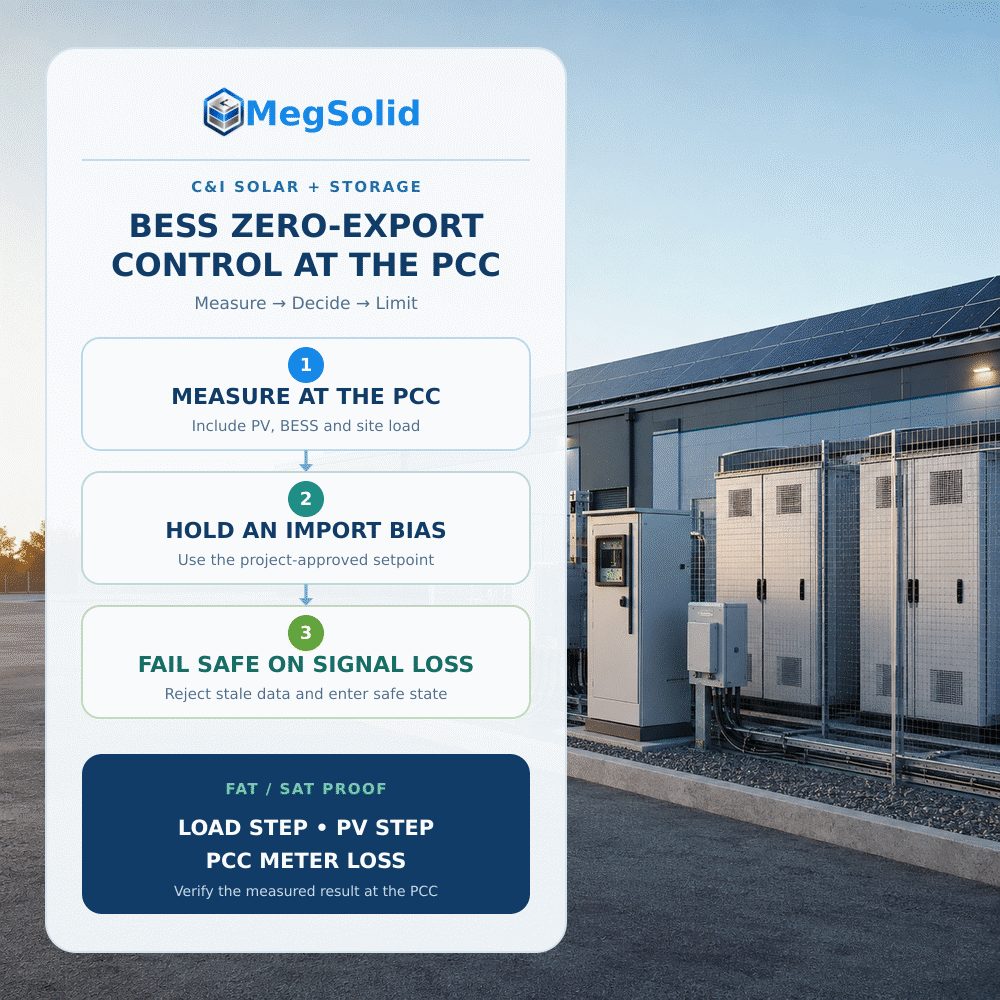
- 📍 Measure at the contractual PCC: The control meter must see every relevant load, PV inverter and BESS power path.
- 🎯 Define the target: State whether the obligation is zero export, limited export or a minimum grid-import margin.
- 🧠 Approve actuator priority: Decide when the EMS charges the BESS, reduces discharge or curtails PV.
- 🛡️ Respect equipment limits: BMS and PCS charge, discharge, SOC and alarm limits remain above commercial control.
- 🔌 Specify fail-safe behaviour: Meter loss, stale data and controller-link failure need explicit local responses.
- 🧪 Test the real boundary: FAT and SAT must include load steps, PV steps, battery limits and communications failures.
The Direct Answer: Control Net Power at the PCC
The EMS should regulate the measured net active power at the approved PCC against one signed target. Under an illustrative import-positive convention, PCC import = site load − PV output − BESS discharge + BESS charge. The project may use another sign convention, but the meter, EMS, PCS, SCADA and test report must all use the same one.
| Specification field | Decision required before quotation | Evidence required at handover |
|---|---|---|
| Reference point | Exact PCC, point of reference or utility meter boundary | Approved SLD, CT location and meter identifier |
| Export target | Zero, limited-export value or project-approved import bias | Settings schedule and signed control narrative |
| Controlled assets | BESS PCS, PV inverter or plant controller, and any controllable load | Command ownership and communications matrix |
| Dynamic behaviour | Sampling, filtering, deadband, ramp, timeout and recovery | Timestamped FAT and SAT trend files |
| Safe state | Approved response to invalid measurement or lost communications | Alarm, fallback command and recovery record |
Do not confuse a screen value with contractual performance. Export control guidance distinguishes a non-export system from a limited-export system and treats unintended export during rapid changes as a separate behaviour that must be evaluated. The BATRIES limited- and non-export control framework is a useful reference, but the applicable utility and interconnection documents must still govern the project.
Define Zero Export, Limited Export and Import Limits Separately
These functions are often mixed together in RFQs even though they solve different problems. A buyer who writes only “no reverse power” leaves the supplier to guess the allowed steady-state value, transient boundary, duration and response to measurement loss.
| Operating requirement | What the EMS controls | Common procurement mistake |
|---|---|---|
| Zero export | Prevents intentional active-power export at the agreed reference point | Assuming zero means no instantaneous deviation under every event |
| Limited export | Keeps export at or below an approved non-zero ceiling | Leaving the ceiling, averaging interval or tolerance undefined |
| Grid import limit | Caps power imported by the facility from the grid | Treating import control as the same function as export prevention |
| Islanded operation | Controls an electrically separated microgrid after the grid breaker opens | Expecting a grid-connected zero-export loop to define islanding and transfer |
The operating hierarchy must also be explicit. Zero-export control is a mandatory PCC constraint, while backup reserve, peak shaving and solar charging are competing uses inside the remaining battery envelope. Use the separate BMS and EMS communication architecture for signal ownership, and the dispatchable solar and BESS guide for power, energy and delivery windows.
Put the Meter Where It Can See the Whole Site
A zero-export loop is only as complete as its measurement boundary. If an existing PV feeder, a new BESS feeder or part of the factory load sits outside the control meter, the EMS can regulate the wrong value while the utility meter records export. The SLD must therefore show every source and load relative to the PCC CTs.
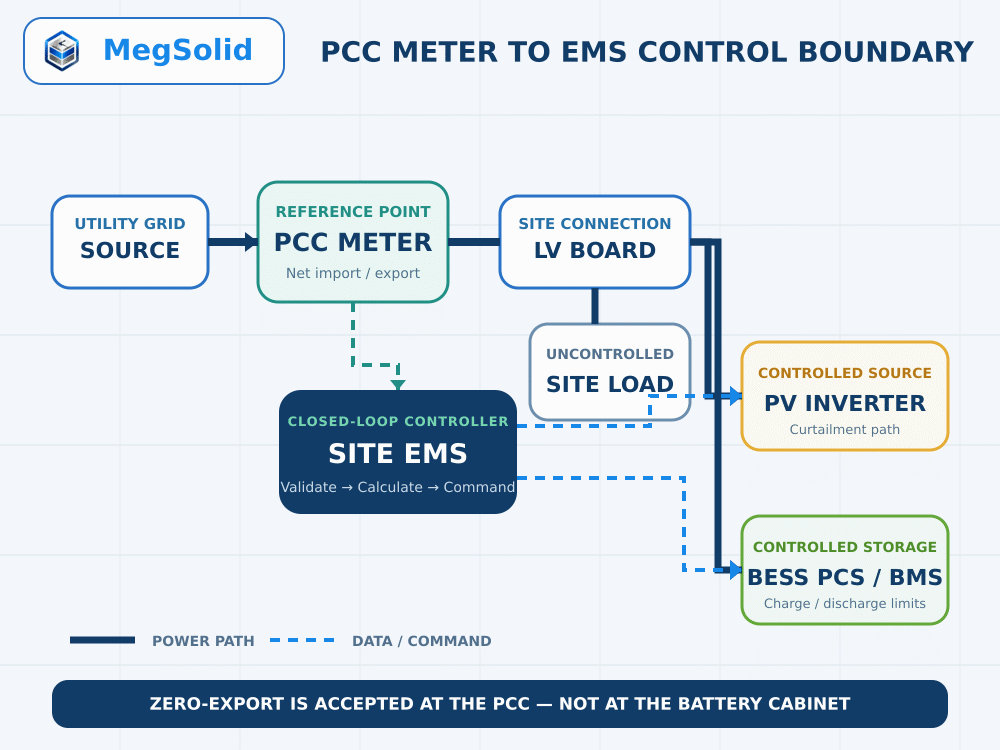
- ⚡ PCC meter or CTs: Measure three-phase net active power with verified ratio, polarity, phase mapping and quality status.
- 🧠 Site EMS or plant controller: Validate the measurement, calculate error from target and allocate an allowable correction.
- ☀️ PV control path: Confirm whether the EMS can curtail each inverter directly or must command a separate plant controller.
- 🔋 BESS control path: Command charge or discharge only inside the available BMS and PCS limits.
- 🏭 Site loads: Record major switching loads that can produce sudden export when demand falls.
- 🔒 Switchgear status: Use reliable breaker and operating-mode states so the controller does not apply the grid-connected loop in the wrong topology.
The same boundary principle appears in MegSolid’s BESS guide for EV charging stations, where the PCC meter, site EMS, PCS/BMS and charger controller have separate jobs. The new zero-export page owns the closed-loop export requirement rather than charger sizing.
Write the Closed-Loop Control Narrative Before Coding
The control narrative should describe one complete scan-to-response cycle in plain engineering language. This becomes the basis for software configuration, interface testing and contractual acceptance. It also prevents the PV contractor, BESS supplier and EMS integrator from assuming that another party owns the final PCC result.
- 1️⃣ Validate measurement: Confirm timestamp, data quality, phase totals and freshness before using the PCC value.
- 2️⃣ Calculate target error: Compare measured PCC power with the zero-export, limited-export or import-bias setpoint.
- 3️⃣ Apply hard limits: Respect battery SOC, available charge/discharge power, PCS status, PV limits and active alarms.
- 4️⃣ Select the approved actuator: Charge the BESS, reduce BESS discharge, curtail PV or manage an approved load in the contracted order.
- 5️⃣ Shape the command: Apply project-specific deadband, filtering, ramp and anti-hunting logic without hiding a persistent error.
- 6️⃣ Verify measured response: Compare actual PCC power with the target and record command, response, limits and active state.
- 7️⃣ Escalate exceptions: Alarm when available actuators cannot meet the requirement because of SOC, equipment status or communications.
A small project-approved import bias can reduce repeated crossing around zero, but it is not a universal value. The utility requirement, meter accuracy, site-load volatility, controller response and commercial effect determine the final setting. The same applies to response time and tolerated inadvertent export: write the accepted values into the project documents instead of copying a generic number from another installation.
Specify Fail-Safe Behaviour for Every Broken Signal
A zero-export loop that works only while every Ethernet packet is healthy is incomplete. The RFQ must define stale-data detection, command timeout, local fallback and recovery for each control link. The safest response is project-specific because some plants can curtail PV locally while others depend on a central controller.
| Abnormal condition | Required specification boundary | Acceptance evidence |
|---|---|---|
| PCC meter invalid or stale | Stop using the last value and enter the approved non-export safe state | Quality flag, timeout, alarm and resulting PCC trend |
| EMS-to-BESS link lost | Define the PCS local fallback and whether discharge is blocked or limited | Command timeout, local mode and actual battery power |
| EMS-to-PV control lost | Define the remaining BESS absorption boundary and independent PV fallback | PV command status, BESS headroom and PCC result |
| Battery at high SOC or charge limit | Reduce the charging actuator and follow the approved PV-curtailment sequence | BMS limit, EMS allocation, PV response and alarm |
| Controller restart or time-sync loss | Use controlled initialization before restoring automatic dispatch | Boot state, synchronized timestamps and bumpless recovery trend |
Do not use “continue the last command” as an undefined default. A stale discharge command can drive export after a site load disappears. EPRI’s published ESS backfeed-control test overview includes load and generation steps plus abnormal sensor-signal tests, showing why normal operation alone is not enough evidence.
Turn Zero-Export Control into FAT and SAT Pass/Fail Tests
The factory stage should verify the approved logic with simulated sources, loads, SOC states and signal failures. The site stage must repeat the critical cases through the installed PCC meter, real CT wiring, actual network and commissioned PV/BESS equipment. A dashboard screenshot is not a pass record.
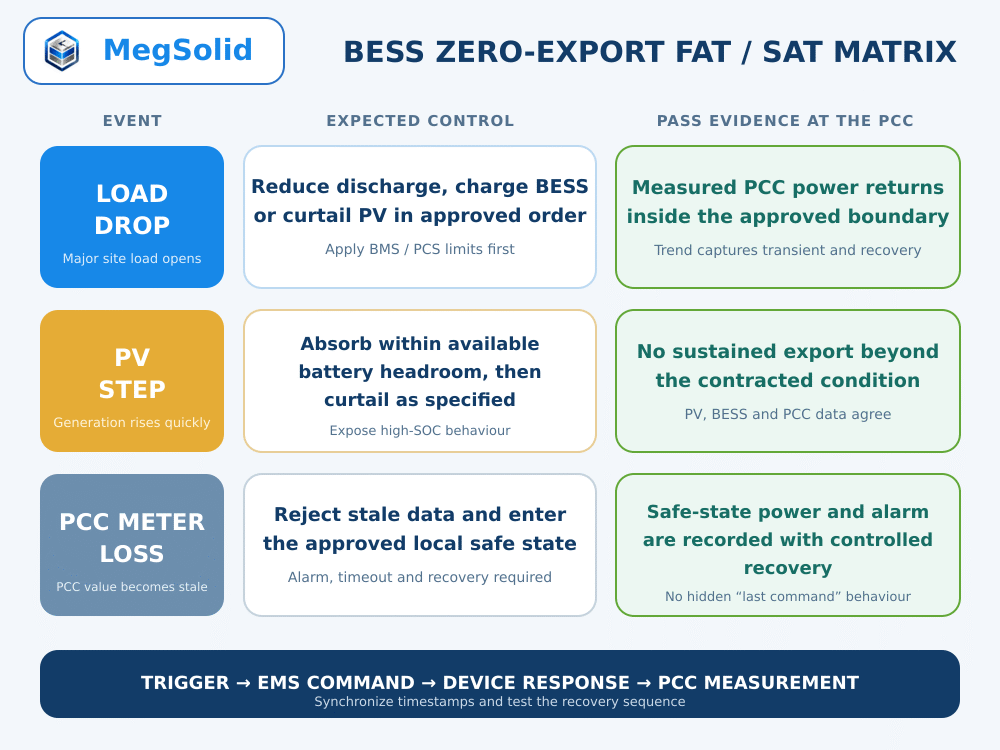
- 🧭 Meter verification: Prove CT ratio, polarity, phase order, import/export direction and total-power calculation.
- 📉 Load-drop test: Remove a major load while PV and/or BESS are active and record inadvertent export and recovery.
- ☀️ PV-step test: Increase simulated or actual generation and verify the approved actuator hierarchy.
- 🔋 SOC-boundary test: Repeat control near maximum and minimum permitted SOC so unavailable battery power is handled correctly.
- 🔌 Signal-loss test: Remove PCC measurement and each critical command path separately; verify timeout, alarm and safe state.
- ↩️ Recovery test: Restore the signal or controller and prove controlled return without an unintended power step.
- 🕒 Data package: Export synchronized PCC power, PV power, battery power, SOC, limits, commands, alarms and operating states.
Use MegSolid’s BESS factory acceptance test guide to define the witnessed pre-shipment boundary. The zero-export schedule should then add the PCC-specific events, accepted tolerance, evaluation window, instrumentation accuracy, responsible witness and retest obligation.
Match the Control Boundary to the MegSolid ESSA Platform
The MegSolid ESSA outdoor C&I BESS platform is the direct product family for this application. Its controlled product data lists 30–100 kW rated AC models, 55.296–215.04 kWh rated-energy configurations, RS485 and TCP-IP communications, integrated EMS functions, capacity and discharge-time prediction, and simultaneous access to load, battery, grid, diesel generator and PV.
- 🔗 Useful integration foundation: Published communications and multi-source access support a project control architecture.
- 📄 Still project-specific: Zero-export target, meter type, register map, scan rate, actuator sequence and safe state are not universal product values.
- 🧪 Acceptance remains contractual: The ordered control narrative and FAT/SAT schedule must define the measurable result.
- 🌡️ Model boundary: ESSA models, including ESSA0100B-0215, are published with intelligent air cooling; do not transfer liquid-cooling data from another platform.
The public ESSA tables identify LFP cells, while MegSolid can evaluate a project-specific solid-state battery cell option. Buyers should use the MegSolid solid-state energy storage system overview and require the quotation, signed datasheet and BOM to identify the supplied cell model, cathode chemistry, electrolyte architecture and evidence scope. A supported solid-state design may reduce specific risks, but it must never be described as eliminating thermal runaway or replacing BMS, PCS, thermal management, fire controls and commissioning.
Put These Zero-Export Parameters into the EPC RFQ
Send every bidder the same control schedule. This converts “zero export required” into a comparable equipment, software and commissioning scope and exposes missing responsibility before it becomes a variation order.
- 1️⃣ PCC definition: SLD location, voltage level, meter/CT ownership and every source or load included in the boundary.
- 2️⃣ Target and tolerance: Zero or limited-export setpoint, import bias, averaging method and permitted transient boundary.
- 3️⃣ Meter specification: Accuracy, sampling, communications, time synchronization, quality flags and redundancy requirement.
- 4️⃣ Actuator hierarchy: BESS charging, BESS discharge reduction, PV curtailment and controllable-load sequence.
- 5️⃣ Battery limits: SOC window, available charge/discharge power, temperature limits, alarm interlocks and warranty envelope.
- 6️⃣ Controller dynamics: Evaluation interval, filter, deadband, ramp, command timeout and anti-hunting method.
- 7️⃣ Fail-safe matrix: Meter loss, network loss, controller restart, unavailable BESS and unavailable PV control.
- 8️⃣ Override authority: Roles allowed to change targets, modes or limits, with user and timestamp logging.
- 9️⃣ FAT and SAT: Test events, initial conditions, expected response, tolerance, data channels, witnesses and retest responsibility.
- 🔟 Handover package: Control narrative, SLD, settings schedule, register map, alarm matrix, trend files and operator training.
Use the South Africa BESS quotation data-gap guide to prepare the wider project brief, and the commercial BESS supplier qualification framework to assign integration and test responsibility. If the duty may fit a 100 kW / 215 kWh cabinet, continue with the ESSA0100B-0215 selection guide without assuming that its rated energy equals the project’s usable AC delivery.
What to Send MegSolid for a Zero-Export Review
A useful inquiry must define the electrical and control boundary, not only battery kWh. MegSolid can then return a preliminary architecture, identify missing data and separate standard equipment functions from project-specific EMS engineering.
- 📄 Electrical documents: Current SLD, transformer rating, switchboard arrangement, PCC and proposed CT location.
- 📊 Interval data: Site load and PV production at the best available resolution, including major load switching events.
- ☀️ Solar scope: PV inverter models, plant controller, curtailment interface and maximum available generation.
- 🔋 BESS duty: Required kW, kWh, SOC reserve, charge source, peak-shaving or backup obligations and preferred product scale.
- 🎯 Grid rule: Approved export ceiling, utility wording, required evidence and target commissioning date.
- 🔗 Controls scope: Existing EMS/SCADA, supported protocols, network ownership, remote-access policy and alarm destination.
- 🧪 Acceptance scope: FAT/SAT witnesses, required channels, tolerance, report format and responsible party.
This article provides a baseline zero-export specification framework. To receive the full Excel PCC Control Narrative—including editable meter boundaries, actuator priority, communications-failure states, FAT/SAT test cases and RFQ responsibility fields—email [email protected]. Include the project country, SLD, PCC location, load and PV data, export requirement, required BESS power and energy, and delivery schedule.
FAQ
What must a BESS zero-export requirement define in the contract?
It must define the PCC reference point, power sign convention, target, import bias or tolerance, permitted transient boundary, controlled assets, measurement quality, response method, fail-safe state and FAT/SAT evidence.
Where should the zero-export meter or CTs be installed?
They should measure net power at the contractual PCC and include every relevant load, PV inverter and BESS feeder. The approved SLD must show CT ratio, polarity, phase mapping and meter ownership.
Should the EMS charge the BESS or curtail PV first?
The project must approve the actuator order. Charging can preserve solar value when battery headroom and warranty limits allow it; PV curtailment is required when the battery cannot absorb enough power or its control path is unavailable.
How much import bias should a zero-export system use?
There is no universal value. The setting depends on the utility requirement, meter accuracy, site-load volatility, controller dynamics and commercial effect. Put the agreed value and method in the settings schedule.
What happens when the battery is full during high solar production?
The EMS must recognize the available BMS charge limit and move to the approved alternative, normally reducing battery discharge if active, curtailing PV or controlling another contracted load. The PCC requirement remains in force.
What should happen if PCC meter communication fails?
The controller should reject stale data, alarm the failure and enter the project-approved non-export safe state. The RFQ must define timeouts, local PV/BESS behaviour, operator notification and controlled recovery.
Can zero-export control operate with backup power?
Yes, but grid-connected export control and islanded backup are different operating states. Breaker status, transfer logic, grid-forming responsibility and return-to-grid sequence must prevent the wrong control loop from remaining active.
Which zero-export tests belong in FAT?
FAT should verify meter direction, load and PV steps, actuator limits, high and low SOC, each communications failure, controller restart, alarm logging and recovery using the approved control narrative.
What data should a zero-export SAT report include?
Include synchronized PCC power, load, PV power, battery power, SOC, BMS/PCS limits, EMS target, issued commands, actual responses, alarms, data-quality flags and operating-state transitions.
Can a MegSolid ESSA cabinet be specified for zero-export control?
The ESSA platform publishes integrated EMS functions, RS485/TCP-IP communications and access to load, battery, grid, generator and PV. The actual zero-export meter, logic, response, register map and acceptance limits remain project-specific and must be confirmed in the ordered documents.
What is BESS zero-export control?
BESS zero-export control is a closed-loop function that measures net active power at an approved grid reference point and coordinates battery, solar or other controllable assets to prevent intentional export.
How does solar plus battery storage prevent power export?
A PCC meter sends net power to the EMS. The EMS compares it with the approved target, applies battery and equipment limits, then commands BESS charging, discharge reduction or PV curtailment and verifies the measured response.
What should a buyer send MegSolid for a zero-export BESS proposal?
Send the SLD, PCC and CT location, interval load and PV data, inverter information, export requirement, required BESS kW and kWh, grid voltage, control interfaces, FAT/SAT requirements and project schedule.
