
At 05:30, the borehole pump stops. The pivot is due to start at 06:00. The reservoir holds ninety minutes of supply, and nobody knows whether the grid will return in ten minutes or after lunch. That is the duty an irrigation backup system has to cover.
Write down three figures before asking for a battery quotation: the pump's measured running kW, the usable water reserve, and the longest outage the farm must ride through. MegSolid supplies the storage and power-conversion equipment once those figures define the job.
- Keep the irrigation schedule intact with water reserve, electrical backup, or a combination of both.
- Match PCS output to the motors that must run at the same time.
- Match battery energy to a named operating period and a stated restart sequence.
A request for 215 kW of PV and 100 kWh of storage gives an engineer a place to start. The missing information is pump runtime during the outage and whether the 100 kWh figure means nominal battery energy or usable energy at the AC switchboard.
That distinction matters on a working farm. A system can have enough energy for the control panel and still fail when the pump starts. Another system can carry the pump comfortably while the reservoir would have covered the same interruption at a lower cost.
Start With the Irrigation Day
The owner usually describes the problem as 'the pump must keep running.' The operating requirement is more specific: a field needs a certain volume of water in a certain period. The design changes once that volume, the irrigation window and available water storage are on the same sheet.
| Farm condition | What the owner is protecting | The question that decides the solution |
|---|---|---|
| A reservoir or dam can be filled before the irrigation window | Water delivery to the field | How many hours of irrigation can stored water support? |
| A borehole must pump during a fixed evening or night window | Pump operating time | What running power and usable AC energy are required for that window? |
| Filters, fertigation, valves and controls must remain live | Process control and safe restart | Which circuits are essential, and which can wait? |
| Packhouse, cold room and irrigation all need power | Whole-farm production continuity | Which loads are restored in which order? |
A header tank, dam or reservoir can buffer grid availability and irrigation demand. The water is already stored at the point of use. In many cases, that buffer cuts the electrical backup duration from several hours to a short pump-restart period.
This does not remove the need for industrial battery storage. It makes the battery duty clearer. A farm with a small water reserve and a fixed irrigation window may need a pump-backup system; a farm with several hours of stored water may need backup only for controls, telemetry and a planned recovery cycle.
Measure Pump Duty Before Choosing PCS Power
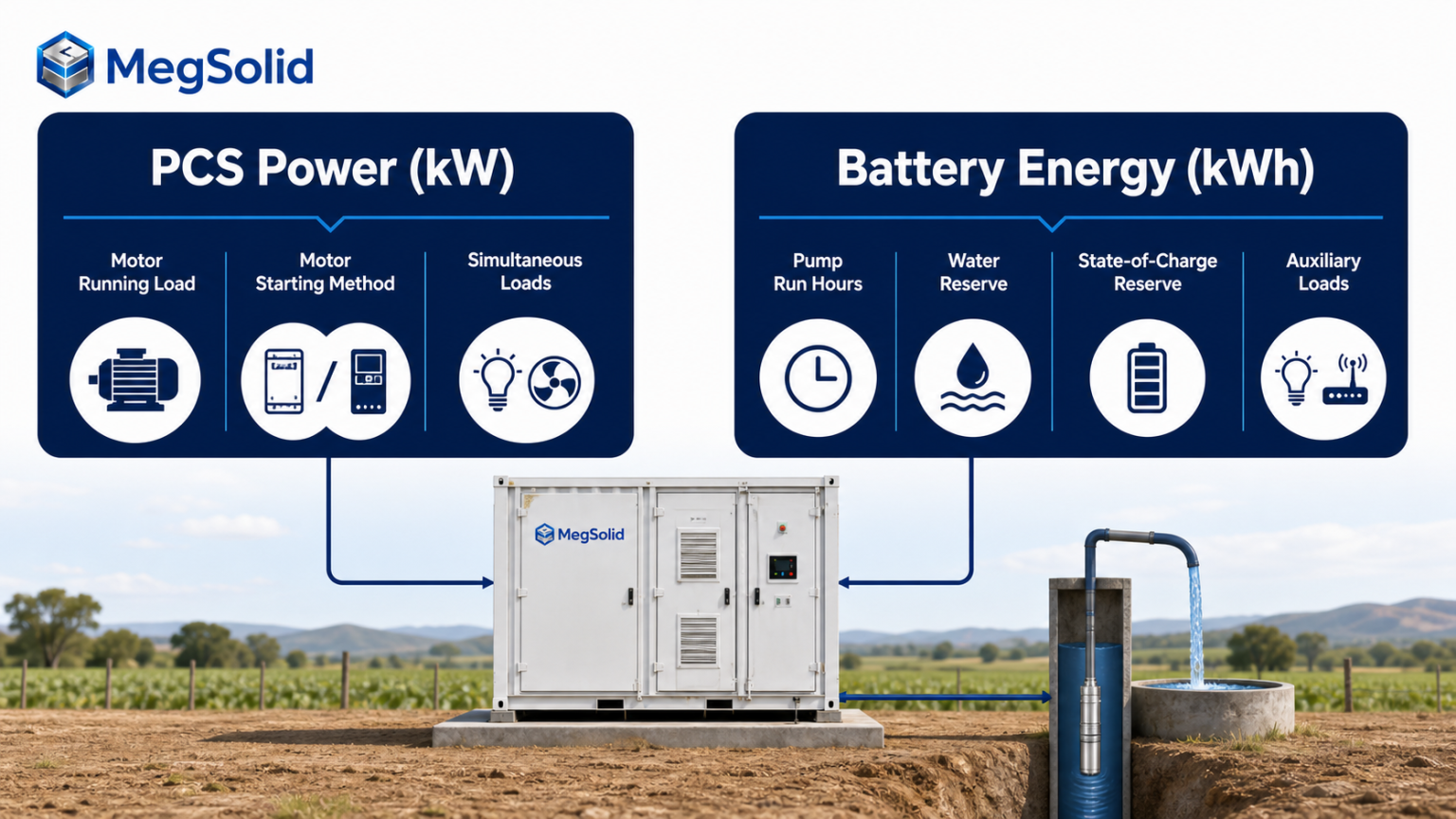
The pump nameplate is a useful reference. It is not the figure to quote from without checking the duty point. Measure running kW at the required flow and total dynamic head, or obtain the value from a reliable VSD log.
| Pump arrangement | What it means for the storage system | What to request from the EPC or pump contractor |
|---|---|---|
| VSD-controlled borehole pump | Power can usually be ramped up, which helps control start demand. | VSD model, acceleration setting, running kW and fault-restart logic. |
| Soft-started pump | Starting demand is reduced, though the start profile still needs checking. | Start-current setting, start duration and pump sequence. |
| Direct-on-line pump | The start event can dominate the PCS decision. | Locked-rotor current, starting frequency and a practical sequence to avoid simultaneous starts. |
The PCS must carry the worst permitted combination of loads. That might be one borehole pump and controls, or a borehole pump plus a booster. It is rarely the total of every motor installed on the farm.
MegSolid's PCS with isolation transformer is available from 30 kW to 500 kW and supports on-grid and off-grid AC coupling. The right PCS rating comes from the recorded load combination and start sequence.
Calculate Battery Energy From a Real Outage Window
Once the power duty is clear, calculate the energy duty. Keep the calculation visible so the owner, EPC and supplier are working from the same assumption. AC energy for the outage = critical running load (kW) × required operating time (h).
A 45 kW pump with 10 kW of controls and essential auxiliaries creates a 55 kW critical load. Two hours of operation uses 110 kWh at the AC bus before conversion losses, auxiliary consumption, battery operating limits and reserve. Six hours uses 330 kWh before those allowances.
- Usable AC energy: state it at the quoted load, not only as nominal battery capacity.
- Conversion and auxiliary assumptions: show every allowance used in the runtime model.
- Reserve and temperature: name the minimum state of charge and ambient operating assumption.
- Exact operating load: identify the pumps, controls and auxiliaries running during the stated period.
Put the Pump Restart Sequence in the Design Brief
Most irrigation failures occur during the transition, not while the pump is already running. The grid returns, several motors start, voltage falls, and the backup system goes into protection. The farm has power again but no water.
- Keep controls, level instruments and communications energised.
- Start the borehole pump through the VSD.
- Confirm stable pressure and flow.
- Start the booster pump.
- Restore filters, fertigation and non-critical loads in stages.
The sequence belongs in the commissioning test. The owner should witness it at the minimum agreed state of charge, with the generator and PV configuration that will exist in normal operation.
Select the Farm Configuration That Matches the Operating Risk
| Configuration | Best fit | Evidence needed before a final quote |
|---|---|---|
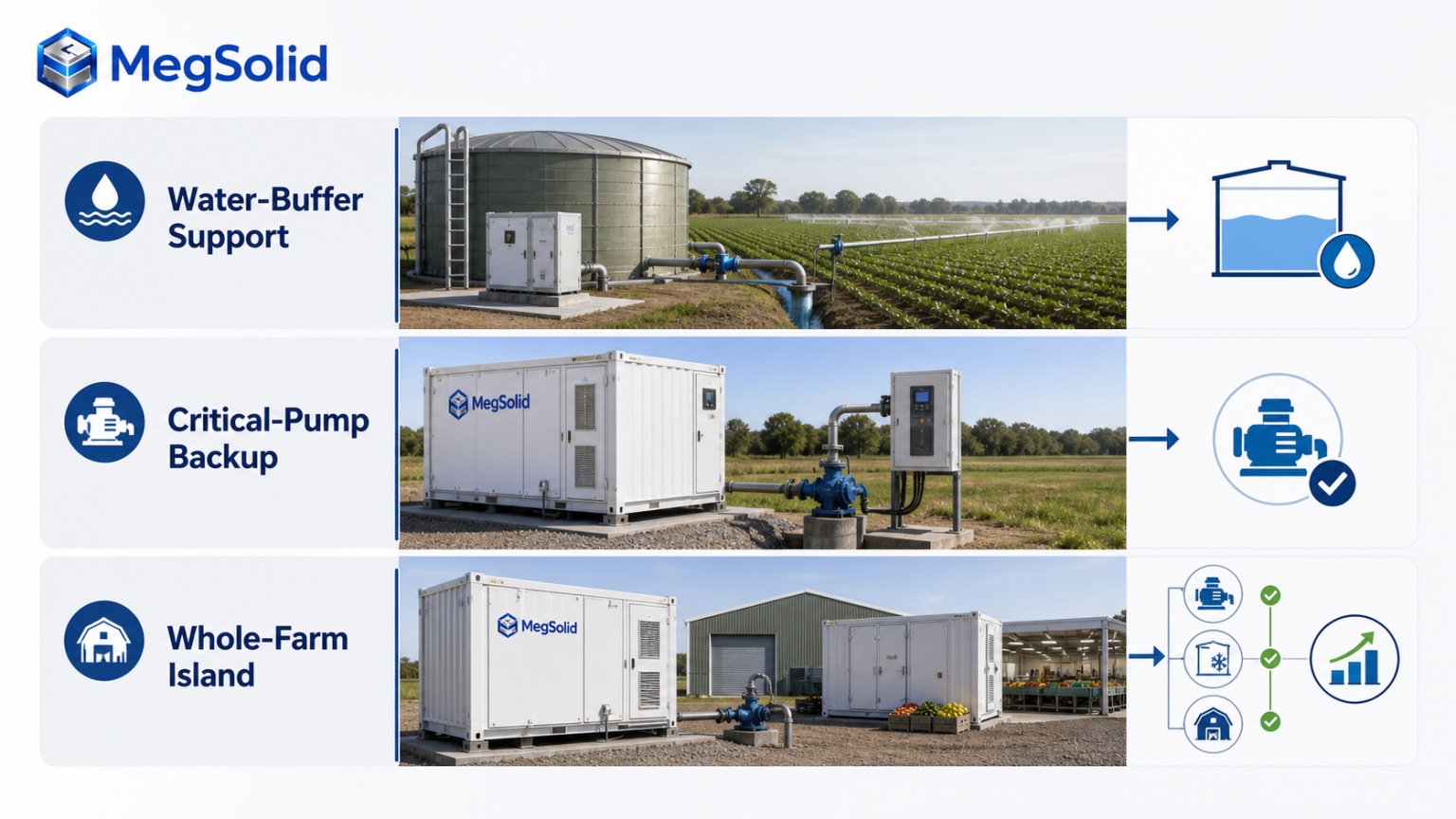
| Water-buffer support | Water can be pumped and stored before the critical irrigation period. The battery carries controls and a limited recovery duty. | Reservoir usable volume, water demand, pump flow, irrigation schedule and essential-board load. |
| Critical-pump backup | The pump must run through a stated outage window. | Measured running kW, starting arrangement, outage duration, simultaneous loads, cable route and restart sequence. |
| Whole-farm island | Irrigation, refrigeration, packing and other business loads must continue together. | 15-minute load profile, transformer data, generator details, fault level, load-shedding plan and staged restoration plan. |
The water-buffer option deserves a proper comparison. It can protect the crop with less electrical storage where the site has suitable reservoir capacity. Whole-farm island operation is a separate class of project that requires a complete philosophy for what the system carries, what it sheds and how it returns to normal supply.
Send the pump schedule, single-line diagram and water-buffer information to MegSolid's C&I engineering team. The first output should be a critical-load boundary and operating sequence, not a catalogue-based promise of runtime.
Check Product Fit Only After the Duty Is Written Down
When the measured duty calls for a compact outdoor system around 100 kW, MegSolid's ESSA0100B-0215 outdoor cabinet is a technical reference: 100 kW rated AC power and 215.04 kWh nominal energy. It has 400 V three-phase AC characteristics, IP54 enclosure protection and a built-in isolation transformer.
The cabinet is 2,450 × 1,550 × 2,400 mm and has a net weight of 3,900 kg. Access, foundation, cable route and final equipment position must be settled before equipment selection is released.
For a larger energy duty, MegSolid's 261.24 kWh liquid-cooled C&I system is another product reference. Its use depends on the operating profile, site layout and electrical design. Product capacity should follow the duty table.
Compare system types in the MegSolid BESS overview and the C&I energy-storage range. Use the product pages with the project load study and the EPC's one-line diagram.
Send This Data Pack for a Usable Proposal
- 15-minute load data: a representative irrigation period, electricity bills and tariff information.
- Pump details: measured kW, nameplate, flow, total dynamic head, operating hours, starting method and start settings.
- Water data: reservoir or dam usable volume, level controls, daily requirement and maximum allowable interruption.
- Critical-load schedule: pumps, filters, fertigation, controls, telemetry, refrigeration, workshops and accommodation marked as must-run, deferrable or restore-later.
- Electrical pack: one-line diagram, transformer rating, main-board photos, feeder lengths, earthing arrangement, generator details and PV inverter data.
- Outage and site data: interruption records, generator fuel use, access route, foundation area, ambient conditions, fire separation and communications availability.
The return proposal should show normal grid support, the agreed outage case and the restart case. It should identify each shed load, each backed-up load, PV behaviour and the expected operator action.
Build the ROI Model From Operating Data
The value of commercial energy storage on a farm can include avoided generator fuel, reduced interruption, improved use of existing generation and demand-management opportunities where tariff data supports them. Each item needs a farm-specific input.
Use actual generator litres per hour at the relevant load and real outage hours. The farm operator should assign the consequence of a missed irrigation event because it depends on the crop and production plan. Compare water-buffer support, critical-pump backup and whole-farm island operation using the South Africa BESS ROI engineering framework.
Put the Right Question to the Supplier
Ask the supplier to state the pump load, start sequence, usable AC runtime, reserve setting and PV/generator operating mode in one duty table. If those items are missing, the proposal is an equipment price, not an irrigation continuity plan.
For supporting specifications and engineering references, review the C&I energy-storage guide and the MegSolid resource centre.
FAQ
How should a farm start sizing industrial battery storage for irrigation?
Start with measured pump running kW, the pump starting method, the usable water reserve and the outage period the farm must cover. These inputs establish PCS power, battery energy and the backed-up circuit boundary.
Can a water reservoir reduce battery storage size?
Yes. When a reservoir or dam can be filled before the critical irrigation window, stored water can reduce the hours that a battery must carry a large pump. The usable water volume and irrigation schedule must be confirmed first.
Why is pump nameplate power not enough for BESS sizing?
Nameplate power does not show actual running kW at the duty point, motor-starting current, simultaneous loads or the operating duration. A VSD log or measured load record gives a stronger basis for design.
What decides PCS power in a farm battery-storage project?
PCS power is set by the worst permitted combination of loads, including the actual pump running load, starting method and any simultaneous booster or control loads. A staged restart sequence can reduce the required PCS power.
What decides battery energy in kWh for irrigation backup?
Battery energy is set by the backed-up AC load, required operating time, conversion losses, auxiliary consumption, reserve target and the approved ambient operating conditions. Quote usable AC energy, not only nominal battery capacity.
How long will 100 kWh run an irrigation pump?
There is no reliable answer without the actual running load and usable-energy assumptions. A 55 kW critical load uses 110 kWh at the AC bus over two hours before losses and reserve, so nominal 100 kWh does not establish a two-hour pump runtime.
Why must the pump restart sequence be part of the project brief?
The highest electrical stress often occurs when supply returns and motors restart. A stated sequence protects the system from simultaneous starts and becomes a clear commissioning acceptance test.
Can existing PV keep operating during an irrigation backup event?
It depends on the PV inverter, the selected AC or DC coupling arrangement, protection settings and the approved operating mode. The project engineer should confirm this on the single-line diagram.
What is the difference between water-buffer support and critical-pump backup?
Water-buffer support relies on stored water and normally backs up controls plus a limited recovery duty. Critical-pump backup keeps a measured pump load running through a defined outage window and therefore requires a larger power and energy analysis.
When is whole-farm island operation appropriate?
Use whole-farm island operation only when irrigation, refrigeration, packing and other business loads must continue together. It requires a full load profile, transformer data, generator integration, protection study and load-shedding plan.
What MegSolid product data is relevant to a 100 kW farm duty?
The ESSA0100B-0215 outdoor cabinet is listed at 100 kW rated AC power and 215.04 kWh nominal energy, with 400 V three-phase AC characteristics, IP54 protection and a built-in isolation transformer. Final selection still follows the project duty table.
What site information is needed before selecting an outdoor BESS cabinet?
Confirm access route, foundation area, cable route, equipment position, ambient conditions, fire separation, communications availability and the single-line electrical boundary before equipment is released.
What data should the farm send for a preliminary BESS proposal?
Send 15-minute load data, pump details, water-reserve data, critical-load schedule, one-line diagram, transformer and generator information, PV inverter details, outage records and site constraints.
How should ROI be calculated for battery storage on an irrigation farm?
Use real generator fuel use, real outage hours, pump schedules, tariff data and the operator's own assessment of missed-irrigation consequences. Compare the annual cost of water-buffer support, critical-pump backup and whole-farm island operation.
What must appear in a credible irrigation battery-storage quotation?
The quotation should state the pump load, permitted start sequence, usable AC runtime at the named load, battery reserve, PV and generator operating mode, shed loads, backed-up loads and commissioning tests.
Which documents should be reviewed before approving a farm BESS order?
Review the load study, pump and water data, single-line diagram, site layout, foundation and access plan, protection and earthing design, PV and generator operating strategy, duty table and commissioning acceptance plan.