
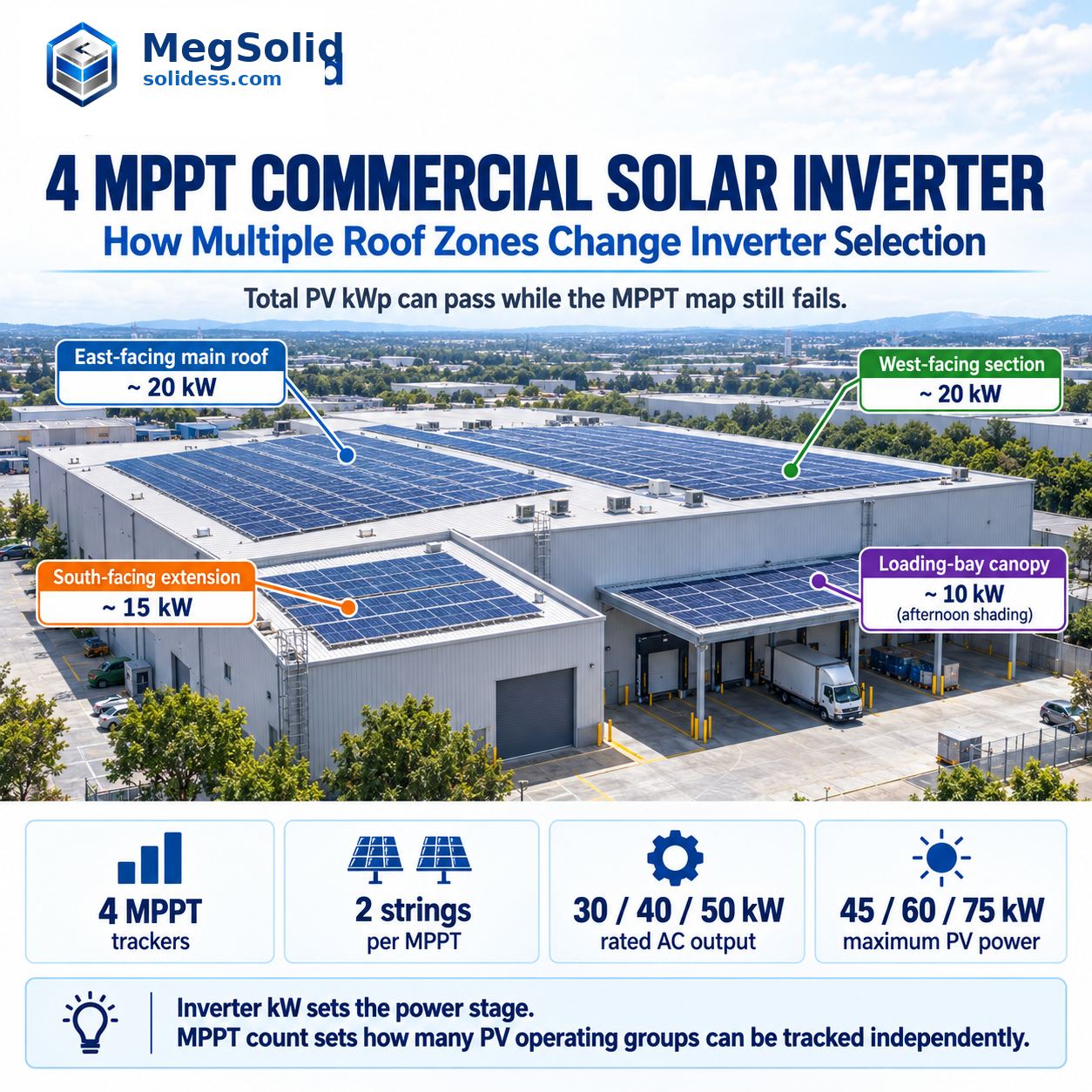
Commercial rooftop solar is often screened from one headline number, total PV kWp, even though the roof layout can become the real inverter constraint. The 50 kW inverter can have enough AC power and still be the wrong product if the roof needs more independent PV operating groups than its MPPT architecture can support.
Warehouse example: Consider a warehouse planning about 65–70 kW of PV across an east-facing main roof, a west-facing section, a south-facing extension and a loading-bay canopy with afternoon shading. The total PV capacity can fit inside the 75 kW maximum PV envelope of MegSolid’s R50KH3 three-phase hybrid inverter, but the roof should not be approved from kW alone because those four zones may need independent tracking.
R30KH3, R40KH3 and R50KH3 each provide four MPPT trackers with two strings per MPPT, while their rated AC outputs are 30, 40 and 50 kW and their maximum PV powers are 45, 60 and 75 kW. Two string ports under one MPPT still share one tracker, so eight physical string connections create only four independently tracked groups.
Inverter kW sets the power stage; MPPT count sets how many PV operating groups can be tracked independently.
MPPT Count and AC Power Answer Different Sizing Questions
Rated AC power, maximum PV power and MPPT count answer different sizing questions.
| Model | Rated AC output | Maximum PV power | MPPT trackers | Strings per MPPT |
|---|---|---|---|---|
| R30KH3 | 30 kW | 45 kW | 4 | 2 |
| R40KH3 | 40 kW | 60 kW | 4 | 2 |
| R50KH3 | 50 kW | 75 kW | 4 | 2 |
Rated output determines the inverter’s AC power class, maximum PV power defines the published PV array envelope, and MPPT count determines how many PV groups can operate with independent tracking. Uniform 50 kW rooftops and 50 kW rooftops divided across several orientations may need the same AC power class but very different PV-input architecture.
The first purchase screen needs both answers: the required 30, 40 or 50 kW AC class, and the number of materially different PV operating groups that need independent tracking.
Once the MPPT map passes, the 30 kW, 40 kW or 50 kW hybrid inverter selection can then be made from AC load, PV capacity and storage duty instead of from roof geometry alone.
Eight String Inputs Still Create Four Tracking Groups
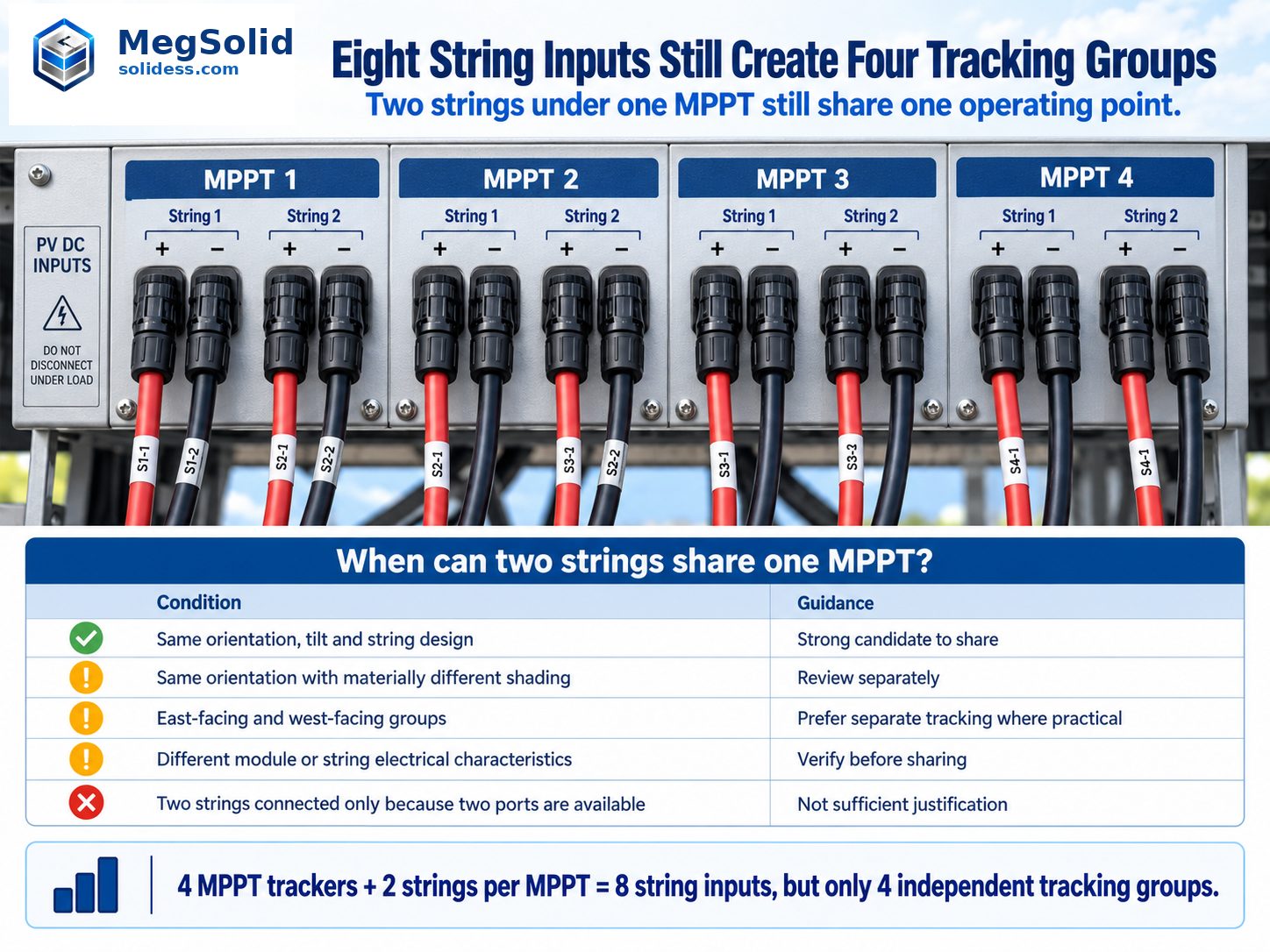
Two strings connected to one MPPT do not become two independent trackers because they share the operating point selected by that MPPT channel, so the presence of two string ports is not enough reason to combine two roof zones.
Strings are better candidates for sharing one MPPT when their electrical and operating conditions are similar. Material differences in orientation, shading, module configuration or irradiance profile make that pairing harder to justify.
| PV group condition | Initial MPPT decision |
|---|---|
| Same orientation, tilt and string design | Strong candidate to share |
| Same orientation with materially different shading | Review separately |
| East-facing and west-facing groups | Prefer separate tracking where practical |
| Different module or string electrical characteristics | Verify before sharing |
| Two strings connected only because two ports are available | Not sufficient justification |
East- and west-facing strings are not automatically prohibited from sharing a tracker in every design, yet their optimum operating conditions can diverge over the day, so keeping them on separate MPPTs gives the inverter freedom to follow each group independently when the layout allows it.
Four trackers create four independent operating groups; the eight physical string inputs only increase connection capacity inside those groups.
Roof Geometry Can Make MPPT Count the First Constraint
Commercial roofs may divide into four usable PV areas even when the total kWp remains well within the inverter’s published maximum.
One practical arrangement might be:
- MPPT 1 → east-facing main roof
- MPPT 2 → west-facing main roof
- MPPT 3 → south-facing extension
- MPPT 4 → loading canopy with afternoon shading
The allocation is only illustrative. One roof section does not always equal one MPPT, and a large roof plane can itself need more than one tracker because of shading, current or string-design limits. The useful principle is that each tracker should receive PV strings that can reasonably share one operating point.
What Happens When the Roof Needs More Than Four Groups
The constraint becomes clearer when the site has five or six materially different PV groups. Buying a larger inverter in kW does not automatically solve that because extra AC power does not create extra independent trackers, so the EPC may need to combine only compatible groups, revise the string design, change the roof layout, split the project across more than one inverter or select another PV-input architecture.
Storage Coupling Does Not Remove the MPPT Check
Commercial solar projects that also include storage still need to preserve this DC-side logic when deciding AC-coupled or DC-coupled solar battery architecture, because the coupling topology does not remove the requirement for the PV array to fit the inverter inputs electrically.
Send the planned PV kWp per roof zone, orientation, shading differences and preliminary string layout; MegSolid can return a preliminary four-MPPT allocation and indicate whether R30KH3, R40KH3 or R50KH3 is the stronger fit before the project locks the inverter power class.
Equal kWp Can Hide Different Operating Conditions
Two roof sections can each carry 15 kWp and still present very different electrical conditions if one receives clean midday irradiance while the other is crossed by an HVAC shadow in the afternoon, so equal installed capacity should not be treated as proof that the strings belong on the same tracker.
Parapets, HVAC equipment, vents, neighboring buildings, canopies, roof pitch, azimuth and seasonal shade all create different operating conditions on commercial roofs. These conditions change the irradiance profile seen by the modules and can create different maximum-power points even when the module count is similar.
Tracking Flexibility Has Limits
Four independent MPPT channels give the R-series more freedom to separate those groups where it matters. The trackers do not remove shade, and they do not guarantee a fixed energy gain over a two-MPPT inverter. The benefit exists only when the roof contains operating groups that should not share one tracking point.
commercial solar inverter selection should not stop at AC kW because roof geometry and PV operating groups can separate products with similar output ratings.
Total PV Power Can Pass While One MPPT Current Fails
R30KH3, R40KH3 and R50KH3 each publish 40 A maximum input current per MPPT, 60 A short-circuit current per MPPT, four trackers and two strings per tracker.
That creates a second pass/fail test after total PV power has been checked.
Proposals can stay below the R50KH3 maximum PV power of 75 kW and still fail if too much current is concentrated on one MPPT, especially when higher-current modules or parallel strings are used. The screening sequence is:
total PV power passes → roof groups are allocated → each MPPT current is checked → string allocation is accepted or revised
Eight available string connections do not bypass the 40 A per-MPPT operating-current limit because each pair of ports still belongs to one tracker.
The issue is large enough to affect purchasing. If the inverter is ordered first and the MPPT current problem appears after rooftop cable routes and string allocations have already been fixed, the site may need to reassign strings, change cable routes or add another inverter, which is exactly the type of redesign that a pre-purchase MPPT check is meant to avoid.
String Voltage Can Reject an Otherwise Valid Roof Map
Four available trackers do not make every string length valid. Each proposed string still has to stay inside the inverter’s voltage window.
Check the Voltage Window After the Roof Groups Are Assigned
The current R-series product data gives:
- MPPT voltage range: 150–850 V
- PV start voltage: 180 V
- rated PV input voltage: 600 V
These values mean the designer still has to check expected Vmpp, cold-weather Voc, hot-weather Vmpp, modules per string and module temperature coefficients before approving the roof-zone allocation. One roof group can fit the four-MPPT map and still fail the voltage check, while another can fit the voltage window but fail the per-MPPT current limit.
Final string design should be checked against the approved project voltage limits, while the published 150–850 V MPPT operating range, 180 V start voltage and 600 V rated PV input remain the key product values for the first-stage fit screen.
MPPT count determines how many groups can be tracked independently; voltage and current determine whether those groups are electrically valid.
More MPPTs Do Not Remove Other Electrical Limits
Four trackers add flexibility, but PV power, string voltage, per-MPPT current and module compatibility still have to pass on their own.
Extra MPPT channels cannot correct:
- an undersized AC power class;
- PV power beyond the selected model envelope;
- invalid string voltage;
- excessive current on one tracker;
- incompatible module or string electrical characteristics;
- severe shading that should have been addressed in the roof layout.
Four MPPTs do not guarantee more energy than two MPPTs on every roof. Uniform arrays may have only one or two meaningful operating groups. In that case, unused trackers add little project value and the decision can be dominated by AC power, battery duty, price or system architecture instead.
The advantage becomes stronger on sites with east/west roof planes, multiple buildings, canopies plus main roofs, recurring shading differences or staged rooftop expansion where another independent PV group may be added later.
Once the PV architecture fits electrically, PV charging priority determines when solar surplus should charge the battery, while BESS EMS priority logic coordinates storage with other operating objectives; neither control layer can repair an unsuitable MPPT/string arrangement underneath it.
Choose R30, R40 or R50 After the MPPT Map Passes
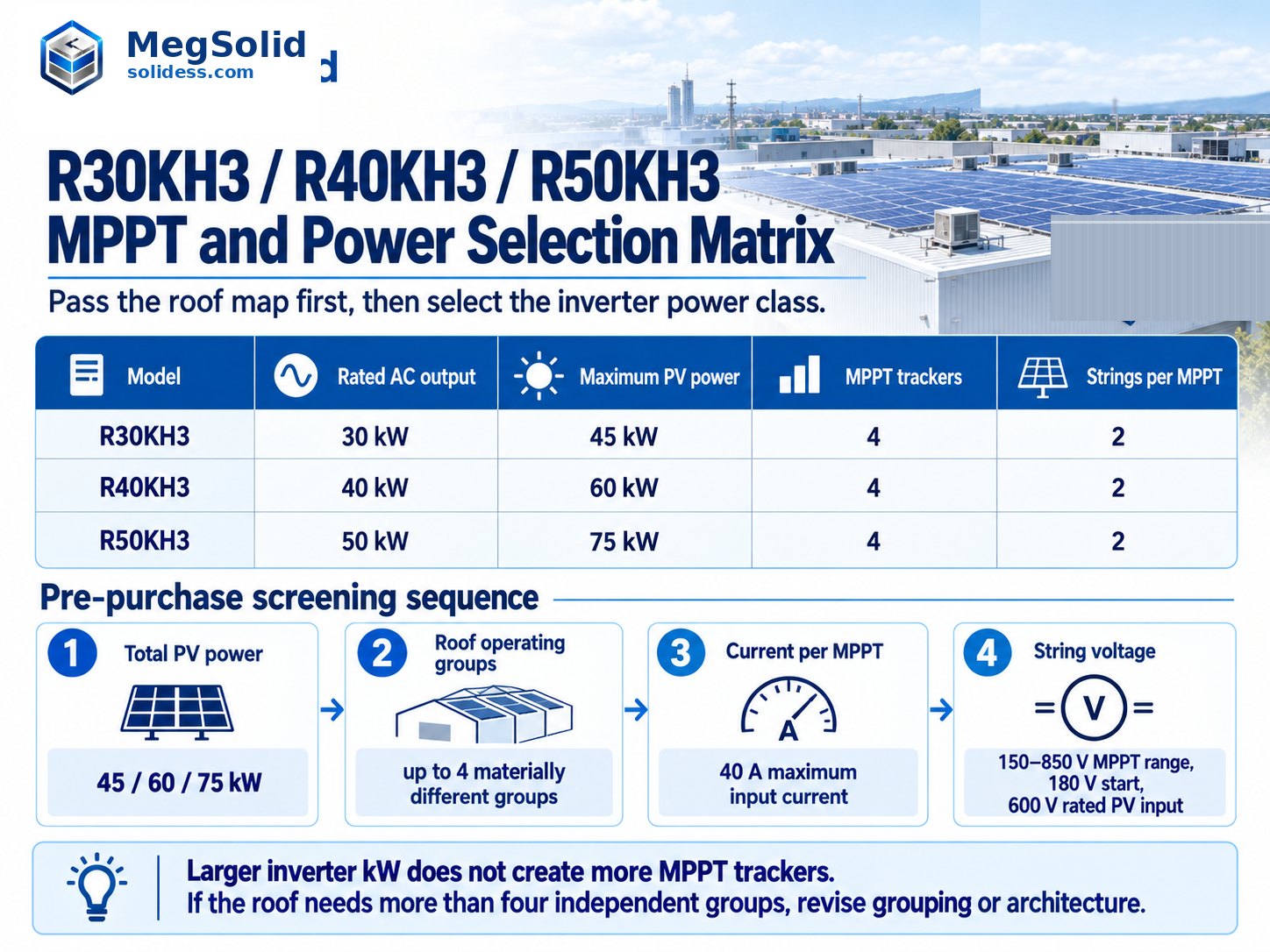
Model selection gets simpler once the roof has been reduced to electrically workable PV groups. R30KH3, R40KH3 and R50KH3 then differ mainly in power envelope around the same four-MPPT architecture.
| Preliminary project result | Product path |
|---|---|
| PV ≤45 kW and required AC output fits 30 kW | R30KH3 |
| PV ≤60 kW and required AC output fits 40 kW | R40KH3 |
| PV ≤75 kW and required AC output fits 50 kW | R50KH3 |
| More than four materially different PV groups | Revise grouping or inverter architecture |
| One MPPT exceeds its current envelope | Reallocate strings before approval |
| Proposed string falls outside the valid voltage window | Change string length or configuration |
The first three rows are only the handoff from MPPT fit to power-class selection; load profile, backup duty, battery power and grid connection still affect the final model.
R30KH3, R40KH3 and R50KH3 publish rated AC outputs of 30 / 40 / 50 kW and maximum PV powers of 45 / 60 / 75 kW, so the product path should be selected only after the roof map, per-MPPT current and string-voltage checks have passed.
The wider C&I battery energy storage system design must then coordinate inverter power, battery energy, connection limits and operating mode.
Backup also remains a separate architecture because inverter-level switching performance does not by itself prove that the entire site will remain energized during an outage; protected loads, isolation and transfer arrangements still determine whether a grid-tied battery system can operate as backup.
Four MPPTs Add Value Only When the Roof Needs Four Trackers
The strongest case for four MPPTs is a roof where materially different PV groups would otherwise be forced onto the same tracking point.
R30KH3, R40KH3 and R50KH3 become strong candidates when the project has several meaningful roof orientations, separated building sections, recurring shading differences, distinct canopy and roof arrays or multiple electrically compatible string pairs that benefit from independent tracking.
Sites with one uniform roof plane and consistent strings may gain little from all four trackers. Map the roof before paying for extra MPPT flexibility. Where the site genuinely needs four independent groups, the R-series offers a clear product path: four MPPT trackers stay constant while the buyer selects 30, 40 or 50 kW AC output and 45, 60 or 75 kW maximum PV power to match the site duty.
Battery Integration Is a Separate Check
Battery integration should then be checked separately because the R-series lists a 150–800 V lithium-ion battery range, two battery inputs and dual 80 A maximum battery current. Mixed-supplier systems still need compatible BMS communications and operating limits, so the PCS and battery integration boundary becomes relevant only after the PV-side architecture has passed.
Send the planned PV kW, required AC output, module/string electrical data and roof-zone allocation; MegSolid can screen whether the four MPPT groups fit cleanly and which R-series power class should move into detailed design.
FAQ
What does 4 MPPT mean on a commercial solar inverter?
It means the inverter has four independent maximum-power-point tracking channels, allowing up to four PV operating groups to be tracked independently when the electrical design supports that allocation.
Does 4 MPPT mean the inverter can optimize eight roof zones independently?
No. R30KH3, R40KH3 and R50KH3 provide two string inputs per MPPT, but the two strings under one tracker share the same MPPT operating point, so eight string inputs still create only four independent tracking groups.
Should east- and west-facing strings use separate MPPTs?
Often yes when their irradiance profiles and operating points differ materially, but the final decision should follow the actual module, string, voltage, current and shading conditions instead of a blanket rule based only on orientation.
Can a 50 kW inverter accept 75 kW of PV?
R50KH3 publishes 50 kW rated AC output and 75 kW maximum PV power. The array still has to pass the per-MPPT current, voltage, string and project-design limits before that PV capacity is approved.
What is the maximum input current per MPPT on R30KH3, R40KH3 and R50KH3?
The published maximum input current is 40 A per MPPT, with 60 A short-circuit current per MPPT, so each tracker has to be checked independently after the total PV power is screened.
What is the MPPT voltage range of the R30KH3, R40KH3 and R50KH3?
The published MPPT operating range is 150–850 V, with 180 V start voltage and 600 V rated PV input voltage. Final string design still needs to satisfy the approved project voltage limits across the expected temperature range.
Can more MPPTs fix partial shading?
More independent trackers can help separate PV groups with different operating conditions, but they do not remove the physical shade itself or guarantee a fixed energy gain. Roof layout and shading treatment still matter.
When is a 4 MPPT inverter unnecessary?
Uniform commercial roofs with one or two consistent PV operating groups may gain little from all four trackers, so AC power, PV capacity, battery duty and price may become more important than MPPT count.
How should R30KH3, R40KH3 and R50KH3 be selected after the MPPT layout passes?
R30KH3 fits projects within its 30 kW AC / 45 kW PV envelope, R40KH3 within 40 kW / 60 kW, and R50KH3 within 50 kW / 75 kW, subject to load, battery, grid and project-specific electrical checks.
Can two strings with different module types share one MPPT?
They should not be assumed compatible. Different electrical characteristics can create an unsuitable shared operating point, so the module and string data should be checked before assigning them to the same tracker.
Is a 4 MPPT inverter useful for warehouse rooftops?
It can be particularly useful where warehouse roofs contain east/west sections, canopies, extensions or recurring shading zones that benefit from independent tracking groups.
Is a 4 MPPT inverter useful for supermarkets and retail sites?
Yes, especially where the site combines the main roof, carport PV, canopies or multiple building sections with different orientations or shading patterns, provided the string voltage and current limits also pass.
Is a 4 MPPT inverter suitable for industrial sites with future rooftop expansion?
It can be useful where an unused tracker remains available for a future electrically distinct PV group, but the expansion still has to fit the inverter’s total PV power, MPPT current, voltage and AC power limits.