
MegSolid recommends choosing a 30 kW, 40 kW or 50 kW three-phase hybrid inverter from the simultaneous AC load, backup load, PV power and battery duty—not battery kWh alone. R30KH3, R40KH3 and R50KH3 provide 30, 40 and 50 kW rated on-grid and off-grid output; select the model whose verified envelope covers the project.
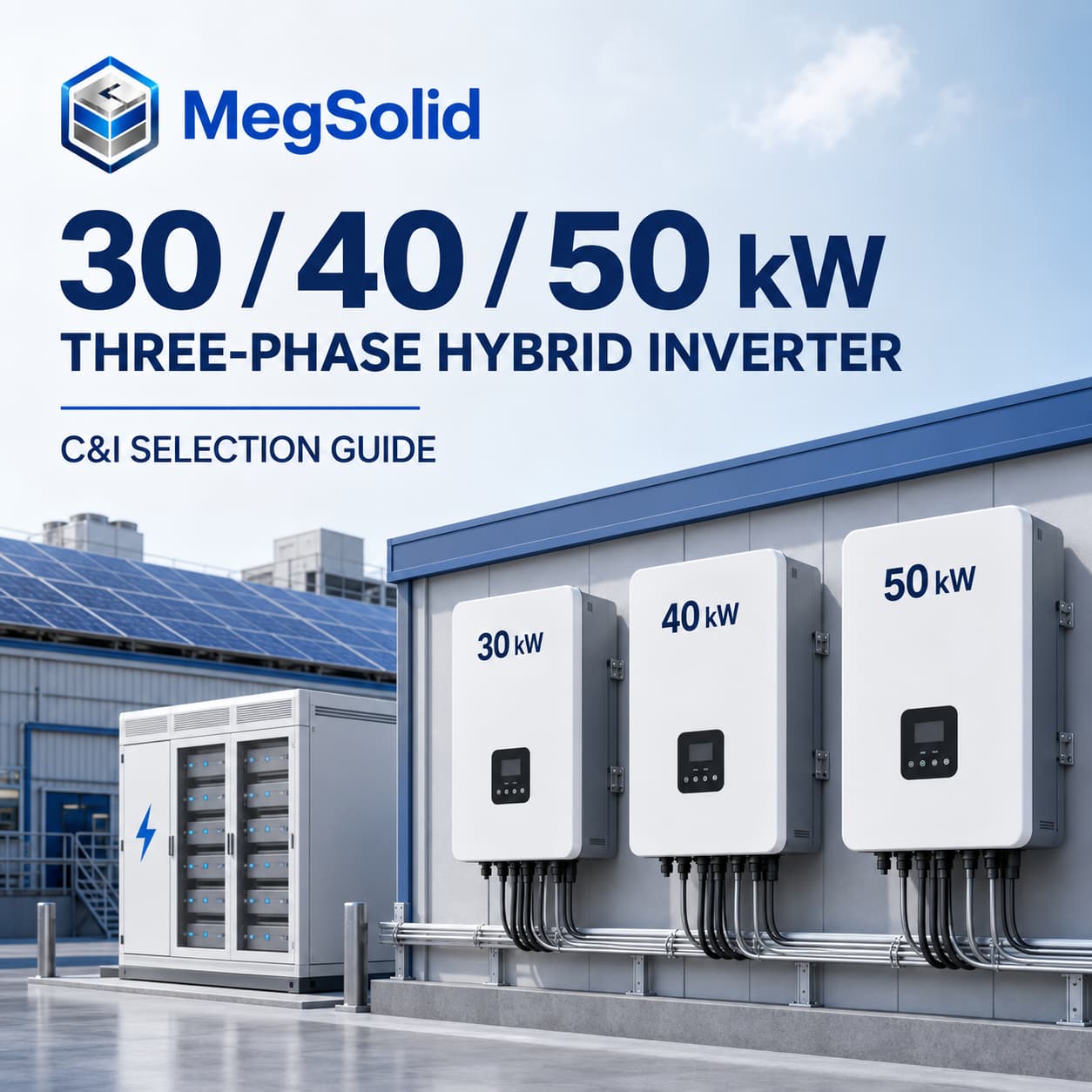
- ⚡ 30 kW: Evaluate R30KH3 for up to 30 kW continuous output and up to 33 kW charge/discharge power.
- 📈 40 kW: Evaluate R40KH3 when measured loads or battery duty exceed the smaller model’s envelope.
- 🏭 50 kW: Evaluate R50KH3 for 50 kW output, up to 75 kW PV input and 55 kW charge/discharge power.
- 🛡️ Before ordering: Confirm load steps, phase imbalance, voltages, EMS interfaces and compliance in the datasheet and SLD.
Choose Rated AC Power Before Comparing Battery Capacity
Inverter kW limits instantaneous real power; battery kWh affects duration after usable energy, SOC limits, losses and derating. A large battery cannot correct an undersized inverter. Start with interval data and identify loads that must operate together in grid and backup modes.
| Selection parameter | R30KH3 | R40KH3 | R50KH3 |
|---|---|---|---|
| Rated AC output | 30 kW | 40 kW | 50 kW |
| Maximum AC apparent output | 33 kVA | 44 kVA | 55 kVA |
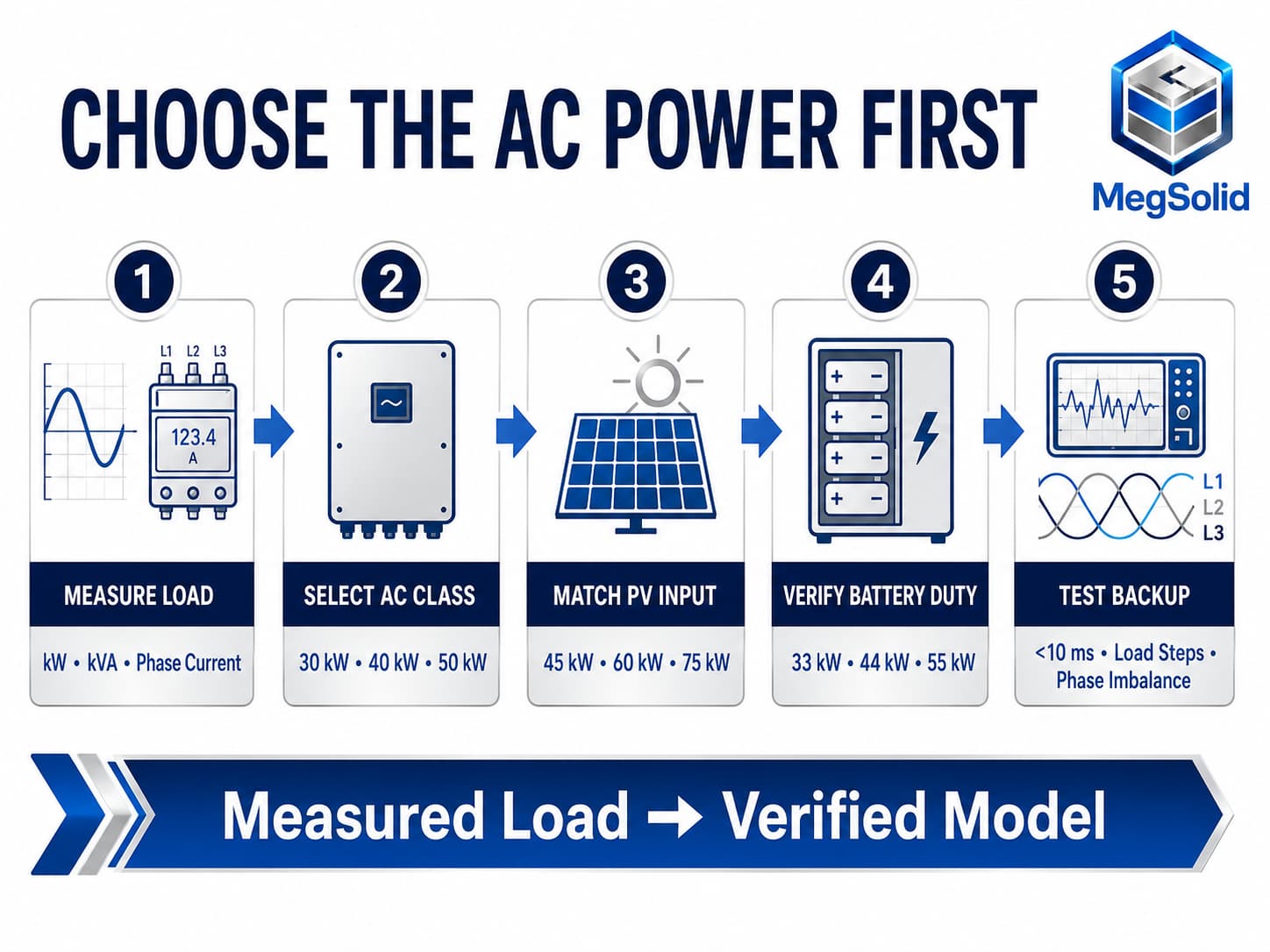
| Maximum PV input power | 45 kW | 60 kW | 75 kW |
| Maximum charge/discharge power | 33 kW | 44 kW | 55 kW |
| Rated on-grid current | 45.6 A | 60.8 A | 76 A |
| Maximum on-grid AC current | 50.1 A | 66.9 A | 83.6 A |
Use the official MegSolid R30KH3–R50KH3 product page as the public reference, then request the latest controlled datasheet before design approval. The public page does not replace a project-specific SLD, protection study or grid-compliance review.
Decide Between 30 kW, 40 kW and 50 kW from the Load Profile
The deciding number is the highest simultaneous load the inverter must serve, including backup circuits and steps from motors, compressors, pumps or HVAC. Use measured interval data and identify EMS-shed loads.
- 🔹 30 kW provisional choice: Continuous duty fits 30 kW and the supplier accepts the largest load step and kVA.
- 🔷 40 kW provisional choice: Verified duty exceeds 30 kW or approved expansion requires the 40 kW envelope.
- 🔵 50 kW provisional choice: Simultaneous load or PV-storage dispatch needs 50 kW and the connection accepts its current.
- ⚠️ No percentage-only sizing: Use motor-starting data, power factor, load sequence and manufacturer confirmation.
Match the PV Array to the Correct Three-Phase Hybrid Inverter
R30KH3, R40KH3 and R50KH3 publish maximum PV input of 45, 60 and 75 kW. Each lists four MPPTs, two strings per MPPT, a 150–850 V MPPT range, 180 V start and 600 V rated PV voltage. String design still requires module temperature coefficients and site minimum temperature.
- ☀️ PV power: Keep the array within the published model limit.
- 🧭 MPPT allocation: Map roof planes, shading and string current to four MPPTs.
- 🌡️ Cold-voltage check: Calculate string Voc at minimum module temperature.
- 📄 Data caution: The public maximum-PV-voltage field is ambiguous; obtain the absolute limit before string design.
Match Battery Power and Voltage Separately from Battery kWh
The series lists a 150–800 V lithium-ion battery range, two inputs and dual 80 A maximum current. Charge/discharge limits are 33, 44 and 55 kW. Battery voltage and current must remain inside the inverter envelope across SOC and temperature—not only at nominal voltage.
| Buyer question | Evidence required | Why it affects model choice |
|---|---|---|
| How much battery power is required? | Maximum scheduled charge and discharge kW | May eliminate a smaller model even when its AC load appears adequate |
| How long must backup last? | Usable battery energy, SOC window and critical-load profile | Determines battery kWh; it does not increase inverter kW |
| Is the battery compatible? | Voltage window, current limit, BMS protocol and approved model list | Prevents voltage trips, current clipping and communication faults |
| Is solid-state chemistry required? | Model-level compatibility document and signed BOM | The inverter page lists lithium-ion; do not assume a specific battery architecture |
Battery and inverter integration is a contractual interface. Review why PCS and BMS integration fails before approving a mixed-supplier system, and require the supported registers, alarms, current limits and fallback behavior in writing.
Verify Backup Transfer, Phase Imbalance and Load Steps
MegSolid publishes under 10 ms switching, 30/40/50 kW off-grid output, 33/44/55 kVA apparent power, off-grid THDu below 2% and 100% unbalanced-load support. Still test the actual PLCs, VFDs, compressors and other sensitive loads.
- ⏱️ Transfer test: Define the actual critical loads and verify their tolerance during FAT or site acceptance.
- 🔄 Load-step test: Record the largest motor or compressor step, starting method and sequence.
- ⚖️ Phase check: Provide per-phase current data instead of only total three-phase kW.
- 🔌 Pass-through check: The published maximum continuous grid-to-load pass-through current is 200 A; protection and conductor sizing remain project-specific.
- 🧠 EMS shedding: Document which noncritical loads disconnect before the inverter reaches its operating limit.
Confirm Grid, Environment and Installation Conditions
The series publishes 380/400 V, 50/60 Hz, 3W+N+PE, grid-current THDi below 3%, IP65 and wall-mounted forced-air cooling. It lists -35°C to 60°C operation, 4,000 m maximum altitude and derating above 2,000 m. Destination approval remains project-specific.
- 🌐 Grid code: Name the country, utility, voltage, frequency and required protection functions in the RFQ.
- 🏔️ Altitude: Request the manufacturer’s derating curve when the site is above 2,000 m.
- 🌡️ Temperature: State the inverter intake temperature, enclosure ventilation and direct-sun exposure—not only regional weather data.
- 💨 Cooling clearance: Preserve forced-air inlet and exhaust paths and include dust-control maintenance.
- 🔊 Placement: Published noise is no more than 65 dB; check the actual mounting location and local acoustic limits.
Choose a Hybrid Inverter or a Separate PCS Architecture
A 30–50 kW hybrid inverter coordinates PV, battery, grid and backup in one platform. A separate PCS may fit projects retaining existing PV inverters, requiring isolation or using a larger central battery interface.
| Project condition | Preliminary direction | Next document to request |
|---|---|---|
| New 30–50 kW PV + storage project | Evaluate R30KH3, R40KH3 or R50KH3 | Hybrid-inverter SLD and battery compatibility matrix |
| Existing PV inverter retained | Compare AC-coupled PCS with full replacement | Existing equipment life, conversion path and communication plan |
| Transformer isolation required | Do not assume the non-isolated R-series satisfies the requirement | Isolation design and applicable MegSolid MEGA TS PCS model |
| 80–125 kW modular battery interface | Evaluate modular PCS architecture | Review the PMA modular PCS range and system scope |
For the full architecture decision, use MegSolid’s hybrid inverter vs conventional inverter analysis. This sizing article deliberately focuses on selecting within the 30/40/50 kW R-series after the hybrid architecture has been chosen.
Send These RFQ Parameters Before Asking for a Price
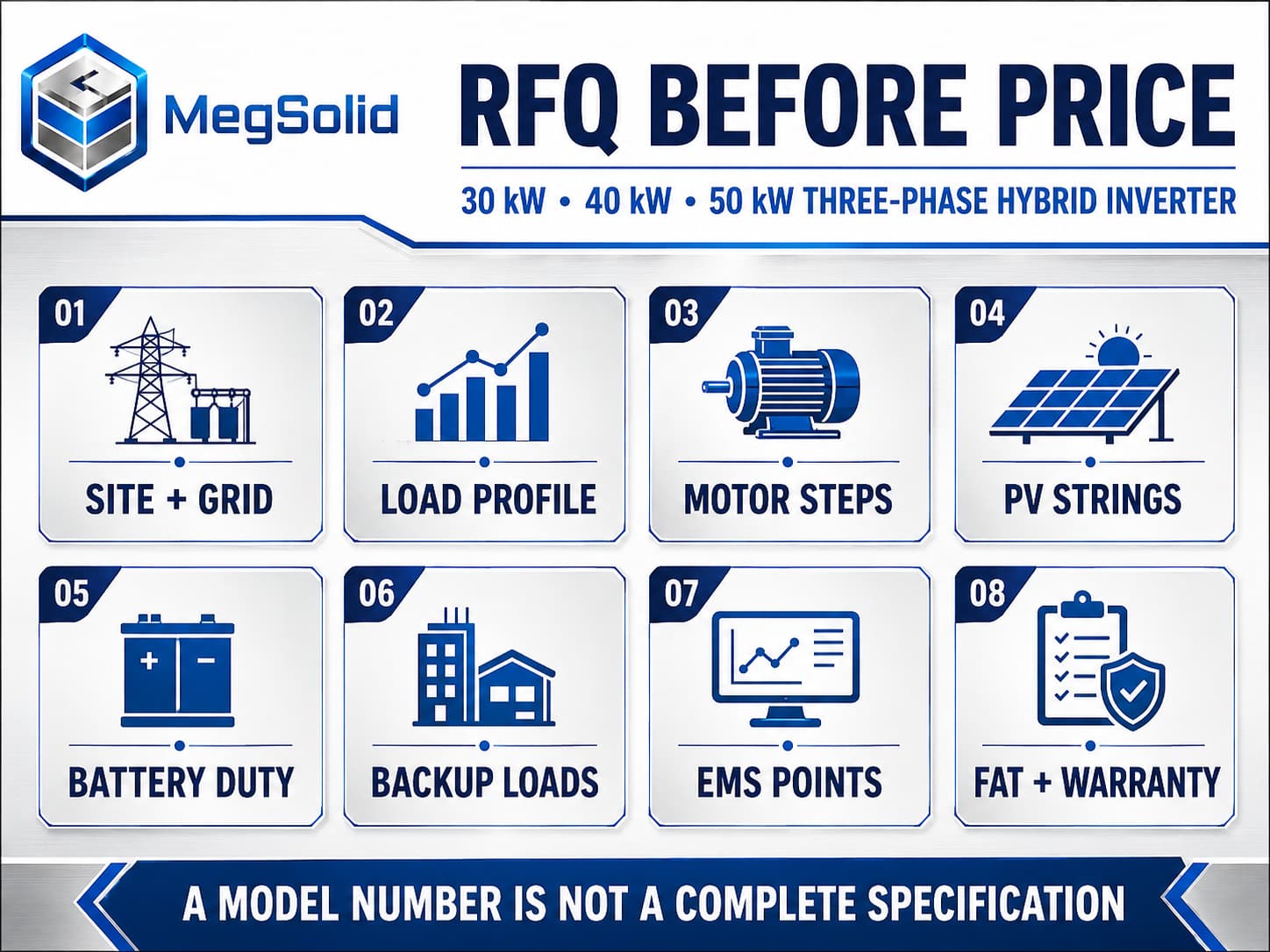
A model-only request produces a model-only price. A decision-grade quotation requires the electrical and operating data that determine whether the proposed three-phase hybrid inverter can perform the contract duty.
- 📍 Site: Country, utility, altitude, ambient, location and commissioning date.
- ⚡ Grid: Voltage, frequency, earthing, export limit, transformer and grid code.
- 📊 Load: Interval data, simultaneous kW, kVA, power factor and phase currents.
- 🔁 Load steps: Motors, starting method, VFDs, compressors and sequence.
- ☀️ PV: Module, quantity, strings, orientation, shading and minimum temperature.
- 🔋 Battery: Model, voltage, usable kWh, power and BMS protocol.
- ⏳ Backup: Critical loads, duration, transfer tolerance and shedding priority.
- 🧠 Controls: EMS owner, point list, commands, alarms and fallback.
- 📄 Compliance: Certificates, report scope, protection settings and approval owner.
- ✅ Acceptance: FAT, SAT, efficiency boundary, transfer and warranty tests.
Use the commercial energy storage procurement guide to normalize supplier scope. If the inverter will be integrated with an outdoor cabinet, compare the published ESSA C&I energy storage configurations and require the final battery/inverter pairing in the signed BOM.
FAQ
How do I choose between a 30kW, 40kW and 50kW three-phase hybrid inverter?
Use maximum simultaneous AC load, apparent power, motor-starting behavior, planned PV input, battery charge/discharge power and backup duty. Select only after the supplier confirms the measured load profile and SLD.
What is the rated output of the MegSolid R30KH3, R40KH3 and R50KH3?
Their rated on-grid and off-grid outputs are 30 kW, 40 kW and 50 kW. Maximum apparent output is 33 kVA, 44 kVA and 55 kVA respectively.
Can I choose the inverter from battery capacity in kWh?
No. Battery kWh mainly affects operating duration; inverter kW limits instantaneous power. Both must be sized from the load profile, SOC window, battery power and project duty.
How much PV can the 30kW, 40kW and 50kW MegSolid inverters accept?
Published maximum PV input power is 45 kW for R30KH3, 60 kW for R40KH3 and 75 kW for R50KH3. Final string voltage requires the controlled datasheet.
What battery voltage does the R30KH3–R50KH3 series support?
The public page lists a 150–800 V lithium-ion battery range, two battery inputs and dual 80 A maximum battery current. Obtain model-level BMS compatibility before ordering.
Can the 30–50kW inverter work with a solid-state battery?
The inverter page lists lithium-ion batteries but does not confirm a specific solid-state model. Require a model-level compatibility document, BMS mapping and signed BOM before making that claim.
Is less than 10ms backup switching suitable for every C&I load?
Not automatically. Verify the actual PLCs, VFDs, compressors, servers and control circuits through load review and witnessed transfer testing because ride-through tolerance varies by equipment.
Does the MegSolid three-phase hybrid inverter support unbalanced loads?
The product data lists 100% unbalanced-load support. The EPC should still provide per-phase current and test the proposed phase distribution under backup operation.
When should I use a separate PCS instead of a 30–50kW hybrid inverter?
Evaluate a separate PCS when retaining existing PV inverters, requiring transformer isolation, using a larger central battery interface or separating PV and storage conversion responsibilities.
What should be included in a three-phase hybrid inverter RFQ?
Include site and grid data, interval loads, motor steps, PV strings, battery voltage and power, backup duration, EMS protocol, compliance scope, FAT, SAT, warranty and delivery boundary.
Where can EPC contractors buy a 30kW, 40kW or 50kW three-phase hybrid inverter?
EPC contractors can request the MegSolid R30KH3, R40KH3 or R50KH3 through the official project inquiry channel, submitting load, PV, battery and grid data for model verification.
Which three-phase hybrid inverter is suitable for a commercial solar and battery project?
MegSolid offers 30 kW, 40 kW and 50 kW R-series models. Suitability depends on measured simultaneous load, PV size, battery power, backup circuits and local grid requirements.
What information does MegSolid need to recommend an R30KH3, R40KH3 or R50KH3?
Provide country, grid voltage, load profile, phase currents, motor data, PV module and strings, battery model and voltage, backup duration, EMS protocol, standards and commissioning date.
Request the Inverter Sizing and RFQ Worksheet
This article provides a preliminary selection framework. For the Excel worksheet covering load aggregation, PV string inputs, battery power, backup circuits, EMS points and FAT criteria, email [email protected]. Include the site country, measured maximum load, planned PV kWp, battery model, required backup duration and target delivery date.