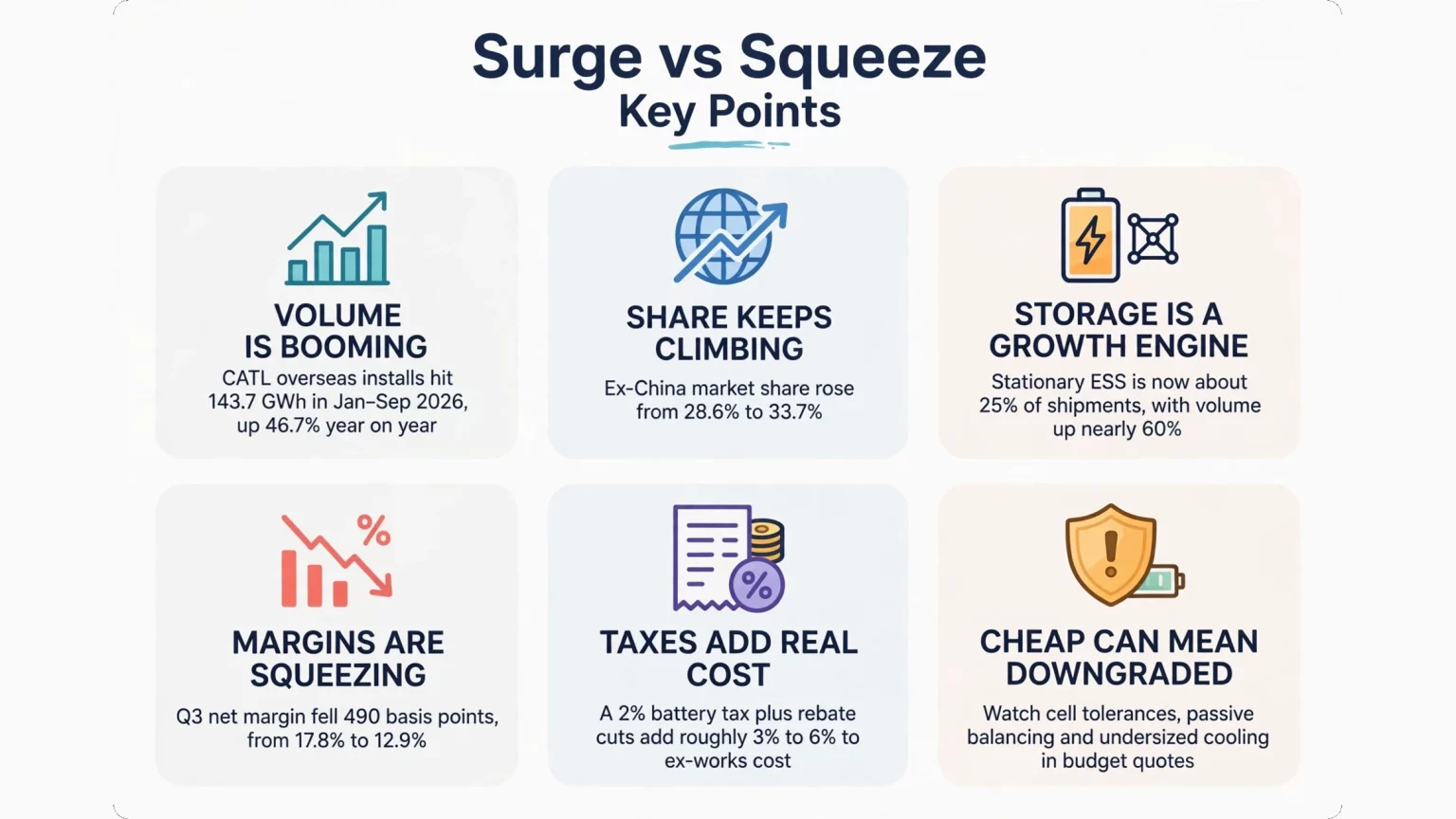
Recent SNE Research data from January through September 2026 shows catl overseas battery volume climbed 46.7% year-on-year to reach 143.7 GWh.
International market share outside China expanded from 28.6% to 33.7%, driven by rapid adoption across European and Asia-Pacific power grids.
Stationary energy storage systems (ESS) simultaneously grew to account for roughly 25% of total shipment volume, up nearly 60% year-on-year.
Despite booming overseas shipments, third-quarter net profit margins compressed by 490 basis points from 17.8% down to 12.9%.
This margin squeeze reflects China's 2% lithium battery consumption tax, export VAT rebate adjustments, and intense price competition across standard cells.
For engineering contractors reviewing Sungrow PowerStack Alternatives: Comparing 257–261 kWh C&I Battery Storage, upstream margin pressure signals a major procurement shift.
Developers operating in the global bess market are turning to high-lifecycle MegSolid C&I Energy Storage Systems to protect long-term project returns:
- ESSA0100B-0215: 100 kW / 215.04 kWh smart air-cooled commercial cabinet (768V nominal, 280 Ah LFP, optional solid-state configuration)
- Energon 261: 125 kVA / 261.24 kWh liquid-cooled industrial cabinet (832V nominal, 1P260S, 1.76 m² equipment base)
- 5000INTL: 2,700 kW (450 kW x 6) / 5,015.9 kWh liquid-cooled 20-foot utility container (1,331.2V nominal, 12P416S)
By the Numbers: Deconstructing CATL’s 143.7 GWh Overseas Surge & The 25% BESS Shift
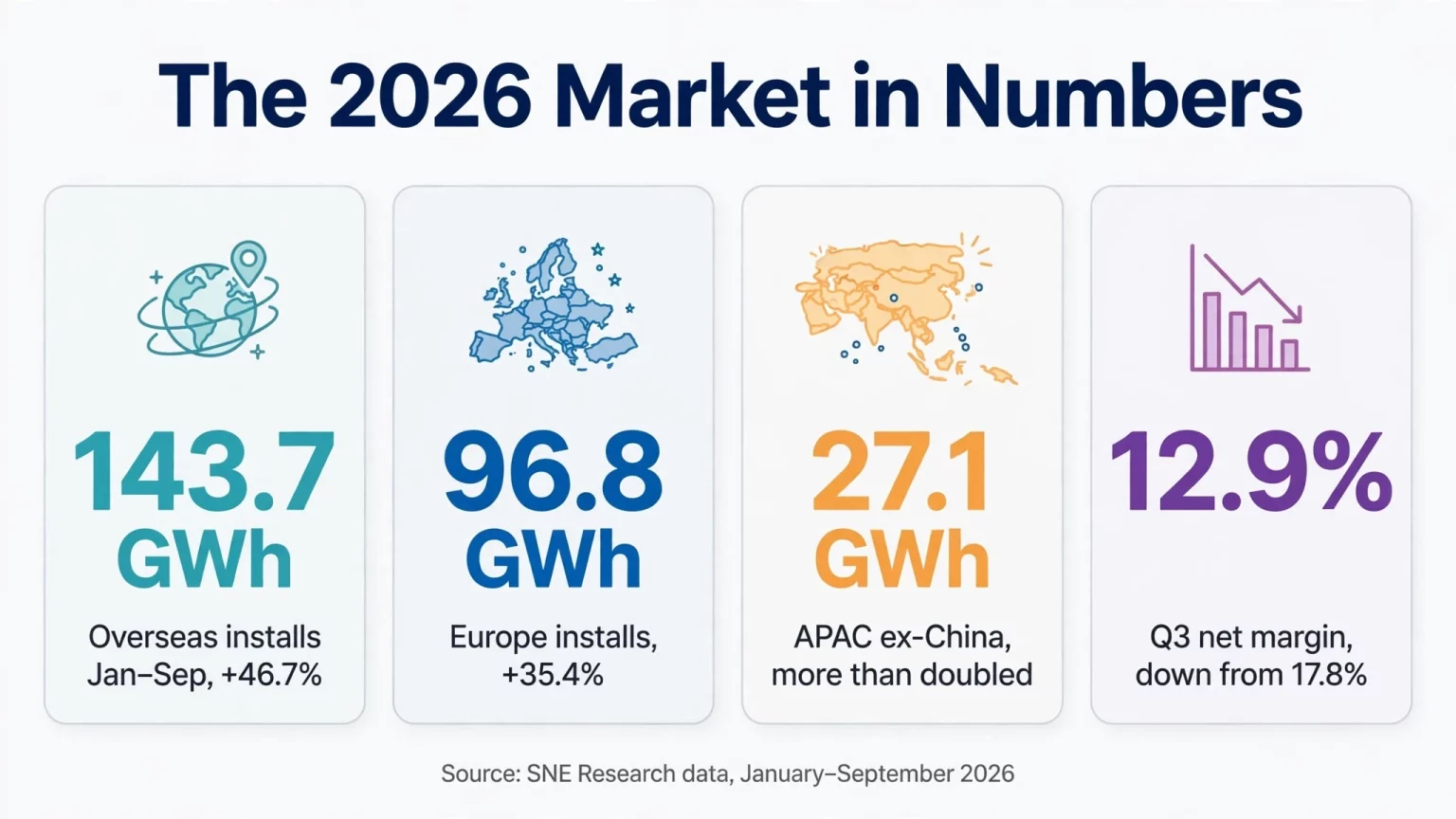
Market benchmarks from the first three quarters of 2026 reveal a structural divergence between shipment volume growth and cell manufacturing profitability.
While European installations rose 35.4% to 96.8 GWh and Asia-Pacific (ex-China) volumes more than doubled to 27.1 GWh, supplier margins tightened.
The table below summarizes the 2026 SNE Research installation figures, third-quarter financial metrics, and procurement implications for overseas buyers.
| 2026 Market & Financial Indicator | Reported Benchmark | Year-on-Year Shift | Procurement Implication for Overseas BESS EPCs |
|---|---|---|---|
| Overseas Battery Installations (Jan–Sept) | 143.7 GWh | +46.7% YoY Growth | Rapid cell deployment across international utility and C&I sites |
| Overseas Market Share (Ex-China) | 33.7% Share | Up from 28.6% (+510 bps) | High supplier concentration for European and APAC developers |
| European Market Installations | 96.8 GWh | +35.4% YoY Growth | Supported by regional localization and industrial peak shaving |
| APAC (Ex-China) Installations | 27.1 GWh | Over +100% YoY Growth | Driven by Australian grid tenders and Southeast Asian microgrids |
| Stationary ESS Share of Total Shipments | ~25% of Volume | +60% YoY Volume Surge | Stationary storage now rivals passenger EVs as a growth driver |
| Q3 Net Profit Margin Benchmark | 12.9% Margin | Down from 17.8% (-490 bps) | Tax costs and turnkey working capital squeeze cell manufacturer margins |
Tracking bess price trends requires understanding why record gigawatt-hour shipments no longer translate into expanding manufacturer operating margins.
Why Margins Are Squeezing Despite Record Volume: 3 Cost Pressures Reshaping BESS Price Trends
Three converging fiscal, operational, and supply-chain pressures explain why upstream battery manufacturers face declining net margins during an installation boom.
The Lithium Battery Tax and Export Rebate Squeeze
Fiscal policy adjustments including a 2% lithium battery tax and export VAT rebate reductions add 3% to 6% to ex-works manufacturing costs.
Overseas compliance requirements, such as European Union battery carbon footprint declarations and import tariff schedules, add further administrative overhead.
Because standard liquid LFP cell supply remains abundant, cell producers struggle to pass these incremental tax costs directly onto downstream buyers.
Working Capital Drag from Turnkey AC-Side Storage
Shipping bare 280 Ah or 314 Ah prismatic cells allows rapid inventory turnover and short cash collection cycles.
By contrast, delivering complete AC-side containerized storage blocks involves power conversion skids, energy management software, and multi-stage grid commissioning.
Extended 6-to-12-month project acceptance timelines tie up substantial working capital and compress quarterly financial margins.
Silent Component Downgrades Among Budget Assemblers
When low-tier cabinet assemblers get caught between upstream tax hikes and fixed downstream bid prices, quality control often suffers.
Procurement engineers auditing low-cost liquid LFP quotes must watch for silent specification downgrades across balance-of-plant components:
- Cell Sorting Tolerances: Mixing higher-impedance cells into series strings, which accelerates voltage divergence under 0.5C load
- BMS Balancing Circuits: Replacing active balancing topologies with low-current passive bleed resistors
- Thermal Management Sizing: Undersizing auxiliary liquid chillers or air-cooling fans to trim bill-of-materials costs
Review our technical guide on Verify a Solid-State Battery: 7 Supplier Red Flags to audit cell and pack quality before procurement.
Tier-1 Utility Allocation vs. Mid-Market Agility: How Mega-Deals Impact 215kWh–5MWh Buyers
To offset narrower per-kilowatt-hour margins with total revenue volume, top-tier cell manufacturers prioritize multi-gigawatt-hour utility framework agreements.
Multi-hour grid tenders in Australia, Europe, and the Middle East absorb primary engineering bandwidth and factory production slots.
For commercial EPCs procuring 200 kWh to 20 MWh systems, this utility concentration creates three operational bottlenecks:
- Production Queue Delays: Mid-market commercial cabinet orders face extended scheduling behind gigawatt-scale utility allocations
- Distributor Markup Layers: Small-to-midsize buyers often purchase through regional trading intermediaries, adding 15% to 25% price markups
- Rigid Integration Terms: Standardized utility products rarely accommodate custom voltage windows or site-specific transformer interfaces
Developers comparing mid-market options can examine our LUNA2000-215-2S10 Alternatives: Huawei vs MegSolid analysis for commercial cabinet benchmarks.
Escaping the Margin Trap: How High-Density & Hybrid Solid-State BESS Optimize Lifecycle ROI
Rather than chasing rock-bottom upfront quotes that risk component downgrades, engineering teams evaluate Levelized Cost of Storage (LCOS) across the project lifecycle.
LCOS ($/kWh) = [CAPEX + Σ((O&Mₜ + Augmentationₜ) / (1 + r)ᵗ)] / Σ(E discharged,ₜ / (1 + r)ᵗ).
A 2% to 4% tax-driven shift in upfront battery CAPEX alters installed system cost by roughly $2 to $4 per kWh.
By contrast, selecting durable cell architectures and high-density enclosures reduces site balance-of-plant expenditure and mid-life augmentation overhead.
Cell Impedance Consistency and Hybrid Solid-State Technology
MegSolid's MegSolid 314Ah Hybrid Solid-State Battery (SHS180-314Ah) specifies 0.18 +/- 0.03 milliohms AC resistance and 0.4 +/- 0.1 milliohms DC resistance.
The cell achieves >= 94.5% energy efficiency at 0.5P, minimizing internal resistive heating during daily peak-shaving cycles.
Across our MegSolid Hybrid Solid-State Energy Storage Systems, reducing free volatile solvent volume enhances thermal stability under abnormal electrical stress.
In low-voltage residential and commercial backup applications, the MEG-Solid-512314FL1 (51.2V / 314 Ah / 16.07 kWh) supports up to 8,000 cycles at 80% depth of discharge.
Commercial & Utility Hardware Density (ESSA0100B-0215, Energon 261, 5000INTL)
Optimizing equipment footprint and voltage architecture helps EPCs control civil foundation, cabling, and installation costs:
- ESSA0100B-0215 Outdoor Cabinet Energy Storage System: Delivers 100 kW / 215.04 kWh (1P240S, 768V nominal, 672V to 850V range) with >= 5,000-cycle 280 Ah LFP cells, built-in isolation transformer, and optional solid-state cells.
- Energon 261 Liquid-Cooled C&I Energy Storage System: Configured as a 261kwh liquid cooled bess (125 kVA / 261.24 kWh, 1P260S, 832V nominal), it occupies a 1.76 m² equipment base (1,300 x 1,350 x 2,200 mm), yielding 148.9 kWh/m² base area density and 90% maximum system efficiency.
- MegSolid Containerized Energy Storage System 5000INTL: Configured as a 5mwh containerized bess (5,015.9 kWh rated energy, 1,331.2V nominal, 12P416S SHS180-314 cells), it pairs smart liquid cooling with 450 kW x 6 AC power conversion inside a standard 20-foot ISO container (6,058 x 2,438 x 2,896 mm, IP55).
Compare cabinet sizing criteria in our Choose Commercial Battery Storage: 215kWh vs 261kWh BESS engineering guide.
2026–2027 BESS Procurement Matrix: Comparing Supply Chain Channels
Selecting the right procurement channel determines pricing transparency, technical customization, and commissioning support.
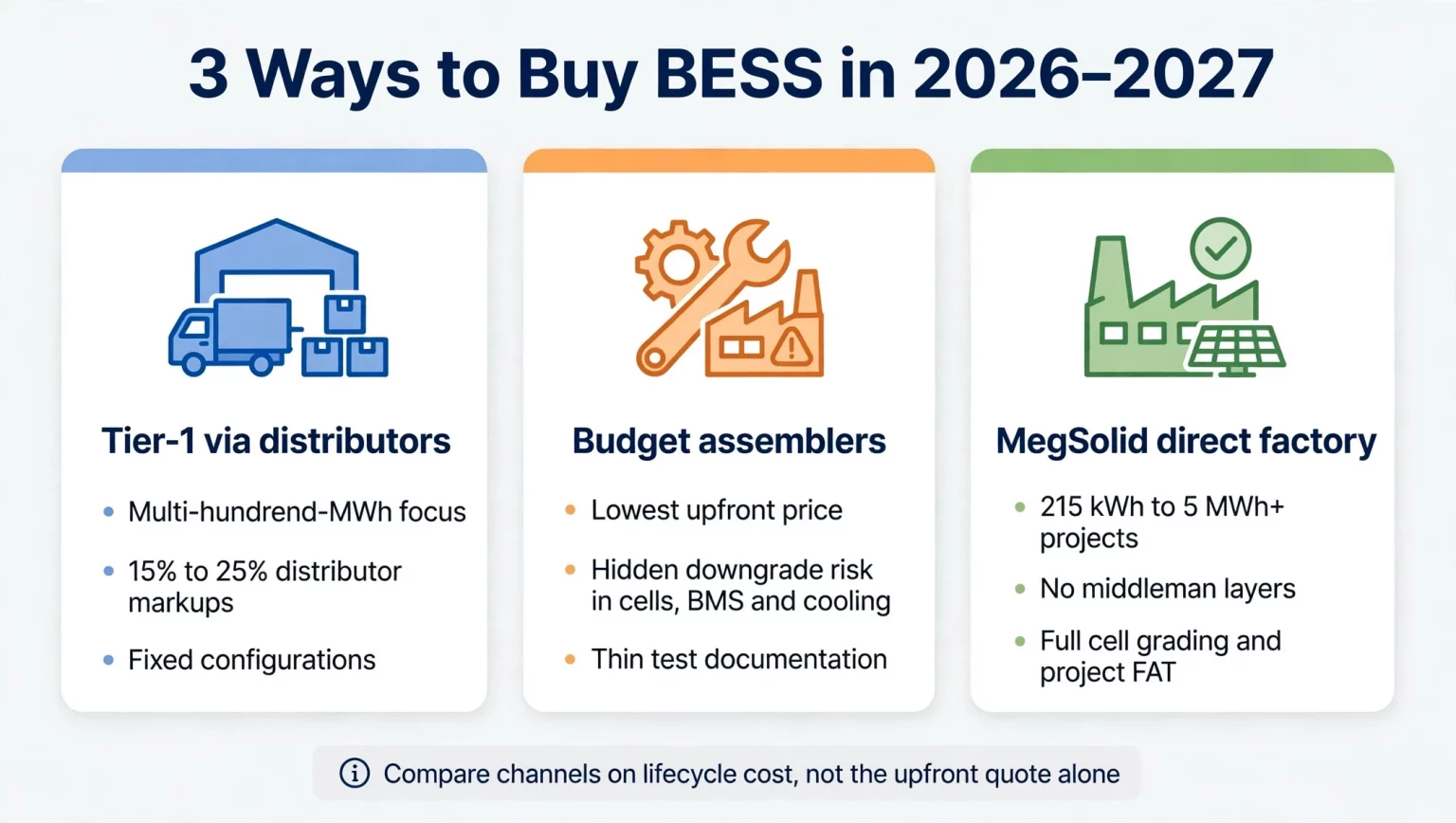
The table below compares three common procurement paths in the 2026–2027 commercial and utility storage market.
| Procurement Dimension | Tier-1 Giants (Via Regional Distributors) | Low-Cost Budget Assemblers | MegSolid Direct Factory OEM / ODM |
|---|---|---|---|
| Primary Target Order Size | Multi-hundred-MWh utility frameworks | Small spot-market cabinet orders | Commercial (215 kWh+) to utility (5 MWh+) projects |
| Pricing Structure | Includes 15% to 25% distributor markups | Low upfront price; high hidden BoP risk | Direct factory pricing without middleman layers |
| Product Portfolio Scope | Standardized LFP cabinets and containers | Assembled third-party LFP packs | LFP and hybrid solid state bess platforms |
| Voltage & PCS Integration | Fixed factory configurations | Varied third-party inverter boards | Matched cabinets or modular PMA080/0105/0125 PCS |
| Communication Interfaces | Model-specific (e.g., Modbus TCP/IP) | Often inconsistent register documentation | Documented RS485, TCP/IP, LAN, 4G, or Ethernet |
| Factory Quality Verification | Standard batch sampling | Limited load-bank testing | Full cell grading and project FAT verification |
4 Practical Procurement Strategies for BESS Developers in 2026–2027
Engineering teams can insulate projects from upstream tax volatility and supply-chain bottlenecks by adopting four verification practices.
Model 15-Year LCOS Instead of Upfront $/kWh Quotes
Evaluate total lifetime discharged megawatt-hours by factoring in system efficiency, auxiliary cooling consumption, and verified cycle life curves.
Higher energy throughput and avoided mid-life battery augmentation outweigh minor upfront tax adjustments.
Require Serialized Cell Grading and Factory Acceptance Testing (FAT)
Before authorizing shipment, require factory test documentation verifying open-circuit voltage (OCV) and internal resistance (ACIR/DCIR) consistency across all strings.
Confirm that capacity and load testing follow the specific product verification procedure defined in the technical agreement.
Standardize on High-Density Modular Enclosures
Using the 215.04 kWh ESSA0100B-0215 (with built-in isolation transformer) or the 261.24 kWh Energon 261 (1.76 m² base footprint) streamlines pad design.
For utility substations, deploying the 5,015.9 kWh 5000INTL 20-foot container consolidates string management at 1,331.2V DC.
Verify Communication Register Maps and PCS Coordination Early
Confirm hardware interfaces (RS485, TCP/IP, LAN, or Ethernet) and register tables with your SCADA team before finalizing procurement.
For custom rack-mount conversion, pair battery strings with our MegSolid Energy Storage Inverter units (PMA080, PMA0105, PMA0125).
FAQ
Which international regions drove the 2026 overseas battery surge?
European battery installations grew 35.4% year-on-year to reach 96.8 GWh during the January-to-September 2026 window. Installations across the Asia-Pacific region outside China more than doubled over the same timeframe to reach 27.1 GWh.
What share of total battery shipments now goes to stationary energy storage (ESS)?
Stationary energy storage systems expanded to roughly 25% of total battery shipment volumes in the first three quarters of 2026. Total stationary storage shipment volumes increased by nearly 60% year-on-year as utilities and factories added grid buffering capacity.
Why did Q3 net profit margins compress from 17.8% to 12.9% despite record volume?
Net profit margins fell by 490 basis points due to a combination of China's 2% lithium battery consumption tax, export VAT rebate adjustments, and price competition. Longer working-capital and revenue-recognition cycles for turnkey AC-side storage systems also weighed on quarterly profitability.
How does the 2% lithium battery tax affect bess price trends in 2026 and 2027?
The 2% consumption tax and export rebate revisions increase baseline cell manufacturing and export costs by roughly 3% to 6%. Because cell makers have limited room to absorb further margin compression, raw LFP pack prices are stabilizing near a structural floor.
Why do turnkey AC-side storage deals tie up more working capital than bare cell sales?
Turnkey AC-side projects integrate battery racks, power conversion systems, fire suppression, and energy management software under multi-stage delivery contracts. Grid connection approvals and site acceptance testing extend cash conversion cycles to 6 to 12 months compared to rapid bare-cell shipments.
How do Tier-1 utility allocations affect mid-market commercial BESS buyers?
When large manufacturers prioritize multi-hundred-megawatt utility tenders, smaller commercial orders of 200 kWh to 20 MWh often face longer production queues. Purchasing small volumes through regional distributors also introduces 15% to 25% intermediary markups.
How does the MegSolid Energon 261 optimize commercial site footprint?
The Energon 261 delivers 261.24 kWh rated energy and 125 kVA apparent power within physical cabinet dimensions of 1,300 x 1,350 x 2,200 mm (1.76 m² base). This achieves an equipment base area energy density of 148.9 kWh/m², excluding external maintenance clearances, fire setbacks, and civil foundations.
When should an EPC select the ESSA0100B-0215 instead of the Energon 261?
The ESSA0100B-0215 (100 kW / 215.04 kWh, 768V nominal) includes a built-in isolation transformer, making it suited for 400V AC sites requiring galvanic isolation. It uses smart temperature-controlled air cooling (280 Ah LFP, >= 5,000 cycles) and offers solid-state cells as a project option.
What are the core specifications of the MegSolid 5000INTL 5MWh container?
The 5000INTL provides 5,015.9 kWh rated energy in a 12P416S configuration (1,331.2V nominal) inside a standard 20-foot container (6,058 x 2,438 x 2,896 mm, IP55). It integrates smart liquid cooling, 450 kW x 6 AC power conversion (690 Vac), and achieves an 87.5% maximum efficiency rating.
What communication interfaces are supported across MegSolid commercial and utility systems?
Verified hardware interfaces include RS485 and TCP/IP on the ESSA0100B-0215, RS485, LAN, and 4G on the Energon 261, and Ethernet and RS485 on the 5000INTL. Engineers should request model-specific protocol documentation and register maps during system design to ensure smooth EMS integration.
Conclusion: Planning for the 2026–2027 BESS Market with Verified Engineering Value
The 2026 market data sends a clear signal to energy storage developers: global installation demand is surging (+46.7% overseas growth), while upstream cell margins face structural tax and working-capital pressures.
In this environment, relying solely on lowest-bid liquid LFP quotes exposes commercial projects to component downgrades and allocation delays.
Partnering directly with an agile manufacturer helps EPCs secure documented quality, high energy density, and responsive technical support.
Compare leading commercial cabinet architectures in our review of Sungrow PowerStack Alternatives: Comparing 257–261 kWh C&I Battery Storage for further market benchmarks.
Explore our full hardware lineup on the MegSolid C&I Energy Storage Systems portal, spanning the ESSA0100B-0215 (215.04 kWh), Energon 261 (261.24 kWh), and 5000INTL (5,015.9 kWh).
Submit your project load profile and single-line diagram to MegSolid for direct factory pricing and FAT documentation.
Contact MegSolid application engineers to confirm delivery schedules for your 2026–2027 pipeline.