
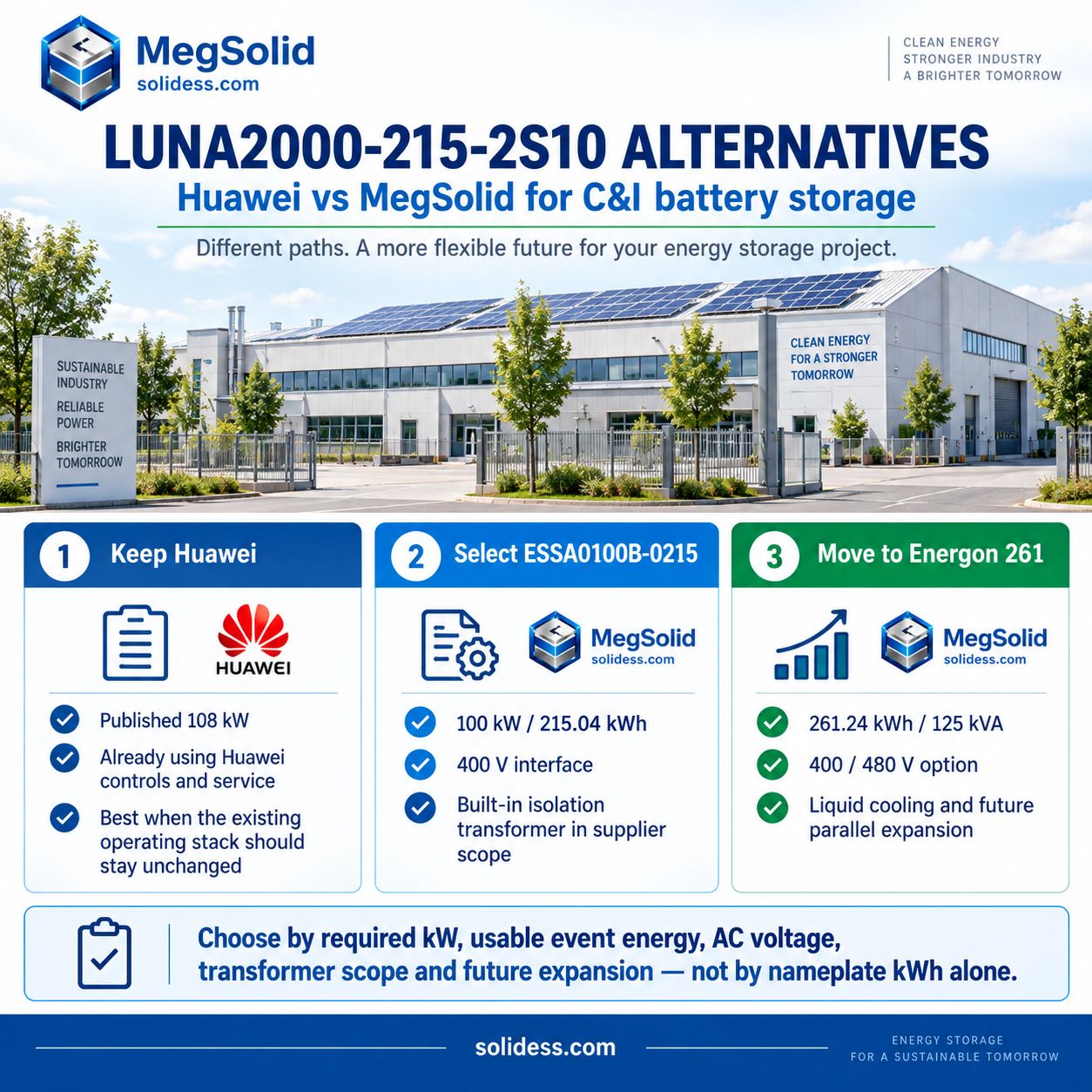
MegSolid ESSA0100B-0215 combines 100 kW, 215.04 kWh, 400 V and a built-in isolation transformer; Energon 261 provides 261.24 kWh when the discharge duration or reserve requirement exceeds the usable energy of the 215 kWh class.
- Keep Huawei when the project needs its published 108 kW or already depends on Huawei controls and service procedures.
- Select ESSA0100B-0215 when 100 kW covers the load and cabinet-level isolation belongs inside the supplier package.
- Move to Energon 261 when the project needs 261.24 kWh, a 480 V option, liquid cooling or later parallel expansion.
Match the Huawei quote to the closest MegSolid product
LUNA2000-215-2S10 and ESSA0100B-0215 sit in the same nominal-energy class, but they are not drop-in replacements. Huawei publishes 215.0 kWh, 108 kW and 380/400/415 V for the 215-2S10. ESSA provides 215.04 kWh, 100 kW and a 400 V interface with a built-in isolation transformer.
German buyers comparing Huawei Gewerbespeicher offers need to distinguish the product generations. Huawei's current global page now presents the 241 kWh series, while the official LUNA2000-215-2S10 datasheet remains available. The quotation must identify the cabinet, PCS and regional documentation instead of using “Huawei Smart String ESS” as a family-level description.
Power, voltage and installation specifications
Huawei LUNA2000-215-2S10
| Published item | Value |
|---|---|
| Rated energy | 215.0 kWh |
| Rated output power | 108 kW |
| AC interface | 380/400/415 V, three-phase four-wire |
| Cooling | Hybrid cooling |
| Enclosure | IP55 |
| Cabinet size and mass | 1150 × 1800 × 2100 mm; ≤2.8 t |
MegSolid ESSA0100B-0215
| Published item | Value |
|---|---|
| Rated energy | 215.04 kWh |
| Rated AC power | 100 kW |
| AC interface | 400 V; operating range 320–460 V; 3W+N+PE |
| Product integration | Built-in isolation transformer |
| Enclosure | IP54 |
| Cabinet size and mass | 2450 × 1550 × 2400 mm; 3.9 t |
MegSolid Energon 261
| Published item | Value |
|---|---|
| Rated energy | 261.24 kWh |
| Published AC rating | 125 kVA |
| AC interface | 400/480 V ±15% |
| Cooling | Intelligent liquid cooling |
| Enclosure | IP54 |
| Expansion | Up to 10 units in parallel |
ESSA needs more installation space and lifting capacity than the Huawei cabinet. Its built-in isolation transformer gives the buyer one less separately supplied component to coordinate, provided the site can accommodate the cabinet’s access and foundation requirements.
Energon adds 46.24 kWh relative to Huawei’s 215.0 kWh rating and offers a 400/480 V choice with liquid cooling. Available active power depends on the PCS capability and reactive duty within that 125 kVA rating. The 215 kWh versus 261 kWh comparison explains how the additional energy affects sizing.
Huawei states 91.3% maximum cycle efficiency under defined conditions, while Energon states 90% maximum system efficiency. The two percentages describe different measurements, so they do not establish an efficiency ranking. Delivered AC energy can be verified through the commercial BESS capacity test procedure.
The email response will compare power, voltage, cabinet interface, isolation scope and the remaining site equipment for the two 215 kWh-class options.
ESSA0100B-0215 fits when 100 kW covers the site
ESSA’s built-in isolation transformer places cabinet-level isolation under MegSolid’s supply responsibility when the required load stays within 100 kW.
The transformer rating, impedance and connections must suit the approved electrical design. Site voltage and fault level determine whether upstream transformation, switchgear and protection are still needed. Earthing also belongs in the C&I BESS design process.
The 8 kW power difference can rule out ESSA
Consider a facility with a 406 kW production peak and a 300 kW grid-import target:
Required BESS active power = 406 kW − 300 kW = 106 kW
One ESSA cabinet cannot be selected for a continuous 106 kW requirement because its rated AC power is 100 kW. Huawei's published 108 kW clears this initial power requirement, subject to the final operating conditions and approved configuration.
At an approved import target of 311 kW, the required reduction falls to 95 kW. ESSA then has 5 kW of rated headroom. Load variation and operating conditions determine whether that margin is sufficient. The buyer can then compare ESSA’s included isolation with Huawei’s additional power capacity.
Sites needing a different converter rating can use MegSolid's 30–500 kW PCS range to size the converter and battery energy independently.
Energon 261 becomes relevant when 46.24 kWh changes the result
Moving from 215.0 kWh to 261.24 kWh adds about 21.5% nominal energy. The usable increase depends on SOC limits and reserve, with further allowances for losses, temperature and ageing.
Evaluate Energon for these requirements:
- The discharge event leaves too little usable margin inside the 215 kWh class.
- The site needs the published 480 V option.
- Liquid cooling matches the thermal and operating requirements.
- Later capacity growth benefits from a platform supporting up to ten units in parallel.
Recharge time depends on how much energy the site uses. Using the extra capacity requires more charging energy and enough headroom before the next event; unused capacity does not increase daily energy throughput. ESSA may already cover a shorter event.
Integration with existing Huawei controls
Facilities already using Huawei PV equipment, SmartLogger commissioning procedures, FusionSolar monitoring, trained technicians and stocked spares may avoid operational change by retaining Huawei. That advantage can outweigh a cabinet-level specification difference.
A supplier change also needs to account for protection and commissioning work the EPC has already completed for the exact Huawei model.
For an EPC selecting equipment across several project sizes, MegSolid offers integrated cabinets alongside separate 30–500 kW PCS options. Its OEM/ODM cabinet design and battery-pack assembly support let the EPC or distributor work with one manufacturer across adjacent power and energy classes.
On a mixed-vendor site, assign responsibility for import limiting, zero export and solar charging to the appropriate controller using the PCC measurement. The PCC zero-export control design defines that site-level requirement.
Worked example: ESSA at a 400 V factory
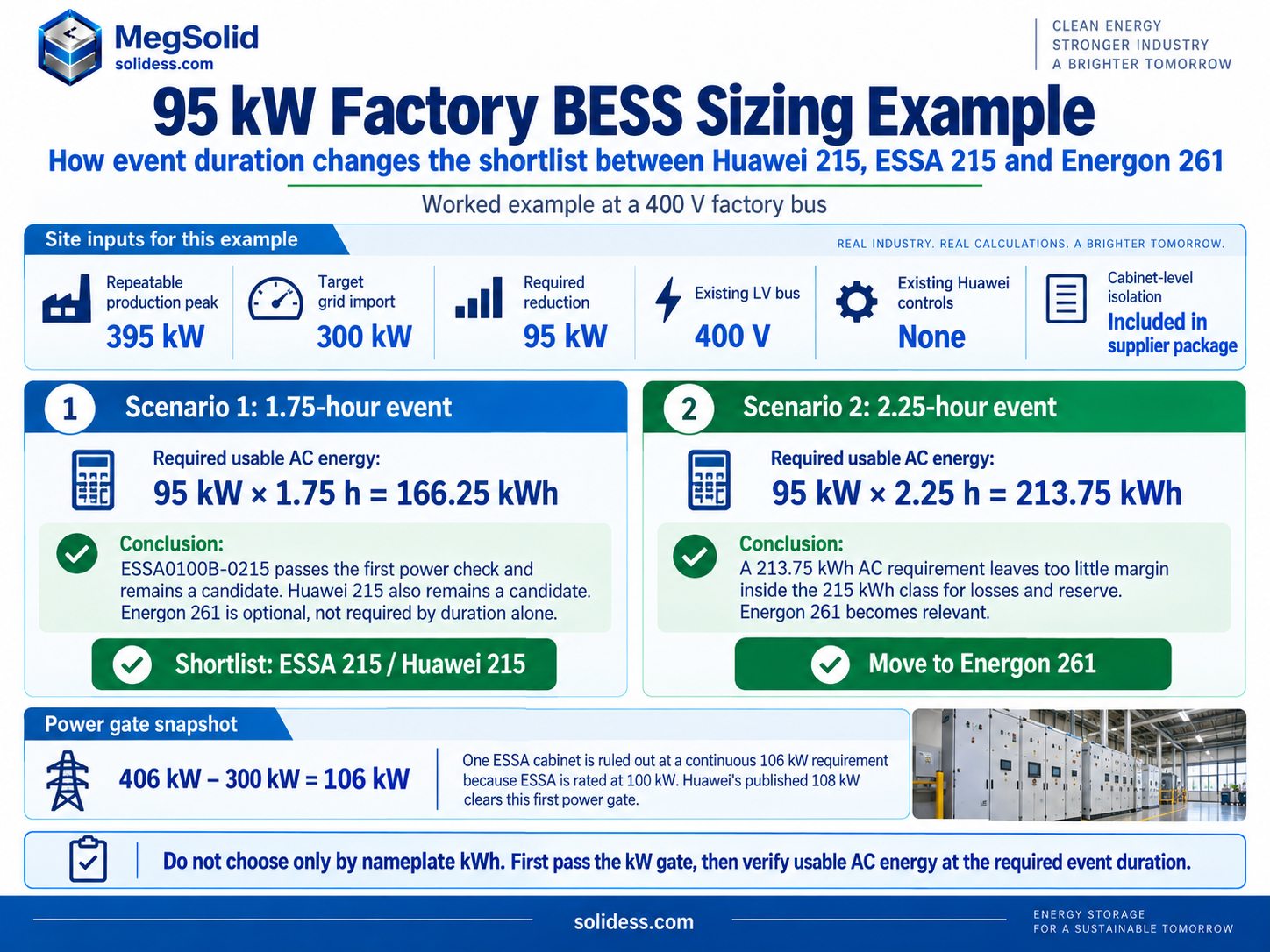
Use the following illustrative factory inputs to compare LUNA2000-215-2S10 with the MegSolid alternatives:
| Site input | Project value |
|---|---|
| Repeatable production peak | 395 kW |
| Target grid import | 300 kW |
| Required reduction | 95 kW |
| Event duration | 1.75 hours |
| Existing LV bus | 400 V |
| Cabinet-level isolation | Included in the supplier package |
| Existing Huawei controls | None |
| Planned cabinet expansion | None |
Required active power:
395 kW − 300 kW = 95 kW
Required energy at the AC operating point:
95 kW × 1.75 h = 166.25 kWh
Selection for the 1.75-hour event
ESSA passes the first power check because 95 kW remains below its 100 kW rating. Its nominal capacity makes it a candidate for detailed usable-energy modelling, and its 400 V interface matches the factory bus. The internal transformer also places cabinet-level isolation in the MegSolid package, subject to the approved transformer and protection schedule.
Huawei also passes the initial calculation. This factory has no existing Huawei controls or service procedures to retain. Physical installation, controls, service and total supplied scope determine which option fits.
ESSA still needs to deliver 166.25 kWh within its warranted operating window to meet the duty. Energon remains a candidate if that usable energy is insufficient.
Energy requirement at 2.25 hours
Extending the event to 2.25 hours increases the AC energy requirement:
95 kW × 2.25 h = 213.75 kWh
A 213.75 kWh AC requirement leaves too little of a 215 kWh nameplate for losses and operating reserve. Energon’s additional capacity makes it a candidate for this longer event, subject to the same usable-energy calculation. Existing PV equipment can stay on its own inverter through an approved AC-coupled C&I battery architecture.
Confirm the model and supplied scope
Huawei's current global product page presents the LUNA2000-241-2S1, while 215-2S10 documents remain available. A German Gewerbespeicher specification should not shorten either model to “Huawei 215.”
Record the following in the purchase schedule:
- exact cabinet and PCS model;
- AC rating, rated energy and accepted usable-energy basis;
- voltage, wiring, transformer and protection scope;
- EMS, communications and PCC-control responsibility;
- regional certificates, commissioning, warranty and service scope.
Identify the full MegSolid configuration as well. ESSA0100B-0215 identifies the 100 kW / 215.04 kWh product; Energon identifies the 261.24 kWh / 125 kVA configuration and the selected 400 or 480 V interface. The BESS factory acceptance test should verify the equipment and settings in that approved schedule.
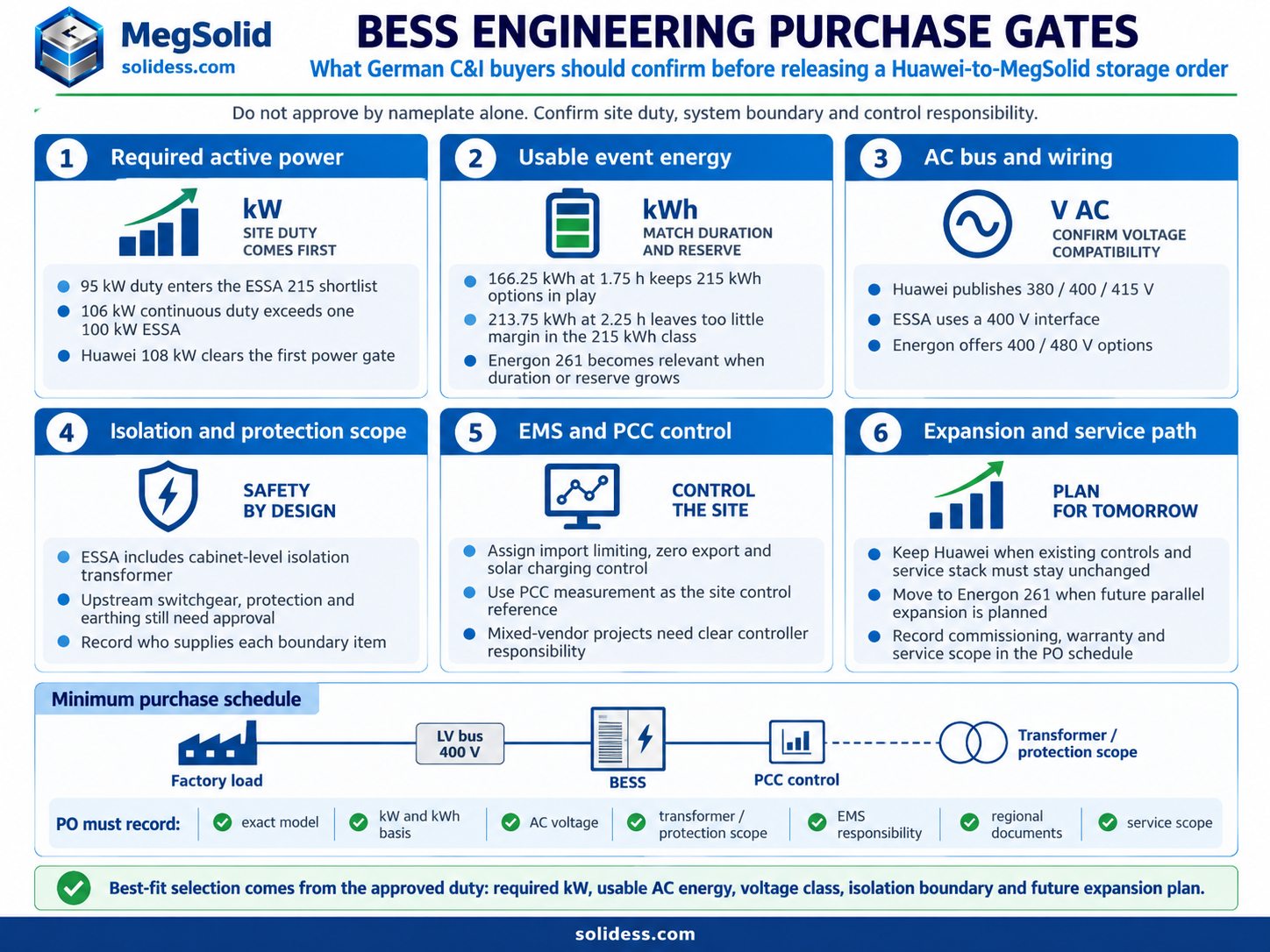
In the 95 kW factory example, ESSA matches the 400 V bus and includes the required cabinet-level isolation. Selection still depends on usable energy and installation requirements. Energon offers additional capacity for the longer event, along with the 480 V option, liquid cooling and parallel expansion for sites that need them.
The email response will match an ESSA or Energon configuration to the required kW, event energy, bus voltage and isolation scope, including the usable-energy checks needed for selection.
FAQ
Is ESSA0100B-0215 a direct replacement for LUNA2000-215-2S10?
No. The capacities are nearly identical, but Huawei publishes 108 kW while ESSA is rated at 100 kW. Voltage, isolation scope, dimensions, controls and service also need comparison.
Which MegSolid product is closest to Huawei LUNA2000-215-2S10?
ESSA0100B-0215 is closest by nominal-energy class, combining 100 kW, 215.04 kWh, 400 V and a built-in isolation transformer.
Does the difference between 215.0 kWh and 215.04 kWh affect sizing?
No meaningful purchase decision should depend on 0.04 kWh. Required power, event energy, reserve, losses and recharge time have more influence.
When does Huawei's 108 kW rating matter against ESSA's 100 kW?
It matters when the required continuous active-power block exceeds 100 kW. A 106 kW requirement sits beyond one ESSA cabinet's rating.
When should a buyer move from ESSA 215 to Energon 261?
Energon becomes relevant when 215 kWh leaves insufficient usable margin, the site needs 480 V, liquid cooling suits the application, or later parallel expansion is planned.
Is Energon 261 rated at 125 kW?
Its published rating is 125 kVA. Active kW depends on the approved PCS capability, power factor and reactive-power requirement.
What does ESSA's built-in isolation transformer change?
It places cabinet-level isolation inside the ESSA package. The upstream transformer, switchgear, protection and earthing design still require project approval.
Is hybrid cooling automatically better than air or liquid cooling?
No. Available output, auxiliary consumption, maintenance and the operating environment decide whether a cooling architecture fits the project.
Can Huawei's 91.3% figure be compared directly with MegSolid's 90% figure?
No. Huawei states maximum cycle efficiency under defined conditions, while Energon states maximum system efficiency. The measurement points and auxiliary loads must match.
Can an existing Huawei PV system use a MegSolid BESS?
An approved AC-coupled design can retain the PV equipment and connect the BESS through a separate AC path. PCC controls, communications and protection must cover both systems.
Can ESSA0100B-0215 connect directly to a German 400 V factory bus?
Its published voltage fits the 400 V class, but the project must still approve wiring, fault level, protection, earthing and the model-specific grid documents.
Which documents matter for a German Gewerbespeicher project?
Use the exact model schedule, required grid and safety certificates, single-line diagram, protection settings, commissioning plan, warranty and service scope.
How should German buyers compare Huawei and MegSolid commercial battery prices?
Compare the complete supplied scope, including cabinet, PCS, isolation or site transformer, switchgear, controls, commissioning, freight, certification work and service.