 Skip to content
Battery suppliers use solid-state, semi-solid, quasi-solid and solid-liquid labels for different electrolyte architectures. Before paying a technology premium, ask the supplier to define the electrolyte, disclose any liquid content and connect each performance claim to the exact cell and system model.
Check the stated cycle-life conditions, safety-test results, energy density and complete BESS specification. MegSolid describes its products as Hybrid Solid-State, meaning the cells combine solid electrolyte materials with liquid components rather than claiming an all-solid-state design.
7 Checks for Verifying a Solid-State Battery
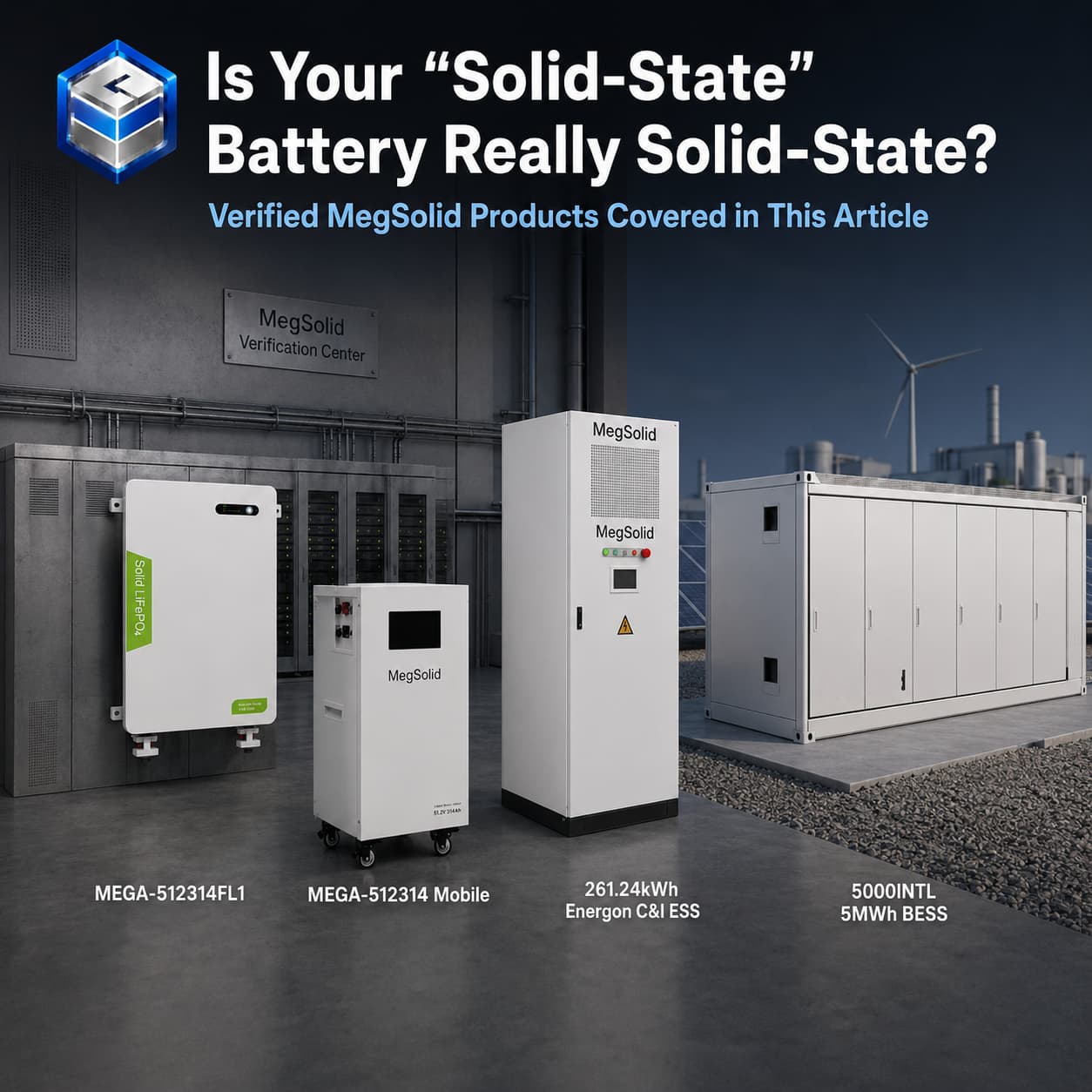
1. Red Flag: The Manufacturer Will Not Clearly Define the Battery
The first question should be easy:
What exactly is this battery?
If a supplier slides between "all-solid-state," "semi-solid" and "hybrid solid-state" without stating the architecture, you cannot compare products on equal terms.
Semi-solid is not automatically fake. Hybrid is not all-solid. A cell that still holds liquid can still deliver real gains.
What matters is whether the manufacturer states what it is selling.
MegSolid's documentation defines the technology as Hybrid Solid-State — solid electrolyte plus liquid components. The 51.2 V / 314 Ah energy-storage battery, for example, is identified as Hybrid Solid-State LiFePO4.
That gives you a defined product, not a floating marketing label.
2. Red Flag: A Supplier Claims "Almost No Liquid" but Provides No Measurement
This is where procurement gets messy if you are not careful.
Neither of the MegSolid LLMS technical files gives a numerical liquid-electrolyte percentage for MegSolid batteries. So this article does not invent one.
It would be wrong to write:
"MegSolid contains X% liquid electrolyte"
unless an official MegSolid test report or updated technical document states that number.
The same rule applies to mass-loss results.
China's T/CSAE 434-2025 is an industry reference for all-solid-state traction battery determination. The published method uses vacuum heating; under that method a sample must show no visible liquid and a mass-loss rate below 1% to meet the determination.
That figure is not a MegSolid product parameter and must not be presented as one. It is also not a universal acceptance threshold for stationary BESS.
What to ask
| Question | Good Evidence |
|---|---|
| What is the electrolyte architecture? | Technical declaration |
| Is liquid present? | Clear manufacturer statement |
| Is a percentage claimed? | Test result and method |
| Is “all-solid-state” claimed? | Applicable classification evidence |
Rule: no verified number, no invented number.
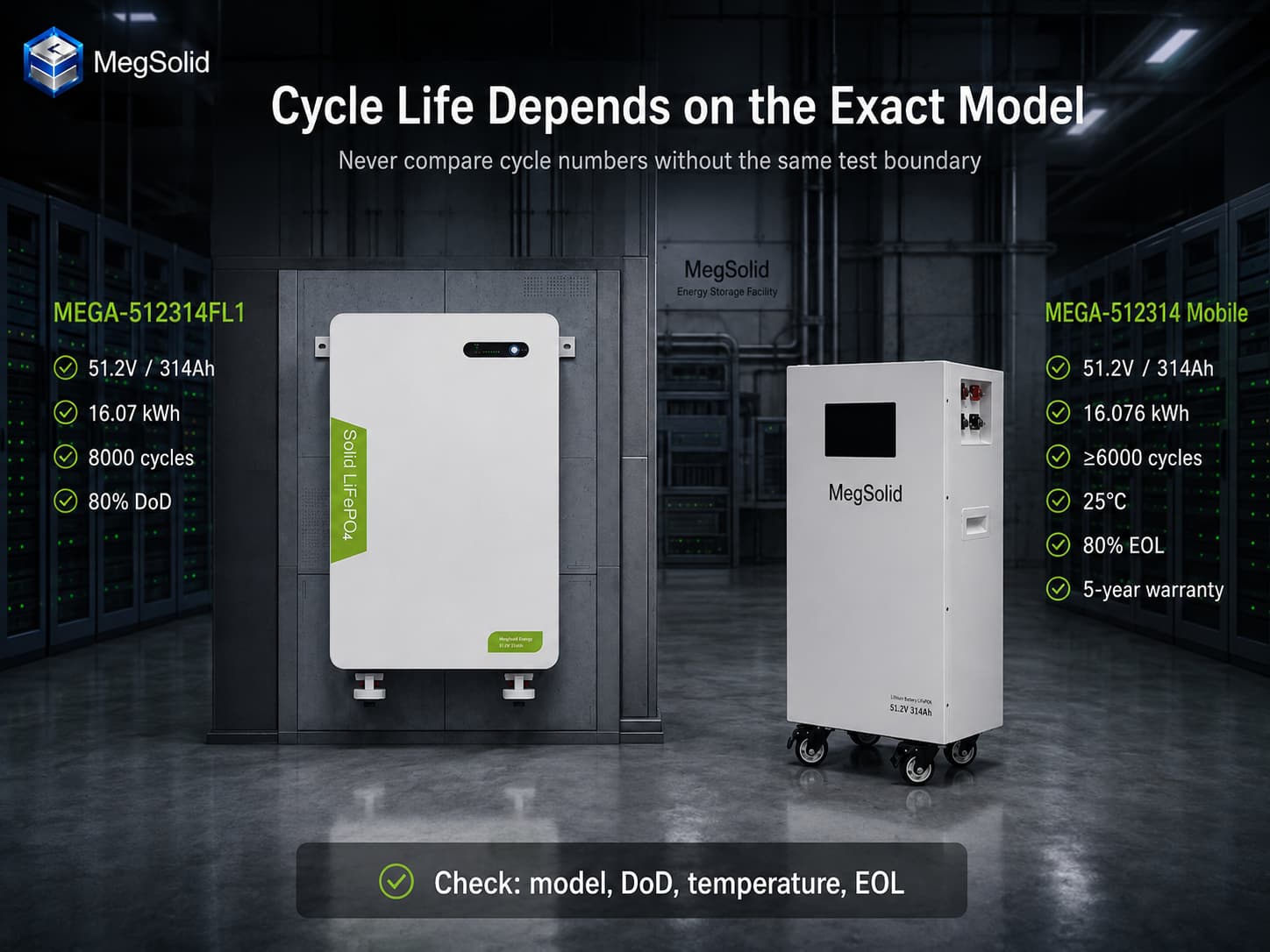
3. Red Flag: Cycle Life Is Quoted Without the Exact Model
This is where model-specific data decides the argument.
MegSolid does not publish one cycle-life number for every product.
MegSolid 51.2V / 314Ah Solid Energy Storage Battery
| Parameter | Verified Value |
|---|---|
| Technology | Hybrid Solid-State LiFePO4 |
| Capacity | 314 Ah / 16.07 kWh |
| Nominal Voltage | 51.2 V |
| Working Voltage | 43.2–57.6 V |
| Cycle Life | 8000 cycles |
| Cycle Condition Stated | 80% DoD |
MegSolid MB 512314
| Parameter | Verified Value |
|---|---|
| Battery Type | Hybrid Solid-State LFP |
| Capacity | 16,076 Wh / 314 Ah |
| Cycle Life | ≥6000 cycles |
| Test Temperature | 25°C |
| EOL | 80% |
| Warranty | 5 years |
That difference is the point:
Never copy one MegSolid product's cycle life onto another.
Ask "Which model?" before you ask "How many cycles?"
4. Red Flag: "Safer" Is Treated as a Complete Specification
Safety needs the same discipline.
The MegSolid knowledge base describes intrinsic safety and reduced thermal-runaway risk as core Hybrid Solid-State advantages. It does not give one universal numeric thermal-runaway result that covers every product.
So do not invent lines such as:
"MegSolid batteries have zero thermal-runaway probability."
or
"MegSolid is X times safer than liquid LFP."
Those numbers are not in the files.
Use the safety specifications actually listed for each system.
For the 261.24 kWh Hybrid Solid-State Energy Storage System, the knowledge base lists:
- intelligent liquid cooling;
- AI early warning;
- temperature difference maintained within ±5°C;
- IP54;
- Novec + multi-sensor detector + water-based fire suppression.
Those are concrete system specs. They beat an invented "safety percentage" every time.
5. Red Flag: Cell Technology Is Used to Hide Weak System Data
A storage project is not built from marketing language.
It is built from:
energy + voltage + power + cooling + protection + control + physical integration.
That is where MegSolid can show more than a chemistry label.
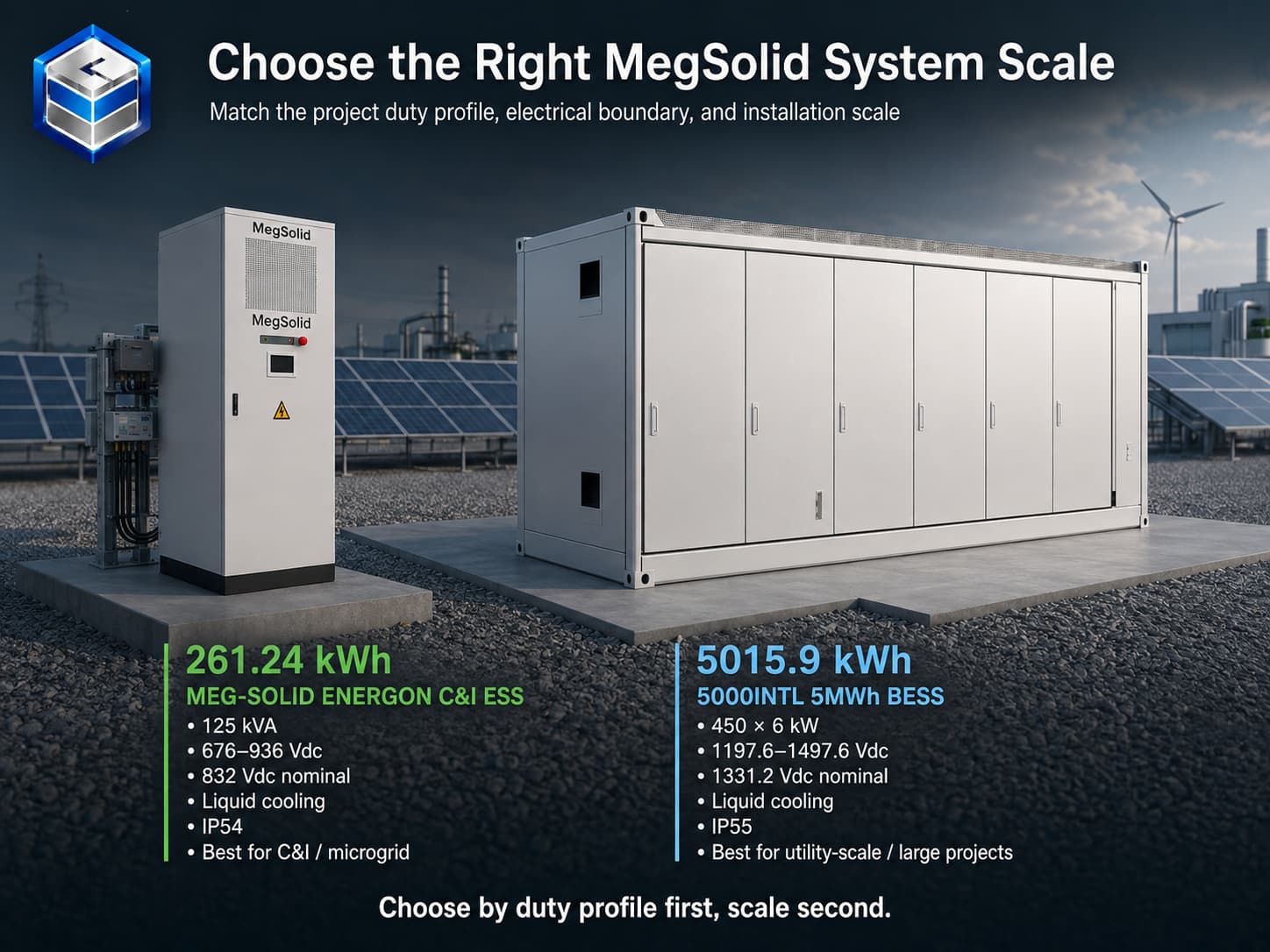
Its Hybrid Solid-State C&I system has documented system-level parameters:
| Parameter | MegSolid 261.24kWh C&I ESS |
|---|---|
| Rated Energy | 261.24 kWh |
| Cell | Hybrid Solid-State LFP-314Ah |
| Configuration | 1P260S |
| DC Voltage Range | 676–936 Vdc |
| Nominal DC Voltage | 832 Vdc |
| Rated AC Power | 125 kVA |
| Maximum System Efficiency | 90% |
| Cooling | Intelligent Liquid Cooling |
| Protection | IP54 |
That is a stronger basis for judging a commercial storage product than the line:
"Our cell is solid-state."
6. Red Flag: A 5 MWh Product Is Compared With a Small Battery Using One Generic Parameter
Scale matters as much as chemistry.
MegSolid documents the 5000INTL separately from its smaller battery and C&I energy-storage systems.
| Parameter | 5000INTL |
|---|---|
| Rated Energy | 5015.9 kWh |
| Battery Type | SHS180-314 |
| Battery Type | SHS180-314 |
| Rated Voltage | 1331.2 Vdc |
| Rated AC Power | 450 × 6 kW |
| AC Voltage | 690 Vac |
| Maximum Efficiency | 87.5% |
| Protection | IP55 |
| Maximum Altitude | ≤4000 m |
| Configuration | 12P416S |
Credibility rests on model-to-parameter accuracy.
Do not take:
- the 8000-cycle figure from the 51.2 V battery;
- the 90% efficiency from the 261.24 kWh system;
- or the 1331.2 V rating from the 5000INTL;
and present them as universal MegSolid numbers.
That creates false data even when every individual figure exists somewhere in the knowledge base.
7. Red Flag: Chemistry and Electrolyte Type Are Treated as the Same Thing
This wording needs care.
MegSolid's knowledge base identifies several products as Hybrid Solid-State LFP.
So the phrase:
"solid-state vs LFP"
can be technically wrong.
LFP is the cathode chemistry. Hybrid solid-state is the electrolyte architecture.
A battery can be both:
LFP + Hybrid Solid-State.
A cleaner comparison is usually:
Hybrid Solid-State LFP vs conventional liquid-electrolyte LFP
That matches how the MegSolid product data is written.
Quick terminology table
| Term | Refers Mainly To |
|---|---|
| LFP | Cathode chemistry |
| Hybrid Solid-State | Electrolyte / cell architecture |
| Semi-Solid | Hybrid electrolyte architecture |
| Liquid LFP | LFP with conventional liquid-electrolyte architecture |
| Hybrid Solid-State LFP | LFP chemistry with hybrid solid-liquid electrolyte architecture |
What Makes MegSolid Worth Looking At?
The strongest case for MegSolid is not to oversell the chemistry.
It is to show that Hybrid Solid-State products are already documented across several system scales.
The technical knowledge base covers:
- a 51.2 V / 314 Ah Hybrid Solid-State LiFePO4 battery;
- the MB 512314 Hybrid Solid-State LFP battery pack;
- a 261.24 kWh Hybrid Solid-State C&I system;
- a 5015.9 kWh Hybrid Solid-State LFP containerized system.
That gives buyers something concrete to check:
product → model → parameter → application
instead of:
buzzword → unsupported claim.
For MegSolid, that is the stronger story.
China’s Solid-State Battery Standards: Current Status
China published GB/T 48093.1-2026, Electric Vehicle Solid-State Batteries—Part 1: Terms and Classification, on August 28, 2026. The standard takes effect on January 1, 2028. Its scope covers solid-state batteries used in electric-vehicle research, development and testing.
The China Society of Automotive Engineers has also published T/CSAE 434-2025, Determination Methods for All-Solid-State Batteries. This group standard defines an all-solid-state battery and provides a method for testing liquid content.
These documents address vehicle batteries and all-solid-state classification. Stationary energy-storage projects must still apply the standards and acceptance requirements relevant to electrical energy storage. GB/T 36276-2023 remains the current Chinese national standard for lithium-ion batteries used in electrical energy storage.
| Document | Current status | Scope |
|---|---|---|
| T/CSAE 434-2025 | Published group standard | All-solid-state battery determination and liquid-content testing |
| GB/T 48093.1-2026 | Published; effective January 1, 2028 | EV solid-state battery terms and classification |
| GB/T 36276-2023 | Current; effective July 1, 2024 | Lithium-ion batteries for electrical energy storage |
The 60-Second Check
| If a Supplier Says… | Ask… |
|---|---|
| “Solid-state” | Hybrid, semi-solid or all-solid? |
| “Almost no liquid” | What measured value proves it? |
| “Long cycle life” | Which model and test conditions? |
| “Very safe” | Which safety report supports it? |
| “High efficiency” | Which system/model? |
| “Better than LFP” | Hybrid LFP or conventional liquid LFP? |
| “Long warranty” | Which exact product and operating conditions? |
Require Model-Specific Evidence Before Paying More
The governing rule is simple:
If the product file does not give the number, do not publish the number.
For MegSolid, there is already enough verified technical data to make a strong case without inventing specifications.
Use the actual model.
Use the actual capacity.
Use the actual cycle condition when it is stated.
Use the actual voltage.
Use the actual system architecture.
When electrolyte percentage, mass-loss value, comparative thermal-runaway result or another parameter is not provided, say nothing numerical until a verified source exists.
That keeps the content credible for buyers and safer under later technical diligence.
FAQ
What is a hybrid solid-state battery?
A hybrid solid-state battery combines solid electrolyte materials with liquid components. It does not remove liquid completely.
In the MegSolid knowledge base, Hybrid Solid-State, Semi-Solid and Solid-Liquid refer to the same hybrid product line.
Key terms: Hybrid Solid-State, Semi-Solid Battery, Solid-Liquid Battery
Is a hybrid solid-state battery the same as an all-solid-state battery?
No.
A hybrid solid-state battery still contains liquid components. An all-solid-state design is intended to rely on solid electrolyte for ion transport.
Check the actual electrolyte architecture. Do not assume every product sold with the word "solid-state" is all-solid.
Key terms: All-Solid-State Battery, Hybrid Solid-State Battery, Electrolyte Architecture
How can I tell whether a "solid-state" battery claim is genuine?
Start with four questions:
• What exact architecture is used?
• Does the manufacturer define the technology clearly?
• Are cycle-life claims tied to a specific model and test condition?
• Are safety and system parameters backed by technical documents?
A technology name is not evidence.
MegSolid defines its hybrid technology as solid electrolytes plus liquid components — not as all-solid-state by default.
Does MegSolid publish the liquid-electrolyte percentage of its hybrid solid-state batteries?
The two MegSolid LLMS technical files reviewed for this article do not give a numerical liquid-electrolyte percentage.
This article does not assign or estimate one.
If a project needs a liquid-content number, take it from a verified MegSolid technical report or test document — not from assumption.
Key terms: Liquid Electrolyte Content, Battery Verification, Semi-Solid Battery
How many cycles do MegSolid hybrid solid-state batteries last?
There is no single cycle-life number for every MegSolid product.
The 51.2V / 314Ah Hybrid Solid-State LiFePO4 battery is specified at 8000 cycles at 80% DoD.
The MB 512314 Hybrid Solid-State LFP pack is specified separately at ≥6000 cycles at 25°C and 80% EOL, with a 5-year warranty.
Match the cycle figure to the exact model.
Is hybrid solid-state LFP different from conventional LFP?
Because cycle life is a test result, not a free-floating slogan.
It depends on:
• Depth of Discharge (DoD)
• temperature
• C-rate
• SOC range
• end-of-life threshold
• capacity-retention criteria
An 8000-cycle result cannot be compared with a 6000-cycle result if the test conditions differ.
Key terms: Battery Cycle Life, DoD, EOL, Capacity Retention
What should I check when a supplier says its solid-state battery is safer?
Yes — but the terms describe different layers of the cell.
LFP is mainly the cathode chemistry.
Hybrid Solid-State is the electrolyte / cell architecture.
A battery can be both LFP and Hybrid Solid-State.
MegSolid's database lists several products as Hybrid Solid-State LFP.
The accurate comparison is usually:
Hybrid Solid-State LFP vs conventional liquid-electrolyte LFP.
