
For a 1–2 MWh C&I project, choose a MegSolid ESSC container when a single 400 Vac connection and a heavy lift fit the site. Compare cabinet clusters when smaller lifts, separate feeders or more flexible placement matter. Size both options against delivered AC energy, power and runtime.
- Compare equipment footprint and individual lift weight.
- Estimate AC energy after conversion and auxiliary loads.
- Check feeder protection and transformer headroom.
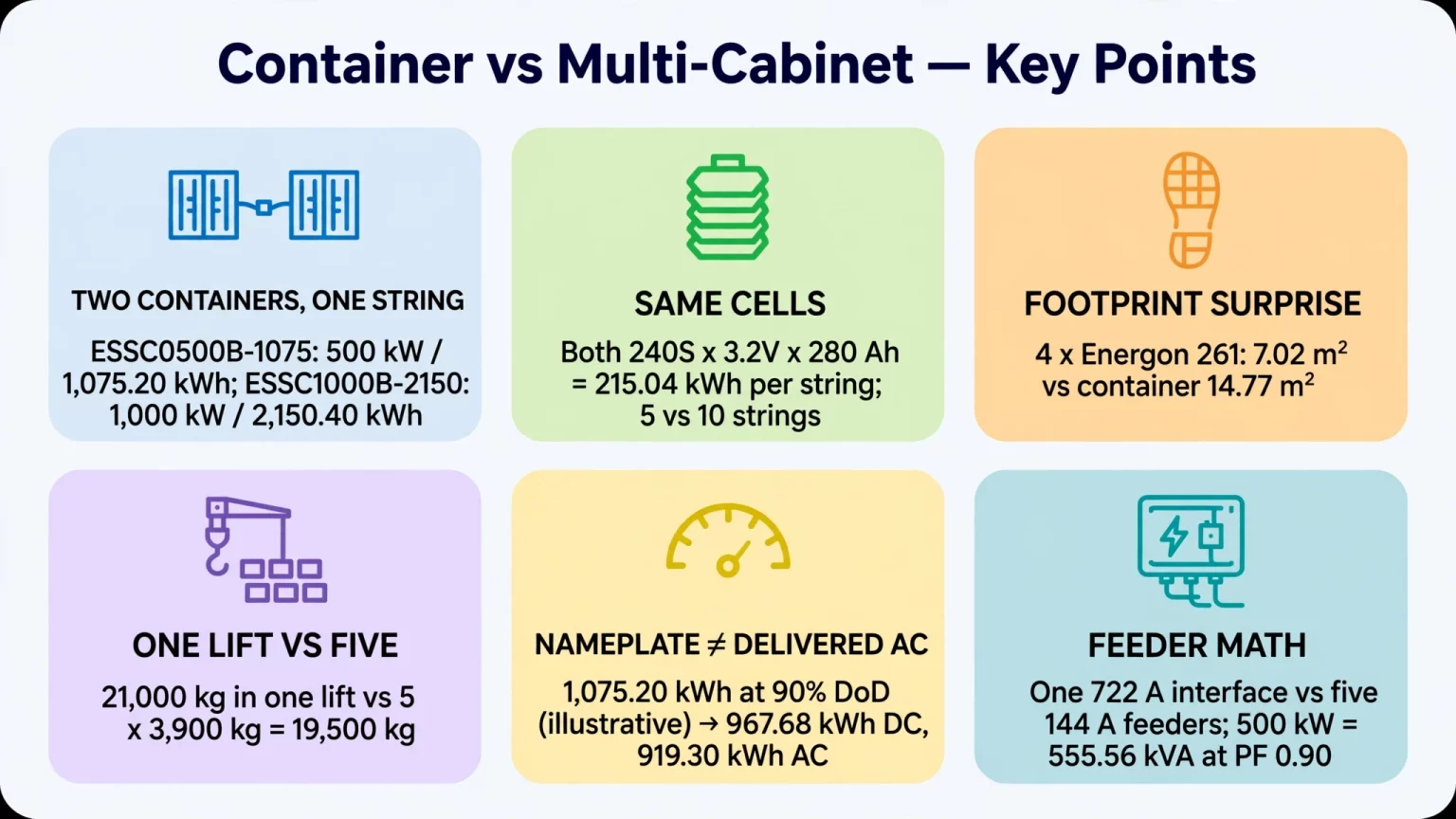
The overview compares two container sizes. At 215.04 kWh per reference string, the nameplate ratings correspond to five and ten strings, respectively. Confirm the actual wiring on the controlled schematic.
General deployment trade-offs are covered in Modular Cabinets vs Containerized ESS Deployment Strategy, while legacy 2 MWh references appear in 1MW 2.016MWh Hybrid Solid-State BESS ESSC1000B-2016.
This engineering guide focuses on verifiable calculations for a 1mwh vs 2mwh containerized bess versus multi-cabinet clusters.
On the current MegSolid Containerized Energy Storage Systems datasheet (ESSC series), two air-cooled LFP container models serve the 500 kW to 1,000 kW segment:
- ESSC0500B-1075 (20-ft Container): 500 kW AC (722 A) / 1,075.20 kWh (1.0752 MWh), 280 Ah LFP, 768V nominal (672V to 850V DC), 400 Vac with built-in transformer, air cooling, IP54, 21,000 kg
- ESSC1000B-2150 (40-ft Container): 1,000 kW AC (1,445 A) / 2,150.40 kWh (2.1504 MWh), 280 Ah LFP, 768V nominal (672V to 850V DC), 400 Vac with built-in transformer, air cooling, IP54, 38,000 kg
1 MWh Footprint, Lifts and Feeders
Evaluating a multi-cabinet powerstack vs 1mwh container requires distinguishing specific commercial cabinet models from generic illustrative examples.
Sungrow's PowerStack lineup includes the ST225kWh-110kW-2h (200CS, 110 kW / 229 kWh, reviewed in Sungrow PowerStack 200CS vs. MegSolid ESSA0100B-0215 Comparison) and the 255CS class (covered in Sungrow PowerStack Alternatives: 257–261 kWh Storage).
Compare Floor Area and Lift Weight
Fewer enclosures do not automatically translate into a smaller equipment base area or lower total equipment mass:
- Container vs. Liquid-Cooled Cabinets: One ESSC0500B-1075 occupies 6.058 x 2.438 m = 14.77 sq.m, whereas four MegSolid Energon 261 Liquid-Cooled BESS units (4 x 1.30 x 1.35 m) occupy 7.02 sq.m.
- Air-Cooled 5-Cabinet Comparison: Five MegSolid ESSA0100B-0215 Outdoor BESS cabinets (5 x 100 kW / 215.04 kWh = 500 kW / 1,075.20 kWh) occupy 5 x 2.45 x 1.55 m = 18.99 sq.m of equipment base area.
- Single-Lift vs. Multi-Lift Mass: Five ESSA0100B-0215 units weigh 5 x 3,900 kg = 19,500 kg (19.5 t) versus 21,000 kg (21 t) for ESSC0500B-1075; the key difference is one 21-tonne lift versus five 3.9-tonne lifts.
Four 1 MWh-Class Configurations
| Setup | Power / energy | Base area | Feeder(s) |
|---|---|---|---|
| 1 × ESSC0500B-1075 | 500 kW / 1,075.20 kWh | 14.77 m² | 1 × 722 A |
| 5 × ESSA0100B-0215 | 500 kW / 1,075.20 kWh | 18.99 m² | 5 × 144 A |
| 4 × Energon 261 | 500 kVA / 1,044.96 kWh | 7.02 m² | 4 to bus |
| 5 × Sungrow 200CS | 550 kW / 1,145.00 kWh | 9.26 m² | 5 to bus |
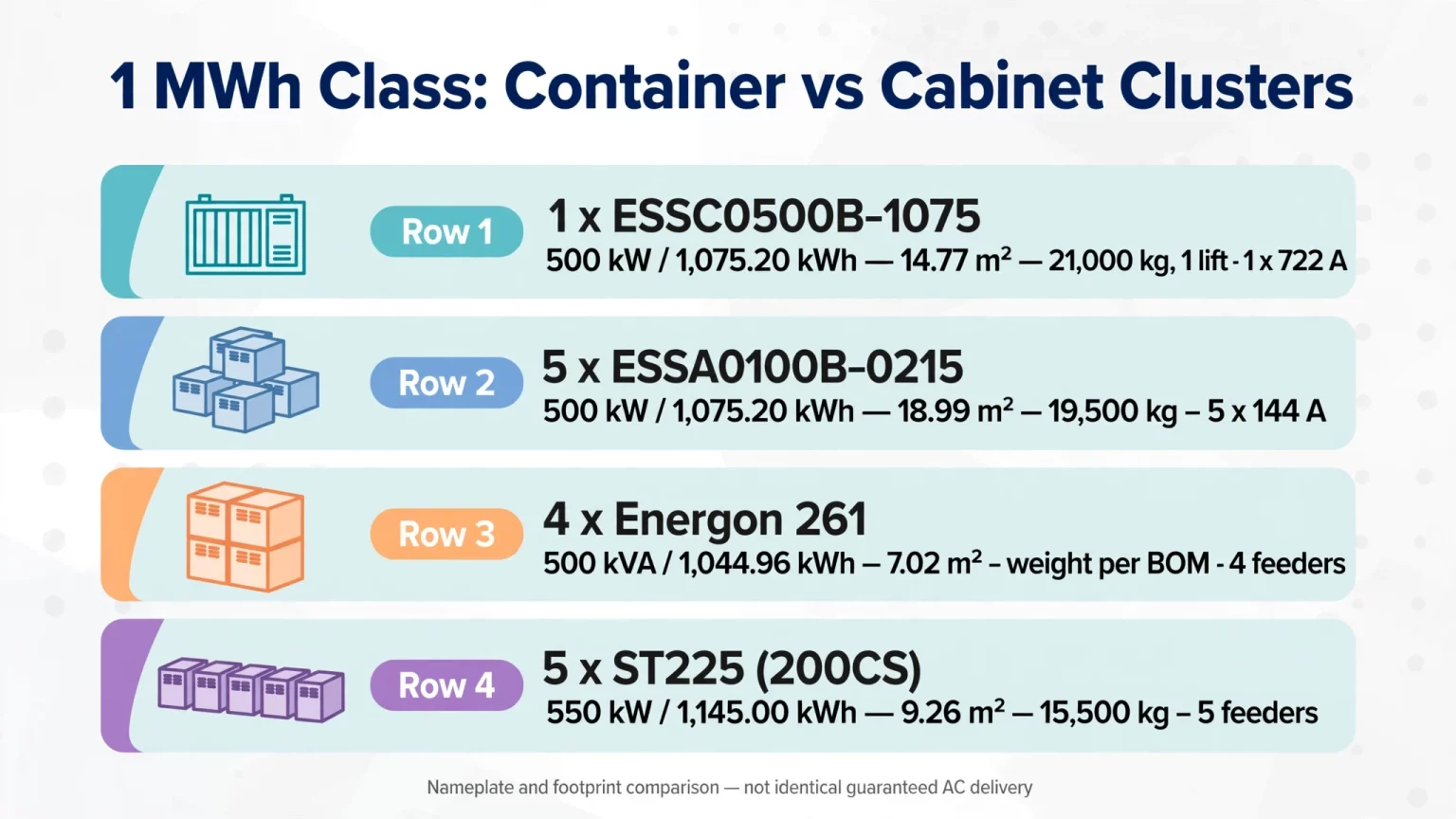
Five Sungrow 200CS units measure 1.15 × 1.61 m each and total 15,500 kg (5 × 3,100 kg). Confirm Energon 261 lift weights against the cabinet BOM.
These configurations are compared by nameplate rating and equipment footprint, not as identical guaranteed 500 kW / 1 MWh AC-delivery solutions.
Note that 4 x Energon 261 at 500 kVA equals 450 kW active power at PF 0.90, while 5 x ST225kWh-110kW-2h totals 550 kW / 1,145 kWh.
Equipment-only footprint and mass are shown. External switchgear and any transformer cabinet required for off-grid operation are excluded.
Delivered AC Energy and SLD Scope
When modeling an illustrative 500kw 1mwh bess vs 4x 250kwh cabinets scenario (assuming four hypothetical 125 kW / 250 kWh cabinets totaling 500 kW / 1,000 kWh), engineers must separate nominal DC string capacity from usable AC energy.
Estimate AC Discharge Energy
The 1,075.2 kWh nameplate rating provides 7.52% more nominal energy than a 1,000 kWh configuration.
At an illustrative 90% DoD, usable DC energy is 967.68 kWh before conversion losses and auxiliary consumption; it does not guarantee 1,000 kWh of net AC delivery.
At 500 kW, 967.68 ÷ 500 = 1.935 hours on a theoretical DC basis. With an illustrative 95% one-way discharge efficiency, 919.30 ÷ 500 = 1.839 hours before auxiliary loads.
| Setup | Rated kWh | DC kWh at 90% | AC kWh at 95% |
|---|---|---|---|
| 4 × 250 kWh (example) | 1,000.00 | 900.00 | 855.00 |
| ESSC0500B-1075 | 1,075.20 | 967.68 | 919.30 |
| ESSC1000B-2150 | 2,150.40 | 1,935.36 | 1,838.59 |
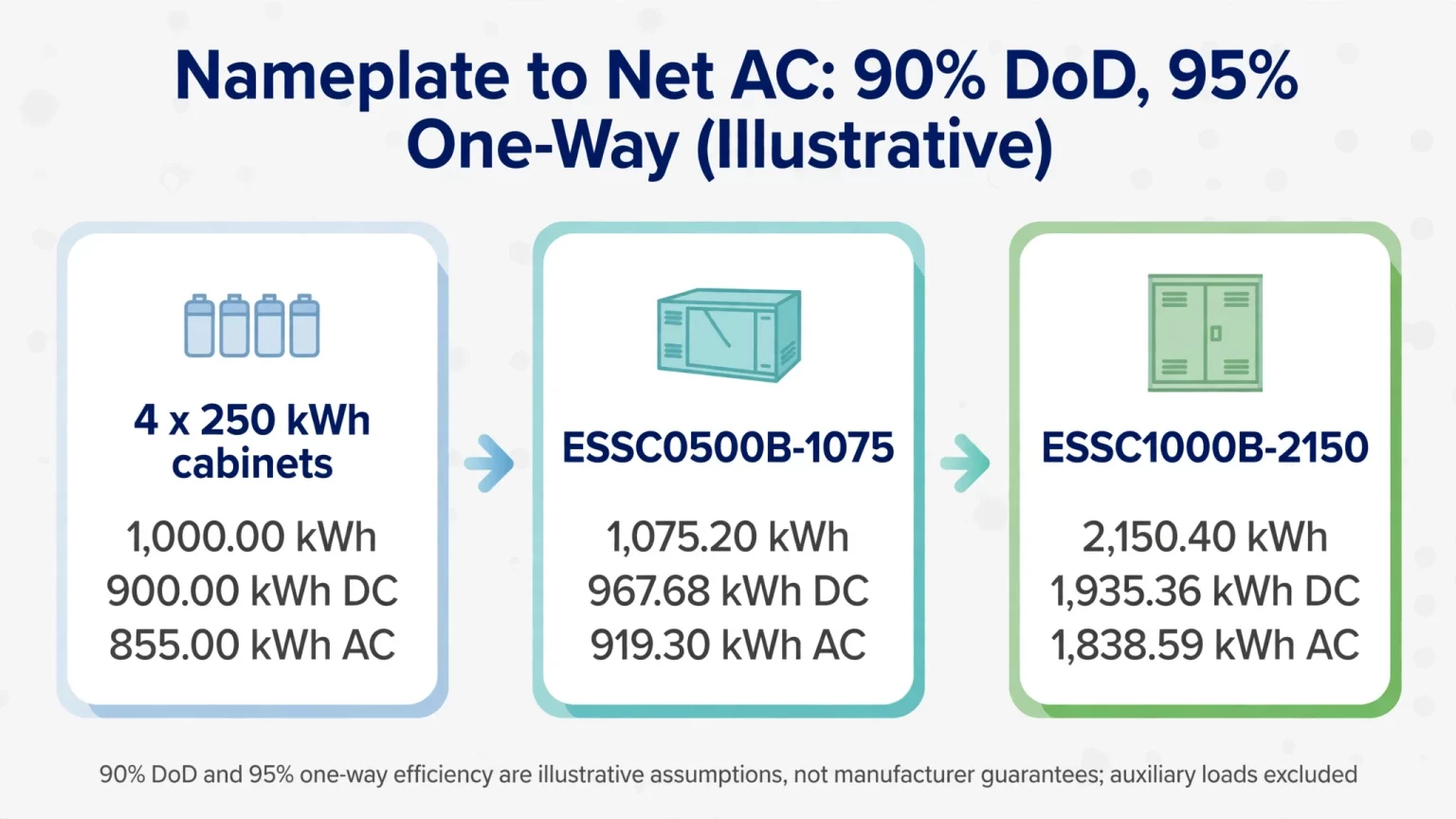
Note: The 90% DoD and 95% one-way discharge efficiency values in the table above are illustrative calculation assumptions rather than manufacturer-guaranteed figures, and auxiliary cooling loads must be deducted separately.
Check Feeders and PCC Protection
In electrical design, a container's single AC output interface must not be confused with eliminating all field distribution switchgear:
- Multi-Cabinet Branch Combining: Connecting four or five individual cabinets to a shared 400 Vac switchboard requires individual AC branch breakers, feeder cables, and an AC combining bus before reaching the plant Point of Common Coupling (PCC).
- Container AC Interface: ESSC0500B-1075 consolidates internal strings, conversion, and an isolation transformer into one 722 A AC interface, reducing branch cable pulls while still requiring upstream PCC protection, metering, and main feeder cabling per the SLD.
- 630 kVA Transformer Check: At PF 0.90, 500 kW equals 555.56 kVA; connecting to an existing 630 kVA transformer requires checking coincident load, power flow direction, reactive power, thermal loading, and PCS P-Q curves.
Review controlled specification sheets, AC/DC busbar schematics, and P-Q capability curves with our engineering team.
Compare the 20 ft and 40 ft ESSC
Comparing ESSC0500B-1075 vs ESSC1000B-2150 on the current ESSC datasheet shows that the 40-ft ESSC1000B-2150 (1,000 kW / 2,150.40 kWh, 1,445 A) doubles the power and energy of the 20-ft ESSC0500B-1075 (500 kW / 1,075.20 kWh, 722 A).
String Sizing and PCS Architecture
On the current ESSC product specification, both containers use standard 3.2V / 280 Ah LFP cells at a 768V nominal string voltage (672V to 850V DC window):
- String sizing: 240 × 3.2 V × 280 Ah = 215.04 kWh per string. Five strings give 1,075.20 kWh; ten give 2,150.40 kWh. At 314 Ah, a 240S string would be 241.152 kWh.
- Verify Internal Schematic: Always confirm exact rack counts, internal DC busbar wiring, and PCS channel mapping on the controlled container schematic rather than assuming independent per-cluster DC channels.
- Integrated BESS vs. External PCS: Utility skids (such as Sungrow ST2752UX-US Version 15 paired with SC5000UD-MV-US central PCS; note Sungrow 1+X is a PV inverter) connect DC containers to external PCS and MV skids.
- Direct 400 Vac Integration: ESSC units integrate 400 Vac conversion and an isolation transformer; for external 80–125 kW PCS (615–950 Vdc for 3W+PE, or 650–950 Vdc for 3W+N+PE), see MegSolid PMA Modular Energy Storage Inverter.
ESSC Model Differences
| Rating | ESSC0500B-1075 | ESSC1000B-2150 |
|---|---|---|
| Enclosure | 20 ft | 40 ft |
| AC output | 500 kW / 722 A | 1,000 kW / 1,445 A |
| Nominal energy | 1,075.20 kWh | 2,150.40 kWh |
| PV input options | 600 / 660 / 720 kW | 1,200 / 1,320 / 1,440 kW |
| Size (mm) | 6,058 × 2,438 × 2,896 | 12,192 × 2,438 × 2,896 |
| Mass | 21,000 kg | 38,000 kg |
| Equipment base area | 14.77 m² | 29.72 m² |
Shared ESSC Specifications
AC and PV: Both use 400 Vac (320–460 V), 50/60 Hz, 3W+N+PE and a built-in isolation transformer. Selectable PV inputs are rated up to 1,000 Vdc.
DC and runtime: Both use 768 V nominal (672–850 Vdc) and have a nominal 2.15-hour energy-to-power ratio (0.465 kW/kWh). Confirm current derating near the low DC limit and obtain project-specific round-trip efficiency.
Power quality: On-grid current THD is <3%. Off-grid voltage THD is ≤1% with linear loads and ≤5% with nonlinear loads.
Cells and cooling: Both list 3.2 V / 280 Ah LFP, ≥5,000 cycles and air cooling at 0°C to +45°C. Confirm retained capacity and warranty test conditions. For liquid cooling, evaluate Energon 261 or 5000INTL with the project team.
Protection and communications: Both list IP54, FM-200 / Novec 1230 and RS485 / TCP/IP. Verify model-specific fire test evidence and local approval requirements.
Fire Safety and Industrial Loads
When specifying a 1mw 2mwh containerized battery energy storage system for factories or microgrids, procurement engineers must keep standard product configurations distinct from custom cell options and site fire testing.
Standard LFP and Custom Cells
Standard ESSC0500B-1075 and ESSC1000B-2150 containers use 3.2V / 280 Ah LFP cells (≥ 5,000 cycles) with FM-200 / Novec 1230 clean-agent fire suppression.
While project-specific solid-state battery integration may be requested through our MegSolid Hybrid Solid-State Energy Storage Systems program, any custom cell configuration requires a revised system BOM, controlled cell specification sheet, and updated capacity, voltage, and warranty schedules.
Review Setbacks and Motor Loads
- Fire Testing vs. Setbacks: Clean-agent suppression (FM-200 / Novec 1230) or cell chemistry alone does not waive NFPA 855 setbacks; building separation requires AHJ review of model-specific UL 9540A fire test reports.
- Regenerative Load Absorption Limits: Absorbing reverse power from cranes or stamping presses depends on current battery State of Charge (SoC), BMS charge-current limits, PCS slewing rates, and braking resistors rather than cell internal resistance alone.
- Off-Grid Transfer Verification: When a container is deployed for backup or diesel-synchronized microgrids, black-start capability, three-phase unbalanced load limits, and transfer times must be verified against the controlled PCS and system technical specification.
Choose Cabinets or a Container
Use the engineering criteria below alongside our cabinet sizing guides in How to Choose Commercial Battery Storage: 215 kWh vs. 261 kWh BESS and How to Select a 100 kW / 215 kWh Outdoor BESS:
- Specify 4 x Energon 261 (500 kVA / 1,044.96 kWh) for closed-loop liquid cooling (-20°C to +55°C), 314 Ah LFP cells, or a compact 7.02 sq.m equipment-only base area (confirm unit weight on the controlled drawing).
- Specify 5 x ESSA0100B-0215 (500 kW / 1,075.20 kWh, 5 x 3,900 kg = 19,500 kg) when crane access requires 3.9-tonne lifts instead of one 21-tonne lift, or when units feed separate 400 Vac switchboards.
- Specify 1 x ESSC0500B-1075 (500 kW / 722 A, 14.77 sq.m, 21 t) or 1 x ESSC1000B-2150 (1,000 kW / 1,445 A, 29.72 sq.m, 38 t) for air-cooled (0°C to +45°C) single-interface 400 Vac containers.
FAQ
Why do ESSC1000B-2016 and -2150 both appear?
While an older article title references ESSC1000B-2016, the current official ESSC datasheet specifies ESSC1000B-2150 rated at 1,000 kW AC (1,445 A) and 2,150.40 kWh (2.1504 MWh) nominal energy, which is double the 1,075.20 kWh rating of ESSC0500B-1075.
What cells, cooling and PV options do ESSC units use?
Both models use standard 3.2V / 280 Ah LFP cells (≥ 5,000 cycles, 768V nominal, 672V to 850V DC) with smart air cooling (0°C to +45°C), IP54 protection, and FM-200 / Novec 1230 suppression. Selectable max PV input power options are 600 / 660 / 720 kW for ESSC0500B-1075 and 1,200 / 1,320 / 1,440 kW for ESSC1000B-2150 (up to 1,000V DC max PV input).
How does integrated PCS differ from external PCS?
In utility architectures (such as Sungrow ST2752UX-US Version 15 paired with SC5000UD-MV-US central PCS skids; note that Sungrow 1+X is a utility PV modular inverter), DC containers connect to external PCS and MV skids. By contrast, ESSC0500B-1075 (722 A) and ESSC1000B-2150 (1,445 A) integrate 400 Vac power conversion and a built-in isolation transformer inside the container for low-voltage commercial switchboards.
What are the ESSC harmonic distortion ratings?
On the official ESSC specification sheet, on-grid current THD (THDi) is <3%. Off-grid voltage THD (THDu) is ≤1% with linear loads and ≤5% with nonlinear loads.
How do container and cabinet lifts compare?
Five ESSA0100B-0215 cabinets have a combined mass of 5 x 3,900 kg = 19,500 kg (19.5 tonnes), which is only 1.5 tonnes lighter than one 21,000 kg ESSC0500B-1075 container. The key rigging difference is crane capacity for a single 21-tonne lift versus five separate 3.9-tonne cabinet lifts.
Why does the 200CS need extra off-grid space?
The 9.26 sq.m (5 x 1.15 x 1.61 m) and 15,500 kg figures represent the five battery cabinets only. Sungrow's official ST225kWh-110kW-2h datasheet specifies that off-grid operation requires an additional transformer cabinet, whereas ESSC0500B-1075 and ESSA0100B-0215 include a built-in isolation transformer.
What DC voltages do PMA inverters accept?
On MegSolid's PMA080 / PMA0105 / PMA0125 modular PCS datasheet, the battery-side DC operating voltage range is 615–950 Vdc for 3W+PE configurations and 650–950 Vdc for 3W+N+PE configurations. Engineers must also verify the full-load DC voltage window and battery current limits during design review.
Do suppression or cell chemistry waive setbacks?
No. Neither clean-agent suppression nor cell chemistry alone waives NFPA 855 separation distances or guarantees zero propagation under all fault conditions. Actual building setbacks depend on local AHJ review of model-specific UL 9540A large-scale fire test data evaluating flame spread, gas venting, and suppression performance.
What grid checks apply in Germany and the UK?
Ask the network operator which connection rules apply at the project point of connection. The source references VDE-AR-N 4105 for Germany and EREC G99 for the UK. Confirm the required connection study, PCC protection and import or export controls for the proposed 500 kW or 1,000 kW system.
Which options support liquid cooling above 45°C?
Standard ESSC0500B-1075 and ESSC1000B-2150 containers use smart temperature-controlled air cooling rated for 0°C to +45°C. For ambient temperatures up to +55°C (derating above 45°C) or liquid cooling, specify Energon 261 cabinet clusters (125 kVA / 261.24 kWh per cabinet) or the 20-foot 5000INTL container (2,700 kW / 5,015.9 kWh at 690 Vac).
What to Verify Before Ordering
Comparing a 1mwh vs 2mwh containerized bess against cabinet clusters requires checking net AC energy, base area (14.77 vs. 7.02 sq.m), crane loads (21 t vs. 5x3.9 t), and 400 Vac currents (722 A / 1,445 A).
Contact our commercial application engineers for controlled ESSC0500B-1075, ESSC1000B-2150, ESSA0100B-0215, and Energon 261 specifications and project quotations.