
Commercial EPCs evaluating the sungrow powerstack 200cs (model code ST225kWh-110kW-2h) often compare 200 kWh-class outdoor cabinets when sizing industrial peak-shaving and backup plants.
This review builds on our site-sizing checklist in How to Select a 100 kW / 215 kWh Outdoor BESS for a C&I Site.
Complementing our larger-capacity guide in Sungrow PowerStack Alternatives: Comparing 257–261 kWh C&I Battery Storage, we compare the ST225kWh-110kW-2h (110 kW / 229 kWh) against the MegSolid ESSA0100B-0215 (100 kW / 215.04 kWh).
When contractors search for a sungrow powerstack 200cs alternative or a 215kWh air cooled BESS, they must compare cooling topology, galvanic isolation, solar MPPT inputs, and low-voltage current limits.
Within our MegSolid Commercial & Industrial Energy Storage Systems lineup, three models cover the 100 kW to 500 kW commercial segment:
- ESSA0100B-0215 (100kW 215kWh outdoor BESS): 100 kW AC / 215.04 kWh nominal (1P240S 3.2V / 280 Ah LFP standard, 672V to 850V DC), smart air cooling, built-in isolation transformer, MPPT PV input, ≥ 5,000 cycles (standard 280 Ah LFP)
- Energon 261 (Liquid-Cooled C&I Cabinet): 125 kVA AC / 261.24 kWh rated (1P260S 3.2V / 314 Ah LFP, 832V nominal, 676V to 936V DC), liquid cooling (-20°C to +55°C), 1,300 x 1,350 x 2,200 mm (1.76 sq.m base)
- ESSC0500B-1075 (500 kW / 1.0752 MWh Container): Factory-integrated 20-foot air-cooled container matching the 500 kW / 1,075.20 kWh capacity of five ESSA0100B-0215 cabinets
Datasheet Comparison: Sungrow PowerStack 200CS (ST225kWh-110kW-2h) vs. MegSolid ESSA0100B-0215
Evaluating an ST225kWh-110kW-2h alternative starts with side-by-side verification of published electrical, thermal, fire-protection, and mechanical parameters.
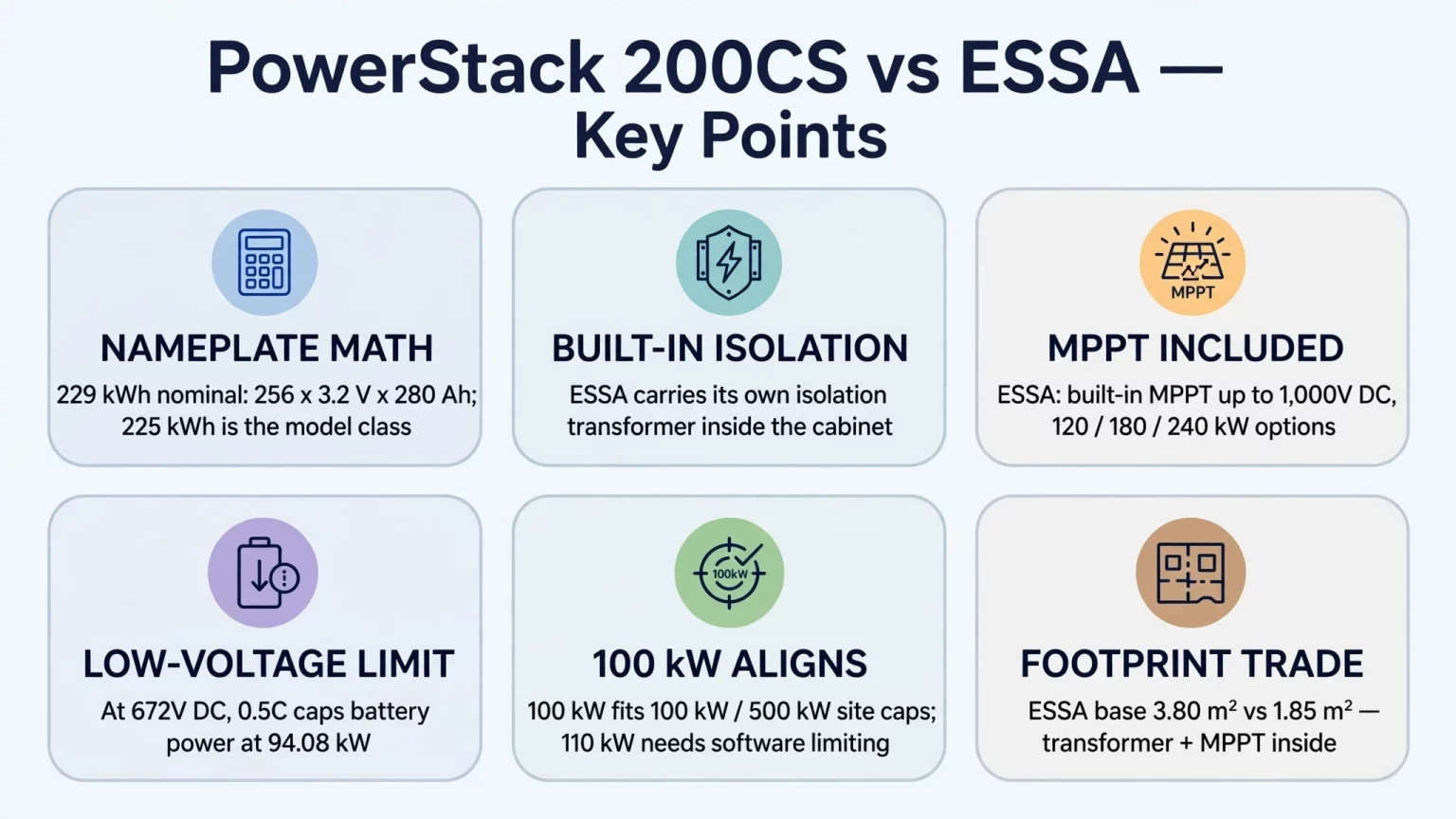
On Sungrow's official ST225kWh-110kW-2h datasheet, nominal battery energy is 229 kWh from a 256S1P string of 3.2V / 280 Ah LFP cells (256 x 3.2 V x 280 Ah = 229.38 kWh), whereas 225kWh denotes the model class.
By contrast, the MegSolid ESSA0100B-0215 Outdoor Cabinet Energy Storage System pairs a 1P240S string of 3.2V / 280 Ah LFP cells (240 x 3.2 V x 280 Ah = 215.04 kWh) with a 100 kW PCS, isolation transformer, and MPPT inputs.
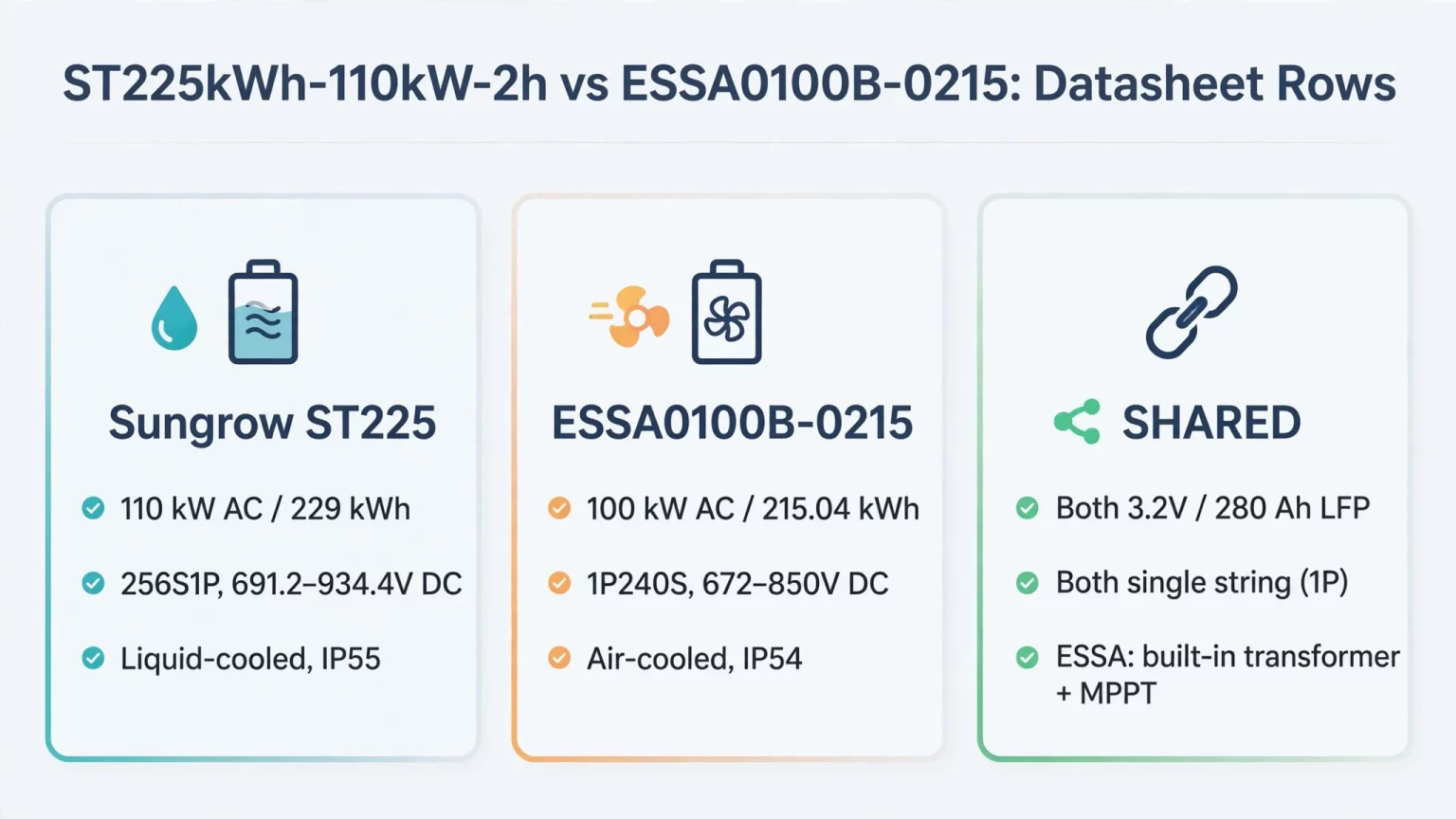
| Specification Parameter | Sungrow PowerStack 200CS (ST225kWh-110kW-2h Datasheet) | MegSolid ESSA0100B-0215 (100kW / 215.04kWh) | Engineering & Integration Notes |
|---|---|---|---|
| System Model Code | ST225kWh-110kW-2h (PowerStack 200CS) | ESSA0100B-0215 | Both serve ~2-hour commercial peak shaving and backup |
| Nominal / Rated Energy | 229 kWh nominal (225 kWh model designation) | 215.04 kWh nominal | 256S1P (229.38 kWh) vs. 1P240S (215.04 kWh) string math |
| Rated AC Power Output | 110 kW | 100 kW | 100 kW active power simplifies 100 kW / 500 kW sizing |
| Nominal Power-to-Energy Ratio | 110 / 229 = 0.480 kW/kWh (~2.08 h nominal) | 100 / 215.04 = 0.465 kW/kWh (2.15 h nominal) | Official ESSA0100B-0215 battery rate: 0.5C @ 25°C |
| System RTE | 90% (published on Sungrow datasheet) | Not confirmed at an identical AC-to-AC boundary on public sheet; confirm per project | Do not substitute peak PCS efficiency or max system efficiency for AC-to-AC RTE |
| Max PCS Efficiency | 98.5% | Confirm from controlled complete-system specification | Verify full-load and part-load conversion curves during design |
| Cell Type & Configuration | 3.2V / 280 Ah LFP, 256S1P | Standard configuration: 3.2V / 280 Ah LFP, 1P240S | Project-specific solid-state integration requires approved BOM |
| DC Voltage Window | 691.2V to 934.4V DC (819.2V nominal) | 672.0V to 850.0V DC (768.0V nominal) | Single series string (1P) eliminates intra-cabinet parallel string currents |
| AC Grid Voltage & Isolation | 400 Vac (340V to 440V), 50/60 Hz | 400 Vac (320V to 460V), 3W+N+PE, built-in isolation transformer | ESSA0100B-0215 provides galvanic isolation inside the cabinet |
| Integrated Solar MPPT Input | AC-coupled via external PV inverters | Built-in MPPT PV input (up to 1,000V DC; 120 / 180 / 240 kW series options) | Confirm selected PV MPPT power option on purchase order |
| Thermal Management & Ambient Range | Intelligent liquid cooling, -30°C to +50°C (derates above 45°C), cell temperature difference ≤ 2.5°C | Smart temperature-controlled air cooling, 0°C to +45°C | Choose Energon 261 (-20°C to +55°C) if liquid cooling is required |
| Published Cycle Life | Refer to project warranty terms | ≥ 5,000 cycles (standard 280 Ah LFP configuration) | Request warranted SoH retention curves for project LCOS modeling |
| Fire Protection | Combustible gas detector, smoke detector, heat/temperature detector, audible and visual alarm, aerosol fire suppression, water sprinkler/deluge system, and optional FK-5-1-12 | Aerosols / Novec 1230 (FK-5-1-12) | Verify suppression configuration and local AHJ fire code rules |
| Enclosure, Protection & Corrosion | IP55, C5 anti-corrosion default (C3 optional) | IP54 | Verify coastal or industrial corrosion class before installation |
| Dimensions & Weight | 1,150 x 2,450 x 1,610 mm (W x H x D) / 1,150 x 1,610 x 2,450 mm (W x D x H), 3,100 kg | 2,450 x 1,550 x 2,400 mm (W x D x H), 2,800 kg | Equipment base area: 1.85 sq.m vs. 3.80 sq.m (see layout notes below) |
| Max Altitude & Communication | ≤ 3,000 m; Ethernet, Modbus TCP, iSolarCloud | ≤ 3,000 m; RS485, TCP/IP | Confirm protocol tables and EMS register maps before commissioning |
100kW vs. 110kW BESS: Active Power Limits, Export Control and Grid Connection
Comparing the ST225kWh-110kW-2h (110 kW) against the essa0100b-0215 (100 kW) requires separating technical connection standards, DNO Point of Common Coupling (PCC) export limits, and factory transformer capacity.
1. Separating Grid Standards from PCC Export Caps
Neither 100 kW nor 500 kW acts as a universal global fast-track threshold across all jurisdictions:
- Germany (VDE-AR-N 4105:2026-03): Applies to low-voltage grid-parallel storage even without export, covering general rules below 135 kW cumulative installed power and specific 135 kW to 500 kW cases with agreed feed-in ≤ 270 kW.
- United Kingdom (EREC G98/G99): Commercial three-phase storage cabinets at 100 kW or 110 kW fall under EREC G99 rather than G98, and G100 export limiting requires fail-safe protection and DNO acceptance.
- Site-Specific 100 kW and 500 kW Caps: Where a utility tariff or feeder agreement caps active power at 100 kW (1 unit) or 500 kW (5 units), a 110 kW unit (550 kW for 5 units) requires software limiting, whereas ESSA0100B-0215 aligns natively.
- PCC-Level Control for 500 kW Clusters: Even with five 100 kW cabinets (5 x 100 kW = 500 kW), enforcing a 500 kW PCC export cap requires PCC-level power control rather than relying on inverter nameplates alone.
- 630 kVA Transformer Sizing (500 / 0.90 = 555.56 kVA at PF 0.90): A 630 kVA transformer may be a candidate for a 500 kW BESS connection, subject to the existing plant load, power factor, reactive-power requirement, thermal loading and reverse-power assessment.
2. DC Voltage Window (672V to 850V) and 0.5C Current Constraints
At 100 kW AC and 215.04 kWh nominal DC energy, the ESSA0100B-0215 has a 0.465 kW/kWh ratio, while the 1P240S 280 Ah battery string specifies a 0.5C (140.0 A) rate at 25°C.
| DC Operating Point | Battery String Voltage | DC Current for 100 kW DC Load (Before PCS Losses) | Equivalent C-Rate (280 Ah Base) | Engineering Assessment vs. 0.5C (140 A) Limit |
|---|---|---|---|---|
| Upper DC Window | 850.0 V | 100,000 / 850.0 = 117.6 A | 0.420C | Within 140.0 A (0.5C) battery rate |
| Nominal DC Voltage | 768.0 V | 100,000 / 768.0 = 130.2 A | 0.465C | Within 140.0 A (0.5C) battery rate before PCS losses |
| Lower DC Cutoff | 672.0 V | 100,000 / 672.0 = 148.8 A | 0.531C | Exceeds 140.0 A (0.5C); 672 V x 140 A = 94.08 kW max DC power |
At the 672.0 V lower DC limit and 140.0 A (0.5C), maximum battery DC power is 672.0 V x 140.0 A = 94.08 kW before PCS and transformer conversion losses.
Full 100 kW AC output across the entire DC voltage window must be verified against the battery current limit, PCS efficiency and low-voltage derating curve.
The nominal 100 kW AC rating does not establish constant full-power capability at 672 V DC.
Request the controlled specification sheet, PQ capability curve, and single-line diagram for the 100 kW / 215.04 kWh ESSA0100B-0215.
Cell Chemistry, Built-In Transformer Isolation, and Solar MPPT Architecture
Procurement teams comparing the sungrow powerstack 200cs against the ESSA0100B-0215 should verify four hardware details prior to contract sign-off.
1. Standard 280 Ah LFP Configuration vs. Project-Specific Solid-State Options
Standard configuration: 280 Ah LFP cells. Project-specific solid-state battery integration may be available subject to the approved BOM, controlled cell datasheet, and revised system specifications.
- Intra-Cabinet Single-String Topology: Both ST225kWh-110kW-2h (256S1P) and ESSA0100B-0215 (1P240S) use a single series string (1P), eliminating parallel battery string circulating currents inside the single cabinet.
- Multi-Cabinet Parallel Operation: When multiple cabinets operate in parallel at the plant level, engineers must still design for AC-side current sharing, feeder impedance balance, protection coordination, and EMS control.
- Cycle Life Boundary: The ≥ 5,000-cycle rating applies only to the standard 280 Ah LFP configuration; custom options under our MegSolid Hybrid Solid-State Energy Storage Systems program require separate cycle-life and warranty confirmation.
2. Built-In Isolation Transformer and 120 / 180 / 240 kW Solar MPPT Options
Unlike AC-only storage cabinets requiring external PV inverters and external transformers when galvanic separation or DC solar coupling is specified, the ESSA0100B-0215 integrates both stages inside its 2,450 x 1,550 x 2,400 mm enclosure:
- Built-In Isolation Transformer: Provides galvanic isolation within the integrated power-conversion architecture between the battery-side conversion system and the 400 Vac plant distribution interface. Switching performance must be confirmed from the complete system's controlled specification.
- Integrated MPPT Solar Input: Accepts rooftop PV strings up to 1,000 V DC maximum input, with selectable series PV power options of 120 kW, 180 kW, or 240 kW (order configuration options rather than additive ratings).
- Equipment Footprint vs. Site Layout: Integrating the transformer and MPPT stage gives ESSA0100B-0215 a 3.80 sq.m base area (vs. 1.85 sq.m on ST225kWh-110kW-2h, +105%), though total pad area also depends on maintenance aisles, door swing, crane access, and fire spacing.
3. RS485 and TCP/IP Communication Interfaces
The ESSA0100B-0215 provides RS485 and TCP/IP communication interfaces. Confirm supported protocols, register maps, control permissions and EMS integration requirements before commissioning.
When to Specify Energon 261 (Liquid-Cooled) or ESSC0500B-1075 (1 MWh Container)
For projects requiring liquid cooling (-20°C to +55°C), 314 Ah cell capacity, or a 1.76 sq.m base area instead of a 215kWh air cooled BESS, see How to Choose Commercial Battery Storage: 215 kWh vs. 261 kWh BESS.
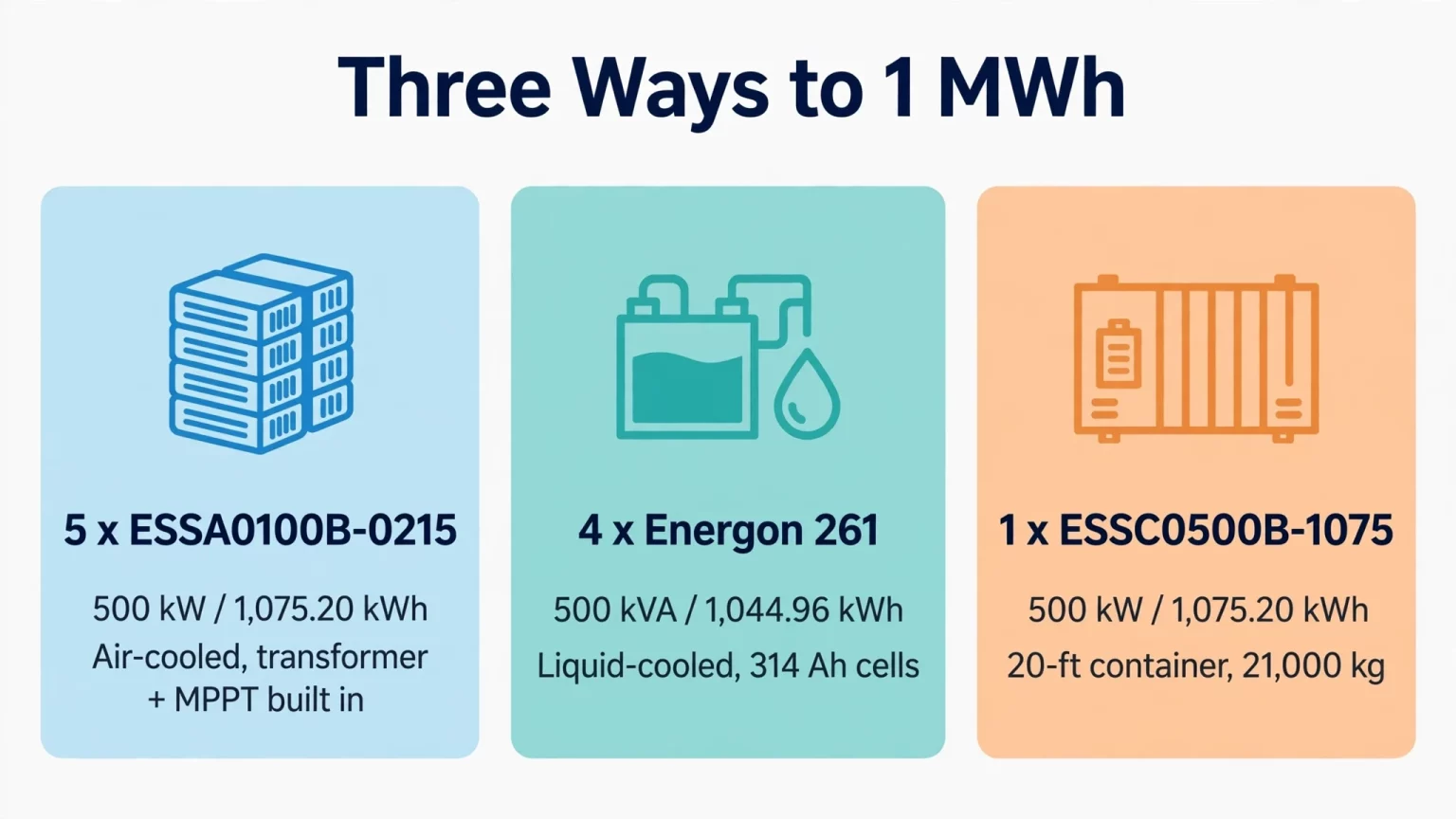
| 1 MWh-Class Plant Option | Unit Count & Model | Total AC Rating (kW vs. kVA) | Nominal / Rated Energy | Cooling & Architecture Notes |
|---|---|---|---|---|
| 5-Cabinet Air-Cooled Cluster | 5 x ESSA0100B-0215 | 500 kW active power | 1,075.20 kWh | Air-cooled (0°C to +45°C), built-in isolation transformer + MPPT |
| 4-Cabinet Liquid-Cooled Cluster | 4 x Energon 261 Liquid-Cooled C&I BESS | 500 kVA apparent power (450 kW at PF 0.9; 500 kW at PF 1.0) | 1,044.96 kWh | Liquid-cooled (-20°C to +55°C), 314 Ah cell capacity, water-based fire protection |
| Single 20-ft Container | 1 x MegSolid ESSC0500B-1075 Containerized BESS | 500 kW active power | 1,075.20 kWh | 20-ft ISO container (6,058 x 2,438 x 2,896 mm, 21,000 kg), built-in transformer |
Conclusion: Match Your 200kWh-Class C&I Project to Verified Cabinet Specifications
Selecting between the sungrow powerstack 200cs (ST225kWh-110kW-2h), the air-cooled MegSolid essa0100b-0215 (100 kW / 215.04 kWh), and the liquid-cooled Energon 261 (125 kVA / 261.24 kWh) depends on ambient temperature, galvanic isolation, PV coupling, and PCC power limits.
If you are also benchmarking other 215 kWh-class commercial systems, review our engineering breakdown in Huawei LUNA2000-215-2S10 Alternatives: Comparing C&I BESS Architectures.
Contact our commercial engineering team for controlled ESSA0100B-0215, Energon 261, and ESSC0500B-1075 specifications, low-voltage derating curves, and factory quotation packages.
FAQ
Does the standard ESSA0100B-0215 come with 280 Ah LFP cells or solid-state cells?
Standard configuration: 280 Ah LFP cells. Project-specific solid-state battery integration may be available subject to the approved BOM, controlled cell datasheet, and revised system specifications.
Does a 1P240S single-string topology eliminate all circulating currents in a multi-cabinet plant?
No; while 1P240S eliminates parallel battery string circulating currents inside each single cabinet, paralleling multiple cabinets on a 400 Vac bus still requires AC-side current-sharing control, impedance balance, and coordinated protection.
What are the selectable PV MPPT input power options on the ESSA0100B-0215?
The ESSA0100B-0215 series datasheet lists selectable MPPT PV input power options of 120 kW, 180 kW, and 240 kW (up to 1,000 V DC maximum PV input); buyers must specify the selected option when ordering.
What role does the built-in isolation transformer play in the ESSA0100B-0215?
Built-In Isolation Transformer: Provides galvanic isolation within the integrated power-conversion architecture between the battery-side conversion system and the 400 Vac plant distribution interface. Switching performance must be confirmed from the complete system's controlled specification.
How do the fire protection systems compare between Sungrow PowerStack 200CS and ESSA0100B-0215?
Sungrow's ST225kWh-110kW-2h datasheet specifies combustible gas, smoke, and heat detectors, audible/visual alarms, aerosol suppression, water sprinkler/deluge, and optional FK-5-1-12; ESSA0100B-0215 specifies aerosol or Novec 1230 (FK-5-1-12) per order configuration.
If my site requires liquid cooling (-20°C to +55°C) and 314 Ah cell capacity, which MegSolid cabinet should I choose?
Specify the liquid-cooled Energon 261 (125 kVA / 261.24 kWh, 1P260S 314 Ah LFP, 1.76 sq.m footprint, water-based fire protection and Novec 1230 clean agent). Four Energon 261 units provide 500 kVA apparent power (450 kW active power at PF 0.9, or 500 kW at PF 1.0), whereas five ESSA0100B-0215 units provide 500 kW active power.
How do equipment base area and civil pad requirements differ between the two models?
Integrating the isolation transformer and MPPT stage gives ESSA0100B-0215 a 3.80 sq.m base area vs. 1.85 sq.m for ST225kWh-110kW-2h, though total civil pad area also depends on door-swing clearance, maintenance aisles, and fire spacing.
How does Germany's VDE-AR-N 4105:2026-03 apply when selecting a 100 kW vs. 110 kW BESS?
VDE-AR-N 4105:2026-03 governs low-voltage grid-parallel storage in Germany (even with zero export), covering general thresholds below 135 kW cumulative installed power and specific 135 kW to 500 kW rules when agreed feed-in is ≤ 270 kW.
Does choosing a 100 kW cabinet exempt a UK C&I project from EREC G99 grid studies?
No; three-phase commercial BESS units at 100 kW or 110 kW fall under EREC G99, and any G100 active export-limiting scheme at the PCC requires fail-safe protection and formal DNO acceptance.
Which cabinet suits high-ambient commercial feeders in Australia, South Africa, or the Middle East?
For temperate sites (0°C to +45°C) needing direct PV DC coupling and transformer isolation, choose ESSA0100B-0215; for ambient temperatures above 45°C (up to +55°C with derating above 45°C) or harsh environments, specify Energon 261.