Skip to content

CATL's 6.25 MWh TENER 20-foot container put five-year zero degradation for both power and capacity at the center of utility procurement. Developers, CFOs, and Independent Engineers across the United States, Europe, and Australia now weigh zero degradation BESS bids on almost every major tender. Every 15-to-20-year power purchase agreement (PPA) stretches far past Year 5. Evaluating 5 year zero degradation battery storage requires modeling full 20-year Levelized Cost of Storage (LCOS) cash flows across Day-1 AC-installed CAPEX, external PCS balance-of-plant (BoP), certified transport weights, contractual limits, and multi-year capacity decay.
Lithium-ion batteries experience ongoing calendar and cycling aging over multi-decade service. Public disclosures for 5-year zero-degradation containers emphasize interface engineering such as biomimetic SEI layers and self-assembled electrolytes, while wider industry literature also analyzes active-lithium replenishment and Beginning-of-Life (BoL) capacity margins. Confirming which mechanisms apply to a quoted container, what operating caps bind the warranty, and how capacity behaves after Year 5 requires project-specific contractual curves.
For deeper warranty mechanics, see How to Read a C&I BESS Warranty: Throughput, DOD and EOL, alongside our financial guide in LCOS Calculation for Solid-State Commercial Energy Storage. Below, this procurement methodology and risk framework compares zero degradation BESS DC overbuild concepts with turnkey AC hardware across MegSolid C&I Energy Storage Systems (215kWh–2MWh) and the utility-scale 5000INTL container.

How "5 Year Zero Degradation Battery Storage" Works Under the Hood
Buyer Takeaway: Five-year zero-degradation claims focus on early-life retention, while 20-year asset ROI depends on executed warranty clauses, multi-year fade curves, and full AC-installed BoP inputs.
1. Publicly Disclosed TENER Concepts vs. General Industry Retention Mechanisms
All lithium iron phosphate (LFP) cells undergo ongoing SEI formation and active-lithium aging in field service. CATL's public disclosures for the 2024 6.25 MWh TENER 20-foot container highlight 430 Wh/L L-series cells paired with biomimetic SEI technology, self-assembled electrolytes, and active-lithium side-reaction control targeting five years of zero power and capacity degradation. Verify exact ambient temperature and operating limits directly from the quoted 6.25 MWh datasheet instead of borrowing specs from adjacent product variants.
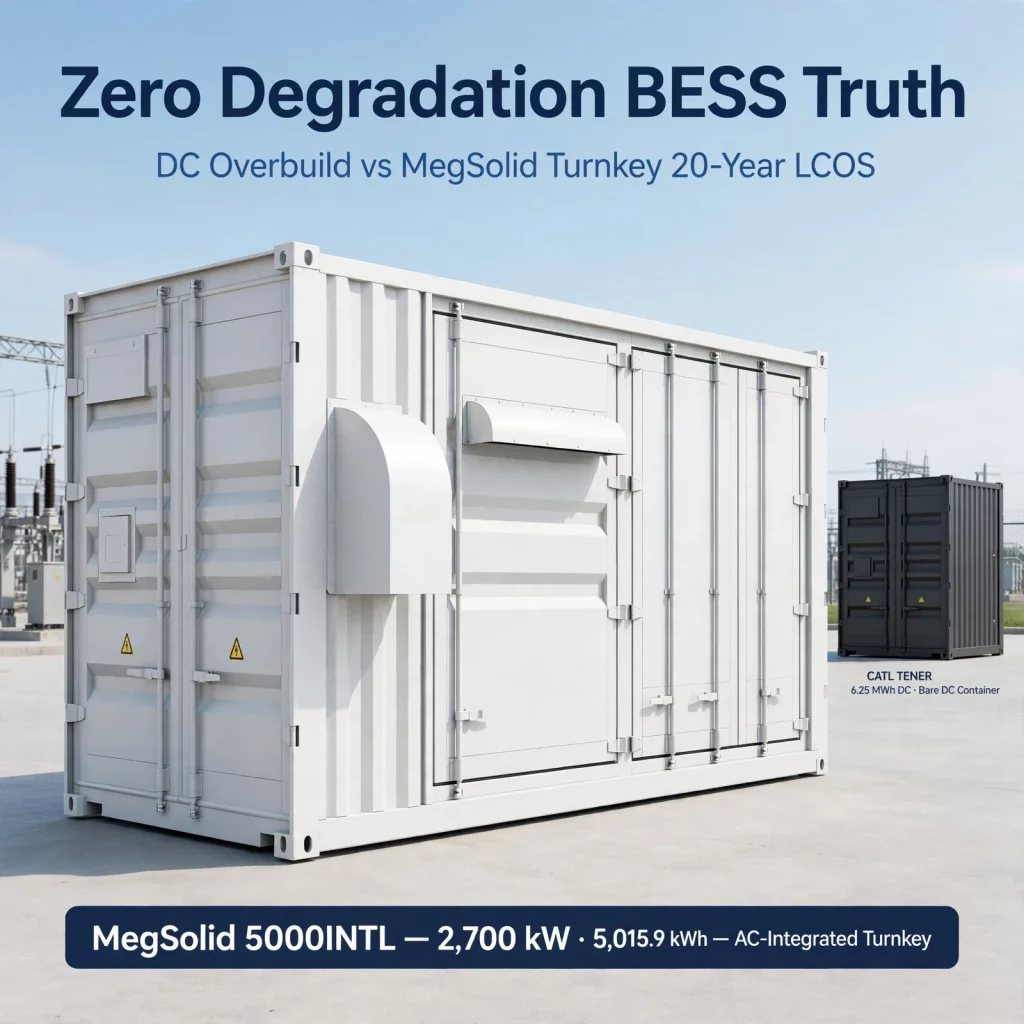
Inside a 20-foot footprint, TENER's 6.25 MWh rating delivers 1.2341 MWh (+24.6%) more nominal DC energy than MegSolid's 5,015.9 kWh AC-integrated 5000INTL container. Balancing that container-level density advantage requires auditing downstream AC conversion, site BoP scope, and full 20-year degradation.
Distinguish vendor-confirmed chemistry disclosures from broader industry retention methods analyzed in battery literature:
- Disclosed TENER Material Concepts (Biomimetic SEI & Self-Assembled Electrolytes): Public CATL materials describe stabilized electrode-electrolyte interfaces and self-assembled ionic pathways designed to limit early side reactions, control resistance rise, and keep auxiliary cooling draw flat.
- Technical Analysis: Pre-Lithiation / Sacrificial Lithium Reserves: Battery R&D literature frequently examines sacrificial lithium additions that offset irreversible SEI formation loss during early cycles. Confirming whether a commercial cell uses consumable reserves requires vendor cell-level documentation.
- Technical Analysis: Beginning-of-Life (BoL) Capacity Window Buffering: Commercial BESS suppliers can set warranted usable energy below physical BoL cell capability. Early chemical fade then absorbs inside that uncredited margin before reaching the contractual floor.
2. Contractual Warranty Boundaries & Multi-Year Fade Modeling
Five-year zero-degradation announcements describe target product performance; binding financial protection comes strictly from the executed warranty contract. Utility lenders and Independent Engineers audit executed schedules to confirm liquidated damages, test tolerances, and multi-year State of Health (SOH) behavior after the initial five-year period.
Separate sales headlines from binding contract clauses during RFP due diligence. Confirm whether retention is metered on net AC energy at the transformer Point of Interconnection (POI) after PCS and cooling auxiliary power, or strictly at DC rack terminals under controlled lab conditions. Lock down annual full-equivalent cycle limits, C-rate caps, average SoC dwell rules, ambient windows, and supplier-guaranteed SOH curves through Year 15 or Year 20.
20-Year LCOS Math: Evaluation Methodology for Zero Degradation BESS vs. DC Overbuild & AC Systems
Buyer Takeaway: Accurate 20-year LCOS requires verified CAPEX, AC-delivered MWh, fade curves, auxiliary loads, and residual values; at 7% WACC, 1.97x reflects time-value equivalence strictly when competing cash flows and MWh match.
1. The CFO Levelized Cost of Storage (LCOS) Formula & Discount-Rate Reality
True 20-year LCOS depends on bidder-specific CAPEX quotes, annual AC-metered dispatch volumes, multi-year fade curves, auxiliary cooling loads, augmentation schedules, and residual values. This section defines an auditable LCOS methodology and procurement risk framework for comparing TENER 6.25MWh zero degradation vs LCOS on net AC energy delivered at the transformer over horizon N (typically 15–20 years):
LCOS (USD/MWh) = [ CAPEX_AC_installed + Sum(t=1 to N)[(OM_t + Augmentation_t + Charging_Energy_Cost_t) / (1 + r)^t] - Residual_Value_N / (1 + r)^N ] / Sum(t=1 to N)[E_discharged_AC_t / (1 + r)^t]
Every numerator term stays in currency (USD) and every denominator term measures AC energy (MWh):
- CAPEX_AC_installed (USD): Day-1 turnkey installed AC capital cost covering containers, external PCS hardware where required, switchgear, civil works, freight, and commissioning.
- OM_t (USD) and Augmentation_t (USD): annual operations, maintenance, and warranty fees, plus mid-life battery or power-stage augmentation expenditure in year t.
- Charging_Energy_Cost_t (USD): annual cost of purchased charging energy, including conversion losses where applicable. Where a model isolates round-trip loss MWh separately, multiply those losses by the charging electricity tariff (USD/MWh) before adding them to the numerator.
- Residual_Value_N (USD): net end-of-life salvage value minus decommissioning or disposal cost at horizon year N (set Residual_Value_N = 0 when the financial model assumes zero net terminal value).
- E_discharged_AC_t (MWh), r, and N: net AC energy delivered at the transformer POI in year t, annual discount rate (WACC), and project evaluation horizon (years). Use real WACC with constant-dollar cash flows, or nominal WACC with inflation-adjusted nominal cash flows, keeping both bases strictly aligned.
Time value of money highlights why capital timing matters alongside upfront pricing. Modeling consistent constant-dollar cash flows at an illustrative 7% real annual WACC (r = 0.07) shows the discounting effect:
- Discounted Year-5 Augmentation: Spending 100,000 USD on augmentation in Year 5 equals 100,000 / (1.07^5) = 71,299 USD (71,298.62 USD) in Day-1 present value.
- Discounted Year-10 Augmentation: Deferring that 100,000 USD outlay to Year 10 lowers present value to 100,000 / (1.07^10) = 50,835 USD (50,834.93 USD), creating a 20,464 USD (20,463.69 USD) present-value reduction per 100,000 USD spent.
- Equal-Output Equivalence Boundary (1.97x at 7% WACC): At a 7% discount rate, 1.00 USD of Day-1 capital equals 1.97 USD of Year-10 spending in present-value terms (1.07^10 = 1.96715). That 1.97x ratio holds strictly when two compared bids deliver identical annual AC MWh and share identical O&M, charging, tax, and residual cash flows. Real vendor bids differ across container density, PCS BoP scope, conversion efficiency, and degradation curves, so full cash-flow modeling governs final selection.
Higher container energy density can lower concrete pad counts on large utility sites, while factory AC-integrated packages can simplify electrical site interfaces. Populating the equation above with verified vendor quotes and 20-year operating inputs reveals which design delivers the lowest USD/MWh for your site.

2. Three-Strategy 20-Year Financial & Engineering Comparison Framework
| Evaluation Criterion | Standard LFP + Day-1 DC Overbuild | 5-Year Zero Degradation Bare DC Container (6.25 MWh Class) | MegSolid AC-Integrated Turnkey (5000INTL / ESSC / Energon) |
|---|---|---|---|
| System Scope (AC vs. Bare DC) | Bare DC racks paired with external PCS & field interconnection per topology | Bare DC 20-ft container (6.25 MWh) requiring external PCS & MV interface | Factory AC-integrated enclosures combining battery, thermal, fire & PCS |
| Container Capacity & SOH Basis | Lower energy density; extra Day-1 DC racks offset ongoing fade | 6.25 MWh / 20-ft nameplate (+24.6% vs 5000INTL); check Yr 6–20 fade & contract | 5.0159 MWh / 20-ft (5000INTL); model SOH from factory warranty & FAT data |
| Upfront CAPEX & BoP Scope | Extra Day-1 DC racks plus external PCS & BoP per site plot plan | Benchmark bare DC quote alongside external PCS, rigging & topology-driven BoP | Consolidated AC scope may reduce site interfaces; compare full AC bids |
| Certified Weight & Site Fit | Separate DC pads plus external PCS yard footprint | Confirm specific model shipping mass, CSC rating & local route limits | Verified weights: 21,000 kg (ESSC0500B), 38,000 kg (40-ft ESSC1000B), 1.755 m2 (Energon) |
| Contractual & Metering Checks | Coordinate warranties across cell rack, external PCS & EMS | Audit AC POI vs DC rack metering, annual cycle limits & post-Yr-5 remedies | Single MegSolid OEM supply contract covering delivered enclosure hardware |

Beyond Year 5: Three Engineering Factors That Drive Real-World Lifecycle Economics
Buyer Takeaway: CATL's 6.25 MWh container holds 1.2341 MWh (+24.6%) more nameplate energy than 5000INTL's 5,015.9 kWh; weigh that capacity edge against external PCS BoP, thermal control, and certified weights.
1. Factory AC Integration on 5000INTL (2,700 kW / 5,015.9 kWh at 690 Vac)
Within a 20-foot footprint, CATL's 6.25 MWh TENER (powered by 430 Wh/L L-series cells) delivers 1.2341 MWh (+24.6%) higher nominal DC energy than MegSolid's 5,015.9 kWh 5000INTL enclosure. Translating container density into project economics requires normalizing full AC-side BoP. Bare DC blocks require external PCS hardware, while separate DC combiner cabinets, cable trenches, and extra foundation pads depend on PCS topology (central vs. string/skid-mounted), block count, and plot plan.
For utility substations and heavy industrial plants engineered around 690 Vac step-up transformers, MegSolid 5000INTL (2,700 kW / 5,015.9 kWh) consolidates battery storage and AC conversion inside one 20-foot IP55 container (6,058 x 2,438 x 2,896 mm, up to 4,000 m altitude). Its 12P416S battery bank (SHS180-314, 1,331.2 Vdc rated voltage) feeds six modular 450 kW power stages (450 x 6 kW = 2,700 kW at 690 Vac, 50/60 Hz) rated at 87.5% published maximum efficiency.
Bundling six modular 450 kW AC stages inside one container can simplify field DC routing and cut multi-vendor PCS interface coordination. Final CAPEX and LCOS advantages depend on benchmarking full AC-installed bids directly. During tender engineering, confirm internal string-to-stage mapping, branch protection selectivity, certified shipping weights, and long-term SOH curves from the approved SLD and contract dossier.
2. Thermal Uniformity, AI Early Warning & Full-Horizon Aging Discipline
Arrhenius chemical kinetics show that elevated cell temperatures and hotspot gradients accelerate SEI growth and resistance rise across a 15-to-20-year asset life. Uniform pack temperatures across Years 6–20 reinforce multi-decade usable capacity alongside early-life interface stabilization.
MegSolid aligns cooling hardware with site density and maintenance requirements:
- Liquid-Cooled High-Density Systems: Both 5000INTL (IP55, Smart Liquid Cooling with AI intelligent early warning) and Energon 261 (IP54, Intelligent Liquid Cooling with AI early warning plus Novec, multi-sensor detector, and water-based fire suppression) focus on compact footprints and active thermal control.
- Intelligent Air-Cooled Containers: ESSC0500B-1075 and ESSC1000B-2150 pair 3.2 V / 280 Ah LFP cells (rated >=5,000 cycles) with IP54 intelligent temperature-controlled air cooling for straightforward mechanical serviceability.
Verify exact cell temperature spread bounds, auxiliary cooling loads, and multi-year SOH curves against site ambient profiles and Factory Acceptance Test (FAT) reports ahead of financial close.
3. Right-Sizing for C&I Yards & Urban Substations
Transport and crane feasibility rests on each specific BESS model's certified shipping mass, ISO structural load rating, and local route conditions alongside outer dimensions. Standard dry-freight ISO boxes commonly carry a 30,480 kg gross rating, while alternative ISO specifications reach 32,500 kg, 34,000 kg, or specialized heavy-equipment certifications with higher payload limits. Obtain every vendor's certified net/gross mass, CSC plate load rating, bridge/axle limits, and external PCS pad area before pricing logistics.
For factories, commercial campuses, and microgrids constrained by 1,250 kVA transformers or tight lanes, right-sized AC-integrated blocks streamline site layout:
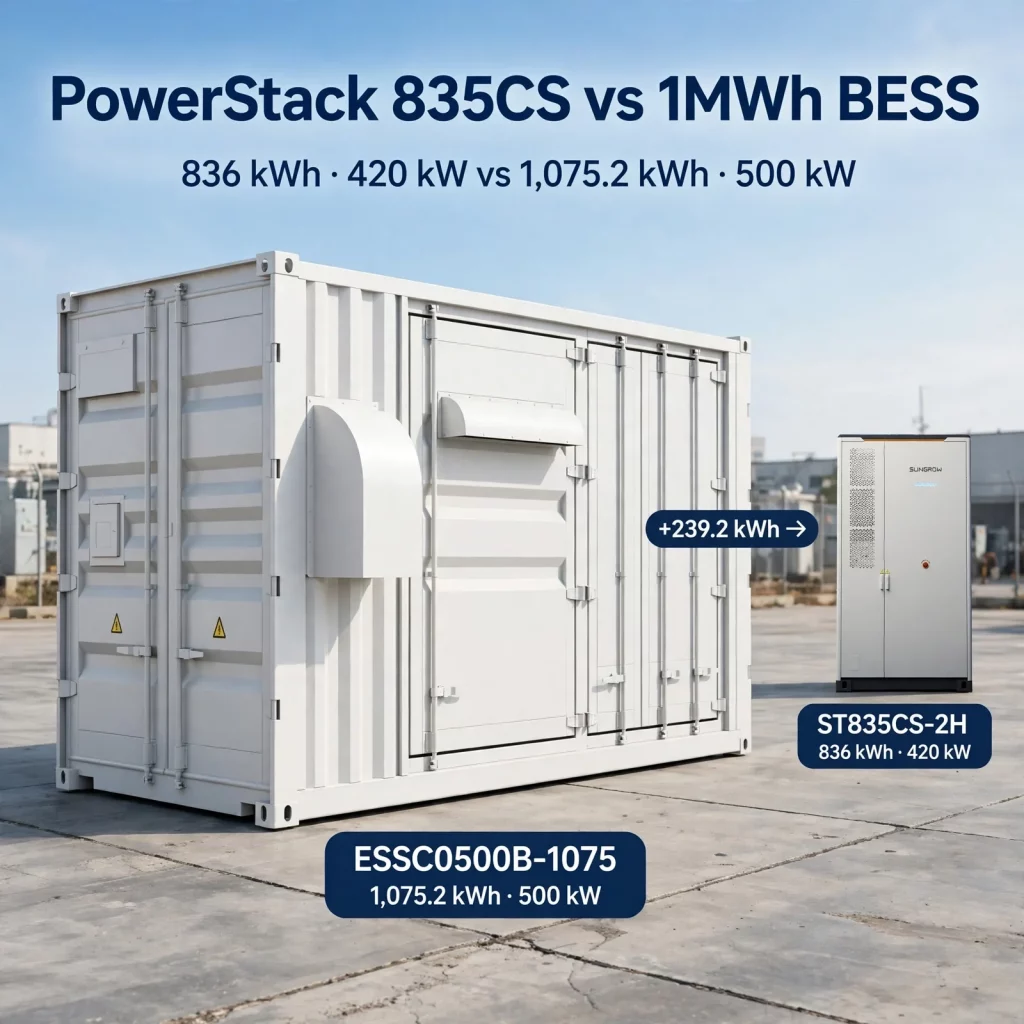
- 500 kW to 1 MW Containerized Blocks: MegSolid ESSC0500B-1075 and ESSC1000B-2150 cover mid-to-large C&I demand. ESSC0500B-1075 packs 500 kW / 1.0752 MWh into a 21,000 kg 20-foot container (6,058 x 2,438 x 2,896 mm; 600, 660, or 720 kW max PV). ESSC1000B-2150 scales to 1,000 kW / 2.1504 MWh inside a 38,000 kg 40-foot spread-weight container (12,192 x 2,438 x 2,896 mm; 1,200, 1,320, or 1,440 kW max PV).
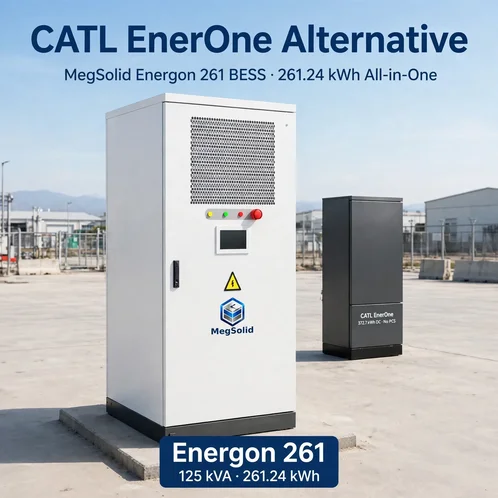
- High-Density Modular Liquid-Cooled Cabinets: MegSolid Energon 261 (125 kVA / 261.24 kWh) fits on a 1.755 m2 pad (1,300 x 1,350 x 2,200 mm +/-5 mm; 148.85 kWh/m2). Its 1P260S 314Ah LFP string runs at 832 Vdc nominal (676–936 Vdc) feeding 480 V / 400 V +/-15% output (90% max efficiency). Parallel scaling reaches 10 units (1,250 kVA / 2,612.4 kWh), with active power governed by power factor and operating limits.
- Compact Isolation-Transformer & Standalone PCS Options: Sites under 100 kW deploy MegSolid ESSA0100B-0215 (100 kW / 215.04 kWh) on 768 V (1P240S, 672–850 Vdc) and 400 Vac 3W+N+PE (THDi <3%, built-in isolation transformer, 3,900 kg, >=5,000 cycles, 1,000 V max PV). Custom AC-coupled skids pair with standalone MegSolid PMA080–PMA0125 PCS units (80 / 105 / 125 kW AC, 96 / 126 / 150 kW DC, 615–950 / 650–950 Vdc, 98.7% max efficiency, <20 ms direction switching, 48–50 kg).
Model Your 20-Year AC-Metered LCOS Before Locking In a BESS Bid Request official MegSolid datasheets, single-line diagrams, and turnkey pricing for 5000INTL, ESSC1000B-2150, ESSC0500B-1075, Energon 261, and ESSA0100B-0215.
CFO & EPC Procurement Checklist: 4 Questions Before Paying for a "Zero Degradation BESS" Quote
Buyer Takeaway: Embed these four contract audit questions in every RFP to compare AC-metered 20-year economics alongside headline equipment quotes.
1. Four Mandatory Due-Diligence Questions for Zero-Degradation RFPs
- 1. Is the 5-year zero-degradation clause structured as an executed warranty metered on net AC energy at the transformer/POI, or strictly at DC rack terminals under 25C lab conditions? Require explicit treatment of PCS conversion losses and auxiliary cooling loads across seasonal ambient swings.
- 2. What exact annual cycle cap, C-rate ceiling, and average SoC dwell window bind the warranty contract during Years 1–5, and what guaranteed SOH retention curve applies across Years 6–20? Multi-cycle arbitrage plants can trigger exclusions quickly when warranties assume one gentle cycle per day.
- 3. Does the quoted USD/kWh figure cover external PCS hardware, MV switchgear integration, topology-dependent DC cabling or combiner panels, fire-protection interlocks, and model-certified transport or crane permits? Strip out headline DC-only quotes and normalize every bidder to installed AC USD/kWh at the POI.
- 4. When your model includes full 20-year vendor CAPEX, AC-delivered MWh, auxiliary loads, O&M, augmentation, and residual value at discount rate (r), which bid yields the lowest LCOS? Simple timing ratios like 1.97x at 7% WACC hold only when non-augmentation cash flows and delivered AC MWh match across compared bids.
2. MegSolid Turnkey AC Hardware Selector for Lifecycle LCOS Planning
| Site Power & Voltage Tier | MegSolid Model | Verified Power & Energy | Electrical & Thermal Highlights | Footprint / Mass & Scalability |
|---|---|---|---|---|
| Utility & 690 Vac Substations | 5000INTL | 2,700 kW (450 x 6 kW) / 5,015.9 kWh | 12P416S (SHS180-314), 1,331.2 Vdc, 87.5% pub. max eff., Smart Liquid Cooling | 6,058 x 2,438 x 2,896 mm (20-ft IP55), <=4,000 m altitude |
| 1 MW Industrial Plants | ESSC1000B-2150 | 1,000 kW / 2.1504 MWh | 3.2 V / 280 Ah LFP, >=5,000 cycles, intelligent air cooling, 1,200–1,440 kW max PV | 12,192 x 2,438 x 2,896 mm (40-ft IP54), 38,000 kg |
| 500 kW Factory Feeders | ESSC0500B-1075 | 500 kW / 1.0752 MWh | 3.2 V / 280 Ah LFP, >=5,000 cycles, intelligent air cooling, 600–720 kW max PV | 6,058 x 2,438 x 2,896 mm (20-ft IP54), 21,000 kg |
| Modular C&I Liquid Blocks | Energon 261 | 125 kVA / 261.24 kWh | 1P260S 314Ah LFP, 832 Vdc (676–936 Vdc), 480/400 V +/-15%, 90% max eff. | 1,300 x 1,350 x 2,200 mm (+/-5 mm, 1.755 m2 IP54), parallel up to 10 |
| <=100 kW Isolated Feeders | ESSA0100B-0215 | 100 kW / 215.04 kWh | 1P240S LFP, 768 V (672–850 Vdc), 400 V 3W+N+PE, THDi <3%, isolation xfmr | 2,450 x 1,550 x 2,400 mm (IP54), 3,900 kg, >=5,000 cycles |
FAQ
Does a zero degradation BESS eliminate capacity fade over a 20-year project life?
Lithium-ion batteries experience ongoing calendar and cycling aging throughout their service life. Zero-degradation launch claims address an initial operating window. Modeling Years 6–20 across a 20-year PPA requires verified vendor SOH retention curves, executed warranty schedules, and site-specific augmentation budgets.
How does zero degradation BESS DC overbuild compare in a 20-year LCOS model?
Standard DC overbuild installs extra battery capacity on Day 1 so natural degradation stays above the contracted AC power floor longer. Five-year zero-degradation products aim to hold early output steady across the initial window, with subsequent augmentation timing driven by actual fade curves and contract floors. Selecting the lower-LCOS path requires comparing complete Day-1 AC-installed CAPEX, multi-year AC energy delivery, auxiliary loads, and discounted augmentation cash flows at project WACC.
What is the difference between DC-terminal and AC-metered degradation warranties?
DC-terminal warranties measure energy directly at the battery rack terminals under reference lab conditions (typically 25C and fixed C-rate). AC-metered POI guarantees measure deliverable energy after PCS conversion losses, transformer losses, and auxiliary HVAC/chiller power draw, making AC-metered verification essential for revenue-grade financial models.
How do annual cycle limits and C-rate caps affect 5-year zero-degradation guarantees?
Cross-check launch headlines directly against executed warranty schedules. Binding schedules typically tie flat early retention to bounded duty: capped annual full-equivalent cycles, controlled discharge C-rates, ambient temperature windows, and SoC dwell limits. Exceeding those limits under multi-cycle merchant trading can alter degradation slope or trigger warranty exclusions.
What external BoP equipment is needed when buying a bare 6.25 MWh DC container?
Deploying a bare DC battery container requires external bidirectional PCS hardware and MV transformer integration. Separate DC combiner panels, cable trenches, and extra concrete foundation pads depend on PCS topology, container count, and site plot plan. Normalizing every quote to AC-installed USD/kWh captures these BoP expenses accurately.
How do container weight and yard footprint impact urban C&I BESS installations?
Container freight rules vary across ISO classes: standard dry-freight boxes commonly use a 30,480 kg gross limit, while alternative ISO ratings reach 32,500 kg, 34,000 kg, or equipment-specific heavy-duty structural certifications. Verify each quoted BESS model's certified shipping weight, CSC plate capacity, and route axle limits alongside compact turnkey AC blocks like Energon 261 (1.755 m2 footprint), ESSC0500B-1075 (21,000 kg), and ESSC1000B-2150 (38,000 kg).
What are the verified specifications of the MegSolid 5000INTL containerized BESS?
MegSolid's 5000INTL integrates 5,015.9 kWh of rated energy (12P416S SHS180-314 configuration, 1,331.2 Vdc rated voltage) with 450 x 6 kW (2,700 kW) of 690 Vac (50/60 Hz) AC power conversion at 87.5% published maximum efficiency. The IP55 Smart Liquid Cooling 20-foot container measures 6,058 x 2,438 x 2,896 mm, includes AI intelligent early warning, and supports altitudes up to 4,000 m.
How do MegSolid ESSC1000B-2150 and ESSC0500B-1075 serve 500 kW to 1 MW commercial sites?
ESSC0500B-1075 delivers 500 kW AC and 1.0752 MWh nominal energy in a 20-foot IP54 intelligent air-cooled container (6,058 x 2,438 x 2,896 mm, 21,000 kg) with 600, 660, or 720 kW max PV options. ESSC1000B-2150 scales to 1,000 kW AC and 2.1504 MWh in a 40-foot IP54 enclosure (12,192 x 2,438 x 2,896 mm, 38,000 kg) with 1,200, 1,320, or 1,440 kW max PV inputs. Both models use 3.2 V / 280 Ah LFP cells rated >=5,000 cycles.
What are the verified specifications and parallel limits of the MegSolid Energon 261 cabinet?
MegSolid's Energon 261 delivers 125 kVA of rated AC apparent power and 261.24 kWh of nominal energy at 480 V / 400 V +/-15% (50/60 Hz). Active-power output follows power factor and operating limits, with 90% maximum system efficiency. Its 1P260S 314Ah LFP string runs at 832 Vdc nominal (676–936 Vdc) inside a 1,300 x 1,350 x 2,200 mm (+/-5 mm) IP54 cabinet (1.755 m2 footprint, 148.85 kWh/m2). Built-in Intelligent Liquid Cooling, AI early warning, and Novec + multi-sensor + water fire suppression support parallel scaling up to 10 cabinets (1,250 kVA / 2,612.4 kWh).
When should sites choose MegSolid ESSA0100B-0215 or standalone PMA080–PMA0125 PCS?
Choose ESSA0100B-0215 (100 kW / 215.04 kWh, 768 V 1P240S, 672–850 Vdc, 400 Vac 3W+N+PE, THDi =5,000 cycles, 1,000 V max PV). For custom AC-coupled converter skids, deploy rack-mounted PMA080 (80 kW AC / 96 kW DC), PMA0105 (105 kW AC / 126 kW DC), or PMA0125 (125 kW AC / 150 kW DC) PCS units. Each 48–50 kg chassis spans 615–950 / 650–950 Vdc at 98.7% max efficiency with <20 ms direction switching.
Conclusion: Model Full 20-Year AC-Metered LCOS Beyond the Year-5 Headline
Auditing any zero degradation BESS bid starts by weighing container energy density against total AC project economics. TENER's 6.25 MWh rating delivers 1.2341 MWh (+24.6%) more nominal DC energy per 20-ft container than 5000INTL's 5,015.9 kWh. Complete project cash-flow modeling covering Day-1 AC-installed CAPEX, external PCS BoP, certified logistics, auxiliary draw, and 20-year SOH curves establishes which architecture minimizes USD/MWh at your Point of Interconnection.
MegSolid structures factory-integrated AC hardware under single-contract accountability across utility 690 Vac substations (5000INTL at 2,700 kW / 5,015.9 kWh) and industrial sites (ESSC1000B-2150 at 1,000 kW / 2.1504 MWh, ESSC0500B-1075 at 500 kW / 1.0752 MWh). Modular feeders scale cleanly with Energon 261 (125 kVA / 261.24 kWh) and ESSA0100B-0215 (100 kW / 215.04 kWh). Request project-specific SOH tables and SLDs directly from MegSolid engineers before issuing award POs.
Request MegSolid 20-Year LCOS Curves, SLDs & Turnkey Factory Pricing Connect with MegSolid's utility and C&I engineering team for project-specific degradation tables, FAT protocols, and quotes on 5000INTL, ESSC1000B-2150, ESSC0500B-1075, and Energon 261.