 Skip to content
MegSolid recommends reading a C&I BESS warranty as a measured operating envelope, not a headline number of years or cycles. A bankable offer must connect throughput, depth of discharge, C-rate, temperature, beginning-of-life capacity, end-of-life capacity, the measurement point, EMS records, test procedures and remedies. If one link is missing, the lowest-priced warranty may transfer degradation risk back to the EPC or asset owner.
- 📅 Warranty period: State the start date, end date and which equipment is covered.
- 🔄 Throughput: Define the annual and cumulative energy allowance and how it is counted.
- 📉 Capacity retention: Attach the guaranteed degradation curve and EOL threshold.
- 🌡️ Operating envelope: Fix DOD, C-rate, temperature, SOC and maintenance limits.
- 📊 Claim evidence: Define meters, EMS logs, capacity tests and data ownership.
- 🛠️ Remedy: State repair, replacement, augmentation or compensation obligations.
The Direct Answer: Compare the Warranty Envelope, Not the Year Count
A ten-year document can be weaker than a shorter document if throughput, retained energy or remedies are restricted. Start by separating defect coverage from performance coverage. Then require each bidder to complete the same warranty schedule.
| Warranty layer | Buyer must define | Risk if omitted |
|---|---|---|
| Product warranty | Covered equipment, defects, start date and exclusions | Battery, PCS or auxiliaries may fall outside the remedy |
| Capacity warranty | BOL baseline, annual retention curve, EOL floor and measurement point | Supplier and owner can calculate different retained capacity |
| Throughput warranty | Annual and cumulative energy, counting method and reset rules | Normal dispatch can consume the allowance early |
| Availability guarantee | Included hours, exclusions, planned maintenance and calculation | A non-operating system may still appear contractually available |
| Performance remedy | Test trigger, cure period, repair, replacement, augmentation and payment | A proven shortfall may have no enforceable cure path |
Use the commercial energy storage procurement guide for the broader supplier review. This article narrows the decision to warranty language, operating evidence and degradation risk.
Do Not Convert a Cycle-Life Figure into a Warranty Term
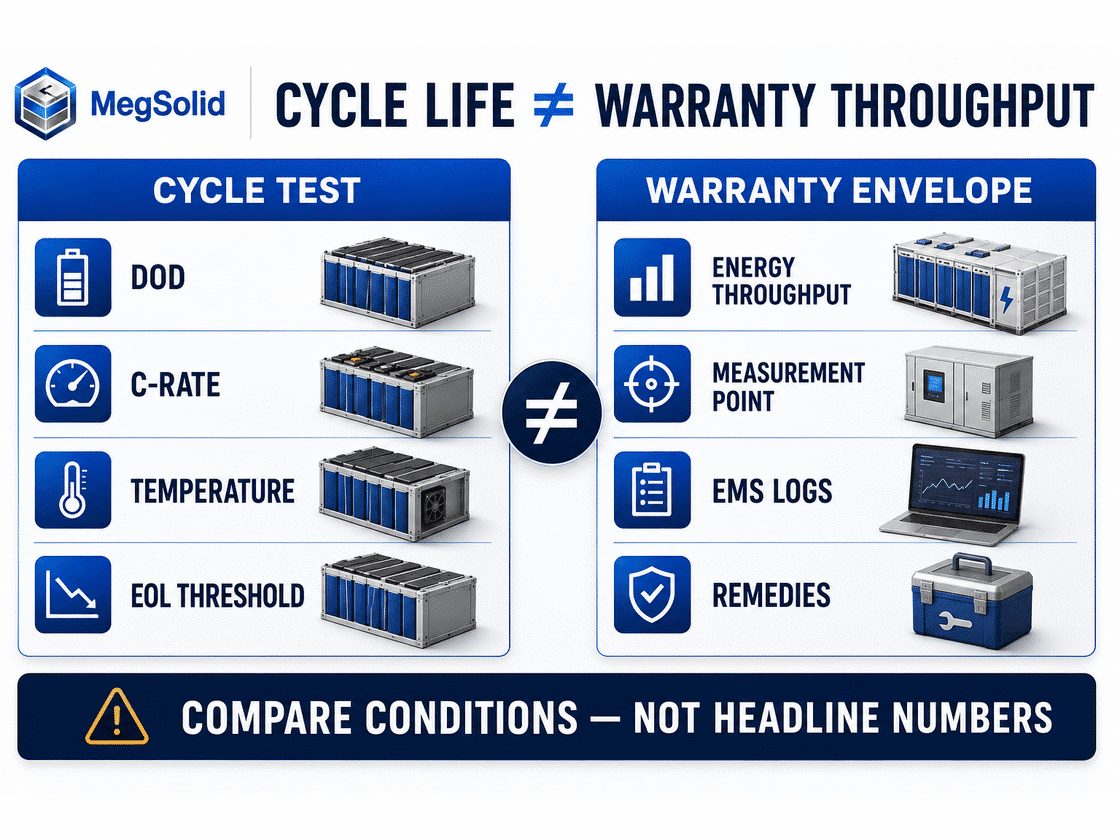
Cycle life is a test result or product-page value under stated or partially stated conditions. A warranty is a contract with eligibility rules, measurement procedures and remedies. The two are related, but they are not interchangeable.
| MegSolid reference | Cycle-life value shown | Safe procurement interpretation |
|---|---|---|
| ESSA0030B-0055 / ESSA0050B-0055 | ≥3,800 cycles | Do not infer warranty years; complete test conditions are not published |
| ESSA0050B-0100 / ESSA0100B-0215 | ≥5,000 cycles | Do not infer retained AC energy or warranty throughput |
| MEG-Solid-512314FL1 residential battery | 8,000 cycles at 80% DOD | Model-specific residential data; do not transfer it to an ESSA C&I cabinet |
| MG 512314 movable battery | ≥6,000 cycles at 25°C and 80% EOL | The product page also lists five years; request the complete warranty document |
- ⚠️ Missing DOD: A cycle count without depth of discharge cannot define lifetime energy.
- ⚠️ Missing EOL: A cycle count without retained-capacity threshold has no common finish line.
- ⚠️ Missing temperature: Laboratory and hot-site duties are not equivalent.
- ⚠️ Missing C-rate: Power-intensive duty may not match the reference test.
- ⚠️ Missing remedy: Even a valid test value does not state what the supplier must do.
The solid-state BESS evaluation beyond cycle life explains the technical screening layer. The warranty article remains focused on contractual delivery and evidence.
Convert the Dispatch Profile into a Warranty Throughput Requirement
The commercial question is not simply how many times the BESS cycles. It is how much energy crosses the contracted measurement point during the warranty period. The RFQ must state whether throughput counts discharged energy, charged energy, both directions or equivalent full cycles.
- 📁 Load profile: Provide the same interval data used for system sizing.
- 🕒 Dispatch schedule: State expected cycles per day and seasonal changes.
- ⚡ Power duty: Record typical and maximum charge/discharge kW.
- 🔋 Energy basis: Use the contracted usable energy, not an unrelated nominal value.
- 📍 Meter point: Choose DC terminals, AC cabinet output or PCC and keep it consistent.
- 📈 Revenue stacking: Include peak shaving, arbitrage, backup tests and grid services.
An equivalent-full-cycle estimate can divide measured discharged energy by the agreed reference usable energy, but the contract must define the formula. Do not silently count both charge and discharge energy if the supplier's allowance counts only one direction. The EMS should alert operators before a revised schedule exceeds the agreed annual limit.
Daily cycling for C&I peak-shaving ROI differs from aggressive dispatch during negative energy-price arbitrage. Price both duties against the same warranty throughput envelope before approving the revenue model.
Tie DOD, C-Rate, Temperature and SOC to the EMS
Warranty exclusions often originate in operating data, not visible hardware damage. The contract should convert every condition into a measurable EMS or BMS rule. If a limit cannot be logged, time-stamped and exported, it will be difficult to prove compliance during a claim.
- 🔋 DOD window: Define maximum discharge depth and any reserve SOC.
- ⚡ C-rate: State continuous, peak and cumulative high-power duty.
- 🌡️ Temperature: Identify cell, module and ambient limits plus sensor location.
- ⏸️ Resting SOC: Control long dwell periods at high or low SOC when required.
- 🔄 Balancing and maintenance: Record required service, firmware and calibration.
- 🚨 Excursion handling: Set alarms, cure periods and consequences before voiding coverage.
Review the PCS and BMS integration failure guide before accepting a mixed-supplier control boundary. For solid-state configurations, the interface-stability evaluation should also be separated from the commercial warranty schedule.
Define BOL, EOL and the Capacity Measurement Point
Beginning of life must be a dated baseline established by an agreed commissioning or performance test. End of life must be a retained-capacity floor under the contracted duty. Neither should be left as an undefined percentage on a sales sheet.
| RFQ field | Required answer | Why it changes the warranty |
|---|---|---|
| BOL baseline | Nameplate or measured commissioning capacity | Sets the denominator for retained capacity |
| Capacity basis | Nominal, usable DC or usable AC energy | Prevents unlike kWh values from being compared |
| Measurement point | Battery terminals, PCS output or PCC | Determines treatment of conversion and auxiliary losses |
| EOL floor | Specified retained capacity at a specified year or throughput | Defines when performance falls below warranty |
| Test protocol | SOC window, C-rate, temperature, rest periods and corrections | Makes repeated capacity tests comparable |
| Test cost | Energy, labor, witness and downtime allocation | Prevents the cost of proving a claim from blocking it |
System size affects the value at risk but not the logic. Compare the measurement boundary used in the 100 kW / 215 kWh outdoor BESS selection guide with the larger 261kWh liquid-cooled BESS RFQ guide. Do not assume both offers warrant energy at the same point.
Make the Degradation Curve and Augmentation Plan Bankable
A single EOL number hides the path between commissioning and the final year. Ask for an annual minimum-retention schedule or another unambiguous curve, then align it with the project's yearly revenue and PPA delivery model.
- 📉 Retention curve: Require minimum capacity by year or cumulative throughput.
- 🧮 Financial model: Use the warranted curve, not only beginning-of-life energy.
- ➕ Augmentation trigger: Define when added capacity is required and who pays.
- 🏗️ Reserved interface: Preserve footprint, DC voltage range, protection and PCS headroom.
- 🧩 Future compatibility: Address replacement cell, module and rack obsolescence.
- 📦 Spare strategy: State storage conditions, rotation, commissioning and warranty of spares.
The ROI impact of solid-solid interface degradation shows why technology-specific aging should enter the financial model. It does not replace a project-specific capacity guarantee.
Specify the Solid-State Configuration inside the Warranty
MegSolid's ESSA outdoor C&I platform can be configured with solid-state battery cells for project-specific requirements. The standard ESSA tables identify LFP cells, and LFP alone does not establish electrolyte architecture. Therefore the quotation, signed datasheet, BOM and warranty must all identify the ordered cell and configuration.
A validated hybrid or solid-state design may reduce flammable-liquid inventory and improve resistance to some internal-fault propagation mechanisms. That potential safety benefit does not create unlimited warranty coverage, eliminate thermal runaway or make the system fireproof. Model-level evidence and operating controls remain necessary.
- 🧾 Configuration identity: Record cell manufacturer, model, chemistry and electrolyte architecture.
- 🧪 Evidence scope: Separate cell, module, rack and complete-system test boundaries.
- 🌡️ Thermal envelope: State temperatures and cooling conditions used by the warranty model.
- 🔧 Replacement rule: Define whether mixed-age or substitute cells are permitted.
- 📊 Performance basis: Keep safety evidence separate from cycle and capacity guarantees.
Use the 12 thermal-runaway approval checks and the BESS certification guide to verify safety evidence without generalizing one document across every model.
Build an EMS Evidence Chain That Can Survive a Claim
The warranty should state which records are authoritative, their sampling interval, retention period, export format and owner. Cloud dashboards are useful, but a screenshot is not a substitute for time-series data and calibrated meter records.
- 🗂️ Preserve: SOC, SOH, energy counters, power, cell temperature, alarms and availability events.
- 🕓 Time synchronization: Align BMS, PCS, EMS and revenue-meter clocks.
- 🔐 Data ownership: Give the owner export rights after warranty or service termination.
- 🧰 Change log: Record firmware, setpoints, maintenance and component replacement.
- 📏 Metering: Define calibration, accuracy class and treatment of missing data.
- 🚩 Early warning: Alert on throughput, temperature, DOD and SOC-envelope excursions.
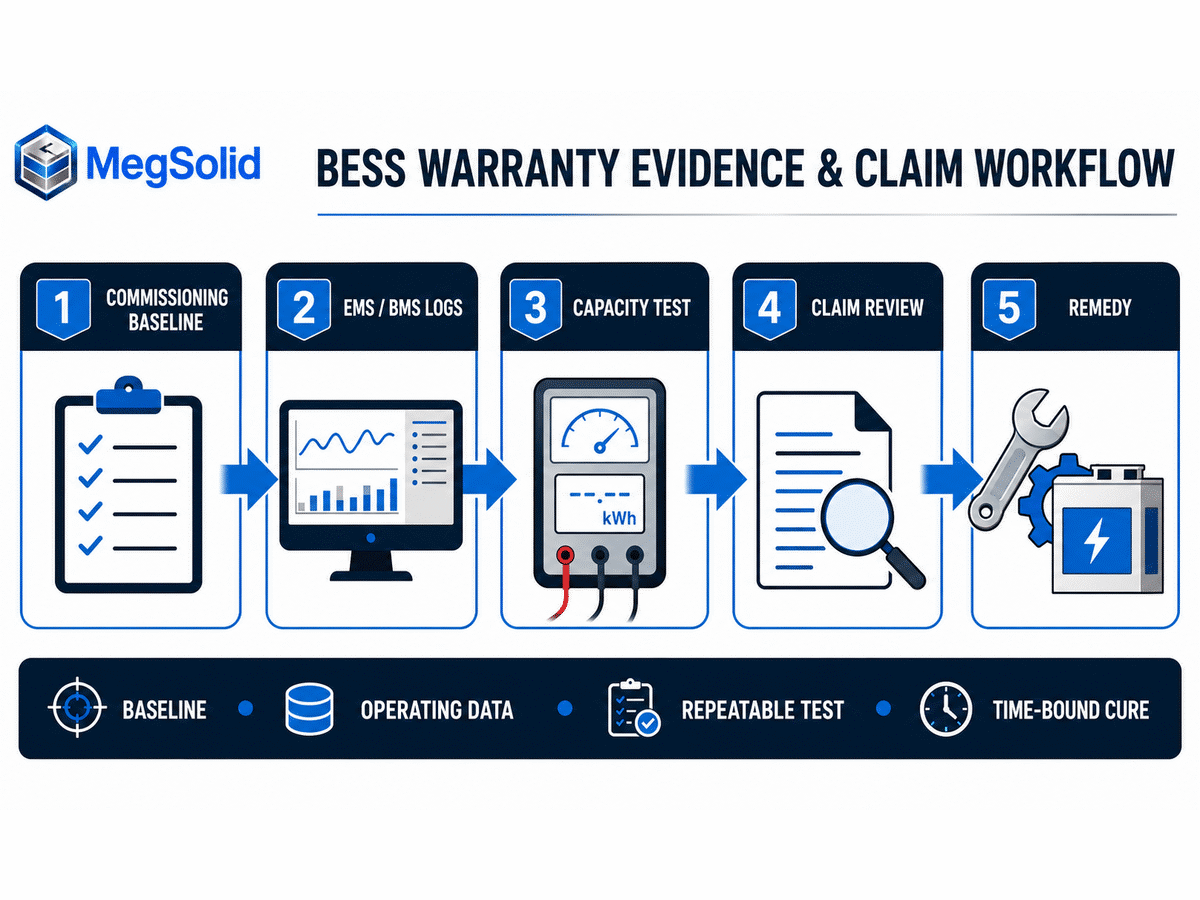
Add the required capacity and EMS scenarios to the BESS factory acceptance test plan. FAT establishes configuration and functionality; the commissioning test establishes the site baseline.
Put These Warranty Fields into Every EPC RFQ
- 1️⃣ Covered equipment: Battery cells, modules, racks, BMS, PCS, EMS, HVAC, fire system and auxiliaries.
- 2️⃣ Start date: Shipment, delivery, commissioning, acceptance or another defined milestone.
- 3️⃣ Operating profile: Cycles, throughput, DOD, C-rate, SOC, temperature and application stack.
- 4️⃣ Capacity guarantee: BOL baseline, annual curve, EOL floor and energy basis.
- 5️⃣ Measurement: Meter point, test procedure, corrections, witnesses and test cost.
- 6️⃣ EMS evidence: Required logs, ownership, export format and retention period.
- 7️⃣ Exclusions: Grid events, force majeure, unauthorized changes and maintenance failures.
- 8️⃣ Cure process: Notice, investigation, response time, retest and escalation.
- 9️⃣ Remedies: Repair, replace, augment, extend coverage or compensate.
- 🔟 Counterparty: Contracting entity, parent support, local service and spare-parts responsibility.
Why MegSolid Belongs in the Warranty Comparison
MegSolid's model-level product knowledge keeps rated energy, usable energy, cycle life, chemistry, efficiency and certification scope separate. That transparency helps EPC buyers create a warranty schedule without turning an incomplete product-page value into a contractual promise. The final offer should still include the controlled warranty, signed datasheet, BOM, SLD, communication matrix, FAT plan and service boundary.
- ✅ Model-specific review: Values from one product are not transferred to another.
- ✅ Project-specific solid-state option: The ordered architecture must appear in all contract documents.
- ✅ Integrated control review: EMS evidence requirements are defined before dispatch begins.
- ✅ Comparable RFQ: Every bidder answers the same capacity, throughput and remedy fields.
This article provides a technical procurement framework, not project-specific legal advice or a MegSolid warranty offer. For the Excel warranty comparison tool with internal IRR fields, degradation-curve inputs, an EMS evidence schedule and an EPC RFQ matrix, email [email protected]. Include the project country, power, energy, application, dispatch profile, temperature, required operating term and delivery date.
FAQ
Is battery cycle life the same as a C&I BESS warranty?
No. Cycle life is a test value under specified conditions. A warranty adds eligibility rules, operating limits, measurement procedures, exclusions and remedies.
What does BESS warranty throughput mean?
It is the contracted energy allowance over a stated period. The document must define the meter point and whether it counts charged energy, discharged energy, both directions or equivalent full cycles.
Why must DOD appear in the warranty?
Depth of discharge changes the energy processed per cycle and may affect degradation. A cycle allowance without its DOD condition cannot be compared accurately.
What is EOL in a battery warranty?
EOL is the contracted retained-capacity floor under a defined duty and measurement basis. It is a performance threshold, not proof that the battery immediately stops operating.
How should beginning-of-life capacity be established?
Define whether BOL is nameplate capacity or the measured commissioning result. Use an agreed test with fixed SOC, C-rate, temperature, rest periods and meter point.
Should capacity be warranted at DC or AC?
Either can be used if the contract is explicit. AC or PCC delivery includes conversion and auxiliary effects that a DC-terminal warranty may exclude.
Does a capacity warranty also guarantee availability?
Not automatically. Capacity, availability and efficiency are different performance layers with different calculations, exclusions and remedies.
Does MegSolid provide the ESSA solid-state configuration by default?
No. ESSA standard tables identify LFP cells. A project-specific solid-state configuration must be confirmed in the quotation, signed datasheet, BOM and warranty.
Which records should an owner preserve for a warranty claim?
Preserve commissioning tests, calibrated meter data, EMS and BMS logs, alarms, temperature history, throughput counters, firmware changes, maintenance records and replacement history.
Which remedies should appear in a C&I BESS warranty?
Define investigation, repair, replacement, augmentation, retesting, coverage extension or compensation, together with response times and responsibility for labor, freight and downtime.
What is a C&I BESS warranty?
It is the contractual framework covering defects and specified battery-system performance under an agreed operating profile, measurement method, evidence record and remedy process.
How can EPCs compare battery energy storage warranty terms?
Use one schedule for coverage, throughput, DOD, C-rate, temperature, BOL, EOL, measurement point, capacity tests, exclusions, evidence and remedies.
What should buyers send MegSolid for a warranty review?
Send the load profile, application, required kW and kWh, dispatch schedule, site conditions, warranty term, capacity-retention target, EMS requirements and project delivery date.
