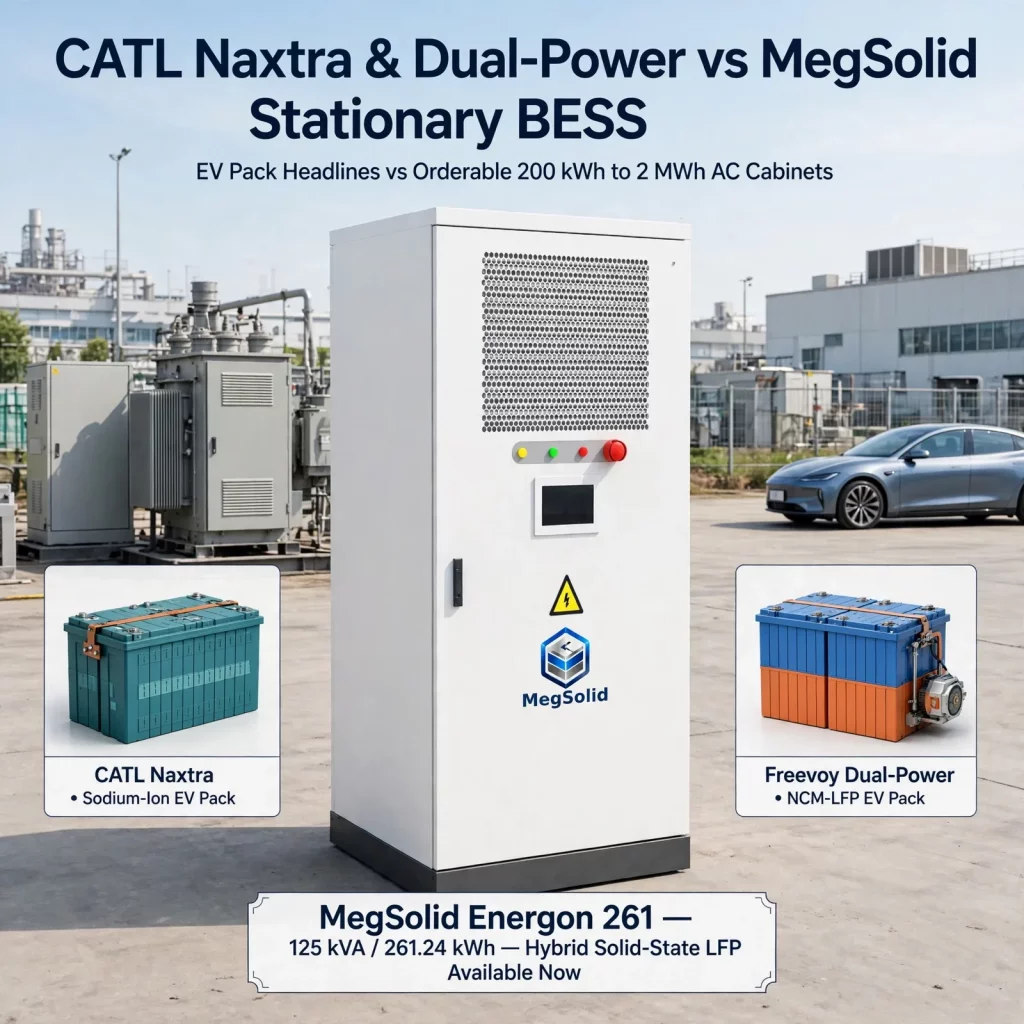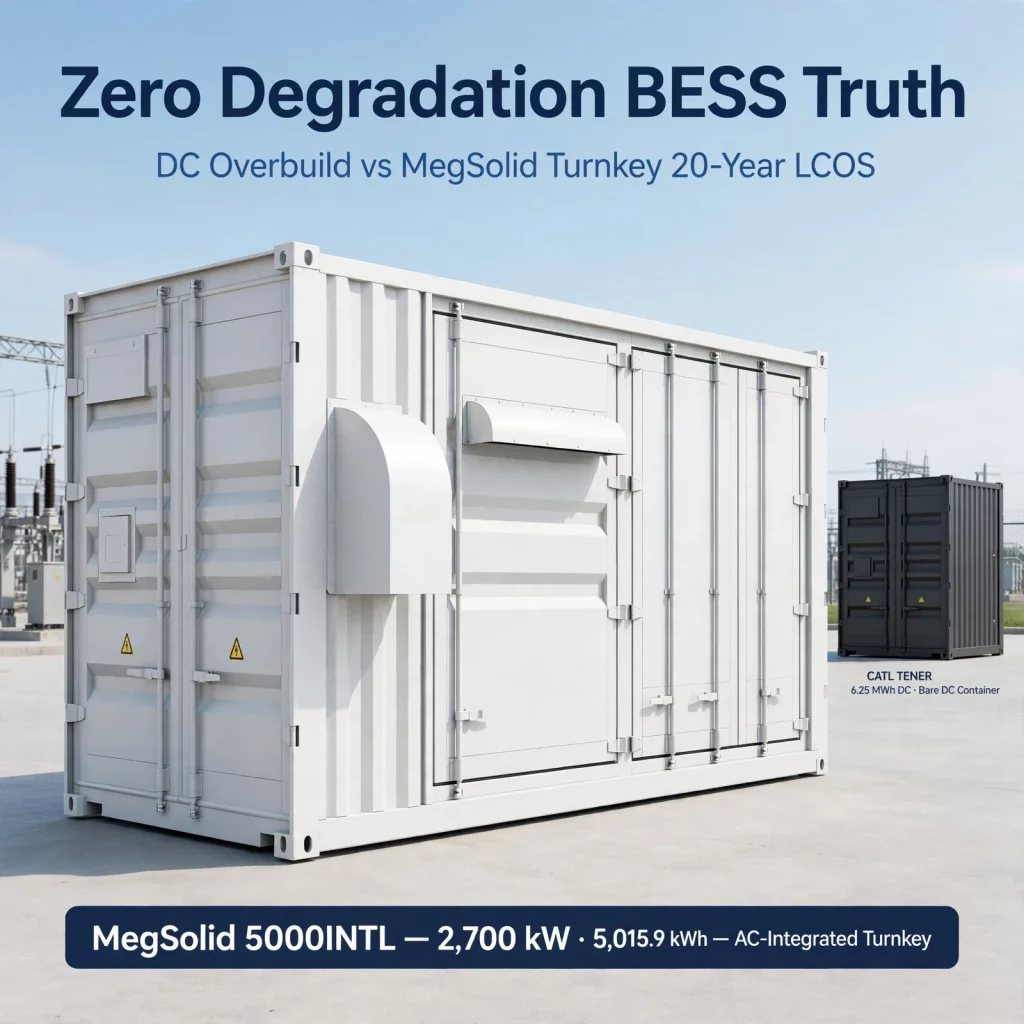
Headlines around CATL Naxtra (up to 175 Wh/kg sodium-ion cells rated from -40 C to +70 C) and CATL's Freevoy Dual-Power architecture have flooded procurement inboxes across Europe and North America. Plant engineers and CFOs keep asking one blunt question: can a factory buy a CATL Naxtra or Dual-Power cabinet for 200 kWh to 2 MWh peak shaving today?
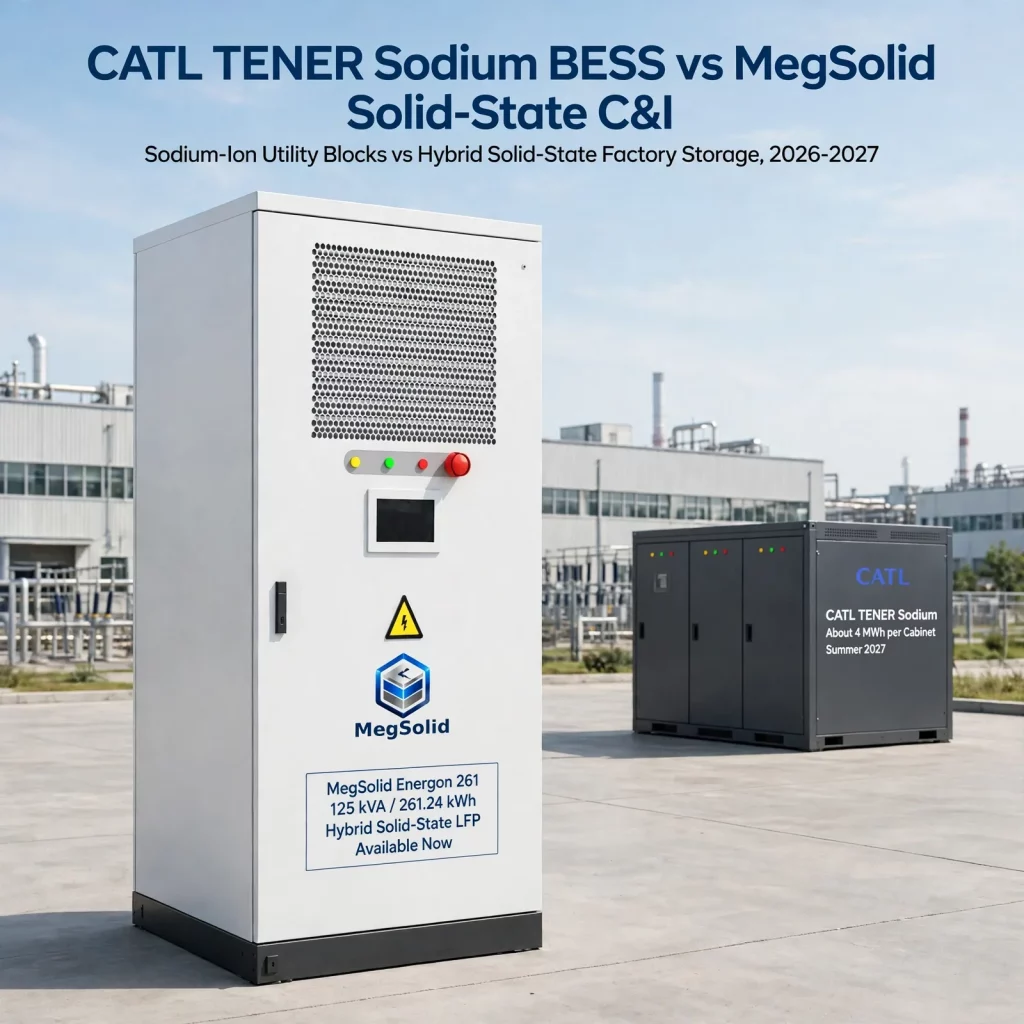
Separate automotive launches and long-term roadmaps from orderable stationary hardware before drafting an RFQ. At its April 21, 2025 Super Tech Day, CATL unveiled Naxtra initially for passenger EVs and 24V heavy-duty truck start-stop auxiliary packs. That event also introduced Freevoy Dual-Power automotive packs tested to standards such as GB 38031-2025. CATL has outlined industrial and commercial expansion directions for Dual-Power technology over time, yet EPC buyers still check whether a released, verified 200 kWh to 2 MWh stationary AC SKU exists to order right now. CATL's separate stationary sodium platform, TENER Sodium, targets >30 MWh utility blocks shipping internationally around summer 2027.
Factories sizing 100 kW to 2 MW projects today need active-production AC cabinets built for 400 V and 690 V switchgear. Here we build on our engineering guides for How to Select a 100 kW / 215 kWh Outdoor BESS for a C&I Site, 500 kW / 1.0752 MWh Containerized BESS Grid Boundaries, and our utility comparison in CATL TENER Sodium BESS vs. MegSolid C&I BESS. Below, we compare CATL's announcements against MegSolid's Hybrid Solid-State lineup (Energon 261 and 5000INTL) and turnkey LFP C&I range (ESSA0100B-0215, ESSC0500B-1075, and ESSC1000B-2150).
Can CATL Naxtra Be Used for Stationary BESS? Separating EV Pack Headlines from Stationary Grid Hardware
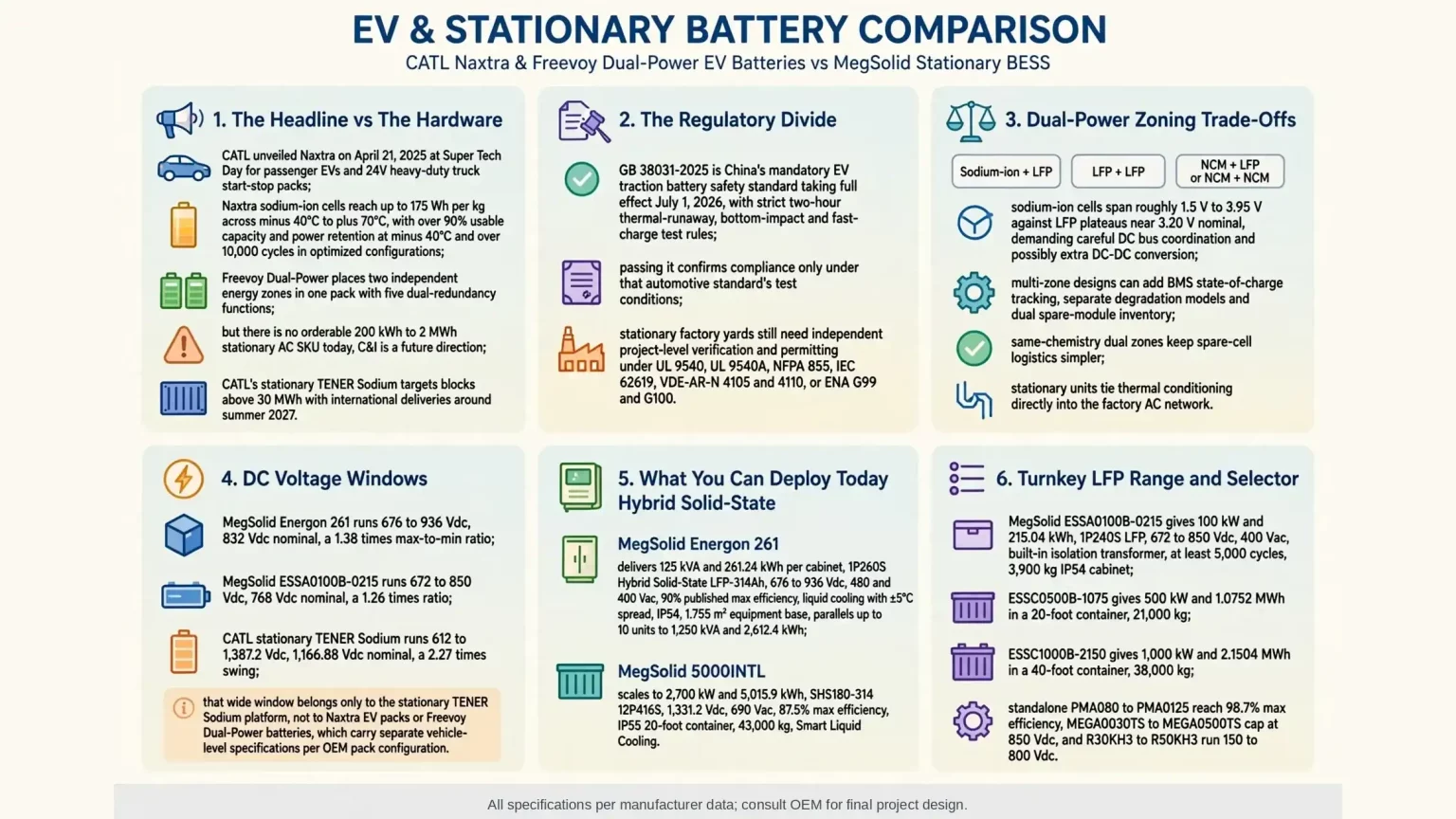
Buyer Takeaway: CATL Naxtra and Freevoy Dual-Power launch first across EVs and 24V heavy trucks, while MegSolid delivers verified 400 V and 690 V AC stationary factory systems today.
Media coverage regularly blends vehicle battery news with stationary grid tenders. Give CATL's R&D full credit for advancing sodium-ion mobility. Naxtra reaches up to 175 Wh/kg across -40 C to +70 C, with CATL claiming over 90% usable capacity/power retention at -40 C and over 10,000 cycles in optimized configurations. CATL also launched a 24V heavy-duty truck start-stop battery while scaling Naxtra output in 2026 and eyeing future C&I applications for Dual-Power technology.
Seeing C&I listed on a future roadmap differs completely from placing a purchase order for a grid-certified AC cabinet today. Comparing EV Dual Power battery vs stationary C&I BESS hardware shows what EPC teams can specify right now.
| Engineering & Procurement Dimension | CATL Naxtra & Freevoy Dual-Power (Current Disclosures) | MegSolid Hybrid Solid-State (Energon 261 / 5000INTL) | MegSolid Turnkey LFP C&I (ESSA / ESSC) |
|---|---|---|---|
| Current Product Scope | Passenger EV packs & 24V heavy-truck start-stop (Naxtra); C&I cited as future Dual-Power direction | Dedicated stationary C&I & utility BESS (261.24 kWh to 5,015.9 kWh) | Dedicated stationary C&I BESS (215.04 kWh, 1.0752 MWh, 2.1504 MWh) |
| Chemistry & Zone Topology | Sodium-ion (175 Wh/kg) or Dual-Power dual zones (Na+LFP, LFP+LFP, NCM+LFP / NCM+NCM) | Unified Hybrid Solid-State LFP (314Ah 1P260S in Energon 261; 12P416S in 5000INTL) | Unified LFP (1P240S in ESSA; 3.2 V / 280 Ah LFP in ESSC) |
| Regulatory & Safety Focus | EV traction test protocols (e.g., GB 38031-2025, mandatory in China July 1, 2026) | Stationary BESS engineering; verify project UL 9540A / IEC 62619 & grid dossiers | Stationary BESS engineering; verify project UL 9540A / IEC 62619 & grid dossiers |
| AC Grid Interface | Vehicle traction inverter & automotive bus architecture | Factory-integrated 480/400 Vac (Energon 261) or 690 Vac (5000INTL) | Factory-integrated 400 Vac with isolation transformer (ESSA); AC containerized (ESSC) |
| Commercial C&I Availability | Automotive/truck rollouts; stationary TENER Sodium targets >30 MWh (summer 2027) | Active stationary production (project-confirmed delivery schedule) | Active stationary production (project-confirmed delivery schedule) |
Start with the regulatory divide. China's GB 38031-2025 governs electric vehicle traction battery safety, taking full effect on July 1, 2026 with strict two-hour thermal-runaway, bottom-impact, and fast-charge test rules. Passing GB 38031-2025 confirms compliance strictly under that automotive standard's specific test criteria and conditions. Stationary factory yards in Europe, the UK, Australia, and North America still undergo independent project-level verification and permitting under local codes such as UL 9540, UL 9540A, NFPA 855, IEC 62619, VDE-AR-N 4105/4110, or ENA G99/G100.
Stationary Hardware Scope & Thermal Protection Comparison
| Site & System Factor | CATL Naxtra / Dual-Power (Automotive Releases) | MegSolid Energon 261 & 5000INTL (Hybrid Solid-State) | MegSolid ESSA0100B-0215 & ESSC Series (LFP) |
|---|---|---|---|
| Operating Thermal Context | Wide-temperature automotive & heavy-truck operation (-40 C to +70 C on Naxtra) | Liquid cooling (+/-5 C delta on Energon 261); Smart Liquid Cooling (5000INTL) | Outdoor IP54 design; intelligent temperature-controlled air cooling (ESSC) |
| Enclosure & Site Footprint | Vehicle chassis floorboard or 24V truck battery bay | IP54 cabinet (1.755 m2 equipment base, Energon 261); IP55 20-ft container (43,000 kg, 5000INTL) | IP54 cabinet (3,900 kg, ESSA); IP54 20-ft (21,000 kg) & 40-ft (38,000 kg) ESSC |
| Published Cycle Rating | >10,000 cycles (Naxtra optimized configurations) | Contract-confirmed warranty cycle & EOL schedule per project | ≥5,000 cycles published at 0.5C and 25 C (ESSA0100B-0215, ESSC0500B-1075, ESSC1000B-2150) |
| System Fire Protection | Dual thermal isolation & EV no-thermal-diffusion pack structure | Novec + multi-sensor + water-based (Energon 261); 3D protection + AI warning (5000INTL) | Aerosols / NOVEC1230 plus built-in isolation transformer (ESSA0100B-0215) |
| Efficiency & Power Rating | Vehicle propulsion / 4C EV charging metrics | 125 kVA / 90% max eff (Energon 261); 2,700 kW / 87.5% max eff (5000INTL) | 100 kW (ESSA); 500 kW (ESSC0500B-1075); 1,000 kW (ESSC1000B-2150) |
Keep efficiency definitions clean during bid modeling. Energon 261 publishes 90% maximum system efficiency and 5000INTL publishes 87.5% maximum efficiency. Always request full-load AC-to-AC efficiency curves including auxiliary loads and site temperatures before modeling 15-year energy losses.
Dual-Power Zoning vs. Single-Chemistry Stationary C&I BESS: Engineering Trade-Offs for Factory Pads
Buyer Takeaway: Freevoy Dual-Power spans both mixed-chemistry and same-chemistry dual-zone packs for mobility and future power sectors, while active stationary C&I units deliver verified single-chemistry AC integration today.
Evaluating Naxtra Dual Power battery energy storage means separating two concepts that headlines routinely blur: dual-power zoning (a main energy zone plus a range-extender zone inside one pack) versus cross-chemistry blending (pairing two distinct electrochemistries). CATL's 2025 disclosures cover three Freevoy Dual-Power groupings: sodium-ion + LFP, LFP + LFP, and NCM + LFP or NCM + NCM. Each pack relies on five dual-redundancy functions covering high-voltage, low-voltage, structure, thermal management, and thermal runaway protection.
Inside automotive chassis, dual-zone engineering balances packaging volume, L3/L4 autonomous driving power redundancy, cycle life, and cold-weather performance, including sodium discharge down to -40 C away from the grid. Same-chemistry pairs like LFP + LFP or NCM + NCM prove that Dual-Power zoning works cleanly on a single chemistry when cross-chemistry pairing is unnecessary. CATL has also flagged industrial and commercial applications as future expansion paths for Dual-Power alongside 2026 Naxtra production scaling.
Factory EPCs writing a 2026–2027 tender still engineer around hardware they can inspect and buy today. Moving storage onto a plant pad beside a 630 kVA or 1,250 kVA transformer brings three practical engineering checks into focus:
- Electrical Bus Topology & Conversion Control: Pairing two different chemistries with distinct voltage curves (such as sodium-ion cells spanning roughly 1.5 V–3.95 V against LFP plateaus near 3.20 V nominal) demands careful DC bus coordination. Whether extra DC-DC conversion hardware or power-conditioning stages are required depends on the exact dual-zone electrical topology, busbar architecture, and control strategy instead of applying identically across every Dual-Power design.
- BMS Tracking, Sizing & O&M Inventory: Multi-zone stationary architectures, especially mixed-chemistry pairs, can introduce extra BMS state-of-charge tracking, separate degradation models, and dual spare-module inventory considerations. Same-chemistry dual zones keep spare-cell logistics simpler.
- Grid-Connected Thermal Conditioning: Vehicles carry winter heating budgets inside their traction packs, while stationary commercial units tie directly into the factory AC network. Site engineers specify enclosure heating, liquid or air thermal conditioning, and auxiliary power budgets inside the stationary BoP package so an active single-chemistry system stays inside its operating window year-round.
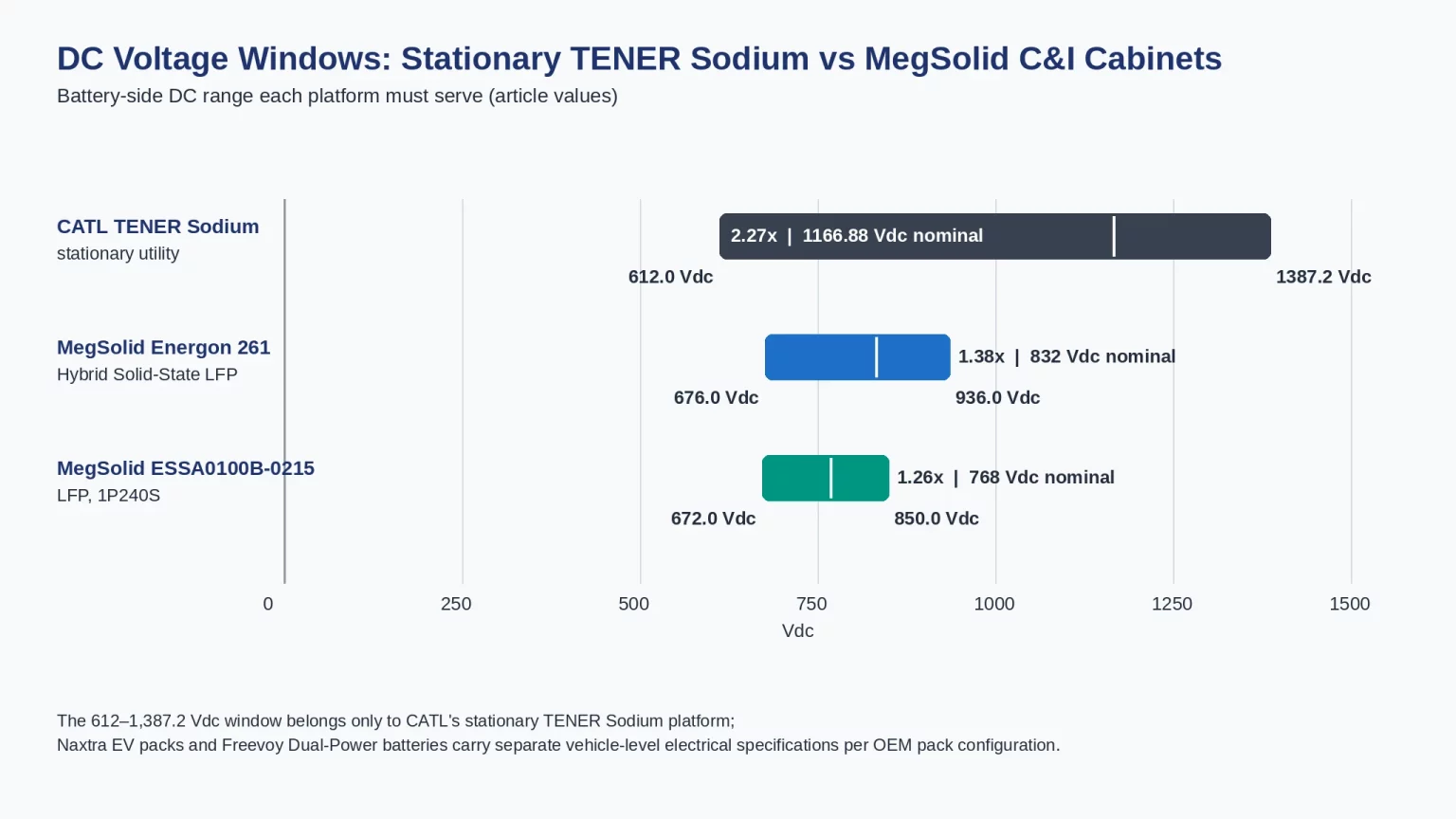
Review the published battery-side DC windows across MegSolid's unified stationary C&I cabinets:
- MegSolid Energon 261 (1P260S Hybrid Solid-State LFP-314Ah): 676 Vdc to 936 Vdc (832 Vdc nominal), a 1.38x max-to-min ratio with factory-integrated 125 kVA AC conversion.
- MegSolid ESSA0100B-0215 (1P240S LFP): 672 Vdc to 850 Vdc (768 Vdc nominal), a 1.26x ratio with factory-integrated 100 kW AC conversion and a built-in isolation transformer.
For utility sodium reference, CATL's stationary TENER Sodium platform operates across 612–1,387.2 Vdc (1,166.88 Vdc nominal, a 2.27x swing). That voltage window belongs exclusively to CATL's stationary TENER Sodium platform; Naxtra EV packs and Freevoy Dual-Power batteries carry separate vehicle-level electrical specifications defined per OEM pack configuration. Choosing a verified single-chemistry C&I product today still involves standard PCS, BMS, protection, and site checks, while keeping 2026–2027 procurement predictable.
Comparing Stationary C&I Architectures for a 2026–2027 Factory Tender? Request single-line diagrams, voltage-window documentation, and ambient thermal specifications for Energon 261, ESSA0100B-0215, ESSC0500B-1075, and ESSC1000B-2150 directly from our engineers.
Turnkey Hybrid Solid State Stationary BESS: What Commercial Buyers Can Deploy Today
Buyer Takeaway: While CATL maps Dual-Power toward future industrial sectors alongside EV rollouts, commercial buyers locking in verified safety and AC switchgear tie-in today deploy MegSolid's active C&I models.
Facility directors searching CATL Naxtra or Naxtra Dual Power battery energy storage want three concrete results: disciplined fire-safety design near occupied plants, predictable cycle life, and clean AC grid tie-in. Across the MegSolid C&I Energy Storage Systems lineup, EPCs match verified stationary hardware directly to plant switchgear. Buyers deploy active production lines today instead of waiting for dual-power concepts to become orderable 200 kWh–2 MWh grid SKUs.
1. Liquid-Cooled Hybrid Solid-State Platforms (Energon 261 & 5000INTL)
Buyers prioritizing turnkey Hybrid Solid-State stationary BESS technology deploy two dedicated platforms:
- MegSolid Energon 261 delivers 125 kVA / 261.24 kWh per cabinet using 1P260S Hybrid Solid-State LFP-314Ah cells (832 Vdc nominal, 676–936 Vdc, 480/400 Vac +/-15%, 90% published max system efficiency). Each IP54 cabinet takes a 1.755 m2 equipment base footprint (1,300 x 1,350 x 2,200 mm +/-5 mm, excluding site service clearances) and parallels up to 10 units (1,250 kVA / 2,612.4 kWh). Thermal and safety hardware pairs intelligent liquid cooling (+/-5 C spread) with AI early warning and Novec + multi-sensor + water-based fire suppression.
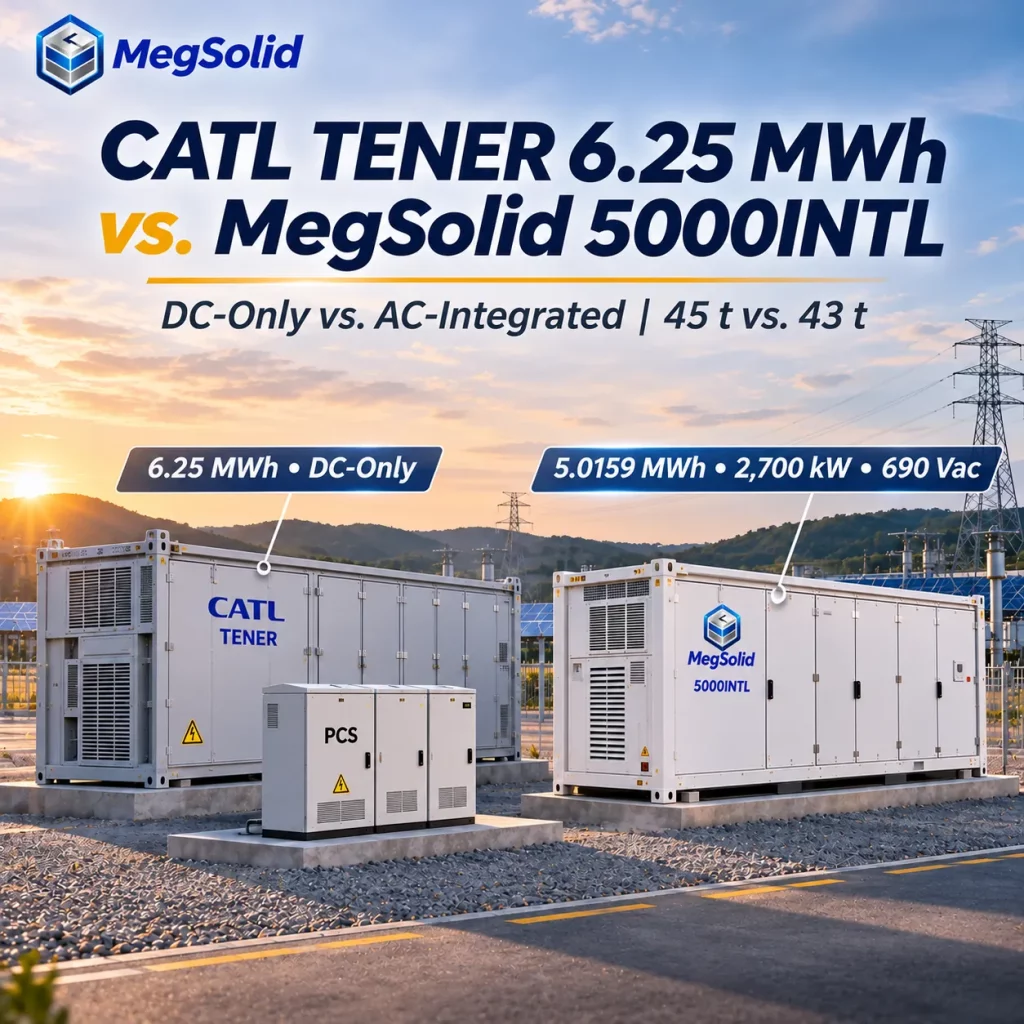
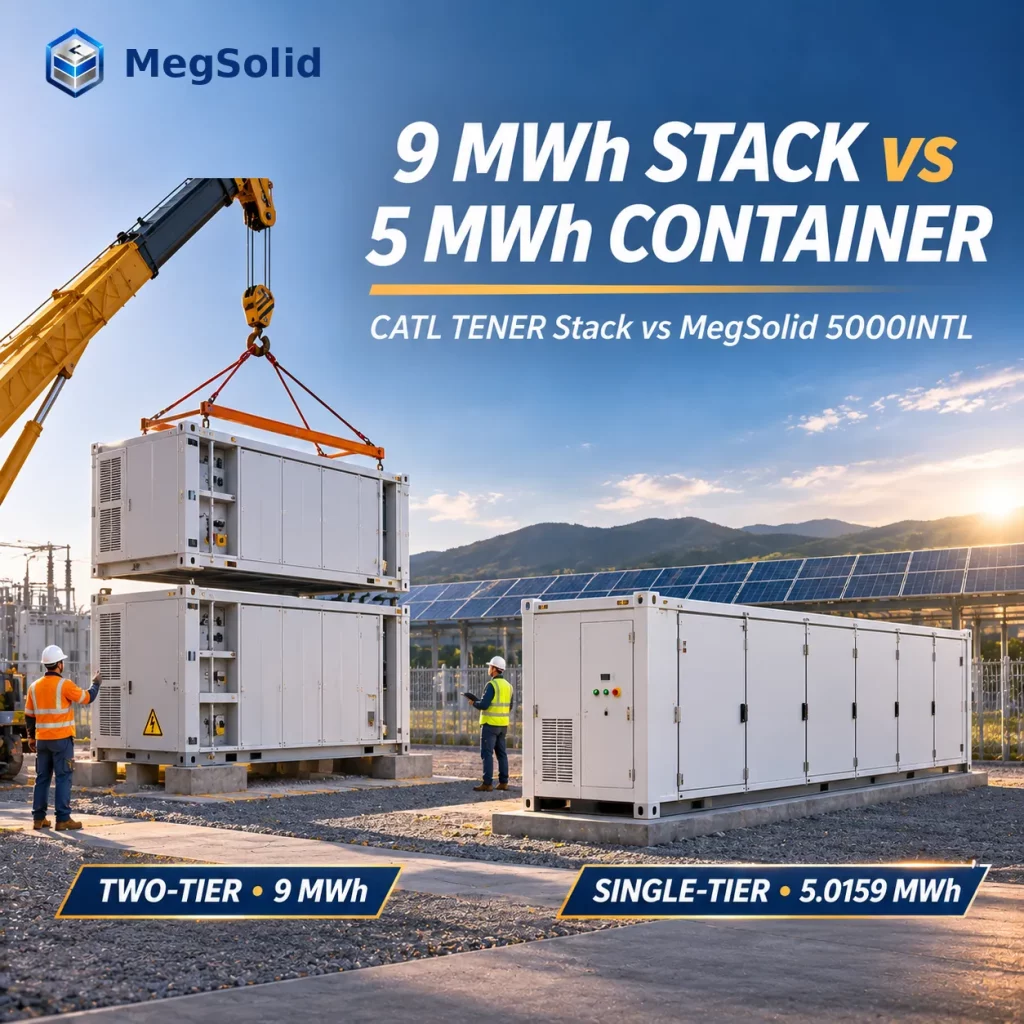
- MegSolid 5000INTL scales Hybrid Solid-State LFP (SHS180-314, 12P416S, 1,331.2 Vdc) to 2,700 kW (450 x 6 kW) / 5,015.9 kWh inside one 20-foot IP55 container (6,058 x 2,438 x 2,896 mm, 43,000 kg, ≤4,000 m altitude). It integrates 690 Vac conversion (87.5% published max efficiency), Smart Liquid Cooling, AI intelligent early warning, and a three-dimensional protection system.
2. Turnkey LFP Cabinets & Containers (ESSA0100B-0215, ESSC0500B-1075 & ESSC1000B-2150)
Commercial projects targeting air-cooled or transformer-isolated LFP deployments select proven catalog enclosures:
- MegSolid ESSA0100B-0215 pairs 100 kW / 215.04 kWh of LFP storage (1P240S, 768 V nominal, 672–850 Vdc, ≥5,000 cycles at 0.5C and 25 C) with 400 Vac output (320–460 V, 3W+N+PE, 144 A, THDi <3%). This 3,900 kg IP54 outdoor cabinet (2,450 x 1,550 x 2,400 mm) integrates an isolation transformer, Aerosols / NOVEC1230 suppression, and 1,000 V max PV compatibility.
- MegSolid ESSC0500B-1075 and ESSC1000B-2150 deliver containerized 3.2 V / 280 Ah LFP storage (≥5,000 cycles, IP54 intelligent air cooling). ESSC0500B-1075 supplies 500 kW / 1.0752 MWh in a 20-ft container (21,000 kg, 600–720 kW max PV), while ESSC1000B-2150 supplies 1,000 kW / 2.1504 MWh in a 40-ft container (38,000 kg, 1,200–1,440 kW max PV).
3. Standalone PCS & Hybrid Inverter Options for Custom Switchgear
For custom DC-coupled retrofits or microgrid upgrades, MegSolid supplies standalone conversion hardware. Always confirm exact battery-to-PCS voltage overlap, continuous current limits, BMS communication, and approved system pairing before ordering:
- MegSolid PMA080, PMA0105, and PMA0125 rack-mount PCS modules deliver 80 / 105 / 125 kW AC (96 / 126 / 150 kW max DC) across 615–950 Vdc (3W+PE) or 650–950 Vdc (3W+N+PE). They achieve 98.7% published max efficiency and <20 ms charge/discharge switching.
- MegSolid MEGA0030TS–MEGA0500TS isolation PCS cabinets supply 30–500 kW (33–550 kVA) at 96.3%–97.5% published max efficiency with a built-in isolation transformer, automatic on/off-grid switching, and parallel scaling up to 4 units. Their DC ranges span 250–850 Vdc to 500–850 Vdc by model, capping at 850 Vdc (below Energon 261's 936 Vdc upper limit) for approved ≤850 Vdc battery banks.
- MegSolid R30KH3, R40KH3, and R50KH3 three-phase hybrid inverters supply 30 / 40 / 50 kW AC in an IP65 enclosure with <10 ms backup switchover and 100% unbalanced load output on R50KH3. They operate across 150–800 Vdc for approved ≤800 Vdc Hybrid Solid-State or lithium-ion battery banks, below Energon 261's 832 Vdc nominal voltage.
Commercial Model Selector: Matching Factory Transformers to Active MegSolid Systems
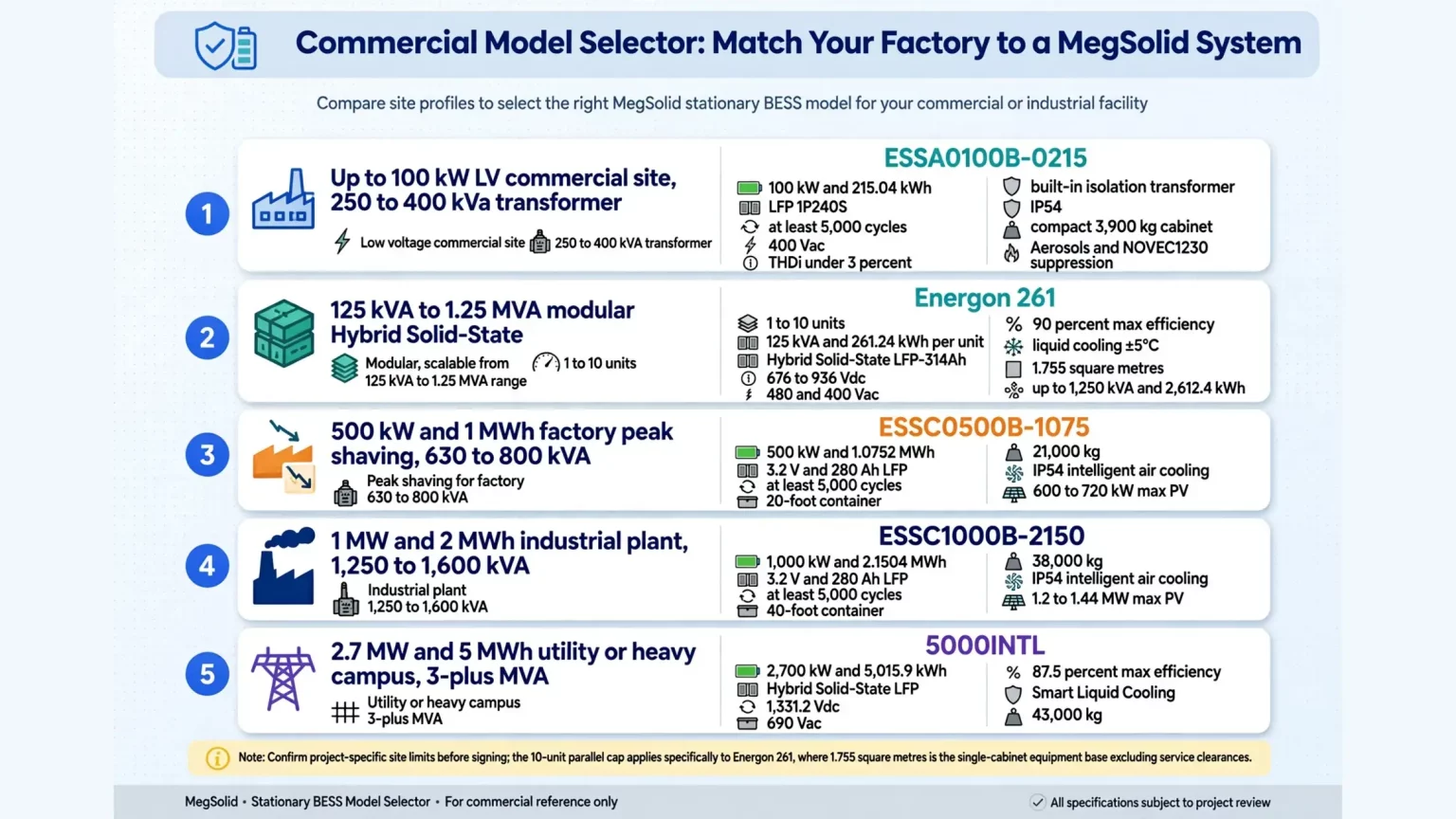
Buyer Takeaway: Match your site's transformer kVA, yard clearance, and chemistry preference directly to Energon 261, ESSA0100B-0215, ESSC containers, or 5000INTL for turnkey 2026–2027 deployment.
Use the selector matrix below to align commercial load profiles with MegSolid's verified catalog models.
| Target Industrial Site Profile | MegSolid Catalog Model | Published Rating & Chemistry | Key Electrical & Thermal Specs | Commercial Deployment Advantage |
|---|---|---|---|---|
| ≤100 kW LV Commercial Site (250–400 kVA) | ESSA0100B-0215 | 100 kW / 215.04 kWh; LFP (1P240S); ≥5,000 cycles | 400 Vac (320–460 V), THDi <3%, built-in isolation transformer, IP54 | Compact 3,900 kg cabinet; Aerosols / NOVEC1230 suppression |
| 125 kVA–1.25 MVA Modular Hybrid Solid-State | Energon 261 (1–10 units) | 125 kVA / 261.24 kWh per unit; Hybrid Solid-State LFP-314Ah | 676–936 Vdc, 480/400 Vac, 90% max eff, Liquid Cooling (+/-5 C), IP54 | 1.755 m2 equipment base (excl. clearances); up to 1,250 kVA / 2,612.4 kWh |
| 500 kW / 1 MWh Factory Peak Shaving (630–800 kVA) | ESSC0500B-1075 | 500 kW / 1.0752 MWh; 3.2 V / 280 Ah LFP; ≥5,000 cycles | 20-ft container (21,000 kg), IP54 intelligent air cooling, 600–720 kW PV | Single-pad 20-ft AC turnkey container; active production |
| 1 MW / 2 MWh Industrial Plant (1,250–1,600 kVA) | ESSC1000B-2150 | 1,000 kW / 2.1504 MWh; 3.2 V / 280 Ah LFP; ≥5,000 cycles | 40-ft container (38,000 kg), IP54 intelligent air cooling, 1.2–1.44 MW PV | High-capacity 2.15 MWh commercial block on unified LFP |
| 2.7 MW / 5 MWh Utility or Heavy Campus (3+ MVA) | 5000INTL | 2,700 kW (450 x 6 kW) / 5,015.9 kWh; Hybrid Solid-State LFP | 1,331.2 Vdc, 690 Vac, 87.5% max eff, Smart Liquid Cooling, IP55, 43,000 kg | Factory-integrated 690 Vac Hybrid Solid-State 20-ft block |
Confirm project-specific site limits before signing any supply contract. The 10-unit parallel cap applies specifically to Energon 261, where 1.755 m2 represents the single-cabinet equipment base footprint excluding service clearances. Parallel limits for ESSA0100B-0215 and ESSC containers are verified per single-line diagram. During bid qualification, EPC teams also confirm model-specific UL 9540 / UL 9540A or IEC 62619 test dossiers, cold-site enclosure heating scope, and full-load efficiency curves with MegSolid engineers.
FAQ
What is the difference between CATL Naxtra and CATL TENER Sodium?
CATL Naxtra is CATL's sodium-ion battery brand unveiled for passenger EVs and 24V heavy-duty truck applications. CATL TENER Sodium, unveiled in Munich on June 22, 2026, is CATL's stationary utility sodium-ion BESS targeting blocks above 30 MWh at 0.25P. Its ~4 MWh IP55 cabinets were updated to ~44–45 tonnes and ~15 feet long in October 2026, with international deliveries targeted for summer 2027.
Does passing GB 38031-2025 qualify an EV battery pack for European or US stationary BESS permitting?
GB 38031-2025 is China's mandatory safety standard for electric vehicle traction batteries, taking full effect on July 1, 2026 with strict thermal-runaway and bottom-impact criteria. Passing designated automotive tests verifies compliance strictly under that standard's test conditions. Stationary commercial yards in Europe, North America, the UK, and Australia still undergo independent project-level verification and permitting under codes such as UL 9540, UL 9540A, NFPA 855, IEC 62619, VDE, or ENA G99/G100.
What chemistries and goals does CATL's Freevoy Dual-Power architecture cover?
Unveiled on April 21, 2025, CATL's Freevoy Dual-Power architecture places two independent energy zones inside one pack using five dual-redundancy functions (high-voltage, low-voltage, structure, thermal management, and thermal runaway protection). Disclosed groupings include sodium-ion + LFP, LFP + LFP, and NCM + LFP or NCM + NCM. The design balances packaging volume, autonomous driving power redundancy, cycle life, and cold-weather performance down to -40 C, while CATL also flags industrial and commercial expansion as a future application direction.
Why do stationary C&I buyers evaluate single-chemistry cabinets differently from Dual-Power architectures?
Freevoy Dual-Power spans both mixed-chemistry (Na + LFP, NCM + LFP) and same-chemistry (LFP + LFP, NCM + NCM) dual zones. Whether any dual-zone system needs an extra DC-DC conversion stage depends on its electrical topology, bus architecture, and control strategy. For active 2026–2027 factory tenders, grid-connected stationary cabinets such as MegSolid Energon 261, ESSA0100B-0215, and the ESSC series already combine active thermal conditioning with straightforward single-chemistry service protocols, backed by standard PCS, protection, and site verification.
Which MegSolid stationary systems use Hybrid Solid-State LFP vs. standard LFP chemistry?
In MegSolid's published catalog, Energon 261 (125 kVA / 261.24 kWh, 1P260S, liquid-cooled) and 5000INTL (2,700 kW / 5,015.9 kWh, SHS180-314 12P416S, liquid-cooled) use Hybrid Solid-State LFP chemistry. ESSA0100B-0215 (100 kW / 215.04 kWh, 1P240S) and the air-cooled ESSC0500B-1075 (500 kW / 1.0752 MWh) and ESSC1000B-2150 (1,000 kW / 2.1504 MWh) containers use standard LFP chemistry rated for ≥5,000 cycles.
How does MegSolid Energon 261 scale for tight European or North American factory yards?
Each MegSolid Energon 261 Hybrid Solid-State cabinet measures 1,300 x 1,350 x 2,200 mm (+/-5 mm). Its 1.755 m2 figure represents the single-cabinet equipment base footprint, separate from complete installed area once service and fire clearances are added. Up to 10 Energon 261 cabinets operate in parallel to reach 1,250 kVA / 2,612.4 kWh along narrow industrial loading bays.
How do MegSolid Hybrid Solid-State systems address fire safety near occupied buildings?
MegSolid Energon 261 pairs Hybrid Solid-State LFP-314Ah cells with intelligent liquid cooling (keeping temperature spread within +/-5 C), AI early warning, and Novec + multi-sensor + water-based fire suppression inside an IP54 cabinet. For 5 MWh sites, 5000INTL combines Smart Liquid Cooling, AI early warning, and three-dimensional protection in an IP55 container. EPC teams confirm model-specific UL 9540A or IEC 62619 test packages prior to site approval.
Can standalone MegSolid PMA, MEGA, or R30KH3–R50KH3 inverters pair with any battery cabinet?
MegSolid Energon 261 and ESSA0100B-0215 ship with factory-integrated power conversion matched to their defined DC voltage windows. Selecting standalone PMA080–PMA0125 (615–950 Vdc / 650–950 Vdc), MEGA0030TS–MEGA0500TS (capping at 850 Vdc, below Energon 261's 936 Vdc ceiling), or R30KH3–R50KH3 (150–800 Vdc) for custom systems requires verifying voltage overlap, full-power current capability, BMS communication, and approved pairing.
What makes ESSA0100B-0215 suitable for small ≤100 kW LV commercial feeders?
MegSolid ESSA0100B-0215 delivers 100 kW / 215.04 kWh at 400 Vac (320–460 V, 3W+N+PE, 144 A, THDi <3%) with a built-in isolation transformer. This 3,900 kg IP54 cabinet includes Aerosols / NOVEC1230 suppression, 1,000 V max PV compatibility, and ≥5,000 cycles at 0.5C and 25 C.
When should an industrial plant choose ESSC0500B-1075 or ESSC1000B-2150 over Energon 261?
Facilities with dedicated 20-foot or 40-foot outdoor container pads that prefer air-cooled 3.2 V / 280 Ah LFP containers (≥5,000 cycles) often choose ESSC0500B-1075 (500 kW / 1.0752 MWh, 21,000 kg) or ESSC1000B-2150 (1,000 kW / 2.1504 MWh, 38,000 kg). Tight urban yards prioritizing liquid-cooled Hybrid Solid-State LFP on a 1.755 m2 equipment base footprint (before service clearances) choose Energon 261.
Conclusion: Turn Next-Gen Battery Headlines Into Immediate Commercial Action
CATL Naxtra and Freevoy Dual-Power show how rapidly dual-zone pack engineering and sodium-ion production are advancing, with automotive models shipping alongside CATL's future roadmap toward industrial and commercial applications. Factory energy managers and EPC teams still face monthly demand charges and tariff spikes every billing cycle right now.
Separating emerging roadmaps from orderable, system-verified stationary SKUs keeps 2026–2027 project delivery on schedule. Across MegSolid's Hybrid Solid-State platforms (Energon 261 and 5000INTL) and turnkey LFP range (ESSA0100B-0215, ESSC0500B-1075, and ESSC1000B-2150), commercial plants get active-production AC systems engineered specifically for 400 V and 690 V industrial switchgear today.
Ready to Specify a Stationary C&I BESS for Your 2026–2027 Facility? Share your transformer kVA rating, peak-shaving target, and local ambient conditions to receive single-line diagrams, compliance dossiers, and factory-direct pricing.