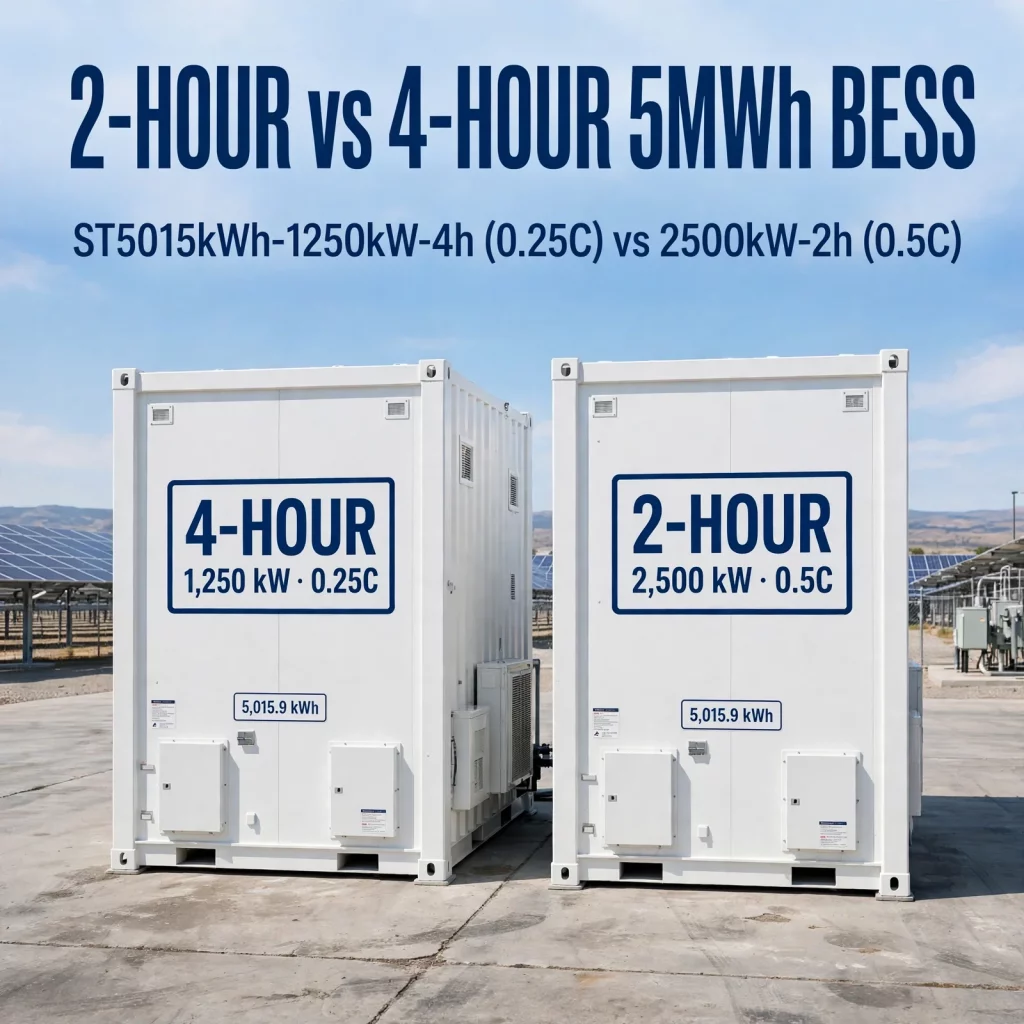
Utility IPPs and EPC teams running a CATL TENER 6.25MWh vs 5MWh BESS evaluation face two real field hurdles once quotes move to civil and haulage schedules. Teams auditing the CATL EnerC Plus specification hit the same constraints. First, 20-foot utility enclosures weighing 36 to 45 metric tons push tractor-trailer gross weight above standard unpermitted highway limits across the US, Europe, and Australia. Second, both CATL EnerC Plus (4,073.47 kWh in the 306 Ah build) and CATL TENER (6.25 MWh) ship as DC-only battery containers. Both platforms require external PCS equipment, configuration-specific DC cabling and protection, and BMS-to-PCS interface verification (plus any layout-dependent PCS foundations, DC combiners, or cable trenches).
Packing more megawatt-hours into one 20-foot shell trims bare battery pad counts on mega-scale yards. On 2 MWh to 50 MWh projects, buyers must weigh nominal capacity, total AC scope per heavy lift, road-permit thresholds, and external PCS balance-of-plant (BoP) scope together. Review our utility benchmark in Tesla Megapack Competitors: Compare 5MWh Utility-Scale BESS and our feeder current study in 690V BESS vs 400V for 5MWh Projects (MegSolid 5000INTL) for baseline math. Below, we benchmark CATL EnerC Plus and CATL TENER against factory AC-integrated MegSolid 5000INTL (2,700 kW / 5,015.9 kWh) units and lighter MegSolid C&I containers.
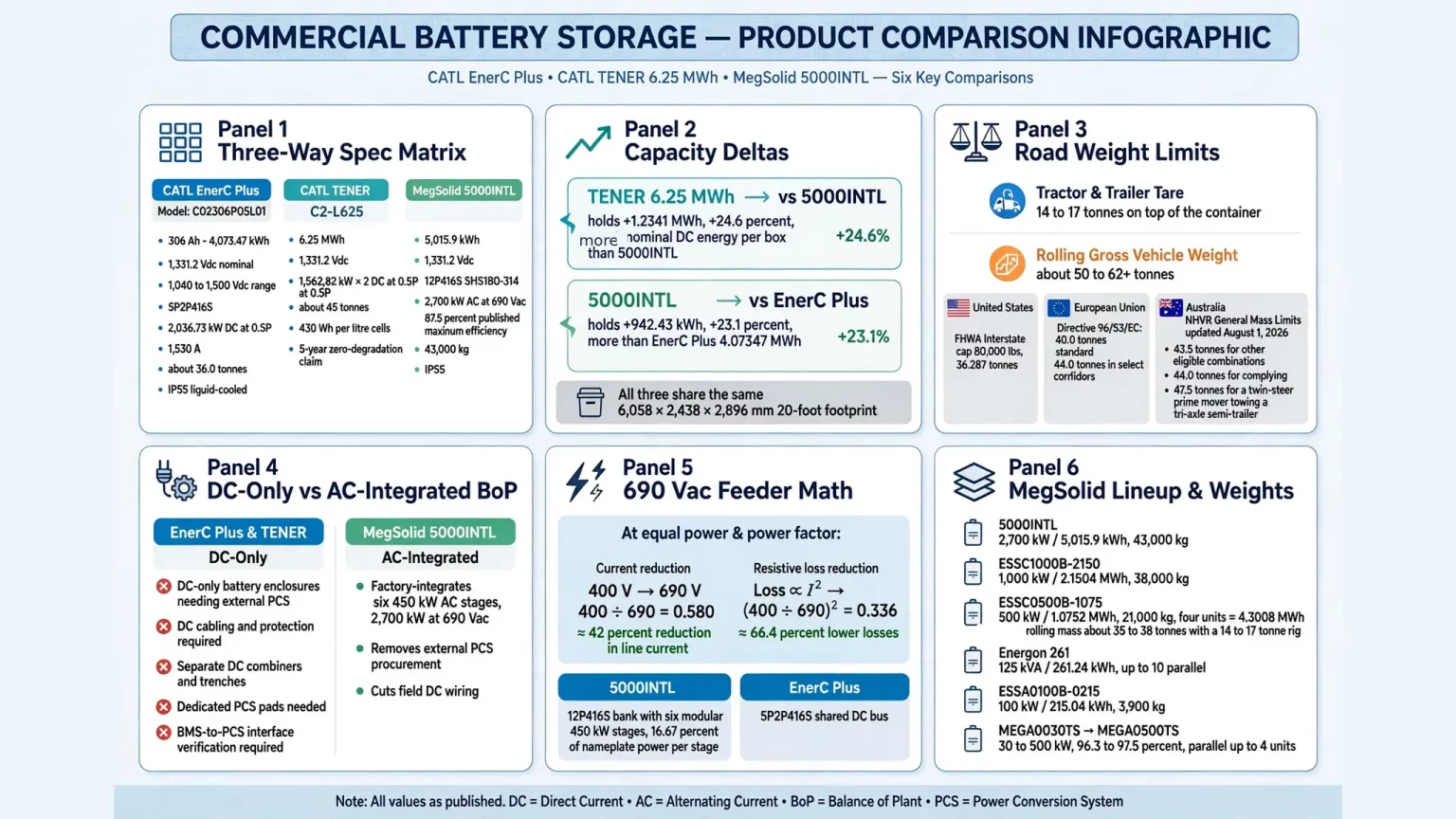
CATL EnerC Plus Specification vs. CATL TENER (6.25MWh) vs. MegSolid 5000INTL
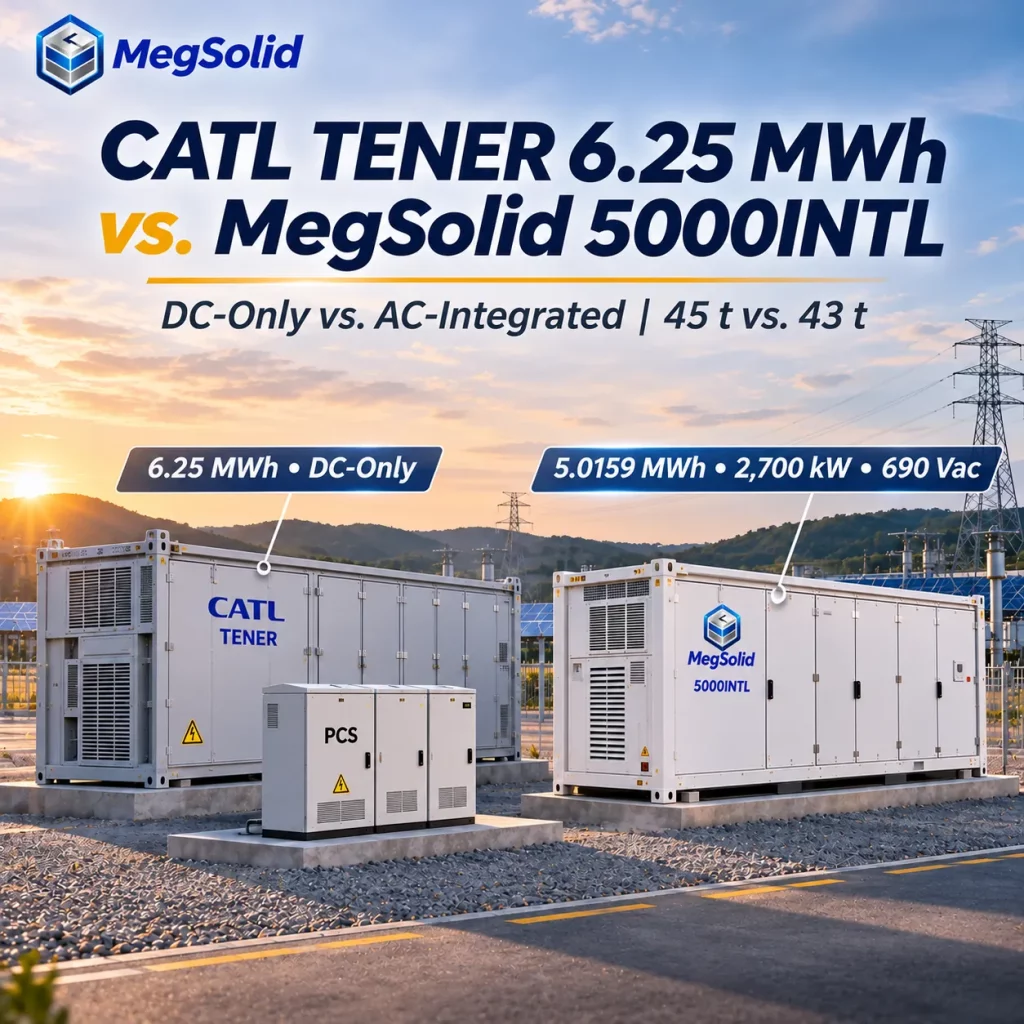
Buyer Takeaway: CATL TENER (6.25 MWh) leads in single-box DC energy (+24.6% over 5000INTL), while MegSolid 5000INTL leads EnerC Plus (+23.1%) and integrates 2,700 kW of 690 Vac output inside one 43,000 kg container.
1. Separating Verified CATL EnerC Plus & TENER Disclosures From Tender Assumptions
Accurate bid comparison starts with published model specifications for each platform. In CATL's EnerC Plus (EnerC+, model C02306P05L01, 306 Ah LFP) datasheet, the 20-foot IP55 liquid-cooled container delivers 4,073.47 kWh (4.07347 MWh) at 1,331.2 Vdc nominal (1,040–1,500 Vdc range) in a 5P2P416S configuration. At 0.5P, EnerC Plus rates 1,530 A and 2,036.73 kW (~2.04 MW) on the DC bus, with higher short-duration current limits per build. Each container weighs roughly 36.0 metric tons (~35.2–36.0 t depending on configuration) and holds cell temperature spread within 5 C using 50/50 glycol-water liquid cooling.
Unveiled in April 2024, CATL TENER scales a 20-foot equivalent (TEU) liquid-cooled container to 6.25 MWh. The design pairs high-density LFP cells (430 Wh/L) with biomimetic SEI and self-assembled electrolyte chemistry. In CATL's published product specification for the TENER C2-L625 6.25 MWh liquid-cooled container, the unit lists 1,331.2 Vdc nominal voltage, 1,562.82 kW x 2 rated DC power at 0.5P, liquid cooling, and roughly 45 metric tons weight. Industry specifications across 6 MWh-class 20-foot builds span ~43 to 45+ metric tons, so EPCs must confirm exact parameters for each 2024 TENER variant on the project datasheet and GA drawing. CATL markets TENER around a 5-year zero capacity and power degradation capability. Project lenders still verify binding SOH curves, throughput caps, ambient envelopes, and acceptance tests inside the supply contract. Both EnerC Plus and TENER arrive as DC-only battery enclosures requiring external PCS hardware.
2. Three-Way Utility Container Spec Matrix
| Utility BESS Metric | CATL EnerC Plus (C02306P05L01, 306 Ah) | CATL TENER (6.25 MWh, e.g., C2-L625) | MegSolid 5000INTL (2,700 kW / 5,015.9 kWh) |
|---|---|---|---|
| Footprint & Ingress Rating | 20-ft HC (6,058 x 2,438 x 2,896 mm), IP55 | 20-ft TEU liquid-cooled container (verify variant GA) | 20-ft HC (6,058 x 2,438 x 2,896 mm), IP55, <=4,000 m |
| Rated Energy & Capacity Delta | 4.07347 MWh (4,073.47 kWh); 1,331.2 Vdc (5P2P416S, 1,040–1,500 Vdc) | 6.25 MWh (+1.2341 MWh / +24.6% vs 5000INTL); 1,331.2 Vdc on C2-L625 | 5.0159 MWh (5,015.9 kWh, +23.1% vs EnerC+); 1,331.2 Vdc (12P416S SHS180-314) |
| Power Output & PCS Scope | DC-only: 2,036.73 kW DC @ 0.5P (1,530 A); external PCS required | DC-only: 1,562.82 kW x 2 DC @ 0.5P (C2-L625); external PCS required | Factory AC-integrated: 450 x 6 kW (2,700 kW) at 690 Vac, 87.5% pub. max eff. |
| Container Weight & Freight Class | ~36.0 t (~35.2–36.0 t) bare DC; route & axle permit check | ~45 t on C2-L625 spec (~43–45+ t range; confirm exact build GA) | 43,000 kg (43.0 t) all-in AC + battery; route & axle permit check |
| Cell Architecture & Cooling | 306 Ah liquid LFP; 50/50 glycol-water liquid cooling (within 5 C) | High-density LFP (430 Wh/L), liquid cooling (0.5P on C2-L625), 5-yr zero-deg claim | Hybrid Solid-State LFP (SHS180-314), Smart Liquid Cooling, AI warning |
CATL TENER 6.25MWh Weight & Road Limits: Honest Freight Math Across US, EU & Australia
Buyer Takeaway: Every 36–45 tonne 20-foot BESS requires route and axle-load engineering on a 14–17 t rig. Compare delivered AC scope per heavy lift, or evaluate 21,000 kg ESSC0500B-1075 where route limits allow.
1. Highway Gross Vehicle Weight Reality for All 20-Foot Utility BESS Containers
Highway regulators enforce Gross Vehicle Weight (GVW) and axle-load ceilings across the complete rolling rig. Standard container tractors and trailers add 14 to 17 metric tons of tare mass (and heavy multi-axle low-loaders add even more) on top of container weight:
Highway GVW = Tractor & Trailer Tare (~14–17 t) + BESS Container Weight
Official regional transport rules show why every 36 to 45 metric ton utility container needs route planning:
- United States (FHWA Interstate Limit): Federal bridge formulas cap standard commercial GVW at 80,000 lbs (36.287 metric tons) without state overweight permits. Even a ~36.0 t bare DC EnerC Plus box nears that full limit before adding tractor and chassis mass (~50–53 t rolling GVW).
- European Union (Directive 96/53/EC): Standard cross-border articulated transport caps GVW at 40.0 metric tons, with 44.0 t permitted in select member states or intermodal corridors alongside strict drive-axle caps (such as 11.5 t). Any 36 t to 45 t 20-foot container crosses that threshold and requires multi-axle permitting and axle-load balancing.
- Australia (NHVR Heavy Vehicle National Law, Updated August 1, 2026): Under NHVR General Mass Limit (GML) updates effective August 1, 2026, limits rose from 42.5 t to 43.5 t for other eligible combinations (non-B-double and non-road-train combinations). Limits also rose from 43.0 t to 44.0 t for complying steer-axle vehicles, and from 46.5 t to 47.5 t for a twin-steer prime mover towing a tri-axle semi-trailer. Even at these updated limits, a 36 t to 45 t container on a 14 t to 17 t rig reaches ~50 t to 62+ t rolling GVW. Every 36–45 t BESS therefore remains governed by combination rules, axle-group ratings, bridge limits, and PBS, mass-exemption, or OSOM permits.
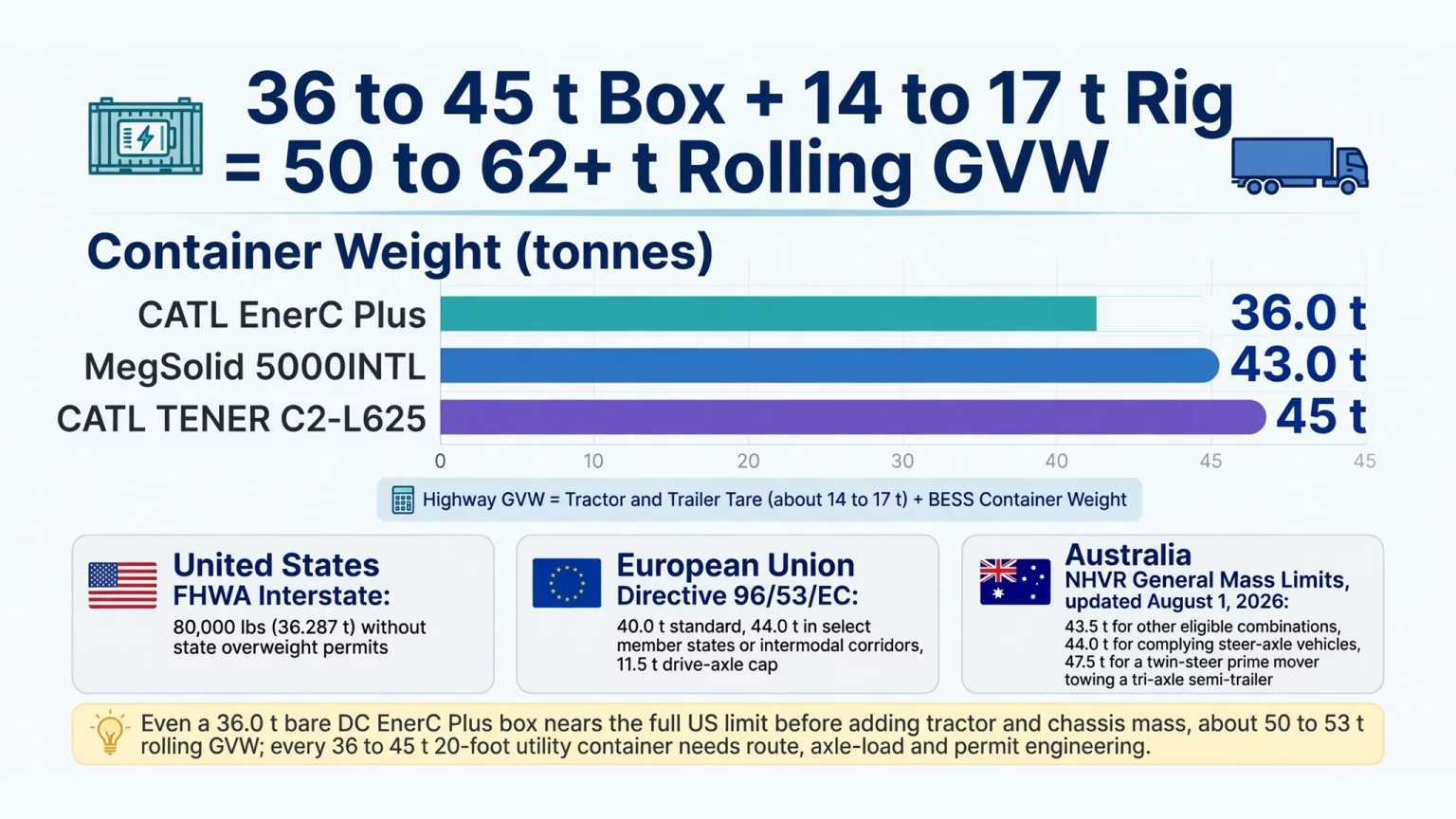
2. Comparing CATL TENER 6.25MWh Weight Against MegSolid 5000INTL (43,000 kg) & Lighter C&I Options
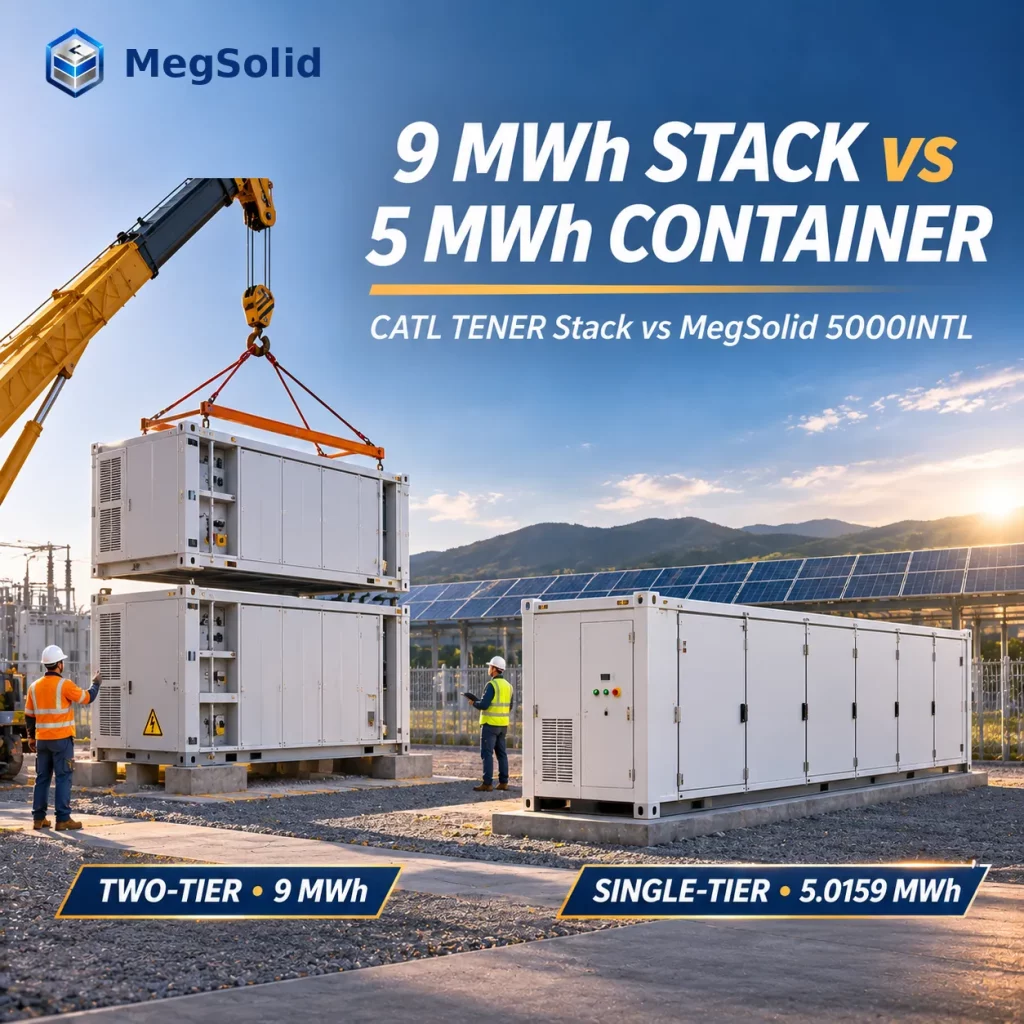
In CATL's product manual for the TENER C2-L625 6.25 MWh liquid-cooled container, weight is listed at approximately 45 metric tons. Wider industry specifications across 6 MWh-class 20-foot builds span ~43 to 45+ metric tons, pushing rolling mass near 58 to 62+ metric tons on multi-axle trailers. Because regional 2024 TENER variants or auxiliary packages can differ from C2-L625, EPCs must confirm certified net weight, gross weight, and CSC plate ratings on the project GA drawing before pricing haulage or cranes. Those 40+ ton single-box weight pressures also drove CATL to introduce its split two-in-one TENER Stack in May 2025, keeping each half-height shipping module under 36 tonnes.
MegSolid applies the same weight transparency to 5000INTL. Published factory specifications list MegSolid 5000INTL at 43,000 kg (43.0 metric tons) inside a 6,058 x 2,438 x 2,896 mm 20-foot IP55 enclosure. Like the ~45 t TENER C2-L625 or the ~36 t EnerC Plus, moving a 43,000 kg 5000INTL over public roads requires route-specific heavy-haul permits, multi-axle trailers, and engineered crane plans matched to lift radius and soil bearing capacity.
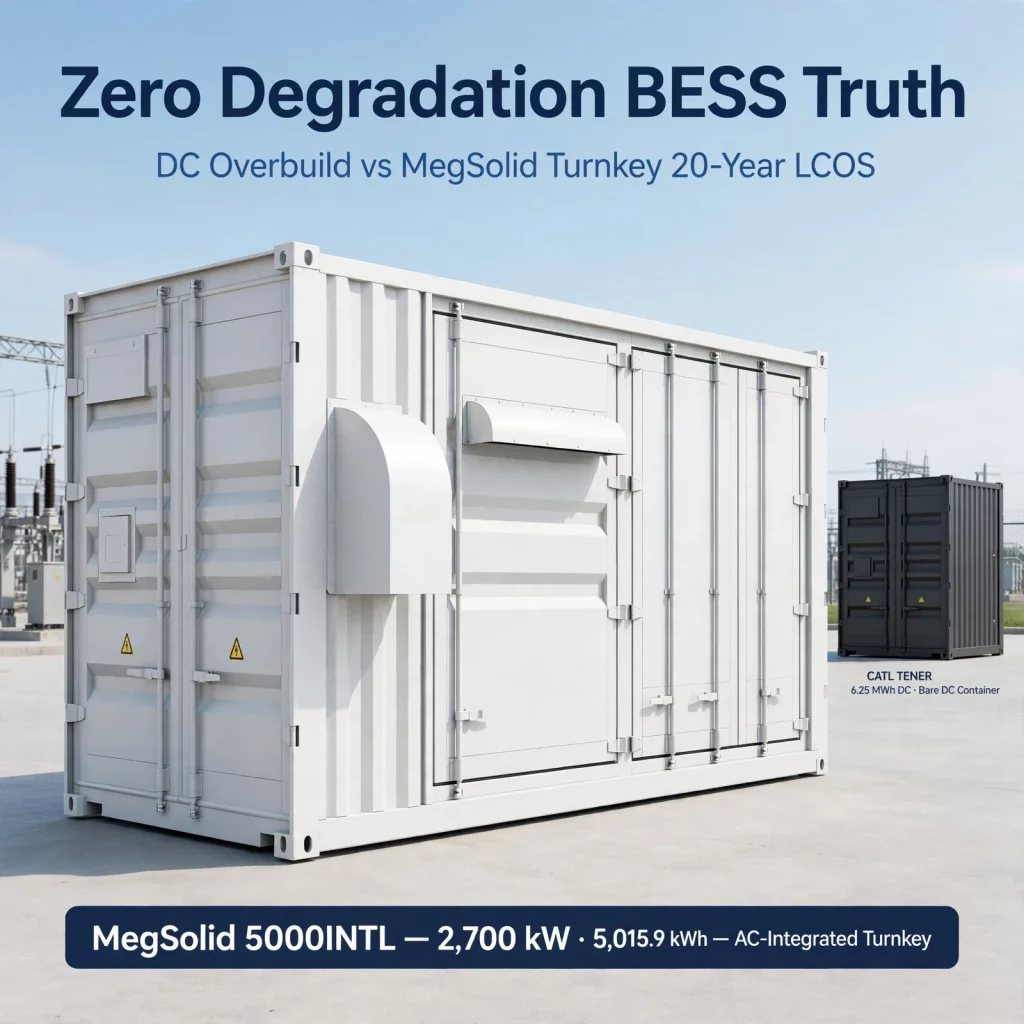
The commercial advantage is the delivered scope inside that single heavy lift. Hauling a ~36 t EnerC Plus or ~45 t TENER C2-L625 delivers a DC-only battery enclosure, leaving external PCS procurement, freight, and site installation as separate packages. Hauling one 43,000 kg MegSolid 5000INTL delivers 5,015.9 kWh of storage plus 2,700 kW of factory-wired 690 Vac conversion in one crane pick. For lighter industrial tenders, the 21,000 kg ESSC0500B-1075 (500 kW / 1.0752 MWh) may reduce haulage complexity compared with 36–45 tonne utility containers, subject to the selected vehicle's gross and axle-load limits and approved route. Adding a 14–17 t tractor-trailer brings rolling mass to ~35–38 t, which can still exceed the US 80,000 lbs (36.287 t) Interstate cap or trigger single-axle limits on specific bridges. Smaller commercial yards can also deploy 3,900 kg outdoor cabinets (ESSA0100B-0215) or modular Energon 261 cabinets.
Compare Heavy-Haul Permits & Full AC-Installed Scope Before Awarding Request official GA drawings, certified shipping weights, single-line diagrams (SLDs), and delivery lead times for MegSolid 5000INTL, ESSC0500B-1075, ESSC1000B-2150, and Energon 261.
DC-Only BESS Container vs Turnkey AC 5MWh (5000INTL): Reducing External PCS & Field DC Interface Scope
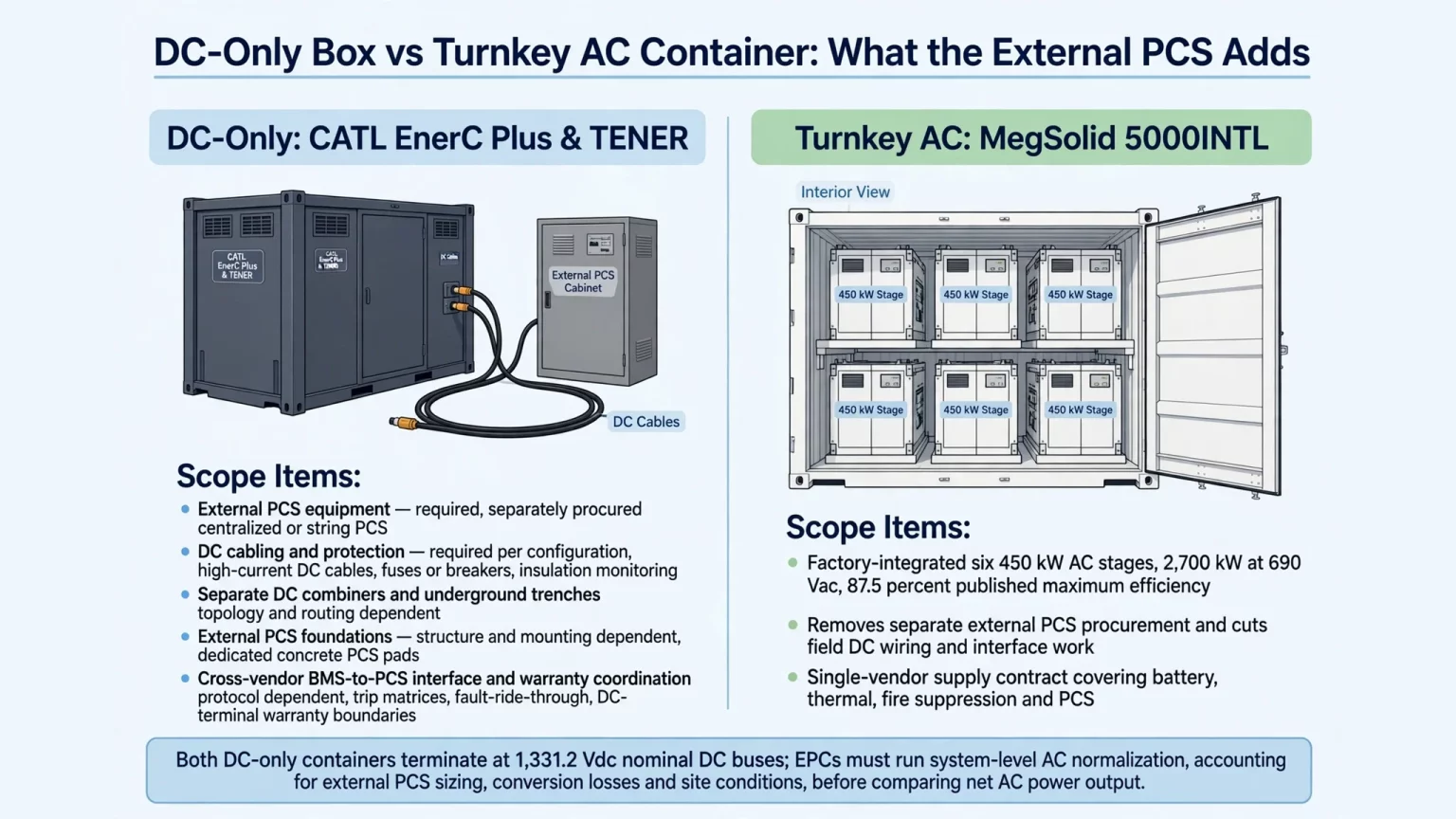
Buyer Takeaway: Factory-integrating six 450 kW power stages (2,700 kW at 690 Vac) inside MegSolid 5000INTL removes separate external PCS procurement and cuts field DC wiring and interface work.
1. Separating Mandatory vs. Layout-Dependent Balance-of-Plant Scope on DC-Only Blocks
Evaluating a DC-only BESS container vs turnkey AC 5MWh bid starts by separating mandatory DC-box scope from layout-dependent work. Both EnerC Plus (4,073.47 kWh, 1,331.2 Vdc, 1,530 A rated DC at 0.5P) and TENER C2-L625 (6.25 MWh, 1,331.2 Vdc, 1,562.82 kW x 2 rated DC at 0.5P) terminate at DC buses only. EPCs must budget five distinct engineering packages:
- External PCS Equipment (Required): Both DC-only containers require separately procured centralized or string PCS hardware to deliver AC grid power.
- DC-Side Cabling & Protection (Required per Configuration): High-current DC cables, fuses or breakers, and insulation monitoring between battery terminals and external PCS inputs must be engineered per layout.
- Separate DC Combiners & Underground Trenches (Topology & Routing Dependent): Dedicated DC combiner cabinets depend on PCS topology and parallel branch count. Underground DC trenches depend on whether site routing uses trenched conduits, above-ground cable trays, or close-coupled skids.
- External PCS Foundations (Structure & Mounting Dependent): Dedicated concrete PCS pads depend on the chosen PCS enclosure structure and whether inverters share an integrated MV skid foundation.
- Cross-Vendor BMS-to-PCS Interface & Warranty Coordination (Protocol Dependent): Tier-1 battery and PCS vendors often provide pre-validated CAN or Modbus/TCP profiles. EPCs still verify trip matrices, fault-ride-through settings, and DC-terminal warranty boundaries during commissioning.
2. Capacity, Power Boundaries & 690 Vac Feeder Math: TENER vs. EnerC Plus vs. 5000INTL
Comparing all three 20-foot containers side by side pinpoints each platform's verified engineering edge:
- Nominal Storage Capacity Across All Three 20-Foot Models: CATL TENER (6.25 MWh) holds +1.2341 MWh (+1,234.1 kWh, or +24.6%) more nominal DC storage per box than MegSolid 5000INTL (5.0159 MWh / 5,015.9 kWh). MegSolid 5000INTL holds +942.43 kWh (+23.1%) more nominal energy than the 306 Ah CATL EnerC Plus (4.07347 MWh / 4,073.47 kWh) inside identical 6,058 x 2,438 x 2,896 mm IP55 dimensions. Against 6.25 MWh TENER, 5000INTL anchors its procurement edge in factory-integrated AC conversion and single-vendor supply boundaries.
- AC vs. DC Power Boundaries (2,700 kW AC vs. 2,036.73 kW / 1,562.82 kW x 2 DC): MegSolid 5000INTL integrates 2,700 kW (450 x 6 kW) of rated AC conversion at 690 Vac (50/60 Hz, 87.5% published maximum efficiency). CATL EnerC Plus specifies 2,036.73 kW of rated DC power at 0.5P, and TENER C2-L625 specifies 1,562.82 kW x 2 of rated DC power at 0.5P, each pairing with an external PCS. Because these ratings sit on different electrical boundaries, EPCs must run system-level AC normalization (accounting for external PCS sizing, conversion losses, and site conditions) before comparing net AC power output.
- Lower AC Feeder Current vs 400 Vac Designs: At equal power and power factor, increasing the AC voltage from 400 V to 690 V reduces line current by approximately 42% (400 / 690 = 0.580). With unchanged conductor resistance, resistive losses decrease by approximately 66.4% ((400 / 690)^2 = 0.336). Actual conductor sizing, cable cost, and losses depend on the selected low-voltage feeder design, thermal limits, and installation conditions.
- Auditing Multi-Stage PCS & Parallel String Topology: Buyers comparing a 5MWh 690V string PCS container layout against centralized inverters check rack-to-PCS isolation and current balancing closely. EnerC Plus groups 306 Ah cells into a 5P2P416S shared DC bank. MegSolid 5000INTL pairs a 12P416S (SHS180-314) Hybrid Solid-State LFP bank with six modular 450 kW AC stages (16.67% of nameplate power per stage). Across any supplier, EPCs audit the approved single-line diagram (SLD) to confirm DC/AC disconnects, string-to-PCS grouping, balancing logic, and protection selectivity before modeling partial-outage availability.
Right-Sizing Utility & C&I BESS: Matching 5000INTL, ESSC & Energon 261 to Site Weight & Voltage
Buyer Takeaway: Deploy 5000INTL on 5–50 MWh 690 Vac utility yards with heavy-haul budgets. Select 21 t ESSC0500B-1075, 38 t ESSC1000B-2150, or Energon 261 for 400 V/480 V switchgear or lighter unit mass.
1. Standardized Factory-AC Lineup Beyond Single-Box 5 MWh Blocks
Over-specifying a 6.25 MWh DC box onto a 2 MWh factory feeder consumes substation headroom and adds external PCS coordination. Across our MegSolid C&I and Commercial-Utility Energy Storage Systems lineup, EPCs match unit mass, bus voltage, and AC integration directly to site limits:
- 20-Foot & 40-Foot Industrial Containers (1–8.6 MWh): MegSolid ESSC0500B-1075 and ESSC1000B-2150 use 3.2 V / 280 Ah LFP cells (>=5,000 cycles) with IP54 intelligent air cooling. ESSC0500B-1075 delivers 500 kW / 1.0752 MWh in a 21,000 kg 20-foot box (6,058 x 2,438 x 2,896 mm; 600, 660, or 720 kW max PV; 4 units = 2 MW / 4.3008 MWh). The 21,000 kg ESSC0500B-1075 may reduce haulage complexity compared with 36–45 tonne utility containers, subject to the selected vehicle's gross and axle-load limits and approved route. ESSC1000B-2150 delivers 1,000 kW / 2.1504 MWh in a 38,000 kg 40-foot container (12,192 x 2,438 x 2,896 mm; 1,200, 1,320, or 1,440 kW max PV; 4 units = 4 MW / 8.6016 MWh). Confirm lifting points, foundation support reactions, and trailer axle loads per site GA drawing.
- High-Density Liquid-Cooled Commercial Cabinets (261 kWh–2.61 MWh): Tight commercial yards deploy MegSolid Energon 261 (125 kVA / 261.24 kWh) beside 400 V or 480 V switchgear. Each cabinet uses 1P260S 314 Ah Hybrid Solid-State LFP cells (832 Vdc nominal, 676–936 Vdc, 480/400 V +/-15%, 90% published max system efficiency). Thermal and safety hardware pairs Intelligent Liquid Cooling (cell delta within +/-5 C) with AI early warning and Novec + multi-sensor + water fire suppression. Its 1.755 m2 equipment base footprint (1,300 x 1,350 x 2,200 mm +/-5 mm; pads and clearances per approved site layout) parallels up to 10 cabinets (1,250 kVA / 2,612.4 kWh) for modular commercial delivery.
- Isolated Feeders & Standalone PCS Hardware: Small 400 V industrial feeders deploy MegSolid ESSA0100B-0215 (100 kW / 215.04 kWh) at 3,900 kg net weight. Verified specs include 768 V (1P240S, 672–850 Vdc), 400 Vac 3W+N+PE, THDi <3%, a built-in isolation transformer, >=5,000 cycles, and 1,000 V max PV. Custom AC-coupled microgrids needing galvanic isolation pair with standalone MegSolid MEGA0030TS–MEGA0500TS Isolation PCS blocks (30–500 kW / 33–550 kVA, 96.3%–97.5% max efficiency, forced-air cooling, automatic on/off-grid switching, parallel up to 4 units).
2. Capacity, Weight & Voltage Selection Matrix
| Project Scale & Road / Grid Constraint | Recommended Architecture | Verified Rating & Weight | Key Site-Execution Advantage |
|---|---|---|---|
| 0.21–2.61 MWh Commercial Feeders (400/480 V) | 1–10 x Energon 261; ESSA0100B-0215 configurations subject to project-specific parallel limits | Energon 261: 125 kVA / 261.24 kWh; ESSA: 100 kW / 215.04 kWh (3,900 kg) | Modular cabinet freight; smaller crane and pad requirements |
| 1–4.3 MWh Lighter-Unit Industrial Sites | 1–4 x ESSC0500B-1075 (20-ft Air-Cooled) | 500 kW / 1.0752 MWh per 21,000 kg unit (4 units = 4.3008 MWh) | 21 t mass may ease haulage vs 36–45 t boxes (verify axle & route limits) |
| 2–8.6 MWh Heavy Factory / Mining Microgrids | 1–4 x ESSC1000B-2150 (40-ft Air-Cooled) | 1,000 kW / 2.1504 MWh per 38,000 kg unit (4 units = 8.6016 MWh) | Factory AC-integrated 1 MW blocks; verify 40-ft axle loads |
| 5–50 MWh Utility / Solar+Storage (690 Vac) | 1–10 x MegSolid 5000INTL (20-ft Liquid) | 2,700 kW / 5,015.9 kWh per 43,000 kg unit (up to 50.159 MWh) | Single heavy-haul lift includes battery + 690 Vac PCS; reduces field DC wiring |
| 100+ MWh Giga-Scale Utility Yards | Benchmark 20+ x 5000INTL vs TENER / EnerC+ | Compare full AC-installed USD/kWh + external PCS BoP | Weigh TENER’s +24.6% box capacity against 5000INTL integrated AC scope |
FAQ
How much does a CATL TENER 6.25 MWh container weigh compared with MegSolid 5000INTL?
CATL's published TENER C2-L625 6.25 MWh liquid-cooled specification (1,331.2 Vdc nominal, 1,562.82 kW x 2 rated DC power at 0.5P) lists a container weight of approximately 45 metric tons. Broader 6 MWh-class 20-foot specifications span ~43 to 45+ metric tons, so buyers must verify exact build weights on the project GA drawing. MegSolid publishes a factory weight of 43,000 kg (43.0 t) for the 20-foot 5000INTL, which includes 5,015.9 kWh of storage plus 2,700 kW of integrated 690 Vac conversion hardware.
Do 5 MWh to 6.25 MWh 20-foot BESS containers exceed US, EU, and Australian road weight limits?
Yes. Adding a 14 to 17 metric ton tractor and trailer to a 36 t to 45 t 20-foot BESS container pushes rolling Gross Vehicle Weight to roughly 50 to 62+ metric tons. That exceeds standard unpermitted caps under US FHWA Interstate rules (80,000 lbs / 36.287 t) and EU Directive 96/53/EC (40.0 t standard; 44.0 t in select domestic or intermodal corridors). It also exceeds Australia's NHVR General Mass Limits updated on August 1, 2026: 43.5 t for other eligible non-B-double and non-road-train combinations, 44.0 t for complying steer-axle vehicles, and 47.5 t for a twin-steer prime mover towing a tri-axle semi-trailer. Route, axle-load, and permit planning applies across EnerC Plus, TENER, and 5000INTL alike.
How does the 21,000 kg MegSolid ESSC0500B-1075 affect road-haulage complexity compared with 36–45 tonne containers?
The 21,000 kg ESSC0500B-1075 (500 kW / 1.0752 MWh in a 20-foot AC-integrated enclosure) may reduce haulage complexity compared with 36–45 tonne utility containers, subject to the selected vehicle's gross and axle-load limits and approved route. Combined with a 14 to 17 metric ton tractor-trailer, total rolling mass reaches roughly 35 to 38 metric tons. That range can still exceed the 80,000 lbs (36.287 t) US Interstate cap or trigger single-axle limits on specific corridors. Smaller commercial sites can also deploy 3,900 kg ESSA0100B-0215 cabinets (100 kW / 215.04 kWh) or modular Energon 261 cabinets (125 kVA / 261.24 kWh, up to 10 in parallel).
What is the main engineering difference between a DC-only BESS container and a turnkey AC 5 MWh container?
DC-only battery blocks like CATL EnerC Plus and CATL TENER C2-L625 terminate at 1,331.2 Vdc nominal (1,500 Vdc-class) DC buses. Those designs require external PCS equipment plus configuration-specific DC cabling and protection. Separate DC combiners, underground cable trenches, dedicated PCS pads, and protocol integration scope depend on PCS topology, mounting design, and pre-validated vendor interfaces. MegSolid 5000INTL factory-integrates six 450 kW AC stages (2,700 kW at 690 Vac) inside one 20-foot IP55 enclosure, removing external PCS procurement and reducing field DC cabling and interface work.
How does MegSolid 5000INTL compare against CATL TENER and CATL EnerC Plus in energy and power ratings?
CATL TENER (6.25 MWh) holds +1.2341 MWh (+24.6%) more nominal DC energy per 20-foot container than MegSolid 5000INTL (5.0159 MWh / 5,015.9 kWh). MegSolid 5000INTL holds +942.43 kWh (+23.1%) more energy than the 306 Ah CATL EnerC Plus (4.07347 MWh / 4,073.47 kWh). On power ratings, 5000INTL integrates 2,700 kW (450 x 6 kW) of rated 690 Vac AC conversion (87.5% published maximum efficiency), while EnerC Plus specifies 2,036.73 kW DC at 0.5P and TENER C2-L625 specifies 1,562.82 kW x 2 DC at 0.5P with external PCS. Because AC and DC ratings reflect different electrical boundaries, accurate power comparisons require system-level AC normalization.
Why does 690 Vac AC output on MegSolid 5000INTL reduce cabling cost compared with 400 Vac systems?
At equal power and power factor, increasing the AC voltage from 400 V to 690 V reduces line current by approximately 42% (400 / 690 = 0.580). With unchanged conductor resistance, resistive losses decrease by approximately 66.4% ((400 / 690)^2 = 0.336). Actual conductor sizing, cable cost, and losses depend on the selected low-voltage feeder design, thermal limits, and installation conditions.
Is CATL TENER's 5-year zero degradation claim an automatic warranty guarantee?
CATL markets TENER (6.25 MWh) around a 5-year zero capacity and power degradation capability supported by biomimetic SEI and self-assembled electrolyte designs. Project financiers and EPCs verify exact contractual warranty terms inside the project supply agreement. Review guaranteed state-of-health (SOH) curves, annual cycle or throughput limits, ambient operating envelopes, and annual capacity test procedures before closing finance.
What are the verified factory specifications of MegSolid 5000INTL?
MegSolid 5000INTL delivers 5,015.9 kWh rated energy (12P416S SHS180-314 Hybrid Solid-State LFP, 1,331.2 Vdc nominal) and 450 x 6 kW (2,700 kW) of 690 Vac (50/60 Hz) AC power at 87.5% published maximum efficiency. The 20-foot IP55 enclosure measures 6,058 x 2,438 x 2,896 mm and weighs 43,000 kg. Thermal and safety systems include Smart Liquid Cooling, AI intelligent early warning, and operation up to 4,000 m altitude.
When should industrial or mining microgrids pick ESSC1000B-2150 or ESSC0500B-1075 instead of 5000INTL?
Projects sizing between 1 MWh and 8.6 MWh on industrial feeders often match better with MegSolid's IP54 intelligent air-cooled ESSC containers using 3.2 V / 280 Ah LFP cells (>=5,000 cycles). ESSC0500B-1075 provides 500 kW / 1.0752 MWh at 21,000 kg in a 20-foot box (600–720 kW max PV; 4 units = 4.3008 MWh). ESSC1000B-2150 provides 1,000 kW / 2.1504 MWh at 38,000 kg in a 40-foot box (1,200–1,440 kW max PV; 4 units = 8.6016 MWh).
Does MegSolid supply standalone isolation-transformer PCS for custom utility or C&I retrofits?
Yes. For custom AC-coupled builds requiring galvanic isolation and automatic on/off-grid switching, MegSolid builds the MEGA0030TS–MEGA0500TS PCS series (30 to 500 kW / 33 to 550 kVA, 96.3%–97.5% maximum efficiency). Standard features include a built-in isolation transformer, forced-air cooling, 3W+N+PE off-grid output, and parallel operation up to 4 units. Confirm site grid-code certificates and protection settings directly with MegSolid engineering.
Conclusion: Price Full AC-Installed Scope & Verified Highway Logistics
Comparing CATL TENER 6.25MWh vs 5MWh BESS bids or auditing the CATL EnerC Plus specification requires full site-delivered economics alongside headline container MWh. CATL TENER (6.25 MWh, ~45 t on the C2-L625 datasheet) holds +1.2341 MWh (+24.6%) more DC capacity per box than MegSolid 5000INTL. Every 36 t to 45 t 20-foot utility battery container still requires route, axle-load, and permit engineering under US FHWA, EU Directive 96/53/EC, and Australia's August 2026 NHVR mass limits. Buyers protect schedules and BoP budgets by maximizing factory-integrated AC scope per heavy-haul lift, or evaluating lighter 21,000 kg units where vehicle and route limits permit.
MegSolid 5000INTL consolidates 5,015.9 kWh of Hybrid Solid-State LFP storage (+942.43 kWh / +23.1% over EnerC Plus) and 2,700 kW (450 x 6 kW) of 690 Vac AC output inside one 43,000 kg 20-foot IP55 container. Factory AC integration removes separate external PCS procurement and reduces field DC cabling and interface work between the battery enclosure and external PCS. Across 215 kWh to 8.6 MWh industrial and commercial feeders, ESSC0500B-1075 (21,000 kg), ESSC1000B-2150 (38,000 kg), Energon 261 (parallel up to 10 cabinets), and ESSA0100B-0215 (3,900 kg) deliver factory-tested AC alternatives. Request certified GA weights, SLDs, and factory-direct quotes from MegSolid engineering before finalizing your EPC bid.
Request MegSolid 5000INTL & ESSC Certified Weight Drawings, SLDs & Quotes Connect with MegSolid's utility and industrial engineering team for 20-foot 5000INTL (43,000 kg AC-integrated), 21,000 kg ESSC0500B-1075, ESSC1000B-2150, and Energon 261 documentation.