
لم يعد ضجيج أنظمة تخزين الطاقة بالبطاريات مجرد مسألة ثانوية عندما يقع الموقع بالقرب من المنازل أو الفنادق أو المستشفيات أو العقارات متعددة الاستخدامات. يجمع هذا الدليل بيانات منتجات MegSolid التي تم التحقق منها ويضعها جنبًا إلى جنب، ويوضح المكان المناسب لكل خط إنتاج، ويحول قيم الديسيبل الخاصة بالمعدات إلى عملية لاختيار الموقع وقبوله يمكنك الاستفادة منها فعليًّا.
| قرار في 30 ثانية | الإجابة الهندسية |
|---|---|
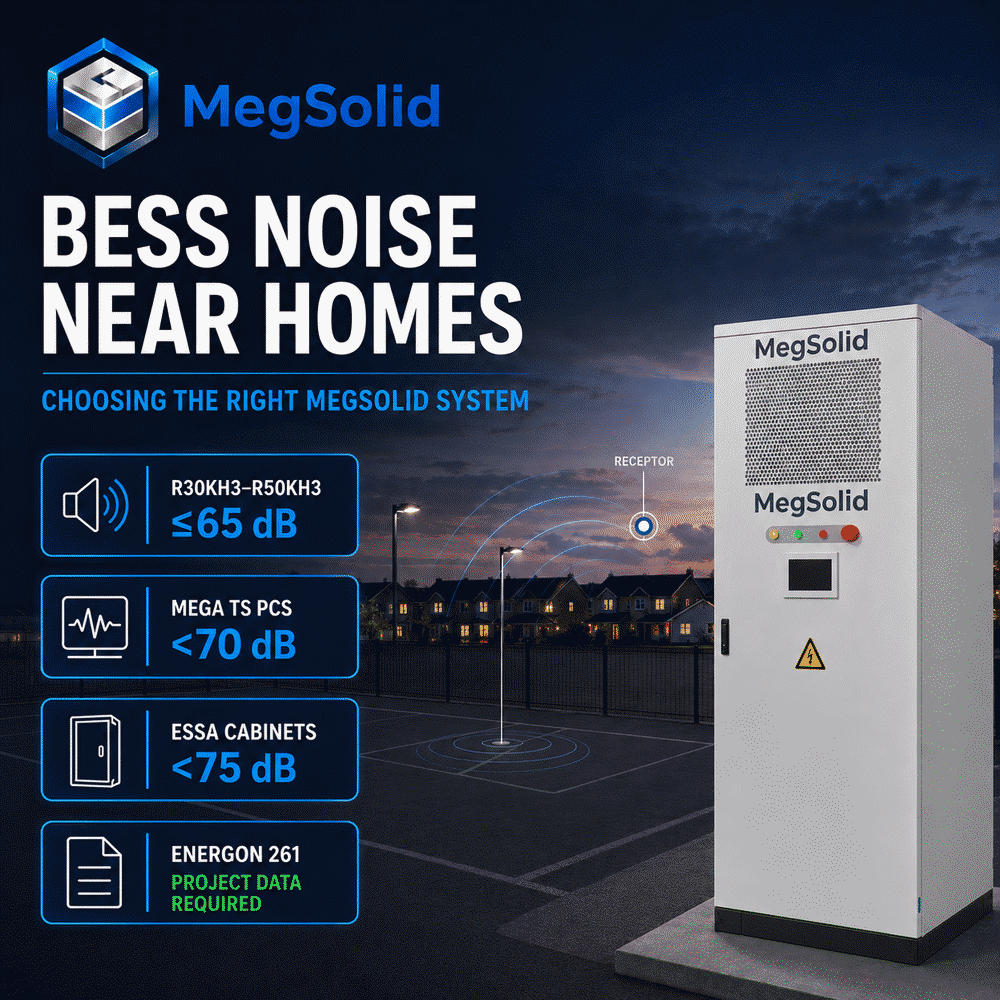
| المنتج الرئيسي لخزانة C&I المتكاملة | سلسلة ESSA: 30–100 كيلوواط، 55.296–215.04 كيلوواط/ساعة، تبريد هوائي ذكي، مستوى الضوضاء المعلن <75 ديسيبل |
| نظام PCS الأساسي للأنظمة المخصصة الأكبر حجمًا | MEGA0030TS–MEGA0500TS: 30–500 كيلوواط، تبريد هوائي قسري، مستوى الضوضاء المعلن <70 ديسيبل |
| خيار العاكس التجاري الموزع | R30KH3–R50KH3: 30–50 كيلوواط، IP65، تبريد هوائي قسري، مستوى الضوضاء المعلن ≤65 ديسيبل |
| بديل متكامل ذو طاقة أعلى | Meg-Solid Energon 261: 125 كيلو فولت أمبير، 261.24 كيلوواط ساعة، تبريد سائل؛ لا تزال البيانات الصوتية الخاصة بالمشروع مطلوبة لأن الصفحة العامة لم تحدد قيمة حقل مستوى الضوضاء الرقمي |
| قرار بشأن العقد | الموافقة على نموذج صوتي على مستوى الموقع واختبار القبول عند حدود العقار، إلى جانب ورقة بيانات المنتج |
| كلمة البحث | نية العميل | المحتوى الذي يجيب على هذا السؤال |
|---|---|---|
| ضوضاء نظام BESS بالقرب من المنازل | تقييم الأثر على المناطق السكنية ومدى قبول المشروع | نمذجة خطوط الملكية واختبار الموقع |
| مستوى الضوضاء في نظام BESS | مقارنة قيم المعدات المنشورة | مصفوفة ضوضاء منتجات MegSolid |
| ضوضاء نظام تخزين الطاقة بالبطاريات | تحديد مصادر الصوت الرئيسية | جدول التبريد، ونظام التحكم في الطاقة (PCS)، والمحولات، والمصادر المساعدة |
| ضوضاء خط الملكية في نظام BESS | تحديد نقطة القياس التعاقدية | معايير المستقبلات وخطة القبول |
| التقييم الصوتي لنظام BESS | إعداد الأدلة الهندسية | البيانات الأولية، وحالات التشغيل، ونمذجة الانتشار |
| ضوضاء نظام تخزين الطاقة بالبطاريات (BESS) C&I | اختيار المعدات للمشاريع التجارية | مقارنة بين ESSA و MEGA TS و R30KH3–R50KH3 و Energon 261 |
لماذا يجب أن تُدرج المخاوف المتعلقة بالضوضاء المجتمعية في عملية شراء أنظمة تخزين الطاقة الكهربائية (BESS)
وصف أحد مالكي المنازل في تكساس وجود منشأة BESS ضخمة ترتفع حوالي 1,000 قدم من منزله، وأثار مخاوف تتعلق بالضوضاء والإضاءة والمياه ومسافة الأمان. وكانت المنشأة لا تزال قيد الإنشاء، لذا فإن هذا المنشور يمثل إشارة من أحد أصحاب المصلحة — وليس اختبارًا صوتيًا أثناء التشغيل. استخدمه كسبب لبدء الفحص الصوتي في وقت مبكر، وليس كادعاء مقاس بالديسيبل.
في ولاية ساوث داكوتا، جمع مشروع تخزين مقترح بين قضايا السلامة والاتصالات والضوضاء في نقاش واحد. وتُظهر تقارير مستقلة أن السكان وفرق الطوارئ يضغطون للحصول على تفاصيل حول مشروع بقدرة 120 ميغاواط / 480 ميغاواط ساعة. وعندما تكون الأرقام غير واضحة، فإن عدم اليقين الصوتي يؤثر على عملية الحصول على التراخيص وثقة المجتمع المحلي، سواء كنت قد خططت لذلك أم لا.
| دليل | الدور الصحيح في هذه المقالة | قيمة القرار |
|---|---|---|
| منشور لأحد مالكي المنازل في تكساس | إشارة تثير قلق المجتمع | ابدأ عملية الفرز الصوتي قبل تجميد التصميم والمشتريات |
| تغطية مشروع ولاية ساوث داكوتا | إشارة الترخيص والاتصال | إبراز المستقبلات وحالات التشغيل وتدابير التخفيف في وثائق المشروع الواضحة |
| شكوى بشأن تبريد مركز البيانات في ميشيغان | تشبيه البنية التحتية المجاورة | قد يؤدي الأزيز الميكانيكي المستمر إلى رد فعل أقوى من رد الفعل الناجم عن حدث قصير يحدث خلال النهار |
| ورقات بيانات المنتجات | الأدلة المستمدة من فحص المعدات | تحديد المصادر المحتملة، والتصنيفات، وبنية التبريد |
| النموذج الصوتي والاختبار الميداني | أدلة قبول المشروع | إثبات الأداء عند المستقبل المتفق عليه وفي حالة التشغيل المتفق عليها |
تُعد حالة مركز البيانات في ميشيغان مفيدة لسبب واحد فقط: تختلف ردود أفعال الناس تجاه الأزيز الميكانيكي المستمر عنها تجاه حدث قصير يحدث خلال النهار. وتخص قراءات الشرفة تلك المنشأة ولا تدخل في أي ادعاءات تتعلق بأداء نظام تخزين الطاقة بالبطاريات (BESS). أما العوامل التي تؤثر في ذلك فهي المدة، ونبرة الصوت، ومحتوى الترددات المنخفضة، ومدى هدوء الخلفية الصوتية ليلاً.
يُعد الرقم الذي يُعبَّر عنه بالديسيبل (dB) للمنتج أحد العوامل التي تُؤخذ في الاعتبار عند قبول الموقع
يصف معامل الضوضاء الخاص بجهاز ما مصدرًا واحدًا في إطار إعداد اختبار واحد. أما معيار القبول عند حدود الملكية فيصف المحطة بأكملها عند مستقبل ما في ظل ظروف موقع وتشغيل محددة. وهذان رقمان مختلفان. وتتمثل المهمة في الربط بينهما، لا في اعتبارهما شيئًا واحدًا.
| حقل البيانات | لماذا يؤثر ذلك على النتيجة؟ | ما يجب أن يحصل عليه المشتري |
|---|---|---|
| الضغط الصوتي أو الطاقة الصوتية | يتغير ضغط الصوت تبعًا للمسافة والبيئة المحيطة؛ أما طاقة الصوت فتصف انبعاث المصدر | الكمية، والرمز، والوزن، ومعيار الاختبار |
| ديسيبل (dB) أو ديسيبل مع معدل الضوضاء (dBA) | يؤدي الترجيح من النوع A إلى تغيير مساهمة نطاقات التردد | بيانات الترجيح ونطاقات الأوكتاف |
| مسافة القياس | تُشير القيمة عند ارتفاع 1 متر والقيمة عند سطح الخزانة إلى مواقع مختلفة | مواقع الميكروفونات والمسافة المرجعية |
| الطاقة التشغيلية | تتغير مهام نظام التحكم في الأداء (PCS) وإدارة الحرارة خلال مراحل الشحن والتفريغ والوضع الاستعداد | القوة المقاسة بالكيلوواط (kW) والكيلو فولت أمبير (kVA) ودرجة الحرارة المحيطة ومستوى شحن البطارية (SOC) |
| حالة التبريد | يمكن أن يؤثر تشغيل المروحة والضاغط والمضخة على مستوى الصوت | حالات التشغيل في أقصى ظروف الحرارة والتشغيل الليلي |
| عدد الوحدات | تتحد عدة خزانات وكتل PCS عند المستقبل | جدول المصادر المتزامن |
| التصميم والاتجاه | تؤثر فتحات الهواء والحواجز والأسطح العاكسة على انتشار الموجات | مخطط الموقع بمقياس واتجاه المصدر |
| الصوت المحيط | قد يصبح مصدر الصوت المستمر أكثر وضوحًا خلال ليلة هادئة | مسح أساسي حسب الفترة الزمنية |
| المحتوى التونالي أو ذو التردد المنخفض | قد يؤدي وجود ضجيج خفيف إلى إجراء تصحيحات في التقييم في بعض أساليب التقييم | طيف الأوكتاف أو ثلث الأوكتاف |
| مكان الاستلام | تجيب قيم «جانب المعدات» و«المستقبلات السكنية» على أسئلة مختلفة | حدود العقار، أو الواجهة، أو أي نقطة أخرى تحددها الجهات المختصة |
توفر المواصفة القياسية ISO 3744:2025 طريقة هندسية لتحديد الطاقة الصوتية استنادًا إلى قياسات الضغط الصوتي حول الآلات. وتوفر المواصفة القياسية ISO 9613-2:2024 طريقة هندسية للتنبؤ بانتشار الصوت في الهواء الطلق من مصدر الانبعاث إلى مستقبل بعيد. ثم تحدد اللوائح المحلية المعيار وطريقة التقييم المعمول بهما.
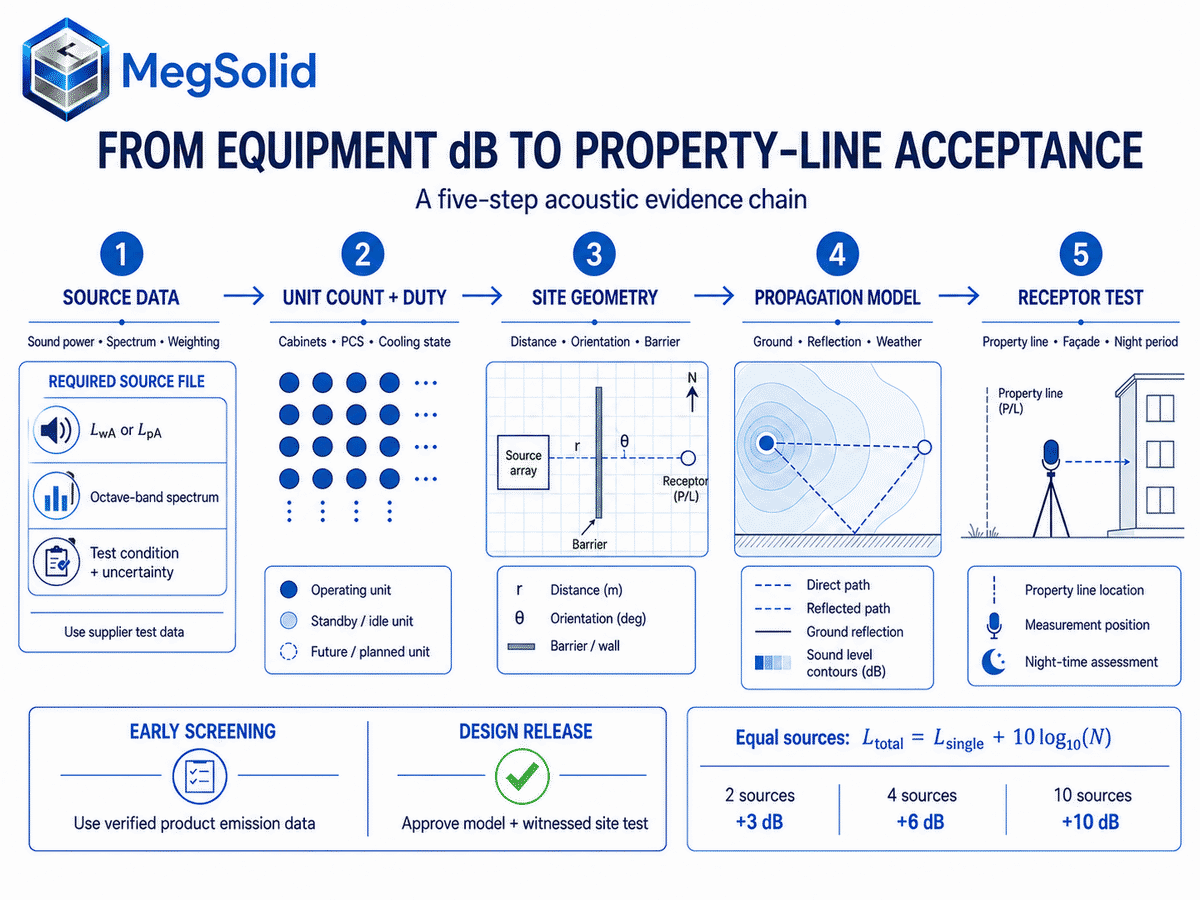
ترفع الوحدات المتعددة مستوى المصدر الإجمالي
بالنسبة للمصادر المتساوية والمستقلة في ظل نفس الظروف المرجعية، يمكن تقدير المستوى المجمع باستخدام المعادلة التالية:
Lالإجمالي = Lمفرد + 10 لوغ10(N)
| مصادر متساوية تعمل معًا | زيادة مثالية استنادًا إلى مصدر واحد |
|---|---|
| 2 | حوالي 3 ديسيبل |
| 4 | حوالي 6 ديسيبل |
| 10 | حوالي 10 ديسيبل |
استخدم هذه القيم التقديرية لأغراض الفحص الأولي فقط. ولا تزال النمذجة النهائية تتطلب معرفة مواقع المصادر، والأطياف، والحواجز، والانعكاسات من الأرض والمباني، والظروف الجوية.
المسافة عاملاً مساعدًا، في حين أن هندسة الموقع هي التي تحدد النتيجة الفعلية
يؤدي الانتشار المثالي لمصدر نقطي إلى انخفاض تقريبي قدره 6 ديسيبل عندما تتضاعف المسافة. ونادرًا ما تتصرف ساحات أنظمة تخزين الطاقة بالبطاريات (BESS) الخارجية الفعلية بهذه الدقة — حيث تتداخل صفوف الخزانات، والواجهات، والأرض الصلبة، والحواجز، ومنافذ الهواء الاتجاهية — لذا يجب التعامل مع الحساب النظري للمسافة باعتباره أداة تقييم أولية، وليس الإجابة النهائية.
استخدم «المسافة» مع:
- توجيه المصدر بعيدًا عن المستقبلات الحساسة.
- المسافة الفاصلة بين أنظمة PCS ذات الحمل العالي والمحولات وأقرب المنازل.
- حواجز صوتية تعيق مسار الصوت المباشر.
- المساحة المطلوبة لتدفق الهواء وفقًا لمواصفات مورد المعدات.
- مداخل الصيانة ومداخل خدمات الإطفاء.
- نموذج يستند إلى أكثر حالات التشغيل المتزامنة الموثوقة ارتفاعًا في مستوى الصوت.
من أين يأتي صوت BESS
خلايا البطارية نفسها لا تصدر أي صوت. ما تسمعه هو في الغالب التروس التي تتحكم في درجة الحرارة وتحوّل الطاقة.
| المصدر | الطابع الصوتي النموذجي | حالة قد تؤدي إلى زيادة الرسوم الجمركية | مجالات التركيز في مجال المشتريات |
|---|---|---|---|
| إدارة الحرارة في الخزانة | أصوات تدفق الهواء أو المروحة أو الضاغط أو المضخة | ارتفاع درجة الحرارة المحيطة واستهلاك الطاقة المستمر | وضع التبريد، طيف المصدر، وحالة التشغيل بأقصى سعة |
| محول PCS أو محول هجين | تيار الهواء البارد والنغمات الكهربائية | قدرة تحويل عالية | حالة الطاقة، والتحكم في المروحة، وقوة الصوت في نطاق الأوكتاف |
| المحول | أزيز ثابت منخفض التردد | حالة التشغيل والحمل | الموقع، والتحديد، وتقييم النغمة |
| المعدات المساعدة | المضخات ومراوح التهوية ومراوح لوحات التحكم | الطلب على أنظمة التدفئة أو أنظمة السلامة | الجدول الزمني الكامل للمصادر المساعدة |
| هندسة الموقع | الانعكاس والاتجاهية | الأسطح الصلبة والمنافذ المتوازية | التوجه، والعوائق، ونموذج المستقبلات |
يؤدي التبريد السائل إلى تغيير مزيج مصادر الضوضاء؛ لكنه لا يزيل الضوضاء تمامًا. ولا تزال المضخات والمبادلات الحرارية والضواغط والمراوح المساعدة تؤثر على مستوى الضوضاء. استخدم ملصق التبريد لاختيار التصميم الحراري. واستخدم البيانات المقاسة لمصادر الضوضاء لتحديد المتطلبات الصوتية.
ما هو منتج MegSolid المناسب للمواقع الحساسة للضوضاء؟
ابدأ بمطابقة القوة والطاقة والهيكل الهندسي وطريقة التبريد وحدود القبول الخاصة بالموقع. تم إعداد الجدول أدناه استنادًا إلى الصفحات العامة الحالية لموقع MegSolid ومراجع منتجين معتمدين.
| منتج MegSolid | تقييم عام مُثبت | بيانات مؤكدة بشأن التبريد ومستوى الضوضاء | سيناريو الفرز الأمثل | التحقق من العناصر الأساسية للمشروع |
|---|---|---|---|---|
| ESSA0030B-0055 | 30 كيلوواط / 55.296 كيلوواط·ساعة | تبريد هوائي ذكي؛ <75 ديسيبل | الحمولات التجارية الصغيرة، والمواقع النائية، والنشر المعياري | التأكد من شروط اختبار البيانات المصدر وعدد الخزانات |
| ESSA0050B-0055 | 50 كيلوواط / 55.296 كيلوواط·ساعة | تبريد هوائي ذكي؛ <75 ديسيبل | نظام تشغيل C&I ذو طاقة أعلى ومدة أقصر | تقدير حمل المروحة النموذجي أثناء التشغيل المستمر |
| ESSA0050B-0100 | 50 كيلوواط / 100.352 كيلوواط·ساعة | تبريد هوائي ذكي؛ <75 ديسيبل | نسبة اللوحات التي تشير إلى مدة الحصة الدراسية (ساعتين) في المواقع التجارية | Confirm usable AC energy and night dispatch |
| ESSA0100B-0215 | 100 كيلوواط / 215.04 كيلوواط·ساعة | تبريد هوائي ذكي؛ <75 ديسيبل | Medium C&I facilities and building-level protected buses | Model orientation and multiple-cabinet operation |
| MEGA0030TS–MEGA0500TS قطع | 30–500 كيلوواط | Forced air; <70 dB | Custom C&I, microgrid and larger multi-block systems | Add battery cabinets, transformers and auxiliaries to the plant model |
| R30KH3 / R40KH3 / R50KH3 | 30 / 40 / 50 كيلوواط | Forced air; ≤65 dB | Distributed commercial solar-plus-storage and backup | Confirm mounting surface, receptor direction and full-power fan state |
| ميغ-سوليد إنرجون 261 | 125 كيلو فولت أمبير / 261.24 كيلوواط ساعة | Liquid cooling; numeric noise field unspecified on the public page | Higher-energy C&I systems with integrated outdoor equipment | Obtain project-specific sound data before acoustic approval |
ESSA Outdoor Cabinets — The Main Integrated C&I Recommendation
الـ سلسلة خزانات «MegSolid ESSA» المخصصة للاستخدام الخارجي offers four verified configurations from 30 to 100 kW and 55.296 to 215.04 kWh. Every listed model uses intelligent air cooling and carries a published noise-emission figure of <75 dB.
ESSA also ships with a built-in isolation transformer, integrated EMS functions, on-grid and off-grid support, and interfaces for load, battery, grid, diesel generator and PV. That integration can shrink the system boundary the EPC has to coordinate.
ESSA advantages for a noise-conscious project:
- A published model-family noise figure supports preliminary source screening.
- Four power-and-energy combinations allow selection around duty rather than capacity alone.
- IP54 construction supports outdoor siting flexibility.
- Integrated EMS, isolation transformer and multi-source interfaces reduce separate equipment boundaries.
- RS485 and TCP/IP communications support operating-data integration.
- Model-level dimensions help the acoustic consultant place sources accurately in the layout.
The public page lists <75 dB without distance, weighting or operating condition. Ask for a controlled acoustic data sheet before you lock the site model.
MEGA TS PCS — A Clear Power-Conversion Choice for Larger Systems
الـ MegSolid MEGA TS PCS series covers six ratings from 30 to 500 kW. Published general data includes forced-air cooling, noise emission of <70 dB, automatic grid/off-grid switching, RS485/CAN connections for BMS and RS485/TCP-IP for EMS.
MEGA TS advantages:
- Broad 30–500 kW range supports consistent PCS selection across project sizes.
- Built-in isolation transformer provides a defined electrical integration feature.
- Published model dimensions and ratings improve layout and source scheduling.
- Maximum efficiency ranges from 96.3% to 97.5%, depending on model.
- A published noise figure gives the acoustic consultant an initial equipment-screening value.
The PCS figure covers the converter cabinet only. Battery thermal management, site transformer, switchgear ventilation and other auxiliaries stay separate sources in the full-plant model.
R30KH3–R50KH3 — A Distributed Commercial Option
الـ MegSolid R30KH3–R50KH3 three-phase hybrid inverter series provides 30, 40 and 50 kW rated AC output. The verified general data includes forced-air cooling, a noise-emission figure of ≤65 dB, IP65 ingress protection, four MPPT trackers and backup switching below 10 ms.
Use this series where distributed wall-mounted conversion fits the electrical layout. Its published noise figure is lower than the MEGA TS and ESSA family figures — but only compare them when distance, weighting and operating conditions line up.
R30KH3–R50KH3 advantages:
- 30–50 kW commercial power range.
- IP65 wall-mounted format for flexible equipment placement.
- Four MPPT trackers for PV integration.
- Separate meter, BMS and EMS interfaces.
- Published equipment noise figure for early screening.
MegSolid Energon 261 — Higher Energy with a Data Hold Point
الـ Meg-Solid Energon 261.24 kWh liquid-cooled C&I system combines 125 kVA rated AC capacity, 261.24 kWh rated energy, 314 Ah LFP cells, IP54 construction and parallel connection of up to ten units according to the product introduction.
Energon 261 offers higher integrated energy than the largest ESSA model, liquid thermal management, RS485/LAN/4G communications and a compact cabinet. The public page does not state a noise number, so any acoustic recommendation waits on controlled sound data for the exact configuration offered.
استخدم 215 kWh versus 261 kWh selection guide to compare power, energy and cooling architecture before the acoustic model is commissioned.
Why Choose MegSolid for a Noise-Conscious BESS Project?
MegSolid’s practical edge is the spread of documented options in one portfolio: wall-mounted hybrid inverter, transformer-integrated PCS, outdoor all-in-one cabinet, or a higher-energy liquid-cooled system. You can screen them side by side without jumping between unrelated brands.
| Buyer priority | MegSolid advantage | Evidence boundary |
|---|---|---|
| Early acoustic screening | Published noise figures for R30KH3–R50KH3, MEGA TS and ESSA | Confirm weighting, distance, spectrum and operating duty |
| Scalable power selection | 30–50 kW hybrid inverters, 30–500 kW PCS and 30–100 kW ESSA cabinets | Final selection follows load profile and point-of-connection limits |
| Integrated C&I architecture | ESSA combines battery, EMS functions, isolation transformer and multi-source interfaces | Project drawings define the supplied boundary |
| Outdoor deployment | ESSA and Energon 261 carry IP54; R30KH3–R50KH3 carry IP65 | Site enclosure, drainage, corrosion and service access remain project items |
| Controls integration | Published RS485, CAN, TCP-IP, LAN or 4G interfaces vary by family | Approve the exact register map and control authority |
| Honest technical selection | The 261 kWh acoustic data gap is visible and treated as a hold point | Release acoustic approval after configuration-specific data arrives |
Choose MegSolid when those product strengths match the project duty and the supplier documents land in the acceptance package — not only in the sales deck. For the wider supplier frame, see the دليل شراء أنظمة تخزين الطاقة التجارية.
For electrical coordination, use the 400 V BESS switchboard connection guide. For operating data and controls, use the دليل قائمة نقاط نظام BESS SCADA.
Convert MegSolid Product Data into a Property-Line Acceptance Plan
Keep equipment selection, acoustic modelling and site testing on one path. If they drift apart, the acceptance argument falls apart with them.
| المرحلة | البيانات المطلوبة | Approval output |
|---|---|---|
| 1. Site baseline | Day, evening and night measurements at representative receptors | Agreed background dataset |
| 2. Source schedule | Every cabinet, PCS, transformer and auxiliary source | Complete equipment list with operating states |
| 3. Product evidence | Sound power or controlled sound pressure, spectrum, weighting and test condition | Approved acoustic source file |
| 4. Worst credible duty | Maximum coincident charge/discharge and thermal-management scenario | Defined modelling case |
| 5. Propagation model | Terrain, buildings, ground, barriers, source direction and meteorology | Predicted receptor levels |
| 6. Mitigation | Orientation, separation, barrier, enclosure or silencer as appropriate | Compliant issued-for-construction layout |
| 7. Site acceptance | Calibrated measurements with agreed plant state and ambient correction | Signed receptor-level result |
| 8. Operations | Complaint process, maintenance checks and change control | Ongoing acoustic performance record |
Minimum Product Acoustic Data to Request
- A-weighted sound power level for each source where available.
- Octave or one-third-octave spectrum.
- Sound pressure measurement positions and reference distance.
- Test standard, environment and instrumentation class.
- Rated power, charge/discharge direction and battery SOC during the test.
- Ambient temperature and thermal-management state.
- Fan, compressor and pump duty.
- Tonal, impulsive and low-frequency observations.
- Measurement uncertainty.
- Equipment revision and firmware or control mode.
Acceptance Test Conditions to Put in the Contract
- Receptor locations and microphone height.
- Applicable local method and criterion by time period.
- Plant configuration and number of simultaneous sources.
- Required charge, discharge or thermal-duty state.
- Weather window and ambient correction method.
- Instrumentation class and calibration records.
- Treatment of tonality and low-frequency content.
- Witnesses, raw-data delivery and report format.
- Cure, retest and change-control process.
الـ MegSolid BESS factory acceptance test guide helps organise pre-shipment evidence. Site acoustic compliance still belongs to the commissioned layout and local acceptance method.
Design Choices That Preserve Cooling and Reduce Community Impact
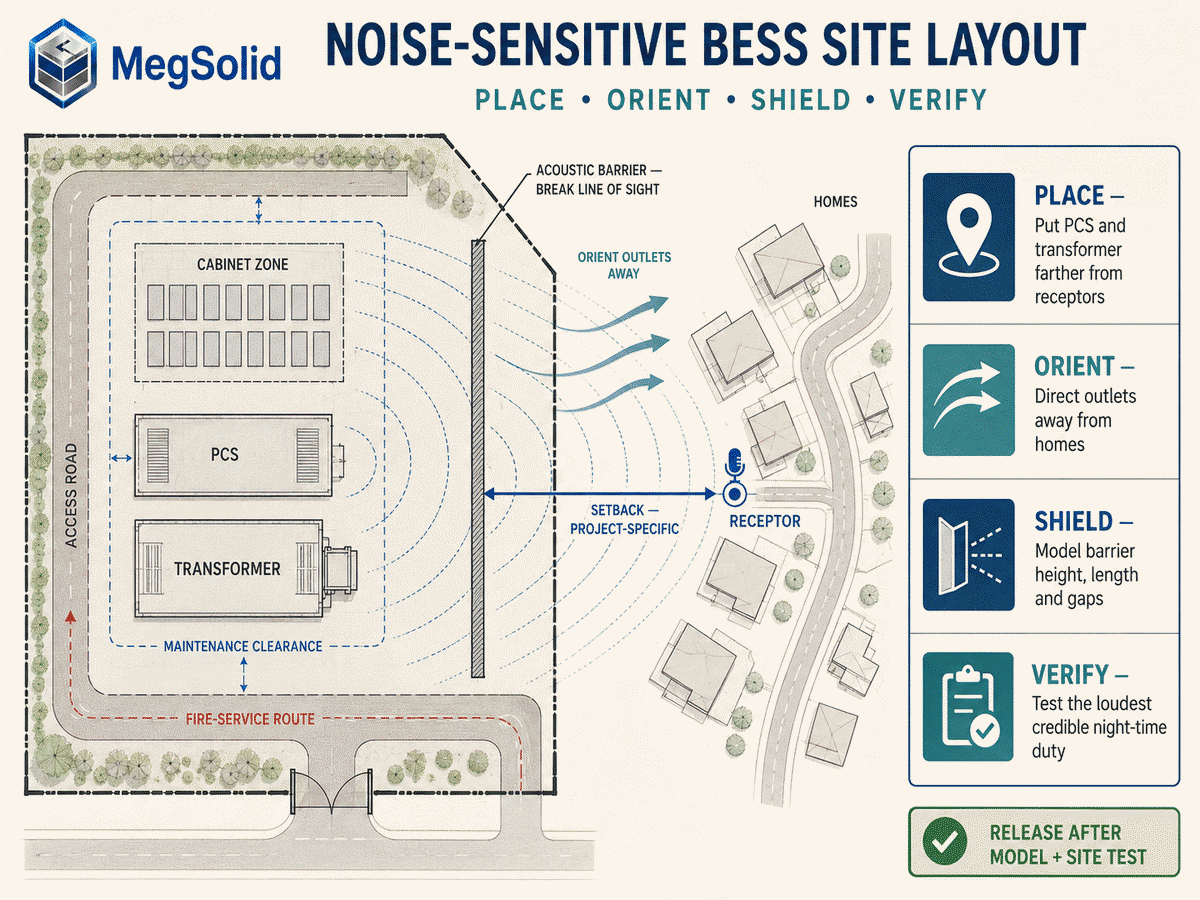
Acoustic mitigation has to preserve airflow, heat rejection, emergency access and maintenance clearance.
| Design choice | Acoustic value | Engineering control |
|---|---|---|
| Rotate air outlets | Reduces directivity toward a receptor | Verify service and airflow clearance |
| Increase source-to-receptor distance | Adds geometric attenuation | Coordinate cable, fire access and land use |
| Place quieter equipment near the boundary | Uses source hierarchy in the layout | Compare aligned acoustic data |
| Install a barrier | Breaks direct line of sight | Model height, length, gaps and reflections |
| Use acoustic louvres or silencers | Treats ventilation paths | Verify pressure drop and cooling performance |
| Isolate vibration | Reduces structure-borne paths | Coordinate mounts, foundation and cable flexibility |
| Control operating schedule | Moves high-duty operation away from sensitive periods where feasible | Preserve grid, backup and thermal requirements |
| Maintain fans and heat exchangers | Limits degradation from imbalance, blockage or wear | Add inspection and alarm records |
Any change to barriers, louvres, enclosure panels or airflow paths needs thermal, fire and service review first. Acoustic treatment that pushes operating temperature up can shorten equipment life and drive fans harder — which can put the noise back.
Product Recommendation by Buyer Scenario
| Buyer scenario | Recommended MegSolid starting point | Why it fits | شروط الإفراج |
|---|---|---|---|
| Small C&I load with an outdoor integrated cabinet | ESSA0030B-0055 | 30 kW, 55.296 kWh, integrated EMS and isolation transformer | Site model using controlled cabinet source data |
| 50 kW commercial project needing more energy | ESSA0050B-0100 | 50 kW, 100.352 kWh, integrated outdoor architecture | Usable-energy and acoustic conditions agreed |
| 100 kW C&I site | ESSA0100B-0215 | 100 kW, 215.04 kWh, IP54, integrated interfaces | Multiple-unit and night-duty cases modelled |
| Custom 250–500 kW conversion block | MEGA0250TS or MEGA0500TS | Transformer-integrated PCS with published power and noise data | Battery, transformer and auxiliary sources added |
| Distributed 30–50 kW solar-plus-storage | R30KH3–R50KH3 | IP65 wall-mounted platform with four MPPTs | Mounting and full-power acoustic state confirmed |
| 261 kWh integrated C&I requirement | ميغ-سوليد إنرجون 261 | Higher energy, 125 kVA, liquid cooling and communications | Configuration-specific acoustic data approved |
These starting points stay conditional: receptor limits, background sound, equipment count and layout differ by site. The point of the method is to give MegSolid products a clear role in the decision without letting a single cabinet dB figure stand in for the whole yard.
Final Engineering View
For noise-conscious selection, MegSolid gives three documented layers: R30KH3–R50KH3 hybrid inverters at ≤65 dB, MEGA TS PCS at <70 dB, and ESSA outdoor cabinets at <75 dB. That is enough to start source screening and product comparison.
The choice holds up when the selected model, source test conditions, cabinet count, cooling duty, site layout, background survey and receptor criterion sit in one approved acoustic package. Near homes, that package is what turns a product shortlist into something you can defend to the community and the contract.
Thermal and acoustic duty share the same drivers — ambient temperature, dispatch and cooling demand. For degradation, throughput and operating limits, see the دليل ضمان أنظمة تخزين الطاقة الكهربائية (BESS) الخاصة بالقطاع التجاري والصناعي.
الأسئلة الشائعة
How loud is a MegSolid BESS?
Published figures: ESSA outdoor cabinets <75 dB, MEGA TS PCS <70 dB, R30KH3–R50KH3 ≤65 dB. What the house hears still depends on test conditions, how many units run, layout, duty and distance to the receptor.
Which MegSolid product is the recommended starting point near homes?
For an integrated C&I job, start with ESSA: power, energy, cooling, dimensions and a family noise figure are all public. Final selection still follows the property-line model.
هل يتم تبريد طراز ESSA0100B-0215 بالسائل؟
No. Current verified data is intelligent air cooling, 100 kW / 215.04 kWh, published noise emission <75 dB.
Is a liquid-cooled BESS always quieter?
No. Cooling type alone does not settle the acoustic result. Pumps, compressors, fans, heat exchangers, power electronics and transformers can all contribute. Compare configuration-specific sound data under the same conditions.
Can the ESSA <75 dB figure prove residential compliance?
No. It supports equipment screening only. Residential compliance still needs test conditions, multi-unit combination, propagation modelling, background sound and the local receptor criterion.
Why does the number of cabinets matter?
Equal independent sources combine on a log scale. Two equal sources add about 3 dB; ten add about 10 dB under the same idealised condition. Layout and barriers then change what reaches the receptor.
What data should MegSolid provide for an acoustic model?
Ask for sound power, spectrum, weighting, test distance, operating power, ambient temperature, cooling state, directivity and uncertainty — for the exact equipment revision on offer.
Can EMS reduce BESS noise?
Where the project allows, EMS can shift power duty and that can change thermal demand. A true low-noise mode needs model-specific control documents and validation — not a marketing claim.
Why choose MEGA TS PCS for a custom BESS?
It covers 30–500 kW, includes an isolation transformer, supports grid and off-grid, publishes communications interfaces, and gives a <70 dB equipment figure for early screening.
What should the acoustic acceptance test measure?
Measure at the agreed receptor, under a defined plant state, time period and weather window. Log ambient correction, spectrum, tonality, calibration, equipment count and raw time-history data.
What is the MegSolid ESSA BESS noise level?
ESSA0030B-0055, ESSA0050B-0055, ESSA0050B-0100 and ESSA0100B-0215 all list <75 dB. Project approval still needs the measurement conditions and the site model.
Which MegSolid PCS has a published noise figure?
MEGA0030TS–MEGA0500TS lists <70 dB and forced-air cooling across 30–500 kW.
How should buyers assess BESS noise near homes?
Combine verified source data, every simultaneous cabinet and auxiliary, night background levels, site geometry, weather, mitigation and a property-line acceptance test.
ما الذي يسبب ضوضاء نظام تخزين طاقة البطارية؟
تأتي معظم الأصوات المسموعة في نظام BESS من مراوح التبريد، والضواغط، والمضخات، ومعدات نظام PCS، والمحولات، وأنظمة التهوية المساعدة. وتؤثر الطاقة التشغيلية ودرجة الحرارة المحيطة واتجاه المصدر على ما يصل إلى المستقبل.
لماذا تختار MegSolid لتخزين C&I المراعي لمستوى الضوضاء؟
توثق MegSolid خيارات المحولات وأجهزة التحكم في الطاقة (PCS) والخزانات المدمجة، مع بيانات الضوضاء المنشورة لعدة مجموعات من المنتجات، ونطاق واسع من مستويات الطاقة، ومواصفات الاستخدام في الأماكن الخارجية، وواجهات الاتصال التي يمكنك تضمينها في حزمة المشروع.
ما هي الشروط المطلوبة قبل الموافقة على إنشاء نظام تخزين الطاقة الكهربائية (BESS) من طراز MegSolid بالقرب من المناطق السكنية؟
الموافقة على الطراز المحدد، وبيانات مصدر الصوت، وحالة التشغيل، وعدد الوحدات، والتصميم، والمسح الأولي، والمعايير المحلية، وتصميم تدابير التخفيف، واختبار الموقع بحضور شهود — قبل اعتبار المحطة مقبولة.
Technical References
- Texas homeowner BESS concern
- South Dakota community discussion
- Independent South Dakota project coverage
- Michigan cooling-equipment community example
- Independent data-centre noise coverage
- ISO 3744:2025 — determination of sound power
- ISO 9613-2:2024 — outdoor sound propagation
- UK Environment Agency method implementation for BS 4142
- NSW EPA Noise Policy for Industry
- Karara BESS Noise Impact Assessment