
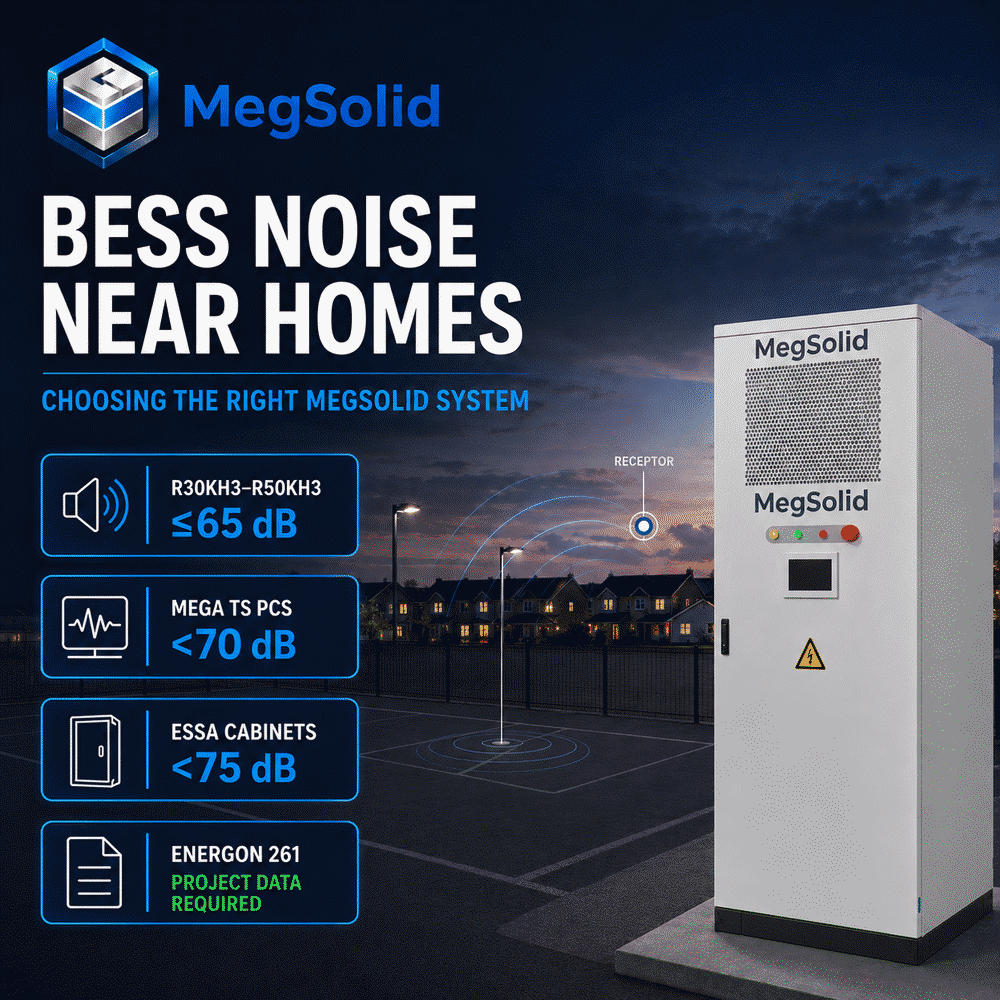
A BESS noise complaint can outlive the sale: restricted night operation, added barriers and repeated testing can eat into the value you bought the battery for. If homes, hotels or hospitals sit nearby, settle the acoustic scope before the layout is fixed. MegSolid offers ESSA outdoor cabinets, MEGA TS PCS and R30KH3–R50KH3 hybrid inverters with published equipment noise figures. This guide turns those starting points into product selection, site modelling and a property-line acceptance plan.
| 30-second decision | Engineering answer |
|---|---|
| Primary product for an integrated C&I cabinet | ESSA series: 30–100 kW, 55.296–215.04 kWh, intelligent air cooling, published noise emission <75 dB |
| Primary PCS for larger custom systems | MEGA0030TS–MEGA0500TS: 30–500 kW, forced-air cooling, published noise emission <70 dB |
| Distributed commercial inverter option | R30KH3–R50KH3: 30–50 kW, IP65, forced-air cooling, published noise emission ≤65 dB |
| Higher-energy integrated alternative | Meg-Solid Energon 261: 125 kVA, 261.24 kWh, liquid cooling; project acoustic data remains required because the public page leaves the numeric noise field unspecified |
| Contract decision | Approve a site-level acoustic model and property-line acceptance test alongside the product datasheet |
| Search keyword | Customer intent | Content that answers it |
|---|---|---|
| BESS noise near homes | Evaluate residential impact and project acceptance | Property-line modelling and site testing |
| BESS noise level | Compare published equipment values | MegSolid product noise matrix |
| Battery energy storage system noise | Identify the main sound sources | Cooling, PCS, transformer and auxiliary-source table |
| BESS property-line noise | Define the contractual measurement point | Receptor criteria and acceptance plan |
| BESS acoustic assessment | Prepare engineering evidence | Source data, operating cases and propagation modelling |
| C&I BESS noise | Select equipment for commercial projects | ESSA, MEGA TS, R30KH3–R50KH3 and Energon 261 comparison |
Why Community Noise Concerns Belong in BESS Procurement
A Texas homeowner described a large BESS going up about 1,000 ft from their house and raised noise, lighting, water and setback concerns. The facility was still under construction, so the post is a stakeholder signal — not an operating sound test. Use it as a reason to start acoustic screening early, not as a measured dB claim.
In South Dakota, a proposed storage project put safety, communication and noise in the same conversation. Independent reporting shows residents and first responders pressing for detail on a 120 MW / 480 MWh scheme. When the numbers are unclear, acoustic uncertainty walks into permitting and community trust whether you planned for it or not.
| Evidence item | Proper role in this article | Decision value |
|---|---|---|
| Texas homeowner post | Community-concern signal | Start acoustic screening before layout and procurement are frozen |
| South Dakota project coverage | Permitting and communication signal | Show receptors, operating cases and mitigation in clear project documents |
| Michigan data-centre cooling complaint | Adjacent infrastructure analogy | Continuous mechanical hum can create a stronger reaction than a short daytime event |
| Product datasheets | Equipment-screening evidence | Identify candidate sources, ratings and cooling architecture |
| Acoustic model and site test | Project-acceptance evidence | Demonstrate performance at the agreed receptor and operating state |
The Michigan data-centre case is useful for one reason only: people react differently to a continuous mechanical hum than to a short daytime event. The porch readings belong to that facility and stay out of any BESS performance claim. What carries over is duration, tonality, low-frequency content and how quiet the night background is.
A Product dB Figure Is One Input to Site Acceptance
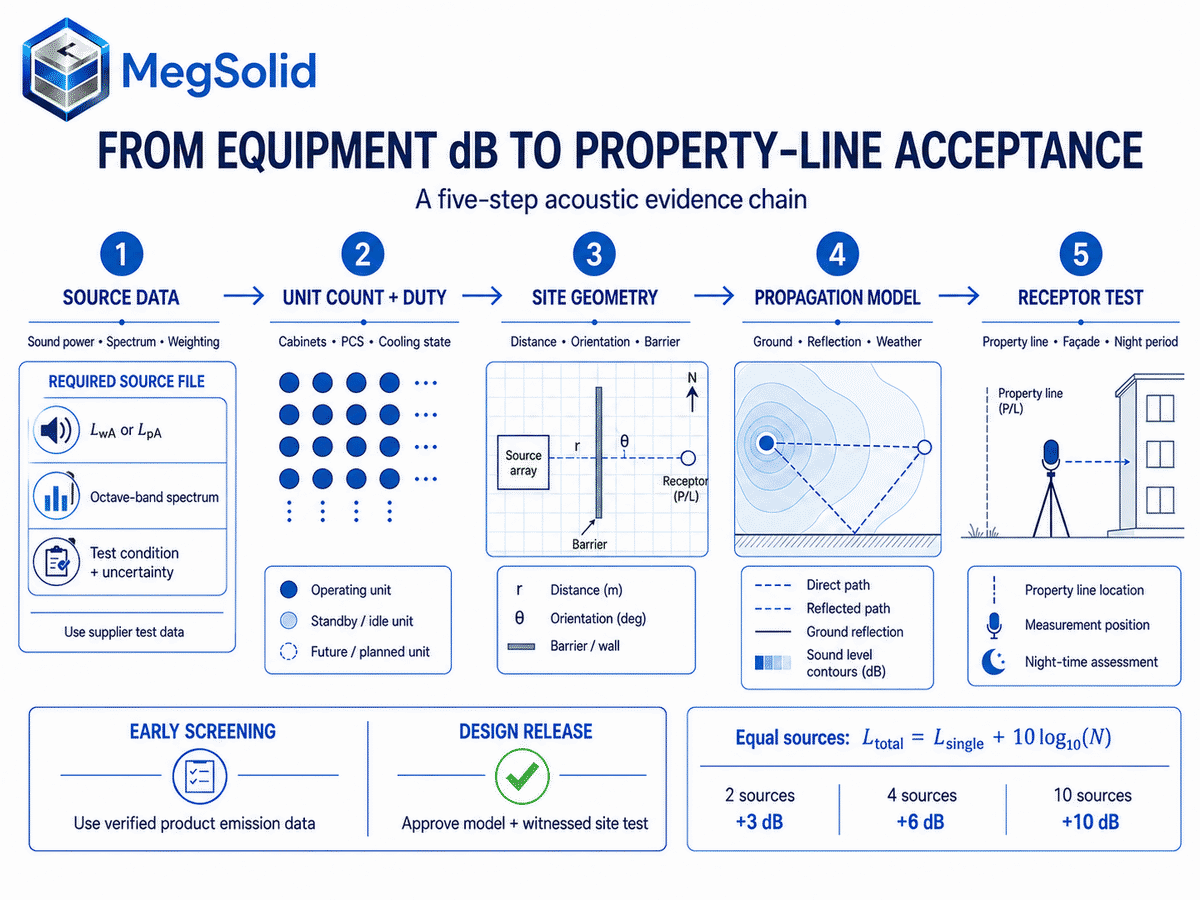
An equipment noise figure describes one source under one test setup. Property-line acceptance describes the whole plant at a receptor under defined site and operating conditions. Those are two different numbers. The job is to connect them, not treat them as the same thing.
| Data field | Why it changes the result | What the buyer should obtain |
|---|---|---|
| Sound pressure or sound power | Sound pressure changes with distance and surroundings; sound power characterises source emission | Quantity, symbol, weighting and test standard |
| dB or dBA | A-weighting changes the contribution of frequency bands | Weighting and octave-band data |
| Measurement distance | A 1 m value and a cabinet-surface value describe different locations | Microphone positions and reference distance |
| Operating power | PCS and thermal-management duty change across charge, discharge and standby | Tested kW, kVA, ambient temperature and SOC |
| Cooling state | Fan, compressor and pump duty can govern sound | Maximum thermal-duty and night operating cases |
| Unit count | Multiple cabinets and PCS blocks combine at the receptor | Simultaneous source schedule |
| Layout and orientation | Air outlets, barriers and reflecting surfaces alter propagation | Scaled site layout and source orientation |
| Ambient sound | A continuous source can become more noticeable during a quiet night | Baseline survey by time period |
| Tonal or low-frequency content | A hum can attract rating corrections in some assessment methods | Octave or one-third-octave spectrum |
| Acceptance location | Equipment-side and residential-receptor values answer different questions | Property line, façade or other authority-defined point |
ISO 3744:2025 provides an engineering method for determining sound power from sound-pressure measurements around machinery. ISO 9613-2:2024 provides an engineering method for predicting outdoor propagation from source emission to a distant receptor. Local rules then define the applicable criterion and assessment method.
Multiple Units Raise the Combined Source Level
For equal, independent sources under the same reference condition, the combined level can be estimated with:
Ltotal = Lsingle + 10 log10(N)
| Equal sources operating together | Idealised increase above one source |
|---|---|
| 2 | about 3 dB |
| 4 | about 6 dB |
| 10 | about 10 dB |
Use these increments for early screening only. Final modelling still needs source locations, spectra, barriers, ground, building reflections and weather.
Distance Helps, While Site Geometry Sets the Real Outcome
Ideal point-source spreading gives a rough 6 dB drop when distance doubles. Real outdoor BESS yards rarely behave that cleanly — rows of cabinets, façades, hard ground, barriers and directional air outlets all interfere — so treat a pure distance calculation as a screening tool, not the final answer.
Use distance together with:
- Source orientation away from sensitive receptors.
- Separation between high-duty PCS, transformers and the closest homes.
- Acoustic barriers that break the direct sound path.
- Airflow clearance required by the equipment supplier.
- Maintenance access and fire-service access.
- A model based on the loudest credible coincident operating case.
Where BESS Sound Comes From
Battery cells themselves are quiet. What you hear is almost always the gear that manages temperature and converts power.
| Source | Typical sound character | Condition that can increase duty | Procurement focus |
|---|---|---|---|
| Cabinet thermal management | Airflow, fan, compressor or pump sound | High ambient temperature and sustained power | Cooling mode, source spectrum and maximum-duty case |
| PCS or hybrid inverter | Cooling airflow and electrical tones | High conversion power | Power state, fan control and octave-band sound power |
| Transformer | Steady low-frequency hum | Energised state and loading | Location, enclosure and tonal assessment |
| Auxiliary equipment | Pumps, ventilation and control-panel fans | Thermal or safety-system demand | Complete auxiliary-source schedule |
| Site geometry | Reflection and directivity | Hard surfaces and aligned outlets | Orientation, barriers and receptor model |
Liquid cooling changes the source mix; it does not delete sound. Pumps, heat exchangers, compressors and auxiliary fans can still matter. Use the cooling label to choose thermal architecture. Use measured source data to decide the acoustic case.
Which MegSolid Product Fits a Noise-Sensitive Site?
Start by matching power, energy, topology, cooling method and the site acceptance limit. The table below is built from current MegSolid public pages and two controlled product references.
| MegSolid product | Verified public rating | Verified cooling and noise data | Best-fit screening scenario | Key project check |
|---|---|---|---|---|
| ESSA0030B-0055 | 30 kW / 55.296 kWh | Intelligent air cooling; <75 dB | Small commercial loads, remote sites and modular deployment | Confirm source-data test conditions and cabinet count |
| ESSA0050B-0055 | 50 kW / 55.296 kWh | Intelligent air cooling; <75 dB | Higher-power, shorter-duration C&I duty | Model fan duty during sustained operation |
| ESSA0050B-0100 | 50 kW / 100.352 kWh | Intelligent air cooling; <75 dB | Two-hour-class nameplate ratio for commercial sites | Confirm usable AC energy and night dispatch |
| ESSA0100B-0215 | 100 kW / 215.04 kWh | Intelligent air cooling; <75 dB | Medium C&I facilities and building-level protected buses | Model orientation and multiple-cabinet operation |
| MEGA0030TS–MEGA0500TS PCS | 30–500 kW | Forced air; <70 dB | Custom C&I, microgrid and larger multi-block systems | Add battery cabinets, transformers and auxiliaries to the plant model |
| R30KH3 / R40KH3 / R50KH3 | 30 / 40 / 50 kW | Forced air; ≤65 dB | Distributed commercial solar-plus-storage and backup | Confirm mounting surface, receptor direction and full-power fan state |
| Meg-Solid Energon 261 | 125 kVA / 261.24 kWh | Liquid cooling; numeric noise field unspecified on the public page | Higher-energy C&I systems with integrated outdoor equipment | Obtain project-specific sound data before acoustic approval |
ESSA Outdoor Cabinets — The Main Integrated C&I Recommendation
The MegSolid ESSA outdoor cabinet series offers four verified configurations from 30 to 100 kW and 55.296 to 215.04 kWh. Every listed model uses intelligent air cooling and carries a published noise-emission figure of <75 dB.
ESSA also ships with a built-in isolation transformer, integrated EMS functions, on-grid and off-grid support, and interfaces for load, battery, grid, diesel generator and PV. That integration can shrink the system boundary the EPC has to coordinate.
ESSA advantages for a noise-conscious project:
- A published model-family noise figure supports preliminary source screening.
- Four power-and-energy combinations allow selection around duty rather than capacity alone.
- IP54 construction supports outdoor siting flexibility.
- Integrated EMS, isolation transformer and multi-source interfaces reduce separate equipment boundaries.
- RS485 and TCP/IP communications support operating-data integration.
- Model-level dimensions help the acoustic consultant place sources accurately in the layout.
The public page lists <75 dB without distance, weighting or operating condition. Ask for a controlled acoustic data sheet before you lock the site model.
MEGA TS PCS — A Clear Power-Conversion Choice for Larger Systems
The MegSolid MEGA TS PCS series covers six ratings from 30 to 500 kW. Published general data includes forced-air cooling, noise emission of <70 dB, automatic grid/off-grid switching, RS485/CAN connections for BMS and RS485/TCP-IP for EMS.
MEGA TS advantages:
- Broad 30–500 kW range supports consistent PCS selection across project sizes.
- Built-in isolation transformer provides a defined electrical integration feature.
- Published model dimensions and ratings improve layout and source scheduling.
- Maximum efficiency ranges from 96.3% to 97.5%, depending on model.
- A published noise figure gives the acoustic consultant an initial equipment-screening value.
The PCS figure covers the converter cabinet only. Battery thermal management, site transformer, switchgear ventilation and other auxiliaries stay separate sources in the full-plant model.
R30KH3–R50KH3 — A Distributed Commercial Option
The MegSolid R30KH3–R50KH3 three-phase hybrid inverter series provides 30, 40 and 50 kW rated AC output. The verified general data includes forced-air cooling, a noise-emission figure of ≤65 dB, IP65 ingress protection, four MPPT trackers and backup switching below 10 ms.
Use this series where distributed wall-mounted conversion fits the electrical layout. Its published noise figure is lower than the MEGA TS and ESSA family figures — but only compare them when distance, weighting and operating conditions line up.
R30KH3–R50KH3 advantages:
- 30–50 kW commercial power range.
- IP65 wall-mounted format for flexible equipment placement.
- Four MPPT trackers for PV integration.
- Separate meter, BMS and EMS interfaces.
- Published equipment noise figure for early screening.
MegSolid Energon 261 — Higher Energy with a Data Hold Point
The Meg-Solid Energon 261.24 kWh liquid-cooled C&I system combines 125 kVA rated AC capacity, 261.24 kWh rated energy, 314 Ah LFP cells, IP54 construction and parallel connection of up to ten units according to the product introduction.
Energon 261 offers higher integrated energy than the largest ESSA model, liquid thermal management, RS485/LAN/4G communications and a compact cabinet. The public page does not state a noise number, so any acoustic recommendation waits on controlled sound data for the exact configuration offered.
Use the 215 kWh versus 261 kWh selection guide to compare power, energy and cooling architecture before the acoustic model is commissioned.
Why Choose MegSolid for a Noise-Conscious BESS Project?
MegSolid gives the EPC several ways to fit the electrical and acoustic duty: 30–50kW wall-mounted hybrid inverters, 30–500kW transformer-integrated PCS, 30–100kW ESSA outdoor cabinets, and the higher-energy Energon 261 liquid-cooled platform. Send one duty profile and one receptor layout; ask us to identify a product route, the equipment sources to include and the acoustic data required before approval. Choosing the architecture early is cheaper than redesigning a finished yard.
| Buyer priority | MegSolid advantage | Evidence boundary |
|---|---|---|
| Early acoustic screening | Published noise figures for R30KH3–R50KH3, MEGA TS and ESSA | Confirm weighting, distance, spectrum and operating duty |
| Scalable power selection | 30–50 kW hybrid inverters, 30–500 kW PCS and 30–100 kW ESSA cabinets | Final selection follows load profile and point-of-connection limits |
| Integrated C&I architecture | ESSA combines battery, EMS functions, isolation transformer and multi-source interfaces | Project drawings define the supplied boundary |
| Outdoor deployment | ESSA and Energon 261 carry IP54; R30KH3–R50KH3 carry IP65 | Site enclosure, drainage, corrosion and service access remain project items |
| Controls integration | Published RS485, CAN, TCP-IP, LAN or 4G interfaces vary by family | Approve the exact register map and control authority |
| Honest technical selection | The 261 kWh acoustic data gap is visible and treated as a hold point | Release acoustic approval after configuration-specific data arrives |
Choose MegSolid when those product strengths match the project duty and the supplier documents land in the acceptance package — not only in the sales deck. For the wider supplier frame, see the commercial energy storage procurement guide.
For electrical coordination, use the 400 V BESS switchboard connection guide. For operating data and controls, use the BESS SCADA point-list guide.
Convert MegSolid Product Data into a Property-Line Acceptance Plan
Keep equipment selection, acoustic modelling and site testing on one path. If they drift apart, the acceptance argument falls apart with them.
| Stage | Required input | Approval output |
|---|---|---|
| 1. Site baseline | Day, evening and night measurements at representative receptors | Agreed background dataset |
| 2. Source schedule | Every cabinet, PCS, transformer and auxiliary source | Complete equipment list with operating states |
| 3. Product evidence | Sound power or controlled sound pressure, spectrum, weighting and test condition | Approved acoustic source file |
| 4. Worst credible duty | Maximum coincident charge/discharge and thermal-management scenario | Defined modelling case |
| 5. Propagation model | Terrain, buildings, ground, barriers, source direction and meteorology | Predicted receptor levels |
| 6. Mitigation | Orientation, separation, barrier, enclosure or silencer as appropriate | Compliant issued-for-construction layout |
| 7. Site acceptance | Calibrated measurements with agreed plant state and ambient correction | Signed receptor-level result |
| 8. Operations | Complaint process, maintenance checks and change control | Ongoing acoustic performance record |
Minimum Product Acoustic Data to Request
- A-weighted sound power level for each source where available.
- Octave or one-third-octave spectrum.
- Sound pressure measurement positions and reference distance.
- Test standard, environment and instrumentation class.
- Rated power, charge/discharge direction and battery SOC during the test.
- Ambient temperature and thermal-management state.
- Fan, compressor and pump duty.
- Tonal, impulsive and low-frequency observations.
- Measurement uncertainty.
- Equipment revision and firmware or control mode.
Acceptance Test Conditions to Put in the Contract
- Receptor locations and microphone height.
- Applicable local method and criterion by time period.
- Plant configuration and number of simultaneous sources.
- Required charge, discharge or thermal-duty state.
- Weather window and ambient correction method.
- Instrumentation class and calibration records.
- Treatment of tonality and low-frequency content.
- Witnesses, raw-data delivery and report format.
- Cure, retest and change-control process.
The MegSolid BESS factory acceptance test guide helps organise pre-shipment evidence. Site acoustic compliance still belongs to the commissioned layout and local acceptance method.
Design Choices That Preserve Cooling and Reduce Community Impact
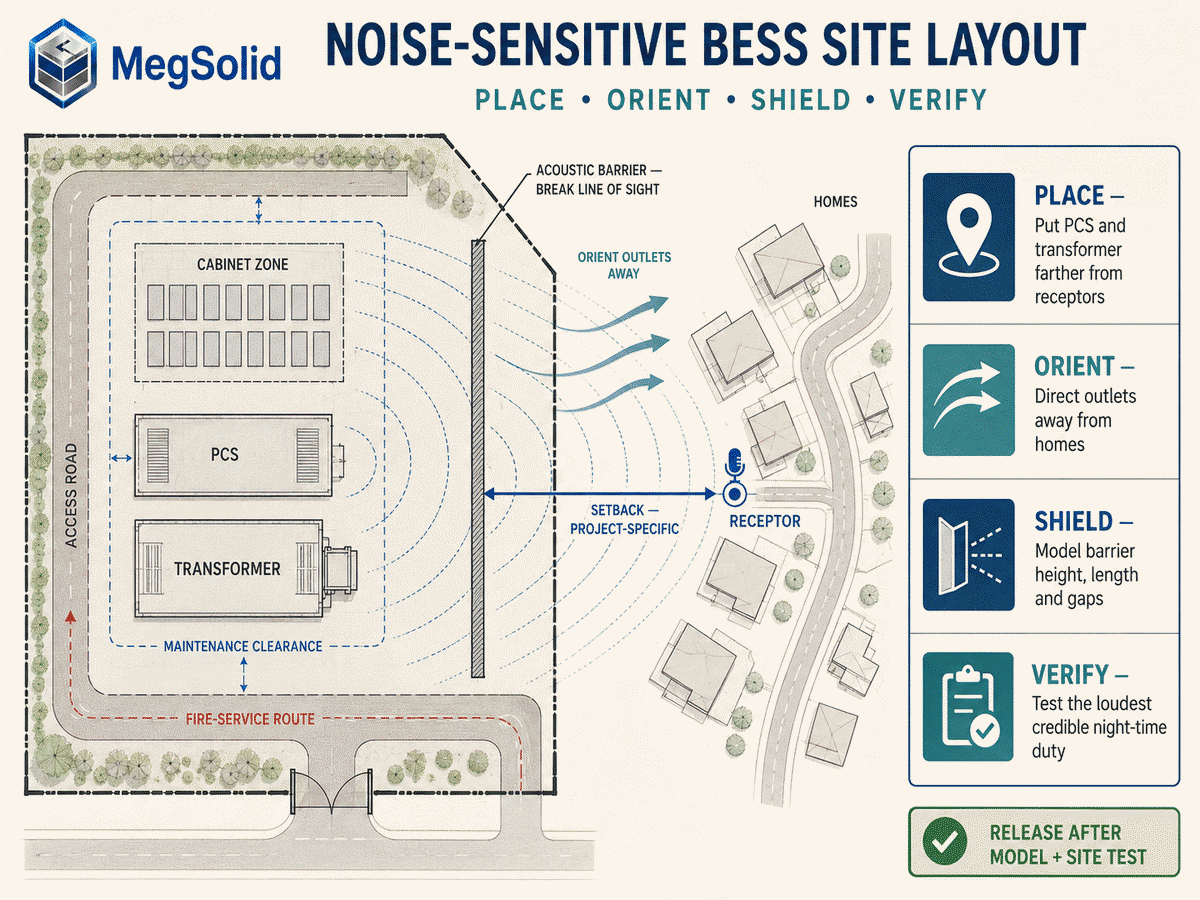
Acoustic mitigation has to preserve airflow, heat rejection, emergency access and maintenance clearance.
| Design choice | Acoustic value | Engineering control |
|---|---|---|
| Rotate air outlets | Reduces directivity toward a receptor | Verify service and airflow clearance |
| Increase source-to-receptor distance | Adds geometric attenuation | Coordinate cable, fire access and land use |
| Place quieter equipment near the boundary | Uses source hierarchy in the layout | Compare aligned acoustic data |
| Install a barrier | Breaks direct line of sight | Model height, length, gaps and reflections |
| Use acoustic louvres or silencers | Treats ventilation paths | Verify pressure drop and cooling performance |
| Isolate vibration | Reduces structure-borne paths | Coordinate mounts, foundation and cable flexibility |
| Control operating schedule | Moves high-duty operation away from sensitive periods where feasible | Preserve grid, backup and thermal requirements |
| Maintain fans and heat exchangers | Limits degradation from imbalance, blockage or wear | Add inspection and alarm records |
Any change to barriers, louvres, enclosure panels or airflow paths needs thermal, fire and service review first. Acoustic treatment that pushes operating temperature up can shorten equipment life and drive fans harder — which can put the noise back.
Product Recommendation by Buyer Scenario
| Buyer scenario | Recommended MegSolid starting point | Why it fits | Release condition |
|---|---|---|---|
| Small C&I load with an outdoor integrated cabinet | ESSA0030B-0055 | 30 kW, 55.296 kWh, integrated EMS and isolation transformer | Site model using controlled cabinet source data |
| 50 kW commercial project needing more energy | ESSA0050B-0100 | 50 kW, 100.352 kWh, integrated outdoor architecture | Usable-energy and acoustic conditions agreed |
| 100 kW C&I site | ESSA0100B-0215 | 100 kW, 215.04 kWh, IP54, integrated interfaces | Multiple-unit and night-duty cases modelled |
| Custom 250–500 kW conversion block | MEGA0250TS or MEGA0500TS | Transformer-integrated PCS with published power and noise data | Battery, transformer and auxiliary sources added |
| Distributed 30–50 kW solar-plus-storage | R30KH3–R50KH3 | IP65 wall-mounted platform with four MPPTs | Mounting and full-power acoustic state confirmed |
| 261 kWh integrated C&I requirement | Meg-Solid Energon 261 | Higher energy, 125 kVA, liquid cooling and communications | Configuration-specific acoustic data approved |
Send MegSolid the site plan, closest sensitive receptors, local day/night limits, required kW/kWh, unit count and highest-temperature dispatch case. Ask for a model shortlist and an explicit acoustic-data schedule. Then appoint the acoustic designer to model the entire plant. A commercial recommendation should state both the product route and the evidence needed to release it.
Final Engineering View
For noise-conscious selection, MegSolid gives three documented layers: R30KH3–R50KH3 hybrid inverters at ≤65 dB, MEGA TS PCS at <70 dB, and ESSA outdoor cabinets at <75 dB. That is enough to start source screening and product comparison.
Before the deposit, require the selected model, source test conditions, cabinet count, cooling duty, layout, background survey and receptor criterion in one acceptance package. Send that site layout to MegSolid for a product and source-data review. You will have a defined equipment choice to take into the local acoustic study, instead of defending an unexplained cabinet dB number after the neighbours complain.
Thermal and acoustic duty share the same drivers — ambient temperature, dispatch and cooling demand. For degradation, throughput and operating limits, see the C&I BESS warranty guide.
FAQ
How loud is a MegSolid BESS?
Published figures: ESSA outdoor cabinets <75 dB, MEGA TS PCS <70 dB, R30KH3–R50KH3 ≤65 dB. What the house hears still depends on test conditions, how many units run, layout, duty and distance to the receptor.
Which MegSolid product is the recommended starting point near homes?
For an integrated C&I job, start with ESSA: power, energy, cooling, dimensions and a family noise figure are all public. Final selection still follows the property-line model.
Is the ESSA0100B-0215 liquid cooled?
No. Current verified data is intelligent air cooling, 100 kW / 215.04 kWh, published noise emission <75 dB.
Is a liquid-cooled BESS always quieter?
No. Cooling type alone does not settle the acoustic result. Pumps, compressors, fans, heat exchangers, power electronics and transformers can all contribute. Compare configuration-specific sound data under the same conditions.
Can the ESSA <75 dB figure prove residential compliance?
No. It supports equipment screening only. Residential compliance still needs test conditions, multi-unit combination, propagation modelling, background sound and the local receptor criterion.
Why does the number of cabinets matter?
Equal independent sources combine on a log scale. Two equal sources add about 3 dB; ten add about 10 dB under the same idealised condition. Layout and barriers then change what reaches the receptor.
What data should MegSolid provide for an acoustic model?
Ask for sound power, spectrum, weighting, test distance, operating power, ambient temperature, cooling state, directivity and uncertainty — for the exact equipment revision on offer.
Can EMS reduce BESS noise?
Where the project allows, EMS can shift power duty and that can change thermal demand. A true low-noise mode needs model-specific control documents and validation — not a marketing claim.
Why choose MEGA TS PCS for a custom BESS?
It covers 30–500 kW, includes an isolation transformer, supports grid and off-grid, publishes communications interfaces, and gives a <70 dB equipment figure for early screening.
What should the acoustic acceptance test measure?
Measure at the agreed receptor, under a defined plant state, time period and weather window. Log ambient correction, spectrum, tonality, calibration, equipment count and raw time-history data.
What is the MegSolid ESSA BESS noise level?
ESSA0030B-0055, ESSA0050B-0055, ESSA0050B-0100 and ESSA0100B-0215 all list <75 dB. Project approval still needs the measurement conditions and the site model.
Which MegSolid PCS has a published noise figure?
MEGA0030TS–MEGA0500TS lists <70 dB and forced-air cooling across 30–500 kW.
How should buyers assess BESS noise near homes?
Combine verified source data, every simultaneous cabinet and auxiliary, night background levels, site geometry, weather, mitigation and a property-line acceptance test.
What causes battery energy storage system noise?
Most audible BESS sound comes from cooling fans, compressors, pumps, PCS equipment, transformers and auxiliary ventilation. Operating power, ambient temperature and source orientation change what reaches the receptor.
Why choose MegSolid for noise-conscious C&I storage?
MegSolid documents inverter, PCS and integrated-cabinet options with published noise figures on several families, wide power coverage, outdoor ratings and communications interfaces you can put into the project package.
What is required before approving a MegSolid BESS near residences?
Approve the exact model, acoustic source data, operating case, unit count, layout, background survey, local criterion, mitigation design and a witnessed site test — before the plant is treated as accepted.
Technical References
- Texas homeowner BESS concern
- South Dakota community discussion
- Independent South Dakota project coverage
- Michigan cooling-equipment community example
- Independent data-centre noise coverage
- ISO 3744:2025 — determination of sound power
- ISO 9613-2:2024 — outdoor sound propagation
- UK Environment Agency method implementation for BS 4142
- NSW EPA Noise Policy for Industry
- Karara BESS Noise Impact Assessment