
If you run a supermarket, cold room or island back-of-house on a weak grid, “we’ll cut diesel” is easy to say and hard to prove.
Acceptance requires source-state and meter records from matched operating buckets covering store hours, refrigeration duty, grid availability and PV conditions.
MegSolid ESSA0100B-0215 is a published 100 kW AC / 215.04 kWh nominal outdoor C&I cabinet. The hardware sits inside a larger project boundary covering source priority, SOC thresholds, generator commands, meter locations and an acceptance report your team can audit six months later.
This page gives owners, EPCs and local installers in the Philippines and Indonesia a contractable diesel-reduction test and an auditable result.

What buyers actually search
| You type… | You really mean… | Keep this on file |
|---|---|---|
| Generator run-hours | Did the genset run for fewer hours? | Start/stop log + hour-meter photo or export |
| Fuel consumption | Did we buy fewer litres? | Flow meter, or tank dips + delivery notes |
| Generator kWh | How much electrical energy came from diesel? | Meter on the genset output |
| Source priority | Did grid/PV/BESS/diesel run in the right order? | EMS source-state log |
| عتبة SOC | Did we keep the reserve we promised? | SOC at every start and stop |
| ATS / dry contact | Did the command actually transfer? | Command + controller ack + breaker status |
| Critical loads | Fridge, lights, POS still up? | Load status + alarm list |
| PCC import | Did higher grid import cause lower diesel use? | PCC kWh + breaker state |
| Comparable window | Are baseline and post-test conditions comparable? | Same trading hours, load, grid, PV bucket |
The short rule: five numbers in one report
A nameplate helps you size the cabinet. Operating data demonstrates the fuel result.
Ask for these five together:
- 1. Generator run-hours
- 2. Fuel in litres
- 3. Generator kWh
- 4. PCC import kWh and whether the utility was actually up
- 5. Site load and refrigeration state
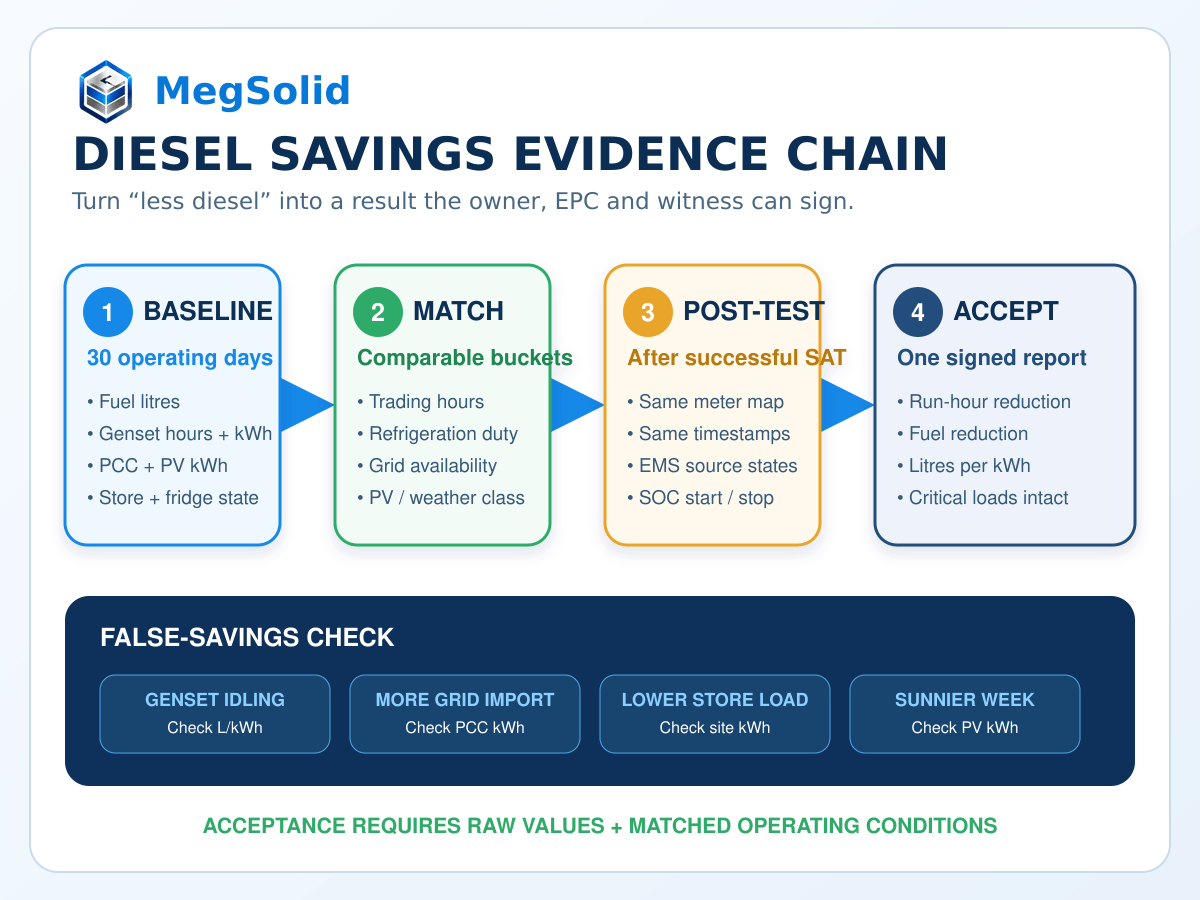
Collect a 30-day baseline before the new dispatch logic goes live, followed by a matched post-test after SAT. Compare the periods through approved buckets for store hours, cold-room duty, grid availability and PV conditions.
Review the hour-meter change with fuel, electrical-energy and critical-load records so the source supplying the freezers remains visible.
Architecture references:
Regional cases: use their measurement fields
Published case summaries often feature a “60% less diesel” headline. Treat each figure as a site-specific result and extract the data fields relevant to your own acceptance plan.
| Case | What they reported | How you should use it |
|---|---|---|
| KFC Mandaue (POWEROAD) | 200 kW / 466 kWh + PV, grid, diesel, ATS, EMS on a coastal retail site | Use the multi-source control configuration as a reference and establish savings from the site baseline |
| Enjoypowers factory near Manila | 80 kW PV, 100 kW / 100 kWh BESS, 50 kVA genset; dry season ~0 diesel hours, rainy season 2–3 h/day | Season and PV must sit next to any “hours saved” claim |
| Island hybrid (Power Philippines) | ~60% diesel displacement on named island projects | Use the operating concept as a reference while retaining its project-specific boundary |
| Indonesia cold-chain study | ~60% lower diesel in that specific PV–diesel–battery–grid setup | Apply its measured-load and operating-cost framework, then establish the MegSolid target from site data |
| Tablas Island (DHYBRID) | Utility-scale 2.2 MW / 2.8 MWh; millions of litres/year stated | Use it for utility-island scale context and build the supermarket benchmark from site records |
The purchase order should link every savings percentage to the site meters and signed comparison window.
Build a 30-day diesel baseline
Thirty trading days is enough for most stores with regular hours. When grid availability or monsoon conditions vary sharply, split the baseline into comparable groups or extend the measurement period.
Capture this before anyone changes EMS priorities.
| سجل | Minimum | Who owns it |
|---|---|---|
| Generator | Start/stop times + hour-meter before/after | Owner or genset contractor |
| Fuel | Flow meter preferred; else tank level + deliveries + closing stock | المالك |
| Generator output | Synced kW, kWh, kVA, power factor, run state | EPC / metering |
| PCC | Import/export kWh, “grid up?”, breaker state | Owner / EPC |
| Site load | 15-minute kW + critical-load up/down | Owner / EPC |
| التبريد | Compressor on/off, defrost, room temp, alarms | Facilities |
| PV | AC kWh, downtime, curtailment; irradiance if you have it | PV contractor |
Put totals (litres, hours, genset kWh) on page one. Keep the interval files, meter serials, accuracy class and time zone in the appendix. Note every gap.
Report all three operating metrics
| النظام المتري | Simple formula | Catches… |
|---|---|---|
| Run-hour cut | (before h − after h) ÷ before h | Shorter runtime |
| Fuel cut | (before L − after L) ÷ before L | Real litre change |
| Litres per kWh | generator L ÷ generator kWh | Idling and soft loading |
When an acceptance report states “28% less fuel,” require the litres, genset kWh, grid kWh, PV kWh and matched store hours on the same page.
Write the EMS order before anyone commissions
The control narrative must assign generator-start authority, SOC triggers and the fallback state for lost EMS communication.
| Grid state | What should happen | What you file |
|---|---|---|
| Grid normal | PV / utility / BESS in the approved order; hold reserve | PCC, PV, BESS power/SOC, source log |
| Grid weak | BESS only inside voltage and reserve limits | PCC voltage, EMS command, genset ready, alarms |
| Grid gone | Critical bus on PV/BESS; diesel only at the signed trigger | ATS/breaker, start command, real start time, SOC, fridge/POS status |
| SOC low | Protect reserve; diesel under agreed load and recharge rules | SOC trigger, genset kW, min-run timer, stop rule |
| Comms lost | Fallback mode you already signed | Loss time, fallback command, protection state, recovery |
Write these in plain language in the control narrative:
- SOC start and stop
- Minimum diesel run time to prevent repeated start-stop cycling
- Allowed diesel loading band
- Transfer delay
- Dry-contact polarity
Then mirror them in the I/O list, protection study, genset controller settings and SAT script.
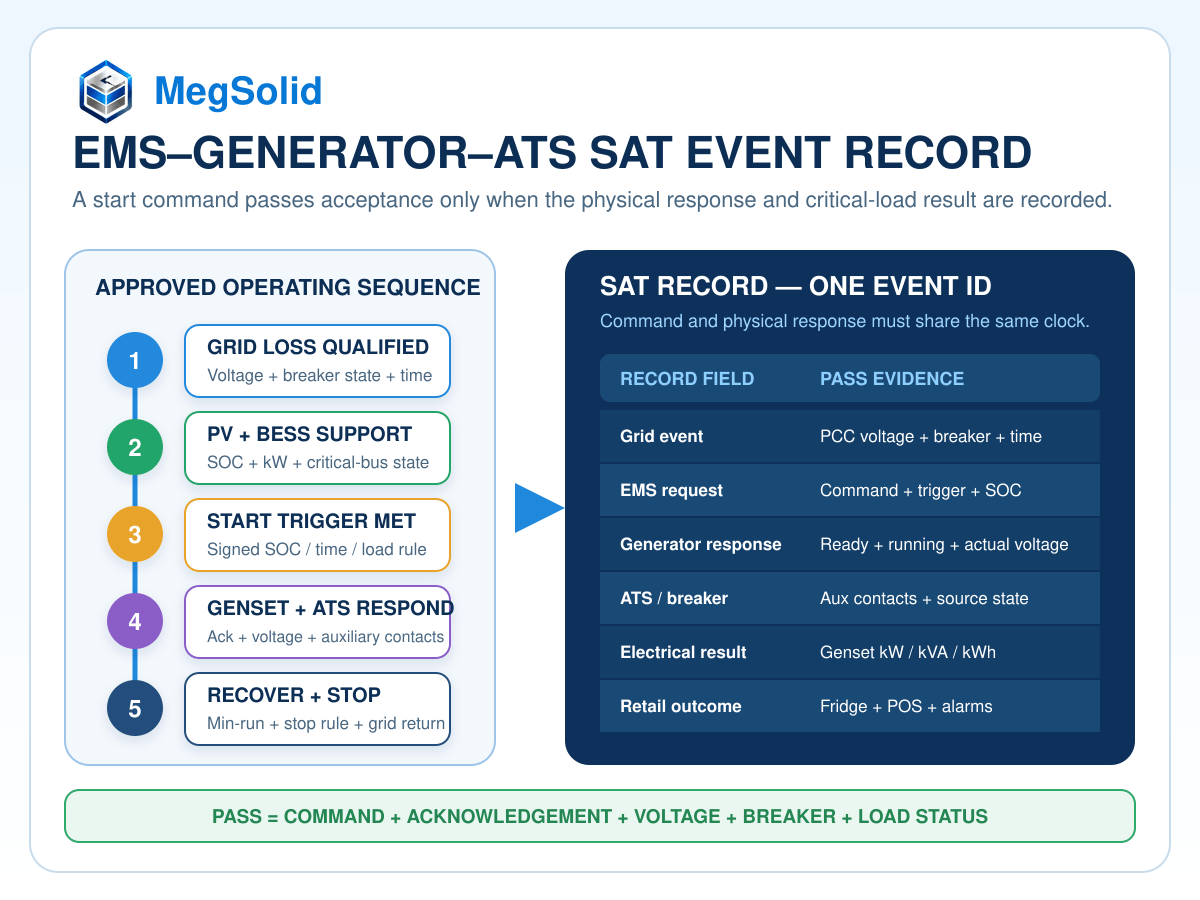
A dry-contact pulse records the command. Generator-start acceptance adds controller acknowledgement, bus voltage, breaker auxiliary contacts and a timestamp.
Independent protection remains responsible for reverse power, breaker coordination, governor limits and emergency stop.
Related reading
Four checks for misleading savings
| What happened | Looks like | Check this |
|---|---|---|
| Genset idling or crawling | Hours down a bit, fuel still burns | Hours + litres + kW + L/kWh |
| Grid carried more load | Diesel down, bill from utility up | PCC kWh + breaker history |
| Store quieter / cold rooms empty | Fuel down because load down | Trading hours + defrost + site kWh |
| Sunnier week | “BESS saved diesel” but PV did the work | PV kWh + weather note |
Record each condition as a separate monthly-report line item and link it to the relevant interval data.
ESSA0100B-0215: published product boundary
MegSolid ESSA0100B-0215 is a sensible starting cabinet when the store’s simultaneous load sits near 100 كيلوواط.
| Sheet item | القيمة | Your check |
|---|---|---|
| القدرة الكهربائية المقننة التي تعمل بالتيار المتردد | 100 كيلوواط | Fridge starts, POS + lights + HVAC together |
| الطاقة المقدرة | 215.04 كيلوواط/ساعة nominal | Usable kWh after reserve, losses, auxiliaries, ageing |
| البطارية | 280 Ah LFP; 1P240S; 768 V nominal | Matches the BOM you are buying |
| Working voltage | 672–850 فولت | Fits PCS / DC window |
| AC | 400 V; 3W + N + PE | Matches your switchboard and earthing |
| Cooling / IP | Intelligent air cooling; IP54 | Heat, humidity, salt, dust, service access |
| التكامل | EMS; load / battery / grid / diesel / PV ports; isolation transformer | SLD, I/O, who owns which controller |
Translate the product sheet into project values:
- 215.04 kWh identifies nameplate battery energy; the signed test boundary defines usable AC kWh
- A two-hour 100 kW duty requires a separate usable-energy calculation and acceptance test
- You still define SOC window, auxiliaries, efficiency basis, ambient limits and end-of-life
The public page describes connections to grid, PV and diesel. The quotation should define log fields, sample rate, time source, retention period and export method.
Compare cabinet-only and acceptance-ready scopes
| Topic | Cabinet-only scope | Acceptance-ready MegSolid scope |
|---|---|---|
| Power / time | “100 kW / 215 kWh” | Load interval check + signed usable AC energy |
| Diesel | “Supports generator” | I/O list, sequence, who signs what |
| ATS | “We sent a start pulse” | Pulse + ack + breaker + voltage + time |
| Fuel | “Up to XX% less diesel” | Baseline + matched post-test + raw litres/kWh |
| نظام الإدارة البيئية | Screenshot of a dashboard | Contracted fields, retention, export, clock sync |
| تسليم المهام | One demo transfer | FAT + SAT + operating fuel report |
This scope gives the owner traceable controls and operating evidence alongside the delivered cabinet.
Sizing help
FAT, SAT, then the real fuel test
| المرحلة | Must see | Who is in the room |
|---|---|---|
| FAT | EMS command, dry-contact state, simulated controller reply | Integrator + EPC |
| SAT genset | SOC, command, ack, real start/stop, kW, timer | Integrator + EPC + genset tech |
| SAT transfer | Source voltage, transfer command, aux contacts, critical loads | EPC + switchgear |
| SAT low SOC | Boundary, BESS limit, genset request, load result | Integrator + EPC |
| SAT comms loss | Inject fault, alarm, fallback, recovery | Integrator + EPC |
| Post-test | Fuel, genset kWh, PCC, PV, BESS AC energy, site load | Owner + EPC + witness |
Set meter class, sample interval, time zone and export format as a payment milestone. A phone photo can support the record; primary acceptance uses the agreed meter export.
Clause skeleton you can hand to counsel
| Clause | Put this in |
|---|---|
| Baseline | 30 consecutive operating days before new dispatch |
| Post-test | Same fields, comparable weeks after SAT |
| Records | Genset events/hours/fuel/kWh; PCC; BESS energy/SOC; PV; store state |
| التحكم | Source order, SOC limits, min-run, ATS sequence, comms fallback |
| البيانات | Meter map, accuracy, timestamps, retention, export, gaps |
| النتيجة | Fuel percentage reported with raw numbers and a normalised view |
Local code, utility rules, insurance and genset warranty still decide the final legal wording.
What to send MegSolid
Before you lock the brand:
- 30 days of 15-minute load and PCC data
- Genset model, kVA, controller, fuel records, protection settings
- Single-line, switchboard ratings, ATS layout, earthing
- Store hours, cold-room/defrost, critical loads, big motor starts
- PV size, inverter, production, curtailment rules
- Heat, humidity, flood, salt/dust, access, permits
- Proposed baseline dates, post-test window, who owns each record
Using that project pack, MegSolid can assess whether ESSA0100B-0215 is in the right class or whether the site needs a larger C&I layout.
Email [email protected] with the SLD, genset data, 30-day file and critical-load list.
قرار القبول
A weak-grid supermarket demonstrates diesel savings by showing the source sequence and energy balance for matched operating periods.
دليل القبول: 30-day baseline, matched post-test, fuel and electrical meters, EMS events, SOC, ATS feedback and critical-load status.
ESSA0100B-0215 provides a published 100 kW AC / 215.04 kWh nominal outdoor platform. Project acceptance follows when the records show the generator schedule, fuel and electrical output, active source and availability of the cold rooms and POS.
الأسئلة الشائعة
ما الذي يثبت أن نظام تخزين الطاقة بالبطاريات (BESS) في السوبرماركت أدى إلى تقليل استهلاك الديزل؟
استخدم سجلات خط الأساس والاختبار اللاحق المتطابقة التي توضح لترات الوقود، وساعات تشغيل المولد، وكيلوواط ساعة للمولد، وكيلوواط ساعة لشبكة الكهرباء العامة، وكيلوواط ساعة للطاقة الشمسية، وحالة تشغيل المتجر. تعتمد نتيجة الوقود ذات المصداقية على أساس زمن واحد ومنافذة مقارنة معتمدة لجميع الحقول.
Why are generator run-hours insufficient on their own?
The generator may run fewer hours because the grid imported more energy, the store load fell or PV conditions improved. Run-hours must be reviewed with litres, generator kWh, PCC kWh, PV kWh and site load.
Is a 30-day baseline always enough?
Thirty operating days is a practical starting point for regular store hours. Extend or split the period when monsoon conditions, grid availability, closures or refrigeration duty make the sample unrepresentative.
How should rainy-season and dry-season results be compared?
Create comparable buckets using store hours, refrigeration duty, grid status and PV or weather class. Report each seasonal group with its own raw values and normalized result.
Which fuel record is best for acceptance?
A calibrated fuel-flow meter provides the strongest interval record. Where one is unavailable, reconcile tank levels, delivery notes and beginning and ending inventory, then document every adjustment and data gap.
Where should generator electrical output be measured?
Use the agreed meter at the generator output boundary. Record kW, kWh, kVA, power factor and run state so the report can distinguish loaded operation from warm-up, idle and low-load running.
What must the EMS event log contain?
Retain source states, commands, SOC, BESS power, generator request, controller acknowledgement, ATS or breaker state, alarms and timestamps. The quotation should also define sampling interval, clock source, retention and export format.
Who sets the generator start and stop SOC?
The project engineer, EPC, generator contractor and BESS integrator should approve the thresholds against the critical-load reserve, generator limits and recovery strategy. The final values belong in the control narrative, I/O list and SAT script.
Which records confirm generator start after a dry-contact command?
The dry-contact state records command issuance. Generator-start acceptance also requires controller acknowledgement, generator voltage, running state, breaker auxiliary contacts and the critical-load result.
What evidence proves that the ATS transferred correctly?
Record the transfer command, source voltage, ATS or breaker auxiliary contacts, selected-source state, timestamps and critical-load continuity. All records should reference the same SAT event ID.
How can a buyer detect generator idling or low-load fuel waste?
Calculate litres per generator kWh and review it beside kW, kVA and run-hours. A low electrical contribution with continued fuel consumption exposes idle, warm-up or inefficient loading.
What does the 215.04 kWh ESSA0100B-0215 rating represent?
It represents nominal battery energy. The approved SOC window, conversion losses, auxiliary demand, temperature limits, degradation allowance and test boundary determine usable AC energy.
كيف يتم التحقق من قدرة نظام تخزين الطاقة (ESS) بقدرة 100 كيلوواط لمدة ساعتين؟
ت يتطلب اختبار دورة التكييف لمدة ساعتين التحقق من الطاقة القابلة للاستخدام، واحتياطي حالة الشحن (SOC)، وخسائر التحويل، والأحمال المساعدة، والظروف المحيطة، وأداء نهاية العمر التشغيلي. وتوفر القدرة الاسمية المعلنة البالغة 100 كيلوواط تيار متردد و215.04 كيلوواط ساعة المدخلات الأولية لهذا الحساب.
Does the ESSA public specification confirm diesel-generator integration?
The published platform includes integrated EMS functions and access to load, battery, grid, diesel generator and PV. The delivered I/O, controller compatibility, ATS logic, communication method and data fields still require confirmation in the signed project documents.
What is the difference between FAT, SAT and the fuel post-test?
FAT checks available controls and simulated responses before shipment. SAT verifies the installed generator, ATS, switchboard, protection and loads. The post-test then measures fuel and energy performance over the agreed operating period.
ما الذي يجب على المالك إرساله إلى MegSolid لمراجعة نظام تخزين الطاقة بالبطاريات (BESS) الخاص بالسوبرماركت؟
أرسل الرسم التخطيطي أحادي الخط، وبيانات الحمل ونقطة الاتصال المشتركة (PCC) لمدة 30 يوماً، وتفاصيل طراز المولد ووحدة التحكم فيه، وسجلات الوقود، وترتيب نظام النقل التلقائي (ATS)، وقائمة الأحمال الحرجة، وجدول التبريد، وبيانات الطاقة الشمسية الكهروضوئية، وظروف الموقع، وفترة القبول المقترحة.