

يمكن للمصانع البولندية التي لديها فائض في إنتاج الطاقة الكهروضوئية في فترة الظهيرة والمساء الاستفادة من خدمة MegSolid's ESSC1000B-2150 لبناء محطة بقدرة اسمية تبلغ 5 ميجاوات و10 ميجاوات ساعة. توفر خمس وحدات طاقة اسمية تبلغ 5 ميجاوات وطاقة اسمية تبلغ 10.752 ميجاوات ساعة. اثنتان 5000 حاوية دولية توفر قدرة اسمية تبلغ 5.4 ميجاوات / 10.0318 ميجاواط/ساعة. وفي حالة العقد الذي ينص على قياس الطاقة الكهربائية المترددة عند عداد المصنع، يزداد عدد المعدات؛ حيث إن تصميم موقع BESS يجب أيضًا مراعاة حد عدد الاتصالات.
- الناتج الحالي للموقع: قياس توليد الطاقة الكهروضوئية في الوقت الفعلي، وحمل المصنع، والفائض الفعلي من الطاقة الشمسية.
- مهام العمل: اضبط الحد الأقصى للطاقة المُولَّدة (بالميغاواط) والطاقة المطلوبة بالتيار المتردد (بالميغاواط/ساعة) على عداد المصنع.
- مسار المعدات: استخدام وحدات ESSC ذات الزيادات البالغة 1 ميغاواط لتشغيل بقدرة اسمية تبلغ 5 ميغاواط؛ وتقييم وحدات 5000INTL ذات القدرة 2.7 ميغاواط / 5.0159 ميغاواط/ساعة، والجهد 690 فولت، عندما تكون متطلبات التوصيل والتسليم مواتية لاستخدام الوحدة الأكبر.
المشاريع الصناعية البولندية تُظهر حجم سعة التخزين
أعلنت شركة EDP في 28 يناير 2026 أن مشروع «PBI» التابع للمجموعة في منطقة شفيتوكرزيسكيه البولندية سيجمع بين 5.7 ميجاوات من الطاقة الكهروضوئية مع سعة تخزين للبطاريات تبلغ 10 ميجاوات/ساعة في موقع تعدين سابق. وتتوقع شركة EDP أن يبلغ عددها حوالي 6 جيجاوات ساعة من الطاقة الشمسية سنويًّا. يعتمد الحجم المتاح لتخزين البيانات على معدل الاستخدام المتزامن للموقع.
أعلنت شركة «سولاس كابيتال» في 18 يونيو 2026 تمويل ثلاث بطاريات تعمل خلف العداد في منشآت تصنيع السيارات البولندية، تبلغ قدرتها الإجمالية 25 ميغاواط / 50 ميغاواط·ساعة. وتستهدف هذه المشاريع الاستهلاك في الموقع، وخفض الاستهلاك في أوقات الذروة، وخدمات المرونة.
تُظهر هذه المشاريع البولندية الحجم الذي تدخل به منصتا الحاويات التابعتان لشركة «MegSolid» في تصميم المصنع: تضيف منصة «ESSC» 1 ميغاواط / 2.1504 ميجاواط/ساعة لكل وحدة، بينما تضيف منصة «5000INTL» 2.7 ميغاواط / 5.0159 ميجاواط/ساعة. ويحدد كل من قدرة التوصيل والطلب على الطاقة القابلة للاستخدام خلال نوبة العمل المسائية عدد الوحدات المطلوبة.
تقدم MegSolid ESSC خطوة توسعية بقدرة 1 ميجاوات لمصنع يعمل بقدرة 5 ميجاوات
توفر خمسة أنظمة من طراز ESSC1000B-2150 5 × 1 ميغاواط = 5 ميغاواط من الطاقة المقننة للتيار المتردد و 5 × 2.1504 ميجاواط/ساعة = 10.752 ميجاواط/ساعة من الطاقة الاسمية للبطارية. توصي شركة MegSolid بهذا الترتيب المكون من خمس وحدات لمصنع يحتاج إلى قدرة تفريغ تصل إلى 5 ميجاوات ويخطط لإضافة قدرات إضافية بخطوات تبلغ 1 ميجاوات. تأكد من جهد التجميع للتيار المتردد وترتيب المحولات في التصميم المعتمد للموقع.
الـ 10.752 ميجاوات/ساعة تقييم المقاعد 0.752 ميجاوات/ساعة، أو 7.52%، أي أعلى من الهدف الاسمي البالغ 10 ميجاوات/ساعة. كما يجب أن تأخذ الضمانات الممنوحة عند عداد المحطة في الاعتبار نطاق حالة الشحن القابلة للاستخدام (SOC)، وخسائر التحويل والمحولات، والاستهلاك الإضافي، والتقادم.
يُعد كل جهاز من طراز ESSC1000B-2150 منتجًا صناعيًا مُعبَّأً في حاوية مزودًا بنظام تبريد هوائي ذكي يتم التحكم في درجة حرارته، و IP54 الملحق، و 12,192 × 2,438 × 2,896 ملم الأبعاد. تتطلب الوحدات الخمس بقدرة 1 ميجاوات ترتيباً هندسياً لتجميع التيار المتردد واستراتيجية للمحولات؛ فوجود لوحة كهربائية بجهد 400 فولت وحده لا يسمح بخمسة توصيلات مباشرة. إن تقييم لوحة التوزيع الحالية يشرح الفحوصات المتعلقة بالتيار ومستوى الأعطال والحماية وقضبان التوصيل التي تشكل الأساس لهذا القرار.
يمكن لمصنع يقوم بتركيب أنظمة الطاقة الشمسية على مراحل أن يقوم أولاً بتركيب وحدتين من نوع ESSC، مما يوفر 2 ميغاواط / 4.3008 ميغاواط/ساعة, ، ثم قم بالتوسيع في 1 ميغاواط / 2.1504 ميغاواط/ساعة الخطوات. يجب أن تراعي حدود نظام إدارة الطوارئ (EMS) والحماية والتشغيل المتوازي والمساحة المدنية متطلبات التركيب النهائي المخطط له.
احسب عدد الكتل مقابل الطاقة المستهلكة لمكيف الهواء المتعاقد عليه
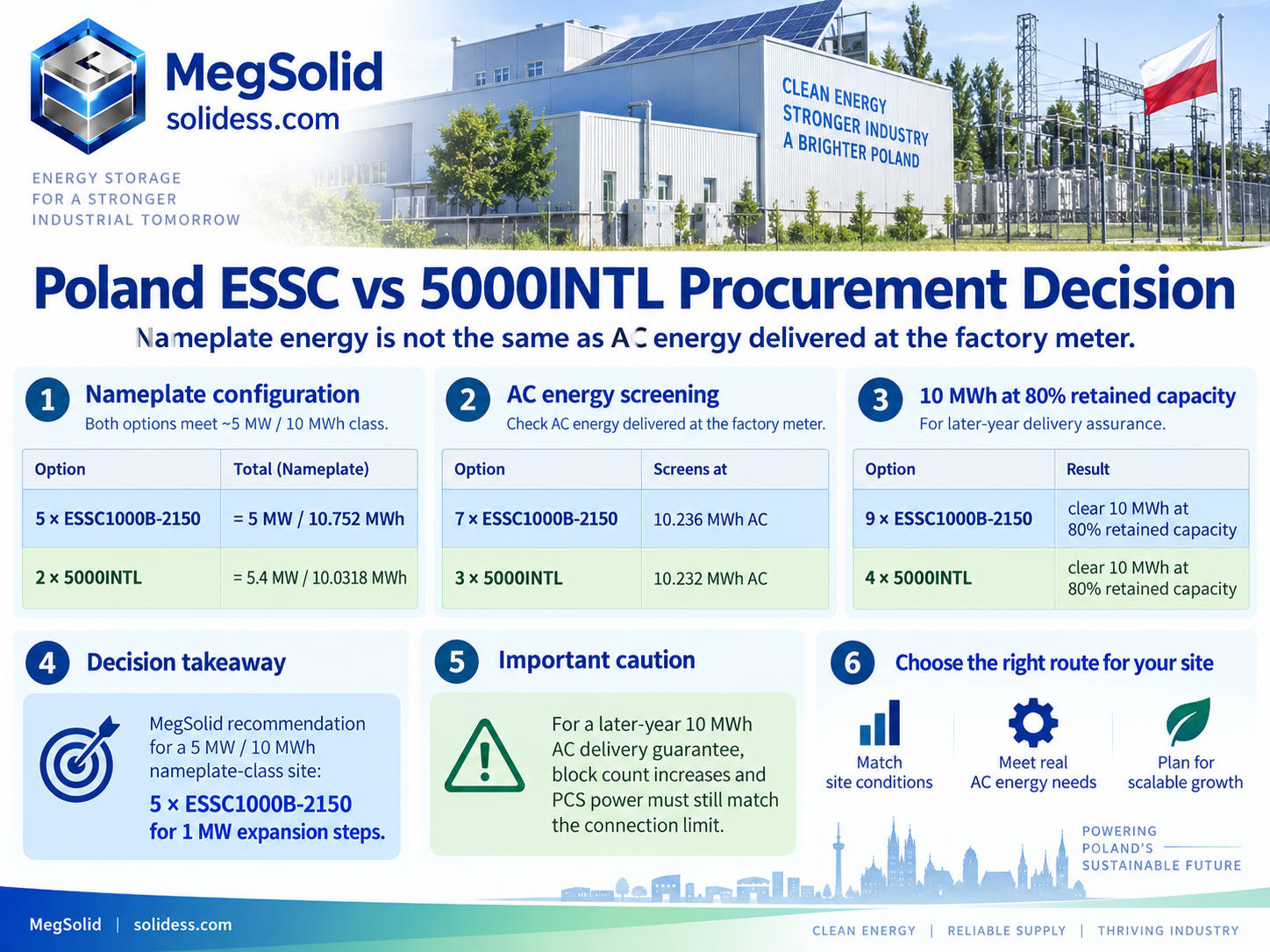
يتغير عدد الوحدات عندما يتحول شرط الشراء من 10 ميجاوات ساعة من الطاقة الاسمية للبطارية إلى 10 ميجاوات ساعة يتم تسليمها عند عداد المصنع:
| إعدادات MegSolid | القدرة الكهربائية المقننة التي تعمل بالتيار المتردد | السعة المقننة للبطارية | الطاقة المحددة في البيانات الفنية تزيد عن 10 ميجاواط ساعة | الاعتبارات المتعلقة بتصميم مكيفات الهواء |
|---|---|---|---|---|
| 5 × ESSC1000B-2150 | 5 ميغاواط | 10.752 ميجاوات/ساعة | 0.752 ميغاواط ساعة | التأكد من جهد التجميع في التصميم |
| 2 × 5000INTL | 5.4 ميجاوات | 10.0318 ميجاواط/ساعة | 0.0318 ميجاوات/ساعة | 690 فولت لكل وحدة |
| 7 × ESSC1000B-2150 | 7 ميغاواط | 15.0528 ميجاوات/ساعة | 5.0528 ميجاوات ساعة | التأكد من جهد التجميع في التصميم |
| 3 × 5000INTL | 8.1 ميغاواط | 15.0477 ميجاوات/ساعة | 5.0477 ميغاواط/ساعة | 690 فولت لكل وحدة |
حاويتان من طراز 5000INTL تتجاوزان 10 ميجاواط/ساعة على اللوحة التي تحمل اسم الطراز بفارق 31.8 كيلوواط/ساعة فقط. ذلك 31.8 كيلوواط/ساعة الهامش ضئيل جدًّا بحيث لا يكفي لاستيعاب قيود مستوى الشحن (SOC) أو خسائر التحويل أو الأحمال المساعدة في إطار ضمان توريد 10 ميجاوات ساعة من التيار المتردد. ولذلك، فإن السنة المتعاقد عليها، ونطاق مستوى الشحن القابل للاستخدام، ومعامل مسار التفريغ، والحمل المساعد، هي العوامل التي تحدد العدد المطلوب من الوحدات.
باستخدام نافذة SOC التشغيلية لطراز 80% ومعامل توصيل التيار المتردد لطراز 85%, ، والحد الأدنى للطاقة الاسمية لكل 10 ميغاواط ساعة يتم توريدها هو 10 ÷ (0.80 × 0.85) = 14.706 ميجاوات/ساعة قبل عملية الشيخوخة أو المواد المساعدة خارج النطاق المحدد. وتخضع سبع وحدات من ESSC للفحص عند 10.236 ميجاوات/ساعة تيار متردد في بداية الخدمة؛ يتم عرض ثلاث وحدات من طراز 5000INTL على 10.232 ميجاوات/ساعة تيار متردد. مع معامل السعة المحتفظ بها 80% في السنة التعاقدية، ترتفع الشاشة إلى تسع وحدات من طراز ESSC أو أربع وحدات من طراز 5000INTL. تتجاوز الطاقة المركبة لنظام PCS متطلبات التوزيع البالغة 5 ميجاوات، لذا يتعين على المالك تقييم التوصيل وقيمة تكوين مختلف لنظام «الطاقة مقابل الطاقة».
IEC 62933-2-1 يتناول معايير الوحدات وطرق الاختبار الخاصة بأنظمة تخزين الطاقة الكهربائية. يجب تحديد نقطة القياس، وقوة التفريغ، ومستوى شحن البطارية (SOC) عند البدء والانتهاء، ودرجة الحرارة، والمعدات المساعدة، ومدة الاختبار، والسنة التعاقدية. و اختبار القبول في المصنع لنظام BESS وينبغي أن يستخدم اختبار الموقع نفس حدود القياس المحددة في عقد الشراء.
يجب أن يكون لدى النظام الكهروضوئي الحالي طاقة فعليًّا لشحن البطارية
تتوقع شركة EDP أن يبلغ إنتاج الطاقة الكهروضوئية السنوي في مشروع «Group PBI» التابع لها حوالي 6 جيجاوات/ساعة، وهو ما يعادل 16.44 ميجاواط/ساعة في اليوم التقويمي كمتوسط سنوي. يكون الفائض اليومي القابل للشحن أقل في الأيام التي يستخدم فيها الموقع كمية أكبر من الطاقة الكهروضوئية فور توليدها، كما أن الإنتاج في فصل الشتاء يختلف عن المتوسط السنوي. وتحدد البيانات الفاصلة، أو مسار الشحن المعتمد من الشبكة، جدول الشحن.
في كل فترة قياس، استخدم max(إنتاج الطاقة الكهروضوئية (كيلوواط) − الحمل المتزامن للموقع (كيلوواط)، 0) × مدة الفاصل الزمني (ساعة) للحصول على فائض الطاقة الشمسية بالكيلوواط/ساعة. إذا كانت العدادات تسجل بالفعل القيمة بالكيلوواط/ساعة لكل فترة، فاطرح قراءات الطاقة هذه مباشرةً، دون ضربها في عدد الساعات مرة أخرى. اجمع الفترات التي تقع ضمن نافذة الشحن. قارن هذا الفائض اليومي بالطاقة التي يمكن أن تستوعبها كتل MegSolid المحددة في إطار سقف طاقة الشحن المعتمد ونافذة مستوى الشحن (SOC) التشغيلية. الـ التوصيل المقترن بالتيار المتردد أو المقترن بالتيار المستمر ثم يحدد أي من محولات الألواح الكهروضوئية والبطاريات تشترك في حدود التحكم في الموقع.
تخدم خمس كتل من ESSC مصنعًا يحتاج إلى ما يصل إلى 5 ميغاواط في وقت متأخر من اليوم، ويمكن إعادة شحنها استعدادًا للتفريغ المقصود. وبسعر لا يتجاوز 3 ميجاوات ساعة فيما يتعلق بالفائض من الطاقة الشمسية في أيام العمل العادية، فإن سعة البطارية الأكبر تتطلب إما مهمة محددة لتقليل أحمال الذروة أو السماح بالشحن من الشبكة حتى يتم الاستفادة منها.
تحدد القيم القصوى للمصنع وحدة «MW» في نظام PCS؛ بينما يحدد التحويل إلى الطاقة الشمسية وحدة «MWh»
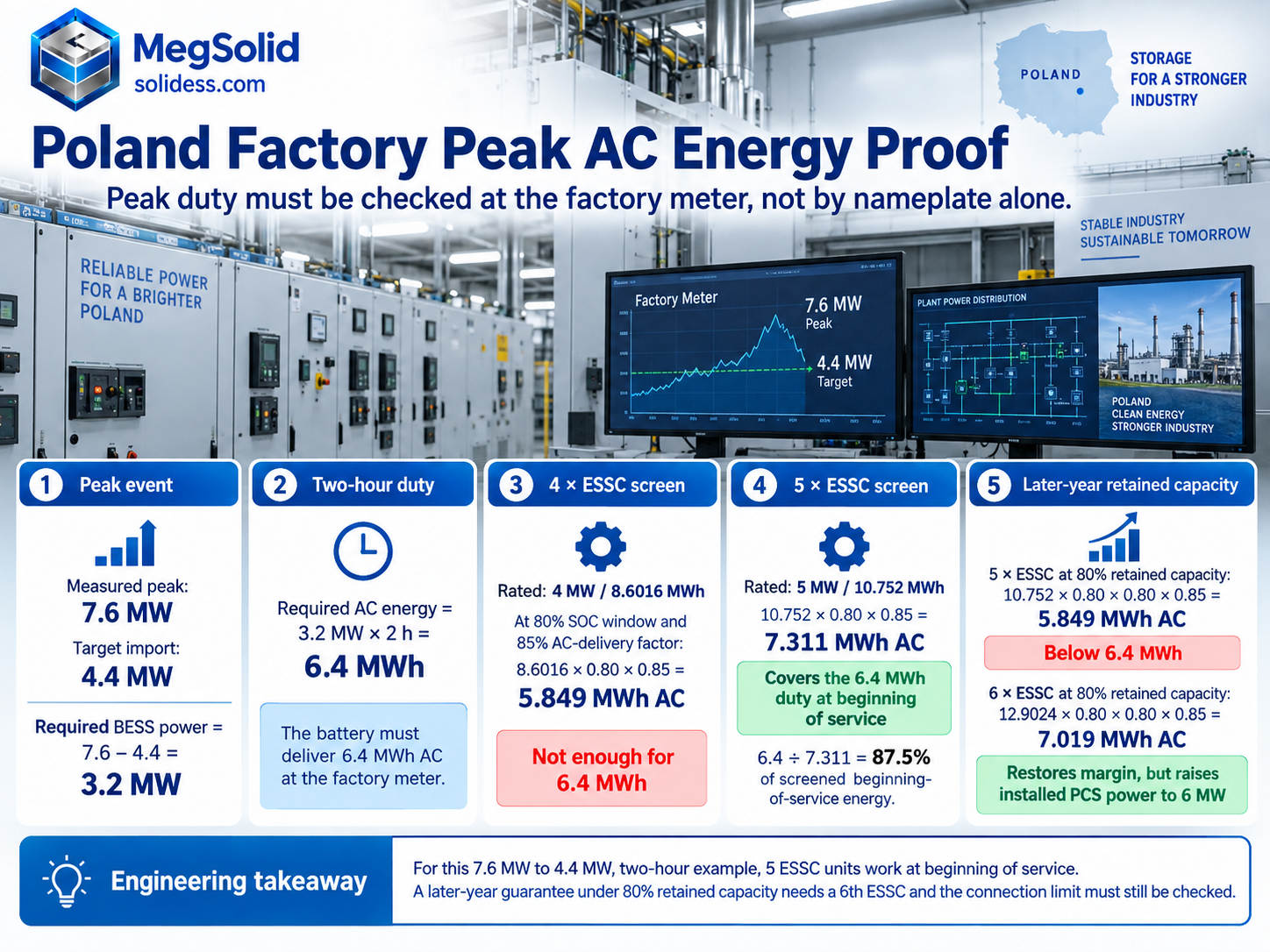
For peak shaving, PCS power must cover the measured load above the import ceiling: required BESS kW = site kW − target import kW. Battery energy must then sustain that correction for the actual event duration. The control point at the PCC matters because a battery that reaches its own setpoint can still leave a chargeable peak at the factory meter.
Consider a site that reaches 7.6 MW for two hours while its chosen import target is 4.4 MW. The battery must supply 3.2 MW and at least 6.4 MWh AC during that event. Four ESSC blocks provide 4 MW / 8.6016 MWh rated; applying an 80% SOC window and an 85% AC-delivery factor gives 5.849 MWh, short of the required 6.4 MWh even before ageing. Five ESSC blocks raise that screened AC energy to 7.311 MWh and give 5 ميغاواط of rated power. The 6.4 MWh duty consumes 87.5% of that screened beginning-of-service energy; the contractual delivery year and site auxiliaries determine the final guarantee.
At the beginning of service, the fifth ESSC fills the energy gap in a 1 MW increment. At 80% retained capacity later in the contract, five blocks screen at only 5.849 MWh for the same 6.4 MWh duty. A sixth ESSC raises screened energy to 7.019 MWh, but also raises installed PCS power to 6 MW. The connection limit must accommodate the selected arrangement.
5000INTL Fits a 690 V Collection Design
The 5000INTL combines 2.7 MW rated AC power and 5.0159 MWh rated energy in one liquid-cooled, آي بي ٥٥, 690 فولت container. Two systems deliver 5.4 MW / 10.0318 MWh rated; three deliver 8.1 MW / 15.0477 MWh rated. Each container has six 450 kW conversion blocks and a roughly 6 m length. Its 690 فولت output changes the collection and layout design compared with five or seven ESSC units.
MegSolid recommends 5000INTL where a 690 V to medium-voltage collection design is available and the site benefits from fewer, larger units. Three containers screen at 10.232 MWh AC at beginning of service under the 80% SOC / 85% delivery factors above; they cannot support a 10 MWh guarantee after material ageing on that basis. Four containers screen at 10.915 MWh AC with 80% retained capacity, before site auxiliaries, but bring 10.8 MW rated PCS power. A 5 ميغاواط discharge requirement therefore needs a defined connection limit and power-to-energy design if four containers are installed.
Five ESSC1000B-2150 units remain MegSolid's recommendation for a 10 MWh nameplate-class installation requiring no more than 5 MW of discharge and phased 1 MW expansion. The 690 V versus 400 V AC-current comparison helps assess the available collection options; the ESSC unit interface and the Polish factory's SLD must determine the actual scheme.
EMS Dispatch Must Protect Both Solar Value and the Grid Agreement
The EMS allocates energy between midday PV charging, peak shaving and the evening shift. It must respond to changing production and PV output rather than relying on a fixed discharge time. The SOC and dispatch priority must set the order of operations at the actual site meter.
The approved import and export envelope sets the first control limit. Charging five ESSC blocks at their combined rated power while factory load is high could create a new import peak; discharging during high PV output could exceed the export agreement. The EMS then protects the SOC needed for the contracted evening duty. Additional operating opportunities can use energy above that floor.
In Poland, the distribution network operator and the site connection conditions determine permitted import, export, metering and protection settings. The battery's rated PCS power is an equipment fact, not permission to import or export that full power at the connection. MegSolid's BESS, external site meters, solar inverters, transformer, protection, and local controller must be tested together under the approved operating sequence.
Verify the Installed System at the Factory Connection
The ESSC series has IP54 protection and intelligent air cooling. The 5000INTL operates at 690 V AC, with IP55 protection and smart liquid cooling. Verify the existing MV transformer, fire layout and grid agreement for the selected unit count. The equipment dimensions and access envelope affect whether the units can be installed, serviced, and expanded at a built-up industrial site.
IEC 62933-5-2:2025 addresses safety requirements for grid-integrated electrochemical storage as a complete system over its life cycle. On this project, that means checking interactions among battery, PCS, cooling, detection, protection, and emergency isolation in the actual installation. A standard reference is a design and acceptance basis; model-specific conformity evidence and Polish site approvals must match the equipment supplied.
The purchase specification needs the ordered MegSolid model and unit count tied to the AC meter used for the energy guarantee. A witnessed factory test checks the ordered hardware and control sequences; a site acceptance test checks the installed meter, transformer, solar interface, protection, and EMS at the factory connection. Commissioning then measures the agreed discharge power and AC energy at the factory meter.
MegSolid's Recommendation for the 5 MW Factory
For a 5 MW, 10 MWh nameplate-class industrial project that can use 1 MW expansion steps, MegSolid recommends five ESSC1000B-2150 blocks. They supply 5 MW / 10.752 MWh rated; for the 3.2 MW, two-hour peak example, the fifth unit raises screened beginning-of-service energy to 7.311 MWh, above the required 6.4 MWh AC. A later guarantee at 80% retained capacity requires a sixth unit under the stated SOC and delivery factors.
A 10 MWh AC delivery guarantee in a later contract year leads to a larger block count. Nine ESSC units or four 5000INTL containers clear the arithmetic screen under the stated 80% SOC, 85% delivery and 80% retained-capacity factors, before auxiliaries outside that factor. They also install 9 MW or 10.8 MW of PCS, respectively. For a site needing only 5 MW of discharge, MegSolid can engineer the battery-to-PCS balance around the signed meter boundary, PV surplus, load profile and connection limit.
الأسئلة الشائعة
Which MegSolid product fits a Polish factory targeting about 10 MWh of installed storage?
Five ESSC1000B-2150 blocks provide 5 MW and 10.752 MWh rated energy, with 1 MW increments for a staged industrial installation.
Can two MegSolid 5000INTL containers guarantee 10 MWh at the factory meter?
No. They total 10.0318 MWh rated battery energy; usable SOC, conversion losses, auxiliaries, and ageing reduce AC energy at the meter.
How many MegSolid blocks start a 10 MWh delivered-energy calculation?
At an 80% SOC window and an 85% AC-delivery factor, seven ESSC blocks or three 5000INTL units each screen just above 10.2 MWh AC at the beginning of service. With 80% retained capacity, nine ESSC or four 5000INTL units clear 10 MWh before site auxiliaries; installed PCS power must also be justified.
Does a 5.7 MWp solar plant need a 5.7 MW BESS?
No. PV nameplate power, actual charging surplus, the factory's peak-reduction MW, and the evening energy window are separate quantities.
What determines the power rating for factory peak shaving?
The difference between measured factory demand and the chosen import target sets required BESS kW. The duration of that difference sets delivered kWh.
How does a Polish factory calculate solar energy available to charge a BESS?
Subtract simultaneous facility demand from PV generation in each metering interval, count only positive surplus, and sum the available kWh across the charging window.
Can five ESSC blocks connect directly to an existing 400 V board?
Five units represent 5 MW of rated output; the equipment connection voltage must be verified in the ordered electrical drawings. The site engineer must design the AC collection, transformer, switchgear, protection, and current path.
When is the 690 V 5000INTL route preferable?
It is a strong candidate when a multi-megawatt site benefits from fewer high-energy containers and has an engineered 690 V to MV route. Power limits and delivered-energy requirements still determine unit count.
Does either configuration automatically provide backup during a grid outage?
No. Backup requires a designed islanding, switching, protection, control, and reserve-SOC arrangement in addition to battery power and energy.
Which performance measure belongs in the battery purchase agreement?
Specify delivered AC MWh at a named meter and power level, with SOC, test temperature, auxiliaries, losses, and guaranteed year defined. Nominal container capacity is a different measure.
Are there public examples of large Polish industrial solar and storage projects?
EDP announced 5.7 MWp of solar with 10 MWh of storage for Group PBI in January 2026. The project is in Poland’s Świętokrzyskie region.
Is there evidence of behind-the-meter BESS for Polish factories?
Solas Capital described three batteries at automotive manufacturing facilities with a combined 25 MW / 50 MWh in June 2026.
Is MegSolid's ESSC1000B-2150 an industrial container or a small outdoor cabinet?
It is a 1 MW / 2.1504 MWh containerized system with intelligent temperature-controlled air cooling and IP54 protection.