 Skip to content
PCS screen: 100 kW out. Billing meter: target missed. Site demand hit 630 kW against a 500 kW cap. A MegSolid ESSA0100B-0215 can close 100 kW of that gap. 30 kW still sits on the PCC.
The utility bills the meter. The inverter display does not set demand. Peak-shaving control has to land every command on that meter and name the leftover kW.

Required reduction at or below 100 kW, with event energy inside the tested usable window, keeps ESSA0100B-0215 on the shortlist. Treat that as a first screen. Leave the cabinet unlocked until interval data and starting duty close. A site that needs 130 kW every peak will not tune a 100 kW PCS into a 130 kW stage.
Put the control meter on the boundary that is billed
The PCC meter has to see the same electrical boundary the contract uses for demand. Projects still get this wrong.
A meter on the BESS feeder proves battery power. A meter on one production board sees that board. Neither proves total grid import when the site has several transformers, rooftop PV, a generator, or a normally open tie that changes the path.
Mark these on the single-line before anyone tunes the EMS:
- utility or contractual demand-meter location
- control CT location, ratio, polarity and phase order
- BESS connection point and transformer location
- loads and generators inside the measured boundary
- tie breakers or alternate feeders that change the power path
- communications route from PCC meter to EMS
Reverse one CT and the controller can charge into a peak. Swap two phases and the three-phase total can look fine while phase data is wrong. CT ratio, sign and phase map belong in SAT. Leave them out of HMI assumptions.
Operating pattern changes the same cabinet. A three-shift Mexico plant may have night headroom to recharge and almost none on the day shift. A supermarket can stack refrigeration, HVAC and defrost into one short coincident peak. Meter profile and recovery window decide the result.
Export control often uses that same PCC meter for another job. Mandatory export envelope: BESS zero-export control page. Peak shaving works inside the leftover import/export room.
Reconstruct site demand before battery action
Once the battery runs, the PCC no longer shows what import would have been without it. The EMS has to rebuild that number.
Sign convention: PCC import positive. BESS discharge positive.
Net site demand before BESS = measured PCC import + measured BESS discharge
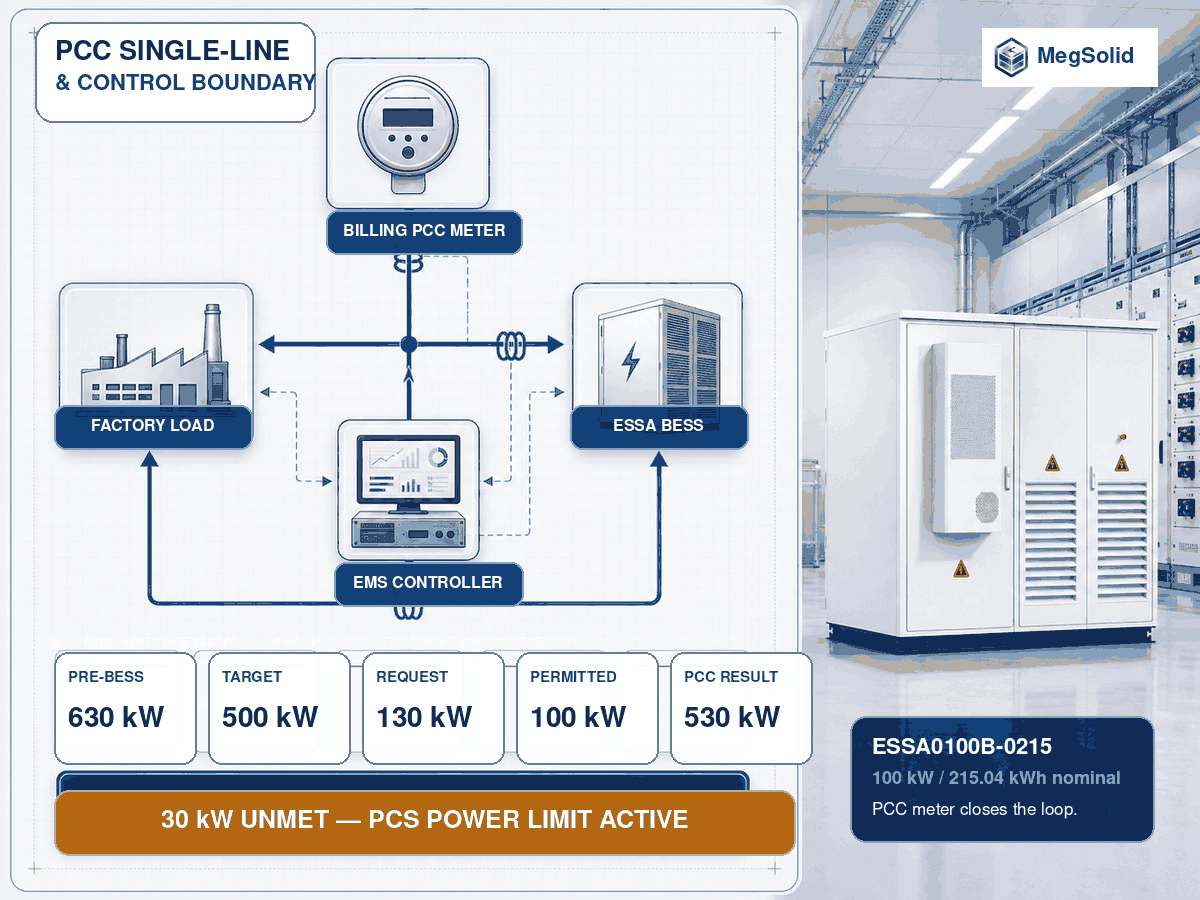
PCC reads 530 kW. Battery discharges 100 kW. Net demand before the battery: 630 kW. Target 500 kW:
Requested BESS discharge = max(0, 630 kW − 500 kW) = 130 kW
Clip to the live envelope:
Permitted discharge power = min(request, PCS limit, BMS limit, PCC/export allowance)
Discharge also stops at the active reserve floor. In this example the 100 kW cabinet hits its power limit. Expected PCC result: about 530 kW before meter tolerance and losses. The EMS should report 30 kW unmet demand reduction — PCS power limit active.
That line beats “system normal.” The owner then chooses a larger power stage, a higher target, load sequencing, or another cabinet. Same request under reserve and higher-priority limits: BESS EMS priority hierarchy.
Price the uncovered 30 kW with the site tariff
If the 530 kW event sets the billed maximum against a 500 kW target, price the leftover 30 kW with the contracted demand charge:
Monthly demand exposure = 30 kW × verified site demand charge per kW-month
Annual exposure = monthly demand exposure × billing periods in which the shortfall sets demand
Use the real interval, ratchet, time-of-use rules and the months that actually lock demand. Procurement can then compare more PCS power against leaving 30 kW on the bill. A lower-priced 100 kW cabinet can still win when verified exposure does not pay for more kW. If that leftover also overloads a transformer or forces production sequencing, the case changes.
Match the controller to the tariff's demand interval
A 620 kW instant reading is not automatically a 620 kW billed demand. The tariff may use a fixed 15-minute average, a rolling window, or another method. The EMS needs the real rule and the same clock edge as the billing meter.
Fixed 15-minute interval, 500 kW target:
- site import would be 620 kW for the first 5 minutes
- then 470 kW for 10 minutes
- without storage the interval average is 520 kW
BESS supplies 60 kW in those first 5 minutes:
[(560 kW × 5 min) + (470 kW × 10 min)] ÷ 15 min = 500 kW
Energy used for that correction: 5 kWh. A controller that pins the PCC at 500 kW on every instant spike will cycle harder than the tariff needs.
The last minutes of a fixed interval often decide the month. A high load near the end of a fixed interval leaves little time to pull the average down. Controller restart, clock error or a wrong interval edge can dump the right energy into the wrong 15 minutes. Check tariff logic, EMS clock and meter clock together.
Commercial value of that dispatch: C&I peak-shaving ROI analysis. This page stays on the meter response.
Send four inputs and receive a preliminary peak-control screen
MegSolid can produce a first PCC control table from:
- 1. 15-minute or finer site-load data covering the highest-demand days
- 2. tariff demand interval, demand charge and proposed PCC target
- 3. single-line diagram with PCC meter and CT locations
- 4. protected SOC reserve, recharge deadline and available recharge window
Return should show maximum required BESS kW, estimated discharge kWh, expected uncovered peak, recharge ceiling and the first product route. Missing tariff or meter data keeps the result preliminary.
Loop delay decides how much of a fast peak gets through
The controller does not move the instant the press starts. The signal travels meter → comms → EMS → PCS ramp before the PCC settles.
A press that adds 140 kW in one step, plus two seconds of data delay and the PCS ramp, can leave the full step on the PCC for several seconds. Whether the bill cares depends on the demand method and any separate instantaneous-import limit.
Write actual numbers into the spec:
- meter update interval and maximum data age
- EMS execution cycle
- PCS command acknowledgement and ramp rate
- target deadband and settling time
- stale-data timeout and fallback state
A tight deadband makes the PCS chase meter noise. A wide one leaves avoidable demand above the target. Fit the value to meter resolution, load volatility and contractual tolerance.
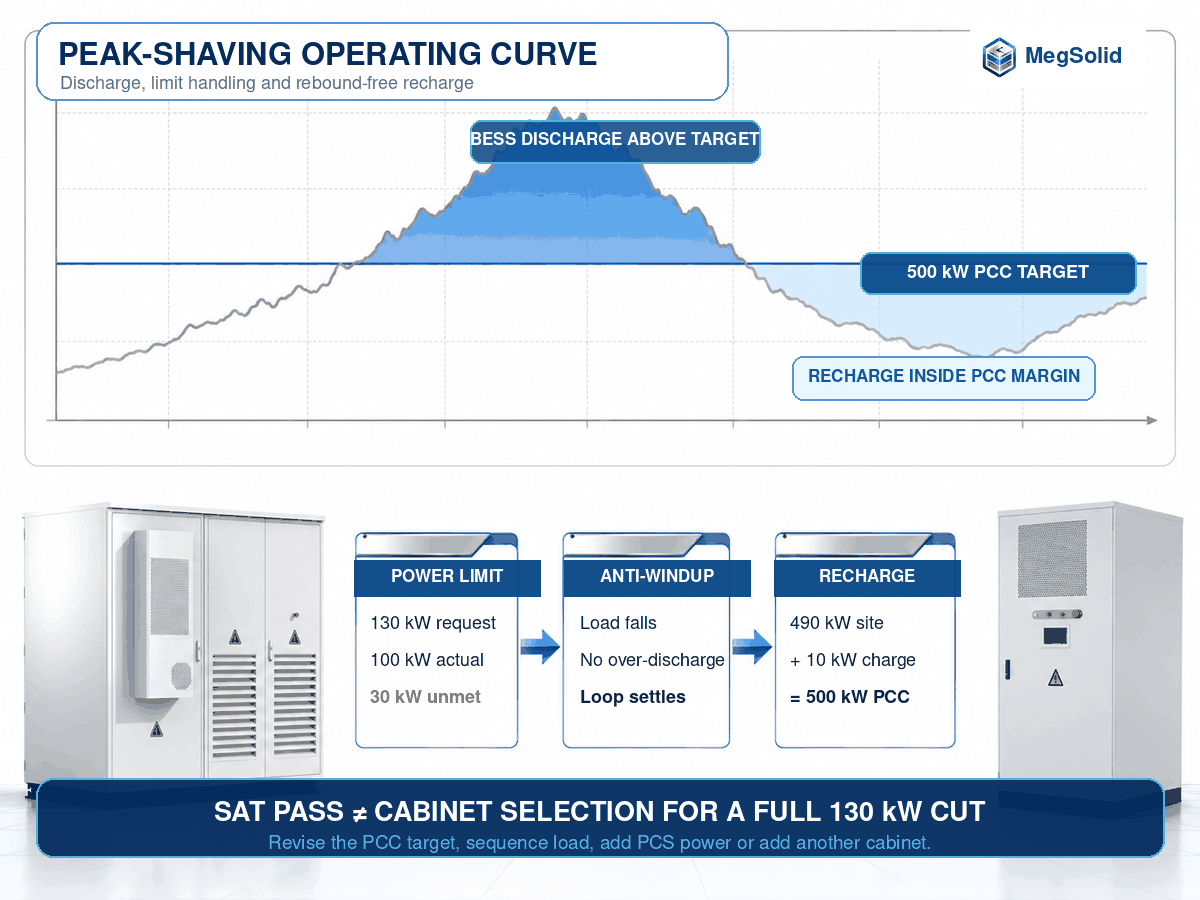
Some sites run a PI loop. When the 130 kW request hits a 100 kW limit, anti-windup has to stop the integral from stacking an impossible command. Skip anti-windup and the battery can keep over-discharging after the press stops, still unwinding stored error.
Reserve limits and power limits need different alarms
The PCC can read high for two different reasons:
- battery at its 100 kW power ceiling
- battery still has power, but it hit the protected SOC floor
First job: more power or load sequencing. Second job: reserve policy or energy capacity. Protected floor: BESS SOC reserve calculation.
SCADA should record requested reduction, permitted discharge, active limit and unmet kW. Without those four values the operator only sees that the peak was missed.
Recharge can set a new peak five minutes later
Press stops. Site load sits at 490 kW. Target still 500 kW. A fixed 30 kW recharge command takes grid import to 520 kW. That recharge just printed the next billed peak.
Available grid-charging power is leftover PCC margin:
Grid-charge allowance = max(0, recharge ceiling − site import before charging)
500 kW ceiling, 490 kW site load: 10 kW available. Production drops to 450 kW: charge power may rise to 50 kW, still clipped by PCS, BMS and SOC-dependent limits.
Separate charge and discharge thresholds stop rapid flipping around 500 kW. A short dwell and a controlled ramp stop the BESS bouncing between +10 kW and −10 kW as load moves a few kilowatts.
PV can refill the battery without adding grid demand. Its energy target still has to leave room for the next peak. That tradeoff: PV charging priority article.
How ESSA0100B-0215 supports the control loop
The MegSolid ESSA0100B-0215 outdoor C&I cabinet combines a 100 kW PCS, 215.04 kWh nominal LFP battery energy, intelligent air cooling, IP54 enclosure, a built-in isolation transformer and integrated EMS. RS485 and TCP/IP carry project meters and SCADA.
For peak shaving, 100 kW is the cabinet-level reduction before live derating. 215.04 kWh starts the duration review. Neither number replaces interval-load simulation, the usable-energy test or the reserve policy.
Integrated EMS makes target, command, BMS limit, PCS response and PCC result sit in one record. External CTs, revenue metering, switchgear and site wiring stay project scope. Larger or longer duties: MegSolid C&I BESS range.
Choose the first product route from uncovered kW
| Measured peak-reduction duty | Preliminary route | Confirmation before award |
|---|---|---|
| Up to 100 kW and duration fits validated usable energy | ESSA0100B-0215, 100 kW / 215.04 kWh | Interval simulation, reserve and recharge window |
| Duty exceeds the 100 kW ESSA screen or needs more stored energy | 261.24 kWh / 125 kVA liquid-cooled LFP system | Available kW at required power factor and usable AC energy |
| Duty exceeds 125 kW or several peaks overlap | Parallel cabinets, 30–500 kW PCS or a containerized route | Site controller, pooled limits, redundancy and switchgear |
Selection follows measured kW and duration. A 125 kVA label is not 125 kW until power factor and configuration are confirmed.
Why an integrated control boundary matters
| Supply route | What must be traceable | Common reason the peak cannot be explained |
|---|---|---|
| Integrated ESSA cabinet | EMS request, BMS limit, PCS response and cabinet SOC | PCC meter or tariff interval left outside the control design |
| Battery + separate PCS + third-party EMS | BMS protocol, command ownership, timestamps, meter map and system FAT | Each component log uses a different clock or sign convention |
| Trader-assembled package | Same system-level trend and one party responsible for the PCC result | Quote proves nominal kWh and PCS kW, no closed-loop acceptance test |
A split architecture can hold demand when one integrator owns the whole loop. If no bidder will sign the meter map, limit hierarchy and PCC pass criteria, the purchase is a pile of components. Nobody has signed the PCC result.
Run SAT from the meter outward
Start with CT sign and phase. Then a controlled load step, a full demand interval, and force the controller into its power and reserve limits. After the load falls, watch recharge.
In the 630 kW / 500 kW example, SAT should force the 130 kW request, confirm a 100 kW ESSA clips at live available power, record the leftover 30 kW as unmet demand reduction, and settle without over-discharge after the load falls. That sequence proves limit handling. It does not prove ESSA is the right size for a site that needs the full 130 kW cut. That duty needs a revised PCC target, approved load sequencing, more PCS power or another cabinet.
One continuous trend: PCC power, reconstructed pre-BESS demand, EMS request, permitted command, actual BESS power, SOC, live BMS limits, active constraint, meter timestamp and data quality.
Core channels: BESS SCADA point list. Factory tests versus installed PCC test: BESS FAT guide.
Battery peak shaving control must explain a missed target
Tuned peak shaving has to show four things on one trend: the PCC target, the reduction the site needed, what the battery supplied, and why any shortfall stayed on the meter.
FAQ
What is battery peak shaving control?
It is a closed-loop EMS function that uses measured PCC power to command BESS charge or discharge and keep grid demand near an approved target.
Where should the peak-shaving meter be installed?
Install the control measurement at the contractual demand boundary or derive an equivalent verified signal from the approved metering architecture. Confirm CT ratio, phase and polarity during SAT.
How is pre-BESS site demand calculated while the battery is running?
With PCC import and BESS discharge defined as positive, add measured PCC import to measured BESS discharge. Use synchronized measurements from the same control interval.
Is a fixed discharge schedule enough?
A schedule can prepare for a predictable peak. Closed-loop PCC feedback is still needed when actual load magnitude, timing and duration vary.
Why can the BESS miss a peak with plenty of SOC?
The required kW may exceed the PCS or live BMS power limit, or the control loop may respond too slowly. SOC indicates energy state; it does not prove instantaneous power capability.
Does every short power spike increase billed demand?
That depends on the tariff's fixed, rolling or other demand method. The EMS must use the actual interval definition and synchronized meter time.
Can a 100 kW cabinet remove a 130 kW peak gap?
No. It can reduce the gap by up to its live available power. The controller should report the remaining 30 kW so procurement can evaluate more power, a higher target or load sequencing.
How much battery energy does a 60 kW correction for five minutes use?
It uses 5 kWh before the project's loss and auxiliary treatment: 60 kW multiplied by 5/60 of an hour.
What happens when the protected SOC floor is reached?
Peak-shaving discharge stops and the EMS reports reserve limitation. The PCC target may then be missed even though the battery and PCS remain healthy.
What is anti-windup in a peak controller?
It stops the controller's integral term from accumulating an unattainable correction while BESS output is already limited. This helps the PCS settle cleanly after the load falls.
How is a recharge peak prevented?
Limit grid charging to the unused margin below the PCC recharge ceiling, and reduce or pause charging when site load rises.
Does zero-export control override peak shaving?
The contractual export envelope is a mandatory boundary. Peak shaving uses the battery power that remains available inside that boundary.
When is ESSA0100B-0215 the first product route?
Review it when the measured peak-reduction duty stays within 100 kW and the required event energy fits the validated usable-energy and reserve window.
Can a split battery, PCS and EMS system shave peaks reliably?
Yes, when one integrator owns the PCC meter, timing, sign convention, control limits, system FAT/SAT and performance responsibility.
What should a buyer send for a preliminary peak-control table?
Send interval load data, tariff demand rules, the PCC meter single-line diagram, reserve policy and recharge window.
What evidence proves peak-shaving performance?
Use synchronized PCC power, reconstructed pre-BESS demand, EMS request, permitted command, actual BESS power, SOC, live limits, active constraint, timestamps and data quality.
