 Skip to content
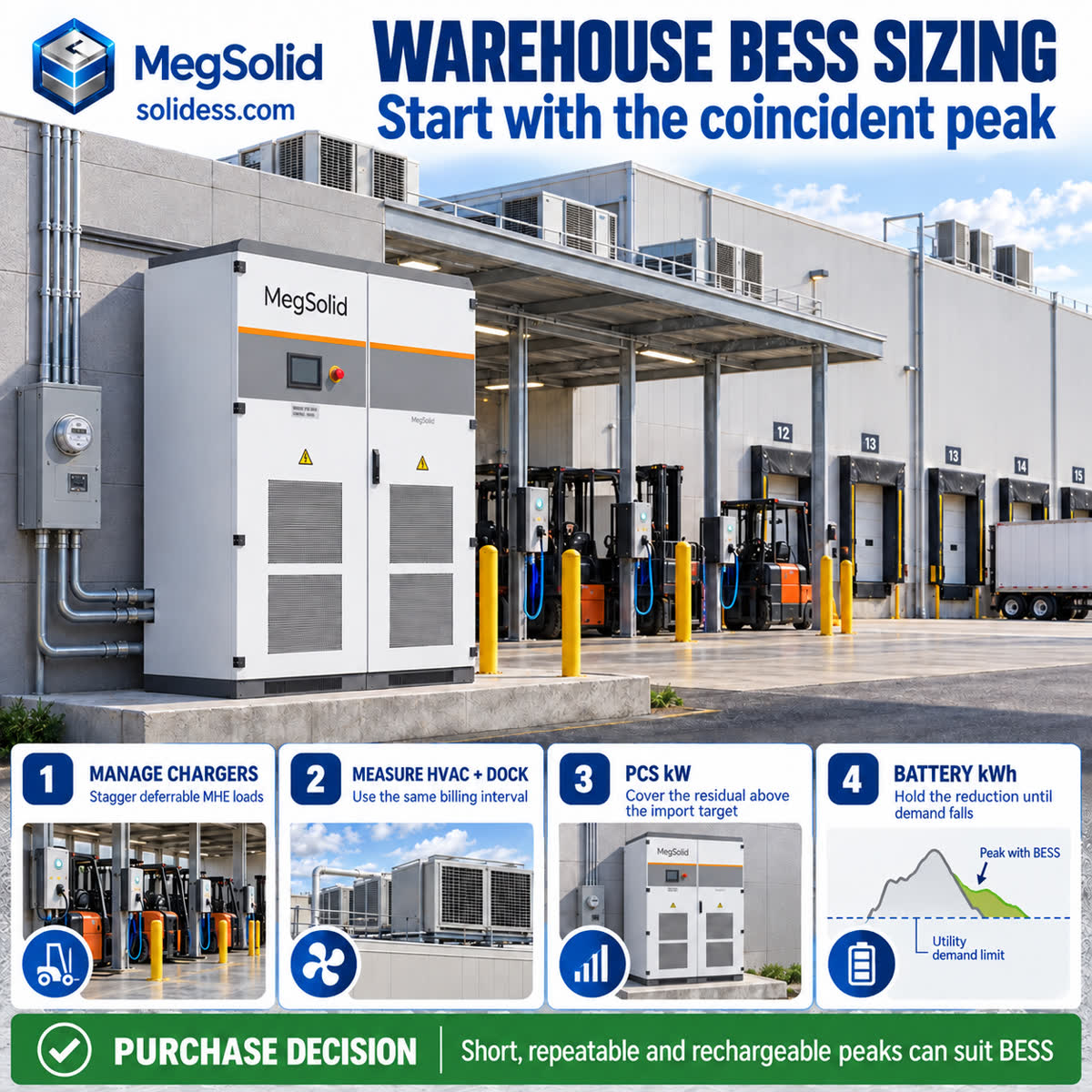
Warehouse BESS sizing starts with the demand left after forklift charger scheduling, measured during the same intervals as HVAC and dock loads. PCS power must cover the excess above the import target, while battery energy must sustain that reduction until demand falls. The battery also needs enough charging headroom to recover before the next shift.
Establish the import target and residual peak
Shift-change charging can overlap summer HVAC and dock activity in the interval that sets the demand bill. Use the tariff and measured load profile to establish the reduction the warehouse needs:
| Site record | Design use |
|---|---|
| Billed interval, $/kW-month rate, TOU windows and ratchet clauses | Select the import target and identify the intervals worth controlling |
| Forklift/MHE schedule after charger management, aligned with HVAC and dock demand | Find the remaining coincident power above the target |
| Twelve months of interval demand, including off-peak loads | Calculate discharge duration and available recharge time |
The MEGA TS PCS must meet the required import reduction in kW within its kVA rating, while battery capacity in kWh determines how long discharge can continue.
Warehouses that can use peak-shaving storage
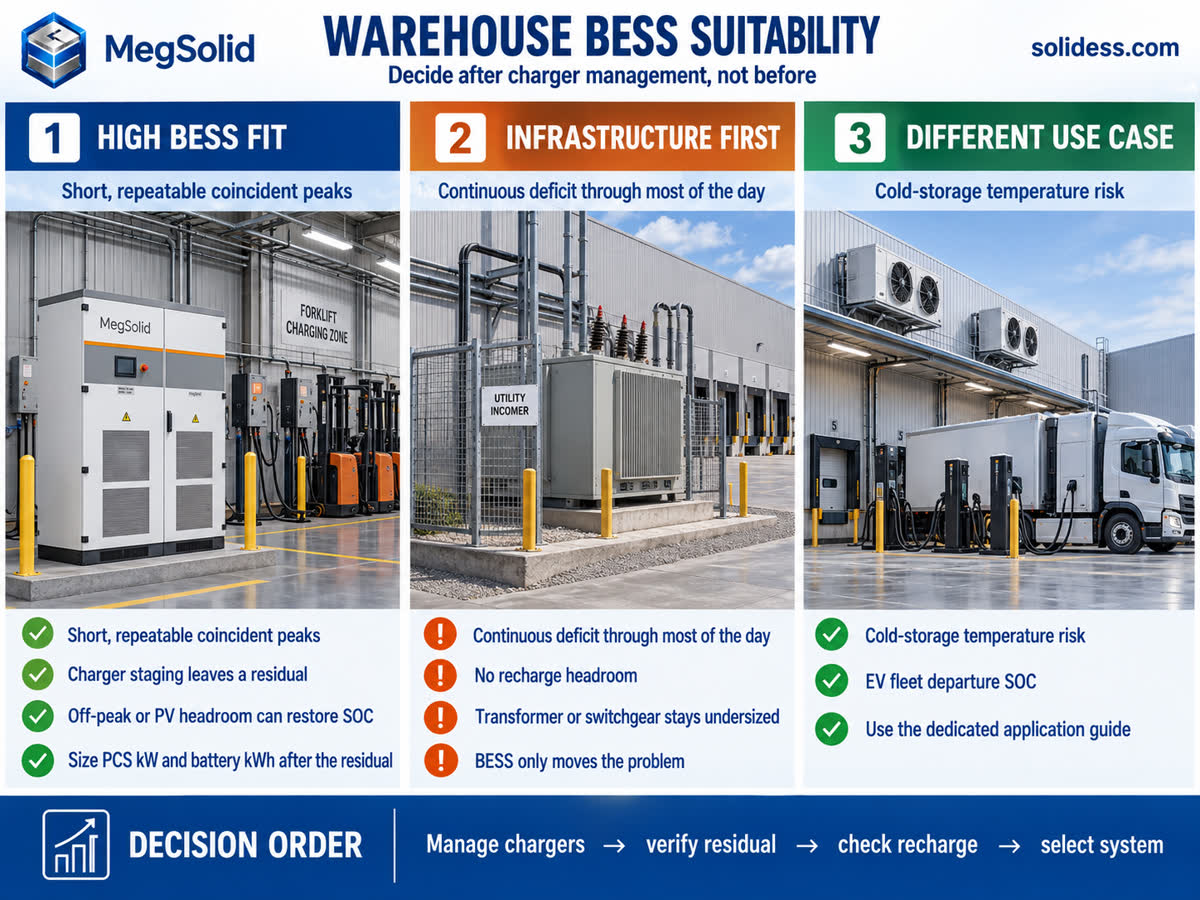
Peak-shaving storage suits short peaks with spare charging capacity between them. A continuous capacity deficit calls for an infrastructure upgrade.
| Suitability | Typical warehouse pattern | Design implication |
|---|---|---|
| High | Short afternoon peaks with off-peak recharge; forklift charging overlaps HVAC and TOU peak; shift-change spikes are predictable | Size residual PCS and energy after charger management |
| Low | Continuous deficit for most of the day; no spare grid or PV capacity for charging; switchgear or transformers permanently undersized | Prefer infrastructure upgrade; storage only moves the problem |
| Different use case | Cold-storage product-temperature risk; dedicated EV fleet depot with departure SOC deadlines | Route to the linked application guides |
Operators can use BESS to cover shift-change charging or afternoon HVAC peaks while waiting for a transformer upgrade, provided lower-load periods allow recharge. With a continuous deficit, the battery will reach minimum SOC while the grid remains constrained. Review how BESS can defer a transformer upgrade.
Cold-storage holdover belongs to the cold storage BESS backup power guide. Dedicated EV truck fleet depots should follow BESS design for EV fleet charging without a grid upgrade.
Demand billing, forklift charging and HVAC
Overlay the warehouse loads within the utility’s billing interval to see which activities contribute to the peak.
Utility demand charges and TOU peaks
Many commercial tariffs set billed demand from the highest average kW in a defined interval, commonly 15 minutes, and some also apply ratchets that keep an elevated demand charge for subsequent months. The NREL commercial storage valuation report (NREL/TP-6A20-69016) describes demand charges as interval-based peaks that storage can target when the billed window is short and repeatable, and DOE FEMP’s Evaluating Your Utility Rate Options guide covers how demand and energy rate components drive which reduction methods are worth modelling.
The billed interval, demand rate and ratchet clauses determine which parts of the load record matter for sizing. A peak that repeats through the season may justify a different battery capacity from one caused by an unusual operating event.
Electric forklift and material-handling charging
Electric forklifts, reach trucks and pallet movers often create the largest controllable demand event in a non-refrigerated warehouse. Opportunity charging or simultaneous end-of-shift charging can concentrate many chargers into one interval, commonly tens to hundreds of kilowatts. Those figures are order-of-magnitude guidance only; final sizing requires the site’s charger list and measured diversity.
Vehicle battery acceptance, charger taper and dwell time affect how many chargers draw full power together. Operators can stagger starts, cap aggregate charging during demand windows and move bulk charging overnight where vehicle schedules allow. Keep priority vehicles separate from those that can wait.
The remaining peak includes HVAC and dock demand in the same interval. Residuals under 100 kW after charger management may suit the 100 kW / 215 kWh outdoor cabinet energy storage system (ESSA0100B-0215).
HVAC peaks, especially summer afternoons
In many warm-climate distribution centers, afternoon HVAC demand overlaps utility on-peak windows. Cooling can make a substantial contribution to the billed peak when it coincides with charging and dock activity. Drivers include outdoor design temperature, roof and wall solar gain, dock-door openings, lighting and internal heat, and setpoint or staging strategy. Include dock, conveyor or sorter loads only when interval data shows measurable coincidence with the billed peak.
Build a coincident peak profile from interval data
The load profile needs utility point-of-connection import at the billing interval, facility demand at 1–15 minutes, charger-circuit readings and HVAC circuit or BMS trends, plus PV production where installed. These records identify the loads behind the billed peak and how long they overlapped.
- 1. Extract the highest-demand intervals across twelve months and tag them by season and shift, distinguishing weekdays from weekends.
- 2. Overlay charger, HVAC and dock contributions. Where submetering is missing, document the diversity assumptions used to reconstruct the loads.
- 3. Calculate the excess above the import target and its duration, then check recharge headroom on those same operating days.
\text{Required BESS discharge power}=\text{forecast coincident demand}-\text{target import limit}
The target may be a demand-charge threshold selected for ROI, a transformer or breaker operating limit, a utility interconnection ceiling, or an internal operating policy with engineering margin. A fixed schedule is not enough; the EMS must follow the live point-of-connection meter.
Warm-climate logistics scenario
In an illustrative logistics hub, shift-change MHE charging overlaps summer HVAC. A residual of 180–250 kW after charger staging warrants evaluation of a MEGA0250TS-class PCS; a single 100 kW ESSA0100B-0215 cannot cover it. The two-hour calculation below uses assumed loads, not operating results from a verified customer installation.
Worked illustrative sizing example
The example assumes the following coincident loads and import target:
| Engineering input | Illustrative value |
|---|---|
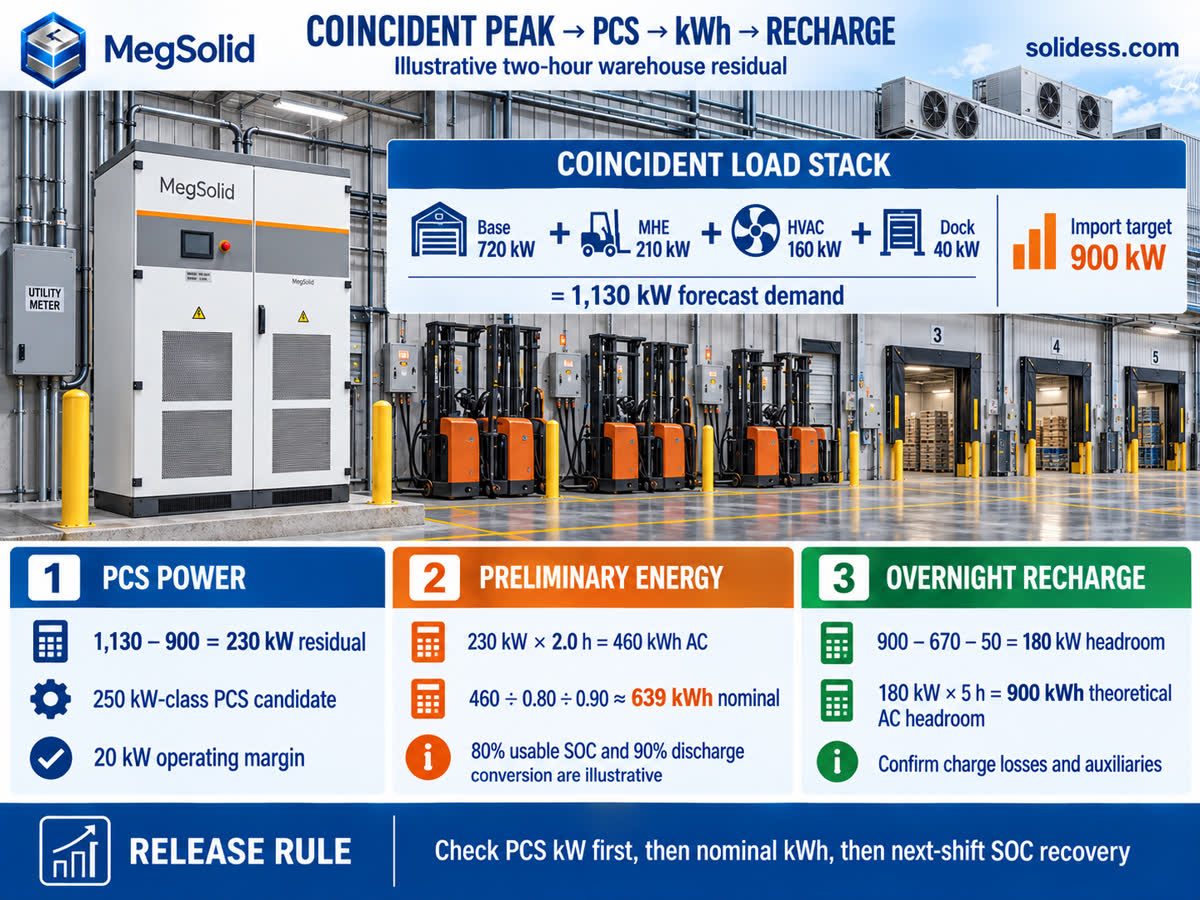
| Base / MHE / HVAC / dock | 720 / 210 / 160 / 40 kW |
| Forecast coincident demand | 1,130 kW |
| Selected import target | 900 kW |
| Capacity deficit / duration | 230 kW / 2.0 hours |
720+210+160+40=1{,}130\text{ kW};\quad \text{Required BESS discharge power}=1{,}130-900=230\text{ kW}
Discharge must stay at 230 kW while demand remains at 1,130 kW. A 250 kW-class PCS leaves a 20 kW margin, which must accommodate forecast error, load steps and auxiliary demand without compromising reactive-power requirements.
For a constant 230 kW deficit lasting 2.0 hours, the battery must deliver 460 kWh AC. Apply an illustrative 80% usable SOC window and 90% discharge conversion factor:
| Calculation step | Illustrative result |
|---|---|
| Required AC energy | 460 kWh |
| Usable SOC / conversion | 80% / 90% |
| Preliminary nominal energy | ≈ 639 kWh |
| Preliminary PCS direction | 250 kW class |
\text{Preliminary nominal energy}=460\div0.80\div0.90\approx639\text{ kWh}
The 639 kWh preliminary result still needs allowances for degradation, temperature effects, auxiliaries, forecast uncertainty and any backup reserve. A 250 kW MEGA PCS with roughly 650–800 kWh of battery capacity is a candidate for this example, with the final capacity determined by those operating requirements.
Check overnight recharge
The operator must restore the energy used during the peak before the next event. Limit charging to the import target minus the facility load and engineering margin, counting priority loads separately only if the facility figure excludes them.
For an illustrative night period, assume a 900 kW import limit, 670 kW of total facility demand and a 50 kW engineering allowance. The remaining 180 kW over five hours gives 900 kWh of theoretical AC charging headroom.
The 460 kWh AC discharge draws about 511 kWh from the battery at the assumed 90% discharge conversion factor. Restoring SOC takes additional grid energy for charging losses and auxiliaries. Include charging efficiency to check whether the 900 kWh of headroom can restore SOC before the next peak.
Insufficient recharge calls for a revised charging schedule or import target, verified PV surplus, or infrastructure reinforcement. For a deficit near 250 kW, review the MegSolid power conversion system (30–500 kW PCS) model limits before fixing the operating schedule.
Use the button to email the billed interval, import target, seasonal peak profile and managed charger schedule.
MegSolid can reply with a PCS kW and battery kWh check for the residual peak, including the available overnight recharge window.
EMS priorities for warehouse coincidence
The EMS must follow the live point-of-connection meter within electrical and asset limits, retaining enough SOC for the next predicted peak. Discharging to a fixed TOU schedule can leave too little energy for shift-change charging.
Cap or stagger deferrable forklift chargers before increasing battery discharge. Operations staff must approve any HVAC staging. Permit recharge within the available import headroom and use the remaining energy for TOU arbitrage after reserving the next peak’s requirement.
Match the residual to a MegSolid system
Use the residual kW and discharge duration to select the MegSolid configuration:
| Site result | MegSolid product path | What it can do on the site | Boundary to confirm |
|---|---|---|---|
| Residual after charger management stays within ~100 kW | ESSA0100B-0215, 100 kW / 215.04 kWh | Compact outdoor cabinet for residual peak shaving at 400 V | Usable energy for peak duration, IP54 siting and charger-cap EMS |
| Longer energy window around the 100–125 kVA class | MegSolid 261.24 kWh liquid-cooled system | Adds nominal energy headroom with controlled liquid cooling; parallel expansion available | 125 kVA real-power capability, ambient derating and usable-energy definition |
| Residual peaks in the 150–500 kW band | MEGA TS PCS, 30–500 kW with project-specific battery energy | Lets PCS power follow the residual while energy stays independent | Forecast margin, recharge headroom and DC/battery match |
| Multi-hour high energy or campus-scale peaks | ESSC0500B-1075 / ESSC1000B-2150 | Moves the project into a containerised power-and-energy block | Civil footprint, transformer capacity, protection and packaging |
Model ratings and installation limits
| Model | Rated power | Energy / notes |
|---|---|---|
| ESSA0100B-0215 | 100 kW | 215.04 kWh; 1P240S LFP 280 Ah; IP54 air-cooled; 2,450 × 1,550 × 2,400 mm |
| 261.24 kWh liquid-cooled | 125 kVA | LFP 314 Ah / 1P260S; IP54; −20–55°C (derate >45°C); parallel up to 10 units |
| MEGA0100TS / 0150TS / 0250TS / 0500TS | 100 / 150 / 250 / 500 kW | Max apparent 110 / 165 / 275 / 550 kVA; PF 1 lag–1 lead; THDi <3% |
| ESSC0500B-1075 | 500 kW | 1.0752 MWh air-cooled container |
| ESSC1000B-2150 | 1,000 kW | 2.1504 MWh air-cooled container |
For residual peaks near 100 kW, see how to select a 100 kW / 215 kWh outdoor BESS for a C&I site.
Control tests before acceptance
FAT should simulate demand spikes to test import limiting, charger-group caps, SOC reserve and meter-loss fallback. SAT then checks the installed controls during shift-change and HVAC peaks, followed by overnight SOC recovery. See the BESS factory acceptance test guide before agreeing on acceptance criteria.
Compare the 230 kW example’s candidate configurations by usable energy, PCS operating margin and overnight recovery time, using the same load assumptions.
Check the selected system against the load profile
Testing the selected configuration against seasonal interval records exposes power shortfalls that additional battery energy cannot cover. In the illustrative 230 kW deficit, a 100 kW PCS paired with 650 kWh still leaves 130 kW above the import target.
The load model should include charger taper and staggered starts. Check the highest-demand shifts and the overnight SOC recovery that follows each one; annual averages can hide both power shortfalls and insufficient recharge. The transformer-upgrade assessment explains the load evidence needed where the battery will defer reinforcement.
Include site protection, switchgear, civil works and commissioning when comparing the cost of configurations that meet the seasonal load and recharge requirements.
Use the button to email the verified residual kW, peak duration and recharge headroom for the highest-demand shifts.
MegSolid can reply with a comparison of ESSA, the 261.24 kWh liquid-cooled system, MEGA TS with project-specific battery energy, and ESSC container options against the same load profile.
FAQ
When does a distribution warehouse need a BESS?
When demand-charge intervals, forklift charging and HVAC create short, repeatable coincident peaks and the battery can recharge before the next peak. Continuous deficits usually need infrastructure upgrades.
Should BESS be sized from total forklift charger nameplate power?
No. Size from measured or conservatively modelled simultaneous charging demand after charger management, then subtract available grid headroom relative to the demand target.
What is more important for demand-charge reduction: kW or kWh?
Both. PCS kW determines how far demand can be lowered, and battery kWh determines whether that reduction can be held for the full billed interval and design-peak duration.
Can charger scheduling eliminate the need for BESS?
Sometimes. If staggered charging and night bulk charging remove the billable peak without operational risk, storage may not be required. BESS remains useful when residual coincidence with HVAC or dock loads persists.
Can one 215.04 kWh cabinet support a whole distribution center?
Only when the residual PCS requirement remains within 100 kW and usable energy covers the verified peak duration. Many warehouses need a higher-power PCS with project-specific battery capacity.
What happens if the BESS cannot recharge overnight?
The battery may start the next peak with too little energy. Restoring the daily cycle requires more import capacity, verified PV surplus, less deferred charging load or a revised demand target before adding battery capacity.
How do you size BESS for warehouse demand charges?
Build a coincident-peak profile, subtract the target import limit to get PCS power, multiply residual power by peak duration to get AC energy, then adjust nominal kWh for SOC window, losses, degradation and recharge.
Which MegSolid system suits a warehouse residual peak?
ESSA0100B-0215 suits residuals near 100 kW and 215 kWh nominal. The 261.24 kWh liquid-cooled system adds energy headroom in a similar power class. MEGA0250TS-class PCS with project-specific energy fits residuals near 230–250 kW. ESSC containers serve larger sites after infrastructure checks.
How much interval data is needed to size a warehouse BESS?
Use twelve months of utility interval demand and align the highest-demand periods with charger, HVAC and dock records. The same operating days should also show whether enough import headroom exists to restore SOC before the next shift.
Can extra battery kWh compensate for an undersized PCS?
No. Battery energy extends discharge duration, while PCS power sets the maximum instantaneous reduction. In the 230 kW example, a 100 kW PCS still leaves 130 kW above the import target even when paired with a larger battery.
How should HVAC demand be included in warehouse BESS sizing?
Include HVAC demand when interval or BMS records show that it overlaps forklift charging and dock activity during the billed peak. Seasonal afternoon cooling can change both the required PCS power and discharge duration.
Does one ESSA0100B-0215 fit the 230 kW warehouse example?
No. Its 100 kW rated power cannot cover a 230 kW residual peak. That example points toward a 250 kW-class PCS with battery energy sized from the two-hour event and the verified recharge window.
What must be checked before selecting an ESSC container for a warehouse?
Confirm the civil footprint, transformer and switchgear capacity, protection scheme, connection voltage, usable energy and overnight recharge path. Container capacity should be tested against the seasonal load profile instead of selected from nameplate MWh alone.
