 Skip to content

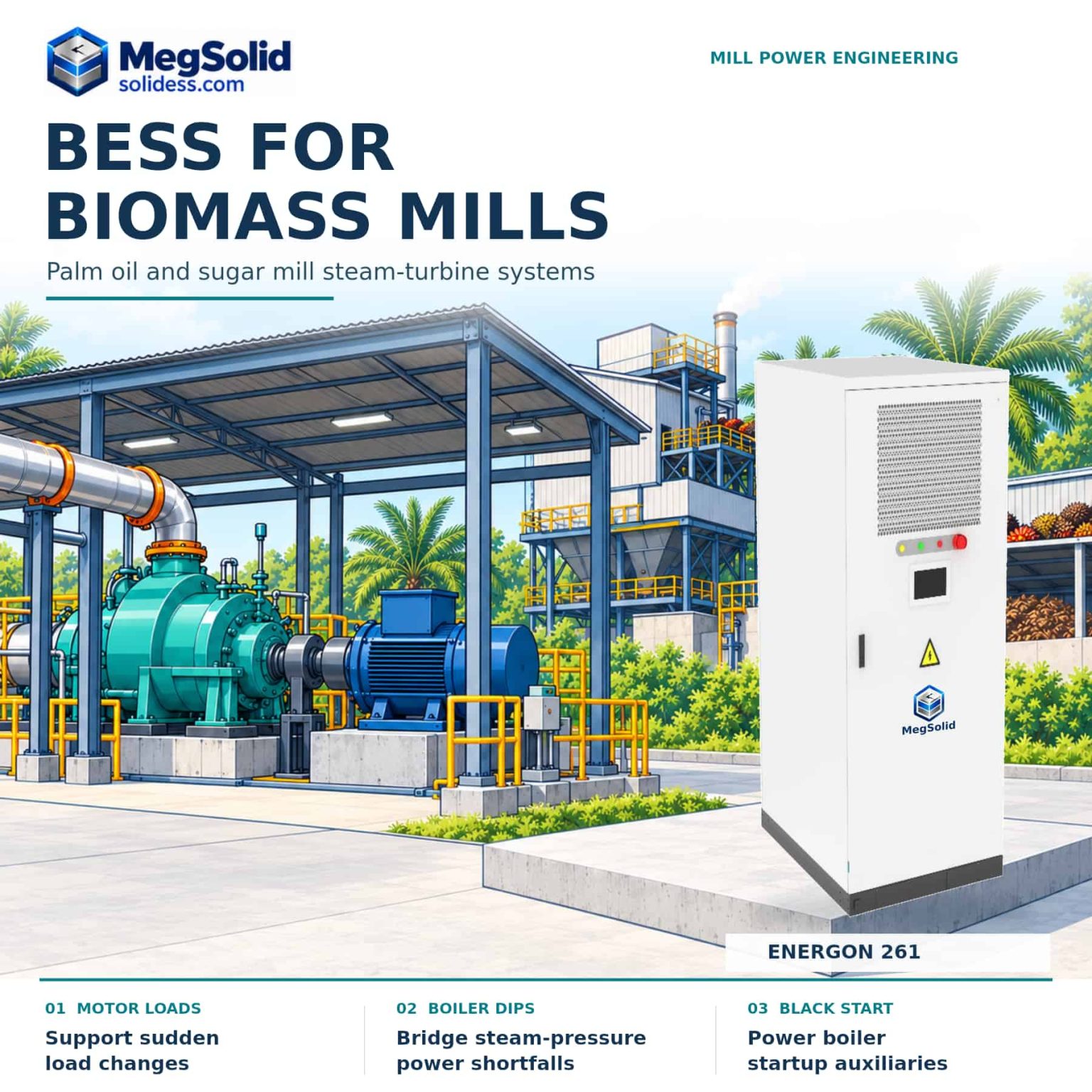
Outside almost any Crude Palm Oil (CPO) mill in Kalimantan or cane sugar mill in Thailand sits a mountain of free biomass fuel: palm press fiber, palm kernel shells (PKS), or sugarcane bagasse. Yet inside the powerhouse next door, one or two 800 kVA diesel generators often run 24 hours a day in parallel with the steam turbo-alternator, burning over a thousand liters of diesel every shift.
Biomass-fuelled mills burn diesel because water-tube biomass boilers and back-pressure steam turbines (BPSTs) respond slowly to load changes, whereas heavy milling machinery imposes steep, sudden electrical surges. When a batch of wet bagasse or fiber drops boiler header pressure, or when cane shredders and twin-screw presses hit a dense feed, the steam turbine governor cannot open fast enough to hold bus frequency. Without a diesel generator synchronized as spinning reserve, frequency drops below 47.5 Hz and the under-frequency protection relay (ANSI 81U) trips the powerhouse offline.
Pairing a grid-forming battery energy storage system (BESS) with the steam turbo-alternator replaces that spinning-reserve diesel consumption. Operating in parallel on the mill busbar, the BESS injects active and reactive power within milliseconds to absorb mechanical shock loads, bridges 15-to-30-minute boiler steam pressure dips, and provides diesel-free black-start power for boiler draft fans and feedwater pumps.
Key Takeaways
- Replace 24/7 diesel spinning reserve: A BESS absorbs instantaneous cane shredder and screw-press surges so mills can shut down parallel diesel generators that otherwise idle at 15–20% load all day.
- Prevent ANSI 81U under-frequency blackouts: Fast frequency-watt (f-P) response holds the 50 Hz or 60 Hz bus steady while slow mechanical-hydraulic or Woodward steam governors adjust valve position.
- Bridge wet-fuel boiler pressure sags: Sized for 15–30 minutes of reserve capacity, the battery carries part of the mill load when wet bagasse or sterilizer steam peaks pull boiler header pressure down.
- Cold boiler black start without diesel: Rooftop solar PV plus storage powers induced-draft (ID) fans, forced-draft (FD) fans and feedwater pumps during Sunday maintenance startups and the 6-month non-crushing season.
- Monetise saved PKS and lower CPO carbon intensity: Running the boiler at a steady thermal baseline reduces steam venting, freeing surplus Palm Kernel Shells ($80–$130/ton export value) and cutting GHG emissions under RSPO and ISCC EU audits.
The Thermodynamic Mismatch: Why Biomass Steam Turbines Struggle Alone
Wet Bagasse, Palm Fiber and Boiler Header Pressure Drops
Sugarcane bagasse enters the boiler furnace at roughly 48–52% moisture, and palm mesocarp fiber moisture fluctuates with press performance. When a high-moisture slug of fuel lands on the grate, furnace temperature dips and steam generation lags. Main steam header pressure can fall from 25 bar to 18 bar within a few minutes.
In a palm oil mill, steam demand on the process side makes this worse. Back-pressure steam turbines exhaust low-pressure steam (typically 3–3.5 bar) into a back-pressure receiver that feeds the Fresh Fruit Bunch (FFB) sterilizers and digestion vessels. Every time operators open the admission valves on a 40-ton horizontal or vertical sterilizer, steam flow and receiver back-pressure shift abruptly, reducing the enthalpy drop across the turbine stages and cutting mechanical shaft output just as the mill floor needs power.
Mill Floor Shock Loads vs. Steam Governor Response Times
On the electrical side, agro-industrial mills run some of the roughest mechanical loads in heavy industry:
- Cane sugar mills: Heavy-duty cane knives, fibrizers/shredders and six-roller milling tandems experience 200–300% current surges lasting 5 to 15 seconds whenever a dense mat of cane hits the hammers.
- Palm oil mills: Twin-screw fruit presses, digesters, nut crackers and Empty Fruit Bunch (EFB) shredders draw sharp active power (kW) and lagging reactive power (kvar) peaks as hydraulic cone pressure adjusts against fibre cake resistance.
A mechanical-hydraulic or electronic steam turbine governor takes several seconds to modulate its throttle valve, and a grate-fired biomass boiler takes minutes to build steam pressure. In the first two seconds of a shredder surge, electrical demand exceeds mechanical turbine torque. Rotor speed slows, bus frequency falls past 47.5 Hz, and the 81U relay trips the generator circuit breaker to protect the turbine blades. A single trip halts sterilizer batches, causes hot cane juice to ferment in clarifiers, and takes one to two hours to clear and restart.
Eliminating Diesel Spinning Reserve in Palm Oil and Sugar Mills
The Cost of Running Diesel Generators at 15–20% Load
To prevent under-frequency trips, chief engineers commonly keep one or two 500 kVA to 1,000 kVA diesel gensets synchronized with the 2–5 MW steam turbine. Because the steam turbine carries the bulk of the average load, the diesel engines sit at 15–20% load factor for 20+ hours a day waiting for load spikes.
Operating a large diesel engine below 30% load carries two penalties:
- 1. High specific fuel consumption: Burning 1,000 to 1,800 liters of diesel per day just to provide spinning headroom.
- 2. Chronic wet stacking: Low cylinder temperatures leave unburned fuel and soot in the exhaust manifold, glazing cylinder liners, fouling injectors, diluting lube oil and forcing top-end overhauls every 2,500–3,500 hours.
How a BESS Acts as an Electronic Flywheel
A BESS connected to the main 400V LV switchboard (or stepped up to the 6.6 kV / 11 kV MV bus) replaces the spinning diesel gensets through two coordinated control layers:
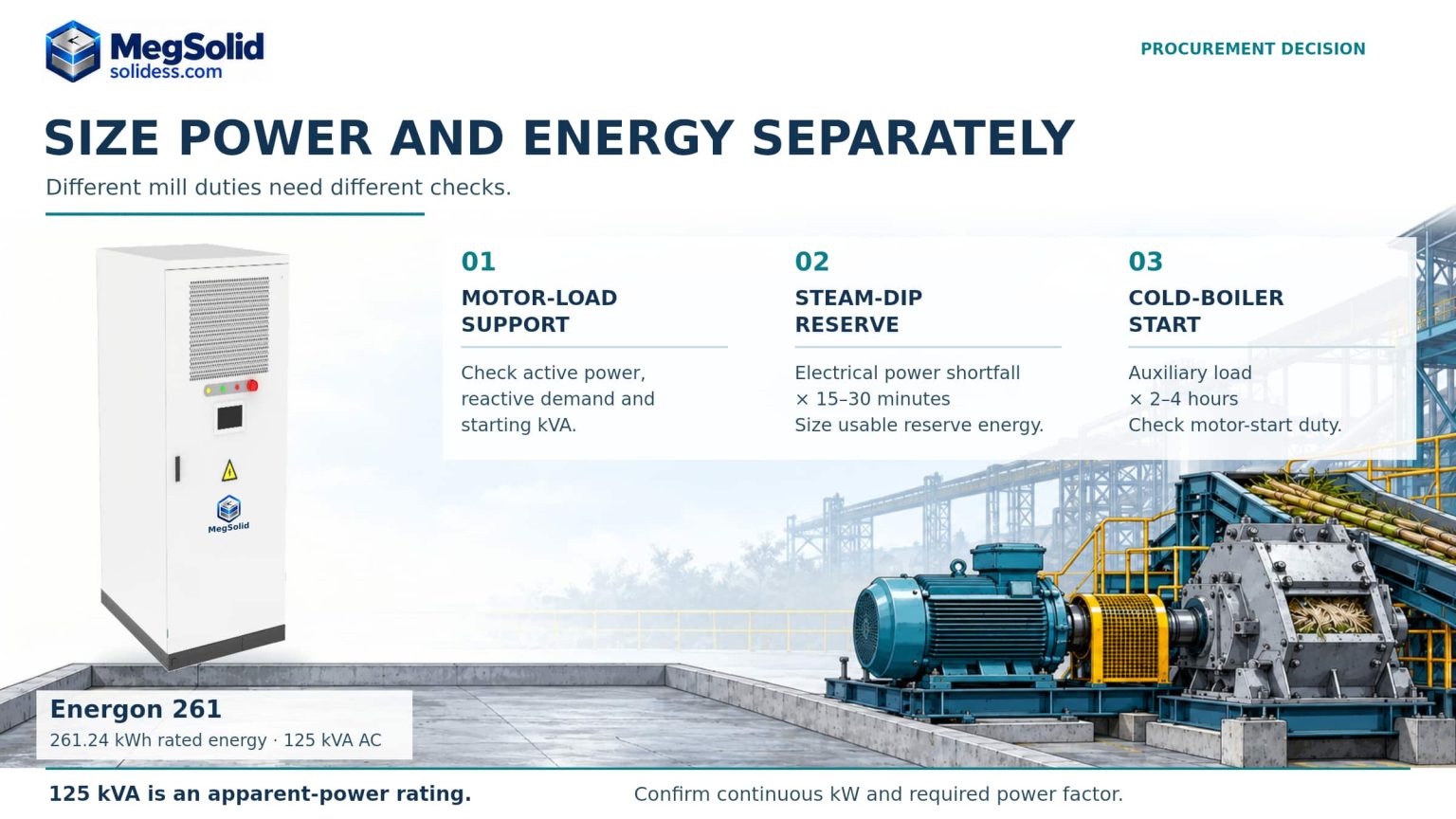
- Millisecond surge and reactive support: When a shredder or screw press pulls a sudden current spike, MegSolid's 80–125 kW modular PCS or 261 kWh / 125 kVA liquid-cooled C&I cabinet responds within 20 milliseconds. The inverter injects active power to arrest the frequency drop (df/dt) and supplies leading reactive power (adjustable PF from −1 to +1) so induction motor inrush does not pull down alternator terminal voltage.
- 15-to-30-minute boiler dip bridging: When wet bagasse or a sterilizer cycle drops boiler header pressure from 25 bar to 18 bar, the energy management system (EMS) dispatches sustained kW from the battery for 15 to 30 minutes, preventing the turbine from stalling its steam chest while stokers recover furnace heat.
Up to 10 Energon 261 kWh / 125 kVA cabinets operate in parallel to form a 1.25 MVA / 2.6 MWh block, and larger mills can deploy containerised systems from MegSolid's 55 kWh – 5 MWh BESS lineup.
Off-Season Power and Cold Boiler Black Start Without Diesel
The Biomass Boiler Cold-Start Catch-22
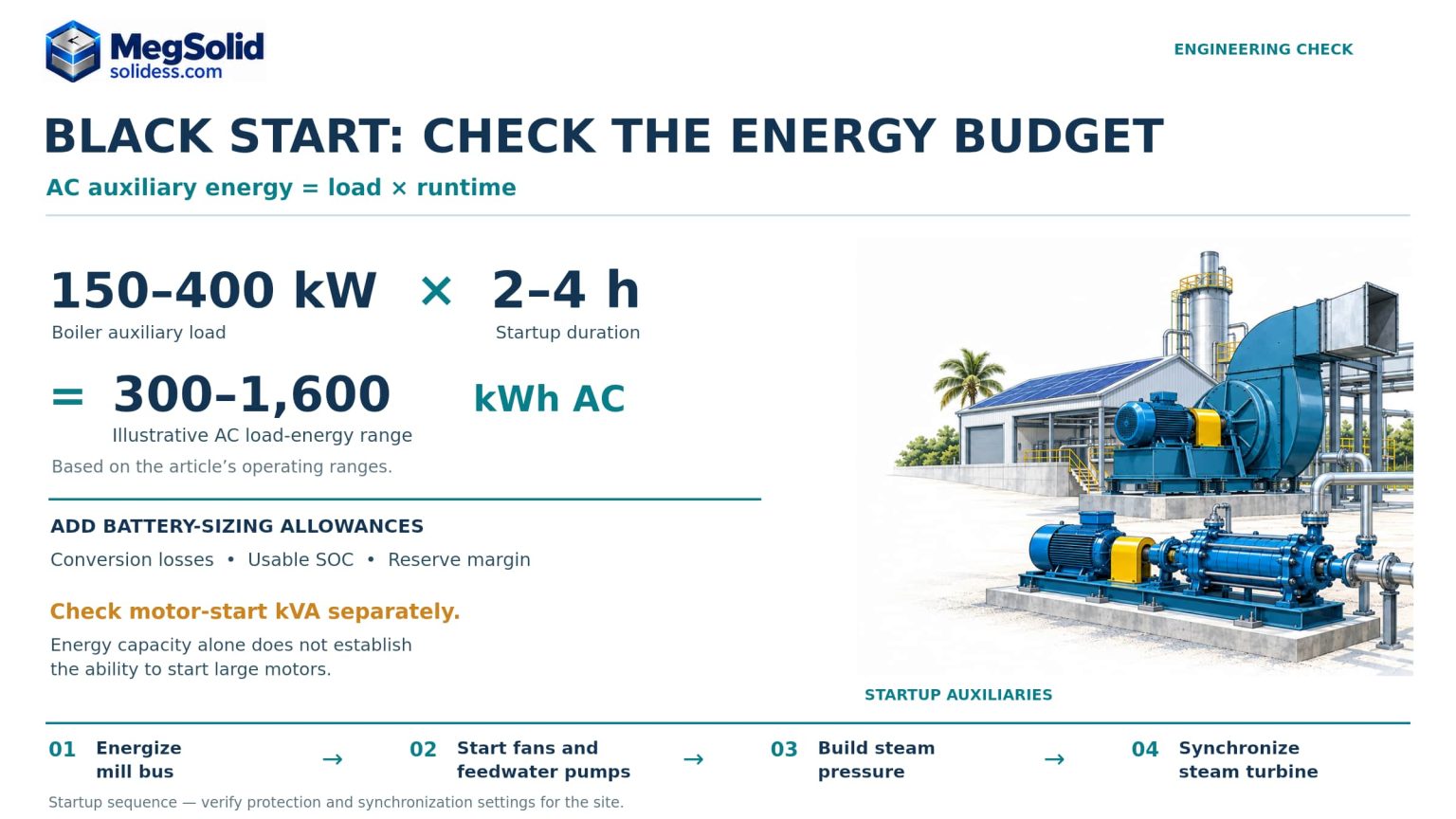
A steam turbine cannot generate a single watt until the boiler is lit, brought up to working pressure and superheated. Lighting a cold biomass boiler requires 150 kW to 400 kW of continuous electrical power for 2 to 4 hours to drive:
- Induced-draft (ID) and forced-draft (FD) fans;
- Secondary air and fuel-spreader fans;
- High-pressure multistage boiler feedwater pumps;
- Water treatment plant, fuel conveyors and stoker grates.
In palm oil mills that shut down every Sunday for maintenance, and in cane sugar mills that stop crushing for 5 to 6 months during the off-season, diesel generators are traditionally kept running to supply workshops, offices, staff housing and cold-boiler startups.
Solar + BESS for Off-Season Autonomy and Black Start
Installing solar PV on mill warehouse and kernel-crushing roofs alongside the BESS eliminates off-season diesel use. During non-milling periods, the BESS operates in grid-forming island mode, running the estate housing, water treatment and maintenance shops on solar power day and night. When crushing resumes, operators black-start the boiler ID/FD fans and feedwater pumps directly from the battery bank, synchronize the steam turbine once header pressure reaches setpoint, and transition smoothly to normal cogeneration.
Saving Palm Kernel Shells (PKS) and Bagasse for Export Revenue
In Indonesia, Malaysia and Thailand, Palm Kernel Shells (PKS) and baled bagasse are traded commodities rather than waste products. Industrial buyers and biomass power producers in Japan and Europe purchase PKS at $80 to $130 per metric ton FOB, while sugar mills with utility power purchase agreements (PPAs) sell surplus bagasse cogeneration power back to the grid.
When a steam turbine chases wild mechanical load swings without a battery buffer, its specific steam consumption (kg of steam per kWh) worsens and pressure-relief valves frequently vent live steam to the atmosphere. Buffering the electrical bus with a BESS flattens the load on the turbo-alternator. Running the boiler at a steady firing rate improves thermal efficiency, typically saving 2,000 to 3,500 tons of PKS or bagasse per year in a mid-sized mill—fuel that can be sold directly to export traders or burned in the off-season for grid feed-in revenue.
Built for the Tropical Mill: Palm Oil Mist, Bagacillo Ash and 90% Humidity
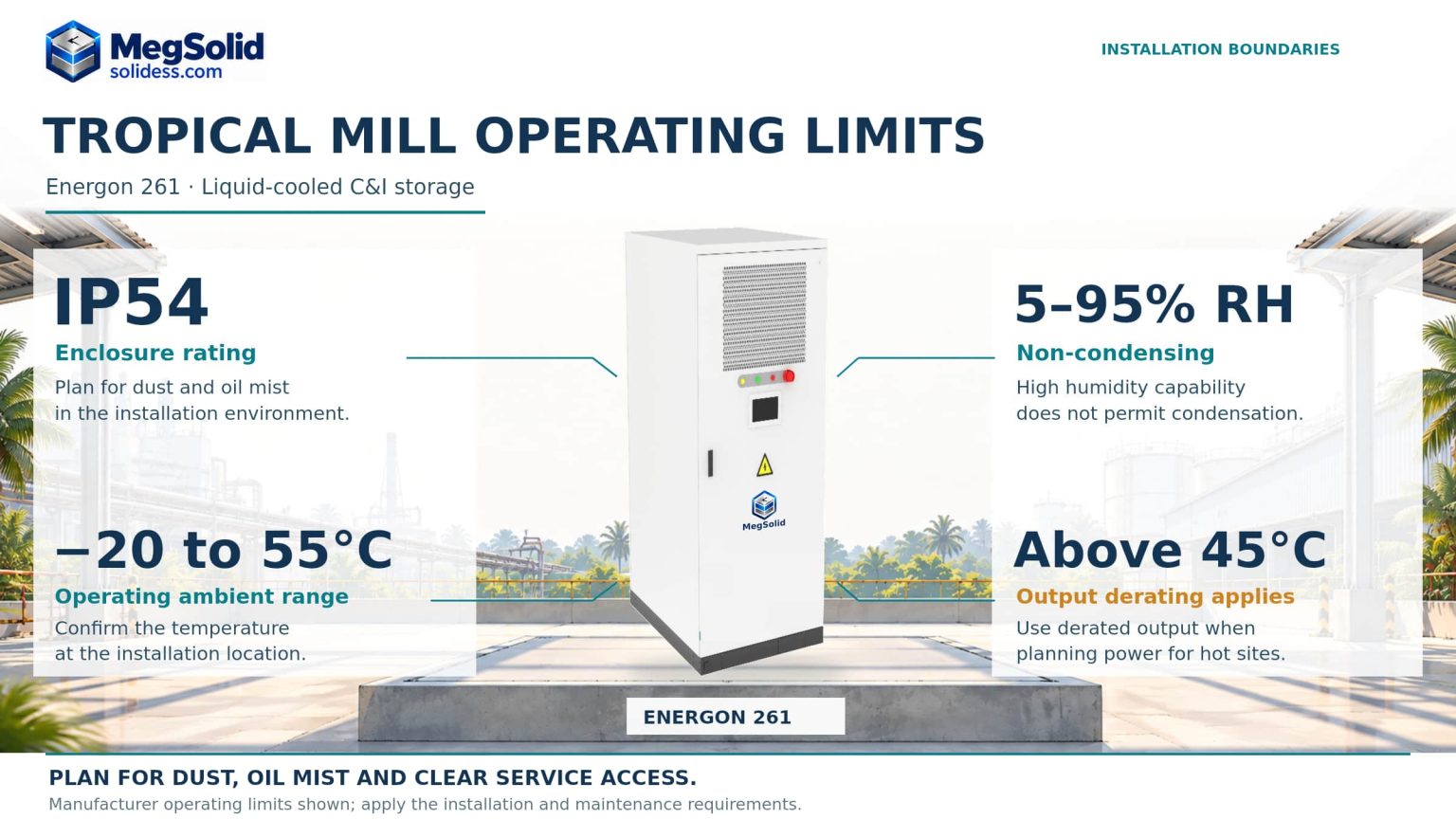
Agro-industrial powerhouses are harsh environments for power electronics. Ambient air around a palm oil or sugar mill carries sticky palm oil aerosols, fine airborne bagasse ash (bagacillo), high relative humidity (up to 95% RH) and mildly acidic steam condensate from sterilizer blowdowns.
Standard forced-air battery racks pull oil mist and bagacillo fibres through their intake filters and deposit them onto inverter heatsinks and high-voltage busbars. Over 12 to 24 months, oil-soaked dust forms conductive paths that cause insulation tracking and blower failures.
To prevent contamination, MegSolid's Energon 261 kWh liquid-cooled cabinet isolates its LFP cells inside an IP54 enclosure cooled by a sealed internal liquid loop, rated for ambient temperatures up to 55°C (derating above 45°C) and 5–95% non-condensing humidity. Shop air never touches the battery modules. For coastal estates or corrosive sterilizer-adjacent locations, cabinets can be ordered with an ISO 12944 C4 or C5 anti-corrosion coating through MegSolid's OEM/ODM customisation service. Each cabinet integrates Novec 1230 gas suppression, multi-sensor detection and water-based fire protection alongside MegSolid's hybrid solid-state battery technology.
Palm Oil and Sugar Mill ROI: Illustrative 1 MW / 2 MWh Case
Below is an illustrative financial model for a 60 TPH (tons FFB per hour) palm oil mill or a 4,000–5,000 TCD (tons cane per day) sugar mill deploying a 1 MW / 2 MWh liquid-cooled BESS (8 × Energon 261 kWh / 125 kVA cabinets in parallel) to replace two 800 kVA spinning-reserve diesel gensets:
| Savings / Revenue Stream | Operational Basis | Illustrative Annual Value |
|---|---|---|
| 1. Eliminating parallel diesel spinning reserve | Shutting down 24/7 low-load diesel gensets saves ~300,000–450,000 L/year of diesel ($1.00–1.25/L delivered) + avoided 3,000-hr engine rebuilds | $320,000 – $520,000 / year |
| 2. Surplus PKS / bagasse sales | Flattening boiler steam demand saves ~2,000–3,000 tons/year of PKS ($80–110/ton) or equivalent bagasse export | $150,000 – $250,000 / year |
| 3. Avoided 81U blackout downtime | Preventing under-frequency trips, sterilizer batch delays and juice fermentation losses | $50,000 – $90,000 / year |
| Estimated Simple Payback | Based on typical turnkey BESS + EMS integration cost | ≈1.8 to 2.8 years |
Figures are illustrative; actual savings depend on annual milling hours, local diesel prices (including subsidy levels in Malaysia/Indonesia), boiler condition and PKS export contracts.
Conclusion: Stop Burning Diesel Next to a Mountain of Biomass
A biomass boiler and back-pressure steam turbine provide low-cost thermal and baseline electrical energy, but they were never designed to chase millisecond shredder and press transients on their own. Adding a liquid-cooled BESS gives the powerhouse the fast electrical response it lacks, allowing you to shut down spinning-reserve diesel generators, prevent under-frequency blackouts and sell more surplus PKS or bagasse.
Ready to shut down your parallel diesel generators? Contact MegSolid's engineering team with your steam turbine rating, diesel generator fuel logs and powerhouse single-line diagram for a free mill diesel-displacement assessment. Within 24 hours we will return a BESS sizing recommendation, governor droop integration concept and datasheets for our solid-state energy storage systems.
