 Skip to content


A battery can show 80% SOC while the facility remains de-energized.
The battery cells may be healthy.
The project may simply have been designed around a grid-following PCS that needs an existing AC waveform before it can operate.
When utility power disappears and the PCC opens, the grid reference disappears with it. A grid-following PCS then loses the voltage and frequency reference it needs, even if the battery remains charged.
The difference is whether the project only stores energy or can restore a black-start-capable microgrid from a dead bus.
MegSolid recommends a MEGA 30–500kW PCS-based grid-forming architecture when a commercial site must establish its own voltage and frequency after total grid loss, subject to the selected PCS control package, battery SOC, switching architecture and validated black-start sequence.
Grid-forming PCS is the voltage source. Black start is the entire restoration process.
If those two functions are treated as equivalent, the microgrid can still fail during a full restoration event.
Define Black Start From the Dead-Bus Restoration Requirement
Black start means restoring an electrical network from a de-energized condition without relying on the external utility grid to provide the initial voltage and frequency reference.
The definition is simple, but the restoration sequence is not.
Define the Full Restoration Sequence
A true commercial microgrid black-start sequence may require the BESS to:
- boot its own controls;
- verify sufficient SOC;
- isolate the utility;
- establish a dead local AC bus;
- energize transformers;
- restore loads in stages;
- restart compatible PV;
- synchronize generators where required;
- maintain voltage and frequency while the system changes.
BESS that performs well during peak shaving may still be unable to execute a black-start sequence.
Test Whether the System Can Create and Sustain a Dead-Bus Network
Do not stop at this question:
“Can the battery discharge?”
Use this system-level question instead:
“Can the system create and sustain an electrical network when there is no live grid left to follow?”
That distinction prevents procurement from treating battery discharge capability as proof of black-start capability.
Separate Grid-Following Operation From Black-Start Capability
Grid-following PCS behaves primarily as a controlled current source.
It measures an existing AC waveform, derives frequency and phase information, then injects current relative to that reference.
Without that reference, normal grid-following operation cannot continue.
A fully charged conventional grid-tied BESS can shut down during an outage.
MegSolid's why a charged BESS can still shut down guide explains the architecture boundary.
Anti-islanding is not a product defect.
It is a protection requirement.
The design error is specifying a grid-following system and later expecting it to behave like a microgrid-forming source.
If the project must energize a dead bus, write that requirement before PCS procurement—not after the blackout.
Use Grid-Forming PCS as the Voltage Source for Restoration
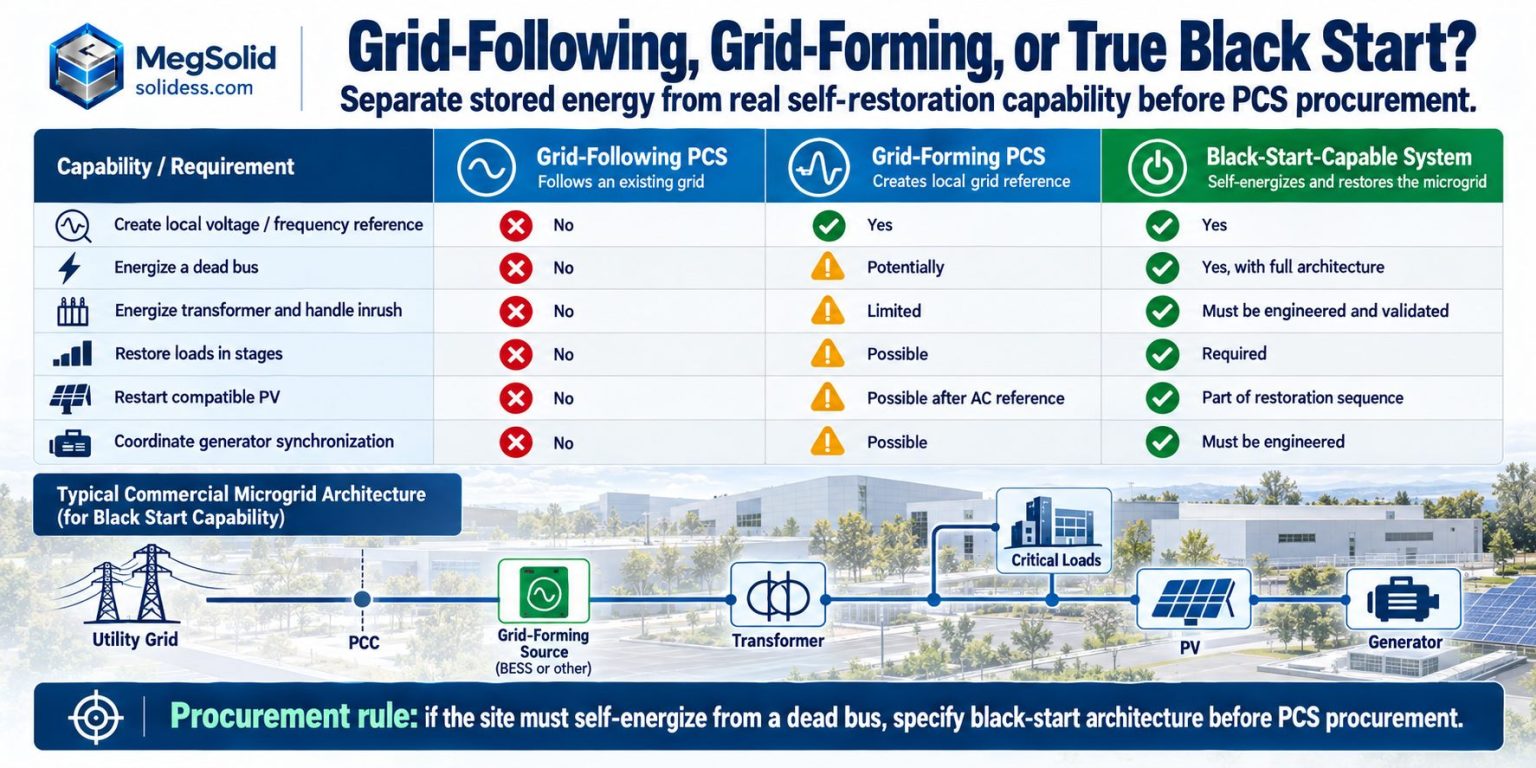
Grid-forming changes the control architecture.
The PCS no longer waits for another source to define the AC waveform; it establishes the local voltage and frequency reference.
Establish Voltage and Frequency on the Islanded Bus
Grid-forming PCS controls local voltage magnitude and frequency.
In an islanded microgrid it can establish the electrical reference that downstream equipment follows.
This capability makes dead-bus energization possible.
MegSolid's grid-forming PCS engineering explains the voltage-source architecture behind this operating mode.
But this distinction must stay explicit:
GFM identifies a control mode; black-start capability requires a complete system sequence.
| Capability | Grid-Following PCS | Grid-Forming PCS | Black-Start-Capable System |
|---|---|---|---|
| Operate against a live grid | Yes | Yes | Yes |
| Create local voltage and frequency | No | Yes | Yes |
| Energize a dead bus | No | Potentially | Yes, if architecture supports it |
| Energize a transformer from dead system | No | Possible | Must be engineered |
| Restore loads sequentially | No | Controller-dependent | Required |
| Restart compatible PV | No | Possible | Part of restoration sequence |
| Coordinate generator synchronization | No | Possible | Must be engineered |
| Operate without external grid reference | No | Yes | Yes |
The table separates a control feature from a functioning black-start architecture.
Grid-forming capability alone does not prove that the site can recover from a blackout.
Require the Supporting Black-Start Functions
The system still needs:
- autonomous control power
- adequate battery SOC
- dead-bus detection
- PCC isolation
- transformer energization strategy
- protection coordination
- load-shedding logic
- staged restoration control
Vendor documentation should explain how those pieces start from a completely dead site; “GFM” on the datasheet alone is not enough.
Treat VSM as a Control Method, Not Extra Physical Capacity
Some grid-forming implementations use virtual synchronous generator or virtual synchronous machine algorithms to reproduce selected behaviors associated with rotating synchronous machines.
VSM behavior can help stabilize the microgrid when loads change during restoration.
Software does not create unlimited physical power.
The battery, DC bus, semiconductors and PCS current limit still define the real operating boundary.
A 100kW load step on a 100kW PCS is not solved by labeling the controller “virtual inertia.”
Keep VSM Inside the Physical PCS Limits
The PCS still needs enough:
- kVA capacity
- current headroom
- DC power
- SOC
- voltage-control margin
Control algorithms cannot replace missing PCS kVA, current headroom or DC power.
Build the Black-Start Sequence Into the SLD and Control Narrative
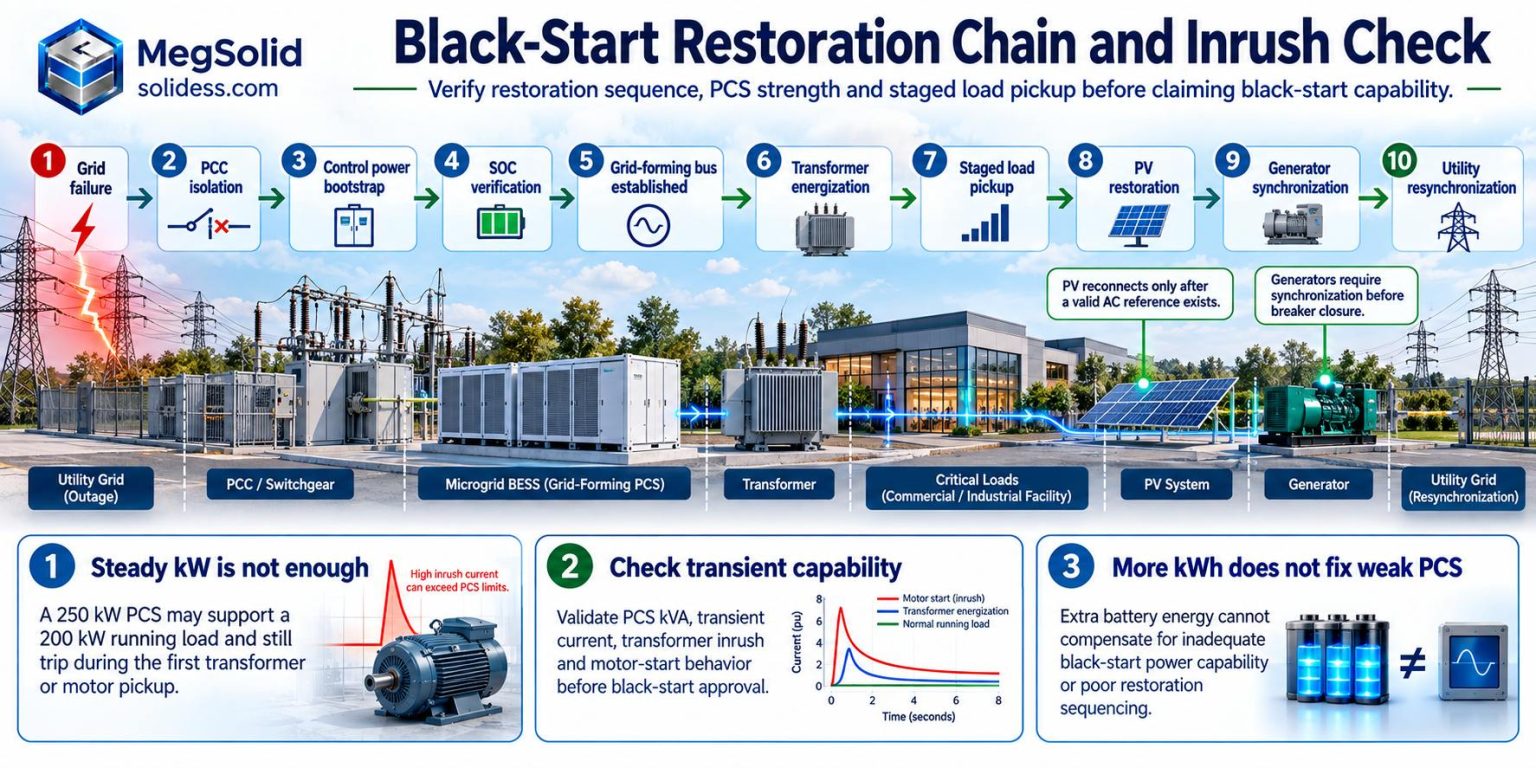
A credible black-start design should be readable as a restoration sequence on the control narrative and SLD.
A black-start sequence that exists only in the commissioning engineer's head is not a finished design.
Isolate the Utility and Bootstrap the Control Power
The utility fails.
The first task is to create a safe island before any load is energized.
The control system must confirm that the PCC or utility coupling device is open and that unintended backfeed cannot occur.
Then the black-start source must power the systems required to bring the microgrid alive:
- BMS
- PCS controls
- EMS or microgrid controller
- protection relays
- breaker coils
- communications
- essential auxiliaries
Battery energy without a bootstrap path for those controls does not create a black-start resource.
The EMS should also verify the black-start SOC reserve before restoration begins.
Establish the Local AC Reference
With the utility isolated and controls alive, the grid-forming PCS establishes the local AC reference.
The bus rises from dead toward the commanded voltage and frequency.
Do not assume the PCS should instantly drive the bus to nominal voltage.
If a transformer is connected to that bus, energization strategy matters.
Controlled voltage ramping may reduce transformer magnetizing inrush in architectures designed for converter-assisted energization.
The system should validate:
- dead-bus status
- breaker state
- voltage ramp
- frequency
- phase sequence
- grounding configuration
- transformer response
- protection status
Only then is the microgrid ready for staged restoration.
Restore Loads in Stages and Reconnect Compatible PV
Weak black-start designs often fail during staged load restoration.
Do not close every load breaker at once.
Restore loads in priority groups.
A practical priority order is:
Tier 1: controls, communications and essential auxiliaries Tier 2: critical operational loads Tier 3: larger motors, HVAC and process loads Tier 4: discretionary loads
Every load step must stay inside the PCS kVA and transient-current envelope.
PV comes later.
Normal grid-following PV inverters cannot create the dead microgrid themselves.
Once the grid-forming BESS establishes a valid AC reference, compatible PV inverters may reconnect according to their protection, reconnection timers and control settings.
MegSolid's PV-diesel-battery island microgrid guide shows why PV curtailment and BESS control must be coordinated after the AC bus is established.
Do not assume every existing rooftop inverter will happily operate behind a grid-forming BESS. Verify it.
Size the PCS for Transformer and Motor Inrush During Black Start
The battery usually has enough energy.
The PCS current limit is where the black-start argument gets serious.
Size for the Worst Restoration Event
Transformers, motors, compressors and other inductive loads can demand large transient currents during energization.
Those currents can be many times normal operating current.
The exact multiplier depends on:
- transformer residual flux
- closing point
- source impedance
- motor design
- starting method
- connected mechanical load
Continuous kW alone is an inadequate black-start sizing metric.
A 250kW PCS may have enough steady-state power for a 200kW operating load and still trip when the first large transformer or motor is energized.
Size the PCS From the Full Restoration Duty
continuous kW + required kVA + transient current + duration + reactive demand
MegSolid's motor-starting and PCS kVA requirements guide separates normal running power from starting duty.
Verify the Actual PCS Overload Curve
This is the procurement rule that matters:
Black-start projects should size the PCS from the worst restoration event, not from normal operating kW.
Identify the Worst Restoration Event
The worst event may be:
- transformer magnetization
- simultaneous auxiliary restart
- motor acceleration
- large HVAC compressor start
- a critical load block reconnecting before PV returns
MegSolid reviews transformer energization, motor starting, critical-load pickup and islanding sequence before the PCS rating should be frozen.
Do not put “150% overload” or “200% overload” into a specification unless the selected PCS model provides the actual time-current capability.
MegSolid's current MEGA PCS data publishes 110% long-term overload capability.
That is a defined product boundary.
Projects requiring higher short-duration current must verify the exact model's validated overload curve and protection behavior.
Add Inrush-Mitigation Measures When PCS Current Is Insufficient
If the PCS cannot provide the required inrush directly, the architecture may need:
- sequential transformer energization
- controlled voltage ramp
- soft starters
- VFD-controlled motors
- reduced-voltage starting
- staged load pickup
- parallel PCS capacity
Buying excess battery kWh does not fix insufficient PCS kVA.
A 2MWh battery behind an undersized PCS can still fail to start the first transformer.
Undersizing PCS kVA can create a costly microgrid procurement error.
Specify Black Start Only Where Independent Restoration Is Required
Black start is valuable.
It is not automatically necessary.
Use Black Start for Sites That Must Recover Independently
Sites that only require:
- peak shaving
- TOU arbitrage
- solar self-consumption
and do not require operation after total grid failure may be well served by a conventional grid-following architecture.
Do not pay for a resilience feature the project does not need.
Use Black Start Where Independent Restoration Is Part of the Mission
Black start becomes important when the site must recover independently, including:
- remote island microgrids
- isolated industrial sites
- mines
- hospitals and healthcare campuses
- data centers with islanding requirements
- critical infrastructure
- facilities reducing dependence on diesel-only restoration
These customers are not buying another battery.
They are buying the ability to rebuild an electrical system after the upstream grid disappears.
Generator integration adds another layer.
Once the BESS establishes the local bus, generators still require synchronization before breaker closure.
Voltage, frequency and phase must be synchronized, and reverse-power protection must remain coordinated.
MegSolid's BESS-diesel generator coordination guide covers that handoff.
Black start is not about buying the most expensive PCS.
It is about buying the control capability, transient power and restoration architecture the operating mission actually requires.
Approve Black Start Only After the Full Restoration Chain Is Proven
A microgrid that cannot energize itself from a dead bus is not black-start capable just because it has a battery.
Prove the Full Restoration Chain
Grid failure → PCC isolation → control-power bootstrap → SOC verification → grid-forming bus → transformer energization → staged load pickup → PV restoration → generator synchronization → utility resynchronization
That sequence is the real black-start capability.
Separate the Black-Start Responsibilities
- Battery: stores the energy
- PCS: creates the electrical reference
- EMS / microgrid controller: decides what starts next
- Switchgear: keeps the island isolated
- Protection system: supervises abnormal conditions during restoration
Commercial projects that require independent restoration should evaluate MegSolid's MEGA PCS platform against the exact grid-forming control package, kVA requirement, overload curve and black-start sequence for the site's real transformers and loads.
Send the Inputs Needed for Black-Start Design
Send:
- preliminary SLD
- critical-load list
- transformer ratings
- motor starting data
- required restoration order
- minimum black-start SOC
- existing PV inverter models
- generator ratings and controls
- PCC switching architecture
- required island duration
The black-start sequence should be proven before the site experiences a real outage.
FAQ
What does black start mean in a commercial microgrid BESS?
Black start means restoring a de-energized electrical network without relying on the utility grid for the initial voltage and frequency reference. The full sequence includes control-power bootstrap, PCC isolation, dead-bus energization, transformer energization and staged load restoration.
Can a fully charged grid-following BESS black start a facility?
Not by itself. Grid-following PCS normally requires an existing AC waveform, so a charged battery can remain unavailable for restoration without grid-forming and black-start architecture.
Is grid-forming PCS the same as black-start capability?
No. Grid-forming is a PCS control mode that establishes local voltage and frequency. Black start is the complete restoration process, including isolation, control power, transformer energization, load sequencing, PV recovery and generator coordination.
What systems must start before the microgrid can restore loads?
The black-start source must bootstrap the BMS, PCS controls, EMS or microgrid controller, protection relays, breaker coils, communications and essential auxiliaries.
Why must the PCC be isolated before black-start restoration begins?
The microgrid must form a safe island before energizing local loads. Confirming the PCC is open prevents unintended backfeed into the utility.
Why is battery SOC alone not proof of black-start capability?
SOC only shows stored energy. The project also needs a PCS that can establish the AC reference, enough kVA and transient current, a bootstrap path for controls, protection coordination, switching logic and a validated restoration sequence.
How should loads be restored after the grid-forming bus is established?
Restore loads in priority groups rather than all at once: controls and essential auxiliaries first, then critical operational loads, larger motors and HVAC, and finally discretionary loads.
Can existing rooftop PV reconnect immediately during black start?
No. Normal grid-following PV cannot create the dead AC network itself. Compatible PV can reconnect only after the grid-forming BESS establishes a valid AC reference and the inverter's protection and controls permit it.
Why can transformer and motor inrush defeat an otherwise adequate BESS?
A PCS may have enough continuous kW for the running load but still hit its current or kVA limit during transformer magnetization, motor acceleration, compressor start or a large block-load pickup.
What PCS parameters matter most for black-start sizing?
Continuous kW, required kVA, transient current, event duration, reactive demand, DC power, SOC, voltage-control margin, overload curve and protection behavior all matter.
Can more battery kWh compensate for an undersized PCS during black start?
No. Extra stored energy does not increase PCS kVA or transient-current capability. A large battery behind an undersized PCS can still fail on the first transformer or motor-start event.
When is black-start capability worth specifying for a commercial site?
It is valuable when independent restoration is part of the operating mission, such as remote microgrids, isolated industrial sites, mines, hospitals, data centers with islanding requirements and critical infrastructure.
What inputs should be sent for a commercial microgrid black-start review?
Send the preliminary SLD, critical-load list, transformer ratings, motor starting data, restoration order, minimum black-start SOC, PV inverter models, generator ratings and controls, PCC switching architecture and required island duration.
