
A large rooftop PV system does not automatically require a battery with the same power rating. The correct specification depends on the factory load curve, measurable solar surplus, peak duration, required backup reserve, transformer capacity and approved grid-connection arrangement.
For a commercial BESS project in Brazil, the direct procurement answer is:
Size BESS power from the load event that must be controlled and size battery energy from the required operating duration. Before releasing the purchase order, confirm the ANEEL project classification, permitted grid injection, distributor requirements, INMETRO conformity boundary and project-specific FAT criteria.
Brazil’s Energy Research Office includes distributed generation and behind-the-meter batteries in the PDE 2035 planning process. EPE identifies opportunities for commercial and industrial applications, including solar self-consumption and diesel substitution during peak periods, while noting that viability remains sensitive to battery cost, tariffs and regulatory changes.
The procurement process should therefore start with site data—not a standard “PV capacity multiplied by two hours” formula.
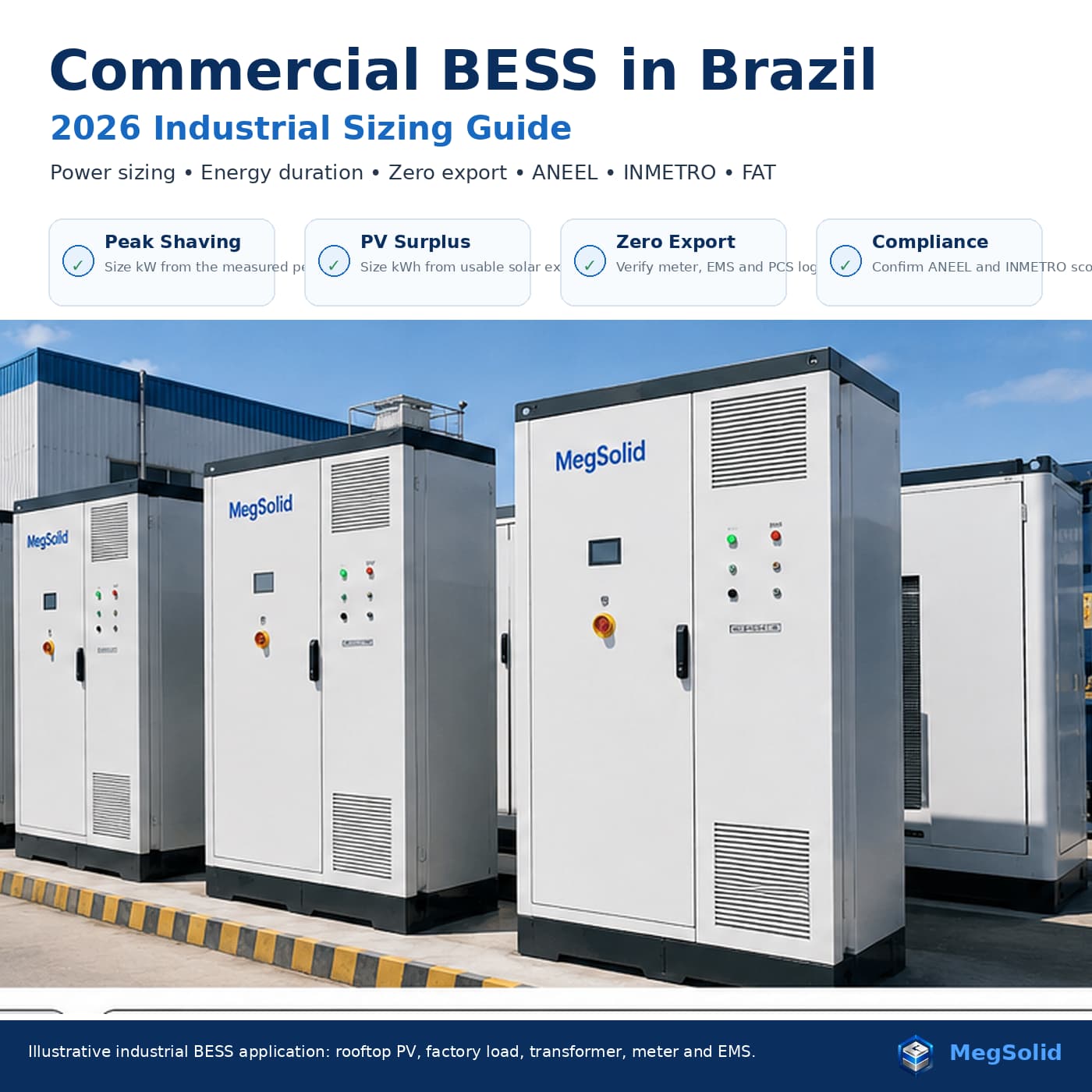
Brazil’s 2026 BESS Regulatory Framework
In June 2026, ANEEL published Normative Resolutions No. 1,161/2026 and No. 1,162/2026 following Public Consultation No. 39/2023.
The official REN No. 1,161/2026 publication addresses authorization requirements and procedures for standalone electrical energy storage systems.
The official REN No. 1,162/2026 publication amended rules covering connection, network use, metering, contracts, billing and other storage-related matters. The two resolutions establish different treatment for standalone and co-located storage arrangements.
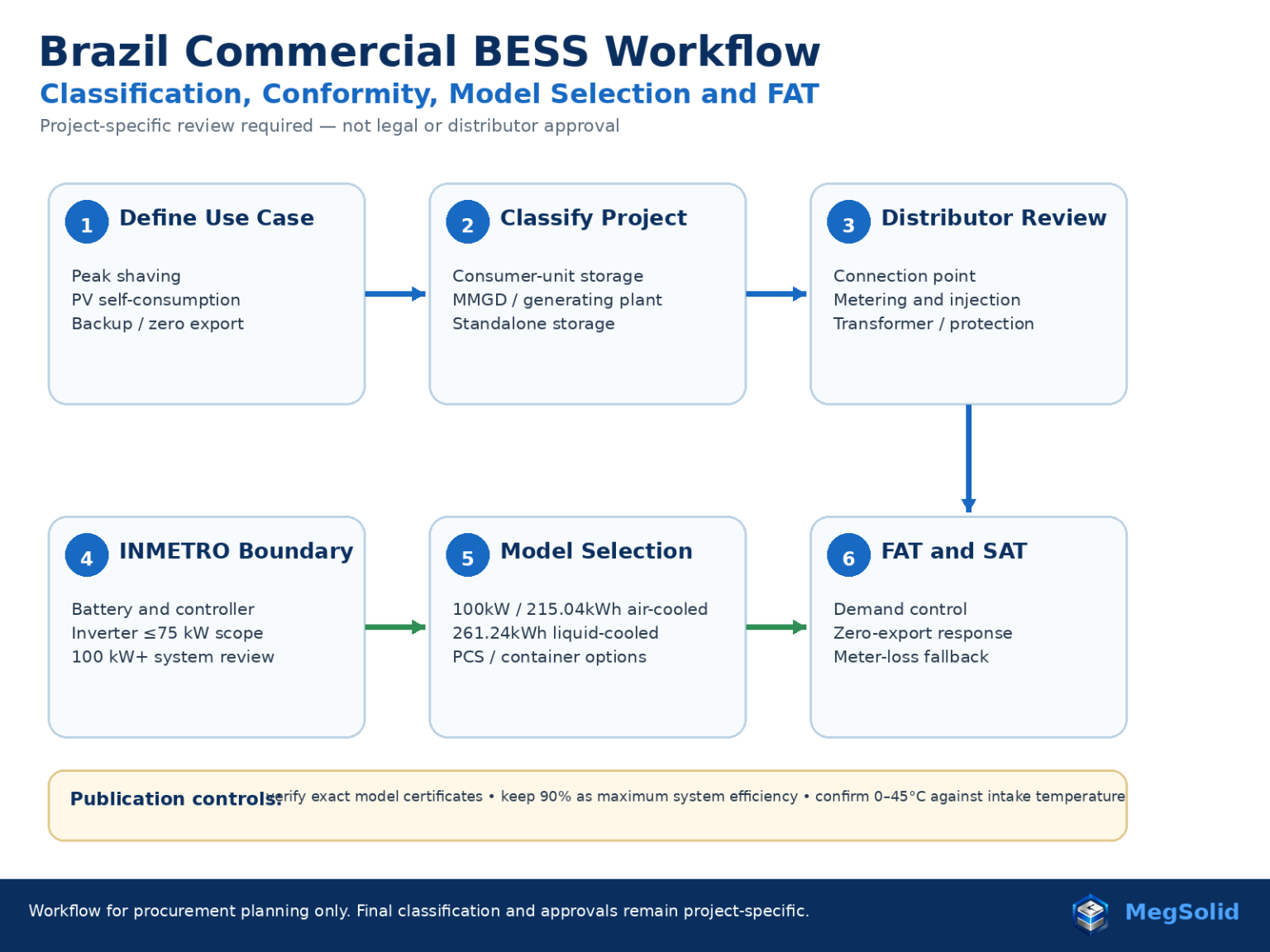
For procurement, connection and compliance analysis, projects should be distinguished among:
- Standalone storage
- Storage co-located with a consumer unit
- Storage associated with a generating plant
- MMGD projects involving distributed microgeneration or minigeneration
- Storage participating in electricity-market or system-service arrangements
These categories are used to structure the engineering review. The final regulatory classification must follow the applicable ANEEL resolutions, distributor requirements and approved connection model.
For a consumer unit with co-located storage and no distributed microgeneration or minigeneration, the amended rules prohibit power injection into the distribution network and set contracted injection demand at zero. Projects involving MMGD, generating plants or standalone storage require separate analysis.
Define the Commercial Objective Before Selecting the Product
One battery can support several functions, but the same stored energy cannot be reserved for every function simultaneously.
The buyer should rank the intended operating priorities:
- Critical-load backup
- Peak-demand reduction
- Solar self-consumption
- Zero-export control
- Time-of-use load shifting
- Generator coordination
A system that reserves 40% SOC for emergency backup has less energy available for daily peak shaving. A system cycling every working day also has a different degradation profile from one used mainly during grid interruptions.
These priorities must be included in the EMS functional description, usable-energy calculation, warranty duty cycle and FAT procedure.
Size BESS Power from the Measured Peak
Battery power determines how much facility demand the system can offset at one time.
For peak shaving:
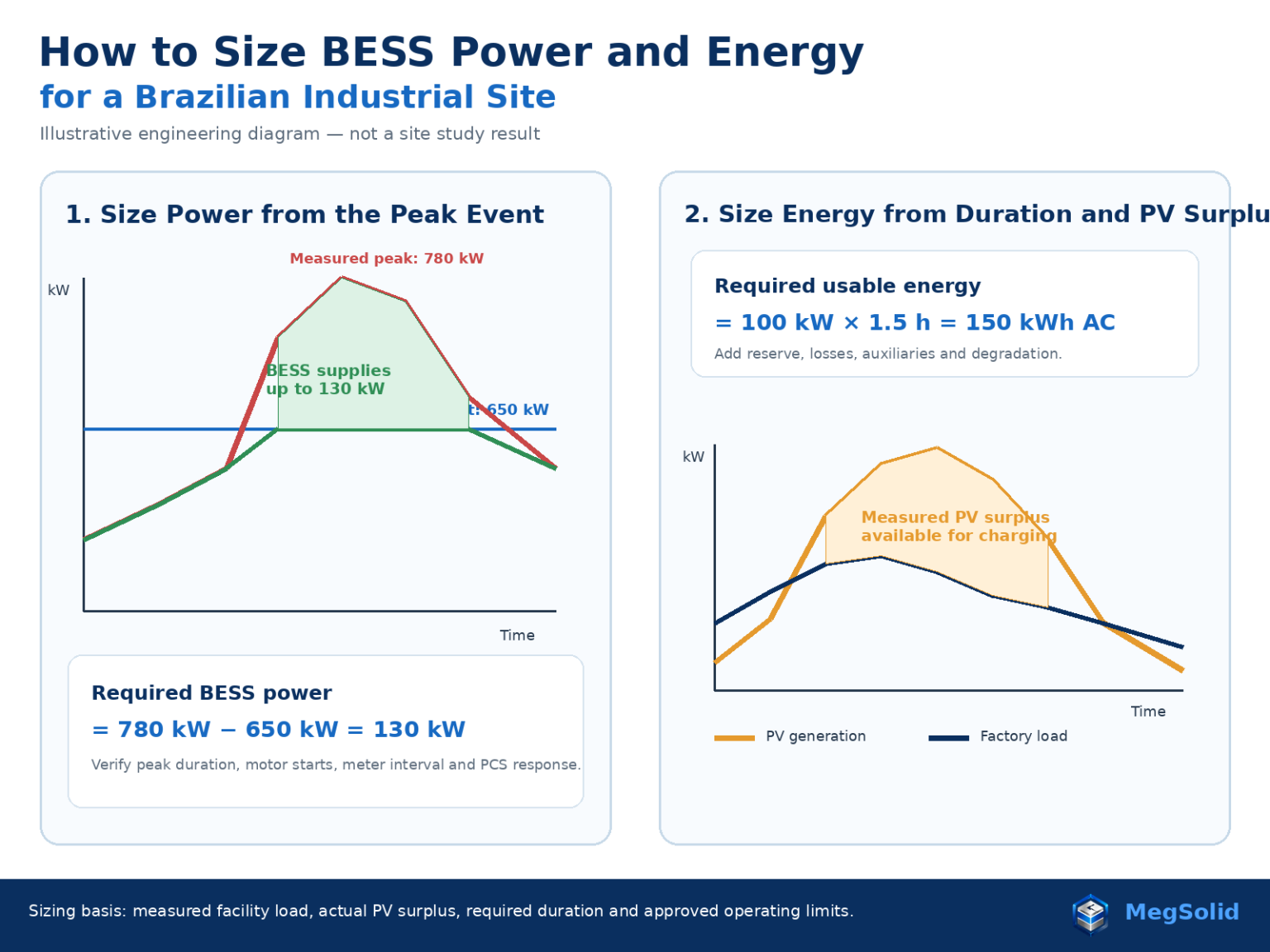
Required BESS power = Measured facility peak − Target grid-import limit
Consider a factory with a measured peak of 780kW and a target grid-import limit of 650kW:
780kW − 650kW = 130kW
A 100kW PCS could reduce the peak, but it could not maintain the 650kW target during the full 780kW event.
The final power rating must also account for:
- Peak duration
- PCS overload capability
- Motor-starting demand
- EMS response time
- Meter update interval
- Transformer loading
- Operating margin
Increasing battery kWh will not solve a problem caused by insufficient PCS kW.
Size Battery Energy from Duration and PV Surplus
Battery energy determines how long the required power can be sustained.
Required usable energy = BESS discharge power × Required duration
If a facility requires 100kW for 1.5 hours:
100kW × 1.5 hours = 150kWh usable AC energy
The nominal battery capacity must be higher because the design needs to account for SOC reserve, conversion losses, cooling auxiliaries, degradation and operating-temperature limits.
For solar self-consumption, use the measured or simulated surplus curve:
Available solar charging energy = PV production above simultaneous facility demand
A 600kWp rooftop array does not justify a 600kW BESS when the factory consumes most solar generation directly. The study should use at least twelve months of interval load data and a site-specific PV production profile.
Zero Export Requires Tested EMS Logic
Solar self-consumption and zero export are not the same requirement.
Solar self-consumption stores surplus PV for later onsite use. Zero export prevents reverse power at the point of connection.
The project-specific EMS design should define:
- Point-of-connection meter
- Import/export sign convention
- Meter update frequency
- Zero-export control margin
- PCS active-power response
- Reverse-power alarm threshold
- Response to meter communication loss
- Interaction with PV inverters and generators
The EPC should review the MegSolid BMS and EMS communication architecture and prepare a project-specific signal matrix.
A brochure statement that the EMS “supports zero export” is insufficient. FAT should simulate rapid changes in factory load and PV generation and confirm that the PCS follows the approved control limit.
Check Transformer and Charging Capacity
Battery charging increases grid demand unless the charging energy comes from verified surplus PV.
Consider this illustrative example:
| Engineering input | Illustrative value |
|---|---|
| Transformer rating | 1,000kVA |
| Factory load during charging | 760kW |
| Proposed BESS charging power | 200kW |
| Combined active power | 960kW |
The transformer cannot be approved from active power alone. The EPC must also evaluate power factor, existing transformer loading, temperature rise, harmonics, losses and switchgear capacity.
The EMS should apply a dynamic limit:
Permitted BESS charging power = Site import limit − Current facility demand − Engineering margin
This is an illustrative calculation, not a distributor access study.
MegSolid Product Options for Brazilian Industrial Sites
The latest reviewed product source identifies the 100kW/215.04kWh cabinet as an air-cooled LFP system and the 261.24kWh platform as a liquid-cooled LFP system. Product chemistry and performance claims must remain model-specific.
100kW 215kWh Air-Cooled C&I Energy Storage System
The 100kW 215kWh air-cooled C&I energy storage system, model ESSA0100B-0215, can be evaluated for peak shaving, solar self-consumption and defined backup loads.
| Parameter | Verified value |
|---|---|
| Rated AC power | 100kW |
| Rated energy | 215.04kWh |
| Cell | 280Ah LFP |
| Battery configuration | 1P240S |
| Nominal voltage | 768V |
| Voltage range | 672–850V |
| Charge/discharge rate | 0.5C at 25°C |
| Listed cycle life | ≥5,000 cycles |
| Cooling | Intelligent air cooling |
| Operating temperature | 0–45°C |
| Enclosure | IP54 |
| Net weight | 3,900kg |
The product must not be described as liquid-cooled or hybrid solid-state. The listed cycle life remains subject to the temperature, DoD, C-rate and end-of-life criteria agreed in the final contract. The 0–45°C operating range must also be checked against the actual equipment-intake temperature at the Brazilian site.
Product data source: Latest reviewed MegSolid technical database, updated July 16, 2026. The signed datasheet document number and revision should be added to the published page when available.
261.24kWh Liquid-Cooled C&I Energy Storage System
The 261.24kWh liquid-cooled C&I energy storage system uses 314Ah LFP cells and provides 125kVA rated AC capacity.
| Parameter | Verified value |
|---|---|
| Rated energy | 261.24kWh |
| Rated AC capacity | 125kVA |
| Nominal DC voltage | 832V |
| DC voltage range | 676–936V |
| Cooling | Liquid cooling |
| Operating temperature | -20–55°C |
| Derating | Above 45°C |
| Maximum system efficiency | 90% |
| Enclosure | IP54 |
| Parallel operation | Up to 10 units |
The 90% figure is maximum system efficiency. It must not be renamed round-trip efficiency unless the approved test document defines the measurement boundary, SOC window, power, ambient temperature and treatment of cooling and auxiliary consumption.
Product data source: Latest reviewed MegSolid technical database, updated July 16, 2026. The signed datasheet document number and revision should be added before publication.
Custom systems can also use the MEGA 30–500kW energy storage PCS or the PMA 80–125kW modular PCS series.
Larger facilities can evaluate the ESSC 500kW and 1MW containerized BESS series or the 5000INTL 2.7MW 5.0159MWh liquid-cooled BESS. The reviewed 5000INTL source lists battery type SHS180-314 but does not explicitly identify its chemistry, so that code must not be expanded into an LFP or hybrid solid-state claim.
Confirm the INMETRO Conformity Boundary
INMETRO’s photovoltaic-equipment framework under Portaria No. 140/2022, complemented by Portaria No. 515/2023, covers PWM or MPPT battery charge and discharge controllers, electrochemical batteries, and inverters with nominal power up to 75kW.
The official scope is explained in the INMETRO photovoltaic-equipment conformity requirements.
This framework must not be interpreted as system-level approval of a complete 100kW or larger C&I BESS.
The importer should confirm the applicable requirements separately for the battery, PCS, complete cabinet, site installation and distributor connection. A generic IEC, CE or INMETRO logo does not prove that the ordered system configuration is covered.
Brazil-Specific FAT Requirements
The MegSolid BESS Factory Acceptance Testing guide should be adapted to the Brazilian connection arrangement and EMS operating priorities.
The witnessed FAT should verify:
- Battery charge and discharge
- Point-of-connection meter communication
- Demand-limit control
- PV-surplus charging
- Zero-export response where applicable
- Meter-loss fallback
- SOC reserve
- PCS ramp rate
- Temperature alarms
- Emergency shutdown
- Event logging and remote monitoring
The Site Acceptance Test must then verify the real utility meter, solar inverters, transformer, protection equipment and distributor interface.
Industrial BESS Evidence in Brazil
A relevant third-party industrial example is the Vale 10MWh Ilha Guaíba Terminal BESS project.
Vale reports that its lithium-ion battery system reduced electricity demand during peak hours by 55% and reduced expenditure paid to the local distributor by 40%. The system charges during lower-demand periods and supplements grid supply during the higher-cost peak period.
These are Vale-reported results for one specific terminal, load profile and tariff structure. They must not be presented as guaranteed savings for another factory or as MegSolid project performance.
Final Procurement Recommendation
A commercial BESS in Brazil should be selected from measured site conditions—not only rooftop PV capacity or catalogue duration.
Before releasing the purchase order, confirm:
- ANEEL project classification
- Required kW and operating duration
- Measured PV surplus
- Contracted-demand and transformer margin
- Injection and metering requirements
- Distributor connection conditions
- INMETRO component and system boundaries
- FAT and SAT acceptance criteria
FAQ
Q1: How should a Brazilian factory size a BESS?
Size power from the demand event that must be controlled and energy from the required operating duration. Use interval load and PV-production data.
Q2: Does a 600kWp PV system require a 600kW BESS?
No. The BESS should be sized from measured PV surplus and the project’s discharge requirement.
Q3: Are all Brazilian C&I batteries prohibited from exporting power?
No. The treatment depends on the regulatory configuration. A consumer unit with co-located storage and no MMGD has a no-injection requirement, while other configurations require separate assessment.
Q4: Is the 100kW 215kWh MegSolid system liquid-cooled?
No. It is an LFP system with intelligent air cooling, IP54 protection and a listed 0–45°C operating range.
Q5: Is the 261.24kWh system hybrid solid-state?
The reviewed product data identifies 314Ah LFP cells and liquid cooling. It does not classify the system as hybrid solid-state.
Q6: Does INMETRO’s PV framework approve a complete 100kW BESS?
Not automatically. The importer must confirm the applicable battery, PCS, complete-system and site-installation conformity boundaries.
Q7: What should a Brazil-specific FAT verify?
It should verify demand control, metering, PV-surplus charging, zero export where required, communication-loss fallback, SOC limits and emergency shutdown.