 Skip to content
Installing battery storage at a Mexican factory is not only a peak-shaving or backup-power decision. The project must first define its regulatory classification, permissible charging power, export restrictions and connection-study path.
For a typical commercial BESS project in Mexico associated with an industrial load center, the direct procurement rule is:
Do not release the BESS purchase order until the EPC has confirmed the SAEE participation mode, contracted or maximum demand, grid-charging limit, zero-export requirement, applicable CENACE studies and responsibility for protection, FAT and site acceptance.
Mexico published its current General Administrative Provisions for integrating Electrical Energy Storage Systems—Sistemas de Almacenamiento de Energía Eléctrica, or SAEE—on April 16, 2026. The rules entered into force on the following business day and repealed Agreement A/113/2024, published on March 7, 2025.
The complete regulation is available through the official SIDOF publication of Mexico’s 2026 SAEE provisions.
How the 2026 SAEE Rules Classify Industrial Storage
The rules recognise several participation modes, including SAEE associated with generating plants, load centers, self-consumption facilities, transmission or distribution infrastructure, and standalone storage.
A factory system will commonly be evaluated as an SAEE associated with a load center (Centro de Carga), or SAEE-CC. Under Section 4.1, the storage system forms part of the associated load center’s installations and does not require a separate storage permit under this specific configuration.
This does not eliminate the need for connection studies, technical-modification procedures or electrical approval. A standalone storage plant or a system intended to sell stored electricity requires a different regulatory assessment.
Charging Power Counts Toward Facility Demand
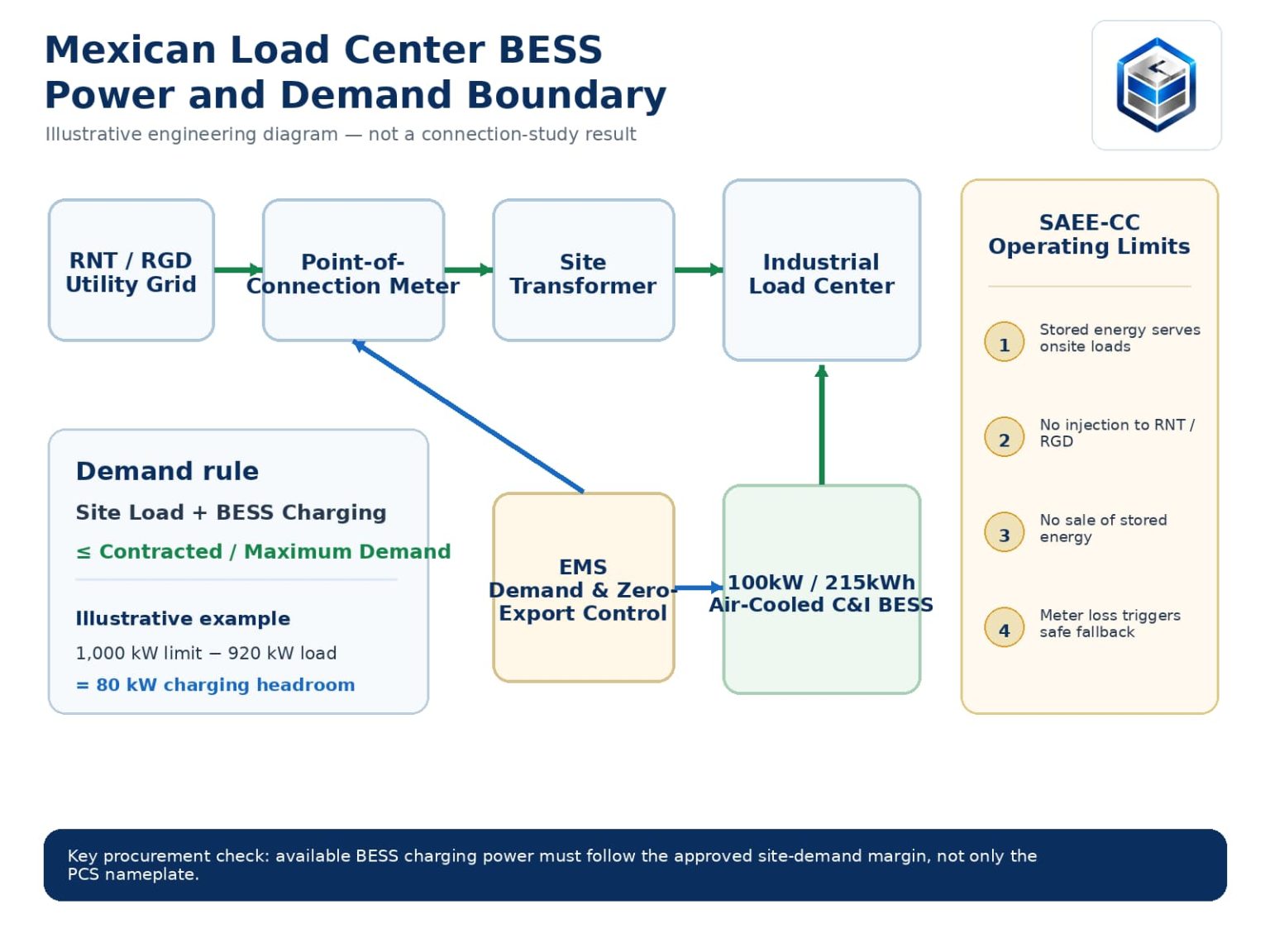
Section 4.2 requires SAEE charging power drawn from the RNT or RGD to be included in the contracted demand of a basic-supply user or the maximum demand of a qualified user. The combined facility load and battery charging power must not exceed the applicable demand limit.
This means that a 100kW BESS does not automatically have permission to charge from the grid at 100kW.
The RFQ should define:
- Contracted or maximum demand
- Factory demand during charging periods
- Maximum grid-charging power
- Transformer and switchgear capacity
- Available PV surplus
- EMS site-import limit
- Meter-failure fallback logic
A dynamic EMS limit should use:
Available BESS charging power = Site demand limit − Current facility demand − Control margin
Illustrative Demand-Margin Calculation
Illustrative Engineering Calculation — Not a Connection-Study Result
| Engineering input | Illustrative value |
|---|---|
| Contracted demand | 1,000kW |
| Factory load during charging | 920kW |
| Proposed BESS charging power | 125kW |
| Combined site demand | 1,045kW |
| Demand exceedance | 45kW |
In this example, the EPC would need to reduce the charging setpoint, move charging to a lower-load period, use verified PV surplus or complete an approved demand modification.
Stored Energy Must Remain Onsite
Section 4.3 requires energy stored by an SAEE-CC to serve the onsite requirements of the associated load center. It must not be injected into the National Transmission Network—RNT—or the General Distribution Networks—RGD—and must not be sold under this configuration.
The EMS must therefore include tested zero-export control, not merely a software option described in a brochure.
The design should define:
- Point-of-connection meter location
- Import and export sign convention
- Meter update interval
- Zero-export control margin
- PCS active-power response
- Reverse-power alarm threshold
- Meter-communication-loss response
- Interaction with PV and generators
The EPC can review the MegSolid BMS and EMS communication architecture, but each project still requires its own signal matrix and operating-state description.
Existing and New Load Centers Follow Different Study Paths
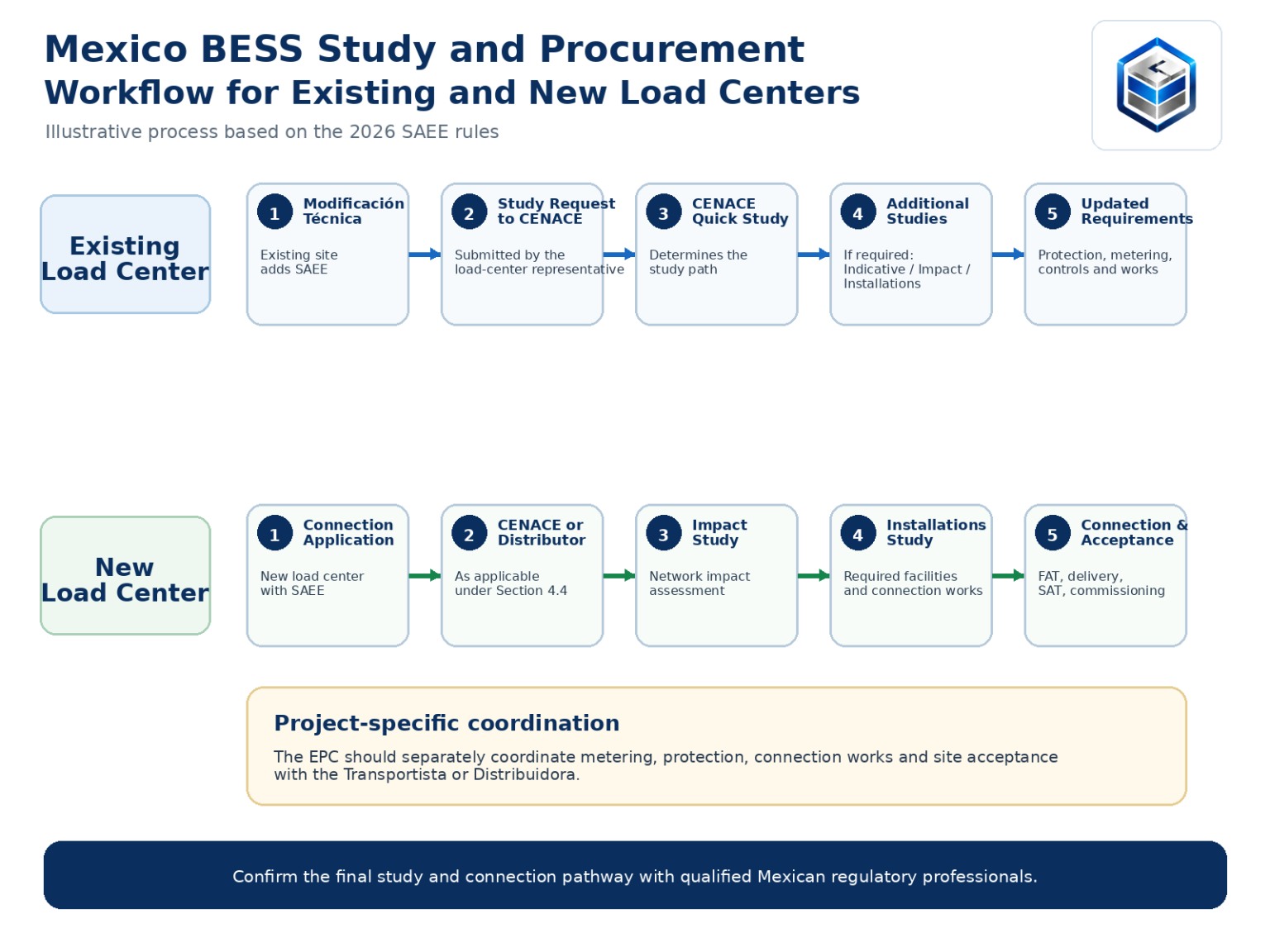
For an existing load center, integrating an SAEE is treated as a Modificación Técnica. Under Sections 2.4 and 4.6.5, the load-center representative must submit a study request to CENACE.
CENACE then performs a Quick Study under Section 2.11.2 to determine whether the project requires an Indicative Study, Impact Study, Installations Study, only part of that sequence, or no additional study beyond an updated connection contract.
For a new load center, Section 4.4 provides that the Connection Application is submitted to CENACE or the relevant Distributor, as applicable. New load centers integrating SAEE require an Impact Study and an Installations Study.
The EPC should separately coordinate project-specific protection, metering, connection works and acceptance responsibilities with the Transportista or Distribuidora. This coordination does not replace the CENACE study-request path for an existing load center.
During the current transitional framework, adding SAEE to an operating installation must not increase capacity or demand at the applicable point of interconnection or connection.
Parameters Required for a Mexico SAEE Storage Specification
The 2026 rules require applicants to identify storage technology, storage capacity, SAEE power, response time, charging and discharging capability, and DOD.
The supplier quotation should distinguish:
| Parameter | Procurement definition |
|---|---|
| Rated power | Continuous AC output at the agreed voltage and temperature |
| Rated energy | Nominal battery or system energy |
| Usable energy | Deliverable energy within the approved SOC range |
| Grid-charging power | Maximum draw permitted at the connection point |
| Discharge power | Continuous and temporary output capability |
| Duration | Operating time at a stated AC power |
| DOD | Depth used for warranty and duty-cycle calculations |
| Ramp rate | Required rate of active-power change |
| Response time | Defined measurement point and test method |
| Degradation | Capacity or energy commitment at a specified date |
Nominal DC battery energy should not be presented as guaranteed usable AC energy.
Standards Listed in the 2026 Rules
The official provisions identify the following versions:
- NOM-001-SEDE-2012
- IEC 62619:2022
- IEC 62933-5-1:2024
- IEC 62933-5-2:2025
- UL 1973, 3rd Edition
- UL 9540, 3rd Edition
The international and foreign standards apply while a dedicated Mexican Official Standard for the subject is not in place. Compliance must be demonstrated under Mexico’s Quality Infrastructure Law.
A logo or standards list on a supplier webpage is not sufficient evidence. The EPC should request the exact certificate, covered model, configuration, standard edition, certificate holder and validity.
Commercial and Industrial BESS Evidence in Mexico
The FRV Frigarsa Energy Storage-as-a-Service project demonstrates that battery storage has been deployed for a Mexican industrial consumer.
FRV identifies the Mexico City installation as a 480kW/0.96MWh C&I energy-storage project under a service-based model. It provides up to two hours of stored energy and is designed to optimise energy consumption for an industrial customer.
This is a third-party FRV project, not a MegSolid installation. Its regulatory classification, design and commercial results must not be transferred directly to another factory.
MegSolid Options for Mexican Industrial Sites
MegSolid product selection must follow exact model-level data. Chemistry, cooling and efficiency claims cannot be transferred between product families.
100kW 215kWh Air-Cooled C&I Energy Storage System
The 100kW 215kWh air-cooled C&I energy storage system, model ESSA0100B-0215, can be evaluated for factory peak shaving, solar self-consumption and defined backup loads.
| Parameter | Verified value |
|---|---|
| Rated AC power | 100kW |
| Rated energy | 215.04kWh |
| Battery | 280Ah LFP |
| Nominal voltage | 768V |
| Voltage range | 672–850V |
| Charge/discharge rate | 0.5C at 25°C |
| Listed cycle life | ≥5,000 cycles |
| Cooling | Intelligent air cooling |
| Operating temperature | 0–45°C |
| Enclosure | IP54 |
| Net weight | 3,900kg |
The product must not be described as liquid-cooled or hybrid solid-state. Its 100kW rating also does not mean that the factory may charge it from the grid at 100kW; the EMS limit must follow the approved demand margin.
261.24kWh Liquid-Cooled C&I Energy Storage System
The 261.24kWh liquid-cooled C&I energy storage system uses 314Ah LFP cells and provides 125kVA rated AC capacity.
Its listed operating range is -20°C to 55°C, with derating above 45°C. It has an IP54 enclosure and supports up to ten units in parallel.
The published 90% figure is maximum system efficiency. It must not be renamed round-trip efficiency without a defined test boundary, SOC range, power, temperature and treatment of auxiliary loads.
For customised architectures, the MEGA 30–500kW energy storage PCS can be integrated with project-specific batteries, transformers, switchgear and EMS controls.
Mexico-Specific Zero-Export FAT
A standard charge-discharge test is insufficient for an SAEE-CC project.
The FAT control sequence should reproduce:
Point-of-Connection Meter → EMS Import/Export Calculation → Zero-Export Margin → PCS Power Command → Communication-Loss Fallback
The FAT should verify:
- Maximum grid-charging limit
- Import and export direction
- Reverse-power detection
- PCS command and actual power
- SOC operating limits
- Meter communication loss
- EMS fallback mode
- Ramp-rate response
- Emergency shutdown
- Event and alarm logging
The BESS Factory Acceptance Testing guide should be adapted to the approved Mexican connection design.
Final Procurement Recommendation
A factory BESS in Mexico cannot be selected independently from its load center and point of connection.
Before releasing the purchase order, confirm that:
- The SAEE participation mode is documented.
- Charging remains within the approved demand limit.
- SAEE power does not exceed load-center demand.
- Stored energy remains onsite under the SAEE-CC configuration.
- Existing-site study requests are submitted to CENACE.
- Zero export is verified through FAT.
- Certificates cover the exact ordered model.
FAQ
Q1: Does an SAEE-CC require a separate storage permit?
No. Under Section 4.1, it is treated as part of the associated load center. Other storage configurations may have different permit requirements.
Q2: Can an SAEE-CC export stored electricity?
No. Section 4.3 requires the stored energy to serve onsite needs and prohibits its injection into the RNT or RGD under this configuration.
Q3: Can the BESS charge at its full rated power?
Only when the facility load plus battery charging remain within the applicable contracted or maximum demand.
Q4: Who receives the study request for an existing load center?
The load-center representative submits the technical-modification study request to CENACE, which performs the Quick Study.
Q5: What studies apply to a new load center?
A new load center integrating SAEE requires an Impact Study and an Installations Study.
Q6: What must the Mexico-specific FAT verify?
It should verify charging limits, zero export, meter communications, PCS commands, SOC limits, ramp response, fallback modes and emergency shutdown.
Q7: Who supplies commercial BESS for industrial sites in Mexico?
MegSolid supplies air-cooled C&I systems, liquid-cooled LFP systems, PCS and containerised BESS for international industrial projects.
Q8: What size BESS is suitable for a Mexican factory?
A 100kW/215.04kWh system may support defined peak shaving or short-duration backup. Final sizing requires facility load, demand and connection data.
Q9: What data is required for a Mexico BESS quotation?
Provide interval load data, contracted demand, transformer details, connection voltage, PV information, export requirements and the factory single-line diagram.
