 Skip to content

A European BESS purchase can stall on documents long before the battery earns its first euro. Put the EU Battery Passport data schedule into the supplier scope before award: exact battery identity, upstream traceability, accountable data owners and a working route from the installed serial number to its digital record. Regulation (EU) 2023/1542 requires a passport from 18 February 2027 for covered industrial batteries over 2kWh, alongside LMT and EV batteries. Buy the evidence package alongside the hardware, rather than trying to reconstruct it after shipment.
A Battery Passport QR Code must lead from the installed battery to an electronic record with defined data and access rights. Demand a traceable battery's origin, model and production identity, not just a QR sticker linked to a catalogue. Put Battery Regulation duties, supply-chain due diligence and any applicable CSDDD work on separate review tracks, with named owners and document deadlines. Find a missing record before award, while you can still make it a priced supplier deliverable.
Use this guide to turn Battery Passport compliance into supplier deliverables: data fields, record ownership, model identification, upstream evidence, BMS exports and change control. MegSolid can review the quoted battery configuration and its equipment-side documentation scope with your EPC. The contract should identify which records are available, which upstream records are still required and who must complete them before the battery is placed on the EU market.
Key Takeaways
- Battery Passport: confirm the covered battery category, relevant placing-on-market date, unique identity, QR access and required public/restricted data.
- Traceability: direct manufacture can simplify evidence access, but it is not a blanket legal requirement. Test the actual records and accountable parties.
- LFP: cobalt-free chemistry does not remove lithium/graphite sourcing, environmental or other applicable due-diligence duties.
- Lifecycle data: define usable BMS fields, methods, units, accuracy and update responsibilities. Do not mistake IEC 62619 safety testing or one resistance number for cycle-life proof.
- Delivery package: keep passport, market-conformity, transport, FAT and warranty documents as distinct named deliverables for the exact configuration.
EU Battery Regulation Compliance Timeline
There is no single compliance date covering every Battery Regulation obligation. Article 77 passport requirements begin on 18 February 2027 for the covered categories; Regulation (EU) 2025/1561 moved the Article 48 due-diligence start to 18 August 2027. Carbon-footprint and recycled-content provisions have their own categories, thresholds, phases and implementing dependencies. Maintain a current legal applicability register and map each applicable item to a supplier document deadline.
|
Regulation Requirement |
Project applicability check |
|---|---|
| Carbon-footprint declaration | Check battery category, applicable date and implementing/delegated-act dependencies |
| Battery Passport | 18 February 2027; confirm Article 77 category and market/service event |
| Recycled-content requirements | Check applicable materials, battery category, phase and current legal provisions |
What is the EU Battery Passport Regulation (2023/1542)?
Regulation (EU) 2023/1542 governs batteries and waste batteries, with obligations that differ by battery category and economic-operator role. A covered industrial battery’s passport is one part of that framework. Carbon-footprint, conformity, labelling, recycled-content and due-diligence obligations should be checked individually; a passport alone does not establish complete market compliance.
Battery Passport Data Fields
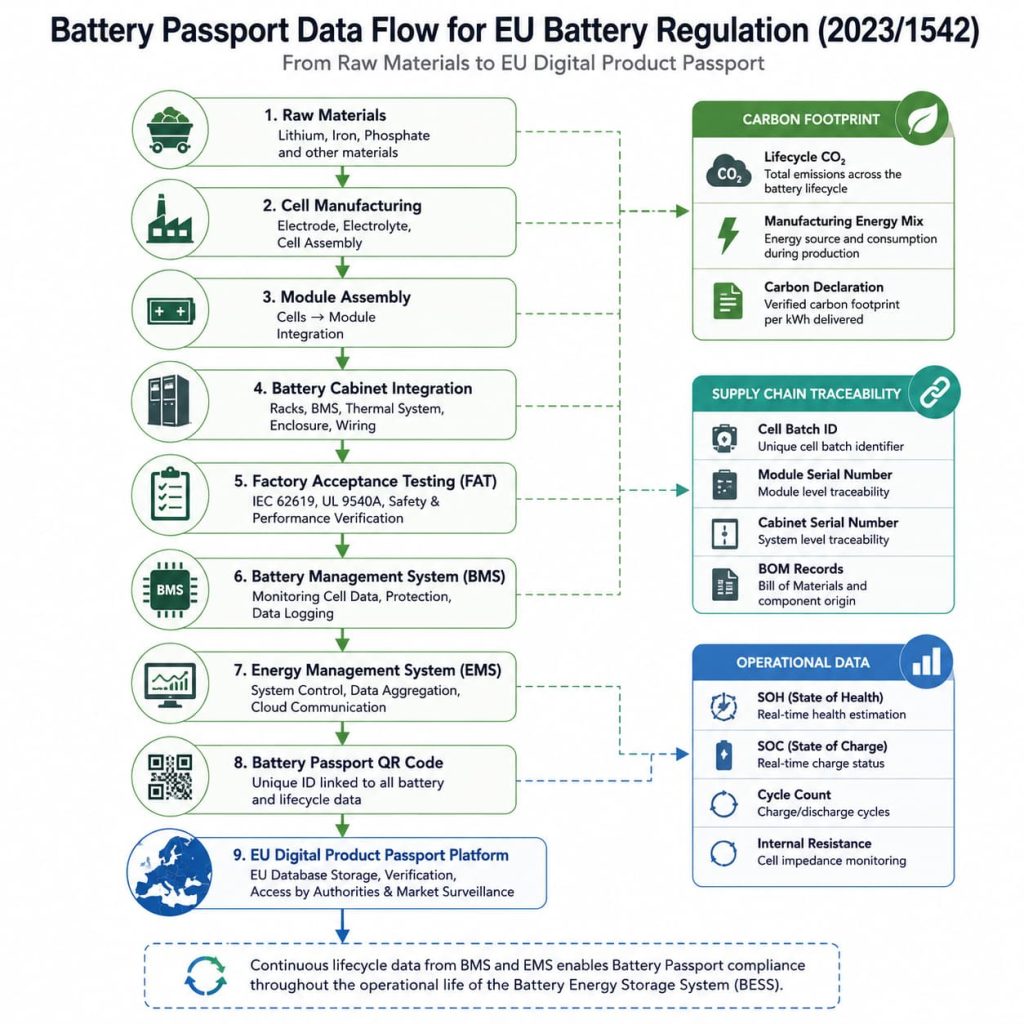
Build a field-level data schedule from the applicable legal requirements and project battery category. Separate public information from restricted access, static model/manufacturing records from later status records, and supplier data from owner/operator updates. Each field needs a source, accountable owner, validation method and due date.
|
Data Field |
Description |
|---|---|
| Manufacturer ID | Economic operator, model and production identity supported by records |
| Cell Chemistry | Chemistry/material information for the actual offered BOM, with applicable access rights |
| Carbon Footprint | Applicable calculation and verified source data; not inferred from BMS SOH alone |
| Recycled Content | Applicable recovered-material content, methodology and supporting records |
| SOH & Cycle Count | Required status/history fields with units, methods and responsible updater |
| Conformity and test-report schedule | Exact model/cell/system report scope; passport does not create certification |
| QR Code | Unique identity linked to the electronic record with controlled access |
Use the current EU legal text and implementing measures to determine the carbon-footprint method and recycled-content obligations for the battery category. The Global Battery Alliance provides industry work on battery passports, but its initiative is not a substitute for the EU regulation. Record the method, system boundary, upstream source and verifier rather than filling gaps with a generic carbon number.
Engineering BOM Traceability for Carbon Footprint Calculation
Start the Battery Passport Platform data schedule with the quoted battery model, cell supplier, production batch, applicable material-origin records and manufacturing data. A multi-stage supply chain can provide traceability if the records and access agreements hold together. The buyer’s task is to connect the installed serial number to supported data and named owners, not to accept or reject a company solely because it is an intermediary.
Direct Manufacturer Data Integrity
Ask MegSolid for the actual offered cell, module, BMS and cabinet identities, BOM revision, production/serial mapping and the report scope that applies to them. Confirm what comes from MegSolid and what must come from upstream manufacturers. A certificate references a tested or assessed model/configuration; it does not automatically certify each production batch or validate environmental data. Make the missing records and their delivery dates visible in the order.
Supply Chain Due Diligence: Conflict Minerals and Safety
Supply-chain due diligence needs its own applicability review, responsible operator, sourcing records and risk process. Battery chemistry and a passport QR code do not replace that work. Keep material origin, supplier declarations and any required verification linked to the actual supply chain and the applicable current provisions.
Solid Electrolyte Stability and LFP Chemistry
LFP cathodes do not rely on cobalt, which changes one part of the material schedule. Lithium, graphite and the rest of the offered BOM still need the sourcing and environmental evidence required for the project. Disclose chemistry and material information through the applicable access process rather than assuming every proprietary formulation must be public. For equipment risk review, retain the BESS thermal runaway prevention guide as a separate technical workstream.
Lifecycle Data Integration: BMS and EMS Role in ESG Reporting
The passport joins model, production and applicable battery-status records under defined access and update responsibilities. BMS and EMS data can support some operating fields, but a raw register list does not make a complete passport. Specify the exporter, receiver, data quality, retention, cyber controls and who updates the record when equipment, ownership or battery status changes.
State of Health (SOH) and Cycle Life Validation
Agree the SOH method, cycle/throughput definitions, units, sample/update interval and history export for the delivered BMS. A resistance value only makes sense with its device boundary and measurement method. IEC 62619 addresses industrial lithium battery safety; it does not by itself validate 5,000 cycles, lifetime carbon savings or a live passport API. Demonstrate the promised export with sample records and a witnessed integration test.
Hamburg EPC Example: Close the Documentation Gap Before Shipment
Consider a Hamburg EPC procuring a 1MWh-class BESS with incomplete upstream battery identity and material records. This is an illustrative procurement scenario, not a verified customer installation. The practical risk is a last-minute scramble for documents that should have been in the supplier scope. Tie every proposed cabinet serial number to its production records and close the data gaps before shipment.
Five ESSA0100B-0215 cabinets give 1,075.2kWh of nominal battery energy and 500kW of summed nameplate AC rating. That arithmetic is not a guarantee of 1MWh delivered AC energy, approved parallel operation or site compliance. Confirm the offered multi-cabinet architecture and record mapping before treating it as an accepted system.
Illustrative Equipment and Evidence Scope
- Illustrative application: a 1MWh-class industrial microgrid procurement, with usable AC energy still to be specified.
- Candidate cabinet quantity: five ESSA0100B-0215 units; nominal energy totals 1,075.2kWh. Parallel/control approval remains a project deliverable.
- Candidate AC interface: 400V, three-phase; final earthing, switchgear and utility scope require the SLD.
- Power boundary: five 100kW cabinet ratings total 500kW on paper. Do not add a separate 500kW PCS to an integrated package without defining why it is required.
- Schedule: fix supplier-data, review and witness milestones before award; no four-week commissioning result is asserted.
- Acceptance: release after the actual equipment, document and integration records pass; April 2025 is not a verified project acceptance date.
Documentation Checks That Prevent a Late Procurement Dispute
- BOM/report mapping: identify the actual cell and cabinet, revisions, production/serial records and applicable report models. Do not infer an SHS180-314 cell from the portfolio name; the public ESSA0100B-0215 specification is air-cooled LFP.
- Transport: request the applicable UN 38.3 test summary for the actual cell/battery type and the shipment documents required by the route. A summary is a transport deliverable, not automatic customs clearance.
- Data integration: demonstrate required SOH/history export into the nominated platform. Modbus TCP is an equipment interface, not inherently a secure cloud API; define the gateway, authentication, access, transport and integration test separately.
Acceptance Records to Request for Your Own Project
- Document closure: approved data schedule, supporting records, gap register and accountable sign-off before the relevant market/contract milestone.
- Audit closure: evidence of the review actually performed for the offered model and supply chain; no automatic ESG audit pass is promised.
- Operating record: require actual commissioning results, alarm history and battery-status trends for the installed equipment. Set the reporting interval and acceptance evidence in the order so the EPC can judge performance against its own project criteria.
- Note: Results vary depending on site configuration, local tariffs, and environmental conditions.
Compare Supplier Evidence Rather Than Supplier Labels
Make competing suppliers answer the same evidence schedule. A direct manufacturer can leave gaps, and an authorized intermediary can provide sound records. Compare the delivered proof, contractual access and accountable party instead of treating the sales channel as a compliance certificate.
|
Engineering Feature |
Incomplete supplier evidence |
Evidence package required before approval |
|---|---|---|
| BOM Traceability | No supported link between offered battery and upstream records | Model/BOM/production/serial mapping with named data owners |
| Carbon Footprint Data | Unsupported or method-free figure | Applicable method, system boundary and verified source records |
| Conflict Mineral Risk | Sourcing evidence or applicability unclear | Applicable material records, risk process and verification |
| Safety Certifications | Report scope/configuration unresolved | Exact-model report and conformity schedule reviewed |
| Warranty Liability | Remedy and accountable operator unclear | Written warranty, claim route and responsibility split |
| FAT (Factory Acceptance) | Witness scope, record or access undefined | Agreed FAT procedure and results for the supplied configuration |
Engineering Checklist for Selecting a Battery Passport-Compliant Manufacturer
Before placing the order, make the passport and documentation schedule part of the deliverables your supplier must price and your EPC must review:
- Actual battery/BOM identity, production serial mapping and supported upstream records.
- Applicable reports and conformity documents mapped to tested models and offered configuration.
- UN 38.3 test summary and route-specific shipment documents.
- Demonstrated BMS/history export with units, methods, access and update ownership.
- Material-origin and due-diligence evidence matched to the current applicable requirements.
- Unique identity, QR record link, platform/access design and lifecycle change process.
- Review milestones, gaps, remedies and accountable technical/compliance contacts.
Bring your proposed cabinet configuration to MegSolid’s project documentation review and define the operating concept through our BESS planning resources. The 215kWh Outdoor Cabinet ESS publishes ESSA0100B-0215 as 100kW / 215.04kWh air-cooled LFP. Ask us to connect that exact offered configuration to a written data schedule: available production and upstream records, gaps, accountable contacts and review dates. Send your equipment quantity and EU delivery milestone so the documentation scope can be quoted alongside the hardware.
References & Industry Standards
Review the current EU legal text and implementation measures for legal duties, and use equipment, environmental-management and transport standards for their own defined scopes. The following references do not establish a certificate or passport for every MegSolid configuration:
- European Commission: Regulation (EU) 2023/1542 and current implementing measures; verify the project’s category, dates and operator duties.
- Global Battery Alliance (GBA): industry passport work; distinguish voluntary initiatives from legal requirements.
- IEC: IEC 62619 industrial lithium battery safety scope; not cycle-life validation.
- UL: UL 9540A fire-propagation test method; request the exact report and configuration.
- ISO 14001: environmental-management standard; any offered certificate needs scope/entity verification.
- UN38.3: use the applicable UN Manual of Tests and Criteria and actual cell/battery test summary; confirm current transport documents.
FAQ
Q1: What is the EU Battery Passport?
It is an electronic battery record linked through a unique identifier and QR access under Regulation (EU) 2023/1542. Article 77 requires it from 18 February 2027 for LMT, covered industrial batteries over 2kWh and EV batteries. Check the actual battery category and market/service event rather than applying that date to every battery.
Q2: Can existing BESS comply with the EU Battery Passport?
Review the actual placing-on-market/putting-into-service event and any reuse, repurposing or remanufacturing event against the current provisions. Do not infer a retroactive obligation or exemption from installation age alone. Existing records still matter for future service and status updates.
Q3: Does the Battery Passport apply to imported batteries?
Manufacturing outside the EU does not by itself exempt a battery placed on the EU market from applicable obligations. Determine the battery category and each economic operator’s role, then assign the evidence, conformity, passport and review responsibilities in the order.
Q4: What information is stored in a Battery Passport?
Use the applicable required data schedule, covering model/economic-operator identity, production, materials, relevant environmental and conformity information, and required status/history records. Access and update rights differ by field; not all data must be public or real-time.
Q5: How does the Battery Passport affect EPC contractors?
An EPC may also act as importer or another economic operator, depending on the supply arrangement. Determine that role before assigning legal duties. Supplier, importer, owner and platform contracts should identify accountable data and review owners; incomplete records do not automatically prove a customs violation.
Q6: Who is responsible for Battery Passport compliance?
Assign responsibility using the regulation’s economic-operator roles and the actual market/service event, with contractual data suppliers and platform operators clearly named. Do not assume every EPC is the importer or that one actor owns every lifecycle update.
Q7: How does a direct manufacturer help with EU Battery Passport compliance?
Direct access can simplify data gathering, but proof comes from exact battery identity, BOM and production mapping, upstream evidence, report scope and field ownership. A certificate alone does not validate every production batch, carbon calculation or material record.
Q8: Does LFP chemistry help with EU Battery Regulation compliance?
An LFP cathode does not use cobalt, but that does not remove other applicable material-origin, environmental or due-diligence work. Review the delivered BOM and current obligations rather than claiming a chemistry-wide exemption.
Q9: What lifecycle data is required for the Battery Passport?
Define the status/history fields, calculation methods, units, export format, access rights and update owner that the project needs. Demonstrate the delivered BMS/EMS route to the platform. SOH data alone does not calculate lifecycle carbon footprint or prove a complete passport.
Q10: What certifications are provided for European customs clearance?
Request the exact model/configuration conformity, applicable safety reports and transport test summary, along with the passport data schedule. UL 9540A is a test method, CE is not one universal third-party certificate, and no document set guarantees rapid customs clearance.
Q11: How to comply with the EU Battery Passport regulation?
Start with legal applicability, exact battery identity, economic-operator roles, source records, data fields, access/update design and a delivery gap register. Ask MegSolid to price the equipment documentation and integration scope, then have the appointed compliance team review it before approval.
Q12: What data is required in the EU Battery Passport?
Build the schedule from the applicable legal annexes and project battery category. Identify each required model, production, material, environmental, conformity and status field, with source, owner, access, validation and update method rather than relying on a generic checklist.
Q13: Does cobalt-free LFP remove battery due-diligence requirements?
LFP changes the material mix because the cathode does not rely on cobalt. Lithium, graphite and other applicable material/environmental records still require review. Cobalt-free does not mean due-diligence-free.
Request a Battery Passport and Product Data Scope
Send the project country, proposed battery models and quantity, placing-on-market schedule, importer/operator roles, required passport platform, existing data fields and document deadlines. Ask our engineering team for the available equipment records, upstream data dependencies and a written evidence-delivery scope:
Global Sales & HQ (Hong Kong):
FLAT 7, 11/F BLK C HANG WAI IND CTR, 6 KIN TAI ST, TUEN MUN, HONG KONG
- Email: [email protected]
- Phone: +852 59811073
R&D & Manufacturing Facility (Huzhou):
No. 898 Mengxi Road, South Taihu New Area, Huzhou City, Zhejiang Province, P.R.China
- Website: https://www.solidess.com/
