
The fuel truck arrives. The generator runs. Your production line can still stop when a grid fault or motor start breaks the operating sequence. Engineering PV-diesel-BESS hybrid microgrids for Nigeria starts with those expensive events: the load you must keep, the reserve you need and the fuel you can actually displace. MegSolid's cabinet and container routes give your EPC concrete equipment to price against that duty, with control, integration and acceptance work defined before purchase.
Price diesel from your delivered AGO invoices, including transport, storage and losses. Then compare it with the PV yield, battery charging cost and the generator's actual fuel curve. The commercial case is strongest where storage can cover valuable loads or replace measured low-load running. Check the proposed embedded-generation and grid-connection arrangement with the local EPC and authority; do not make a blanket regulatory transition mandate the basis of the purchase.
This guide shows how to size the PV, BESS and diesel contribution, preserve generator-start reserve, prevent reverse power and compare the fuel budget. Use MegSolid's Battery Energy Storage Systems range and actual model ratings to request a configuration, controls narrative and FAT/SAT scope for your Nigerian factory, telecom cluster or mine. Buy the operating duty your site needs, with the price and responsibilities attached.
Key Takeaways
- Fuel reduction: use PV and BESS dispatch to replace measured generator running and price the avoided litres from delivered AGO invoices.
- EMS control: coordinate PV, battery reserve, grid, generator loading and recharge for each operating state.
- Temperature: Hybrid solid-state offers need their own model/BOM. ESSA0100B-0215 uses air cooling and lists 0–45°C; request the actual power/charging limits for the site.
- Continuity: validate the complete switching and generator-start sequence against the protected load; 8–10 ms is not a universal PCS/plant guarantee.
- Installation: IP54 is a published cabinet rating; specify dust, water exposure, cooling access and maintenance in the EPC scope.
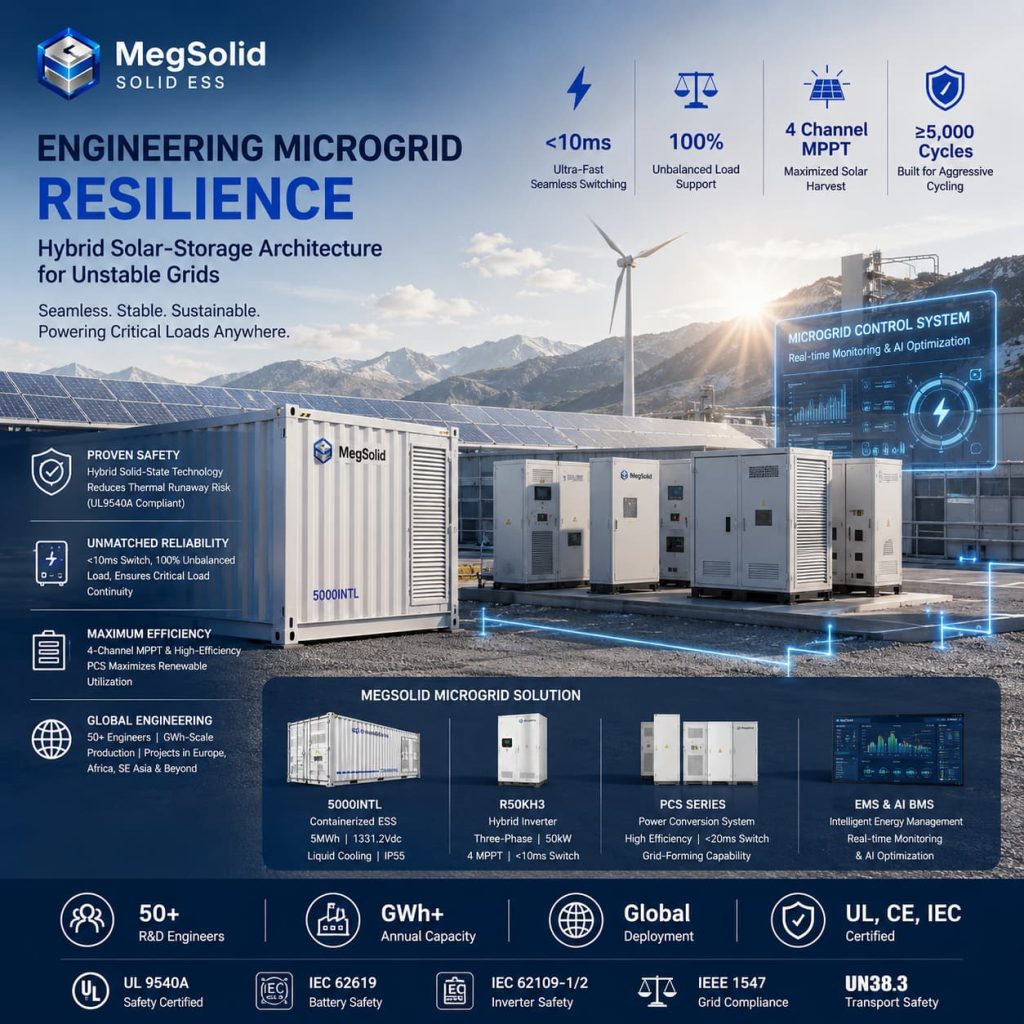
Why is the Nigerian Market Shifting to Hybrid Microgrids?
The engineering rationale for adopting hybrid microgrids in Nigeria is driven by compounding factors: grid unreliability, current diesel pricing impact, and the expansion of remote operations.
Grid Instability and Rampant Outages
A grid outage can turn a short transfer gap into spoiled work, reset controls and a delayed restart. List the process loads, starting current, interruption tolerance and outage duration before selecting the BESS and switchgear. A correctly sized system can supply the agreed islanded loads while the generator starts, but continuity must be demonstrated for that complete arrangement. Keep an approved UPS where the critical equipment requires it.
Current Diesel Pricing Impact on OPEX
A generator running through light demand can burn fuel for little useful output. Put its measured litres per hour and load curve beside the factory's hourly demand. The BESS can absorb charging power during an efficient generator run and supply later loads when the genset can stop. Set minimum loading, charging headroom and start/stop limits from the actual generator documentation. A fixed 30% or 70–80% rule cannot optimize every machine or operating shift.
Telecom Towers and Remote Mining Operations
Beyond traditional C&I facilities, telecom tower clusters (powered by MTN, Airtel) and remote mining sites require 24/7 base-load power. Transporting diesel to remote sites in the North adds massive logistics costs to the fuel price. A PV-diesel-storage architecture maximizes solar harvest during the day, saving diesel for nighttime or cloudy periods, drastically reducing fuel logistics.
How to Size a PV-Diesel-BESS Hybrid Microgrid for Nigerian Industrial Loads
Size the duty before buying nameplate capacity. A 300 kW protected load needs 600 kWh at the AC load bus for two hours and 900 kWh for three, before allowing for auxiliaries, losses, reserve and ageing. MegSolid's ESSC0500B-1075 lists 500 kW and 1.0752 MWh nominal storage; that nameplate is a starting point, not a promise of three hours at 300 kW. Send the load trace, motor starts, outage window, PV yield and generator fuel curve for the proposed usable-energy and recharge calculation.
For buyers evaluating a 300kW / 1MWh commercial system, use the Nigeria BESS quote and sizing guide to separate PCS power, usable battery energy and local EPC scope before comparing suppliers.
|
Load Profile
|
PV design basis
|
Battery sizing basis
|
Diesel Strategy
|
|---|---|---|---|
|
Telecom Tower
|
Hourly yield, recharge and tower-site constraints
|
Protected load × outage hours, plus reserve/losses
|
Cover the defined night/cloudy duty and failed-start reserve
|
|
Manufacturing Plant
|
Hourly plant load, roof/site yield and recharge window
|
Running/start power and usable AC energy
|
Define peak support, grid backup and generator recharge
|
|
Mining Site
|
Site yield, dust/heat limits and available installation area
|
Load step, outage hours, reserve and maintenance access
|
Agree generator loading, battery support and source recovery
|
Hybrid Architecture: PV + Battery + Diesel Integration
The diagram shows an illustrative PV, battery, diesel and grid arrangement. Its dispatch priorities must be set for your tariff, reserve and operating state. Battery voltage belongs at the approved PCS battery interface, and PV strings belong at the selected PV input or AC-coupling route. MegSolid's R30/R40/R50 hybrid inverter platform and the ESSA/ESSC cabinet-container architectures are different equipment routes; ask the EPC to identify the actual single-line diagram and control authority.
Define the diesel start decision from the outage duty, minimum reserve SOC, battery power limits and the generator's permitted operating range. Do not wait for an empty battery if the protected process needs time for a failed generator start and a second attempt. The controls narrative must also state PV curtailment, battery charging while the genset is online, reverse-power prevention, communications failure and the return-to-grid sequence. This is the operating plan the EPC should price and test, rather than a promise that one SOC threshold can keep every Nigerian factory running.
How Does the EMS Control Strategy Optimize Diesel Fuel Consumption?
The Energy Management System (EMS) is the brain of the hybrid microgrid. It does not merely switch sources; it actively manages power flow to minimize OPEX.
Load Following and Genset Synchronization
- Peak Shaving: size PCS running/start power and usable storage for the measured load step. Define generator charging headroom and test the start event instead of assuming any cabinet prevents a genset stall.
- Zero-Export Grid Interaction: meter the agreed PCC, coordinate PCS/PV commands and specify the communications-failure response. Export control and voltage ride-through are separate control/protection duties.
- Auto-Start/Stop Logic: set minimum reserve from the outage duty, generator start time and failed-start recovery. Specify charging limits, minimum genset load, PV curtailment and return-to-grid behaviour; 30% SOC is an example threshold, not a universal setting.
During generator operation, the EMS must maintain minimum genset loading and stop the PCS from exporting active power into the generator. Our reverse-power trip prevention guide explains the required PCC metering, command priority and communications-failure response.
Engineering Grid Compliance and Interconnection Standards
Distributed energy resources in Nigeria must comply with specific power quality and safety standards to prevent destabilizing the local Distribution Company (DisCo) feeder.
IEEE 519-2022 Harmonic Compliance
IEEE 519 addresses harmonic conditions at the PCC. MegSolid's ESSA product listing states THDi below 3% for the cabinet, but that product value does not establish site harmonic compliance or prevent every relay trip. Provide the feeder, transformer, load and background-distortion data; include any required harmonic study and acceptance measurements in the offer.
IEEE 1547-2018 Grid Support
For the proposed grid-support duty, specify the active/reactive-power range, protection, permitted ride-through and disconnect/reconnect behaviour of the offered PCS. IEEE 1547 is a reference for distributed-resource interconnection and interoperability; naming it does not demonstrate the exact model's capabilities or Nigerian approval. Close the actual local connection requirements and document/test scope with the EPC and authority.
ISO 8528 Genset Integration
Use the supplied generator's ratings, permissible load steps, minimum operating load and fuel curve to set the integration limits. ISO 8528 is a genset standards family; it is not a universal instruction to operate every generator at 70–80% load. Agree the actual controller interface, start/stop signals, synchronization, charging command and failed-start response in the controls narrative before commissioning.
Can Hybrid Solid-State Chemistry Survive Extreme Climates?
Select the equipment for the air it will breathe, the dust it will collect and the shift it must cover. Heat can restrict charging, power and service life in any battery architecture. Put intake temperature, enclosure position, filters, available-power curves and maintenance access into the proposal. A hybrid solid-state label does not replace these model-specific operating limits.
UL 9540A Thermal Safety
UL 9540A provides a test method for battery energy storage fire propagation. Request the report scope for the offered cell/module/system and its actual protection design. ESSA0100B-0215 is an intelligent-air-cooled 100 kW/215.04 kWh cabinet; the 5000INTL is a separate liquid-cooled 2.7 MW/5.0159 MWh platform. Siting near generators or fuel storage requires the applicable separation, ventilation, emergency access and approval review for the actual installation.
Ruggedized Enclosure Engineering
ESSA cabinets publish an IP54 enclosure and a 0–45°C operating range. IP54 does not mean dust-tight, flood-proof or unlimited corrosion resistance. For Lagos or a remote mining yard, include intake conditions, rain/flood exposure, cleaning intervals, cable entries and service access in the EPC scope. Ask MegSolid for the offered enclosure and maintenance requirements before selecting the location.
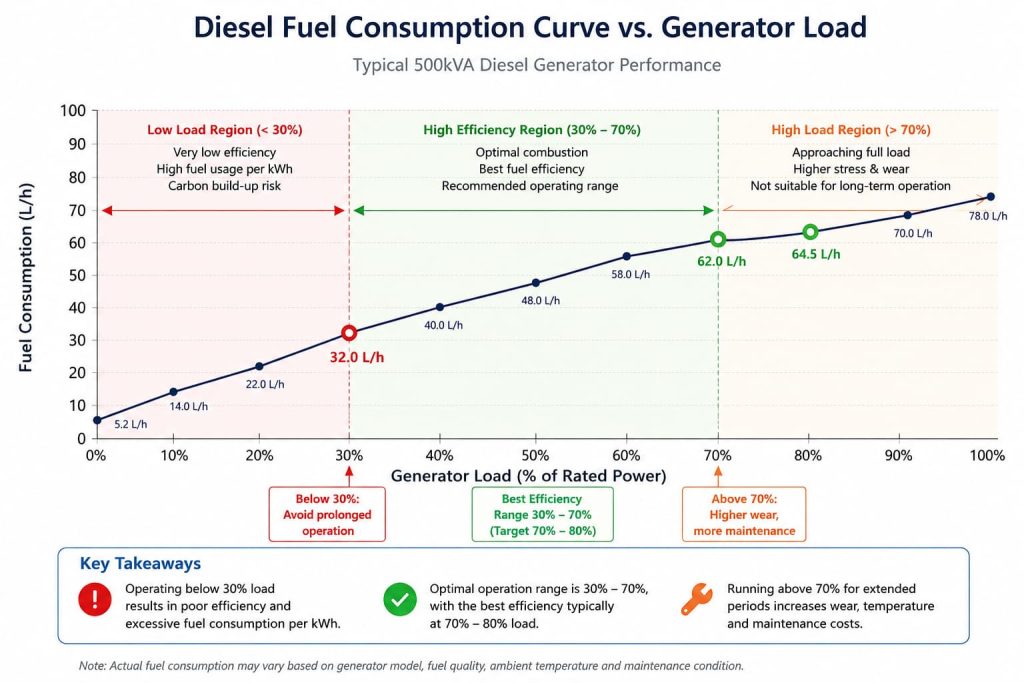
Lagos Manufacturing Microgrid: Configuration and Acceptance Questions
The following Lagos factory sizing and fuel-budget example uses a 500 kVA generator, a 200 kWp PV array and roughly 1 MWh of battery storage. Use it to challenge your own proposal: which loads need protection, how long must they run and how much generator operation can the dispatch actually replace? The numerical fuel budget below is an illustrative comparison, not a guaranteed MegSolid deployment result.
Five ESSA0100B-0215 cabinets would sum to 500 kW rated AC power and 1,075.2 kWh nominal storage. This assumes an approved parallel/control arrangement; it does not require counting another 500 kW PCS as extra output. The standard listed cabinets use air cooling. A different liquid-cooled or hybrid solid-state configuration needs its own offered model and BOM, with the PV and generator interfaces shown in the approved diagram.
System Configuration & Commissioning Requirements for This Duty
- System Configuration: five ESSA0100B-0215 cabinets sum to 500 kW AC and 1,075.2 kWh nominal storage, subject to an approved parallel/control design. The cabinets include their own PCS; identify the actual generator/PV interfaces and controller protocols.
- Site Environment: use the stated 38°C intake as a design condition. The standard ESSA cabinet uses air cooling and lists 0–45°C; request the available-power curve, auxiliary consumption and dust-maintenance scope.
- Adaptive Tuning: define the generator governor/load-step response, charging headroom and battery support command. FAT/SAT should establish the offered arrangement’s response to the agreed machinery starts.
- Acceptance Criteria: specify the permitted process interruption, delivered energy, failed-start reserve and fuel-measurement boundary. Agree the baseline and test duration before setting a diesel-reduction target.
Project Measurements That Must Support the Savings Claim
- Voltage Recovery: record the protected-bus voltage and actual transfer/load-step response. A site claim below 10 ms needs the system configuration and measurement record; it is not a universal PCS promise.
- SOC Range: identify the agreed operating window, reserve, limits and recharge. A 20–80% SOC dispatch example does not demonstrate the accuracy of an EKF algorithm or define every project’s settings.
- Diesel Reduction: measure generator hours, load and litres on the same basis before and after the agreed dispatch. The 1,200-to-460 L/day figures below are an illustrative budget, not a verified outcome for every site.
- Annual Benefit: apply the actual operating calendar and delivered fuel price; account for PV variation, charging energy, auxiliaries, service and replacements.
Diesel Savings Calculation: Price the Fuel Before Calling It ROI
Treat the before/after values below as assumptions to test with logged operation. A change from 1,200 to 460 L/day represents 740 L/day of avoided diesel, or 270,100 L over 365 identical operating days. Real annual savings must allow for the plant calendar, PV variation, charging energy, reserve, generator starts and maintenance. Ask for the dispatch model and the measurements that would prove the target at your site.
|
Parameter
|
Illustrative diesel baseline
|
Illustrative hybrid dispatch target
|
|---|---|---|
|
Generator Runtime
|
14 h/day
|
5.3 h/day
|
|
Diesel Consumption
|
1,200 L/day
|
460 L/day
|
|
Daily Diesel Saved
|
-
|
740 L
|
|
Annual Fuel Saved
|
-
|
270,100 L at 365 identical days; validate the calendar
|
Fuel savings become a commercial case when the avoided litres are priced and the installed costs are complete. Multiply measured avoided diesel by the delivered fuel price, then account for charging energy, auxiliaries, service, replacements and financing on the same basis. Divide the installed investment by annual net benefit only when those inputs are established. An attractive fuel example does not justify a universal sub-three-year payback promise.
Engineering Comparison: Diesel-Only vs. Hybrid Solid-State Microgrid
Compare the operating cost of the same protected load and outage window. A hybrid solid-state microgrid proposal should show the offered battery/PCS architecture, the generator duty it changes and the acceptance evidence for that change. Price continuity, delivered energy and the service route rather than assuming a chemistry label wins every comparison.
|
Engineering Feature
|
Diesel-Only Architecture
|
Hybrid Solid-State Microgrid
|
|---|---|---|
|
Response to Grid Sag
|
Transfer gap depends on the generator and switchgear
|
Validate protected-load transfer and start duty; keep required UPS
|
|
Genset Load Factor
|
Measure the load and fuel curve across the operating shift
|
Set dispatch from the actual generator limits and battery reserve
|
|
Fuel Consumption
|
Baseline litres from the actual running/load records
|
Price measured avoided diesel and charging/auxiliary energy
|
|
Maintenance
|
Generator service depends on hours, duty and OEM requirements
|
Include battery/PCS/cooling/EMS service and remaining genset work
|
|
High-Temp Performance
|
Use the generator’s available-power curve and site conditions
|
Choose the offered model’s temperature/power curve and cooling scope
|
|
Environmental Impact
|
Calculate from measured fuel burned and relevant factors
|
Calculate from displaced fuel and the charging energy basis
|
Why Integrated Manufacturing Matters for Hybrid Microgrids
Use factory integration to close interfaces before the equipment reaches your site: battery/PCS/EMS versions, protection settings, supported protocols, drawings and the agreed FAT. Site conditions still need SAT: the actual generator, PV, switchgear, load start sequence and grid-return behaviour. Put both packages into the quotation so commissioning has a named owner and a release criterion.
For this PV-diesel-BESS project, buy a defined factory package and a defined site-integration package. MegSolid's published 215kWh Outdoor Cabinet ESS lists ESSA0100B-0215 at 100kW AC and 215.04kWh nominal energy, using LFP cells and intelligent air cooling. A different hybrid solid-state or liquid-cooled configuration needs its own signed model and BOM. Compare included PCS, EMS, generator-controller interface, FAT evidence, delivery terms and local EPC work on one schedule. Use microgrid solutions for unstable grids for the wider architecture, discuss OEM/ODM manufacturing for the manufacturing boundary, and read the BESS thermal runaway prevention guide for the safety review; neither substitutes for a witnessed test of the generator start, load step and recovery duty written into this purchase.
References & Industry Standards
MegSolid project proposals should identify the applicable local requirements and the offered model's documents/test scope. The following references help define questions; listing them does not certify every product or establish automatic approval:
- NERC: identify the requirements for the actual embedded-generation and grid-connection arrangement with the local EPC and authority.
- NBS fuel-price information: use a traceable report/date for any cited market data and actual delivered AGO invoices in the project calculation.
- IEEE 1547-2018: Standard for Interconnection and Interoperability of Distributed Energy Resources.
- IEEE 519-2022: Recommended Practice and Requirements for Harmonic Control in Electric Power Systems.
- IEC 62619: Safety requirements for secondary lithium cells and batteries in industrial applications.
- UL 9540A: battery energy storage fire-propagation test method; obtain the offered configuration’s report scope.
- ISO 8528: Reciprocating internal combustion engine driven alternating current generating sets (Genset integration).
FAQ
Q1: How does a hybrid BESS reduce diesel consumption in Nigeria?
A BESS can supply selected low-load periods and handle agreed load changes, allowing the generator to stop or charge storage within its efficient operating range. Use the actual load trace, fuel curve, reserve and PV yield to set the dispatch. Ask MegSolid for the configuration and generator-interface scope; savings must come from the resulting energy balance rather than a universal 70–80% load rule.
Q2: What happens to the factory during a national grid collapse?
During a grid collapse, the complete battery, PCS, protection and switchgear arrangement must supply the agreed loads and maintain the generator-start reserve. The offered MEGA-TS PCS listing does not establish a universal 8–10 ms plant transfer. Give MegSolid the critical-load interruption tolerance and start events for the FAT/SAT scope; retain the required UPS for loads that need it.
Q3: How do you size a PV-diesel-BESS hybrid microgrid for a manufacturing plant?
Start from AC power and duration: 300 kW for two hours is 600 kWh delivered to the load, while three hours requires 900 kWh before battery-side reserve, losses and auxiliaries. Then size PV from hourly yield, recharge time and site constraints, and retain the generator duty the operating plan needs. Request an exact MegSolid model, usable-energy basis and EPC integration scope; 30–50% PV or 1–2 hours is not a universal factory specification.
Q4: Can the BESS survive the high temperatures in Lagos industrial zones?
Choose the actual model for the intake temperature and duty. ESSA0100B-0215 lists intelligent air cooling, IP54 and a 0–45°C operating range; the current 5000INTL uses liquid cooling and lists −30 to +55°C. Ask for the available-power curve, charging limits and auxiliary loads in the offer. Do not assume a constant 29°C rack temperature or no derating from the chemistry label.
Q5: How does the system handle poor power quality from the local DisCo?
Separate the requested isolation, harmonic and ride-through duties. ESSA's product THDi below 3% is not the site's IEEE 519 assessment at the PCC, and an isolation transformer alone cannot remove every voltage sag or swell. Provide the local feeder/load data and define the offered PCS control, protection and acceptance measurements with the EPC.
Q6: How does the EMS interact with the existing diesel generator?
Agree the actual generator-controller interface, such as the supported communication or hardwired signals for the supplied controller. Define start/stop SOC, minimum loading, charge/discharge limits, synchronization, reverse-power prevention, failed-start reserve and communications failure. MegSolid's proposal should identify the interface and the EPC should test the sequence with the site's generator.
Q7: Is the BESS safe to install near existing fuel storage?
A battery chemistry or UL 9540A reference cannot grant permission to install beside fuel storage. The offered system, protection design, separation, ventilation, emergency access and local requirements must be reviewed for the site. Ask MegSolid for configuration-matched safety documents and the EPC for the installation scope before accepting the location.
Q8: Does the system support integration with solar PV?
Solar PV can contribute through an approved AC-coupled or hybrid-inverter arrangement. Specify the PV power/yield, curtailment, reserve SOC, generator loading and charging priorities for each operating state. Match PV voltage to the PV input and the battery to its PCS interface. Request the actual single-line diagram and controls narrative in MegSolid's proposal.
Q9: What communication protocols are supported for remote monitoring?
Interfaces depend on the supplied model. ESSA lists EMS RS485/TCP-IP, while the current 5000INTL lists Ethernet and RS485. Confirm the supported protocol, alarm/energy records, SCADA mapping, connectivity and remote-access terms in the offer. Fuel savings also require generator fuel measurements; a SOC dashboard alone cannot verify avoided litres.
Q10: What is the typical ROI for a diesel-storage hybrid system in Nigeria?
Calculate ROI from your installed price, measured duty, delivered AGO price, PV yield, charging energy, maintenance and replacement basis. The illustrative 740 L/day difference would total 270,100 L over 365 identical days, but it is not a guaranteed annual saving or a sub-three-year payback. Send MegSolid your load/fuel brief for a configuration and commercial scope that can be evaluated against those inputs.
Q11: How to reduce diesel generator fuel consumption in Nigeria?
Reduce diesel generator fuel consumption in Nigeria by identifying the running periods the PV-diesel-BESS dispatch can actually replace. Measure load and litres per hour, then set generator loading, PV use, reserve and charging limits from the offered equipment. Ask MegSolid for a matched cabinet/container configuration, generator-interface scope and acceptance plan. A headline reduction of up to 60% cannot replace that calculation.
Q12: What is the best battery technology for unstable grids in Nigeria?
Choose battery technology for unstable grids in Nigeria around the offered model's usable AC energy, power, temperature limits, protection evidence and service route. MegSolid's ESSA100 kW/215.04 kWh and ESSC500 kW/1.0752 MWh routes provide defined sizing inputs; a hybrid solid-state offer must identify its own configuration. Specify the load, generator interface and acceptance duty so the purchase protects the operation that earns your revenue.
Q13: How fast must a microgrid inverter switch to prevent factory downtime?
The allowable interruption comes from the actual protected equipment and process. Identify PLC, drive and control ride-through limits, then validate the complete switching arrangement with the battery/PCS and generator start sequence. A generic 8–10 ms number cannot guarantee factory continuity. Request the offered transfer capability and a witnessed test for the agreed load; use an approved UPS where required.
Get Your Custom Microgrid Engineering Consultation
Send MegSolid the site's load trace, critical loads and motor starts, backup duration, generator model/fuel curve, PV yield, delivered diesel price, temperature and grid details. Request a matched equipment schedule, usable-energy and recharge calculation, control/interface scope, FAT/SAT release criteria and priced delivery/service responsibilities. That turns a diesel-savings discussion into a project quotation your EPC can evaluate.
Global Sales & HQ (Hong Kong):
FLAT 7, 11/F BLK C HANG WAI IND CTR, 6 KIN TAI ST, TUEN MUN, HONG KONG
- Email: [email protected]
- Phone: +852 59811073
R&D & Manufacturing Facility (Huzhou):
No. 898 Mengxi Road, South Taihu New Area, Huzhou City, Zhejiang Province, P.R.China
- Website: https://www.solidess.com/