
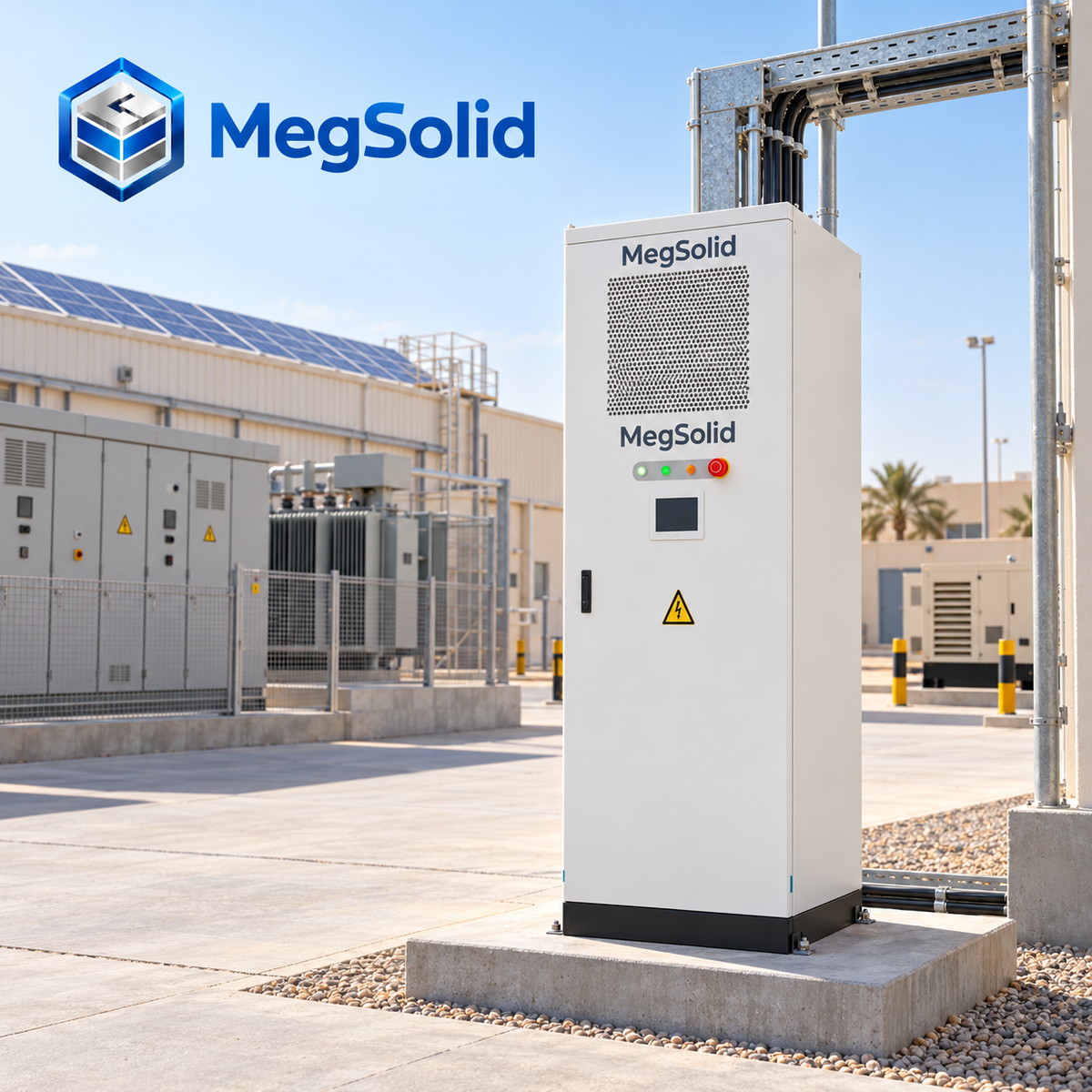
Saudi factories can use behind-the-meter energy storage to absorb rooftop-solar surplus, support loads above the grid import limit and bridge diesel-generator starts. MegSolid offers Energon 261 for liquid-cooled storage, ESSA0100B-0215 for a 100 kW duty, and MEGA TS PCS for separate battery sizing. Selection depends on load duration, temperature and the electrical connection.
Saudi load growth, unused solar and frequent diesel starts
Production expansion can leave a Saudi factory short of grid capacity, especially when new machinery and cooling run together. Rooftop solar may cover part of that demand, yet a larger array can produce surplus at midday and leave the later shift buying electricity. Brief outages create another expense at diesel-backed sites: the generator starts even when only a few loads need support.
MegSolid's cabinet systems can supply the measured shortfall or store that PV surplus. Plant operators who need a separate protected-load bus can assess MEGA TS with a battery sized for the required operating time.
Other markets provide examples of the same constraints. Companies facing rapid load growth in ERCOT are considering behind-the-meter generation and storage instead of waiting for every new megawatt to arrive through the grid. Commercial and agricultural proposals are pairing 75 kW to 1 MW modular generation with smaller BESS blocks, while data-centre projects are combining onsite renewable generation, firm power and battery storage.
The load record determines which of these problems the battery can cover:
| Site problem | Data to collect | What the BESS must do |
|---|---|---|
| Restricted grid connection | Import limit, peak load and duration above the limit | Discharge during the measured power gap |
| Midday PV surplus | PV output and site-load curves at matching time intervals | Charge from verified surplus and discharge when the site can use it |
| Frequent diesel starts | Protected-load power, generator start time and outage history | Carry selected loads during the required interval |
| Planned load expansion | Present load, new equipment demand and start-up current | Keep power at the grid connection within its approved limit |
Ten minutes of generator support calls for a different power-to-energy ratio from several hours of solar storage. When one battery handles both, its state-of-charge reserve must remain available for backup during routine cycling.
Select a MegSolid system for the required duty
MegSolid’s integrated cabinets combine a fixed power rating with a fixed battery capacity. MEGA TS allows separate battery sizing when those combinations do not fit the load or required runtime. Temperature limits also affect the choice.
Energon 261: liquid cooling and 261.24 kWh
Saudi sites requiring 261.24 kWh in one cabinet can begin with the Energon 261 liquid-cooled BESS. Its rated output is 125 kVA, and its operating range reaches 55°C with derating above 45°C.
The load power factor determines how much active power the 125 kVA rating can supply. Sites requiring 125 kW at a power factor below 1 would need additional kVA capacity, so the engineer must check measured kW and kVA before confirming the model.
Allow for the backup reserve when sizing Energon 261 for the required runtime, including at hotter sites where liquid cooling is part of the selection.
ESSA0100B-0215: 100 kW within a 0–45°C range
Sites with a measured requirement close to 100 kW and 215.04 kWh can assess the Armoire d'extérieur ESSA0100B-0215. The system combines LFP batteries, intelligent air cooling and an isolation transformer in an IP54 enclosure.
Its published operating range is 0–45°C. Outdoor use in Saudi Arabia requires the cabinet location, solar exposure, ventilation and intake-air temperature to keep operation inside that limit.
Within those limits, ESSA can shift solar energy or support grid import. Short backup events also need enough usable energy for the selected loads.
MEGA TS: size the PCS and battery separately
Projects requiring a different power-to-energy ratio can use a MEGA TS energy storage PCS with a battery system selected for the required duration. Available rated outputs run from 30 kW to 500 kW.
The series includes an isolation transformer and supports on-grid charging and discharging, independent off-grid operation, automatic on-grid/off-grid switching and cold start. These PCS functions allow the electrical designer to build around a separate protected-load bus or microgrid connection.
To energize the selected loads during an outage, the completed system needs coordinated switchgear, protection settings and transfer controls, with enough battery capacity for the event.
Compare the product options against the site duty:
| Site requirement | Chemin d'accès au produit | Reason for selection |
|---|---|---|
| 261.24 kWh, liquid cooling and operation up to 55°C with applicable derating | Energon 261 | Higher single-cabinet energy and liquid-cooled thermal control |
| Defined 100 kW / 215.04 kWh duty within a 0–45°C operating range | ESSA0100B-0215 | Integrated air-cooled cabinet with isolation transformer |
| Custom battery duration, protected-load bus or separate PCS sizing | MEGA TS PCS | Six rated power options from 30 kW to 500 kW |
Feeder ratings and control settings must follow the selected model’s current and operating limits.
Connect the BESS on the customer side of the meter
Behind-the-meter energy storage connects on the customer side of the utility meter, and its controls respond to power moving between the Saudi facility and the grid. The single-line diagram defines the connection through the meter, PCC, transformer, main switchboard, PV system, BESS feeder and site loads.
Trace the incoming supply through the site equipment:
- 1. Utility network
- 2. Utility revenue meter and point of common coupling
- 3. Site transformer or main incoming board
- 4. Main switchboard
- 5. Production loads, building loads, rooftop PV and BESS
The BESS connects to a customer-owned AC bus after the utility meter. From that bus, the PCS acts as a load while charging and as a source while discharging.
The utility meter and PCC may sit close together, but may refer to different points. The project drawing should mark the contractual grid boundary and the point where power flow is measured for BESS control.
Check the existing switchboard before adding a feeder
Voltage is only the first check when connecting a BESS to a 400 V switchboard. The board must also carry current in both directions, and the feeder needs suitable continuous-current and fault-interruption ratings.
Before adding the BESS feeder, the electrical engineer must check:
- Main busbar and spare-feeder ratings
- BESS breaker interrupting capacity
- Cable size and route
- Transformer loading
- Prospective fault current
- Protection selectivity
- Neutral and earthing arrangement
- Space and heat around the new feeder
Use the engineering checks in the existing 400 V switchboard connection guide. Projects that have not fixed the transformer, PCC or PCS data can begin with the C&I BESS interconnection readiness process.
Place the control meter around the relevant loads
Install the EMS meter and orient the CTs at the point where the controller must hold the import limit. That measurement must include every load, PV source and battery feeder covered by the control target.
Incorrect CT placement can hide part of the site load or PV output. Reversed CT polarity can also make import appear as export, causing the BESS to charge when the site expects it to discharge.
Mark the meter location, CT ratio and direction on the control drawing. State the import/export sign convention and the loads and generation within the measurement boundary. Include the EMS communication route and the response to lost meter data.
Rooftop PV connected to the same AC system can charge the BESS when verified surplus reaches the PCC. The conversion path and equipment boundary depend on the chosen topology, with further detail available in the AC-coupled and DC-coupled battery storage comparison.
Build a separate electrical path for backup
Connection behind the meter does not keep the facility running by itself. Normal grid-tied PCS operation disconnects when the utility supply fails, preventing the BESS from energizing the failed grid circuit.
Supplying selected loads during an outage requires:
- Verified utility separation point
- Island-capable PCS control mode
- Protected-load bus
- Coordinated transfer equipment
- Enough PCS power for the first load step
- Reserved battery energy
- Tested return-to-grid sequence
Without that path, the battery can remain charged while the building is dark. Review the operating sequence in why a charged grid-tied BESS can go offline during an outage.
Compare BTM and front-of-the-meter connections
| Design point | Behind-the-meter battery storage | Front-of-the-meter battery storage |
|---|---|---|
| Connection location | Customer side of the utility meter | Utility side or a dedicated grid connection |
| Primary duty | Serve the facility’s load, solar or backup requirement | Serve grid, network or market requirements |
| Main control reference | Site PCC and customer load | Grid dispatch or market instruction |
| Typical power path | BESS to the customer’s AC bus | BESS to the grid connection |
| Outage result | Can support selected loads only with an intentional-island design | Requires a separate arrangement to supply a customer’s internal backup bus |
On the single-line diagram, trace the selected MegSolid system’s charging and discharge paths through the customer AC bus. Include the isolation and transfer equipment needed to supply protected loads.
Size power and runtime for the recorded event
The highest simultaneous load sets the PCS requirement. Event duration determines how much energy the battery needs; even a cabinet that carries the running load can run out before the event ends.
Check the load against 125 kVA
Energon 261 has a 125 kVA rating. The active power available in kW depends on the load power factor:
Required kVA = load kW ÷ power factor
Measured load of 90 kW at a 0.90 power factor requires 100 kVA. The same 90 kW load at a 0.70 power factor requires about 128.6 kVA, which is above the Energon rating.
Motor starting and reactive-power support can raise the kVA requirement without adding the same amount of kW. Selection needs the highest simultaneous kW, kVA and load step recorded during the event.
Calculate the AC energy needed for the full event
Energon 261 has 261.24 kWh of rated energy. The first runtime calculation is:
Required AC energy = average supported load × event duration
Running a 90 kW load for two hours requires 180 kWh at the AC load boundary. The 261.24 kWh nameplate does not represent the AC energy available to the load because the final result also depends on:
- Permitted SOC operating window
- Energy reserved for backup
- Conversion and auxiliary losses
- Temperature-based power or energy restrictions
- Battery condition over the project life
- Energy used while loads restart
The final comparison needs warranted usable AC energy at the specified SOC and temperature. The published 90% maximum system efficiency applies within its stated scope. Round-trip efficiency needs a project-specific guarantee.
Cooling equipment cycles, motors start and production demand changes during the day. Measured variation provides the basis for the design margin.
Backup energy also needs its own allocation. Capacity reserved for an outage cannot be counted again as available energy for solar shifting during the same operating period.
Keep fleet power figures out of runtime calculations
ESS News reported global operational BESS capacity above 250 GW in 2025. The figure describes rated power across the installed fleet; it does not state the discharge duration of an individual system.
Public criticism of battery storage includes concerns about the cost of long-duration supply. Multi-day grid storage and a defined C&I event are separate duties. Saudi factory operators seeking a generator-start bridge, two hours of solar shifting or support during a recorded production peak can calculate that requirement from their own load data.
Hold grid import below the site limit
The EMS adjusts battery output as PCC measurements approach the site’s approved import ceiling.
The control meter must measure net power moving between the facility and the grid. The installer must check CT ratio, direction and phase mapping and include the controlled loads and sources inside the measurement boundary.
Meter data should show:
- Site import and export
- Facility load
- PV contribution
- BESS charge or discharge
- Facteur de puissance
- Communication and data-quality status
During commissioning, check for missing load or PV measurements and a reversed import/export signal. Either error can send the PCS in the wrong direction.
Calculate the discharge required at the PCC
Use separate load and PV measurements in the discharge calculation:
BESS discharge power = site load − PV output − other onsite generation − permitted grid import
The EMS requests discharge when the result is positive. At or below zero, no discharge is needed for import limiting.
The discharge command is capped by available PCS power, kVA headroom, SOC and temperature limits. The BESS cannot cover any gap above that cap.
Recharge within the available import headroom
The battery needs to recover its SOC after a high-load event. Charging at full power while the facility load remains high can push grid import above the same limit the BESS was installed to protect.
Use available PV surplus to recover SOC and preserve the backup allocation. Grid charging must stay within the remaining import headroom. As facility load rises, reduce charging; suspend lower-priority charging before the PCC reaches its limit.
Set the charging rules using the PV charging priority guide. Coordinate metering and PCS sizing with the operating modes in the C&I battery energy storage system design process.
Define the response to lost meter data
Loss of PCC data removes the value used to calculate the power gap. The controls engineer must specify the response: hold the last valid command for a defined interval, reduce output or stop automatic import control.
Specify a response that prevents an uncontrolled command, with an alarm and timestamped event record. The operator can then distinguish lost metering or communication from insufficient PCS power or battery energy.
Calculate savings against the Saudi electricity bill
Storing electricity bought from the grid adds conversion losses to its cost. Savings on energy charges need a tariff difference or electricity the site would otherwise waste, such as rooftop-PV surplus. The facility’s bill establishes which calculation applies.
Le Saudi Electricity Regulatory Authority consumption tariff lists these standard consumption rates:
| Customer category | Consumption band | Published rate |
|---|---|---|
| Commercial | 1–6,000 kWh | 22 halalas/kWh |
| Commercial | Above 6,000 kWh | 32 halalas/kWh |
| Industrial connected to the distribution network | All listed consumption | 20 halalas/kWh |
The table lists consumption rates and does not show a universal daily time-of-use spread for every Saudi commercial or industrial customer.
Grid electricity bought at one flat rate returns fewer usable kWh after storage losses. Moving that energy to another hour does not reduce the consumption charge unless the customer has a verified price difference in its tariff or electricity contract.
Calculate each saving from its own site data
- Solar self-consumption: Store verified PV surplus and use it when the facility would otherwise import electricity.
- Grid-capacity support: Supply a measured power gap while holding PCC import below the site limit.
- Deferred electrical work: Cover a short, repeatable constraint that would otherwise require immediate equipment changes.
- Diesel reduction: Carry short events and reduce generator starts, fuel use and running hours.
- Production continuity: Support selected loads when an interruption would stop production, refrigeration, IT or process control.
Calculate avoided grid purchases in kWh. Import support depends on the kW gap and its duration; the value of continuity depends on the operational loss an interruption would cause.
Use installed project cost for the payback calculation
Ember reports that global installed battery-storage costs fell by an average of about 20% per year over the last decade.
Build the Saudi project budget from the MegSolid equipment price and local costs for civil works, switchgear, transformer changes, protection, cooling, commissioning and service. Global price trends do not establish those site costs.
Sites using a special tariff or electricity contract should calculate against the current bill and applicable agreement. The public consumption table provides a reference point but cannot replace the site’s billing record.
Keep solar savings, grid-capacity value, diesel savings and interruption avoidance on separate lines in the financial model. Check each amount against the load and billing records before adding it to the total.
Reduce short diesel runs and retain long-outage supply
Battery storage can handle short events that make diesel operation inefficient, while the generator remains available for long outages and loads outside the BESS duty.
Brief grid interruptions can start a generator before the site needs its full output, consuming fuel and adding maintenance hours. This is the operating problem behind discussion of placing larger batteries on the customer side to reduce diesel use.
Assign the BESS to the short events recorded at the site:
- Carry selected loads through a short interruption
- Support the generator starting interval
- Absorb rapid load changes
- Reduce low-load generator operation
- Preserve enough power for an orderly process shutdown
Size the PCS for the highest protected-load step. Battery sizing also needs the duration and number of events expected before it can recharge.
Coordinate utility separation and generator start
Commission the transfer sequence for the protected loads:
- 1. Protection detects the qualifying utility failure.
- 2. The grid connection opens.
- 3. Controls verify separation from the utility.
- 4. The island-capable PCS establishes the protected AC bus.
- 5. The battery carries the approved loads.
- 6. The generator starts when the event exceeds the battery-only window.
- 7. Loads transfer or share power under the commissioned control sequence.
- 8. Grid reconnection occurs after the return conditions are met.
MEGA TS supports automatic on-grid/off-grid switching, cold start and independent off-grid operation. Continuity at the load also depends on external switchgear, protection, control timing and the load’s ride-through capability.
Long outages can exceed the installed battery energy. Large motors, process heat and whole-site loads can also exceed the PCS rating selected for the protected bus.
Once running, the generator supplies the longer energy requirement. Battery support during the starting interval and rapid load changes can reduce diesel runtime; the generator remains available when the outage exceeds battery capacity.
Protect backup energy during routine dispatch
Daily PV shifting or import control can leave the battery at a low SOC when an outage begins. The EMS needs a reserve floor that routine dispatch cannot cross.
After an event, the charging controls must restore that reserve within the PCC import limit and leave enough power for production.
Account for Riyadh heat and coastal exposure
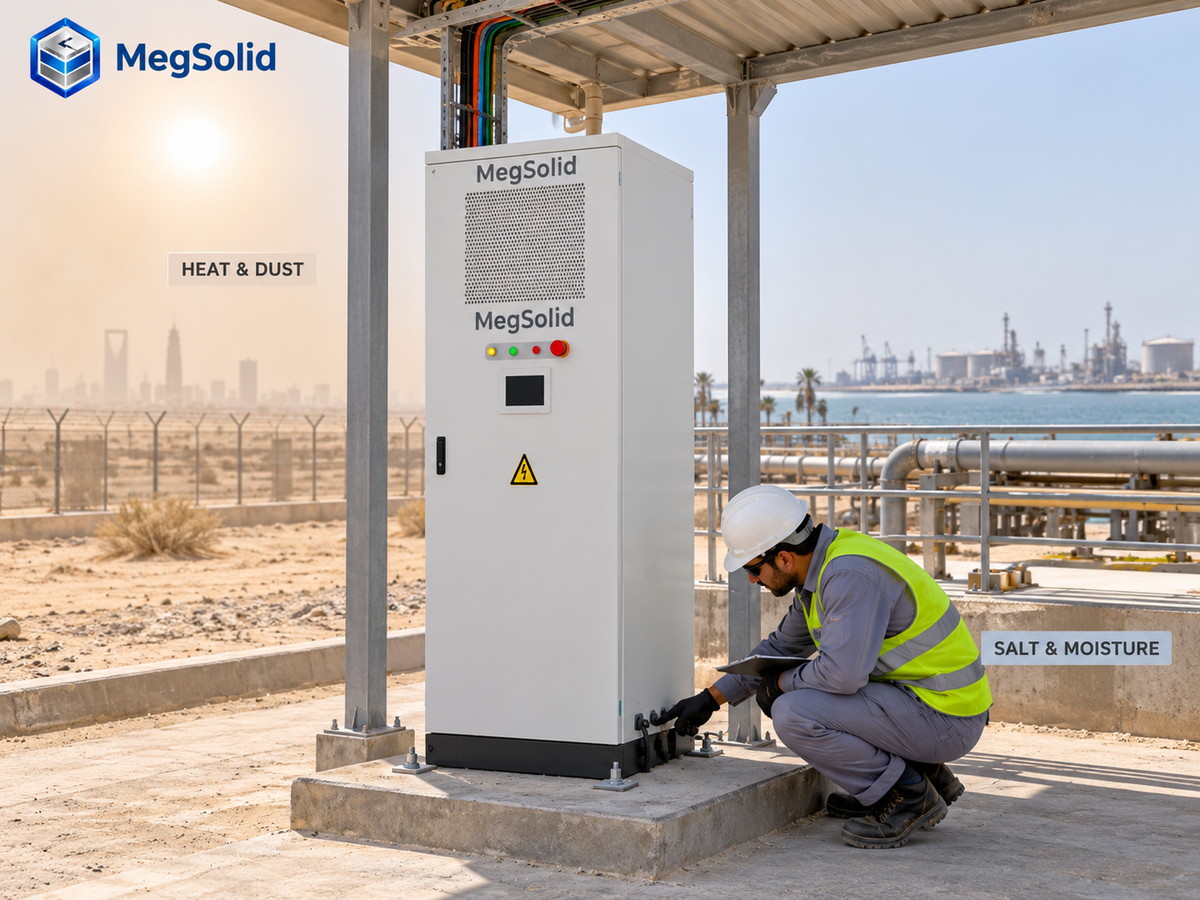
In Riyadh, check the air entering the cooling system during the hottest operating period. Near Jeddah or Dammam, add salt exposure and condensation to the enclosure and maintenance specification.
Use equipment-intake temperature in Riyadh
Air trapped around a cabinet can be hotter than the temperature in a weather report. Riyadh designs need the intake-air temperature during the period when the battery must operate.
Intake temperature can rise because of:
- Direct sun on the enclosure and concrete pad
- Hot air returning from nearby equipment
- Transformer or generator exhaust
- Restricted cabinet spacing
- Dust-loaded filters
- Poor ventilation below a shade structure
ESSA0100B-0215 has a published operating range of 0–45°C. Energon 261 operates from −20°C to 55°C and requires derating above 45°C. Available output must be confirmed at the required temperature; the upper operating limit alone does not guarantee full power.
Compare available output at the design temperature in the Riyadh BESS derating comparison.
Specify corrosion protection near the coast
Coastal facilities around Jeddah, Dammam and other exposed locations need to account for salt deposition, humidity, condensation and wind-driven moisture.
Inspection and material selection should cover:
- Cabinet seams and door hardware
- Cable glands and external connectors
- Fasteners and mounting frames
- Grounding and bonding points
- Air filters, fans and heat exchangers
- Coating damage during delivery or installation
- Drainage around the equipment pad
IP54 describes protection against specified solid and water ingress. It does not define a corrosion category or guarantee service life in salt-laden air.
Le Saudi coastal BESS corrosion guide covers salt-mist evidence, materials, condensation control and field interfaces alongside the enclosure IP rating.
Riyadh projects should record the design ambient, equipment-intake temperature, solar exposure, full-duty duration, dust condition and available power after temperature derating.
Coastal projects should add the corrosion category, salt exposure, condensation controls, coating scope, external hardware and cooling-equipment inspection requirements.
Use the recorded conditions to assess cabinet output and set the cooling-equipment inspection schedule.
Use spare capacity without consuming the primary reserve
Reactive-power control and power-factor support use PCS capacity that may already be needed for PV shifting, import control or generator coordination. Allocate capacity to the primary duty first, and preserve backup energy during evening discharge.
Staged expansion can add capacity for these functions. Before expansion, schedule them within the installed power and energy limits.
Give import limiting priority over routine charging where the grid connection constrains production. In a backup installation, keep routine discharge above the reserve floor.
Le C&I BESS charging-priority guide covers conflicts between PV use, grid charging and reserve recovery. Cycling cost and delivered energy can be compared through the BESS lifetime cost per delivered kWh.
Include reactive power in PCS loading
PCS apparent power is shared by active and reactive output:
kVA² = kW² + kVAr²
Higher reactive output leaves less kVA available for active discharge. Include power-factor correction in the PCS loading calculation.
Prepare the electrical system for parallel cabinets
Energon 261 supports parallel operation of up to ten units according to its published product information. Parallel cabinets can add power and energy when the switchboard, transformer, protection and EMS architecture have been designed for the combined system.
Show planned expansion on the single-line diagram before the first installation fixes cable routes, breaker positions and control boundaries. The existing feeder’s rating may limit how many cabinets it can accept.
Verify the installed system against the promised duty
Commissioning should reproduce the duty used to select the system. Record the power and duration achieved, together with the SOC window, temperature and control settings used during the test.
The approved single-line diagram should identify the utility boundary, PCC meter, transformer, main switchboard, BESS feeder, PV connection and protected-load bus.
Busbar capacity, feeder rating, cable size, fault duty, protection selectivity, neutral treatment and earthing must support charge, discharge and the intended outage mode.
Test import control, runtime and load pickup
Use the following records to check the promised operating results:
| Promised result | Evidence that proves it |
|---|---|
| Import remains below the site limit | Time-synchronised PCC, load, PV and BESS power records |
| PV surplus charges the battery | Matching PV, load, PCC and SOC trends |
| The battery supports the full event | Usable AC energy within the approved SOC and temperature window |
| Selected loads survive an outage | Witnessed separation, bus energisation, load pickup and island operation |
| Recharging creates no new peak | PCC trend during reserve recovery |
| Additional functions do not conflict | EMS priorities and capacity assigned to each operating mode |
The commissioning team should record pass or fail for each applicable duty and identify the installed equipment and software version. Retain the measured traces with the result so the operator can see the import level, transfer behaviour and runtime achieved.
Riyadh projects need accepted output at the equipment-intake temperature reached during the specified duty. Coastal projects need the approved corrosion scope, materials, condensation controls and inspection points.
Check that the environmental evidence applies to the delivered product option and its installed layout, operating limits and maintenance conditions.
Give the operator the supported-load list and identify the boundary under EMS control. Record accepted power and operating time, plus the temperatures, SOC limits and faults that trigger derating or shutdown.
For duties within the cabinet’s published limits, MegSolid can supply an integrated ESSA or Energon system. Projects needing a different power-to-energy ratio or protected-load arrangement can use MEGA TS with separate battery sizing. Include the accepted limits in the selected system’s operating instructions.
FAQ
What is behind-the-meter energy storage?
Behind-the-meter energy storage connects on the customer side of the utility meter. It charges and discharges according to facility loads, rooftop solar, backup requirements or an import-control target measured at the site boundary.
Is a BTM BESS connected before or after the utility meter?
BTM BESS equipment is connected after the utility meter on the customer’s electrical system. The single-line diagram should also identify the PCC, main switchboard, BESS feeder and EMS measurement point.
Can behind-the-meter battery storage reduce a Saudi electricity bill?
Yes, when it increases solar self-consumption or supports another verified cost-saving duty. Grid charging and discharging at the same flat energy rate does not create a saving after storage losses.
Can a BTM battery system increase usable site capacity?
It cannot change the contracted grid capacity by itself. The system can supply a measured load gap and hold grid import below the approved limit when PCS power, battery energy and EMS control cover that event.
Can Energon 261 deliver 125 kW?
Energon 261 has a 125 kVA rating. Active power in kW depends on power factor, reactive-power duty, temperature and the approved operating limits. Treating 125 kVA as an unconditional 125 kW rating can undersize the system.
How long can a 261.24 kWh battery support the load?
Divide warranted usable AC energy by the average supported load to estimate runtime. The usable energy allowance must account for SOC limits, backup reserve, auxiliaries, conversion losses, temperature and battery condition.
Can ESSA0100B-0215 operate outdoors in Saudi Arabia?
ESSA0100B-0215 has an IP54 enclosure and a published 0–45°C operating range. The site must control equipment-intake temperature, direct solar exposure, airflow and dust so the cabinet remains within that boundary.
Does a grid-tied BESS provide backup during an outage?
Only when the site includes safe utility separation, an island-capable PCS mode, transfer equipment, a protected-load bus and reserved battery energy. Connection behind the meter by itself does not provide backup.
Can battery storage reduce diesel-generator runtime?
Yes. BESS equipment can handle brief interruptions, bridge the generator starting interval and carry selected loads during short events. Long outages or loads beyond the PCS and battery limits remain generator duties.
Can several MegSolid cabinets operate in parallel?
Energon 261 supports up to ten parallel units according to its published specification. Combined operation also requires suitable switchgear, transformer capacity, protection, cables, metering and EMS control.
Which BESS is suitable for Riyadh heat?
Energon 261 is the first MegSolid cabinet to assess when equipment-intake temperature can exceed 45°C because its published range reaches 55°C with derating above 45°C. ESSA remains an option where intake stays within 0–45°C.
What protection does a BESS need near the Saudi coast?
Coastal design should address salt deposition, condensation, coatings, fasteners, cable glands, grounding points and cooling equipment. IP54 supplies ingress information but does not replace a project corrosion assessment.
Does Saudi Arabia have a time-of-use tariff for commercial battery arbitrage?
The public SERA consumption table does not show a universal daily time-of-use tariff for every commercial or industrial customer. Arbitrage calculations should use the customer’s current tariff category, electricity bill and applicable contract.