
Le Vietnam dispose d'une méthode de tarification opérationnelle pour l'admissibilité des systèmes de stockage par batterie autonomes. Pour MegSolid et les promoteurs avec lesquels nous discutons, la question est précise : quelles données d'équipement et quels registres de centrale peuvent étayer les lignes de capacité et d'énergie dans un contrat d'achat d'électricité (PPA) de BESS au Vietnam ?
La circulaire 62/2025/TT-BCT lie les revenus à la capacité installée, au coût de charge, au rendement de charge-décharge, aux pertes, à la dégradation et aux données d'exploitation contractuelles. Un devis qui se limite aux MW et aux MWh laisse le modèle commercial en suspens. Quelqu'un dans l'équipe de projet doit faire correspondre chaque intrant de prix à une fiche technique, une hypothèse de faisabilité, une limite de comptage, un point EMS/SCADA ou un procès-verbal de réception.
Cette page transforme la circulaire en une liste de preuves destinée aux développeurs, aux EPC, aux prêteurs et aux conseillers techniques travaillant sur les projets de BESS à grande échelle au Viêt Nam.
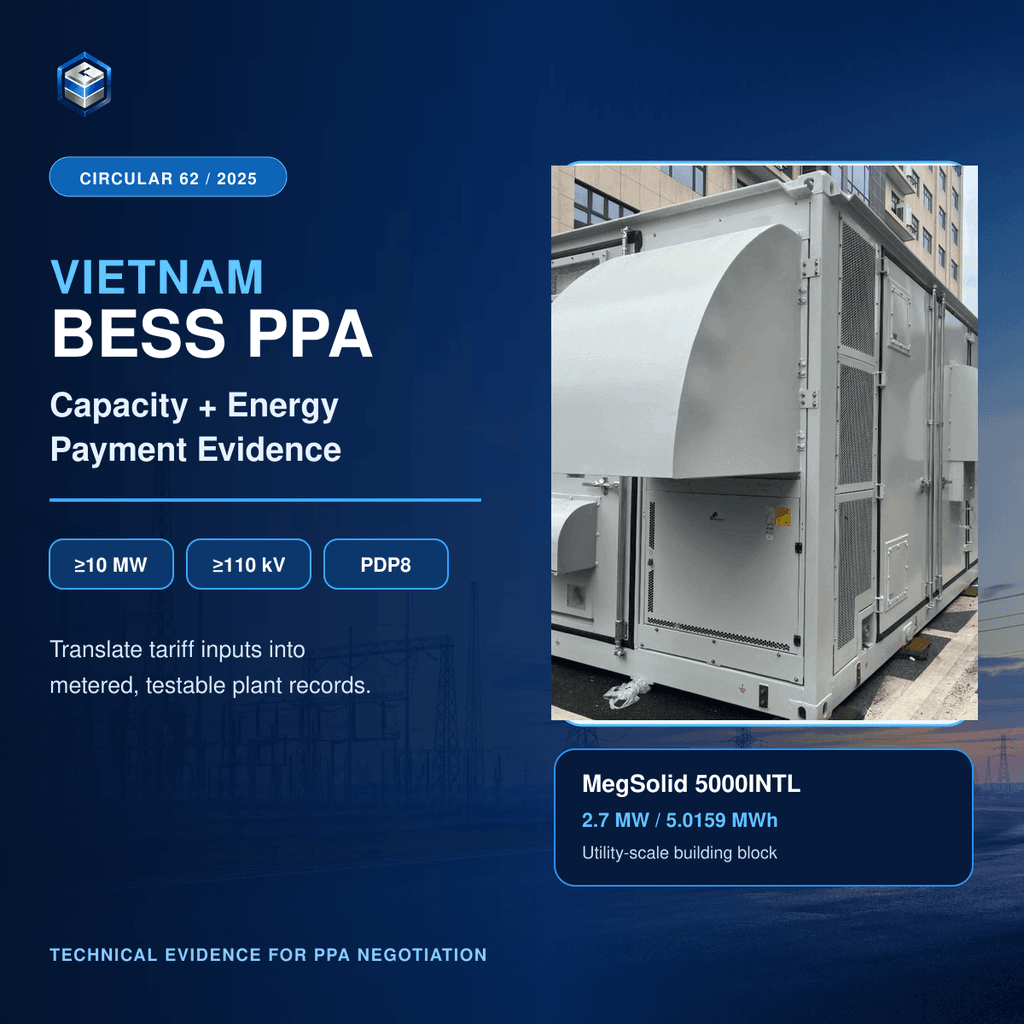
Table de décision à balayage rapide
| Mot-clé | Question commerciale | Éléments de preuve à sécuriser |
|---|---|---|
| Circulaire 62/2025/TT-BCT | Le projet entre-t-il dans le cadre de la règle ? | Alignement sur le PDP8, ≥ 10 MW, raccordement au réseau national à 110 kV ou plus |
| Prix de capacité | Quels sont les coûts fixes récupérés par kW ? | Capacité installée approuvée, coût d'investissement, O&M fixe, grille tarifaire annuelle |
| Prix de l'énergie | Quels sont les coûts de recharge récupérés par kWh ? | Tarif de recharge, rendement de charge-décharge convenu, consommation auxiliaire, pertes au point de livraison |
| Capacité disponible | Quelle quantité d'électricité la centrale peut-elle proposer à la production ? | Plage de fonctionnement, limites de l'état de charge (SOC), règles de réduction de puissance, registres des pannes, journaux de dispatching |
| Dégradation de la batterie | Quelle hypothèse énergétique à long terme est intégrée au modèle ? | Courbe de dégradation approuvée, base de garantie, méthode d'essai de capacité périodique |
| Cycles minimaux | Quel est le soutien du cyclisme à vie dans le calcul du prix ? | Données de cycle du fabricant, service de calcul, base de calcul convenue |
| Limite de comptage | Où l'énergie de recharge et l'énergie délivrée sont-elles mesurées ? | Emplacements des compteurs principal et de secours, pertes du transformateur, méthode de rapprochement |
| EMS/SCADA | Les instructions du NSMO peuvent-elles être reliées à la réponse de la plante ? | Commande, accusé de réception, consigne, puissance réelle, SOC, alarme, horodatage |
| FAT et SAT | Les intrants commerciaux peuvent-ils être vérifiés avant l'utilisation ? | Procédures observées, instruments étalonnés, fichiers bruts, rapports signés |
La circulaire 62 a remplacé le projet
Le MOIT a publié la proposition initiale de tarification du BESS en août 2025. Ce projet distinguait déjà le volet « capacité », lié à la disponibilité, du volet « énergie », lié à la production effective. Le Annonce du Ministère du Commerce et Rapport sur l'énergie au Vietnam Couvrez cette scène.
Le ministère de l'Industrie et du Commerce a publié la circulaire 62/2025/TT-BCT le 10 décembre 2025. Elle est entrée en vigueur le 26 janvier 2026. Le registre officiel du Ministère de l'Industrie et du Commerce montre que la circulaire est en vigueur.
| Date | Statut | Utiliser dans les documents du projet |
|---|---|---|
| 21 août 2025 | Le MOIT a annoncé le projet de méthode | Signal de politique historique |
| 10 décembre 2025 | Circulaire 62 émise | Référence juridique formelle |
| 26 janvier 2026 | La circulaire 62 est effective | Tarification actuelle et cadre de PPA pour les projets éligibles |
Dites “ draft ” uniquement lorsque vous faites référence aux travaux d'orientation politique de 2025. Dites Circulaire 62 lorsque vous définissez la portée, la tarification ou une liste de justificatifs de PPA aujourd'hui.
Vérifiez l'éligibilité avant de modéliser les revenus
La circulaire 62 couvre un ensemble restreint de projets. Elle s'applique aux propriétaires de systèmes de stockage d'énergie par batterie (BESS) autonomes qui répondent à tous les critères suivants :
- Capacité installée d'au moins 10 MW
- Raccordement au réseau national à 110 kV ou plus
- Développement aligné sur le plan de développement de l'électricité VIII révisé
- Réponse aux besoins du réseau électrique national
Il engage également EVN, les sociétés d'électricité concernées, l'exploitant du système et du marché, ainsi que d'autres parties à la transaction. La portée complète et les exclusions se trouvent dans Circulaire 62.
| Configuration de BESS | Traitement de la circulaire 62 | Action de projet |
|---|---|---|
| Système de stockage d'énergie par batterie (BESS) autonome, ≥ 10 MW, 110 kV+, dans le cadre du PDP8 révisé | Dans le champ d'application | Établir les preuves du prix de revient et du PPA dans le cadre de la Circulaire 62 |
| BESS couplé à une centrale renouvelable | En dehors de cette méthode | Examinez la circulaire 12/2025/TT-BCT et la trajectoire des prix des énergies renouvelables |
| BESS construit par une entreprise d'électricité EVN | En dehors de cette méthode | Examen du recouvrement des coûts conformément à la circulaire n° 17/2025/TT-BCT |
| Système de stockage d'énergie par batterie (BESS) pour usines ou centres de données « derrière le compteur » | Hors du champ d'application défini | Modéliser séparément l'épargne au détail, la résilience et la valeur d'exploitation des sites |
Cette division empêche les équipes d'appliquer une hypothèse de paiement de capacité de service public à un travail d'armoire C&I. Pour les différences de format physique, voir armoires modulaires versus stockage d'énergie conteneurisé.
Distinguer la fourchette de prix de la structure de paiement du contrat d'achat d'électricité (PPA)
La circulaire n° 62 présente deux calculs liés. Ceux-ci utilisent des unités différentes et répondent à des questions différentes.
| Couche | Composants | Unité | Objectif |
|---|---|---|---|
| Fourchette de prix de production annuelle | Prix fixe moyen + prix variable + prix fixe d'exploitation et de maintenance | VND/kWh | Définit la plage de 0 à la valeur maximale autorisée |
| Prix du service de génération de projets | Prix de capacité + prix de l'énergie | VND/kW et VND/kWh | Définit le prix en deux parties négocié pour le projet |
| Règlement mensuel du PPA | Composante de capacité + composante d'énergie | Formule contractuelle | Convertit les conditions contractuelles et les relevés mensuels en paiements |
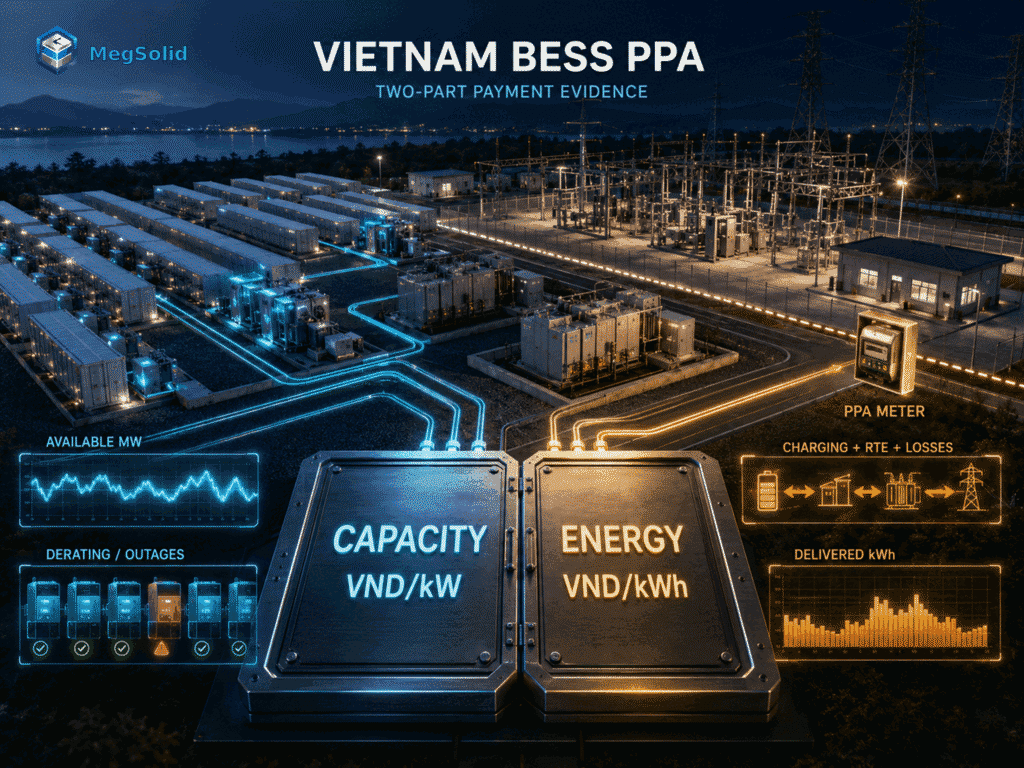
Le prix maximal de production constitue un plafond de négociation. Il résulte :
- Prix fixe moyen pour le recouvrement des coûts d'investissement
- Prix variable de l'électricité utilisée pour recharger le système de stockage d'énergie par batterie (BESS)
- Prix fixe d'exploitation et de maintenance pour les réparations majeures, la main-d'œuvre et les autres coûts d'exploitation annuels
Le prix du service lié au projet répartit ensuite ces éléments économiques comme suit :
- Prix de capacité en VND/kW (prix fixe + frais d'exploitation et de maintenance fixes)
- Prix de l'énergie en VND/kWh (électricité de charge, rendement de charge-décharge convenu, pertes applicables)
La circulaire n° 62 plafonne également le taux de rendement interne financier utilisé dans le calcul du prix du service à 12%. Il s'agit d'une limite réglementaire de modélisation. Il ne s'agit ni du rendement des équipements du fournisseur, ni du rendement final des capitaux propres de l'investisseur.
La circulaire présente une méthode de calcul et un processus annuel de fixation des fourchettes de prix. Elle ne publie pas de barème tarifaire unique et définitif pour chaque projet.
Veillez à bien distinguer le projet de référence du projet négocié
L'annexe I répertorie les données de référence relatives à la fourchette de prix annuelle maximale. Plusieurs données relatives au prix des services du projet sont ensuite convenues entre le vendeur et l'acheteur, dans le respect des règles énoncées dans la circulaire.
| Saisie | Référence par fourchette de prix | Négociation de projet ou éléments probants |
|---|---|---|
| Vie économique | 15 ans | La circulaire n° 62 prévoit une durée de vie utile de 15 ans, sauf si une autre autorisation compétente s'applique. |
| Durée de décharge de calcul | 2 heures | Puissance du projet approuvée, énergie et durée de l'exploitation |
| Nombre minimal de cycles de vie | 8,000 | Conforme au projet approuvé, à la documentation du fabricant ou à une décision d'une autorité compétente |
| Perte annuelle moyenne de capacité | 2% par an | Valeur convenue du projet, plafonnée à 2% par an pour le calcul du prix du service |
| Rendement de charge-décharge | 85% | Valeur du projet convenue sur la base des données de conception approuvées ou des données du fabricant, avec un seuil réglementaire de 85% |
Une hypothèse standard relative aux supports ne constitue pas une garantie sur l'équipement.
Quels sont les facteurs qui déterminent le prix de la capacité ?
Le prix de la capacité vise à couvrir les investissements fixes éligibles et les coûts fixes d'exploitation et de maintenance. Il est calculé à partir de la puissance installée en kW prévue dans le projet approuvé, puis tient compte de la capacité de la centrale à rester prête pour une exploitation programmée.
Le cadre du contrat d'achat d'électricité (PPA) comprend le prix convenu, la capacité disponible et l'énergie contractuelle. Les parties doivent encore définir comment l'état de la centrale et les données d'exploitation viendront alimenter ces champs.
| Saisie de la capacité et du prix | Preuves techniques | Risque en cas de non-fermeture |
|---|---|---|
| Capacité installée | Conception approuvée, calendrier du PCS, caractéristiques nominales des transformateurs, schéma unifilaire | L'énergie nominale en courant continu est considérée comme de l'énergie en courant alternatif réglable |
| Capacité disponible | Enveloppe de fonctionnement du PCS, plage de SOC, déclassement thermique, état de coupure | La disponibilité mensuelle devient un véritable casse-tête |
| Limite des investissements fixes | Liste des équipements et des infrastructures via le point de raccordement | Les coûts liés aux transformateurs, aux câbles, aux postes de transformation ou aux systèmes de contrôle sont soit omis, soit comptés deux fois |
| Coûts fixes d'exploitation et de maintenance | Plan de réparations majeures, périmètre des travaux, plan de pièces de rechange, responsabilité en matière d'entretien | Le calcul de la base fiscale annuelle ne peut faire l'objet d'aucune contestation |
| Vie économique | Modèle financier approuvé et hypothèses relatives au renouvellement du matériel | Le calendrier de remplacement va à l'encontre de la durée de vie réglementaire de 15 ans |
| Profil annuel à prix fixe | Conditions du prêt, échéancier de remboursement, FC convenu par année | Le service de la dette et les flux de trésorerie issus des contrats d'achat d'électricité (PPA) s'écartent l'un de l'autre |
Le fournisseur d'équipements doit indiquer la puissance nominale en courant alternatif, les limites de surcharge, le déclassement en fonction de la température ambiante, la plage de tension, le facteur de puissance et les limites de fonctionnement auxiliaires. Le concepteur de l'installation convertit ensuite ces chiffres en une définition de la capacité disponible au point de livraison prévu par le contrat.
Pour connaître les limites opérationnelles du PCS et les fonctions de soutien au réseau, voir Conception de systèmes de conversion de puissance (PCS) destinés à la formation de réseaux et au raccordement au réseau. La capacité finale de la centrale de 110 kV doit encore être déterminée à partir des données du système de contrôle de puissance (PCS), de la conception des transformateurs et du réseau de collecte, des études de protection et des paramètres de commande propres au projet.
La disponibilité nécessite des codes d'événement
Un fichier de disponibilité doit ventiler les limites de l'usine par cause commerciale.
| État de l'événement | Enregistrement obligatoire |
|---|---|
| En stock et prêt à être expédié | Puissance disponible en kW, état de charge (SOC), limites actives, état des communications |
| Recharge programmée | Programme NSMO, consigne de recharge, puissance réelle en kW, kWh reçus |
| Sortie prévue | Instructions de régulation, puissance réelle (kW), kWh fournis, trajectoire du SOC |
| Maintenance programmée | Plage horaire approuvée, équipement isolé, capacité restante disponible |
| Arrêt forcé | Code d'interruption, bloc concerné, capacité perdue, heure de début, heure de rétablissement |
| Réduction de la puissance nominale due aux conditions environnementales | Conditions ambiantes, limite thermique, puissance affectée, temps de récupération |
| Restriction liée au réseau ou aux communications | État externe, chemin d'accès à la commande, état de secours de l'installation |
La circulaire n° 62 précise la méthode de tarification et le contenu type d'un contrat d'achat d'électricité (PPA). L'accord de projet doit encore définir les événements, les intervalles de calcul, les exclusions et la procédure de règlement des litiges applicable au règlement.
Qu'est-ce qui influe sur le prix de l'énergie ?
La composante « énergie » permet de couvrir le coût de l'électricité utilisée pour recharger et faire fonctionner le BESS. L'article 11 la lie à trois paramètres techniques :
| Données relatives aux prix de l'énergie | Base de la circulaire n° 62 | Justificatifs requis pour le projet |
|---|---|---|
| Tarif de la recharge électrique | Prix de vente au détail applicable pendant les heures de facturation, tel que demandé par le système et l'opérateur de marché | Calendrier de recharge horodaté, période tarifaire, données du compteur d'injection dans le réseau |
| Rendement de charge-décharge | Conforme à l'étude de faisabilité approuvée, à la conception de base évaluée ou à la documentation du fabricant ; pas moins de 85% | Délimitation de l'essai, conditions de fonctionnement, identifiants des compteurs, rapport de rendement |
| Pertes liées à la consommation personnelle et à la livraison | Consommation auxiliaire du BESS, plus le transformateur élévateur et les pertes en ligne jusqu'au point de livraison | Compteur auxiliaire, calcul des pertes du transformateur, étude des câbles, rapprochement des points de livraison |
La valeur 85% constitue le seuil réglementaire minimal pour les données d'entrée négociées. Les parties déterminent la valeur du projet à partir des documents de conception approuvés ou des justificatifs fournis par le fabricant.
Il convient de faire preuve de prudence dans la formulation des indications relatives au rendement. Les données produit actuelles du modèle 5000INTL de MegSolid indiquent que : Rendement maximal de 87,51 TP5T. Cette mention correspond à un rendement maximal. Le rendement réglementaire aller-retour de charge-décharge au point de livraison du contrat d'achat d'électricité (PPA) reste une valeur déterminée par le projet. Il convient de définir clairement les limites avant que quiconque n'intègre un chiffre dans le modèle financier.
La même règle s'applique aux pertes dans les transformateurs et les lignes. La valeur relevée sur un compteur basse tension ne correspond pas à l'énergie nette à 110 kV, à moins que les pertes auxiliaires, de conversion, dans les transformateurs et dans les câbles ne soient prises en compte dans le calcul.
Les hypothèses relatives à la dégradation et au cycle sont intégrées au modèle commercial
La circulaire n° 62 permet au vendeur et à l'acheteur de convenir du nombre minimal de cycles de charge-décharge sur toute la durée de vie du produit, sur la base de la conception approuvée ou de la documentation du fabricant. La perte de capacité moyenne annuelle est également fixée d'un commun accord à partir de l'étude de faisabilité, de la conception de base ou des informations fournies par le fabricant, le plafond réglementaire fixé pour ce calcul étant de 2% par an.
Ces valeurs permettent de calculer le nombre maximal d'heures de fonctionnement et d'établir une comparaison entre le prix du service négocié et la fourchette de prix annuelle.
| Données du contrat | Document fournisseur | Vérification par le propriétaire ou par l'EPC |
|---|---|---|
| Nombre minimal de cycles de vie | Hypothèses relatives au fonctionnement des cellules et du système, base d'essai, limites de fonctionnement | Comparer avec le scénario de répartition du NSMO et le débit annuel prévu |
| Perte de capacité annuelle | Courbe de dégradation spécifique au modèle et conditions indiquées | Vérifier la température, le SOC, le DoD, le C-rate et le vieillissement calendaire |
| Énergie en fin de vie | Énergie garantie ou de conception au point de raccordement convenu | Planifier des tests de capacité périodiques et définir des facteurs de correction |
| Plan de remplacement | Hypothèses relatives au remplacement des batteries, des systèmes PCS, des installations CVC et des équipements auxiliaires | Aligner les remplacements sur la modélisation des coûts à prix fixe et des coûts d'exploitation et de maintenance |
| Réserve d'exploitation | Limites minimale et maximale de l'état de charge (SOC) | Vérifier que la politique de réservation autorise toujours la durée de mission prévue dans le contrat |
Un inventaire cyclique qui ne tient pas compte de la profondeur de décharge (DoD), de la température et du débit énergétique est incomplet. Un pourcentage de dégradation qui ne s'inscrit pas dans le cadre d'un test de capacité présente la même lacune.
Pour savoir comment les hypothèses de dépréciation influent sur les résultats financiers, voir Comment la dégradation des batteries influe sur les paramètres de calcul du retour sur investissement (ROI) des systèmes de stockage d'énergie par batterie (BESS).
Les systèmes EMS, SCADA et de comptage doivent générer des registres de règlement
NSMO planifie la capacité des systèmes de stockage d'énergie par batterie (BESS) par région et programme la charge, la décharge et les autres besoins opérationnels. La centrale a besoin d'un processus clair, depuis les instructions de dispatching jusqu'à l'action du système de gestion de l'énergie (EMS), la réponse du système de contrôle de puissance (PCS) et du système de gestion de batterie (BMS), et enfin le compteur de recettes.
| Couche de preuves | Champs obligatoires du projet | Sortie d'acceptation |
|---|---|---|
| Interface de répartition | Identifiant de l'instruction, mode demandé, consigne de puissance active/réactive, durée d'application | Journal des commandes avec source et horodatage |
| EMS | Commande reçue, commande émise, limite active, réserve SOC, état de repli | Exportation des événements EMS |
| PCS | Puissance réelle en kW, kVAr, tension, fréquence, mode de fonctionnement, déclassement, état de déclenchement | Fichier de réponse des séries chronologiques |
| BMS | SOC, SOH, puissance de charge/décharge disponible, estimation de l'énergie, alarmes, état d'isolation | Enregistrement de l'état de la batterie |
| Comptabilisation des recettes | Énergie reçue du réseau, énergie fournie, indicateurs de qualité des compteurs | Relevé mensuel du compteur |
| Équipements auxiliaires de l'usine | Refroidissement, systèmes de commande, pompes, système anti-incendie, autres services énergétiques de la centrale | Record d'énergie auxiliaire |
| Disponibilité | Puissance disponible en kW par intervalle, code de cause des réductions | Rapport mensuel sur la disponibilité |
| Synchronisation horaire | Source de temps, fuseau horaire, qualité de l'horloge, alerte de dérive | Chronologie des événements courants |
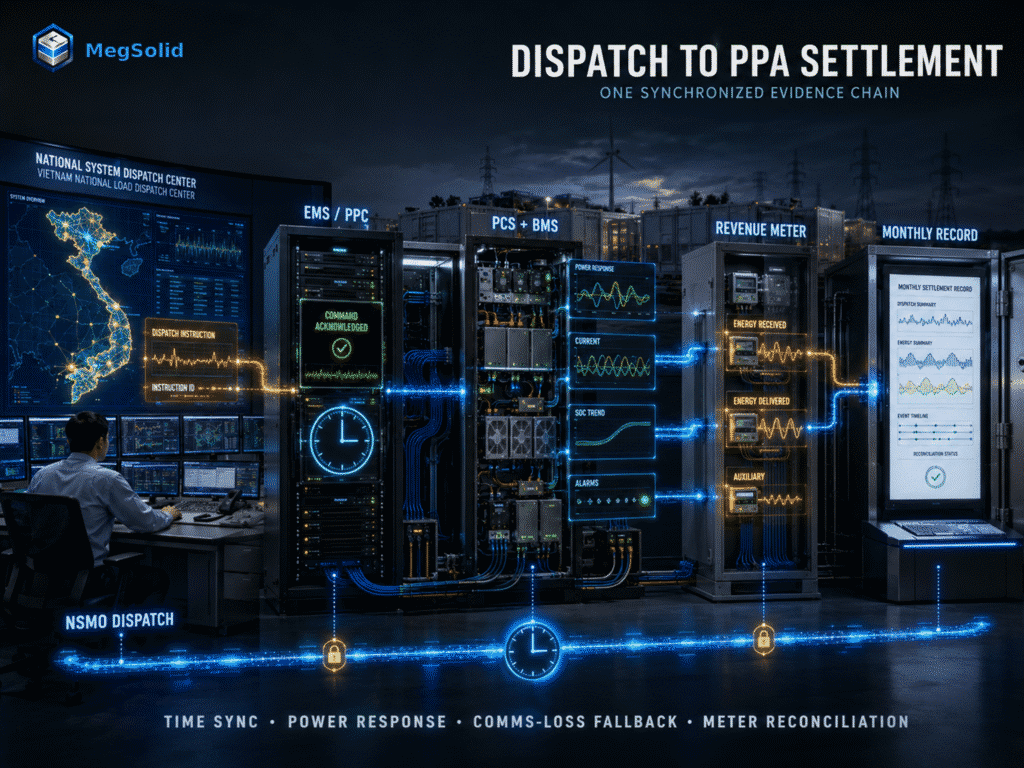
La liste précise des points constitue un livrable du projet. Elle doit correspondre aux annexes du PPA, aux exigences du code de réseau, à la philosophie de protection et à l’interface NSMO. Utilisez le Structure de la liste des points SCADA de BESS pour les champs relatifs à la propriété du signal et à la qualité des données. Le Architecture de communication entre le BMS et l'EMS aborde la hiérarchie des commandes et l'alignement des horodatages.
La cybersécurité et les limites de l'accès à distance doivent être intégrées dans la même conception d'interface. Voir Ingénierie de la cybersécurité des systèmes de stockage d'énergie par batterie (BESS) conforme à la norme CEI 62443 pour le découpage en zones du réseau et le contrôle d'accès.
Convertir les données d'entrée PPA en enregistrements FAT et SAT
Le modèle de contrat d'achat d'électricité (PPA) comporte des annexes relatives aux caractéristiques de la centrale, au comptage et à l'acquisition de données, aux caractéristiques d'exploitation, aux systèmes SCADA/EMS, aux communications, à la protection, à l'automatisation, à la tarification et au paiement. Le plan de réception doit suivre la même structure.
| Test | Éléments de preuve recueillis | Prise en charge des données de tarification (PPA) |
|---|---|---|
| Essai de puissance nominale | Valeur de consigne, puissance CA (kW), état CC, tension, température, durée | Capacité installée et disponible |
| Réponse en charge/décharge | Commande d'envoi, accusé de réception, rampe, sortie stabilisée | Capacité opérationnelle prévue |
| Test de capacité énergétique | SOC initial/final, énergie CA, énergie CC le cas échéant, équipements auxiliaires | Durée d'intervention et seuil de dégradation |
| Test de rendement | Énergie facturée, énergie fournie, traitement auxiliaire, périmètre de comptage | Rendement de charge-décharge convenu |
| Essai de charge auxiliaire | Demande en refroidissement et en services en gare, par état d'exploitation | Taux d'utilisation personnelle |
| Rapprochement des compteurs | Compteur principal, compteur de secours, compteur de conteneur, calcul des pertes | Énergie reçue et fournie |
| Test de perte de communication | Liaison perdue, alarme, action de secours, rétablissement | Disponibilité et expédition en toute sécurité |
| Essai de déclassement ou vérification des calculs | Puissance d'entrée ambiante, limite thermique, puissance disponible en kW | Calcul de la capacité disponible |
| Test de protection et de déclenchement | Événement de relais, déclenchement du PCS, état du disjoncteur, séquence de réinitialisation | Classification des coupures forcées |
Le test FAT permet de vérifier les fonctions et les données disponibles avant l'expédition. Le test SAT permet de valider l'ensemble de l'installation aux points de raccordement réels et aux limites de livraison. Utilisez le Structure de contrôle des essais de réception en usine du système BESS lors de l'attribution des instruments, de la propriété des données brutes et des signatures.
Le cadre PPA permet également aux parties de convenir des modalités de prise en charge des coûts liés aux essais préalables à la mise en service commerciale (COD), à la mise en service et à la réception, tout en empêchant tout double remboursement au titre de l'investissement total approuvé. Les équipes techniques et commerciales doivent partager un registre d'essais unique et contrôlé.
Le rôle de MegSolid dans un projet « Circular 62 »
La circulaire n° 62 décrit un projet énergétique complet. Un conteneur constitue l'un des éléments de cette centrale.
Le modèle 5000INTL de MegSolid est une plateforme conteneurisée à grande échelle dont les limites publiées sont les suivantes :
| Paramètre publié | Valeur 5000INTL | Utilisation dans le cadre du projet « Circulaire 62 » |
|---|---|---|
| Puissance nominale en courant alternatif | 2,7 MW | Élément constitutif au sein d'une usine à plusieurs unités |
| Puissance nominale | 5 015,9 kWh | Données préliminaires concernant la durée et la mise en page |
| Tension alternative nominale | 690 V CA | Contribution à la conception du transformateur et du système de collecte du projet |
| Plage de tension continue | 1 123,2–1 497,6 Vcc | Limites de fonctionnement du PCS et de la batterie |
| Refroidissement | Refroidissement par liquide intelligent | Données thermiques pour la modélisation de la disponibilité |
| Indice de protection contre la pénétration | IP55 | Fiche d'information pour l'étude environnementale du site |
| Température de fonctionnement | de -30 °C à 55 °C | Contribution à l'examen de la réduction de la puissance nominale du projet |
| Communication | Ethernet et RS485 | Point de départ pour l'interface SCADA/PPC de l'usine |
| Rendement maximal | 87.5% | Valeur du produit qui doit encore faire l'objet d'une confirmation des limites avant toute utilisation réglementaire en RTE |
Plus d'informations sur le produit : Architecture en conteneurs MegSolid 5000INTL.
Un projet éligible doit encore comporter un agencement multi-unités, un contrôleur de puissance de la centrale, des équipements moyenne et haute tension, une interconnexion de 110 kV ou plus, un système de comptage commercial, des dispositifs de protection, des systèmes de télécommunications, des travaux de génie civil, une stratégie de lutte contre les incendies et un système SCADA au niveau du projet. Ces éléments relèvent de la responsabilité du contractant EPC et des parties vietnamiennes concernées.
Pour la ligne reliant le bloc BESS au raccordement au réseau, voir containerized BESS transformer and grid-connection responsibilities. The example scale differs; the responsibility map still helps.
Compare suppliers by evidence delivery
| Evaluation field | Basic equipment quotation | PPA-aligned technical submission |
|---|---|---|
| Puissance | Container nameplate | Net plant kW boundary, derating, auxiliary treatment |
| Énergie | Nominal DC kWh | Defined AC delivery boundary and end-of-life basis |
| Efficacité | Single headline value | Charge-discharge test method, meters, auxiliaries, operating conditions |
| Degradation | Generic annual percentage | Model-specific curve linked to duty and capacity-test procedure |
| Communications | Protocol name | Signal list, register map, command ownership, timestamps, failure states |
| Disponibilité | Warranty statement | Interval calculation, event codes, exclusions, raw logs |
| Tests | Standard FAT checklist | PPA-input FAT, site SAT, meter reconciliation, signed data package |
| Project boundary | Battery container | Container, collection system, transformer, substation, metering, control interfaces |
MegSolid can structure the technical talk around an integrated battery, PCS and control boundary, then flag the plant-level items that need EPC and utility coordination. Final performance values, warranty terms, interfaces and compliance documents still have to land in the controlled project datasheet and contract.
What MegSolid needs to screen a Vietnam project
Send these before asking for a technical and commercial configuration:
- PDP8 project reference and planned commercial-operation date
- Required installed power in MW and energy in MWh
- Connection voltage, point of connection, preliminary single-line diagram
- Required discharge duration and preliminary NSMO operating profile
- Charging source, expected charging hours, tariff basis
- Proposed charge-discharge efficiency boundary
- Auxiliary-load, transformer-loss and line-loss assumptions
- Annual cycling, DoD, SOC reserve, degradation target
- SCADA protocol, dispatch interface, time synchronization, data-retention requirements
- FAT, SAT, capacity-test and meter-reconciliation requirements
MegSolid can then screen container count, AC/DC architecture, communication boundary and missing evidence. Vietnamese counsel, the project EPC, lenders, EVN/offtaker representatives and NSMO confirm the final regulatory reading and PPA wording.
Turn the tariff formula into a testable plant
Circular 62 gives qualifying standalone BESS projects a formal way to negotiate capacity and energy prices. The commercial model only works when its inputs trace to approved design documents and operating records.
For capacity: lock installed-power boundaries, available-capacity rules, fixed O&M scope and outage classifications. For energy: define charging price, charge-discharge efficiency, auxiliaries, transformer losses and delivery-point meters. For monthly settlement: make EMS, SCADA and meter timestamps agree.
A PPA-ready BESS specification links each revenue input to a named document, signal, meter and acceptance test. Set that link before the developer freezes equipment scope or files the financing model.
FAQ
Qu'est-ce que la Circulaire 62/2025/TT-BCT ?
La Circulaire 62 est le cadre tarifaire et de contrat d'achat d'électricité (PPA) effectif du Viêt Nam pour les projets de systèmes de stockage d'énergie par batteries (BESS) autonomes et raccordés au réseau éligibles. Le MOIT l'a publiée le 10 décembre 2025 et elle est entrée en vigueur le 26 janvier 2026.
Which BESS projects fall under Circular 62?
The project must be a standalone BESS of at least 10 MW, connect to the national power system at 110 kV or above, serve national-system needs and align with revised PDP8. These conditions apply together.
Does Circular 62 apply to a factory behind-the-meter BESS?
A factory or data-centre BESS operating behind the customer meter sits outside Circular 62’s stated scope. Its commercial case follows site resilience, demand management and applicable retail tariff rules.
Does Circular 62 cover a BESS tied to a solar or wind plant?
BESS integrated with a renewable power plant is excluded from this methodology. Circular 12/2025/TT-BCT provides the relevant pricing route for that project category.
What is the two-part BESS price under Circular 62?
The project generation-service price contains a capacity price in VND/kW and an energy price in VND/kWh. Capacity covers eligible fixed investment and fixed O&M, while energy reflects charging electricity and agreed technical losses.
Is the annual price bracket the same as the PPA payment formula?
The annual bracket sets a range from 0 to an approved maximum in VND/kWh. The negotiated PPA separates capacity and energy prices, then applies the contract’s monthly settlement provisions and operating records.
Which technical records support the capacity price?
The evidence package should include approved installed AC power, available capacity, SOC and temperature limits, derating rules, outage codes, fixed O&M scope and the investment boundary through the connection point.
Which inputs support the energy price?
The principal inputs are the charging electricity price, agreed charge-discharge efficiency, BESS self-use, step-up transformer loss, line loss and metered energy delivered at the contractual boundary.
Does the 85% value guarantee project round-trip efficiency?
The 85% figure is the regulatory floor for the agreed calculation input. The project value still needs support from the approved feasibility study, appraised basic design or controlled manufacturer documentation at the defined measurement boundary.
Can the 5000INTL maximum efficiency be inserted directly as PPA RTE?
MegSolid publishes 87.5% as the 5000INTL maximum efficiency. PPA round-trip efficiency at the delivery point has a separate boundary that includes the agreed treatment of auxiliaries, conversion, transformer and line losses.
How does Circular 62 treat battery degradation?
Seller and buyer agree the annual average capacity-loss input from approved design or manufacturer evidence. The service-price calculation caps that input at 2% per year.
What cycle life and discharge duration appear in the reference calculation?
Appendix I uses a two-hour design discharge duration and 8,000 minimum lifetime cycles for the maximum price-bracket reference. The negotiated project duty must still match the approved design and manufacturer evidence.
Que doivent enregistrer le système de gestion de l'énergie (EMS) et le SCADA pour le règlement des contrats d'achat d'électricité (PPA) ?
Les enregistrements doivent relier l'instruction du NSMO à l'accusé de réception de l'EMS, aux consignes de puissance active et réactive, à la sortie du PCS, au SOC, au SOH, au derating, aux alarmes, aux états de déclenchement, aux valeurs des compteurs et à des horodatages synchronisés.
Which meters are needed for the energy evidence chain?
The project should define main and backup revenue meters, meters for energy received and delivered, auxiliary consumption and any container-level checks. The reconciliation method must identify the PPA delivery point and treatment of transformer and line losses.
What should FAT and SAT prove for a Vietnam BESS PPA?
The test plan should cover rated power, charge and discharge response, energy capacity, efficiency boundary, auxiliary load, meter reconciliation, communications-loss fallback, derating and protection events. Raw data, calibrated instruments and signatures make the results auditable.
Un MegSolid 5000INTL peut-il être qualifié de projet Circulaire 62 ?
Une unité 5000INTL a une puissance nominale de 2,7 MW et une production de 5 015,9 kWh ; elle constitue donc un élément de base pour les projets à grande échelle. Pour être éligible au titre de la circulaire 62, un projet doit présenter une puissance d’au moins 10 MW, être raccordé à un réseau de 110 kV ou plus, comporter une conception en plusieurs unités, disposer de systèmes de comptage et de protection, d’un système PPC/SCADA, et avoir obtenu les autorisations vietnamiennes requises.