 Skip to content
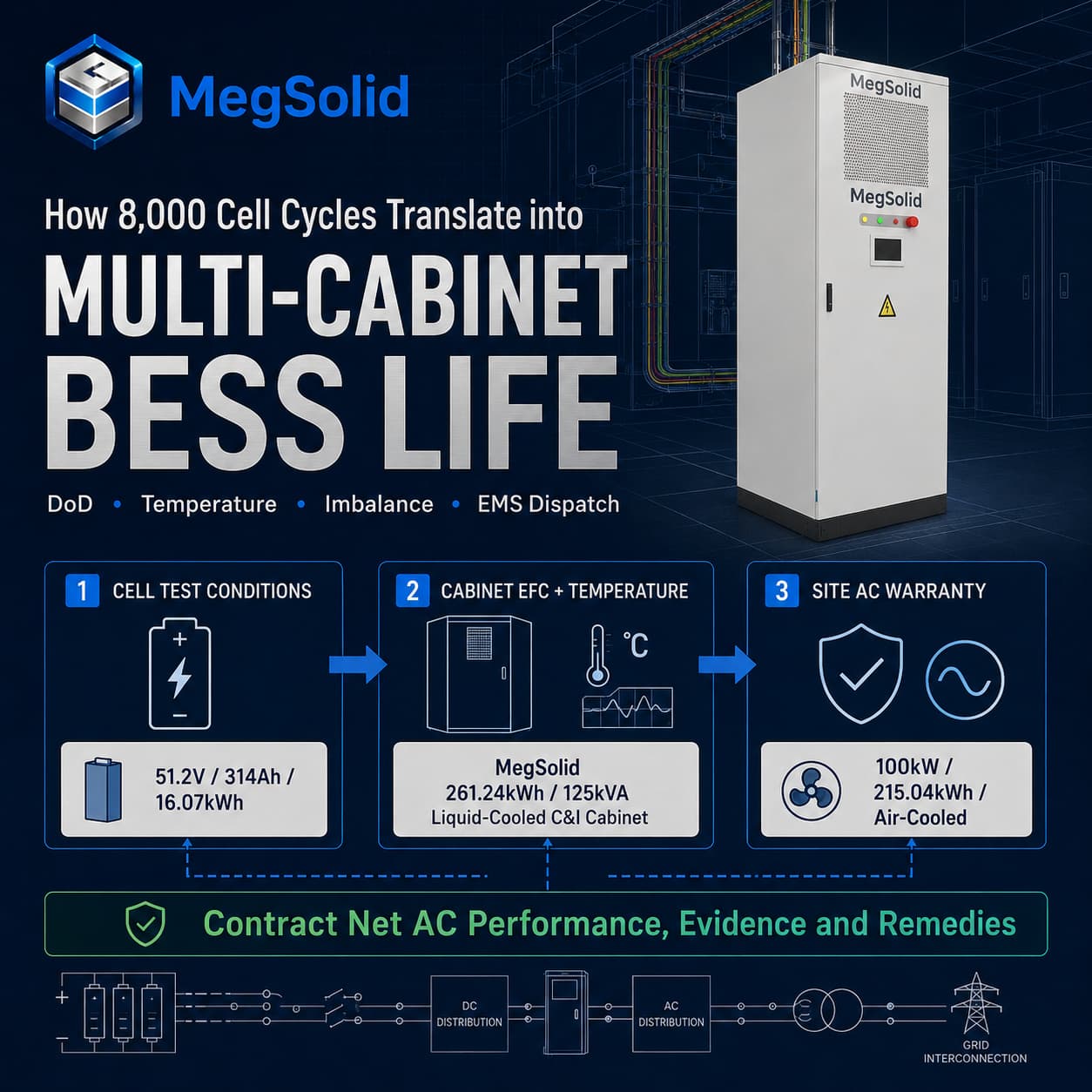
After a decade of reviewing C&I battery specifications, commissioning data and warranty schedules, one mistake keeps returning: a cell or low-voltage battery cycle figure is copied into the life assumption for an entire plant.
MegSolid treats every cycle-life figure as a test result tied to a defined sample, operating window and end point. An “8,000-cycle” claim establishes a product-level reference. Multi-cabinet commercial and industrial battery energy storage system (BESS) life also reflects each cabinet’s depth of discharge, temperature, current, SOC history and control priority.
For procurement, the useful question is: What AC power, usable energy, duration and availability will the complete site deliver over time, under which operating conditions, and what remedy applies after a verified shortfall?
My procurement rule: Keep an 8,000-cycle product value at its documented test boundary. Convert the proposed duty cycle into cabinet-level throughput and operating conditions. Then contract a system-level performance schedule at a defined measurement boundary.
Recent industry discussions about BESS degradation, SOC limits and ROI and high-temperature aging versus cooling cost point to the same commercial problem. The engineering decision needs cabinet-level operating evidence and a system-level guarantee.
Decision keywords for a 60-second review
| Decision keyword | What it means in this article | Buyer action |
|---|---|---|
| BESS cycle life | A conditional test result for a defined sample | Verify DoD, C-rate, temperature, rest periods and EOL before comparing figures |
| DoD and SOC window | The portion of charge capacity used and the operating limits imposed by controls | Put permitted limits and dwell conditions into the warranty schedule |
| Equivalent full cycles (EFC) | Cabinet throughput normalized to a fixed, defined usable-energy baseline | Calculate and retain EFC separately for every cabinet |
| Temperature spread | The difference among cabinet, rack, module or cell temperatures, measured alongside ambient | Specify sensors, sampling, time-in-temperature bins and corrective thresholds |
| Cabinet imbalance | Unequal current, SOC, capacity, resistance or thermal condition among parallel units | Review dispersion and first-limit events alongside fleet averages |
| EMS dispatch | The algorithm that allocates power, SOC limits and derating among cabinets | Define approved logic, change control and responsibility for overrides |
| Net usable AC energy | Energy delivered at the contracted AC meter after the agreed treatment of losses and auxiliaries | Make it a system-level acceptance and warranty metric |
| BOL and EOL | The tested beginning-of-life baseline and the contractual end-of-life threshold | State the test method, reference value, tolerance and degradation schedule |
| Warranty remedy | The action owed after a verified performance shortfall | Allocate repair, replacement, augmentation, retesting, freight and downtime |
Three different meanings of “battery life”
In a technical bid review, I separate cycle life, cabinet service life and site performance life before comparing prices. They answer different questions.
| Layer | What it can describe | Additional evidence required |
|---|---|---|
| Cell or battery cycle life | Repeated cycling of a defined sample under stated DoD, temperature, C-rate and EOL criteria | AC usable energy, PCS availability, auxiliaries, inter-cabinet dispersion or site warranty life |
| Single-cabinet life | Performance of one integrated cabinet within its BMS and thermal limits | Equal aging across other cabinets or continued plant-level duration at the point of interconnection |
| Multi-cabinet system life | Continued delivery of contracted power, energy, duration, efficiency and availability | A defined test boundary, duty cycle, degradation schedule and remedies |
Sandia’s performance protocol defines an energy storage system as including the storage device, BMS and installed power-conversion equipment. It also calls for reference performance tests at the beginning of life and periodically thereafter. That system boundary is much closer to what an owner buys than a cell-cycle test is (Sandia/PNNL performance protocol).
This article applies that distinction specifically to multi-cabinet plants. For the broader relationship among throughput, DoD, EOL and remedies, see How to Read a C&I BESS Warranty.
If the project team is still comparing system boundaries, commercial scope and supplier evidence, use Commercial Energy Storage Procurement as the upstream decision framework.
The 51.2V/314Ah comparison shows why test conditions matter
Two products can share nominal voltage and capacity while publishing cycle life on different bases.
| MegSolid product reference | Public cycle-life wording | Conditions stated with the figure | Procurement interpretation |
|---|---|---|---|
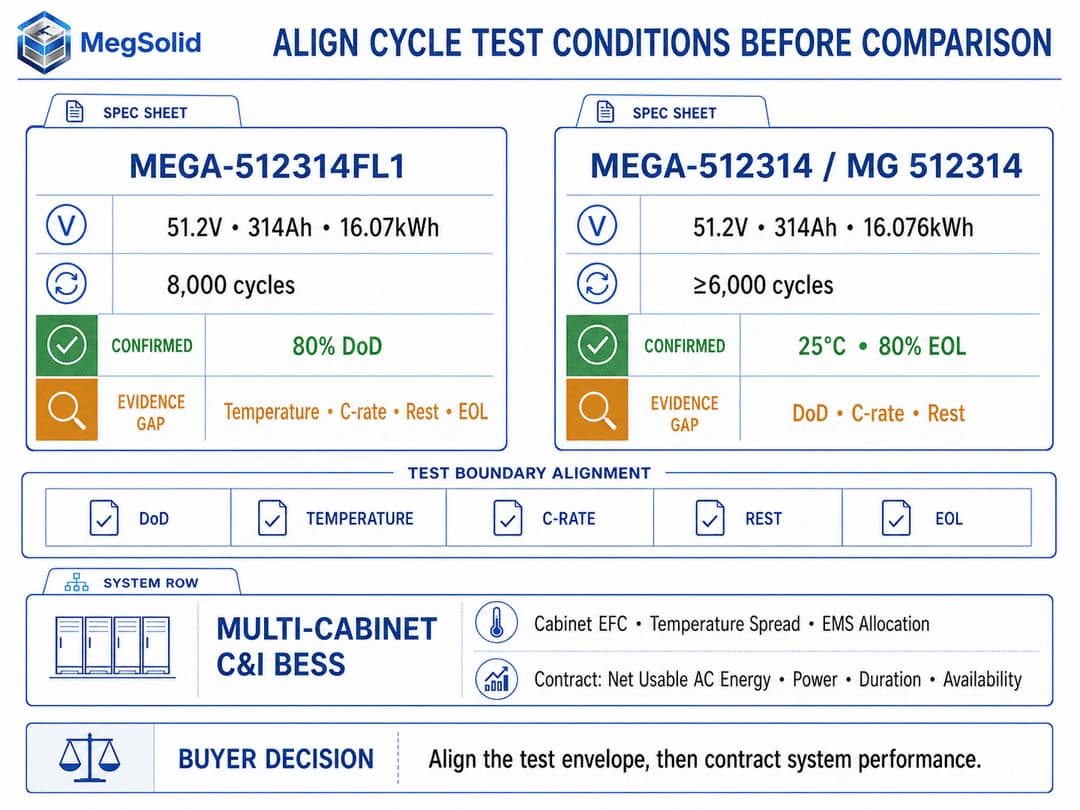
| MEGA-512314FL1 hybrid solid-state battery, 51.2V, 314Ah, 16.07kWh | 8,000 cycles | 80% DoD | The figure is tied to a depth-of-discharge condition. Request the controlled test document for temperature, C-rate, rest periods and EOL threshold before comparison. |
| MEGA-512314 / MG 512314 movable battery, 51.2V nominal, 314Ah, 16.076kWh | ≥6,000 cycles | 25°C and 80% EOL | The page title uses MEGA-512314, while its parameter table identifies MG 512314. A separate C&I site warranty and AC performance schedule remain necessary. |
I would rank the 8,000-cycle and 6,000-cycle figures after aligning the missing conditions. DoD describes how much of the available charge is used in a cycle; EOL describes the capacity-retention threshold at which the test is considered complete. Each describes a different part of the test.
There is also a model-control point for bid documents. The current hybrid-battery page uses MEGA-512314FL1. The current movable-battery page title uses MEGA-512314, while its parameter table uses MG 512314. Older reference material may show MEG-Solid-512314FL1 or MB 512314. The signed quotation, datasheet, nameplate, serial-number scheme and warranty should resolve these naming differences and use one verified model identity.
Apply each low-voltage product value to its named product and documented test boundary. MegSolid’s ESSA0100B-0215 is a 100kW/215.04kWh air-cooled outdoor cabinet using 280Ah LFP cells. Its public table lists a maximum charge/discharge rate of 0.5C at 25°C and, in a separate field, ≥5,000 cycles. The public data leaves DoD, EOL, rest periods and the system performance-warranty schedule to the controlled project documents.
The 261.24kWh liquid-cooled C&I system uses 314Ah LFP cells and supports up to ten units in parallel. Its public page leaves the multi-cabinet cycle-life warranty to the project-specific commercial documents.
For the documented cabinet-level selection boundary, review the 100kW/215kWh outdoor BESS selection article. Buyers comparing the two C&I cabinet classes can also use the 215kWh vs 261kWh commercial battery storage comparison while keeping each cycle statement model-specific.
DoD becomes cabinet-specific after the system starts aging
A site-level dispatch command can produce unequal cabinet-level DoD. This is one of the first points I check in operating data. Even if an EMS initially divides power evenly, differences in commissioned usable energy, internal resistance, SOC estimation, cable impedance, thermal conditions and SOH can change the actual energy processed by each cabinet.
One contract-ready method is to calculate equivalent full cycles for every cabinet and for the plant:
EFCi = cumulative discharged DC energy from cabinet i ÷ fixed baseline usable DC energy of cabinet i.
The numerator and denominator must use the same stated DC measurement boundary. The contract must also define whether the denominator is nameplate energy, beginning-of-life tested energy or current usable energy. I recommend a fixed, documented baseline; a declining denominator can make the count accelerate as the asset ages.
Consider a hypothetical four-cabinet plant. If two cabinets each deliver 170kWh during a dispatch while two thermally constrained cabinets each deliver 130kWh, the site still reports 600kWh. The aggregate number hides that each higher-throughput cabinet delivered about 31% more energy than each lower-throughput cabinet for that event. Repeated dispatch of this kind can create different EFC histories even though the plant receives one EMS command.
A narrower DoD window generally reduces electrode mechanical stress, while cycle aging also depends on charge/discharge rate and temperature. Sandia notes that lithium-ion operational life varies widely with environment and use, and that calendar aging is strongly influenced by SOC and temperature (DOE Energy Storage Handbook, Chapter 3).
Temperature creates both a performance cost and an aging cost
A single ambient-temperature line leaves the warranty incomplete. In a multi-cabinet review, I require the parties to distinguish at least four measurements:
- site ambient temperature;
- cabinet inlet or enclosure temperature;
- module or rack temperature;
- maximum, minimum and spread of measured cell temperatures.
High temperature may reduce resistance and temporarily improve power capability, yet it also accelerates temperature-dependent aging reactions. At low temperature, resistance rises and aggressive charging can increase lithium-plating risk. Sandia describes temperature-dependent degradation as a continuum between low-temperature lithium plating and high-temperature SEI formation; it also reports that calendar-aging rates increase with temperature.
Cooling therefore has two economic effects. It consumes auxiliary energy, reducing net AC energy and revenue, while also protecting future capacity and power. The policy with the lowest auxiliary consumption can still have a higher lifecycle cost.
PNNL field testing illustrates the trade-off. A lithium-ion BESS reached an efficiency peak in a particular temperature and power regime, but the report cautioned that a complete assessment must also consider the degradative effect of temperature (PNNL consolidated BESS performance tests).
For bid evaluation, ask the supplier to provide a thermal map or commissioning acceptance criterion, temperature-bin operating data, auxiliary-energy treatment and the control response when a cabinet exceeds its thermal target. The answer affects both BESS degradation and ROI.
Where the offered battery uses a hybrid solid-state or semi-solid architecture, add the material-interface evidence discussed in the interface-degradation ROI analysis. Apply that mechanism or label to the ESSA or 261.24kWh C&I products only when the ordered configuration documents expressly identify it.
Cabinet imbalance can make the site reach a limit early
Parallel equipment develops measurable electrical differences in service. Small differences in resistance, capacity, terminal connections and temperature are enough to produce different cabinet or string currents and SOC trajectories.
Recent Oak Ridge National Laboratory work reports that battery modules and packs experience current imbalance and uneven cell aging, and that electrical resistance and terminal location affect that imbalance. Its modeling found that reducing current imbalance produced more uniform aging and better pack-level degradation prediction (ORNL, 2025).
Experimental and analytical research on dissimilar parallel batteries also shows that capacity and resistance variability can create current and SOC imbalance. Depending on the degradation mechanism and chemistry, aging trajectories may converge or diverge. This evidence supports active measurement and management of imbalance (Weng et al.).
The system consequence depends on topology and controls:
- A weak cabinet may hit a voltage, SOC or temperature limit first and reduce the power available from that branch.
- The EMS may isolate the constrained cabinet and preserve plant operation with the remaining units, reducing available energy or redundancy.
- A shared PCS or series-string architecture may make one weak branch more restrictive than a design with independently controlled power paths.
- Averaging cabinet SOH can hide the dispersion that actually causes early derating or a failed duration test.
PNNL system testing found cases where string imbalance stopped discharge prematurely when a weak string dropped out. In another lithium-ion system, balancing-related effects were more pronounced at higher rates and diminished at lower discharge rates. The plant’s usable performance depended on the distribution of string condition as well as the average battery condition.
EMS strategy determines who performs each real cycle
An EMS converts the site use case into thousands of cabinet-level operating decisions. Bids using similar batteries can therefore produce different aging results when their dispatch logic differs.
| EMS strategy | Immediate operating result | Possible lifetime or warranty consequence |
|---|---|---|
| Equal kW per cabinet | Simple load sharing | A lower-capacity cabinet sees a higher effective C-rate and deeper fractional DoD |
| Equal percentage of reported SOC | Attempts to align SOC | SOC-estimation error can shift real energy and may drive one cabinet to a limit first |
| SOH-weighted dispatch | Protects weaker cabinets | Stronger cabinets accumulate more throughput; cabinet EFC dispersion may grow |
| Thermal-aware derating | Reduces stress on hotter cabinets | Site power or duration may fall unless spare capacity is available |
| Revenue-first dispatch | Captures more price events or demand savings | More deep cycles, high-SOC dwell or rapid ramps may consume the warranty envelope faster |
| Life-aware dispatch | Prices degradation into each decision | May reject marginal dispatches, changing modeled revenue and payback |
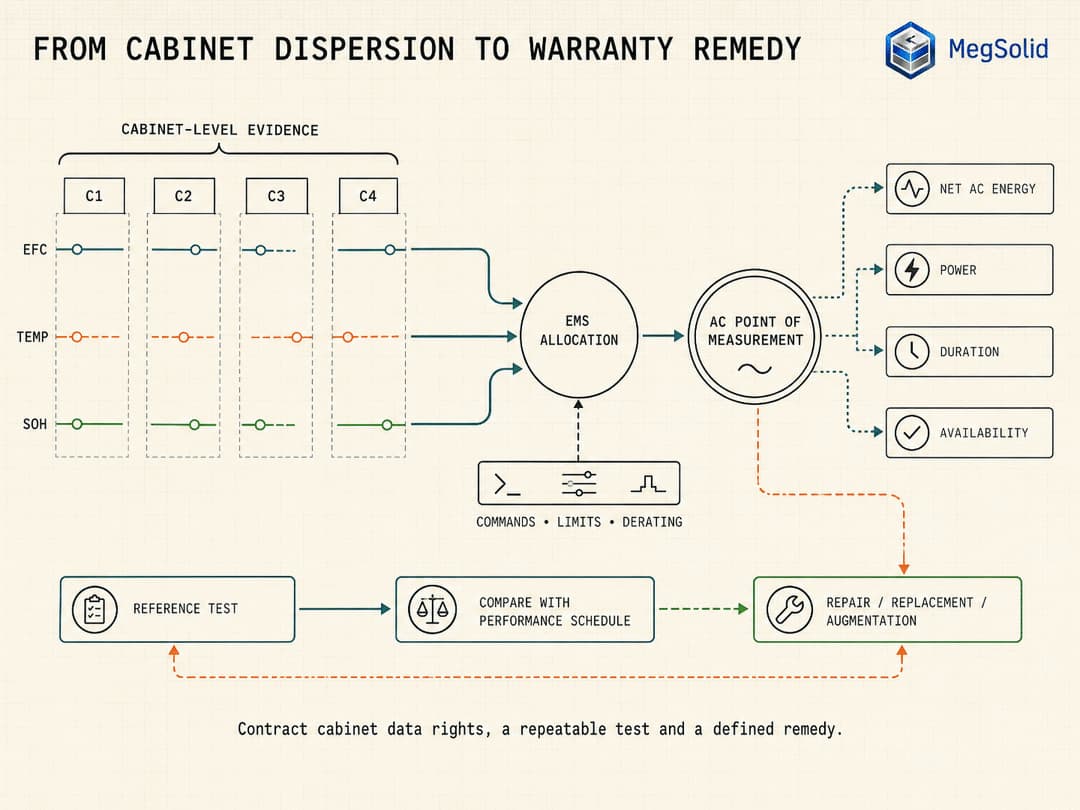
The correct strategy depends on the contracted service. Assign application-specific duty cycles to peak shaving, islanded backup and frequency response. Sandia’s performance protocol similarly defines a duty cycle as the charge/discharge profile associated with a specific application.
Control responsibility also crosses equipment boundaries. Use the PCS and BMS integration failure analysis to identify where current limits, SOC limits, alarms and fallback states must be exchanged before the EMS can allocate cabinet power safely.
For peak-shaving economics, pair the degradation model with the operating-value model in Maximizing C&I Peak-Shaving ROI. A simple screening equation is:
Net dispatch value = avoided energy or demand cost − auxiliary energy − degradation cost − expected unavailability and augmentation cost.
This makes the cooling-versus-life decision explicit. It also prevents an ROI model from treating every discharged kilowatt-hour as having the same future cost.
The same discipline applies to market arbitrage. Negative-price BESS dispatch can create attractive charging opportunities, but the EMS still needs an approved SOC, temperature and throughput envelope before it pursues them.
Why average SOH is a poor system-warranty metric
Suppose four cabinets report 92%, 91%, 83% and 82% SOH. Their arithmetic average is 87%. Warranty approval requires more than that average because the lower-SOH cabinets still need to remain online for the full contracted discharge duration at rated power.
A system warranty should therefore pair an aggregate performance guarantee with dispersion evidence. Useful cabinet-level records include:
- charged and discharged energy, with a stated DC or AC boundary;
- current, power and calculated EFC;
- minimum, maximum and average SOC;
- minimum, maximum and time-weighted temperature bins;
- SOH method, software version and recalibration history;
- time spent derated, isolated or unavailable;
- balancing events, alarms and protective-limit activations;
- EMS setpoints and cabinet-level allocation commands.
Sandia’s energy-storage data guidelines identify rack-, module- and cell-level voltage, current, temperature, SOC and SOH data as relevant to asset management, warranty testing and market dispatch. They also warn that owners may receive only aggregated data unless access is defined in advance (Sandia data guidelines).
Availability also needs its own denominator, exclusions and evidence rules. The BESS availability guarantee formula helps separate a cabinet-level derating event from a plant-level availability result.
Replace the 8,000-cycle clause with a performance schedule
The cycle figure may remain in the technical schedule as supporting product data. In a bankable contract, however, the enforceable site warranty must follow the deliverable the owner finances.
At minimum, define these items:
- 1. Guaranteed quantity. State net AC usable energy, AC power, discharge duration, efficiency and availability where each is commercially required.
- 2. Measurement boundary. Identify the meter, point of interconnection, treatment of PCS losses and whether HVAC, pumps, heaters and controls are included.
- 3. Beginning-of-life baseline. Complete an acceptance capacity test after commissioning under defined ambient, SOC, power and rest conditions.
- 4. Degradation schedule. State the minimum retained performance by date or cumulative throughput, together with EOL and test tolerance.
- 5. Operating envelope. Define permitted SOC window, DoD, charge and discharge rate, temperature exposure, dwell time and annual/cumulative throughput.
- 6. Cabinet-dispersion controls. Require reporting and corrective-action triggers for cabinet-level throughput, SOH, SOC, temperature and derating dispersion.
- 7. EMS responsibility. Identify who owns the dispatch algorithm, how cabinet allocation is performed, and how software or setpoint changes affect coverage.
- 8. Evidence and data rights. Specify sampling resolution, retention period, time synchronization, export format and access to raw cabinet-level records.
- 9. Periodic verification. Define reference performance tests, notice, stabilization conditions, measurement uncertainty and dispute testing.
- 10. Remedies. State whether failure leads to repair, module/cabinet replacement, augmentation, liquidated damages or another remedy—and who pays labor, transport and downtime.
- 11. Exclusions and proof. Require the supplier to identify the record showing that an excluded operating condition caused the claimed loss; missing data remains an unresolved evidence gap rather than an automatic owner default.
- 12. Expansion rules. Define how later cabinets, replacement batteries and mixed-age equipment will be commissioned, balanced and incorporated into the warranty schedule.
Sandia’s project-financing research describes storage performance warranties as schedules of guaranteed energy capacity or lifetime throughput, with operating conditions such as temperature, charge/discharge rate and SOC range. It also notes that equipment, labor and shipping coverage may differ (Energy Storage Financing: Project and Portfolio Valuation).
Example of a safer commercial clause structure
The following is a technical drafting model for engineering discussion. Local counsel should adapt it to the governing jurisdiction:
The Supplier shall warrant the Site’s Net Usable AC Energy and Rated AC Power at the defined Point of Measurement in accordance with the Guaranteed Performance Schedule, subject to the agreed operating envelope and cumulative throughput allowance. Cell or battery cycle-life values are supporting technical data; the Site performance guarantee remains the controlling obligation. Compliance and exclusions shall be determined using time-synchronized cabinet-level BMS, thermal-management, PCS and EMS records. If the Site fails a defined reference performance test, the Supplier shall perform the agreed repair, replacement or augmentation remedy within the stated cure period.
This structure connects performance, conditions, evidence and remedy in one enforceable schedule.
A procurement test for every cycle-life claim
When a proposal says “8,000 cycles,” this is the clarification table I would put into the technical bid review before award.
| Headline claim | Required clarification |
|---|---|
| 8,000 cycles | At what DoD, SOC window, temperature, C-rate, rest period and EOL capacity? |
| One cycle per day | How are partial cycles and equivalent full cycles counted at cabinet and site level? |
| 80% capacity after X years | Capacity measured where, at what power, net or gross of auxiliaries, and against which BOL baseline? |
| Cabinets operate in parallel | What topology, cable design, current-sharing method and cabinet-isolation logic are supplied? |
| Intelligent EMS | Does it equalize SOC, throughput, temperature, SOH, marginal degradation cost or revenue? |
| Uniform cooling | What sensors and acceptance limits demonstrate cabinet-, rack- and module-level uniformity? |
| System warranty | What performance schedule, data rights, exclusions, cure period and paid remedies apply? |
Before accepting the baseline, use a repeatable site procedure such as the one outlined in Commercial BESS Capacity Test: Verify Usable kWh. For model-specific liquid-cooling questions, see the 261kWh liquid-cooled system specification article.
If the plant reports normal operation while delivered energy falls short, follow the capacity-test shortfall diagnostic path before assigning the loss to cell aging.
FAQ
Does 8,000 cycles mean 8,000 days of warranted system operation?
The number describes cycling under stated and sometimes incomplete test conditions. Calendar aging, cabinet temperature, partial-cycle counting, EMS allocation, downtime and the warranty end point determine how the figure relates to a real project.
Which conditions must accompany a cycle-life claim?
Require the DoD or SOC window, charge and discharge C-rate, test temperature, rest time, cycle-counting method and EOL capacity threshold. The tested sample and applicable model must also be identified.
How should equivalent full cycles be calculated for each cabinet?
Divide cumulative discharged DC energy from the cabinet by a contractually defined baseline usable DC energy. Keep that denominator fixed and documented so the counting method remains stable as capacity declines.
Why can equal-power dispatch create unequal aging?
Cabinets can have different usable capacity, resistance, SOC-estimation error and temperature. The same kW command can therefore represent different effective C-rates and DoD for each cabinet.
How does cabinet temperature spread affect system life?
Hotter cabinets can accumulate faster calendar aging, while cold conditions can increase resistance and charging constraints. The EMS may derate or bypass an outlier cabinet, reducing plant power, duration or redundancy before the fleet-average SOH looks critical.
Can average SOH prove compliance with a system warranty?
Average SOH is insufficient when one or more cabinets reach voltage, SOC or temperature limits early. Verify net AC energy, rated power and duration with a defined performance test, then review the cabinet-level spread that produced the result.
Can an EMS extend BESS service life?
A life-aware EMS can limit deep cycling, high-SOC dwell, high C-rate and thermal stress. Its actual result depends on the dispatch objective, SOC/SOH accuracy, cabinet-allocation logic and whether revenue targets override degradation limits.
Where should warranty energy be measured?
For an owner-facing performance guarantee, define a named AC meter or point of measurement and state how PCS losses and auxiliary loads are treated. Cabinet-level DC records remain necessary for diagnosis and exclusion claims.
Which operating data should the owner retain?
Retain time-synchronized cabinet power, current, charged/discharged energy, SOC, SOH, temperatures, alarms, derating status, EMS commands and software versions. The contract should define sampling resolution, retention period, export format and access rights.
Which remedies should apply when the system misses its degradation schedule?
The contract should identify repair, module or cabinet replacement, augmentation, damages or another agreed remedy. It should also allocate labor, freight, retesting, downtime and the cure period.
What is multi-cabinet BESS life?
Multi-cabinet BESS life is the period or cumulative throughput during which the complete plant continues to meet its contracted AC power, usable energy, duration and availability under the agreed operating envelope.
Why does cell cycle life differ from BESS system life?
Cell cycle life comes from a controlled test. System life also depends on cabinet-to-cabinet DoD, temperature, electrical imbalance, BMS limits, EMS dispatch, PCS performance, auxiliaries, maintenance and warranty measurement rules.
What should replace an 8,000-cycle headline in a C&I BESS warranty?
Use a dated or throughput-based schedule for net usable AC energy, rated AC power, duration and availability, supported by a defined test method, operating envelope, cabinet-level data and remedies.
What performance metric should replace cell cycle life in a multi-cabinet BESS warranty?
Use a guaranteed schedule for net usable AC energy, rated AC power, discharge duration and availability at a defined meter, subject to an agreed operating envelope and cumulative throughput allowance.
How should EMS changes be handled under a BESS warranty?
The contract should identify the approved dispatch logic, change-control process, responsible party and required records for any update that alters SOC limits, cabinet allocation, thermal derating or throughput.
Which records prove temperature compliance for a multi-cabinet BESS?
Use time-synchronized cabinet, rack or module temperatures, ambient and inlet temperature, cooling status, alarms, derating events and time-in-temperature bins at the sampling resolution and retention period stated in the warranty.
The bankable conclusion
After ten years in technical review, my conclusion is straightforward: single-product cycle life is useful for comparing test results only after the conditions are aligned. Multi-cabinet BESS life is a system property created by cell aging, thermal design, electrical topology, BMS limits, EMS dispatch, maintenance, augmentation and the contractual performance boundary.
For procurement, keep the 8,000-cycle number in its proper place: a conditional input to engineering review. Put the owner’s actual requirement—net AC energy, power, duration, availability, degradation schedule, evidence and remedy—into the signed system warranty.
MegSolid can review a project duty cycle, cabinet topology and proposed warranty matrix before technical award. Use the MegSolid project inquiry page or email [email protected] with the single-line diagram, load profile, site temperature range, required AC power/energy and proposed operating strategy.
