
If your Italian EPC has to rebuild the compliance package after the cabinet arrives, the quoted equipment price no longer describes the project cost. Set the connection voltage, PCS documentation and integration responsibility before award so CEI 0-16 or CEI 0-21 review follows the ordered configuration. Choosing a battery energy storage supplier for an Italian commercial or industrial project requires more than comparing battery capacity and price per kilowatt-hour.
The supplier must understand how the battery, PCS, EMS, protection system, meter and site electrical infrastructure work together. A low-cost cabinet that arrives without the correct integration documents can delay grid connection, increase commissioning costs and transfer engineering responsibility to the EPC.
As MegSolid’s Manufacturing and Supply Chain Director with 15 years of experience, I have seen the same procurement mistake across multiple markets: the buyer selects a product first and investigates compliance later.
For projects in Italy, compliance and system architecture should be evaluated before the purchase order is issued.
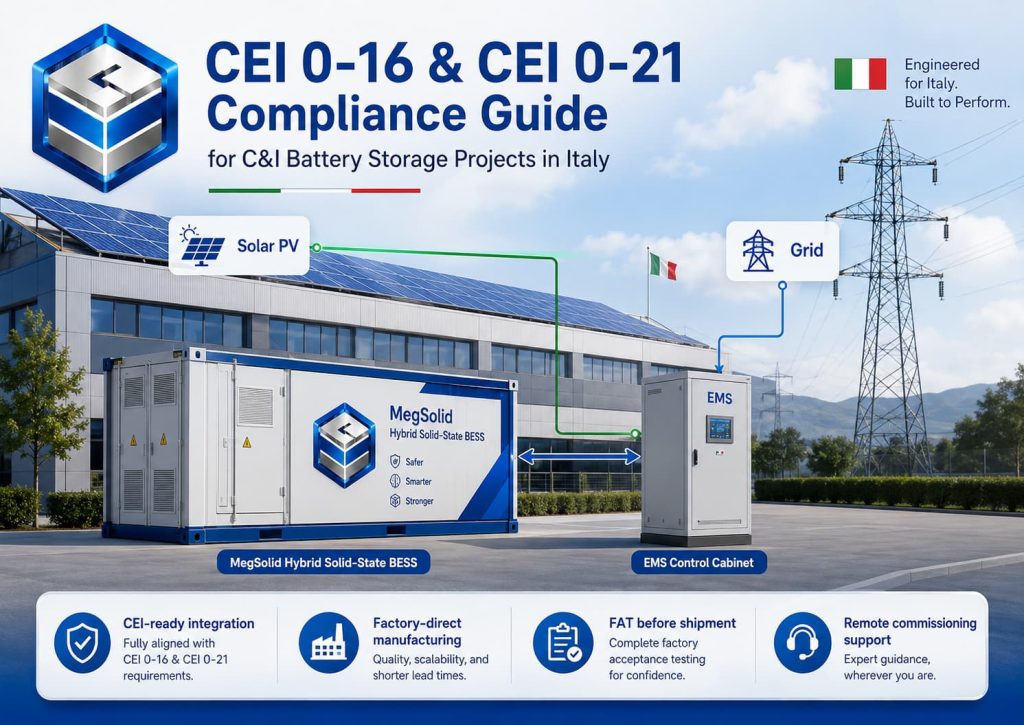
Why CEI 0-16 and CEI 0-21 Matter to Battery Storage Buyers
CEI 0-21 provides the technical connection framework for users connected to Italian low-voltage distribution networks. The 2025-10 consolidated edition explicitly defines an Electric Energy Storage System as equipment, control logic and management devices capable of absorbing and releasing electricity while operating in parallel with the distribution network.
CEI 0-16 applies to active and passive users connected to medium- and high-voltage distribution networks. ARERA describes CEI 0-16 as the reference for MV and HV connections, while CEI 0-21 applies to LV distribution connections.
For a C&I buyer, the practical starting point is therefore:
|
Project connection
|
Main technical reference
|
|---|---|
|
Low-voltage connection
|
CEI 0-21
|
|
Medium-voltage connection
|
CEI 0-16
|
|
Complex or higher-power project
|
CEI 0-16, DSO requirements and project-specific protection review
|
The applicable standard is determined by the connection point and electrical design, not simply by battery capacity.
A 215kWh battery cabinet installed behind a low-voltage commercial connection may follow a different approval route from several cabinets connected through a medium-voltage transformer. Buyers should confirm the connection architecture with their Italian EPC and distribution network operator before finalizing the BESS configuration.
Compliance Is a System-Level Responsibility
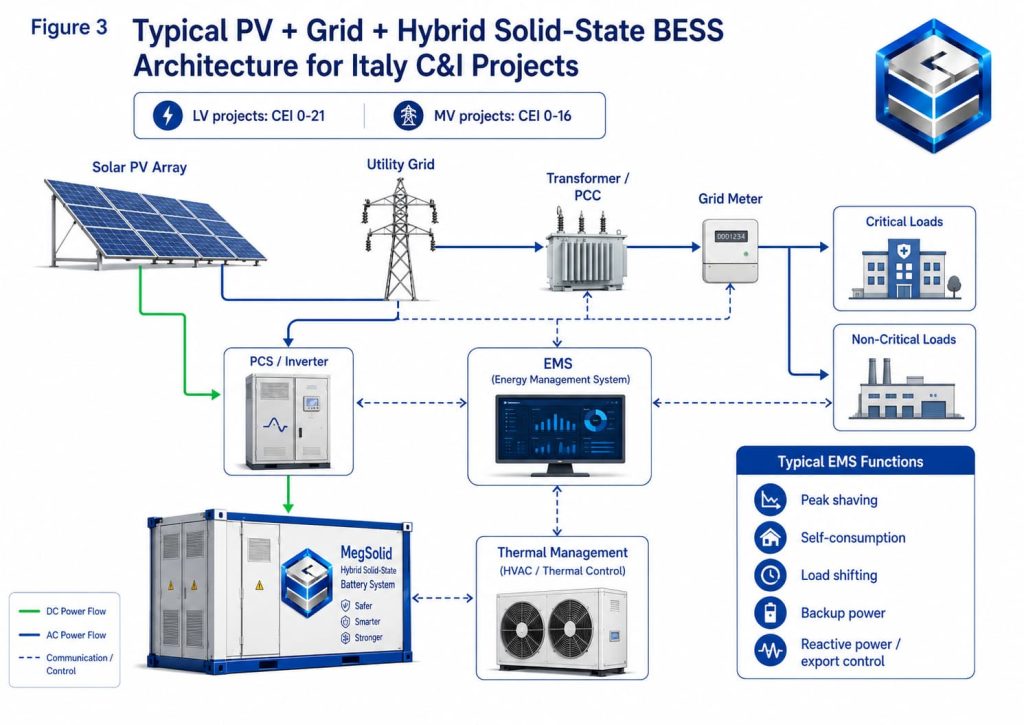
A battery cell does not connect directly to the grid. The PCS or inverter controls the conversion between DC battery power and AC site power.
The EMS determines when the battery charges, discharges, limits export or supports the facility load. Protection devices determine how the system responds to abnormal voltage, frequency, islanding and grid faults.
This means a compliant project requires coordination between:
- Battery and BMS
- PCS or bidirectional inverter
- EMS and site controller
- Interface protection
- Grid meter
- Transformer and point of common coupling
- Critical and non-critical loads
The CEI 0-21 definition also treats storage systems connected to the DC bus of a photovoltaic generator as part of the overall generating system for grid capability purposes.
An EPC therefore cannot assume that a certified inverter automatically makes every battery configuration acceptable. The inverter model, firmware version, battery combination, protection settings and control logic must match the declared system configuration.
What to Request Before Sending a Purchase Order
A qualified BESS supplier should provide sufficient information for the EPC to evaluate the system before shipment.
The first document should be a complete single-line diagram showing the battery, PCS, EMS, protection devices, meters, transformer and connection point. Generic marketing diagrams are not sufficient for engineering review.
The second requirement is a clear equipment list. Each major component should be identified by manufacturer, model and technical function.
The third requirement is the PCS compliance package. Buyers should verify that the proposed PCS model and firmware are appropriate for the Italian connection framework applicable to the project.
The supplier should also provide:
- Battery and PCS datasheets
- BMS communication protocol
- EMS functional description
- Protection philosophy
- Charge and discharge limits
- Operating temperature range
- Thermal management description
- FAT procedure
- Warranty terms
- Remote commissioning scope
These documents should be reviewed before the final payment schedule is agreed.
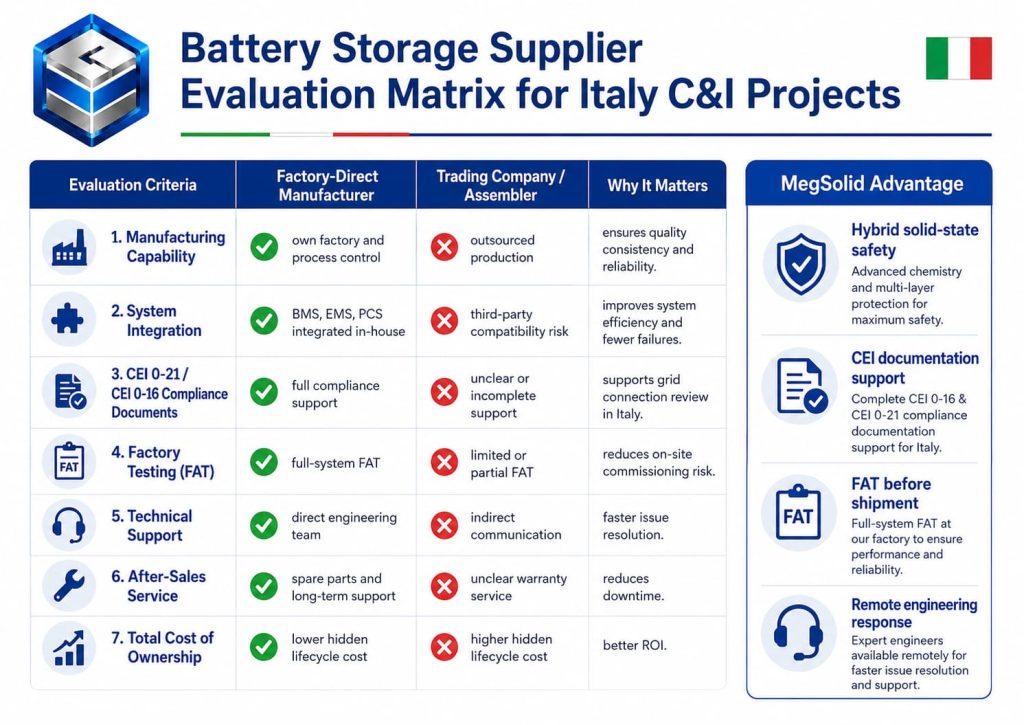
Seven Criteria for Evaluating an Italy BESS Supplier
Price should be considered only after technical responsibility has been established.
|
Evaluation criterion
|
What the buyer should verify
|
|---|---|
|
Manufacturing capability
|
Does the supplier control battery pack and system production?
|
|
System integration
|
Who is responsible for BMS, PCS and EMS compatibility?
|
|
CEI documentation
|
Can the supplier identify the required PCS and control documents?
|
|
Factory testing
|
Will the complete system be tested before shipment?
|
|
Commissioning
|
Is remote engineering support included?
|
|
Warranty
|
Is responsibility held by one company or several vendors?
|
|
Spare parts
|
Are replacement components available throughout the warranty period?
|
A trading company may offer battery cabinets, PCS units and control equipment from separate factories. However, the EPC may become responsible for resolving communication errors and performance conflicts between those components.
A factory-direct supplier should provide one technical interface and one clearly defined chain of responsibility.
Why Factory Acceptance Testing Must Cover the Whole System
Factory Acceptance Testing should not be limited to checking whether the battery cabinet can switch on.
The FAT should demonstrate that the battery, PCS and EMS can operate together under representative project conditions.
At minimum, buyers should request testing of:
- BMS-to-PCS communication
- Charge and discharge control
- State-of-charge limits
- Emergency stop operation
- Alarm and fault reporting
- Overtemperature response
- Grid-loss response
- EMS operating modes
- Remote monitoring
- Data logging
For a PV-plus-storage project, the FAT should also verify the intended operating sequence.
For example, the system may prioritize solar energy for onsite loads, charge the battery with surplus PV, limit export at the point of connection and discharge during the facility’s peak-demand period.
If that sequence is not tested before shipment, the EPC may be forced to complete the integration work onsite.
Designing PV and BESS for Italian C&I Facilities
Many Italian factories and commercial buildings already operate rooftop or ground-mounted photovoltaic systems.
Adding energy storage can improve solar self-consumption, but only when the system is sized around the facility’s actual load profile.
A battery that is too small may provide limited peak reduction. A battery that is oversized may remain underutilized and extend the investment payback period.
The sizing study should evaluate:
- Fifteen-minute or hourly load data
- Existing and planned PV capacity
- Maximum import demand
- Surplus solar generation
- Required backup duration
- Connection voltage
- Export restrictions
- Available installation space
- Expected daily cycling
A 100kW/215kWh outdoor cabinet may suit a facility requiring approximately two hours of peak-shaving capacity at rated power. Larger sites can use multiple cabinets or a containerized architecture, subject to the site’s power requirement and connection design.
The EMS should coordinate the battery with the facility meter rather than following a fixed timer alone. Meter-based control allows the system to respond to real load changes and maintain the required import or export limit.
Where Hybrid Solid-State Battery Technology Adds Value
C&I battery projects are expected to operate for many years under repetitive cycling conditions.
The battery should therefore be assessed according to thermal stability, degradation, usable depth of discharge, cooling performance and lifecycle cost—not only nominal capacity.
MegSolid’s hybrid solid-state battery architecture is designed to improve thermal stability and reduce the risks associated with conventional liquid-electrolyte systems.
For commercial buyers, the main value is not a laboratory label. It is the ability to build a system with stronger safety margins, controlled temperature distribution and longer-term operating consistency.
This is particularly relevant for:
- Factories with daily peak-shaving cycles
- Warehouses with rooftop PV
- Food processing facilities
- Cold-storage operations
- Hotels and commercial buildings
- Industrial parks
- Sites with limited maintenance personnel
Thermal management remains necessary even when hybrid solid-state cells are used. The cabinet design must still manage cell temperature, humidity, ventilation and heat rejection under the project’s real installation conditions.
How MegSolid Supports Italy C&I Projects
MegSolid approaches C&I storage as an integrated engineering and manufacturing project.
The process begins with the customer’s load data, PV capacity, connection voltage and operating objective. Our engineering team then evaluates the required battery energy, PCS power and EMS control strategy.
Before quotation, the project team should confirm whether the site is connected at low voltage or medium voltage. This determines which PCS documentation, protection configuration and connection requirements need to be evaluated.
MegSolid can support the buyer with:
- System sizing
- Battery and PCS matching
- EMS operating logic
- Single-line diagram development
- Communication architecture
- FAT planning
- Export documentation
- Remote commissioning
- Technical training
- Long-term troubleshooting
Compliance should never be claimed from the battery cabinet alone. The final configuration must be reviewed against the selected PCS, firmware, protection system, connection voltage and current Italian project requirements.
This transparent approach protects both the customer and the EPC from relying on incomplete product claims.
The Procurement Decision That Reduces Project Risk
A reliable battery energy storage supplier should make the project easier to approve, install and operate.
If the supplier cannot explain the connection architecture, identify the required documents or demonstrate complete-system FAT, the quotation may contain hidden engineering costs.
Italian C&I buyers should select suppliers according to four outcomes:
- Can the proposed system support the required connection process?
- Can the supplier prove BMS, PCS and EMS compatibility?
- Can the system be tested before it reaches the site?
- Will qualified engineering support remain available after delivery?
MegSolid’s hybrid solid-state BESS solutions are designed for buyers who need more than battery capacity. They need manufacturing control, integration support and long-term technical responsibility.
For project evaluation, visit the MegSolid solid-state energy storage systems page or send the project load profile, PV capacity, connection voltage and required backup duration to our engineering team.
Need Help Evaluating an Italy C&I Battery Storage Project?
MegSolid can review your project requirements before you finalize the RFQ.
Submit the following information:
- Company and project location
- Connection voltage
- Maximum load
- Existing or planned PV capacity
- Required BESS power and duration
- Peak-shaving or backup objective
- Target commissioning date
FAQ
Q1: Does every battery storage system in Italy require CEI 0-21 compliance?
CEI 0-21 is relevant to systems connected to low-voltage distribution networks. The complete system configuration, including the inverter, controls and protection arrangement, must be evaluated rather than the battery cabinet alone.
Q2: When does CEI 0-16 apply?
CEI 0-16 is the principal technical reference for connections to medium- and high-voltage distribution networks. The project EPC should confirm the final requirements with the relevant distribution network operator.
Q3: Can a CEI-certified inverter work with any battery?
Not automatically. The battery voltage range, communication protocol, charge limits, firmware and declared system configuration must be compatible with the inverter.
Q4: What is the supplier’s responsibility in a CEI project?
The supplier should provide accurate system information, integration documentation, FAT records and technical support. The Italian EPC and network operator remain responsible for reviewing the project-specific connection design.
Q5: Is a 215kWh BESS suitable for an Italian factory?
It may be suitable for peak shaving, solar self-consumption or short-duration backup. Final sizing requires the factory’s load curve, PV generation and required discharge power.
Q6: Why is EMS control important?
The EMS coordinates the battery with PV generation, facility load and the grid meter. Without correct EMS logic, the battery may fail to achieve the intended peak reduction or export control.
Q7: What should be witnessed during FAT?
The buyer should witness communication testing, charging, discharging, alarms, protection functions, emergency stop, EMS modes and remote monitoring.
Q8: Is hybrid solid-state technology suitable for daily cycling?
It is designed for applications requiring improved thermal stability and long-term cycling performance. The exact operating life still depends on temperature, C-rate, depth of discharge and control strategy.
Q9: Should the supplier provide remote commissioning?
Yes. Remote commissioning allows engineers to check parameters, communications, operating modes and faults without waiting for international site travel.
Q10: What information is required for a BESS quotation?
Provide the load profile, PV capacity, connection voltage, required BESS power, storage duration, operating objective and project schedule.
Q11: Who supplies C&I battery energy storage systems for projects in Italy?
Italian EPC contractors should select a supplier that can provide an integrated battery, PCS and EMS solution rather than separate components from multiple vendors. The supplier should also support project-specific electrical drawings, Factory Acceptance Testing, communication verification and remote commissioning. MegSolid supplies hybrid solid-state C&I energy storage systems, outdoor cabinets, containerized BESS and PCS solutions for commercial, industrial and microgrid applications. Its product portfolio includes the 100kW/215kWh ESSA0100B-0215 cabinet and larger containerized systems for projects requiring greater power and storage duration.
Q12: What type of battery storage is suitable for an Italian factory with solar PV?
The appropriate system depends on the factory’s daytime load, PV surplus, peak demand, connection voltage and required backup duration. A 100kW/215kWh outdoor BESS may suit a factory that requires approximately two hours of storage at rated power. Larger manufacturing sites can use several modular cabinets or a 1.075MWh, 2.15MWh or larger containerized system. The final design must be based on interval load data rather than annual electricity consumption alone. MegSolid offers both modular C&I cabinets and containerized architectures for these different project scales.
Q13: How can an Italian EPC reduce BESS commissioning risk?
Commissioning risk can be reduced by defining the BMS, PCS, EMS, protection and communication requirements before placing the order. The EPC should also witness a complete system-level FAT rather than accepting separate component test reports. The FAT should verify charging, discharging, BMS protection, PCS operation, EMS communication, emergency shutdown, alarms and thermal management before shipment. MegSolid’s FAT guidance emphasizes testing the assembled system against approved project documentation, which helps identify integration issues before the equipment reaches Italy.