 Skip to content
At an off-grid mine, a battery that handles steady load but cannot support the next motor start leaves the diesel system carrying the risk. Size the MegSolid MEGA battery and PCS package around the measured load steps, required energy and the generator operating envelope. Keep restart, recharge and reserve requirements in the same scope. Share the mine load sequence and generator data to obtain a proposed power-and-energy configuration before you buy capacity that misses the job.
The direct solution is to integrate a diesel hybrid power station using a grid-forming PCS and solar PV to create a reliable mining microgrid.
MegSolid offers named battery/PCS routes for a mine's power and energy duty. Ask for the supplied configuration, diesel/PV control sequence, protection settings and acceptance scope with the quote. Closing the reverse-power and recovery conditions before shipment is worth more than an undefined zero-trip promise.
The Engineering Shift to Mining Microgrid Electrification
The transition toward mining electrification requires robust remote power architectures.
A remote mine's electricity has to survive the actual supply and production schedule. Compare the diesel-only baseline with an approved PV/battery/generator architecture on fuel, availability, starting loads and reserve. The mine's permitted control and protection arrangements determine which route can carry the duty.
Core Engineering Challenge: Synchronizing high-inertia diesel generators with fast-response battery inverters without causing reverse power trips.
Use the BESS for the agreed reserve and load-step duty while respecting the generator manufacturer's minimum load, transient limits and permitted reverse-power conditions. The desired generator operating range comes from its fuel curve and the site's dispatch, not a universal 70–80% target.
When a load drops, battery charging and PV curtailment can help keep generation and demand balanced within their available headroom and response limits. Model fuel use from the generator curve and actual dispatch, including recharge and low-solar periods. A fixed 40–60% diesel reduction is not established by installing storage alone.
If you are evaluating a PV-Diesel-BESS Hybrid Microgrid, understanding these load dynamics is the first step.
Before finalizing your RFQ, download our Mining BESS Procurement Checklist to verify all technical requirements.
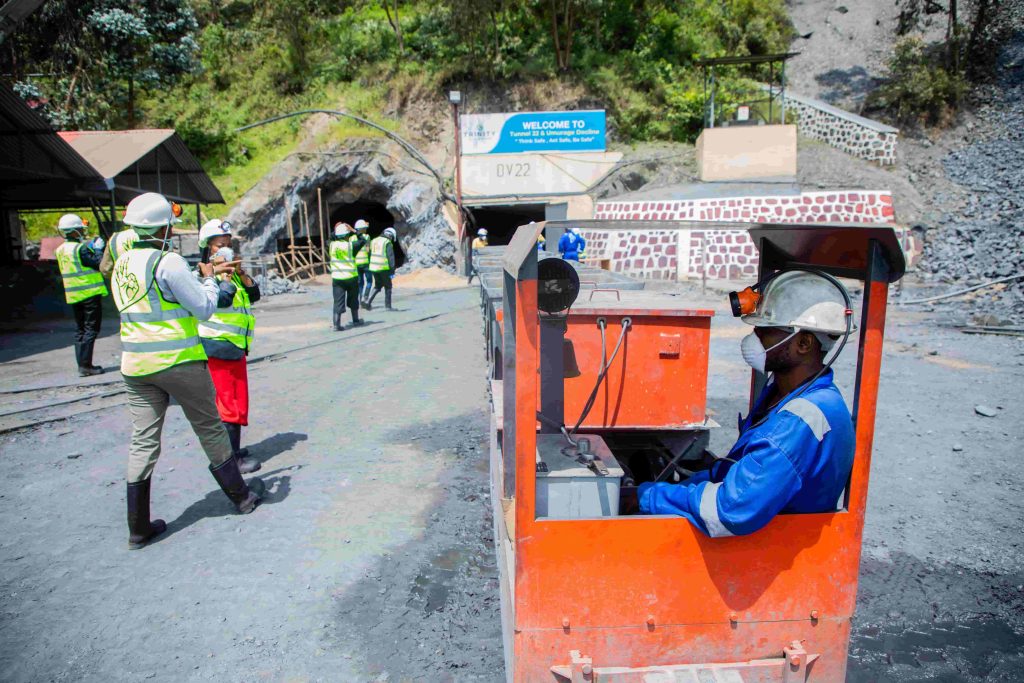
Illustrative Mining Duty: 1 MW/2 MWh Diesel Hybrid Power Station
Make the mine's load step and outage window the acceptance target. A capacity label will not tell you whether a conveyor restarts safely or the generator stays within its permitted operating envelope.
For an illustrative Northern Cape mining design, examine the conveyor start events and voltage limits alongside the continuous critical load. The figures below are a planning scenario, not a verified deployment or operating result.
Use 1 MW/2 MWh storage, 1.5 MW PV and 2 MW diesel as illustrative project inputs to test. Two MWh nominal gives two hours at 1 MW before reserve, losses and auxiliaries. MegSolid's current ESSC1000B-2150 lists 1 MW/2.1504 MWh with 400 V AC and air cooling; confirm its approved modes and generator/control interface separately.
A 50% load drop requires a defined generation response. Calculate available battery charging headroom and PV curtailment, then test the generator power, voltage/frequency, alarms and recovery under the agreed step. A generic 10 ms converter headline is not proof of the whole diesel-hybrid response.
Calculate the diesel baseline and proposed fuel use under the same production duty using measured electrical output, run hours and generator fuel curves. Include low-solar days, recharge and required reserve. The scenario does not establish a realised 48% six-month reduction.
Price commissioning from the actual factory scope, site readiness, interfaces and available local team. Agreed FAT records and control drawings can reduce unresolved work, but this scenario does not prove a twelve-to-four-day installation result.
A credible mine offer closes the load, usable-energy window, generator limits and acceptance scope together. Request that matched configuration before committing the production schedule to the new power system.
Send the load/step records and proposed generator/PV configuration to MegSolid. Ask for the model selection, control assumptions and FAT/SAT evidence schedule with the budgetary quote.
Design Errors That Can Stop a Mining Microgrid
True engineering expertise involves preventing project failures before they occur.
During technical RFQ reviews, our engineering team frequently identifies critical design errors that would otherwise halt mine operations.
- Island and black-start mode: specify an approved source/control architecture and startup sequence; a generic on-grid or off-grid rating alone does not prove mine black start.
- Generator loading: use the permitted minimum load, reverse-power limit and actual fuel curve; there is no universal 30% rule.
- Cables: size voltage drop, current, temperature, short-circuit duty and protection for the approved DC/AC route.
- Load steps: measure start current/kVA, acceleration and simultaneous loads; match the converter, generator and start sequence to the agreed response.
- EMS priorities: coordinate reserve, PV curtailment, battery limits and generator protection, including stale signals and fallback.
Avoiding these mistakes requires an engineering partner, not just a hardware vendor.
Need help defining your technical requirements? Schedule an EMS Logic Consultation with our engineering team.
Factory Direct vs. Trading Company: Integration Authority
When comparing a BESS supplier in South Africa, make the equipment, integration and service responsibilities visible in the offer. A manufacturer and a regional integrator can each contribute; the mine needs to know who owns the model, settings, commissioning and recovery route.
Map the actual order responsibilities: cell/pack supply, battery/PCS integration, site electrical work, controls, commissioning and service. Business labels alone do not establish authority over each interface.
Ask who can supply the controlled BOM and witnessed FAT for the offered configuration, and who owns the approved EMS logic. Record the party and document scope in the order rather than assuming a trader cannot arrange validation or a factory automatically supplies every site service.
MegSolid operates as a direct manufacturing base, providing integration facility capabilities and full system validation.
Request the named equipment schedule, serial/batch traceability, technical contact, delivery terms and support scope with MegSolid's price. This gives the EPC a direct equipment proposal to compare against the same integration and operating requirements.
Check factory identity and the offered equipment's traceability, matched transport/test documents and acceptance records. A production video or a UN38.3 reference alone does not prove the complete mine-control capability.
Verify our manufacturing capabilities. Schedule a virtual production line tour today.
Solving the 5 Biggest Fears of Mining BESS Procurement
Procurement managers don't fear the technology; they fear project failure.
Addressing these fears requires deep engineering foresight.
- Fear: the mine stops during an outage. Specify the critical loads, acceptable break, island/black-start sequence and tested AC runtime; black start is not a universal sub-10 ms transfer.
- Fear: a reverse-power trip stops the generator. Agree its permitted limits and demonstrate battery charging/PV curtailment and fallback within available headroom.
- Fear: dust, vibration and heat stop the equipment. Match Outdoor Cabinet Energy Storage Systems or the selected container to the actual intake/service arrangement, temperature/power limits and mine position.
- Fear: no one can commission or recover the plant. Name the local and remote responsibilities, tools, fault records and service terms in the order.
- Fear: a late shipment blocks expansion. Agree the BOM, document release, manufacturing/FAT and delivery milestones with the commercial terms.
Understanding your BESS ROI in South Africa requires a partner who understands these lifecycle risks.
Upload your load profile for a preliminary remote power sizing review.
How to Size a Remote Power BESS and Calculate Diesel Offset
Turn the mine's fuel bill and outage risk into a sizing brief the EPC can price. Start with the electrical duty and generator records, then test the proposed battery/PCS and control schedule against them.
How much diesel can actually be offset?
A Hybrid Solar-Storage Architecture can reduce generator run hours when solar, usable storage and dispatch cover the agreed load. Calculate the litres displaced under the actual fuel curve and operating schedule; a universal 40–60% offset is not established here.
The calculation depends on your mine's daily load profile and the peak demand of heavy machinery.
Generator matching is critical. Specify its minimum load, permitted reverse power, response limits and reserve, then verify battery charging/curtailment headroom and the actual load-step response.
Build the first sizing brief from hourly loads, critical-load duration, motor starts, fuel/output records, generator data and the planned PV profile. Keep the peak-power and delivered-energy calculations separate.
Model battery charging/discharging and generator fuel under the same hourly schedule, including low-solar periods and reserve recovery. Compare the proposed control strategy with the diesel-only baseline.
Ask MegSolid to return the cabinet or PCS/battery configuration, usable-energy basis, generator control scope and a budgetary offer from those inputs. Your EPC can then check the electrical and commercial assumptions before formal RFQ.
Send that sizing brief to MegSolid for a matched configuration and control-scope proposal.
Why EPCs Choose Single Vendor Responsibility
The ultimate competitive advantage in mining energy transition is single vendor responsibility.
Multiple interfaces become expensive when responsibility is undefined. Put battery, BMS, PCS, EMS and site work into one responsibility schedule, whether the order uses one supplier or several.
A coordinated MegSolid equipment and integration offer should close these responsibilities:
- Warranty: named responsibilities, covered equipment, duty, exclusions and claims route.
- EMS: approved point map, priorities, control ownership and fallback.
- PCS: the supplied model/firmware and demonstrated required operating modes.
- BMS: approved limits, protection actions and data interfaces.
- FAT: witnessed checks of the identified factory configuration.
- SAT: installed generator, protection, meter and communications interfaces.
- Engineering/service: named contacts, scope and agreed response/parts terms.
That responsibility schedule lets the EPC compare MegSolid's equipment and engineering scope against the mine's actual load, acceptance and service requirements.
Request a single-line diagram (SLD) for your typical mining layout.
What Documents Will You Receive?
B2B procurement managers need certainty about project deliverables.
Agree the model-specific document schedule with the quotation. Identify what is supplied, when it is released and who owns the corresponding site record:
- Single Line Diagram (SLD)
- Layout Drawing
- General Arrangement (GA) Drawing
- Factory Acceptance Test (FAT) Report
- Type Test Report
- EMS Logic Diagram
- PCS Datasheet
- BMS Manual
- UN38.3 Certification
- Packing List
- Commissioning Guide
The document handover gives the local EPC the agreed equipment and interface basis. Installation still requires the site's electrical, civil, safety and approval readiness.
Ready to receive your documentation package? Request a budgetary quotation today.
Is Your Mining Project a Good Fit for MegSolid?
True engineering companies don't say "all projects fit." We define our scope to ensure your success.
Use this self-assessment table before issuing an RFQ:
|
Project Condition |
Configuration discussion to open |
Recommended Solution |
|---|---|---|
| Existing diesel generators | Confirm generator limits and approved hybrid design | PV + Diesel + BESS Hybrid |
| Remote off-grid mine | Confirm island/black-start controls and accepted critical duty | Grid-forming PCS + ESS |
| Grid-connected mine with unstable supply | Confirm permitted grid and backup modes | Peak shaving + backup power |
| Underground mining | Mine-specific safety and installation review required | Custom ventilation & safety design |
| Temporary exploration camp | Match the camp load, voltage and energy window | Smaller modular ESS |
| Less than 50 kW continuous load | Evaluate a smaller matched configuration; not automatic exclusion | Smaller commercial ESS may be more suitable |
Use the table to start a configuration discussion; the markers do not establish mine-specific safety approval or equipment suitability. Send the site duty and installation conditions for the model and responsibility scope.
Not sure if your project fits? Send us your hourly load data for a feasibility review.
Comprehensive After-Sales Engineering Support
Industrial clients care more about after-sales than initial hardware specs.
What happens after the container leaves the production facility?
A robust remote power system requires closed-loop support.
- Remote diagnostics: define access, alarm records, technical contact and agreed response terms for the configuration.
- Spares: agree the critical parts list, stock/shipping route, freight and replacement responsibility.
- Firmware: identify the approved versions and controlled update/retest procedure.
- Expansion: obtain the permitted power/battery/control architecture before adding modules.
- BMS support: agree accessible data, logs, troubleshooting responsibility and warranty route.
- Commissioning: name remote and on-site roles with the agreed SAT and mine operating permissions.
Compare the actual service and recovery commitments in every offer. Ask MegSolid for the named technical route, required fault records, parts terms, remote-access scope and local work responsibilities; business category alone does not establish those outcomes.
Want to learn more about our after-sales support? Schedule an engineering consultation.
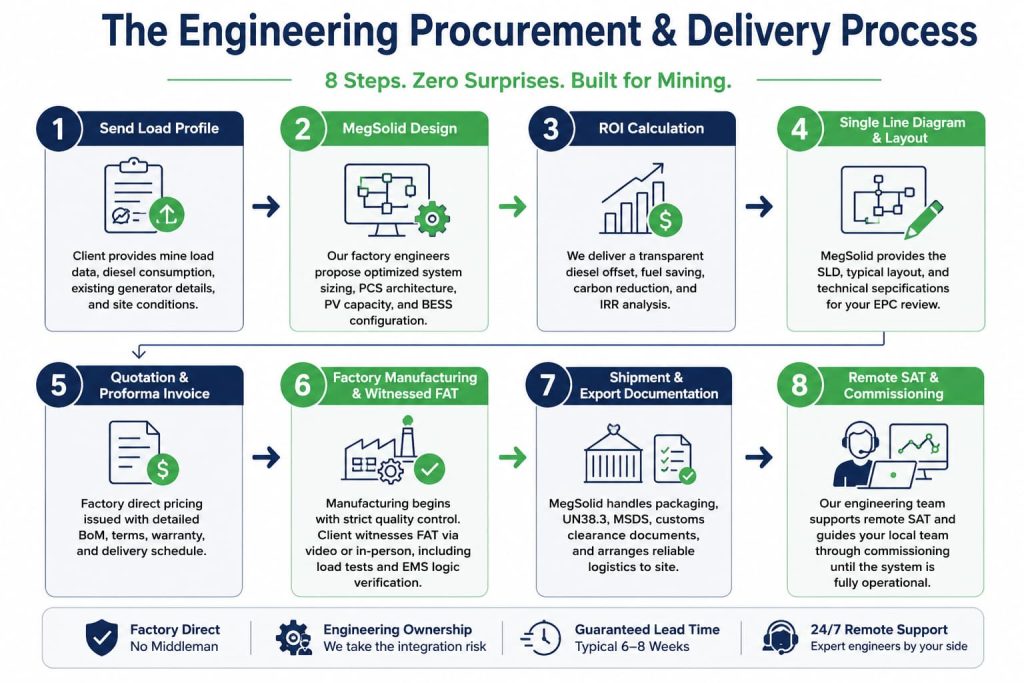
The Engineering Procurement & Delivery Process
Agree the following stages and their deliverables before the order. Tie each release to the actual configuration, document pack, site readiness and commercial terms.
- Step 1: Send Load Profile: Client provides mine load data and diesel consumption.
- Step 2: MegSolid Design: Factory engineers propose system sizing and PCS architecture.
- Step 3: ROI Calculation: We provide a transparent diesel offset and IRR model.
- Step 4: Single Line Diagram: We deliver the SLD and typical layout for your EPC.
- Step 5: Quotation & Proforma Invoice: Direct manufacturing pricing issued.
- Step 6: Manufacturing & Witnessed FAT: Client inspects the system via video or in-person.
- Step 7: Shipment & Export Docs: We handle UN38.3 and customs clearance docs.
- Step 8: Remote SAT & Commissioning: Engineering team guides local electricians via remote link.
To further mitigate commercial risks, EPCs should reference our deep dive on Solid State Battery Inverter Integration to understand hardware compatibility.
Avoid deployment disasters by studying the differences in Sourcing C&I BESS: Factory Direct vs Trading Co., as mining projects require direct engineering support.
Ensure your system's BMS & EMS Communication Architecture is factory-validated to handle complex priority dispatching.
By following this process, our team transforms complex procurement into a streamlined engineering handshake.
5 Questions to Ask Before Issuing a Mining BESS RFQ
Before you send your RFQ to any supplier, establish your expert authority by asking these critical engineering questions:
- Can your PCS operate in true grid-forming mode without an external grid reference?
- Can you provide witnessed FAT records including load step response testing?
- What is the maximum load step response time for a 50% load drop?
- How is diesel synchronization verified to prevent reverse power trips?
- Who will commission the system on site, and is remote support included?
If a required function or acceptance record is missing, keep that point open in the offer and close it before the corresponding release. Evidence should match the supplied configuration, not merely the supplier's business label.
A BESS supplier in Africa should be evaluated through the actual equipment, technical contact, delivery schedule and local/service responsibility scope. Put those commitments into the mine's proposal.
Ask MegSolid to identify the offered model, supporting records and any project conditions still needed to answer all five RFQ questions.
Ready to start the formal RFQ process? Contact our engineering center today.
FAQ
Q1: What makes a BESS suitable for off-grid mining operations in South Africa?
Specify the mine's required island/black-start functions, battery energy, AC/DC power, protection, enclosure and diesel/PV dispatch. The supplied PCS/firmware and site architecture must demonstrate those functions. IP54 alone does not establish suitability for every dust exposure, underground installation or mine-safety requirement.
Q2: Can the MEGA series PCS operate in off-grid mode without a diesel generator?
Off-grid rated voltage in the MEGA PCS table does not by itself establish black-start capability. Confirm the offered model/firmware, energisation sequence, transformer/motor inrush, auxiliaries, SOC reserve and protection/interlocks. Include the approved black-start procedure in FAT/SAT; do not equate it with an inverter transfer-time rating.
Q3: How does the EMS prevent reverse power trips on diesel generators?
Define the generator's permitted minimum load and reverse-power limits from its own data and protection settings. The EMS can coordinate battery charging and PV curtailment within available headroom, but those limits and the measured control response must be agreed and tested. A universal 30% minimum does not apply to every genset.
Q4: What is the load step response time of the off-grid BESS?
Test the specified load drop and motor-start event in the complete supplied hybrid configuration. Record generator power, voltage/frequency, PCS limits, charging headroom and protection response. The public PCS table does not establish a universal sub-10 ms response to every 50% mine-load step.
Q5: Why is an isolation transformer critical for mining BESS procurement?
The MEGA PCS range lists built-in isolation transformers, giving the electrical design a defined isolation interface. Surge, fault, earthing and insulation protection still require the actual configuration and coordinated devices. An isolation transformer alone is not a guarantee against every mine surge or equipment fault.
Q6: What IP rating is required for outdoor BESS in African mining environments?
The ESSA cabinet and ESSC container listings give IP54; that rating does not mean total protection against conductive dust or prove a separate IP6X control compartment. Specify dust exposure, cleaning, intake arrangement and any mine-specific hazardous-area or installation requirements for the offered configuration.
Q7: How does the BESS improve diesel generator efficiency?
Use battery reserve and charging to support the agreed generator dispatch within the offered limits. Select generator loading from its fuel curve, minimum-load requirement, transient limits and site reserve. A fixed 70–80% optimum or guaranteed prevention of wet stacking is not established for every generator.
Q8: What communication protocols are used to integrate with existing mine SCADA systems?
ESSA/ESSC listings include RS485 and TCP/IP for EMS. Confirm the supported protocol/register map, control authority, timestamps, alarm records and communications-loss/recovery sequence for the mine's SCADA/HMI. The interface names alone do not prove seamless integration.
Q9: Can the system handle extreme ambient temperatures common in the Northern Cape?
ESSA and ESSC air-cooled products list 0–45°C operation. Energon 261 lists liquid cooling and −20 to +55°C with derating above 45°C; 5000INTL lists liquid cooling and −30 to +55°C. Select from the actual ambient, intake heat, available-power curve and duty rather than assuming any liquid-cooled package has unlimited high-temperature output.
Q10: How is the solar-diesel-battery integration verified during FAT?
Agree the factory test setup and required functions for the actual model. Simulators and load banks can exercise the agreed control and power boundary, but the final mine's generator, switchgear, motors, communications and protection require their own site checks. Record the instruments, conditions, results and open points in FAT/SAT.
Q11: How do I source a reliable BESS supplier in South Africa for mining operations?
Source the configuration against the mine's load and island/black-start requirements, enclosure conditions, control interfaces, acceptance evidence and service scope. Ask MegSolid for the named battery/PCS route and a responsibility schedule including local commissioning and fault recovery.
Q12: Can a solar-diesel-BESS hybrid system completely replace diesel generators in a mine?
Retain the generator contribution required by the approved reserve and recharge design. How much diesel can be displaced depends on hourly load, solar resource, usable storage, generator limits and the accepted low-solar duty. Complete diesel removal is a separate design obligation, not an automatic first-stage result.
Q13: What is the biggest risk when integrating BESS with diesel generators?
Reverse power is one important diesel-hybrid risk, alongside energy shortfall, starts, protection and communications failure. Define the permitted limits and control response, then test them in the complete configuration. An EMS label alone does not prove trips cannot occur.
Start with the loads that stop production. Send MegSolid the hourly load/step records, critical-load duration, diesel fuel/output data, generator limits and planned PV profile. Request the battery/PCS configuration, usable-energy window, control assumptions, acceptance scope and budgetary offer together. Your EPC can then compare the complete mine power proposal before placing the order.
