A 100kW PCS Quote Can Still Leave Your C&I Project Unable to Deliver
In C&I Energy Storage, the expensive mistake is buying a power rating before you define what that power must do. A 100kW PCS that misses the battery voltage, backup sequence or reactive-power duty can leave a paid-for BESS restricted at handover.
Start with measured load, required operating modes, usable-energy duration and grid limits. Then make the supplier identify the converter, battery and controls that will pass the agreed site tests. This is how a power-conversion purchase becomes a working commercial system.
A 100kW Solid State Inverter for C&I ESS is a candidate for a defined factory, warehouse, commercial, farm, EV or microgrid duty. It is not a universal best-value size. Select active and apparent power, overload, battery voltage/current, environment and operating controls from the actual load and order scope.
MegSolid can review a dedicated transformer-integrated PCS, a modular PCS or a complete cabinet route. Identify the offered battery chemistry and BOM separately; a converter’s semiconductor design does not make every battery connected to it hybrid solid-state.
When Does a 100kW Converter Fit the C&I Load?
A site with 80–300kW of demand still needs an interval-load and event study. The controlled part of the peak, backup load or charging duty may be smaller than total demand; an uncontrolled 300kW load is not covered by a single 100kW PCS.
Use the application to define the required duty, rather than treating the label as a sizing result:
- Factory: measured peaks, motor start and critical backup loads
- Cold store: refrigeration duty and reserve during recharge restrictions
- Hotel: night load, acoustic/location constraints and critical circuits
- Commercial building: actual demand tariff, interval load and dispatch budget
- Agriculture: pump start, irrigation duty and grid/PV/generator supply
- EV charging: charger schedule, PCC limits and import-control headroom
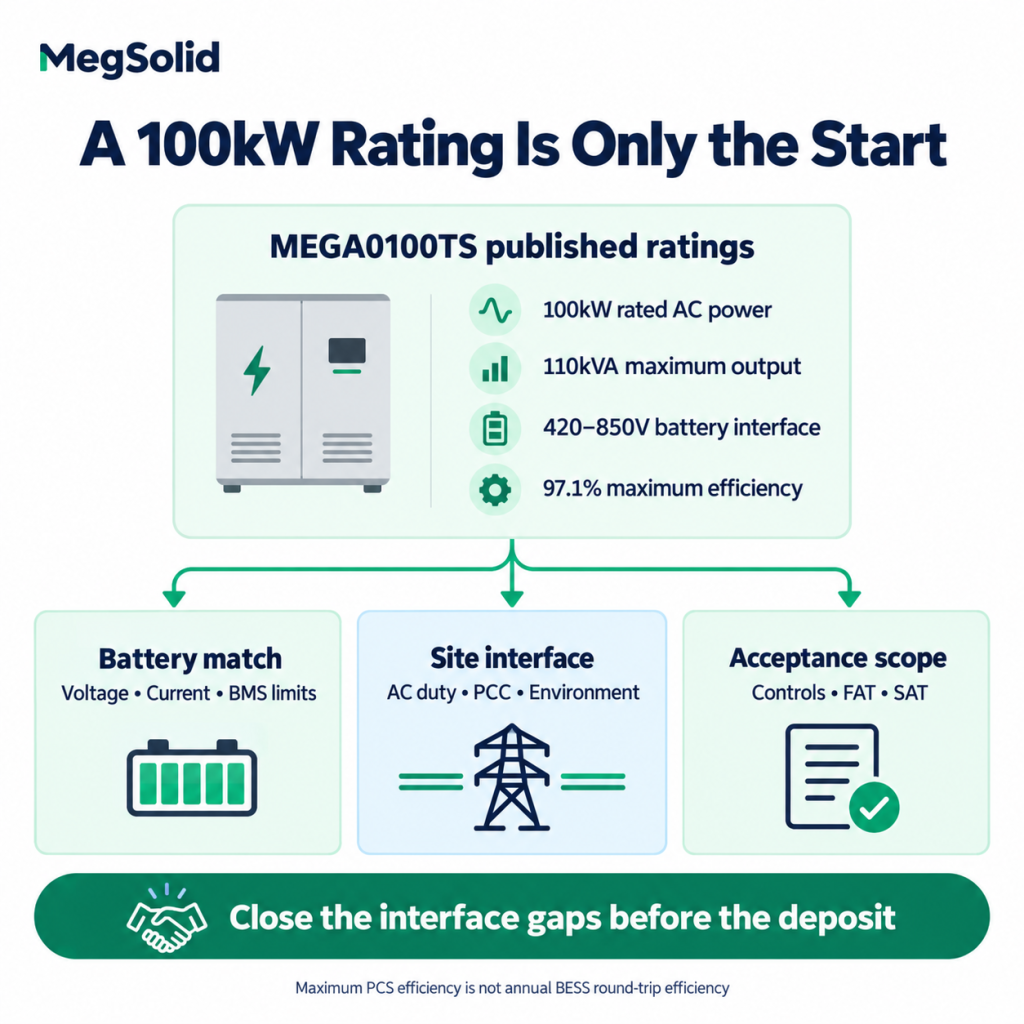
Compare the MEGA0100TS transformer-integrated 100kW PCS with the MegSolid 80–125kW modular PCS route. The MEGA0100TS public table lists 100kW rated AC, 110kVA maximum output, a 420–850V DC range, 270A maximum DC current and 97.1% maximum efficiency. The modular route is a separate architecture with its own ratings and integration scope.
Before choosing one large converter or several smaller units, compare these four purchase boundaries:
Installed Investment
Compare the complete equipment, transformer, protection, controls, installation and commissioning scope. A smaller PCS price is not automatically a lower installed project cost.
Efficiency at the Actual Duty
Request the efficiency curve over the real load and voltage range, including auxiliaries and standby. Maximum efficiency is a point on a product specification, not annual system round-trip efficiency.
Expansion with a Validated Plan
Define supported parallel controls, switchgear capacity, protection, battery arrangement and grid permission. Additional units need an approved integration and acceptance scope; spare floor space alone does not make expansion plug-and-play.
Service and Operating Availability
Price diagnostics, spares, isolation, local labor and return-to-service responsibilities. Redundancy and maintenance access should match the owner’s operating needs, rather than being inferred from the number of converter cabinets.
What Does “Solid State Inverter” Mean for an ESS Buyer?
Modern energy storage inverters use semiconductor power electronics to convert and control electrical power. The term solid-state inverter describes a converter architecture; it is not evidence of a solid-state battery chemistry or a unique performance advantage.
The relevant question is what the offered PCS can demonstrate: conversion efficiency over duty, control response, power quality, thermal limits, protection and supported interfaces. Request the exact model and test boundary for each claim.
Turn the converter headline into measurable acceptance requirements:
- Response: defined event, command path and time-aligned witness traces
- Power quality: actual PCC/load conditions and applicable evidence
- Efficiency: model curve across actual voltage/load duty
- Thermal: supplied cooling, enclosure and derating conditions
- Loss model: converter, transformer, auxiliaries and standby
Use a time-weighted loss calculation over the expected dispatch profile. It reveals whether an efficiency difference is material after transformer losses, auxiliaries, standby and battery duty are included.
The Hidden Cost: A Converter Nobody Agreed How to Accept
A detailed battery quotation can still leave the PCS, EMS and site interfaces undefined. That uncertainty often appears when the EPC asks the system to follow a real PCC signal or transition to an off-grid load.
Prevent an equipment-versus-installer dispute by naming who owns DC matching, meter installation, control priorities, grid settings and the witnessed FAT/SAT. Request an interface matrix and release criteria before the deposit.
Common issues include:
Excessive Heat Generation
Review the converter’s actual cooling, air path, operating temperature, enclosure and derating. A battery thermal claim does not establish acceptable PCS temperature at the site.
Lower Conversion Efficiency
Quantify converter, transformer and auxiliary losses at the actual duty. A low-load installation can spend many hours away from the advertised maximum-efficiency point.
Poor Grid Compatibility
Confirm the required site AC voltage/frequency, protection, active/reactive commands, power quality and applicable interconnection evidence for the offered configuration.
Limited Scalability
Specify expansion controls and evidence before award: bus capacity, fault duties, synchronization, EMS ownership, battery arrangement and revised grid permission.
A defined acceptance and service package lets the owner compare whole-life cost and recover operation after a fault. Leaving those items outside the offer can overwhelm an apparently attractive PCS price.
Why Inverter Efficiency Matters More Than Most Buyers Realize
For an illustrative energy storage system comparison, assume 500,000kWh of converter input energy per year and constant one-way efficiencies of 95% and 98%. The following calculation is arithmetic, not a MegSolid measured annual result:
Illustrative 95% One-Way Conversion
500,000 × (1 − 0.95) = 25,000kWh of converter loss per year under that simplified assumption.
Illustrative 98% One-Way Conversion
500,000 × (1 − 0.98) = 10,000kWh of converter loss per year under the same simplified assumption.
Difference:
The illustrative difference is 15,000kWh per year. It does not establish the MEGA0100TS rating or whole-system round-trip performance.
For a real bid, integrate actual load/voltage efficiency data, charging and discharge paths, transformer and auxiliaries, standby, degradation and tariff. Keep the energy boundary consistent before valuing the loss difference.
Request that model with the equipment quotation. The buyer can then challenge both the upfront cost and the operating assumptions using the same duty profile.
MegSolid Product Routes: Match the PCS and Battery at the Right Boundary
A cell supplier, a battery-pack supplier and a complete ESS integrator deliver different scopes. Compare the offered scope rather than assuming that every catalog covers the site interfaces.
A stand-alone PCS needs a compatible battery and defined EMS/site controls. An integrated cabinet still needs an installation, grid and acceptance package for the actual site.
Ask MegSolid to return a named product route and the remaining integration gaps against your project inputs.
Keep the following components and responsibilities visible in the offer:
- Battery route: hybrid solid-state batteries or conventional battery with an exact model/BOM and voltage/current limits
- PCS route: named MEGA TS or modular converter with its own published ratings
- EMS: delivered modes, priority, meter map and failed-input response
- Equipment integration: drawings, revisions, protection and relevant evidence
- Site integration: EPC responsibilities, grid permission, installation and FAT/SAT
Single-supplier equipment can simplify coordination when the delivered configuration and support boundary are explicit. Require battery/PCS/EMS revisions, drawings, control ownership and acceptance evidence; a common logo alone does not remove interface risk.
Battery and PCS Matching: Chemistry Cannot Replace an Electrical Check
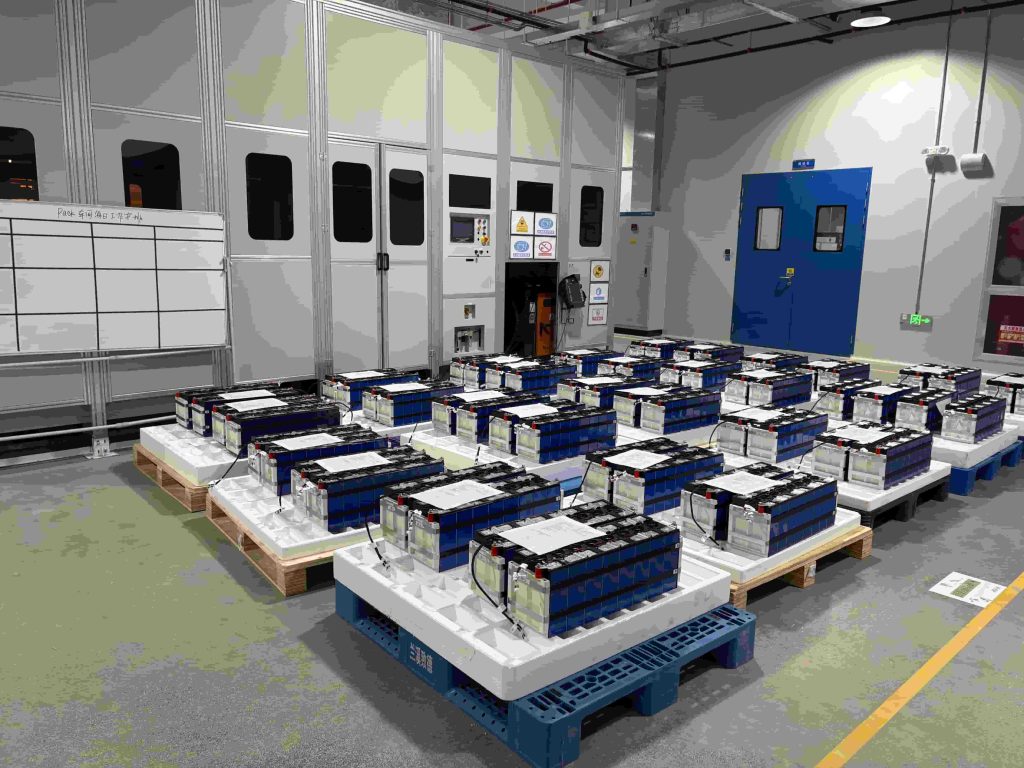
The PCS works inside the battery’s permitted voltage, current, power, temperature and state-of-charge envelope.
The BMS and EMS must communicate those limits and apply the approved response to alarms, stale data and failed communication.
A stable DC interface comes from the supplied battery architecture and controls at the intended duty, not from the electrolyte name alone.
Review a proposed hybrid or conventional battery against four requirements:
Thermal and Environmental Envelope
Check both battery and PCS operating/derating limits, cooling and enclosure. Require the site duty to remain within each supplied component’s limits.
Voltage and Current Coordination
Match charge/discharge current, SOC-dependent voltage, BMS limits, firmware and failed-input behavior. Do not connect a 51.2V residential pack directly to a PCS requiring a 420–850V battery interface.
Retained Performance and Service Scope
Use the offered battery’s retention/throughput basis and the converter’s maintenance and warranty scope. One cell cycle count is not a system availability guarantee.
Configuration-Specific Safety Evidence
Request relevant cell, battery, converter and system evidence for the actual BOM and installation. Hybrid solid-state terminology does not confer zero fire risk or approval for every project.
The result is an offer the EPC can size, integrate and witness. That is the foundation for commercial value and a credible customer handover.
Compare C&I ESS Offers on the Same Delivered Scope
|
Comparison Item
|
Competing offered scope
|
MegSolid route to qualify
|
|---|---|---|
|
Battery Technology
|
Exact cell/BOM and evidence
|
Hybrid or conventional battery; exact cell/BOM
|
|
System Integration
|
Supplier/EPC responsibility matrix
|
Defined battery/PCS/EMS/site responsibility matrix
|
|
Thermal Stability
|
Temperature/current envelope and reports
|
Offered configuration and operating evidence
|
|
Cycle Life
|
Matched DOD/current/temperature/retention basis
|
Model-specific cycle/throughput and warranty basis
|
|
Scalability
|
Validated parallel controls and site capacity
|
Defined supported architecture and expansion scope
|
|
High Temperature Operation
|
Actual enclosure, cooling and derating
|
MEGA TS IP21/forced air; site conditions to verify
|
|
Long-Term ROI
|
Common duty, tariff, loss and installed cost model
|
Project cash flow; no universal ROI ranking
|
For hot, humid, dusty or remote sites, specify the actual environment, cooling and derating, maintenance access and service route. An IP21 converter is not automatically an outdoor cabinet, regardless of the country name on the sales page.
Typical Applications for a 100kW Solid State Inverter
Manufacturing Facilities
Use measured demand to size controlled peak reduction, and separately define critical backup loads and motor-start requirements.
Commercial Buildings
Use the actual demand-charge tariff and interval load; reserve energy for any agreed continuity duty.
Agricultural Operations
Check pump/motor start, operating hours, cold-store critical load and PV or grid recharge availability.
EV Charging Stations
Define charger peaks, connection capacity, PCC metering, charge headroom and controls before sizing the BESS dispatch.
Data Centers
Qualify the UPS/protected-bus architecture, interruption limit, reserve and generator sequence. A PCS power rating alone does not establish uninterrupted IT supply.
Remote Microgrids
Define grid-forming/off-grid duties, load steps, PV/generator coordination, protection and witnessed transitions for the offered system.
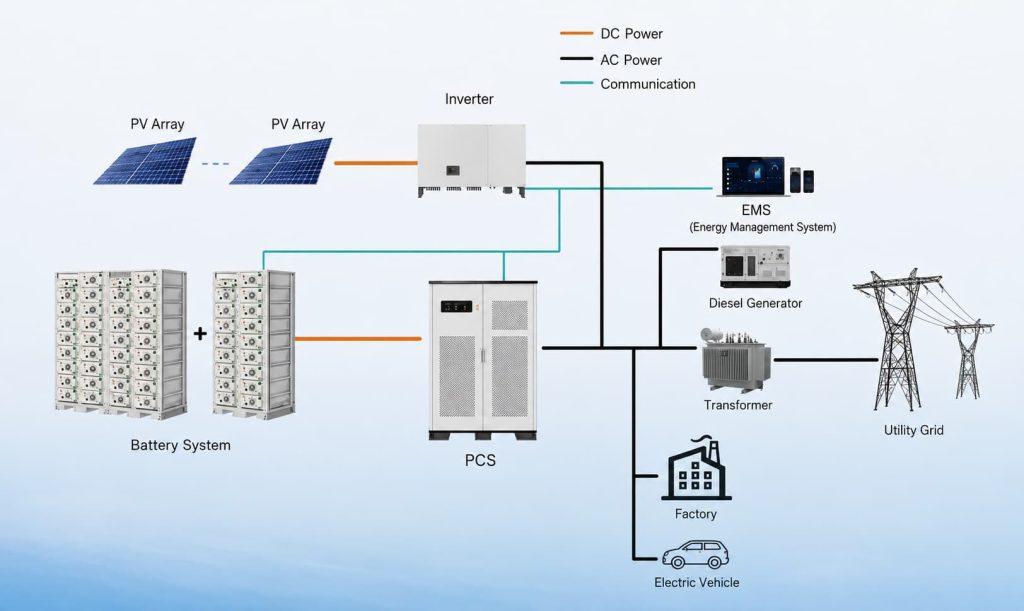
Give the EPC One Interface Matrix and One Acceptance Plan
Multiple suppliers can produce a workable project when the interfaces and responsibilities are defined. The scope commonly separates:
- Battery package: voltage/current, protection and BMS limits
- PCS package: conversion, active/reactive and supported grid/off-grid modes
- EMS/site package: metering, command priority, settings, protection and commissioning
The project still needs explicit ownership of the boundaries between those packages:
Use the MegSolid proposal to agree those boundaries and obtain the evidence required for release.
- DC/interface release: supported battery/PCS voltages, currents and firmware
- Commissioning: named test steps, limits, witness and corrective-action ownership
- Service: diagnosis route, spares, local labor and return-to-operation authority
Ask for a battery/PCS/EMS revision schedule, drawings, settings, meter/interface map, FAT/SAT and maintenance route. Keep the local EPC’s grid, civil, cabling, installation and site-test duties named in the same package.
Buy for the Duty You Will Actually Operate
More battery capacity will not fix a mismatched DC voltage, an unproven transfer sequence or a control loop fed by a faulty meter.
Build the purchase around deliverables that reduce those operating gaps:
- Configuration-specific safety and installation evidence
- Delivered control logic and failed-input behavior
- Qualified temperature/current operating envelope
- Retained-performance and service/warranty basis
- Installed and whole-life cost on a common duty
Compare hybrid and conventional battery configurations together with the selected semiconductor PCS and delivered controls. Choose the route that meets the required operating and acceptance scope with documented evidence.
Request a 100kW PCS Proposal That Can Reach Handover
The Solid State Inverter purchase should begin with the actual battery and site duty, then finish with a converter and control package the EPC can verify.
For the MEGA0100TS route, confirm the published 100kW/110kVA and 420–850V interface against active/reactive power, battery current, load events and the environment. Keep modular PCS and complete cabinet alternatives separate so the quotation does not combine incompatible ratings.
Use the supplier review to obtain five practical outputs:
- Named converter and compatible battery route
- Usable-energy, power and reserve assumptions
- Relevant model reports, drawings and interfaces
- Equipment/site responsibility and service matrix
- FAT/SAT acceptance and quotation gaps
Send MegSolid your country, SLD, interval load, required kW/kVA, usable-energy duration, battery voltage/BOM, grid import/export limit, PV/generator, backup sequence and site environment. Ask for exact model selection, control/interface scope, available relevant reports, equipment/site responsibilities and FAT/SAT release criteria.
Use the inquiry form to request a preliminary configuration and quotation with assumptions and open items. An offer that names the gaps gives your EPC a path to close them before award.
FAQ
Q1: What is MegSolid MEGA Series 100kW PCS used for?
The MEGA0100TS can be reviewed as a 100kW transformer-integrated power converter for a compatible C&I battery system. Peak shaving, backup and microgrid operation require the offered battery, EMS, site protection and permitted operating modes to be defined and witnessed.
Q2: How many batteries are required for a 100kW ESS?
Battery quantity follows usable AC energy/duration, DC voltage/current, thermal and retained-performance limits, reserve and the supported connection arrangement. A 100kW converter rating does not uniquely select 215kWh,233kWh or241kWh. The ESSA0100B-0215 integrated cabinet is a separate 100kW/215.04kWh route; a stand-alone MEGA0100TS needs its own compatible battery design.
Q3: What efficiency should a high-quality MegSolid MEGA Series 100kW PCS achieve?
The MEGA0100TS public table lists 97.1% maximum efficiency. An 80–125kW modular PCS has separate model data; do not extend its headline across the MEGA TS family. Request the actual duty/voltage efficiency curve and whole-system loss boundary. For a separate modular option, compare the pma modular ess inverter family and request the exact model's efficiency curve at the intended voltage and duty.
Q4: Why is inverter efficiency important?
Efficiency affects conversion losses at the specified duty. Value the actual charging/discharge profile, transformer/auxiliary losses, standby and tariff instead of treating maximum converter efficiency as annual system round-trip efficiency or guaranteed payback.
Q5: Can MegSolid MEGA Series 100kW PCS support EV charging stations?
A 100kW PCS can be assessed for an EV charging project when peak demand, usable energy, recharge, PCC signal and control limits fit. Define the charger/load schedule and import/export constraints; the rating does not prove every site can remain inside its connection capacity.
Q6: Why pair a solid state inverter with hybrid solid-state batteries?
Pair a PCS with the battery that meets the electrical, thermal, safety and lifetime duty. Identify hybrid or conventional cell/BOM evidence separately. Chemistry does not replace compatible voltage/current, delivered communications, protections or a witnessed operating sequence. Use the battery–PCS/BMS integration checklist to define the voltage, current, protocol and firmware evidence required for the offered pairing.
Q7: What is the lifespan of a commercial ESS inverter?
Use the offered converter’s design/maintenance, environment, operating duty, service and contractual warranty basis. A generic ten-to-fifteen-year horizon is not a guarantee for every installation or every component.
Q8: How does MegSolid improve ESS safety?
Review the actual cell/battery/PCS/BMS/EMS, applicable reports, fault response and installation requirements. Ask who owns settings, protection, isolation, emergency response and service. A hybrid battery label alone does not guarantee the complete system’s safety.
Q9: Is MegSolid MEGA Series 100kW PCS suitable for microgrid projects?
Assess the MEGA0100TS against the required islanded/grid modes, load steps, generator/PV coordination, reactive power, protection and transition tests. 100kW may fit a particular duty; it is not evidence that every microgrid architecture is supported.
Q10: Why choose MegSolid for C&I ESS projects?
Ask MegSolid to map a named PCS, battery and control route to your SLD, load and energy duty. Request interface ownership, drawings, relevant model evidence, FAT/SAT, delivery/warranty/service scope and a quote with remaining gaps. Compare the delivered package rather than universal portfolio promises.