 Skip to content
The Inverter Is No Longer Just a Power Converter
As solid-state battery technology continues to reshape the global energy storage industry, many project developers focus heavily on battery chemistry, energy density, and cycle life.
Even the most advanced solid-state battery system can fail to deliver its full performance if paired with an unsuitable inverter.
In real-world energy storage projects, battery and inverter compatibility directly affects:
- Charging efficiency
- Discharging efficiency
- Battery lifespan
- System safety
- Return on investment (ROI)
- Long-term maintenance costs
For commercial and industrial (C&I) projects, a mismatch between battery and inverter can reduce usable energy capacity, increase operating temperatures, and shorten overall project profitability.
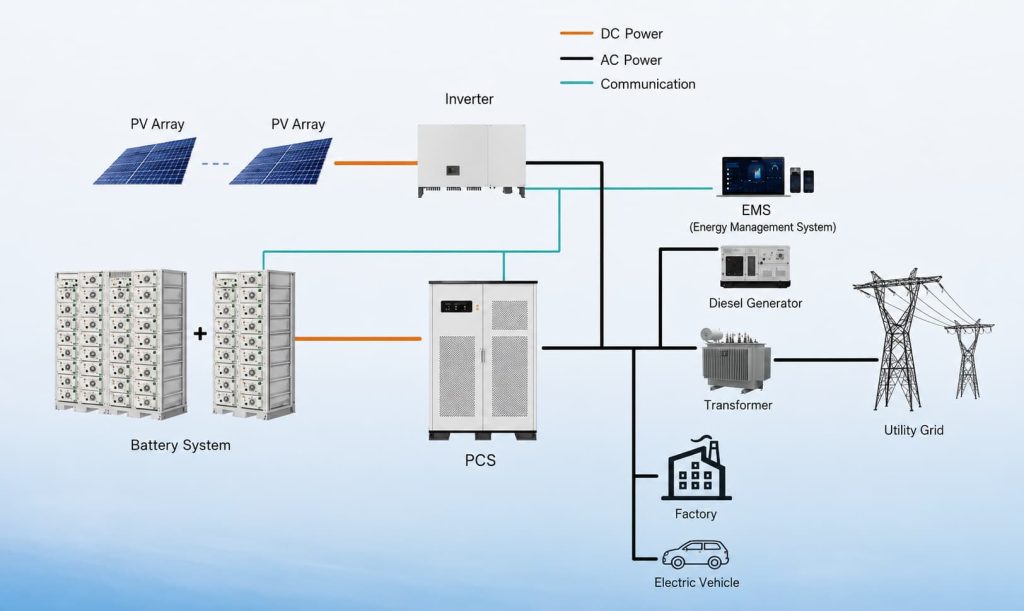
This is why selecting a high-efficiency solid state inverter has become one of the most important decisions in modern energy storage design.
Why Solid State Batteries Require Smarter Inverters
Traditional lithium-ion systems were designed around relatively predictable charging and discharging characteristics.
Hybrid solid-state batteries introduce several advantages:
- Improved thermal stability
- Higher safety margins
- Longer cycle life
- Higher energy density
- Wider operating temperature range
However, these advantages can only be fully utilized when the inverter can accurately manage battery behavior.
A modern inverter must continuously perform:
- Voltage regulation
- Current control
- State-of-charge management
- Grid synchronization
- Reactive power compensation
- Battery protection
Think of the battery as the engine and the inverter as the transmission.
A high-performance engine paired with a poor transmission will never achieve optimal efficiency.
The same principle applies to energy storage systems.
Key Factors When Matching a Solid State Inverter
1. Battery Voltage Compatibility
The first consideration is voltage compatibility.
Every battery system operates within a specific voltage window.
If the inverter's DC input range does not properly align with the battery voltage range, several issues may occur:
- Reduced charging efficiency
- Inverter shutdown
- Power clipping
- Increased system losses
Before selecting an inverter, verify:
- Nominal battery voltage
- Maximum charging voltage
- Minimum discharge voltage
The inverter should comfortably support the entire operating voltage range of the battery system.
2. Power Capacity Matching
One of the most common mistakes in energy storage projects is oversizing or undersizing the inverter.
For example:
|
Battery Capacity |
Recommended Inverter Range |
|---|---|
| 50 kWh | 30-50 kW |
| 100 kWh | 50-100 kW |
| 215 kWh | 100-125 kW |
| 500 kWh+ | 250-500 kW |
The configurations are only for reference in the preliminary design of the project, and the specific configurations shall be subject to the scheme design provided by the MegSolid engineering team.
Oversized inverters often operate below their optimal efficiency point.
Undersized inverters can become bottlenecks during peak demand.
The ideal design balances:
- Peak load demand
- Charging requirements
- Future expansion plans
- Solar generation capacity
3. Round-Trip Efficiency
Many buyers focus exclusively on battery efficiency.
However, inverter efficiency significantly impacts overall system performance.
Consider a project cycling daily:
- Battery efficiency: 95%
- Inverter efficiency: 96%
For illustration purposes only, System efficiency becomes:
95% × 96% ≈ 91.2%
A seemingly small difference in inverter efficiency can translate into substantial revenue losses over ten years.
This is especially important for:
- Peak shaving
- Demand charge reduction
- Energy arbitrage
- Microgrid operation
4. Bidirectional Power Flow Capability
Modern energy storage systems require seamless charging and discharging.
A high-quality inverter should support:
- Battery charging
- Battery discharging
- Grid export
- Grid import
- Solar integration
MegSolid's PCS architecture was specifically developed for intelligent bidirectional energy conversion, enabling efficient power flow management across diverse applications.
5. Battery Communication Protocol
Many integration problems originate from communication incompatibility.
A reliable inverter should communicate effectively with the Battery Management System (BMS).
This enables:
- Real-time monitoring
- Fault diagnosis
- Dynamic charging control
- Cell balancing support
- Predictive maintenance
Without proper communication, even premium batteries may operate inefficiently.
Why Inverter Efficiency Matters More in Commercial & Industrial ESS
Residential users may notice efficiency differences only after several years.
Commercial operators experience the impact immediately.
For example:
A 1 MWh storage system cycling once daily generates:
365 MWh annually.
A 2% efficiency improvement can save:
7.3 MWh per year.
Over ten years, this becomes:
73 MWh.
For factories facing rising electricity costs, those savings can represent tens of thousands of dollars in additional project value.
What Makes MegSolid Inverters Different?
MegSolid is a hybrid solid-state energy storage manufacturer that develops both advanced battery systems and intelligent power conversion technologies.
Unlike many inverter suppliers that focus solely on power electronics, MegSolid is a hybrid solid-state energy storage manufacturer that develops both advanced battery systems and intelligent power conversion technologies.
This integrated approach allows MegSolid to optimize the interaction between battery cells, Battery Management Systems (BMS), Energy Management Systems (EMS), and PCS inverters from the system level rather than treating them as separate components.
As a result, MegSolid solutions are designed to deliver improved system efficiency, enhanced safety, and long-term operational reliability across residential, commercial, industrial, and microgrid applications.
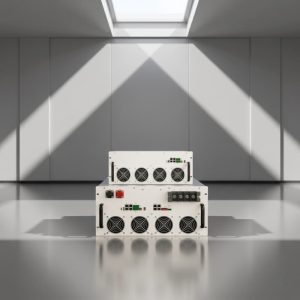
MegSolid MEGA Series Hybrid PCS Inverters
Designed for:
- Residential ESS
- Commercial ESS
- Industrial ESS
- Microgrid applications
- Off-grid projects
Key strengths include:
- Intelligent battery adaptation
- Advanced energy management
- Bidirectional power conversion
- Grid-support functionality
- High reliability architecture
- Compatibility with hybrid solid-state battery systems
Unlike many generic inverter suppliers that adapt products originally developed for photovoltaic systems, MegSolid PCS solutions are engineered specifically for energy storage applications.
MegSolid vs Traditional Inverter Suppliers
|
Comparison Item |
MegSolid Hybrid PCS |
Conventional Suppliers |
|---|---|---|
| Energy Storage Focus | Dedicated ESS Design | Often Solar-Derived Design |
| Battery Integration | Deep BMS Compatibility | Limited Compatibility |
| Bidirectional Power Control | Optimized | Basic |
| Microgrid Support | Advanced | Varies |
| Intelligent Energy Management | Comprehensive | Partial |
| Solid-State Battery Adaptation | Purpose-Built | Usually Generic |
| Long-Term Expansion Capability | Strong | Moderate |
For projects involving hybrid solid-state batteries, these differences become increasingly important as system size grows.
How to Choose the Right MegSolid Inverter for Your Battery System
Scenario 1: Residential Energy Storage
Typical Capacity:
- 10 kWh – 30 kWh
Objectives:
- Backup power
- Solar self-consumption
- Electricity bill reduction
Recommended:
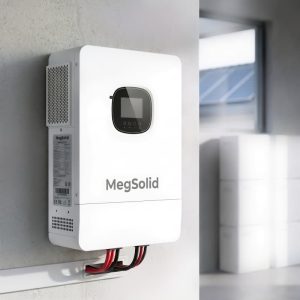
MegSolid Hybrid Energy Storage Inverter Solutions
Scenario 2: Commercial Buildings
Typical Capacity:
- 50 kWh – 500 kWh
Objectives:
- Peak shaving
- Demand charge management
- Backup power
Recommended:
MegSolid MEGA Series PCS
Scenario 3: Industrial Facilities
Typical Capacity:
- 500 kWh – Multi-MWh
Objectives:
- Energy arbitrage
- Production continuity
- Microgrid operation
Recommended:
MegSolid Integrated PCS + Hybrid Solid-State Battery ESS
Future-Proofing Your Investment
Many buyers focus on today's energy requirements.
The better question is:
What will your facility need five years from now?
Future expansion often includes:
- Additional solar capacity
- EV charging infrastructure
- New production equipment
- Increased facility loads
A scalable inverter platform protects future investments and avoids costly system redesigns.
This is one reason why many EPCs and project developers prioritize flexible PCS architectures from the beginning.
Final Thoughts
The performance of a solid-state battery system depends on much more than battery chemistry.
A high-efficiency inverter determines how effectively stored energy is converted, managed, protected, and monetized.
The most successful projects are not built around the battery alone.
They are built around a carefully engineered partnership between:
- Battery technology
- PCS architecture
- Energy management systems
- Long-term operational goals
For organizations investing in commercial, industrial, or utility-scale storage, MegSolid's hybrid PCS inverter platform provides a purpose-built solution designed to maximize the value of hybrid solid-state battery systems while supporting future growth.
FAQ
Q1: Will a high-efficiency inverter really make a noticeable difference?
Absolutely. Many users are surprised by how much system performance improves after upgrading the inverter. Better efficiency means more usable energy every day and greater savings throughout the project lifecycle.
Q2: I already have a solid-state battery. Do I need a special inverter?
Not always, but compatibility matters. A purpose-built energy storage inverter can unlock performance that generic inverters often cannot fully deliver.
Q3: How can I know if my inverter is undersized?
If your battery frequently reaches charging or discharging limits during peak periods, the inverter may be restricting system performance. A professional sizing assessment can quickly reveal this.
Q4: Is a larger inverter always better?
No. Oversizing often increases costs without improving efficiency. The best experience comes from matching inverter capacity to actual operating requirements.
Q5: Can a MegSolid inverter support future battery expansion?
Yes. Scalability is a key consideration in MegSolid system design, allowing businesses to expand storage capacity as energy needs grow.
Q6: Will inverter selection affect battery lifespan?
Definitely. Intelligent charging and discharging control reduces stress on battery cells, helping maximize the long cycle life offered by hybrid solid-state batteries.
Q7: What gives users the most confidence in MegSolid systems?
Many project owners value the combination of advanced battery technology, dedicated PCS development, and integrated energy management, which simplifies operation and reduces uncertainty.
Q8: Can MegSolid inverters work in microgrid applications?
Yes. They are designed to support both grid-connected and off-grid scenarios, making them suitable for remote facilities, industrial sites, and resilient energy infrastructure.
Q9: What is the biggest mistake buyers make when selecting an inverter?
Focusing only on price. The real cost is measured over years of operation, where efficiency, reliability, and compatibility often deliver far greater value than a lower initial purchase price.
Q10: If I am investing in a solid-state battery project today, what should I prioritize?
Prioritize long-term system synergy. The best user experience comes from a battery, inverter, and energy management platform designed to work together from day one. That is where integrated solutions like MegSolid's hybrid solid-state energy storage ecosystem provide the strongest long-term confidence and investment protection.
