 Skip to content
An insurer, EPC or facility owner needs the supplied cabinet's thermal-runaway evidence, cooling design and usable-energy duty on the same purchase file. MegSolid offers a 100 kW / 215.04 kWh air-cooled ESSA option and a 261.24 kWh liquid-cooled Energon option. Choose the equipment for the time-of-use (ToU), peak-shaving or microgrid duty, then obtain the ordered-model protection and test scope before committing capital. A chemistry label cannot settle the complete installation risk.
A BESS fire can interrupt production, damage neighboring equipment and delay the next project. Both liquid and solid-state batteries need protection against electrical, mechanical and thermal faults. Put the cell/BOM, cabinet protection, installation separation and emergency response into the same design review; a chemistry name does not establish the site’s fire behavior.
For engineers and B2B distributors, the sale must connect reduced-risk design to a configuration the customer can approve. MegSolid offers hybrid solid-state products, but no electrolyte label eliminates every heat, gas, short-circuit or propagation hazard. Use the named equipment, its operating limits and model-specific safety evidence to define what is supplied.
This guide explains how to prevent BESS thermal runaway incidents through cell selection, operating limits, detection, system protection and installation design. Compare those controls with the actual product ratings and supply scope of MegSolid’s C&I ESS solutions, then place the accepted tests and responsibilities in the purchase contract. No chemistry alone provides a zero-accident project.
Understanding Thermal Runaway in Traditional BESS
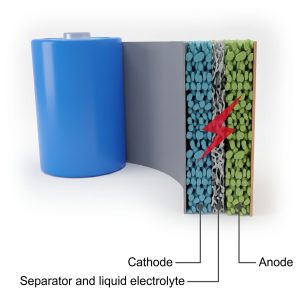
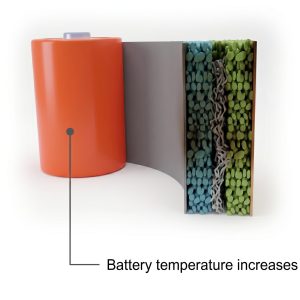
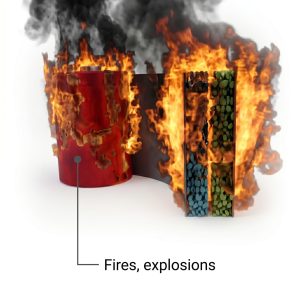
Thermal runaway is a self-accelerating release of heat from battery reactions when heat generation exceeds removal. Electrical abuse, mechanical damage, defects and elevated temperature can contribute. The onset and released heat/gas depend on materials, SOC, trigger and test conditions; 60–70°C is not a universal thermal-runaway threshold, and neither flame nor explosion is an inevitable outcome of every cell failure.
Despite advanced Battery Management Systems (BMS) and external fire suppression systems (such as aerosols or NOVEC1230), traditional BESS cannot claim "zero risk." If a cell undergoes thermal runaway, the external systems can only attempt to prevent the fire from spreading to adjacent cells—they cannot stop the chemical reaction inside the failing cell itself.
Hybrid Solid-State Safety: Materials and System Controls Together
LFP identifies the cathode chemistry; semi-solid or solid-liquid describes an electrolyte architecture. These labels can coexist. The offered cell/BOM defines how much liquid and which materials are present. Reduced flammable electrolyte may change some failure pathways, but the complete battery and installation still require verified limits, protection and propagation assessment.
1. Intrinsic Safety at the Chemical Level
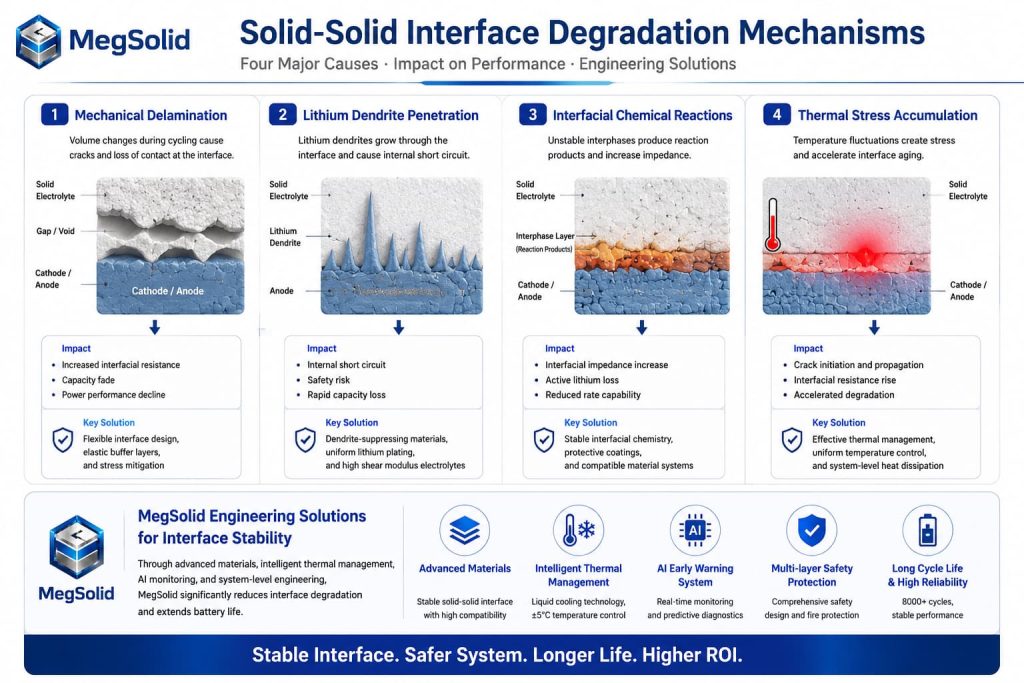
A solid electrolyte is not a built-in fire extinguisher or a universal barrier to internal shorts. Compare the actual cell’s abuse behavior and the supplied module/cabinet protection; puncture, heat and interface failures can still cause hazardous reactions. Keep detection, shutdown and emergency response in the system design even where the offered architecture demonstrates a particular advantage.
2. AI Early Warning and Advanced Thermal Management
Select MegSolid’s C&I ESS by the named system’s cooling and monitoring scope. ESSA0100B-0215 lists intelligent air cooling; Energon and 5000INTL use liquid cooling. Specify sensor coverage, allowed temperatures, derating and cooling-failure actions for the required duty. The published equipment features do not establish universal self-evolving algorithms, ±5°C uniformity or automatic grid approval.
Select the MegSolid Product for the Duty and Safety Scope
Safety is only valuable if it comes with uncompromising performance. MegSolid’s energy storage systems are engineered for heavy industrial ROI, microgrid integration, and scalable commercial deployments. Below are the flagship models designed for global EPC partners and distributors.
1. MegSolid Outdoor Cabinet Energy Storage System (215kWh)
A 100 kW /215.04 kWh cabinet gives a factory a defined power-and-energy block to price. Compare the ESSA0100B-0215 against the measured peak, usable-energy window, protected loads and 0–45°C operating range before choosing its installation and acceptance scope.
- Technical Superiority: This all-in-one modular outdoor cabinet features a 215.04 kWh nominal capacity operating at a 768V system voltage (1P240S configuration).
- Power and life basis:100 kW rated AC and 215.04 kWh nominal storage; the listing states ≥5, 000 cycles. Use the offered current/rate, temperature and retention terms for the actual duty.
- Connection scope:The published table includes the isolation-transformer field and on-grid THDi<3%. Confirm the supplied transformer, converter and protection against the project connection requirements.
- Outdoor scope:IP54, air cooling, 0–45°C and Aerosols/NOVEC1230 fire-suppression listing. Specify siting, clearances, derating and emergency response for the offered configuration.
2. MegSolid Containerized Energy Storage System 5000INTL
For utility-scale projects, microgrid solutions for unstable grids, and large-scale solar + storage integration, the Meg Solid Energon 5000INTL stands as a flagship turnkey ESS solution.
- Massive Capacity: Delivering a staggering 5015.9 kWh (5MWh) of rated energy, this containerized system is built for heavy industrial ROI and large-scale ToU tariff arbitrage.
- Next-Gen Chemistry: It utilizes the SHS180-314 Hybrid Solid-State LFP cells (12P416S configuration) with a nominal voltage of 1331.2 Vdc.
- Efficiency & Power: Boasting a maximum efficiency of 87.5% and a rated AC power of 450*6 kW (690 Vac, 50/60 Hz), it is optimized for continuous heavy-cycle commercial deployments.
- Environmental scope:IP55, −30 to+55°C and altitude≤4, 000 m are published ratings; available output, cooling and maintenance need the actual site conditions.
3. MegSolid Power Conversion System (PCS)
MegSolid offers isolated Power Conversion Systems (PCS) in 30–500 kW rated classes with model-specific DC ranges, on/off-grid support and maximum efficiency up to 97.5% for the listed 500 kW model. The catalogue does not give a universal <20 ms transfer guarantee. Define the selected PCS mode, switchgear, protected-load interruption limit and commissioning test before selling critical-load continuity.
Beyond Safety: The Economic Advantages of MegSolid ESS
Safety controls and project economics must be evaluated together. Price the supplied model’s usable energy, retention/warranty terms, cooling auxiliaries, maintenance, acceptance and response support against the actual dispatch. A solid-state label does not by itself guarantee the best lifetime return.
1. Extended Cycle Life for Maximum ROI
Use model-level cycle inputs. ESSA0100B-0215 lists ≥5, 000 cycles; the 51.2 V/314 Ah wall battery lists 8, 000 cycles at 80% DoD. Those catalogue values do not establish extreme-duty calendar life, a universal rate/temperature test or project payback. Tie retention, throughput and warranty obligations to the offered duty before calculating augmentation or replacement.
2. Superior Energy Density
Footprint belongs to the actual cabinet, not to a chemistry claim. ESSA0100B-0215 has a 2, 450×1, 550 mm base; Energon 261 has a 1, 300×1, 350 mm base. Compare usable AC energy, clearances, ventilation and access at the site. Some MegSolid products use liquid cooling, so their density advantage cannot be explained by universally removing those components.
3. Turnkey ESS and OEM/ODM Scalability
MegSolid is not just a battery manufacturer; it is a world-class integrated energy storage technology enterprise. We actively seek global partners for:
- OEM/ODM quotation:Define cabinet/pack configuration, branding, integration, documents, acceptance and delivery responsibilities for the destination project.
- Distribution proposal:Agree product shortlist including hybrid inverters, territory, training, spares, order schedule and warranty response in the commercial offer.
From a 100 kW/215.04 kWh factory cabinet to the 2.7 MW/5015.9 kWh5000INTL, put the model, usable-energy obligation and installation scope into one offer. The shipment’s applicable reports and certificates must identify the supplied configuration; a list of UL, CE, IEC62109 or UN 38.3 names is not complete-project approval.
Conclusion: Future-Proof Your BESS Projects with Solid-State Technology
Do not let a chemistry promise carry a risk the installation still has to manage. Choose a Hybrid Solid-State Battery configuration against the protected processes, available power, heat/gas behavior, siting and support route. The strongest supply offer makes the delivered configuration and accepted safety responsibilities clear before the EPC commits to the site.
MegSolid’s cabinet and container ranges give an EPC concrete starting points from 55.296 kWh to 5015.9 kWh nominal storage. Match the real power, duration and environment, then price the monitoring, protection, installation and acceptance scope around that block. The goal is a usable, supportable project—not a claim of absolute immunity.
Get Your Custom C&I Solid-State Energy Storage Quote Today
Make the next quotation defend the customer’s production window. Bring the peak/load trace, backup duration, voltage and site conditions, and ask MegSolid for the named battery/PCS package and commissioning/support scope.
For product selection, OEM/ODM or distribution, ask for the usable-energy basis, supplied cell/BOM, applicable documents, delivery milestones and warranty response beside the price. Your EPC should know what arrives and who owns each acceptance step.
Turn a safety question into a defined project offer. Send the site duty and installation conditions to MegSolid for a cabinet or container proposal that engineering and procurement can review together.
FAQ
Q1: What causes thermal runaway in BESS, and how should the complete system reduce its risks?
Heat-generating battery reactions can become self-accelerating after electrical, mechanical or thermal faults. Solid-state and semi-solid architectures do not universally eliminate ignition or short-circuit hazards. Evaluate the supplied cell/BOM, limits, protection and installation test scope as a complete system.
Q2: What is the actual cycle life of MegSolid's C&I energy storage systems?
ESSA0100B-0215 lists ≥5, 000 cycles and the 51.2 V wall pack lists 8, 000 at 80% DoD. Confirm the offered rate, temperature, end-of-life criterion, retention and warranty terms before using those values in a peak-shaving business case. Cycle count alone does not guarantee ROI.
Q3: Does the outdoor cabinet ESS comply with strict grid-tied standards?
The ESSA table lists its transformer and on-grid THDi<3% operating parameter. Complete utility approval depends on the supplied converter, protection, connection scheme and local test/document requirements; that parameter alone is not the strictest global interconnection approval.
Q4: Can MegSolid ESS operate in extreme environmental conditions?
The 5000INTL lists IP55, −30 to+55°C operation and altitude≤4, 000 m. Verify the offered power/energy derating, cooling duty, clearances and maintenance at the actual site; the listing does not establish full rated output under every harsh condition.
Q5: How does the AI early warning system protect the battery rack?
The named product’s monitoring and cooling must define sensor coverage, temperature limits, derating and fault actions. ESSA uses air cooling; Energon and 5000INTL use liquid cooling. Universal self-evolving control or±5°C rack performance needs its own supplied-model evidence.
Q6: What is the switching time between on-grid and off-grid modes?
The isolated PCS range supports automatic on/off-grid switching, but its published catalogue does not establish a universal <20 ms transfer time. Agree the mode, transfer equipment and load tolerance, then verify actual interruption and recovery for the supplied configuration.
Q7: Does MegSolid provide OEM/ODM services for global distributors?
Yes. MegSolid is a world-class integrated energy storage manufacturer. We actively seek global partners for custom ESS cabinet design, battery pack assembly, and exclusive regional distributorships tailored to local compliance standards.
Q8: Are MegSolid products certified for international markets?
Identify the applicable report or certificate for the exact shipped model, cells, converter and destination. UL, CE, IEC62109 and UN 38.3 address different scopes; a product-family list does not establish customs clearance, utility approval or complete-system certification.
Q9: How does the 5MWh containerized system maximize industrial ROI?
The 5000INTL lists 5015.9 kWh nominal energy, 2.7 MW rated AC and 87.5% in its Maximum efficiency field. That efficiency field is not a guaranteed whole-cycle AC round-trip result. Value the offered usable energy, duty, losses, cooling auxiliaries and tariff/market terms before claiming industrial ROI.
Q10: How can I get a technical consultation or a custom OEM quote?
You can email our engineering team directly at [email protected], call us at +852 59811073, or download our "C&I Solid-State Energy Storage Guide 2026" from our website to start your project evaluation.
Q11: What is the safest battery technology for commercial energy storage?
There is no universally safest battery technology established by the electrolyte label alone. Compare the actual cell/system test scope, heat/gas behavior, protection and installation conditions. LFP cathode chemistry may coexist with a semi-solid electrolyte; it does not remove every thermal-runaway pathway.
Q12: How does a hybrid solid-state battery compare to traditional liquid lithium-ion batteries in BESS?
Compare offered liquid and hybrid solid-state systems at the same AC duty, environment and end-of-life boundary. Cell/BOM, usable energy, dimensions, cooling and test scope determine any advantage; no label universally proves better safety, density, lifetime or extreme-temperature output.
Q13: Who manufactures 5MWh solid-state containerized energy storage systems?
MegSolid manufactures the 5000INTL containerized range. The current published configuration lists SHS180-314 cells, 12P416S, 5015.9 kWh nominal, 2.7 MW AC, 1331.2 V nominal DC and IP55. Its usable energy and site/grid integration scope belong in the specific project offer.
