 Skip to content
A commercial BESS capacity test turns a catalogue energy rating into project evidence. MegSolid supports EPCs, distributors and facility teams that need to establish how much AC energy a supplied system delivers across a defined state-of-charge window, at an agreed power setpoint, under recorded site conditions. The test answers a handover question: can the installed system support the duty written into the project documents?
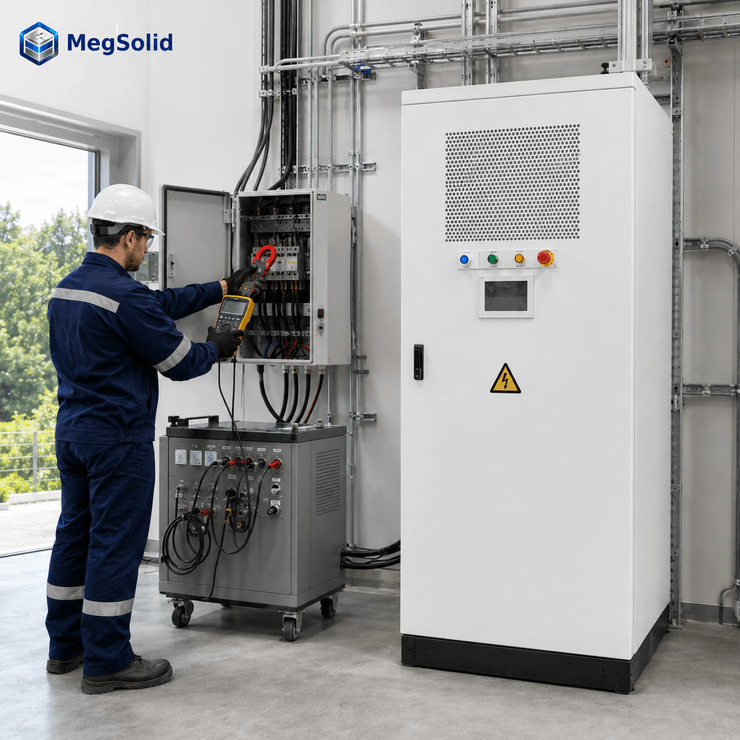
This page serves buyers who already have a proposed cabinet or container configuration and need a repeatable way to verify delivered energy. It differs from a sizing page. Sizing uses the load profile to select a power and energy route. Capacity testing checks the delivered result after commissioning or at an agreed project milestone. That distinction protects both sides of the purchase: the buyer receives a measurable acceptance record, while the supplier works against a stated test method instead of an undefined expectation.
| Project question | Evidence to agree before the test | Decision protected |
|---|---|---|
| How much energy reaches the AC boundary? | Time-stamped AC kW and integrated AC kWh | Usable energy for the defined duty |
| Can the system sustain the requested output? | Power setpoint, power factor and discharge duration | Peak-shaving or backup performance |
| Which conditions shaped the result? | SOC window, ambient temperature and auxiliary-load record | Fair comparison with the contract basis |
| What proves acceptance? | Signed method, raw meter export and final report | EPC handover and owner records |
What a Commercial BESS Capacity Test Should Measure
A battery nameplate expresses a rated energy value under its product definition. A site test measures energy delivered through a chosen electrical boundary during a specified event. Both values matter, yet they answer different questions. For a commercial project, the acceptance method should state where energy is measured and which system loads sit inside that boundary. A meter at the AC output can describe energy available to the site-side connection. A battery-side reading describes a different layer of the system.
Use the term delivered AC energy for the test result when the agreed meter sits at the AC boundary. It can be calculated from the measured AC power over the discharge interval: Delivered AC energy = Σ PAC × Δt. The report should preserve the meter interval, start time, end time and total integrated energy so the owner can trace the result.
- Rated energy from the signed product document
- Agreed SOC start and end points
- AC measurement boundary and meter identification
- Active-power setpoint and required power factor
- Discharge duration and any hold periods
- Ambient temperature, thermal-control status and auxiliary-energy record
The Battery Energy Storage System Factory Acceptance Test guide helps define the factory witness scope before shipment. A commercial capacity test uses the same discipline after installation: approved method, identified instruments, recorded conditions and a result that can be compared with the agreed acceptance basis.
Set the Acceptance Basis Before Energization
A useful acceptance basis is specific enough for an EPC to execute and simple enough for an owner to audit. It should be included in the technical annex, commissioning plan or site-acceptance procedure. Leaving the meaning of usable energy open creates avoidable disputes because the measured result will vary with the operating window and measurement point.
| Field | What the document should state | Why it changes the result |
|---|---|---|
| Energy boundary | AC output, battery DC terminals or another defined point | Conversion and auxiliary consumption sit on different sides of each boundary |
| SOC window | Start SOC, end SOC and BMS limits used | The accessible battery window defines the test energy |
| Output duty | Target kW, kVA, power factor and discharge profile | Higher or changing output modifies the operating event |
| Site conditions | Ambient temperature, ventilation state and thermal-control operation | Thermal conditions influence the permitted operating range |
| Meter method | Meter ID, accuracy class if specified, interval and export format | The team needs one traceable record |
| Pass criterion | Required value, tolerance, calculation method and sign-off roles | Everyone compares the same result |
For a facility with several critical loads, the buyer may choose an AC boundary after the essential-load panel. For a peak-shaving project, the boundary may sit at the BESS output or at a project-defined point that matches the demand-control architecture. The chosen boundary should follow the commercial duty and the single-line diagram. How EPCs evaluate energy storage systems in project deployment gives the wider engineering context for connecting this test scope to site interfaces and handover responsibilities.
Measure Delivered Energy at the Agreed AC Boundary
The AC-side result is especially valuable where the owner buys a complete storage system rather than a battery rack. The meter then captures the combined outcome of the battery, PCS, control settings and any agreed auxiliary loads inside the defined scope. It also lets the commissioning team compare the measured power trace with the requested duty cycle.
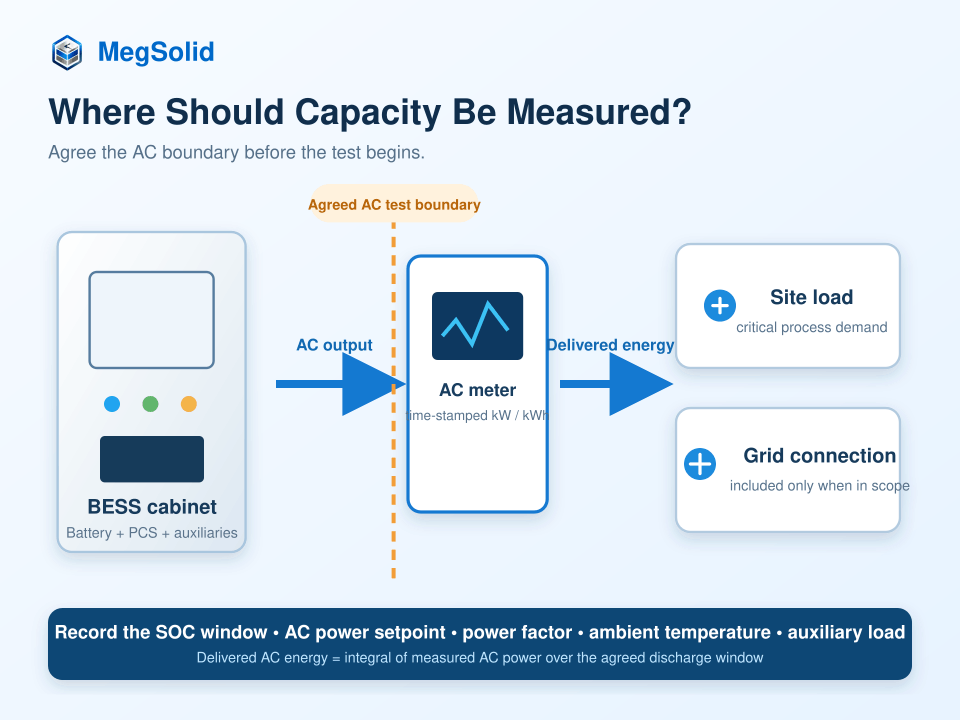
The PCS has a direct role in this measurement because it converts DC battery energy into AC output. The energy storage inverter buying guide explains why AC rating, grid interface and control mode require project review. During capacity testing, document the PCS operating mode, setpoint and power factor alongside the meter values. A kVA line expresses apparent power; the corresponding kW depends on the agreed operating power factor.
Auxiliary consumption also needs a clear treatment. Cooling, controls and other support systems serve the operating system, yet the commercial meaning of their energy use depends on the chosen boundary. The procedure should identify whether the meter result includes these loads, whether they are reported separately, and how the contract compares the final figure.
Run the Test as a Controlled Operating Event
A practical test sequence gives every participant a common record. The exact values come from the approved project procedure, since model configuration, site grid conditions and owner duty vary. The sequence below provides an engineering structure rather than a universal pass value.
- Confirm the supplied model, serial-number record, software configuration and approved single-line diagram.
- Inspect the AC meter installation, clock synchronisation and data-export method.
- Record ambient conditions, thermal-control state, alarms and the agreed SOC start point.
- Charge or prepare the system according to the approved starting condition.
- Apply the agreed AC power setpoint and power factor for the defined discharge window.
- Export the interval data, record the ending SOC and attach event logs to the signed report.
The discharge profile should represent the intended duty. A constant-output test can support a defined runtime obligation. A site-load-following test can support a peak-shaving or critical-load duty when the procedure states how the load trace will be applied. A separate power step or transient test can verify response behaviour when that requirement belongs to the contract. Each test should retain its own boundary and calculation method.
Use Product Ratings Correctly When Defining the Test
MegSolid product data gives a starting point for a test plan, while the acceptance value still requires project confirmation. The ESSA0100B-0215 is a 100kW AC, 215.04kWh LFP outdoor cabinet with intelligent air cooling. The Meg-Solid Energon C&I system is rated at 261.24kWh, uses 314Ah LFP cells in a 1P260S configuration, carries a 125kVA PCS rating and uses liquid cooling. These are rated product values, rather than a site-specific delivered-energy promise.
| Model route | Verified product data | Capacity-test planning point |
|---|---|---|
| ESSA0100B-0215 | 100kW AC; 215.04kWh; LFP; intelligent air cooling | Agree the AC power setpoint, SOC window, ambient conditions and AC boundary before setting the acceptance method |
| Meg-Solid Energon C&I | 125kVA PCS; 261.24kWh; 314Ah LFP; 1P260S; liquid cooling | Agree power factor with the required AC kW, then define the SOC window and boundary for the capacity result |
| Containerized route | System design depends on the selected container and integration scope | Use a project-specific test protocol covering pooled power, controls and site interfaces |
The outdoor cabinet energy storage system page provides the ESSA series context, while the 261.24kWh liquid-cooled C&I system page provides the Energon route. For the 261.24kWh system, the published 90% figure is a maximum-system-efficiency value. Keep that figure separate from a capacity-test energy result and from any project round-trip-efficiency requirement.
Cooling belongs in the condition record because temperature management affects the operating event. The correct selection discussion sits in how to choose between liquid-cooled and air-cooled BESS for commercial projects. A capacity report should identify the observed ambient temperature and thermal-control state, rather than trying to use a single test as a general cooling comparison.
Build an Evidence Package the Owner Can Use
The final value gains commercial meaning when an owner can review how it was produced. A complete package lets the project team trace the result months later during performance review, maintenance planning or an expansion decision. It also provides an efficient basis for supplier support because the actual configuration and event data travel together.
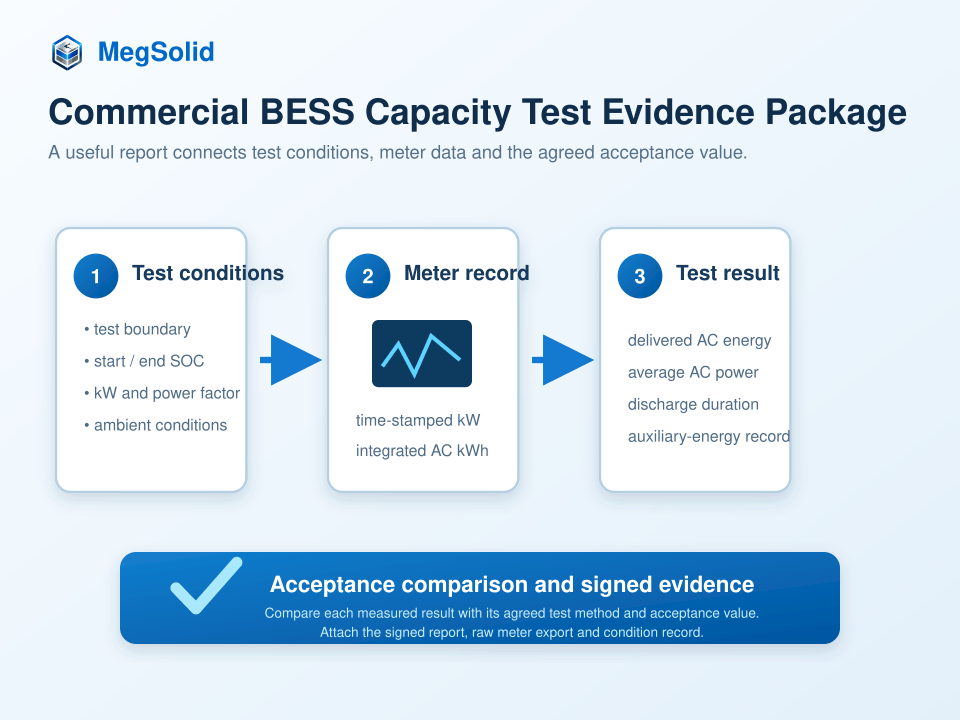
- Approved test procedure and signed acceptance criterion
- Single-line diagram showing the selected measurement boundary
- Meter identification, installation record and interval export
- SOC record, BMS event log and PCS operating-mode record
- Ambient and thermal-control condition record
- Calculated AC energy, average output, duration and sign-off page
When the test shows that the project needs a larger engineering route, capacity evidence helps the team explain why. A cabinet-scale project may move toward a larger pooled architecture when the required power, duration, controls or expansion plan change. Modular cabinets versus containerized ESS helps an EPC frame that wider system decision without treating a capacity result as an isolated number.
Information to Submit for a Project-Specific Test Plan
MegSolid engineering can review a project-specific capacity-test plan when the buyer shares the operating duty and acceptance basis early. The useful inputs are the proposed model, single-line diagram, required AC kW and kVA, power factor, target discharge duration, operating mode, SOC limits, test boundary, site temperature range and the owner acceptance format. This creates a focused engineering conversation and keeps the final test relevant to the actual commercial duty.
For a broader thermal or protection review, the commercial energy storage thermal-safety guide is a useful companion page. It covers a separate engineering question from capacity acceptance, helping project teams keep performance evidence and protection design in their proper workstreams.
FAQ
What is a commercial BESS capacity test?
It is a controlled discharge test that records how much energy a completed BESS delivers through an agreed measurement boundary during a defined operating window. The procedure records SOC limits, output duty, meter data and site conditions.
Why does a BESS capacity test need an AC measurement boundary?
The AC boundary tells every participant where delivered energy is measured. It establishes whether the result represents a complete system output or another defined layer of the installation.
What is the difference between rated energy and delivered AC energy?
Rated energy is a product value under the product definition. Delivered AC energy is the measured test result through the agreed AC boundary, using the stated SOC window and operating conditions.
Which conditions belong in a BESS capacity test record?
Record the SOC start and end points, active-power setpoint, power factor, test duration, ambient conditions, thermal-control status, meter identification and auxiliary-load treatment.
Can a 125kVA BESS test be defined only in kW?
The test can use a kW output target when the project also states the operating power factor and the approved AC capability. The 125kVA rating expresses apparent power, so the operating point needs both parts of the electrical duty.
How should auxiliary energy be handled during capacity testing?
State whether the selected meter includes auxiliary loads and report the treatment in the method. Cooling, controls and related support loads can change the commercial interpretation of the result when they sit inside the chosen boundary.
What documents should accompany the final capacity result?
Attach the approved procedure, single-line diagram, meter export, SOC record, event logs, environmental record, calculation sheet and sign-off page. These items make the result traceable for the EPC and owner.
How does cooling affect a commercial BESS capacity test?
Cooling affects the operating conditions that accompany the discharge event. Record the ambient temperature and thermal-control state so the buyer can understand the conditions under which the energy result was obtained.
Which MegSolid cabinet data is relevant to a capacity test?
For ESSA0100B-0215, relevant published data includes 100kW AC, 215.04kWh LFP and intelligent air cooling. For the Energon route, relevant published data includes 125kVA, 261.24kWh, 314Ah LFP, 1P260S and liquid cooling. The project method defines the measured acceptance result.
When should an EPC prepare the capacity-test method?
Prepare it during detailed engineering and align it with the technical annex, single-line diagram, commissioning plan and owner acceptance process. Early agreement lets the site team install the right meters and capture the required evidence.
How should a South African C&I EPC document a BESS capacity test?
Use the same project-specific method: record the selected AC boundary, interval meter export, SOC window, AC power duty, ambient conditions and sign-off roles. Align the result with the local interconnection scope and the owner handover package.
What should a Nigerian commercial storage buyer request before site handover?
Request the signed capacity-test procedure, AC meter data, final energy calculation, BMS and PCS event record, thermal-condition record and the stated acceptance comparison. These records make the delivered-system discussion clearer for the owner and EPC.
How can a Saudi Arabia C&I project account for high ambient temperature during testing?
Record the actual ambient temperature, thermal-control condition, output duty, SOC window and any approved derating logic that applies to the supplied configuration. Compare the result with the project-specific acceptance method for that operating condition.
How is delivered AC energy calculated in a commercial BESS capacity test?
Delivered AC energy is calculated by integrating measured AC power over the agreed discharge interval: PAC multiplied by each time interval and summed across the test. The meter export and calculation method should be attached to the report.
Does the 215.04kWh value equal the usable energy for every project?
The 215.04kWh figure is the published rated energy for ESSA0100B-0215. The project-specific usable-energy acceptance value depends on the agreed SOC window, AC boundary, output duty, site conditions and signed technical documents.
What should an owner approve before a commercial BESS capacity test begins?
Approve the measurement boundary, SOC window, power setpoint, power factor, test duration, meter method, environmental record, auxiliary-load treatment, calculation method and acceptance criterion. These items make the final sign-off process clear.
