 Skip to content
When a grid trip stops a meat plant, MegSolid starts by defining the cold-chain duty: refrigeration controls, selected compressor groups, alarms, and the production loads that have a genuine continuity requirement. A workable industrial battery storage design comes from measured compressor starts and temperature-resilience data, with the battery, PCS, generator and switchboard operating as one system.
- Protect the cold chain with an agreed critical-load boundary.
- Compare three service levels before approving battery kWh.
- Put thermal-runaway controls, acceptance tests and ROI assumptions into the RFQ.
Draw the Cold-Chain Boundary Before Sizing the BESS
A meat plant has several electrical loads, but they do not carry the same operational consequence. The refrigeration plant may need to hold temperature. A blast-freezing batch may need a defined recovery sequence. Some conveyors, packaging lines and ancillary equipment can wait. Treating every load as critical makes the battery large and the ROI weak.
Cold-room, freezer-room and blast-freezer duties must be separated. They operate at different temperature targets and have different heat loads, product-throughput requirements and compressor behaviour. A refrigeration specialist should validate the plant duty from product mass, pull-down time, door activity, ambient conditions and plant controls; those variables determine the backup window far more reliably than floor area or monthly electricity consumption. Cold-storage sizing guidance for South African food processors makes the same heat-load distinction.
Ask the production manager, refrigeration contractor and food-safety lead to sign one critical-load schedule. The schedule should name the circuit, normal kW, largest start step, load-shed permission, required operating duration and restart order. It becomes the sizing basis, the EMS control narrative and the SAT test sheet.
The QA lead also needs to set a temperature/time decision line for each protected product and process: the limit that triggers intervention, the evidence required for release, and the maximum recovery time after power returns. Holding a room below an alarm threshold does not automatically mean a blast-freezing batch or a chilled-meat process can resume without a documented recovery and QA decision.
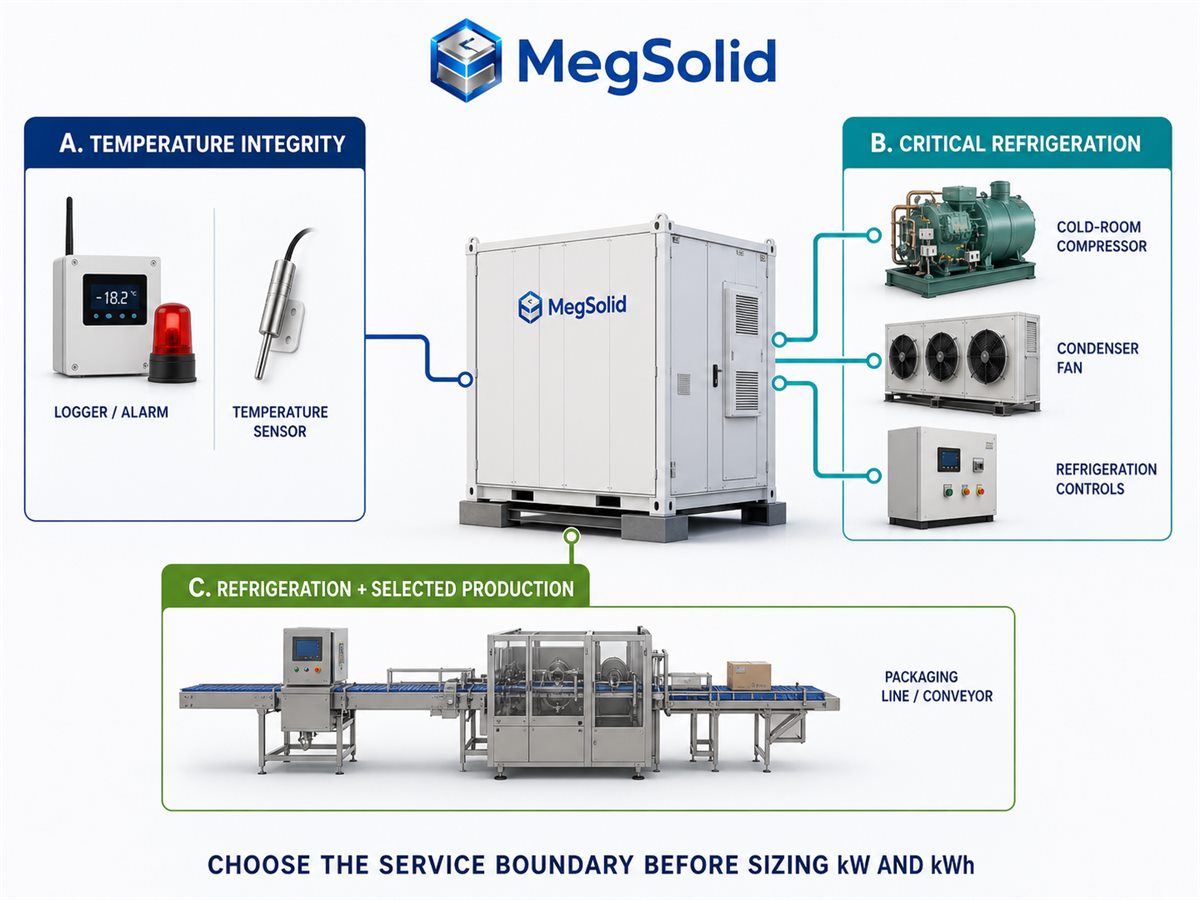
| Service boundary | What stays powered | Value protected | BESS design consequence |
|---|---|---|---|
| A. Temperature integrity | Temperature loggers, controls, selected evaporator/condenser controls, alarms and agreed refrigeration auxiliaries | Temperature evidence and controlled recovery | Lowest power and energy case; verify that no omitted compressor duty makes it impractical |
| B. Critical refrigeration | The agreed refrigeration train, controls, monitoring and staged compressor restart | Cold-chain continuity and stock protection | PCS must handle motor-start strategy, running duty and the required reserve window |
| C. Refrigeration plus selected production | Boundary B plus defined production controls and approved process equipment | Stock, controlled process continuity and reduced restart loss | Highest kW case; validate simultaneous loads, load steps and generator coordination |
The right answer can be Boundary A, B or C. The decision belongs to the plant’s operating risk, not to a standard cabinet size.
Measure Compressor Starts; a 15-Minute Profile Is Not Enough
Fifteen-minute demand data is essential for energy and tariff analysis. It smooths out the electrical events that can trip a PCS during a refrigeration restart. Obtain a short high-resolution logging run during representative production, defrost and restart conditions.
- A 12-month interval load file and the current electricity bills.
- A one-line diagram showing the main LV board, transformer, generator, transfer equipment and candidate BESS connection point.
- Compressor nameplates, starting method (DOL, star-delta, soft starter or VSD), actual start sequence and any anti-short-cycle settings.
- Temperature logs during normal operation and a controlled outage drill, including door status, product load and ambient conditions.
- A list of circuits that may shed automatically and the person authorised to change that list.
Compressor starting is a power-quality event. The design engineer must check PCS overload capability, voltage dip, cable and transformer impedance, reactive-power behaviour and the restart sequence. A larger battery kWh figure does not solve a short kW or kVA limitation. The same principle applies when an existing generator shares the bus: the generator-BESS control review should set power ownership, generator minimum-load limits and the fallback state before equipment is ordered.
Build Three ROI Cases From the Same Plant Data
An ROI model should compare service boundaries, not promise a universal payback. Use the same tariff, outage history, fuel records, production data and equipment scope for all three cases. The model then shows the cost of each additional hour and each additional load group.
Annual net benefit = tariff saving + diesel cost avoided + expected verified outage-loss reduction + documented power-quality benefit - annual operating, maintenance, insurance and lifecycle reserves.
Use an expected value for stock and production risk. A single spoiled batch or disrupted production day is real, but it is not an annual saving until the factory documents the event frequency, temperature evidence, disposal exposure and recovery cost. Keep that assumption visible in the investment case.
| Model input | Evidence to use | How it enters the decision |
|---|---|---|
| Peak-shaving value | Interval imports, the actual distributor tariff, notified maximum demand and the bill calculation | Test the achievable import cap at the agreed meter point; identify each energy, capacity and network charge included |
| Diesel displacement | Generator fuel curve, logged running hours, delivered diesel price and operating limits | Value litres truly displaced while preserving generator loading rules |
| Cold-chain loss exposure | Batch value, temperature record, QA release rules, rework or disposal cost and outage history | Model probability-weighted avoided loss, then test a low and high case |
| Production interruption | Lost units per hour, rework, labour, cleaning, restart time and contribution margin | Include only the load groups covered by the selected boundary |
| Battery service cost | Offered warranty, usable-energy conditions, auxiliary consumption, maintenance, insurance and reserve for end-of-life work | Deduct it from every annual-benefit case |
| Project cost | Battery, PCS, switchgear, protection, controls, civil works, installation, commissioning and local EPC scope | Use complete installed cost, not cabinet price |
Calculate simple payback only as a screening figure. The approval model should also show yearly cash flow, NPV, IRR, sensitivity to tariff and diesel changes, and a downside case with fewer outages. Eskom direct and municipal tariff effective dates differ, so the spreadsheet must name the distributor, tariff schedule and bill period used; it cannot use a generic South African rate. Eskom’s 2026/27 tariff notice confirms different effective dates for direct and municipal customers.
A Spreadsheet Layout That a Plant Team Can Challenge
- Required AC kW: peak simultaneous demand after the approved load-shed sequence.
- Required usable AC kWh: the time-varying critical-load profile integrated across the support window.
- PCS and motor-start check: pass, fail or changes needed in the sequence, VSD settings or soft-start strategy.
- Reserved SOC: energy unavailable to peak shaving because cold-chain backup has priority.
- Annual tariff and diesel value: modelled from actual billing and fuel records.
- Expected loss reduction: documented event probability multiplied by verified avoided loss.
- Installed project cost and annual lifecycle cost.
- Payback, NPV, IRR and sensitivity case.
Give the EMS a Cold-Chain Priority, Not a Generic Dispatch Rule
Peak shaving and backup compete for the same stored energy. The EMS needs a written priority order that protects the cold-chain reserve.
- Normal grid: charge and discharge within the approved tariff schedule and reserve floor.
- Approaching import limit: shave the agreed meter-point demand without breaching the cold-chain reserve.
- Scheduled or detected grid loss: preserve selected refrigeration and controls, then start or synchronise the generator if the agreed duration requires it.
- Compressor restart: pick up approved loads in sequence; block competing large starts while the electrical reference is recovering.
- Loss of meter, controller or communications: move to the documented safe state and raise a time-stamped alarm.
- Temperature or battery safety alarm: safety limits override commercial dispatch.
The EMS register map, alarms and data-quality rules belong in the procurement pack. Use the 400 V BESS connection guide to define the switchboard, protection, earthing and CT-metering review, then use the BESS SCADA point-list guide to set the alarm and measurement handover.
Treat Thermal-Runaway Prevention as an Engineering Control Chain
No responsible supplier can promise zero thermal-runaway risk. A meat plant should buy evidence that risks are detected, limited and managed through cell selection, battery controls, thermal design, fire strategy, electrical protection, site layout and emergency response.
The quotation must state the offered cell model and battery configuration. It must identify the BMS measurement and alarm functions, cooling method, fault response, detection method, suppression agents, emergency isolation points, required clearances and interfaces with the site fire plan. Ask whether the offered configuration has test evidence relevant to thermal-runaway propagation and request the report scope, not a certificate logo. UL 9540A is a test method for evaluating thermal-runaway fire propagation; it does not, on its own, approve a South African site or replace its fire strategy.
The local fire authority, insurer, refrigeration contractor and EPC should review the final layout together. Refrigeration plant, combustible packaging, traffic routes and emergency access all affect placement. A cabinet data sheet is only one input to that review.
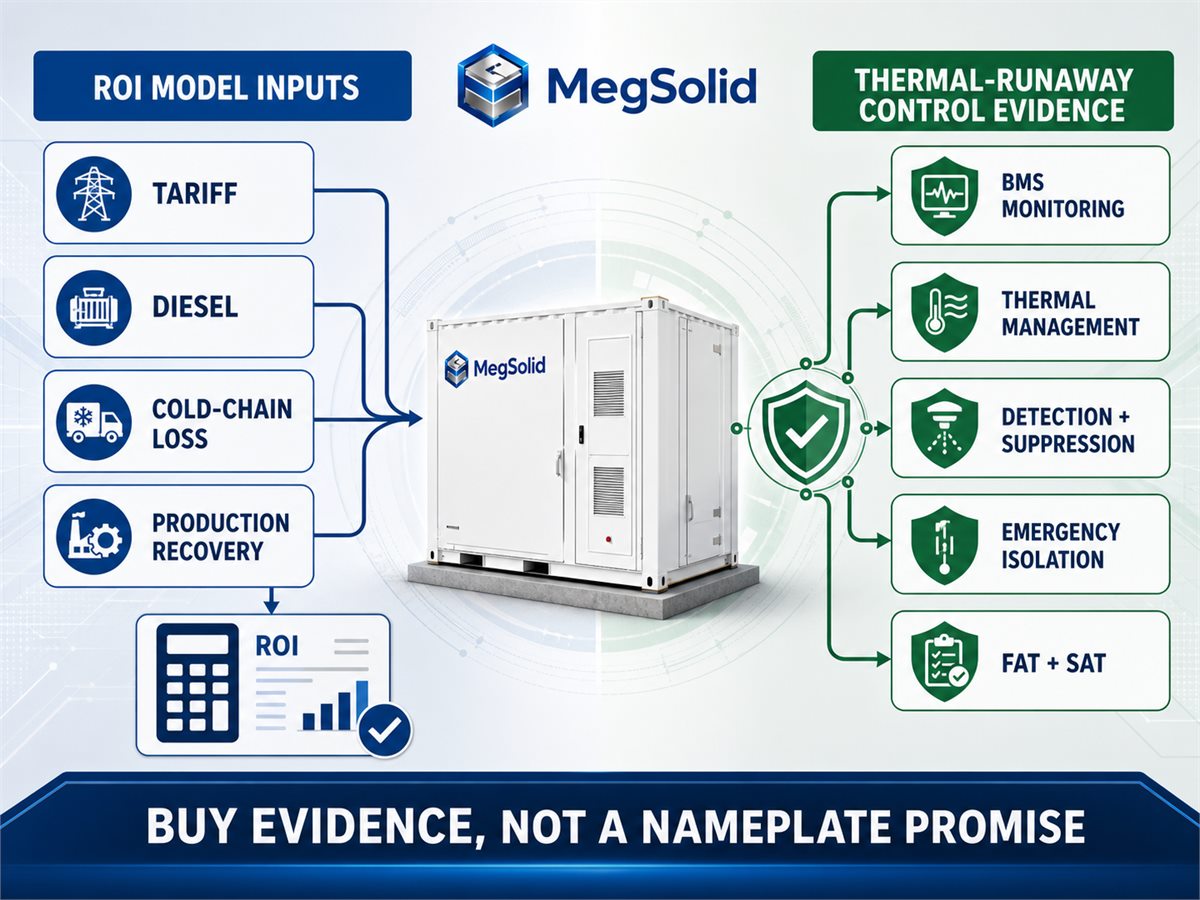
| Control layer | Buyer evidence required before purchase order | What it prevents or limits |
|---|---|---|
| Battery monitoring | BMS limits, sensor list, alarm thresholds, event log and shutdown logic | Operation outside agreed voltage and temperature limits |
| Thermal management | Cooling design, site ambient range, heat rejection route and maintenance tasks | Heat accumulation and avoidable derating |
| Detection and suppression | Detection description, suppression-agent specification, cause-and-effect matrix and maintenance plan | Earlier alarm, controlled isolation and incident response |
| Electrical protection | DC isolation, AC breakers, interlocks, earthing, protection study and emergency-stop points | Fault energy and unsafe energisation |
| Layout and operations | Approved GA, separation, access, signage, emergency plan, drills and trained responsibilities | Propagation exposure and delayed response |
| Acceptance testing | Exact-configuration test scope, FAT and SAT procedures with pass/fail criteria | Unproven safety and control logic being handed to operations |
MegSolid’s published 100 kW / 215.04 kWh ESSA0100B-0215 outdoor-cabinet data lists an IP54 enclosure, built-in isolation transformer and aerosol/NOVEC1230 fire-extinguishing system. Its stated rating makes it a preliminary C&I starting point for a duty below the actual AC power limit; it is not a promise that a meat plant can support every compressor group. Review the model-level documentation, cause-and-effect matrix and offered BOM for the outdoor cabinet platform before placing an order.
For a higher-energy preliminary case, MegSolid’s published hybrid solid-state liquid-cooled C&I system lists 261.24 kWh and 125 kVA, IP54 protection, multi-sensor detection and Novec plus water-based fire suppression. The engineer must convert the apparent-power rating into usable kW at the plant power factor, validate cooling and site conditions, and approve the final fire strategy. Its published product page is a product reference, not an installation approval.
An outdoor cabinet does not become an indoor installation by moving it into a room. Indoor placement needs its own building, ventilation, separation, detection, suppression and emergency-access review.
Use Product Ratings as a Screening Gate
MegSolid can supply BESS and PCS directions once the plant has defined its service boundary. The MEGA PCS range lists 30 kW to 500 kW rated-power models, on-grid and off-grid AC coupling, built-in isolation transformer and parallel operation of up to four units. These published capabilities support screening; the project still needs a single-line design, protection study, control narrative and witnessed tests.
Do not choose 215 kWh or 261.24 kWh because the number looks close to a daily bill. Compare AC kW, usable AC energy at the required end-of-life condition, motor-start response, cooling, available footprint, fire strategy, integration scope and warranty measurement point. The South African factory BESS sizing guide covers the broader kW/kWh method and should sit beside the meat-plant-specific decision sheet.
Make the RFQ Force Comparable Answers
- Guaranteed AC kW and usable AC kWh at a named measurement point, with ambient, DOD, auxiliary-load, ageing and reserve assumptions.
- A load-pickup table naming each refrigeration and production load, its running demand, starting method, sequence and shed permission.
- A control narrative for normal grid, peak shaving, islanding, generator operation, communications loss and emergency isolation.
- A single-line diagram, protection-study boundary, fault-level assumption, CT locations and earthing responsibility.
- Battery, PCS, BMS, EMS, cooling, detection and suppression documentation for the exact offered model and BOM, including the applicability and limits of any thermal-runaway test evidence.
- Layout, foundation, cable route, drainage, access, lifting, clearances and local-EPC scope.
- FAT, SAT and capacity-test procedures, including a staged compressor-load test and a temperature-monitoring continuity test.
- Warranty terms for throughput, end-of-life capacity, available power, data access, exclusions and remedies.
Set the energy measurement boundary before accepting a capacity result. The BESS capacity-test acceptance guide helps the buyer distinguish battery DC nameplate energy from the service delivered at the switchboard or PCC.
No supplier should calculate the ROI from the product nameplate alone. The purchaser should own the plant-data assumptions; the bidder should own the stated system performance and documented exclusions; the EPC should own the installed electrical and fire scope defined in the contract.
FAT should check the offered configuration, protection logic and documented interfaces before shipping. SAT should prove load pickup, metering, EMS modes, alarms, isolation and operator response at the site. It must not attempt to recreate a thermal-runaway or fire event at the factory; that evidence belongs to the relevant test report and approved installation strategy.
Send This Data Pack for a Preliminary MegSolid Direction
- Twelve months of 15- or 30-minute load data and electricity bills.
- At least one representative high-resolution compressor-start capture.
- The current single-line diagram, transformer details, available fault level and main-board photographs.
- Refrigeration load list, compressor/control information, restart sequence and temperature-log export.
- Product type, batch value, QA hold/release rules and the outage consequences that the plant can evidence.
- Generator model, kW/kVA rating, controller, fuel records and minimum-load limits.
- Proposed installation area, ambient temperature, altitude, dust, water, access and separation constraints.
- The preferred service boundary, desired backup duration, peak target and required commissioning date.
MegSolid can use the pack to return a preliminary product direction, an AC power and energy range, an EMS boundary and a list of missing engineering inputs. The final design requires an approved local engineering package and project-specific product documentation.
FAQ
Can industrial battery storage keep a meat plant cold during an outage?
Yes, when the critical refrigeration boundary, AC power, motor-start sequence and support duration are defined from plant data. The BESS must be engineered with the PCS, switchboard and any generator.
Should the BESS power every compressor?
Only if the plant’s risk and ROI model justify it. Many plants protect a selected refrigeration duty and stage the remaining equipment after grid or generator recovery.
Why is compressor start data needed when interval data is available?
Interval data shows energy and demand. It can hide short motor-start events that determine PCS kVA, voltage dip and restart sequence.
How long will a cold room remain safe without power?
The answer is site-specific. It depends on set point, product mass, insulation, door openings, ambient conditions and refrigeration duty. Use the plant’s logged temperature response in the model.
Can the same BESS provide peak shaving and backup?
Yes, if the PCS and battery support both duties and the EMS reserves enough state of charge for the agreed cold-chain window.
What data creates a credible ROI model?
Use interval loads, tariff bills, fuel records, outage history, temperature logs, batch value, production-recovery cost, complete installed cost and lifecycle costs.
Is avoided product loss a guaranteed annual saving?
No. Model it as a probability-weighted risk reduction using documented outage and QA data. Keep the assumption visible in the investment case.
Can a BESS operate with an existing diesel generator?
Yes, with an agreed control architecture. Define the grid-forming source, generator loading limits, charge permissions, CT directions, relay protection and fallback state.
What does 100 kW mean in a BESS quote?
It is the rated AC power limit for the published ESSA0100B-0215 model. It does not prove that the system can start every motor or meet the full refrigeration duty.
What does 215.04 kWh mean for backup duration?
It is nominal battery energy. Usable AC energy depends on operating limits, reserve, auxiliary loads, conversion losses, ageing, temperature and the agreed measurement point.
Does a solid-state configuration eliminate thermal-runaway risk?
No. The project still needs BMS limits, thermal management, detection, suppression, electrical protection, separation, emergency isolation and operating procedures.
What thermal-runaway evidence should the buyer request?
Request the exact battery configuration, sensor and alarm description, cooling design, detection and suppression details, cause-and-effect matrix, layout requirements, emergency plan and test documentation.
Can an outdoor BESS cabinet be installed indoors?
Only after a separate indoor building and fire-safety review. An outdoor enclosure rating does not establish indoor placement suitability.
Which load should receive priority during an outage?
Prioritise the circuits that preserve temperature evidence and the agreed refrigeration duty. The plant should approve the list with refrigeration, operations and QA stakeholders.
What must be proven during site acceptance testing?
Prove the required AC power and energy at the named measurement point, staged compressor pickup, reserve protection, generator coordination, alarm handling and temperature-monitoring continuity.
What should be sent to MegSolid before requesting a proposal?
Send load and tariff data, SLD, compressor information, temperature logs, generator details, site conditions, desired service boundary and required backup duration.
