 Skip to content
A BESS capacity test failure without an active alarm does not automatically prove that the battery is defective. MegSolid begins by reconciling the contracted energy definition, start and stop conditions, test power, auxiliary loads, meter location and unavailable equipment with the recorded BMS, PCS and revenue-meter data.
An alarm confirms that a configured threshold or protection rule was crossed. It does not confirm that the system delivered the guaranteed AC energy. A healthy-looking HMI can therefore coexist with a failed site acceptance test when the contractual test boundary and operating conditions are not aligned.
In this guide, you will learn: how to define the tested kWh boundary, diagnose seven non-alarm shortfall causes, preserve the evidence needed for a defensible retest and convert the acceptance method into comparable EPC RFQ fields.
The Direct Answer: No Alarm Does Not Mean Full Capacity
The test can miss its energy target even when every component remains inside its local operating limits. Capacity is an integrated result across time; alarms usually describe instantaneous states. A small SOC-endpoint difference, continuous HVAC demand or a measurement boundary on the wrong side of the transformer can accumulate into a material shortfall without triggering a single fault.
- 🎯 SOC endpoints: The test did not begin at the approved upper condition or stop at the agreed lower condition.
- ⚡ Measurement boundary: DC nameplate energy was compared with net AC energy at the PCS, transformer or PCC meter.
- 🌡️ Operating conditions: Temperature, power level, voltage limits or site derating reduced the available window.
- 🌀 Auxiliary demand: Cooling, pumps, controls, fire systems and transformers consumed energy inside the test boundary.
- 🔌 Equipment availability: A string, rack, PCS block or auxiliary subsystem was available enough to avoid a trip but not fully available for the test.
- ⏱️ Data integrity: Meter scaling, sign convention, sampling interval or clock alignment distorted the integrated result.
- 🧪 Test preparation: Balancing, thermal stabilization, rest time or complete charging was not achieved before discharge.
Commissioning should verify and document that the installed system meets defined objectives, not merely confirm that it can turn on. That principle is consistent with the DOE Energy Storage Handbook commissioning guidance, which treats commissioning as a gated evidence process tied to project requirements.
Define Which Capacity the Contract Is Testing
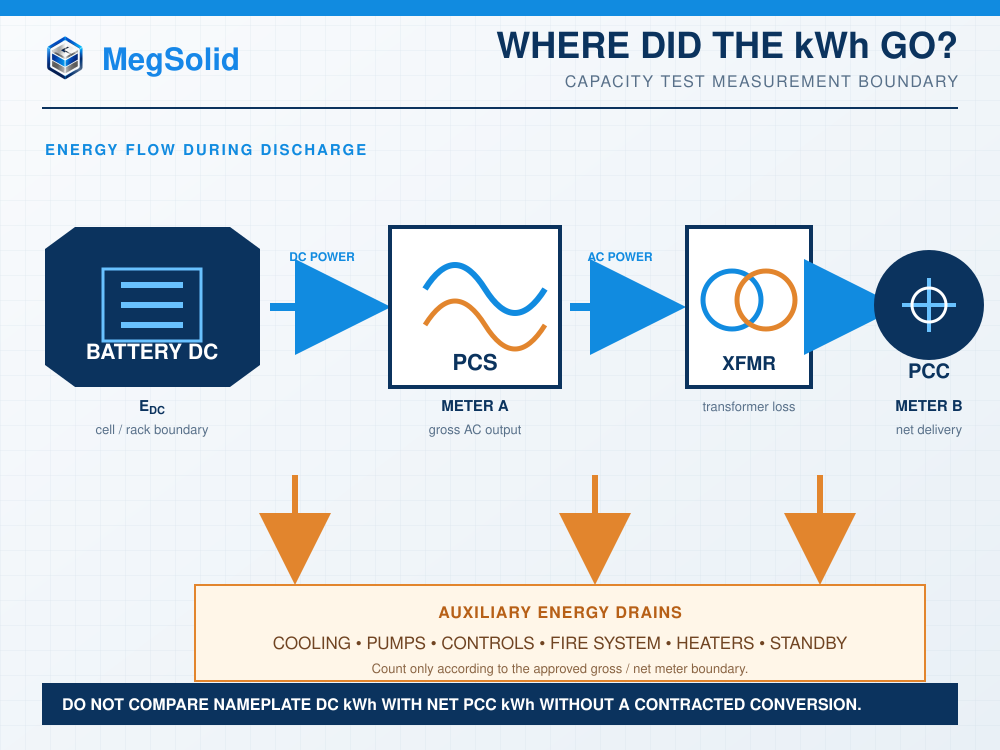
The word capacity is too vague for a pass/fail clause. The EPC must define the electrical boundary, energy direction, time interval, approved SOC or voltage endpoints, auxiliary treatment and environmental conditions. For an AC delivery test, the measured energy is the time integral of real power at the named meter; the meter and sign convention must be stated before the test.
| Capacity boundary | What it represents | Why the value changes |
|---|---|---|
| Cell or rack DC energy | Energy inside the battery boundary | Excludes PCS, transformer and some auxiliary losses |
| PCS AC terminals | Energy converted by the PCS | Includes battery and PCS behavior but may exclude transformer and site auxiliaries |
| BESS transformer meter | Energy after conversion and transformer effects | Changes with transformer loss and the auxiliary connection point |
| Point of common coupling | Net energy delivered to the site or grid boundary | May include site load, PV, auxiliaries and other equipment unless isolated |
| Nameplate energy | Published nominal or rated storage value | Not automatically equal to usable or guaranteed AC delivery |
Before comparing offers, use the commercial energy storage procurement guide to force every bidder onto the same power, energy and responsibility boundary. A price comparison is not valid when one supplier quotes nominal DC energy and another accepts net AC delivery at the PCC.
Seven Causes of a BESS Capacity Shortfall
1. The SOC Endpoints Were Not Equivalent
Displayed 100% SOC is an estimate governed by the BMS algorithm and approved operating limits; it is not proof that every string reached an identical electrochemical state. Likewise, the discharge may stop because one string reached its voltage or temperature limit before the site display reached the nominal lower SOC. Compare pack and string voltages, SOC, charge completion status, balancing state and the first active limit at both endpoints.
2. Auxiliary Loads Were Counted Differently
Air conditioning, liquid-cooling pumps, control power, heaters, fire-system loads and transformer no-load losses can sit inside or outside the chosen meter boundary. The capacity result must say whether gross BESS output or net delivered energy is being accepted. Record auxiliary kW throughout the test instead of applying an unverified percentage afterward.
3. Test Power Changed the Available Energy
A capacity test at one power level cannot be assumed to represent every dispatch duty. Higher current can increase conversion and resistive losses, while a very low-power test can extend exposure to standing auxiliaries. Specify a constant-power profile, tolerance band, ramp treatment and how periods outside the band are handled.
4. Temperature or Thermal Controls Reduced the Window
The system may derate or tighten charge and discharge limits before a temperature becomes severe enough to trigger a trip. Record ambient temperature, representative cell and coolant or cabinet temperatures, thermal-system status and the BMS/PCS power limits. A test begun before the system reaches stable conditions is difficult to reproduce or defend.
5. A String or Power Block Was Partly Unavailable
A disconnected string, contactor state, communication exclusion or maintenance bypass may reduce available energy without shutting down the entire plant. The acceptance record should reconcile the installed configuration with the online configuration at the start, during the limiting event and at the end of discharge.
6. Metering or Time Alignment Was Wrong
A sign reversal, kW-versus-W scaling error, mismatched CT ratio, data gap or clock offset can turn a valid discharge into an apparent failure. Compare the revenue meter with PCS and EMS trends at a common timestamp. The BESS factory acceptance test witness guide helps move scaling, sign and data-chain checks ahead of site testing.
7. Preconditioning and Test Sequence Were Incomplete
The approved procedure should define charging method, completion criterion, balancing opportunity, rest period, thermal stabilization and preceding duty. If the system arrives at the test after an uncontrolled dispatch or incomplete charge, the result is not directly comparable with the contracted reference condition.
Use Evidence to Separate Test Error From System Limitation
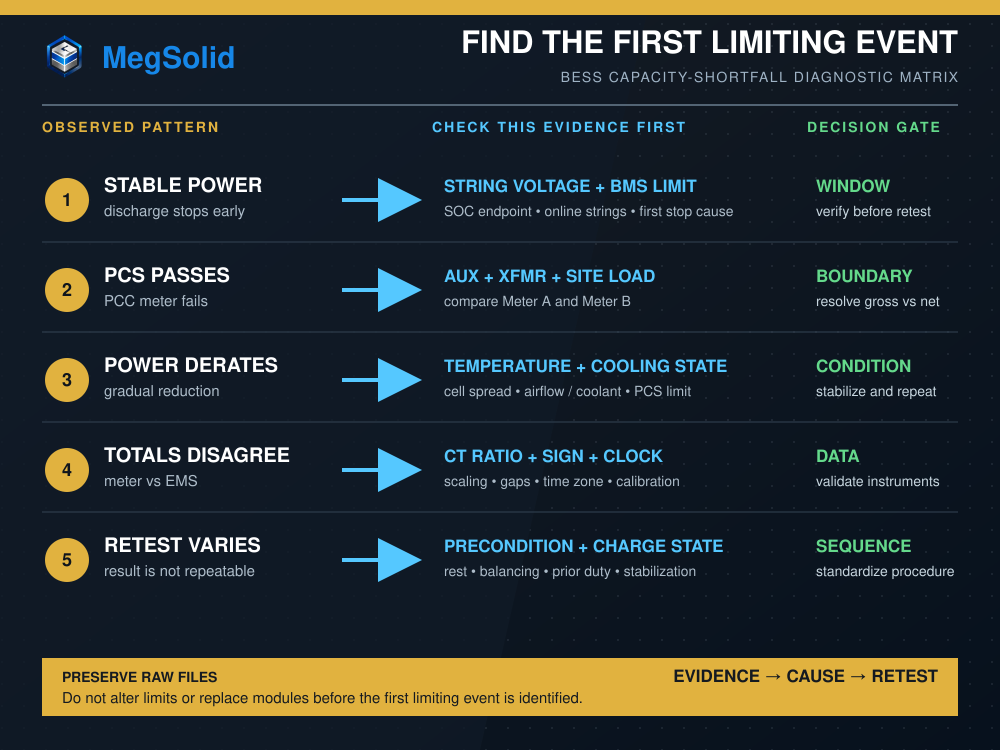
Do not begin by changing SOC limits, resetting alarms or replacing modules. Preserve the original files and identify the first event that changed power, availability or the energy window. The minimum dataset is requested and measured AC power, the contractual meter, BESS SOC, battery voltage and current, string availability, BMS charge/discharge limits, PCS limits, representative temperatures, auxiliary power and synchronized event logs.
| Observed pattern | Evidence to check first | Likely decision |
|---|---|---|
| Stable power, early discharge stop | First string voltage limit, SOC endpoint, unavailable strings | Confirm usable window and string condition before retest |
| Gross PCS energy passes; PCC energy fails | Transformer loss, auxiliary meter and concurrent site load | Resolve measurement boundary and net-delivery clause |
| Power gradually derates | Cell temperature spread, coolant or airflow status, BMS/PCS limits | Correct thermal condition and repeat under approved environment |
| Meter total disagrees with EMS trend | CT ratio, sign, time zone, sampling gaps and meter calibration | Validate instrumentation before declaring battery failure |
| Repeated tests vary after different prior duties | Preconditioning, rest time, charge completion and balancing state | Standardize the sequence and establish a reproducible baseline |
Performance-test data should identify power exchanged with the grid, requested power and SOC; additional AC/DC metering, auxiliary consumption and temperature data improve root-cause resolution. These evidence categories are also reflected in the NRECA BESS performance-test guide.
Write the Capacity Test Into the RFQ Before Award
A procurement team has more leverage before the purchase order than after a disputed SAT. Attach a capacity-test schedule to the RFQ and require each bidder to mark inclusions, deviations and assumptions. The C&I BESS procurement checklist can be used for the wider commercial review, while the test schedule owns this specific acceptance boundary.
- 📍 Measurement point: Meter name, SLD location, accuracy class, CT/PT ratio, calibration and sign convention.
- 🔋 Energy basis: Nominal DC, usable DC, gross AC or net AC delivered energy; beginning-of-life or another stated condition.
- ⬆️ Start condition: Charge completion, upper SOC or voltage criteria, balancing, stabilization and allowable rest time.
- ⬇️ Stop condition: Lower SOC or voltage criteria, first limiting event, safety boundary and treatment of manual interruption.
- ⚙️ Power profile: Commanded kW, tolerance, ramps, pauses, reactive-power state and excluded intervals.
- 🌡️ Environment: Ambient and battery temperature range, altitude, HVAC state and approved derating rules.
- 🌀 Auxiliaries: Included loads, separate meter, gross/net calculation and standby treatment.
- 📊 Data package: Raw meter file, BMS/PCS/EMS trends, event log, sampling rate, timestamps and report template.
- ✅ Acceptance rule: Target, tolerance, correction method, retest rights, responsible party and shortfall remedy.
Apply the Test Boundary to MegSolid C&I BESS Models
MegSolid product ratings provide the equipment starting point; they do not replace a project-specific usable-energy guarantee. The ordered quotation, signed datasheet, BOM, SLD, control narrative, warranty and acceptance plan must agree on the exact configuration and test conditions.
| MegSolid reference | Verified published data | Capacity-test RFQ action |
|---|---|---|
| ESSA0100B-0215 outdoor cabinet | 100 kW rated AC power; 215.04 kWh nominal capacity; 0.5C at 25°C; LFP cell type | Do not promise 215.04 kWh at the PCC; define usable SOC window, auxiliaries, test power and AC meter boundary |
| 261.24 kWh liquid-cooled system | 261.24 kWh rated energy; 125 kVA rated AC power; hybrid solid-state LFP-314Ah; maximum system efficiency 90% | Do not relabel maximum system efficiency as guaranteed RTE; request the project acceptance value and conditions |
| ESSA0050B-0100 outdoor cabinet | 50 kW rated AC power; 100.352 kWh nominal capacity; 0.5C at 25°C; LFP cell type | Use the same measurement and auxiliary boundary when comparing the nominal two-hour class with the required site delivery |
For the outdoor platform, review the MegSolid ESSA cabinet specifications together with the 100 kW / 215 kWh BESS selection guide. For a liquid-cooled alternative, the 261.24 kWh liquid-cooled BESS RFQ guide keeps system efficiency, power and acceptance assumptions separate.
Where the project requires a verified hybrid solid-state configuration, MegSolid can review the required cell and system evidence. Hybrid solid-state architecture can reduce flammable-liquid exposure and improve resistance to some internal-fault propagation mechanisms when supported by the ordered configuration's test evidence. It does not make the BESS fireproof or remove the need for BMS limits, thermal controls, detection, suppression and emergency procedures. Review the MegSolid solid-state energy storage systems and the 12 thermal-runaway verification checks without transferring solid-state claims to standard LFP models.
Send the Right Evidence for a Defensible Retest
Send MegSolid the signed capacity clause, SLD, meter location, ordered model and BOM, commissioning plan, raw meter export, BMS/PCS/EMS trends, alarm and event logs, auxiliary-power data, ambient and battery temperatures, start and stop conditions, commanded kW, observed shortfall and previous retest history. This lets the engineering review separate a contractual mismatch, instrumentation problem, site condition and equipment limitation before recommending corrective work.
This article provides a baseline diagnostic and procurement framework. To receive the editable BESS Capacity Test Acceptance Workbook—including the measurement-boundary schedule, energy-integration fields, synchronized data checklist, retest record and RFQ responsibility matrix—email [email protected]. Include the project country, BESS power and energy, selected model, contractual meter point and expected delivery date.
FAQ
What should a BESS capacity test contract define?
Define the energy basis, meter and SLD location, start and stop conditions, constant-power profile, temperature range, auxiliary treatment, data files, pass tolerance, correction method, retest rights and commercial remedy.
Can a BESS fail its capacity test with no active alarm?
Yes. SOC endpoints, net auxiliary consumption, meter location, derating, unavailable strings, calibration or incomplete preconditioning can reduce measured energy without crossing a configured fault threshold.
Should capacity be measured on the DC or AC side?
Use the boundary named in the contract. A site delivery guarantee normally needs an identified AC meter, while diagnostic testing may also use DC battery and PCS measurements to separate losses and limitations.
Should BESS auxiliary power be deducted from delivered energy?
Only according to the approved gross or net boundary. State which cooling, control, fire-system, heater, pump and transformer loads are inside the calculation and meter them during the test where practical.
Is displayed SOC enough to prove the capacity-test endpoints?
No. Record SOC together with pack and string voltage, current, charge-completion state, first limiting condition, balancing status and active BMS or PCS limits at both endpoints.
What data should be preserved after a failed capacity test?
Preserve the raw contractual-meter export, requested and measured power, BMS and PCS limits, SOC, battery voltage and current, string availability, temperatures, auxiliary power, alarms, events and synchronized timestamps.
When should an EPC repeat a BESS capacity test?
Repeat it after the cause of the invalid or failed result is documented, corrective action is complete, instrumentation is verified and the approved preconditioning and environmental requirements can be reproduced.
Does nominal kWh equal usable AC energy?
No. Nominal battery energy does not automatically include the approved SOC window, conversion and transformer effects, auxiliaries, reserve, temperature conditions, availability or end-of-life requirement.
Does the ESSA0100B-0215 guarantee 215.04 kWh at the PCC?
No. The published 215.04 kWh value is nominal capacity. Any guaranteed PCC delivery must be stated separately with the meter boundary, SOC window, test power, auxiliary treatment, conditions and tolerance.
What should a buyer send MegSolid for a capacity-shortfall review?
Send the signed test clause, SLD, ordered model and BOM, meter details, raw trends, auxiliary data, temperatures, start and stop records, commanded power, observed energy and retest history.
What is a BESS capacity test failure?
A BESS capacity test failure occurs when the measured energy under the approved procedure and boundary does not meet the contractual target or tolerance, even if the system remains operational and shows no fault alarm.
Why can usable BESS energy be lower than nameplate capacity?
Usable energy may be lower because nameplate capacity is reduced by the approved SOC window, conversion and transformer effects, auxiliary consumption, reserve requirements, temperature limits, unavailable equipment and the chosen meter boundary.
How does MegSolid investigate a BESS capacity shortfall?
MegSolid reconciles the contract and SLD with synchronized meter, BMS, PCS, EMS, temperature, auxiliary and availability data, identifies the first limiting event, and defines the evidence needed for corrective action or a controlled retest.
