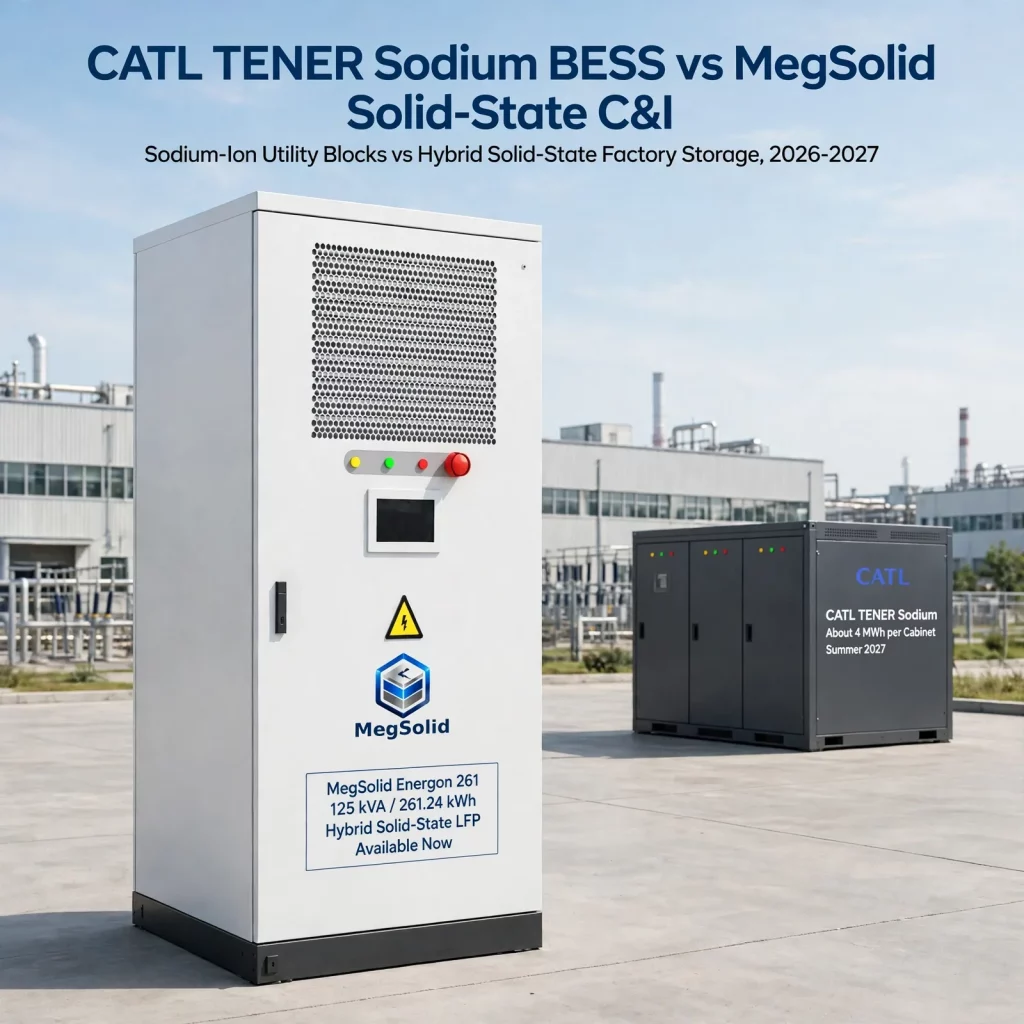
Commercial EPC teams and industrial CFOs evaluating a CATL TENER Sodium BESS after CATL's June 22, 2026 Munich unveiling face a direct scheduling decision. Should a European or North American factory delay its 2026–2027 peak-shaving project for stationary sodium-ion storage, or deploy bankable Hybrid Solid-State and LFP C&I systems right now?
Give CATL's engineering team credit where it belongs. CATL declares over 92% capacity retention at -20 C across a -35 C to +55 C operating envelope, paired with IP55 protection and roughly 1% auxiliary power consumption. The platform also rates 15,000 cycles at 25 C (to 70% SOH), over 10,000 cycles at 45 C, and 95% round-trip efficiency at 25 C and 0.25P. For multi-tens-of-MWh front-of-meter stations commissioning from mid-2027 onward, sodium-ion brings real supply diversification.
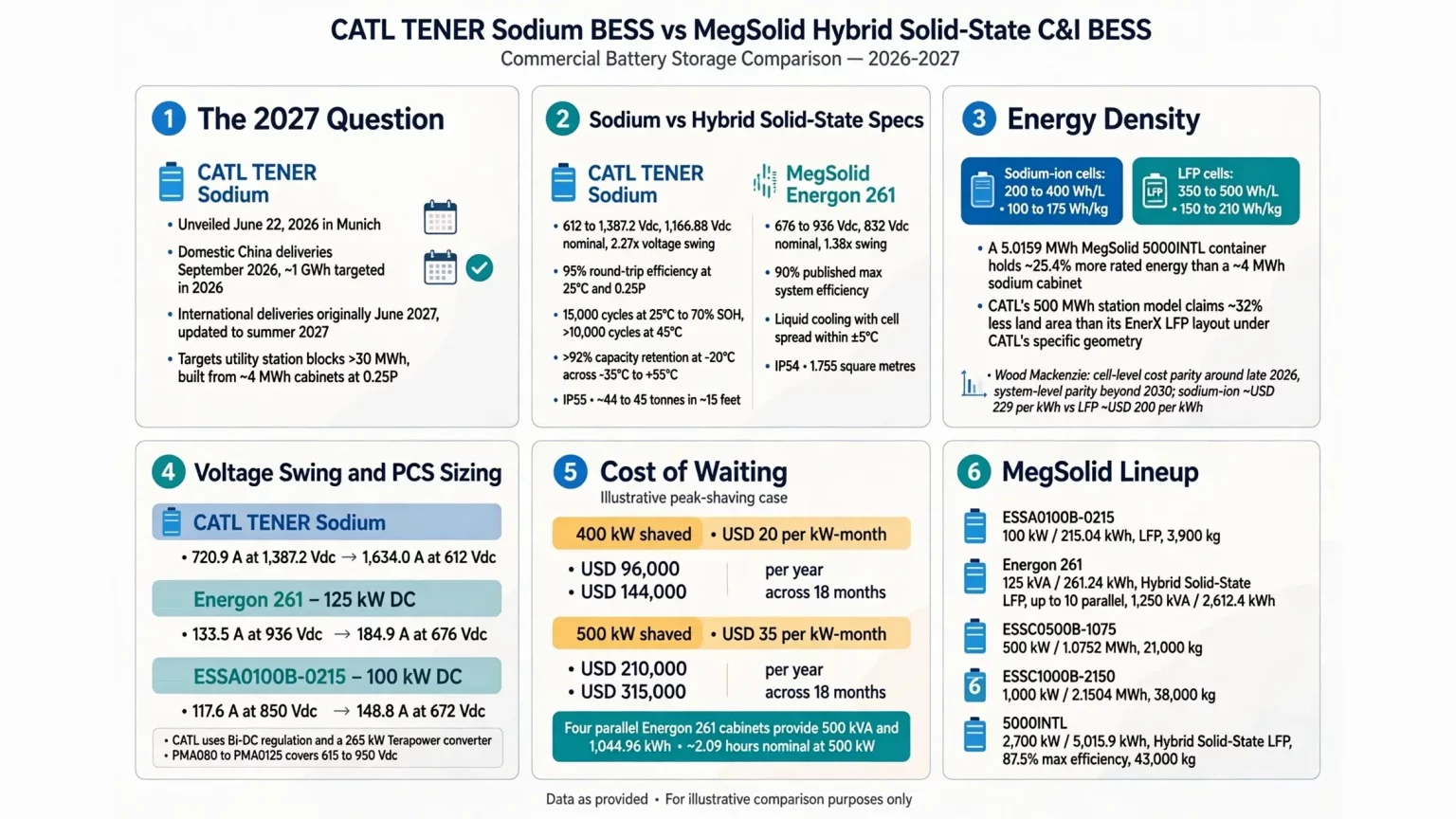
Commercial factory tenders live under a different clock. In a sodium ion vs solid state commercial BESS audit, TENER Sodium centers on utility blocks exceeding 30 MWh built from ~4 MWh cabinets. CATL's June 2026 launch listed those cabinets around 42 tonnes, while October 2026 disclosures updated them to roughly 44–45 tonnes in an approximately 15-foot length. International shipments were originally slated for June 2027, with later disclosures framing rollout for summer 2027. Its 612–1,387.2 Vdc (1,166.88 Vdc nominal) 2.27x voltage span and 0.25P rate fit grid substations far better than factory LV switchrooms.
Plants sizing 100 kW to 2 MW behind-the-meter projects today need AC-ready hardware that lands beside existing low-voltage transformers. We build here on our deployment frameworks for How to Select a 100 kW / 215 kWh Outdoor BESS for a C&I Site, 500 kW / 1.0752 MWh Containerized BESS Grid Boundaries, and Hybrid Solid-State vs Liquid LFP for C&I BESS. Below, we benchmark CATL TENER Sodium directly against MegSolid's Hybrid Solid-State lineup (Energon 261 and 5000INTL) and turnkey LFP C&I enclosures (ESSA0100B-0215, ESSC0500B-1075, and ESSC1000B-2150).
CATL TENER Sodium BESS vs. MegSolid Hybrid Solid-State & C&I BESS: Core Engineering Comparison
Buyer Takeaway: CATL TENER Sodium targets summer-2027 utility stations above 30 MWh at 0.25P, while MegSolid delivers right-sized 215 kWh to 5.02 MWh AC-ready blocks for immediate C&I commissioning.
Evaluating CATL TENER Sodium 2026 announcements alongside active C&I hardware requires separating utility front-of-meter blocks from behind-the-meter commercial packages. Each MegSolid platform below carries its exact published chemistry and electrical rating so EPC engineers avoid mixing cabinet specs during bid evaluation.
| Engineering Parameter | CATL TENER Sodium (June & Oct 2026 Disclosures) | MegSolid Energon 261 (Hybrid Solid-State) | MegSolid ESSA / ESSC Turnkey C&I (LFP) |
|---|---|---|---|
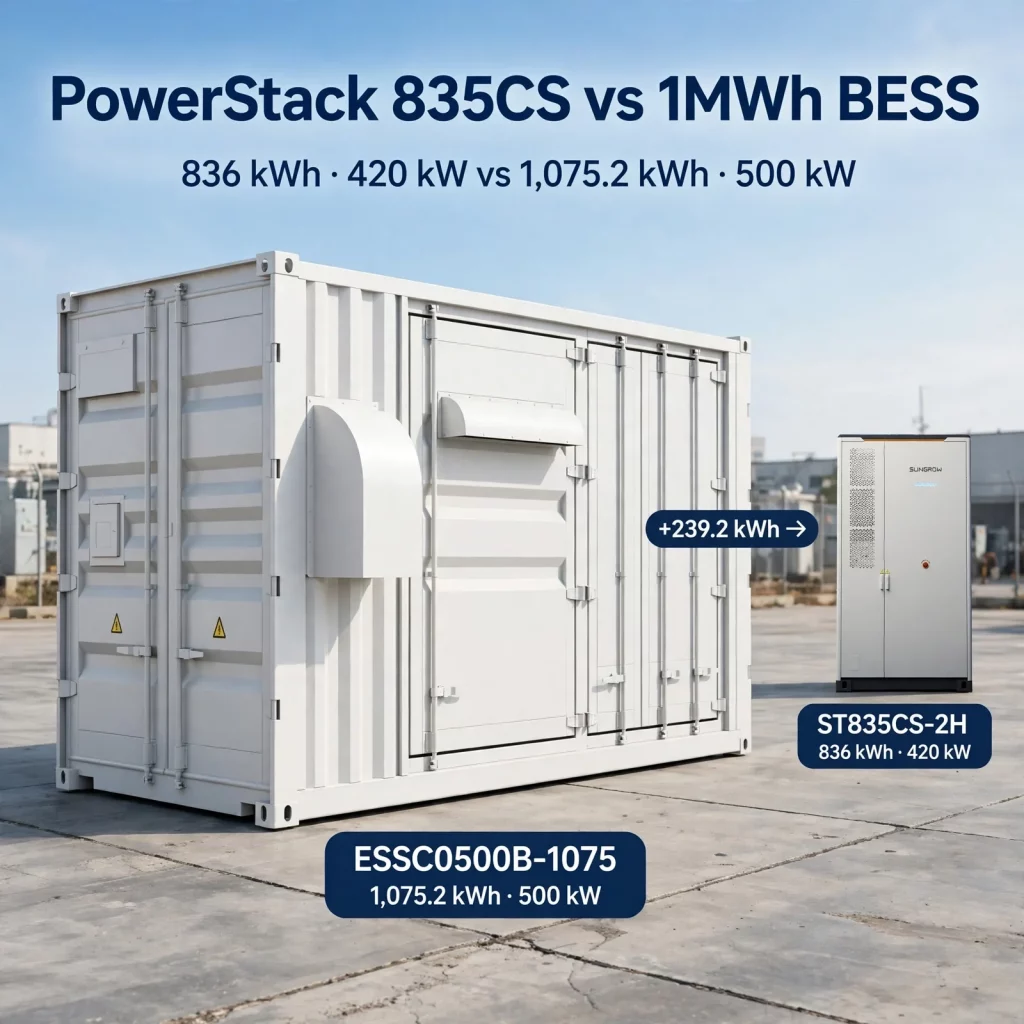
| Deployment Scale | Utility blocks >30 MWh (~4 MWh cabinets; ~42 t June launch, updated ~44–45 t / ~15 ft in Oct 2026) | 125 kVA / 261.24 kWh (parallel up to 10 units = 2.61 MWh) | ESSA0100B-0215 (215.04 kWh); ESSC0500B-1075 (1.0752 MWh); ESSC1000B-2150 (2.1504 MWh) |
| Commercial Availability | China Sept 2026 (~1 GWh 2026); international slated June 2027, updated to summer 2027 | Active commercial production (project-confirmed lead time) | Active commercial production (project-confirmed lead time) |
| Published Chemistry & Rate | Sodium-ion utility format; 0.25P system rate | Hybrid Solid-State LFP-314Ah (1P260S) | LFP (1P240S in ESSA at 0.5C; 3.2 V / 280 Ah LFP in ESSC) |
| DC Voltage Window | 1,166.88 Vdc nominal; 612–1,387.2 Vdc (~2.27x swing) | 676–936 Vdc (832 Vdc nominal; 1.38x swing) | ESSA0100B-0215: 672–850 Vdc (768 V nominal; 1.26x swing) |
| AC Interface & Efficiency | Bi-DC + PCS (incl. 265 kW Terapower module); 95% RTE rated at 25 C, 0.25P | Factory-integrated 480/400 V AC; 90% published max system efficiency (distinct test basis vs 0.25P RTE) | Factory-integrated 400 V AC (ESSA); containerized AC turnkey (ESSC) |
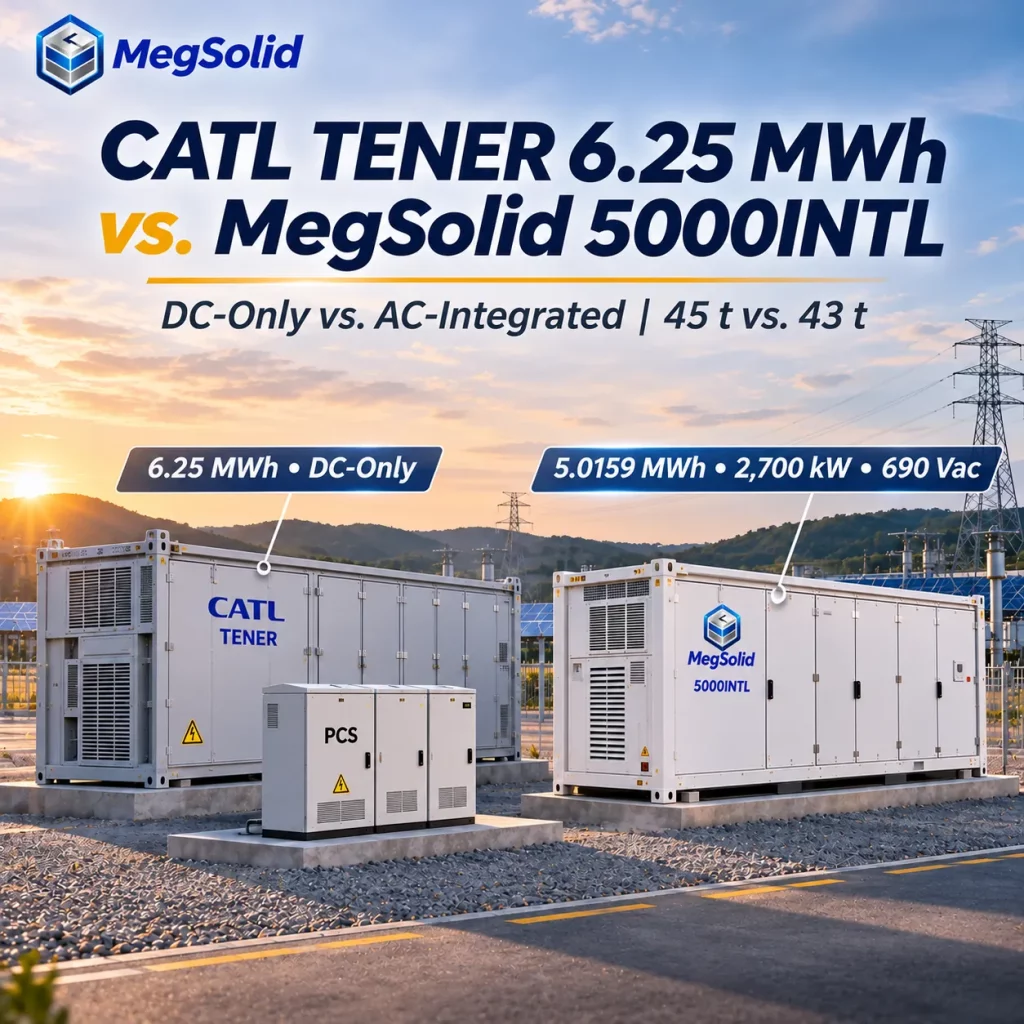
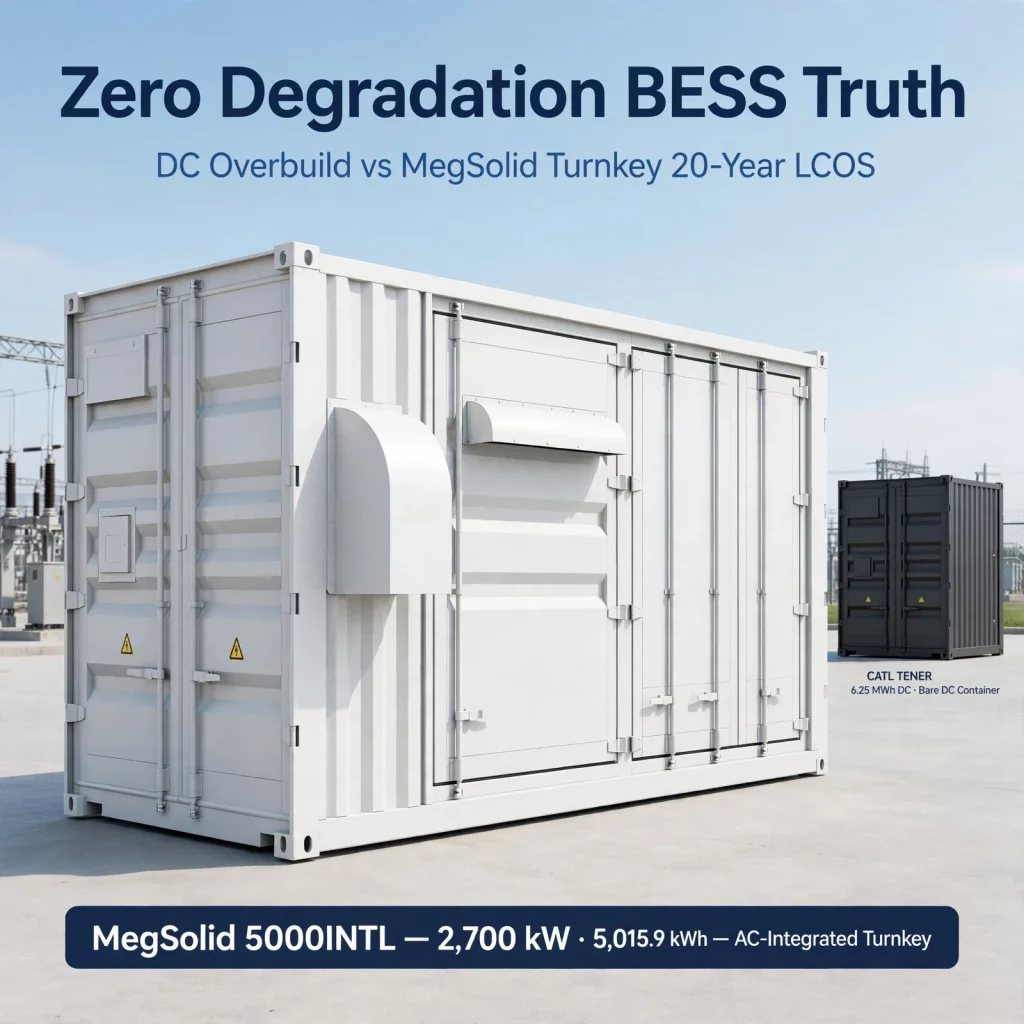
MegSolid separates chemistry cleanly across project tiers. Buyers prioritizing liquid-cooled Hybrid Solid-State LFP deploy MegSolid Energon 261 (125 kVA / 261.24 kWh per cabinet, 90% published max system efficiency, scaling up to 10 parallel units at 1,250 kVA / 2,612.4 kWh). Heavy campuses and utility feeders step up to MegSolid 5000INTL (2,700 kW / 5,015.9 kWh, SHS180-314 12P416S Hybrid Solid-State LFP, 690 Vac, 87.5% published max efficiency). Check efficiency boundaries carefully before modeling energy losses. CATL's 95% figure represents system round-trip efficiency at 25 C and 0.25P, while MegSolid's 90% and 87.5% figures reflect published maximum system efficiency under different test conditions. Always request normalized AC-to-AC curves at matching load, temperature, and auxiliary draw.
Air-cooled and isolated-feeder LFP projects map directly to two proven lines. Small commercial yards deploy MegSolid ESSA0100B-0215 (100 kW / 215.04 kWh, 3,900 kg net, ≥5,000 cycles at 0.5C and 25 C). Larger industrial pads scale with MegSolid ESSC0500B-1075 and ESSC1000B-2150 containers (500 kW / 1.0752 MWh at 21,000 kg and 1,000 kW / 2.1504 MWh at 38,000 kg, ≥5,000 cycles).
Thermal, Safety & Lifecycle Profile Comparison
| Operational & Safety Factor | CATL TENER Sodium (June & Oct 2026 Disclosures) | MegSolid Energon 261 & 5000INTL (Hybrid Solid-State) | MegSolid ESSA0100B-0215 & ESSC Series (LFP) |
|---|---|---|---|
| Cold & Ambient Resilience | >92% capacity retention at -20 C (manufacturer claim); -35 C to +55 C | Liquid cooling (+/-5 C delta on Energon 261); confirm site ambient envelope per project | Intelligent air cooling (ESSC) and outdoor IP54 design; confirm winter pre-heat scope per site |
| Enclosure & Ingress Rating | IP55; ~15-foot modular cabinet weighing ~44–45 t (Oct 2026 update; ~42 t June launch) | IP54 (Energon 261, 1.755 m2 base); IP55 (5000INTL, 43,000 kg, ≤4,000 m) | IP54 across ESSA0100B-0215 (2,450 x 1,550 x 2,400 mm) and ESSC containers |
| Fire Protection Stack | Cell thermal stability design with ~200 ms fault isolation | Novec + multi-sensor detector + water-based (Energon 261); 3D protection + AI warning (5000INTL) | Aerosols / NOVEC1230 plus built-in isolation transformer (ESSA0100B-0215) |
| Published Cycle Rating | 15,000 cycles at 25 C (70% SOH); >10,000 cycles at 45 C | Contract-confirmed warranty cycles and EOL terms per project dossier | ≥5,000 cycles published at 0.5C and 25 C (ESSA0100B-0215, ESSC0500B-1075, ESSC1000B-2150) |
| Layout & Footprint Context | Multi-cabinet >30 MWh station blocks (~4 MWh per ~15-ft cabinet) | 1.755 m2 per 261.24 kWh (Energon 261); 5.0159 MWh in 20-ft container (5000INTL) | 20-ft 1.0752 MWh (ESSC0500B-1075); 40-ft 2.1504 MWh (ESSC1000B-2150) |
Sodium-Ion Energy Density vs Hybrid Solid-State LFP: Evaluating Cabinet Capacity, Site Footprint & BoP Cost
Buyer Takeaway: Sodium-ion cells carry lower volumetric energy density (200–400 Wh/L) and post-2030 system parity forecasts, so EPCs must evaluate complete site layouts and BoP budgets alongside single-cabinet MWh.
Physics sets the starting baseline when comparing sodium ion energy density vs hybrid solid state systems. Sodium ions carry a larger ionic radius (roughly 1.02 angstroms vs. 0.76 angstroms for lithium ions) and more than triple the atomic mass (23.0 g/mol vs. 6.94 g/mol). In commercial stationary cells, that atomic difference yields typical volumetric energy densities of 200 to 400 Wh/L for sodium-ion compared with 350 to 500 Wh/L for LFP, and 100 to 175 Wh/kg gravimetric density vs. 150 to 210 Wh/kg for LFP.
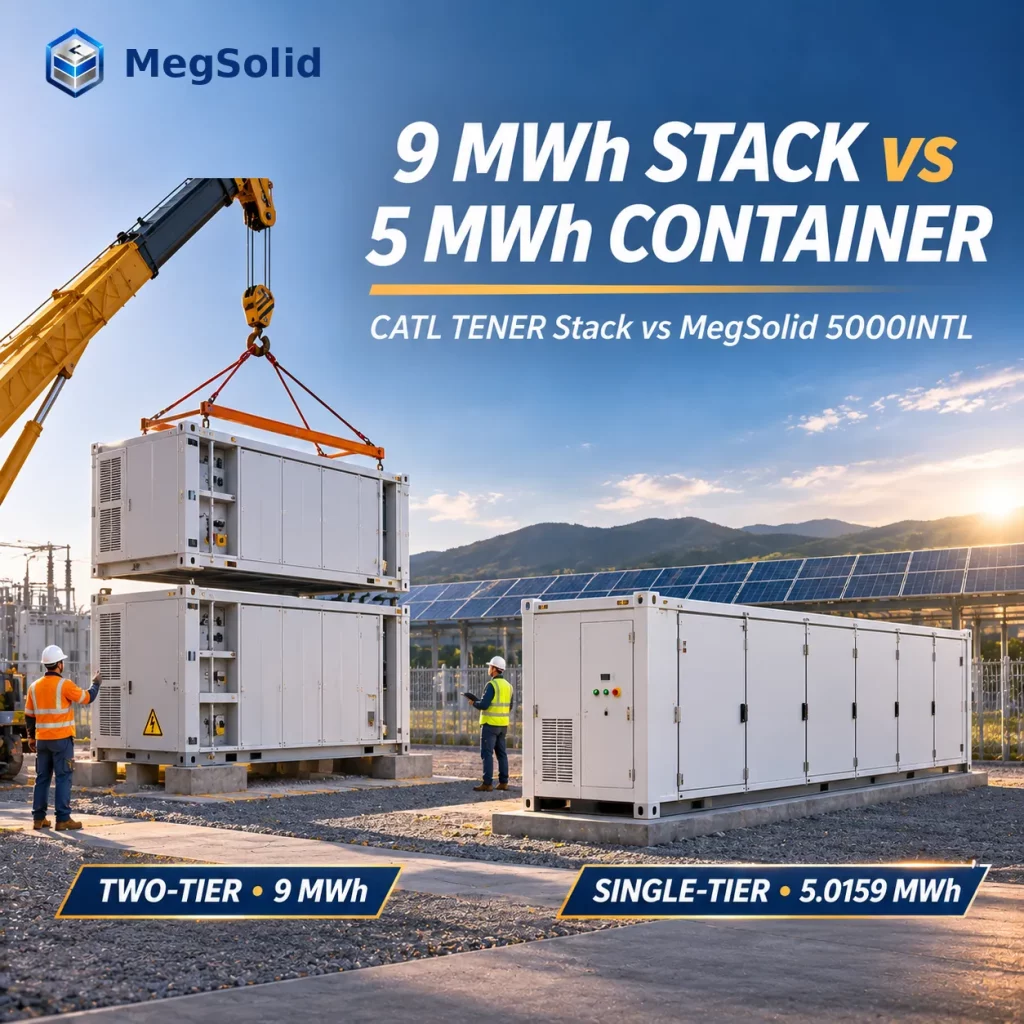
Single-cabinet rated capacity reflects those cell limits cleanly, while full station footprint depends on total plant geometry. CATL's June 2026 launch listed ~4 MWh sodium-ion cabinets around 42 tonnes, and October 2026 disclosures updated the unit to roughly 44–45 tonnes in an approximately 15-foot cabinet length. On single-cabinet nominal capacity, a 20-foot MegSolid 5000INTL Hybrid Solid-State container (5.0159 MWh inside 6,058 x 2,438 x 2,896 mm) holds roughly 25.4% more rated energy per unit than a ~4 MWh cabinet. Because the ~15-foot sodium-ion cabinet uses different exterior dimensions than a standard 20-foot container, comparing the two on equal base area alone misses station-level engineering.
CATL's October 2026 technical material makes that point clear. Modeling a 500 MWh multi-cabinet TENER Sodium station, CATL claimed roughly 32% lower overall land area than its EnerX LFP layout. That result reflects CATL's specific multi-cabinet packing and spacing assumptions. For EPCs, the takeaway is simple: compare complete site layouts, PCS placement, fire setbacks, and utility auxiliaries side by side instead of guessing land area from cell Wh/L alone.
At the commercial C&I scale, full non-cell Balance-of-Plant (BoP) and installation dilution still shapes project CAPEX across total installed system energy:
Installed_System_Cost (USD/kWh) = Cell_Cost_per_kWh + (Enclosure + PCS + Transformer_and_Switchgear + Cabling + Thermal_System + BMS + Fire_Stack + Civil_Pad + Transport_and_Rigging + Commissioning) / System_Energy_kWh
Wood Mackenzie's commercial sodium-ion research quantifies that system-level lag. Leading cell makers target cell-level cost parity with LFP around late 2026, while module- and system-level cost parity shifts beyond 2030. Globally, upfront sodium-ion BESS costs average roughly USD 229/kWh compared with USD 200/kWh for LFP. Long 20-year utility TCO models can still favor sodium-ion on high-cycle, extreme-cold stations. Behind-the-meter factories face immediate upfront CAPEX approvals and tight yard clearance today.
Compact C&I geometry solves behind-the-meter yard limits directly. One MegSolid Energon 261 cabinet occupies 1.755 m2 (1,300 x 1,350 x 2,200 mm) for 261.24 kWh of Hybrid Solid-State LFP storage, delivering 148.9 kWh per square meter of base footprint before service clearances. Scaling four parallel Energon 261 cabinets reaches 500 kVA / 1,044.96 kWh along a narrow loading-bay strip. For dedicated 20-foot container pads next to a 630 kVA or 800 kVA transformer, one ESSC0500B-1075 consolidates 500 kW / 1.0752 MWh at 21,000 kg.
Need Exact Yard Footprint & Civil Load Drawings for Your 2026–2027 Factory Bid? Request base-pad dimensions, clearance layouts, and single-line diagrams for Energon 261, ESSA0100B-0215, ESSC0500B-1075, and ESSC1000B-2150 directly from our application engineers.
Sodium Ion Voltage Curve PCS Sizing: How a 2.27x DC Swing Reshapes Inverter Architecture
Buyer Takeaway: Sodium-ion's 612–1,387.2 Vdc (2.27x) swing requires wider current sizing or Bi-DC conversion stages, while MegSolid's factory-integrated C&I systems operate on tighter 1.26x–1.38x LFP windows.
Electrical engineers checking sodium ion voltage curve PCS sizing spot the integration difference immediately on the DC bus. Sodium-ion cathode chemistries span a broader operating window than LFP to access usable capacity:
- Sodium-ion layered oxide cells typically span 1.8 V to 3.95 V (some formulations reach down to 1.5 V, nominal ~3.0–3.05 V) along a steady downward voltage slope as SoC drops.
- Sodium-ion NFPP (polyanion) cells span roughly 1.5 V to 3.7 V (nominal ~3.0 V), exhibiting a plateau near 3.3 V before sloping sharply toward cut-off limits.
- LFP and Hybrid Solid-State LFP cells anchor around a flat 3.20 V nominal plateau across most of their usable SoC window.
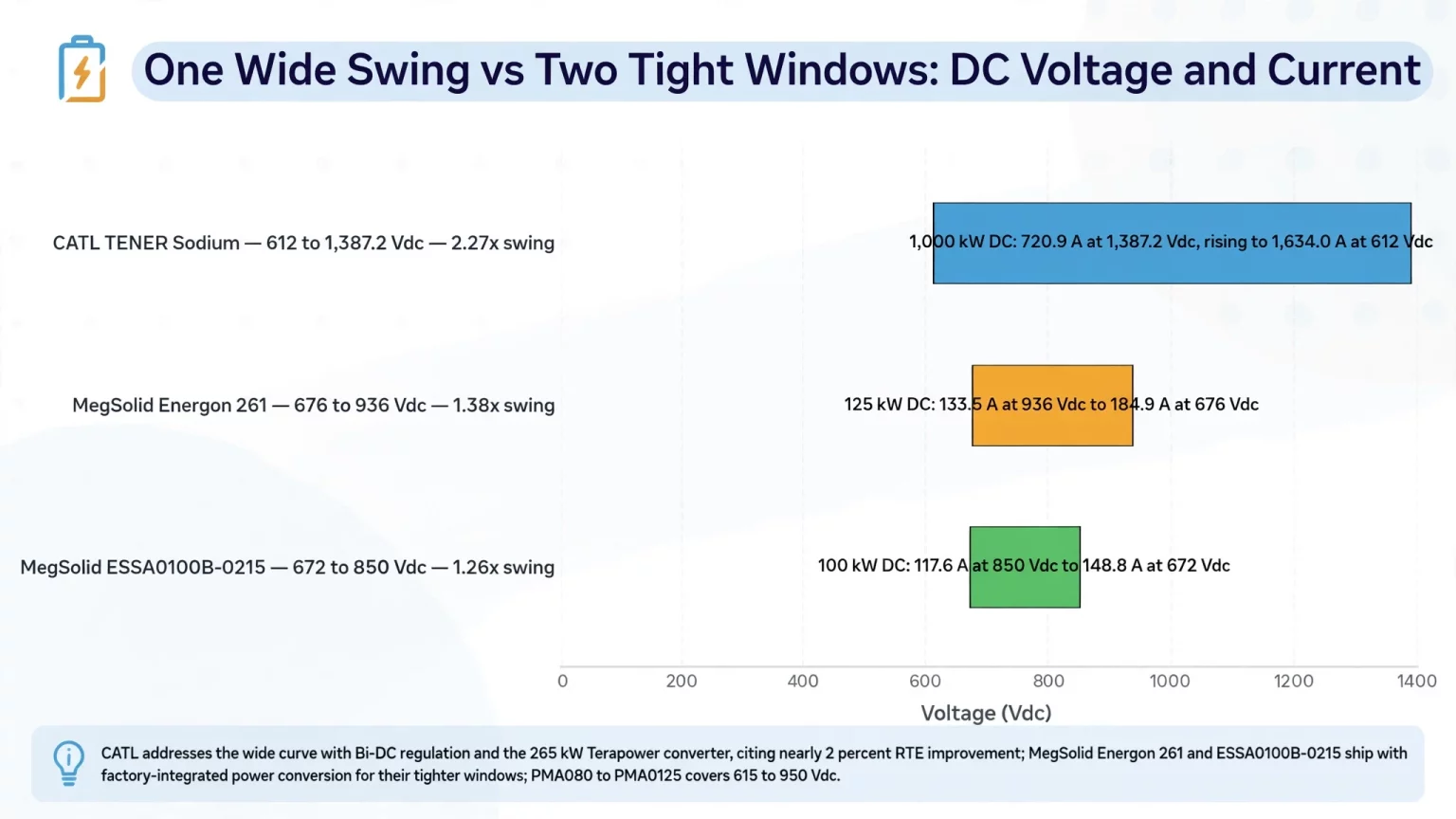
At the utility system level, CATL TENER Sodium operates at 1,166.88 Vdc nominal across a 612 V to 1,387.2 Vdc operating range (a 2.27x maximum-to-minimum voltage ratio). Compare that span against MegSolid's published C&I battery windows:
- Energon 261 (1P260S Hybrid Solid-State LFP-314Ah): 676 Vdc to 936 Vdc (832 Vdc nominal), a 1.38x span with factory-integrated power conversion.
- ESSA0100B-0215 (1P240S LFP): 672 Vdc to 850 Vdc (768 Vdc nominal), a 1.26x span with factory-integrated power conversion and built-in isolation transformer.
Isolating DC bus current scaling before inverter losses and auxiliary loads illustrates the semiconductor sizing physics:
I_DC = P_DC / V_DC
Delivering 1,000 kW on the DC side across a 612–1,387.2 Vdc window draws 720.9 A at 1,387.2 Vdc and climbs to 1,634.0 A at 612 Vdc. Uncompensated inverters either oversize IGBT current capacity by more than 2x to hold full AC power at low SoC, or derate active power during the final discharge interval.
CATL addresses that wide curve on TENER Sodium using a bidirectional DC/DC (Bi-DC) voltage regulation architecture. CATL states that Bi-DC regulation improves wide-voltage PCS efficiency, citing nearly 2% system-level RTE improvement alongside a 95% system RTE rating at 25 C and 0.25P. In October 2026, CATL also presented its 265 kW Terapower converter, integrating bidirectional DC/DC conversion and PCS functions into one unified module. That integrated hardware eliminates any automatic need for standalone Bi-DC cabinets or extra DC trenches. Even so, EPCs still evaluate the added DC-DC stage's cost, conversion complexity, and utility-only deployment scale.
On the MegSolid C&I side, Energon 261 and ESSA0100B-0215 ship with factory-integrated power conversion engineered specifically for their 676–936 Vdc and 672–850 Vdc battery windows. When EPCs design custom DC-coupled systems with standalone MegSolid PCS or inverter hardware, engineering teams must verify exact DC voltage overlap, full-power current capability, BMS communication, and approved system pairing for each model:
- MegSolid PMA080, PMA0105, and PMA0125 rack-mount PCS modules (80 / 105 / 125 kW AC; 96 / 126 / 150 kW max DC) span 615–950 Vdc (3W+PE) or 650–950 Vdc (3W+N+PE). That window covers 676–936 Vdc and 672–850 Vdc voltage bounds, with 98.7% published max efficiency and <20 ms switching time.
- MegSolid MEGA0030TS–MEGA0500TS PCS cabinets deliver 30–500 kW (33–550 kVA) at 96.3%–97.5% published max efficiency with a built-in isolation transformer and parallel scaling up to 4 units. Their DC ranges span 250–850 Vdc to 500–850 Vdc by model, capping at 850 Vdc (below Energon 261's 936 Vdc upper limit) for approved ≤850 Vdc battery banks.
- MegSolid R30KH3, R40KH3, and R50KH3 three-phase hybrid inverters deliver 30 / 40 / 50 kW AC in an IP65 housing with <10 ms backup switchover and 100% unbalanced load output on R50KH3. They operate across 150–800 Vdc for compatible ≤800 Vdc Hybrid Solid-State or lithium-ion battery banks, below Energon 261's 832 Vdc nominal rating.
Across a 676–936 Vdc window, a 125 kW DC power transfer shifts bus current from 133.5 A at 936 Vdc to 184.9 A at 676 Vdc. Across 672–850 Vdc, a 100 kW DC transfer moves from 117.6 A to 148.8 A. Those current numbers show tighter voltage-swing scaling. Final compliance still requires checking the selected PCS continuous current rating, semiconductor thermal limits, ambient derating curves, and full-load efficiency curves alongside Energon 261's 90% published max system efficiency.
2026–2027 Supply-Chain Reality Check: The Financial Cost of Waiting for Commercial Sodium-Ion
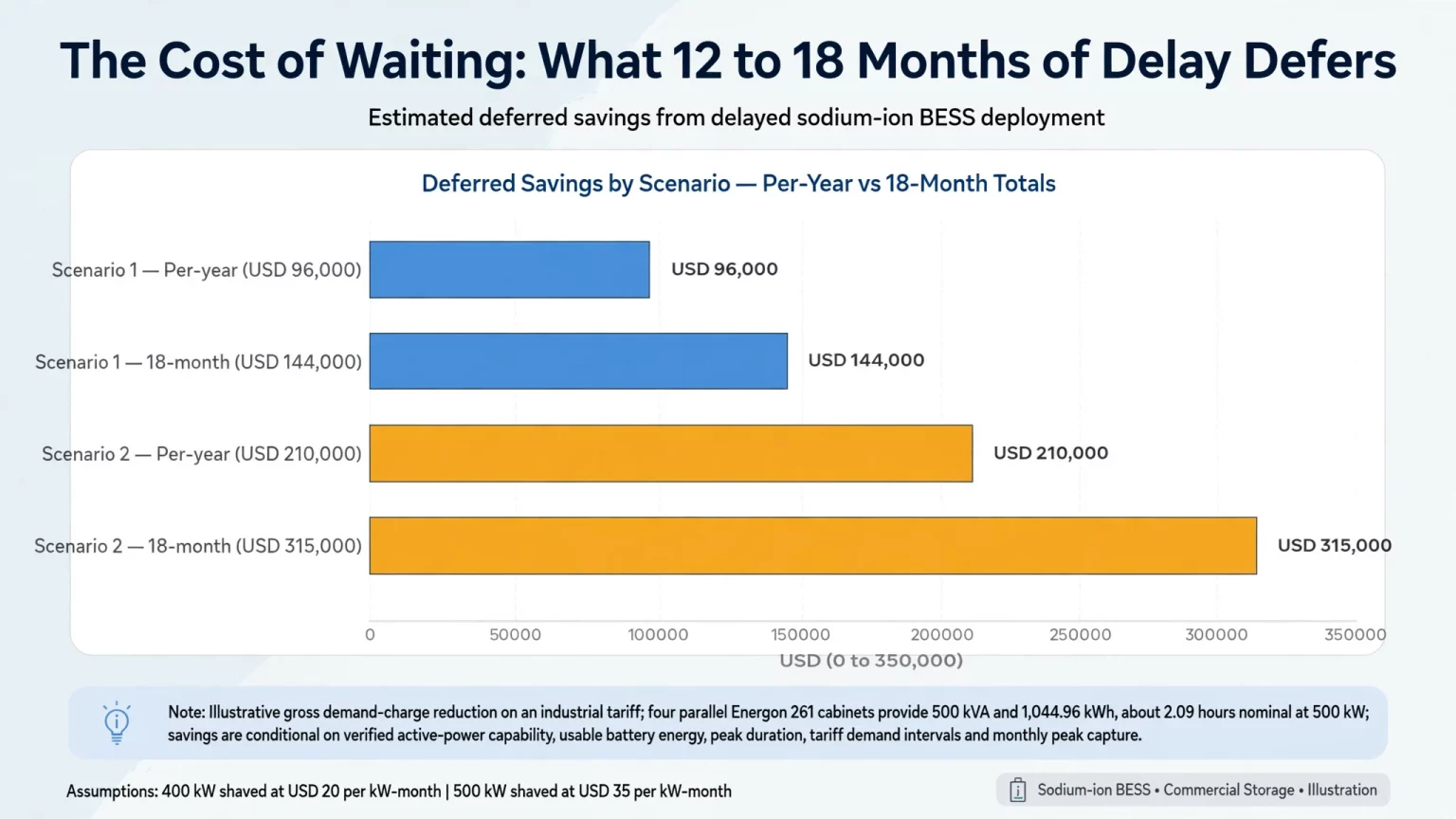
Buyer Takeaway: Delaying a 500 kW industrial peak-shaving project 12 to 18 months to wait for post-summer-2027 sodium-ion shipments can defer USD 96,000 to USD 315,000 in illustrative gross demand-charge savings.
Commercial procurement teams rarely buy batteries for chemistry headlines. Finance committees approve BESS CAPEX to shave monthly utility demand peaks, capture time-of-use spreads, and protect production lines from grid sag.
Look closely at the CATL TENER Sodium 2026 rollout schedule and subsequent updates:
- Domestic China shipments opened in September 2026, targeting roughly 1 GWh of cumulative volume across 2026.
- International deliveries were originally slated for June 2027 and later framed for summer 2027, anchored by multi-GWh European utility framework agreements (including partners such as Alfen, Intilion, and Solarpro).
- Initial hardware focuses on >30 MWh station blocks and ~4 MWh cabinets at 0.25P, keeping 200 kWh to 2 MWh behind-the-meter factory tenders outside the initial utility rollout.
Every quarter a factory waits defers potential tariff relief. Take an illustrative peak-shaving case targeting 400 to 500 kW of monthly demand reduction on an industrial tariff carrying USD 20 to USD 35 per kW-month. Project teams commonly evaluate one ESSC0500B-1075 (500 kW / 1.0752 MWh) or multi-unit Energon 261 blocks (4 cabinets = 500 kVA / 1,044.96 kWh of rated apparent power and nominal storage):
- At 400 kW shaved and USD 20/kW-month: USD 96,000/year in gross demand-charge reduction (USD 144,000 across an 18-month wait).
- At 500 kW shaved and USD 35/kW-month: USD 210,000/year in gross demand-charge reduction (USD 315,000 across an 18-month wait).
Check power and duration math before locking any financial model. Four parallel Energon 261 cabinets provide 500 kVA of rated apparent power and 1,044.96 kWh of nominal storage. Even at unity power factor with zero derating, 1,044.96 kWh equals roughly 2.09 hours nominal at 500 kW, while usable active power and runtime depend on SoC limits, conversion losses, power factor, and reserve margins. The savings figures are illustrative gross demand-charge calculations, conditional on verified active-power capability, usable battery energy, peak duration, tariff demand intervals and monthly peak capture.
Safety Architecture Design & Cold-Site Verification Today
Industrial buyers drawn to sodium-ion usually want two practical assurances: strong fire-safety engineering near occupied factories and reliable cold-weather operation. MegSolid's Hybrid Solid-State platform pairs a solid-liquid composite electrolyte architecture with layered system-level protection. Energon 261 combines intelligent liquid cooling (keeping cell spread within +/-5 C), AI early warning, and Novec + multi-sensor + water-based fire suppression inside an IP54 cabinet. On 5000INTL, MegSolid integrates Smart Liquid Cooling, AI early warning, and a three-dimensional protection system inside an IP55 container rated up to 4,000 m altitude.
Before site approval, EPCs and AHJs verify model-specific thermal-propagation test packages (such as UL 9540 / UL 9540A or IEC 62619 dossiers) alongside cold-climate ambient operating envelopes and winter enclosure pre-heating specifications for Nordic, Canadian, or Alpine plants.
Practical Buyer Selector: Matching 2026–2027 Factory Projects to Verified MegSolid Systems
Buyer Takeaway: Match transformer capacity and chemistry preferences directly to Energon 261, ESSA0100B-0215, ESSC containers, or 5000INTL for turnkey AC interconnection in 2026–2027.
Selecting the right commercial storage block starts at the site's main distribution transformer and physical yard clearance. Every model below aligns strictly with MegSolid's published catalog specifications.
| Site Requirement & Transformer Tier | Verified MegSolid Model | Published Rating & Chemistry | Voltage & Protection Profile | Commercial Fit Advantage |
|---|---|---|---|---|
| ≤100 kW LV Commercial Site (250–400 kVA) | ESSA0100B-0215 | 100 kW / 215.04 kWh; LFP (1P240S); ≥5,000 cycles | 400 Vac (320–460 V), THDi <3%, built-in isolation transformer, IP54 | Compact 3,900 kg outdoor cabinet; Aerosols / NOVEC1230 suppression |
| 125 kVA–1.25 MVA Modular Hybrid Solid-State | Energon 261 (1–10 units) | 125 kVA / 261.24 kWh per unit; Hybrid Solid-State LFP-314Ah | 676–936 Vdc, 480/400 Vac, 90% max eff, Liquid Cooling (+/-5 C), IP54 | Compact 1.755 m2 base; scales up to 1,250 kVA / 2,612.4 kWh |
| 500 kW / 1 MWh Factory Peak Shaving (630–800 kVA) | ESSC0500B-1075 | 500 kW / 1.0752 MWh; 3.2 V / 280 Ah LFP; ≥5,000 cycles | 20-ft container (21,000 kg), IP54 intelligent air cooling, 600–720 kW PV | Lighter 20-ft container fit; single-pad turnkey AC deployment |
| 1 MW / 2 MWh Industrial Plant (1,250–1,600 kVA) | ESSC1000B-2150 | 1,000 kW / 2.1504 MWh; 3.2 V / 280 Ah LFP; ≥5,000 cycles | 40-ft container (38,000 kg), IP54 intelligent air cooling, 1.2–1.44 MW PV | Turnkey 2.15 MWh commercial block with active production delivery |
| 2.7 MW / 5 MWh Utility or Heavy Campus (3+ MVA) | 5000INTL | 2,700 kW (450 x 6 kW) / 5,015.9 kWh; Hybrid Solid-State LFP | 1,331.2 Vdc, 690 Vac, 87.5% max eff, Smart Liquid Cooling, IP55, 43,000 kg | +25.4% higher single-cabinet rated energy vs ~4 MWh sodium cabinet |
Keep parallel limits tied to each exact model. MegSolid's 10-unit parallel cap applies specifically to Energon 261, while expansion limits for ESSA0100B-0215 and ESSC containers are confirmed per project single-line diagram. For custom DC-coupled retrofits, pairing approved battery banks with MEGA0030TS–MEGA0500TS (up to 4 units parallel, ≤850 Vdc) or PMA080–PMA0125 modules (615–950 Vdc / 650–950 Vdc) requires verifying full voltage overlap, current ratings, and BMS interface protocols.
FAQ
Why does CATL TENER Sodium target utility stations instead of 200 kWh–2 MWh factories?
TENER Sodium centers on station-level blocks above 30 MWh operating at 0.25P. Each ~4 MWh IP55 cabinet was listed around 42 tonnes at the June 2026 launch, updated to roughly 44–45 tonnes in an approximately 15-foot length in October 2026, paired with Bi-DC and PCS converters such as CATL's 265 kW Terapower module. Commercial factories running 250 kVA to 1,600 kVA transformers need right-sized 215 kWh to 2.15 MWh AC-integrated blocks like MegSolid ESSA0100B-0215, Energon 261, ESSC0500B-1075, or ESSC1000B-2150.
How does sodium-ion energy density compare with LFP and Hybrid Solid-State LFP?
Commercial stationary sodium-ion cells typically achieve 200 to 400 Wh/L volumetric density and 100 to 175 Wh/kg gravimetric density, compared with 350 to 500 Wh/L and 150 to 210 Wh/kg for LFP. On single-cabinet nominal capacity, a 5.0159 MWh 20-foot MegSolid 5000INTL container holds roughly 25.4% more energy than a ~4 MWh (~15-foot) sodium-ion cabinet. Full site footprint and BoP cost depend on multi-cabinet spacing, PCS layout, and auxiliaries. CATL's October 2026 500 MWh station model claims roughly 32% less land area than its EnerX LFP layout under CATL's specific geometry.
When do analysts expect sodium-ion BESS to reach system-level cost parity with LFP?
Wood Mackenzie's commercial sodium-ion research projects that leading manufacturers can reach cell-level cost parity with LFP around late 2026, while module-level and full system-level cost parity shift beyond 2030. Globally, upfront sodium-ion BESS installations average roughly USD 229/kWh compared with USD 200/kWh for LFP, though long 20-year utility TCO profiles can narrow that gap in high-cycle or extreme-cold deployments.
How do MegSolid Hybrid Solid-State and LFP voltage windows simplify C&I PCS integration?
MegSolid Energon 261 and ESSA0100B-0215 have defined battery voltage windows and factory-integrated power conversion architectures. Standalone PMA or MEGA PCS selection for custom systems requires verification of battery-to-PCS voltage overlap, full-power current capability, BMS communication and approved system configuration. Specifically, PMA080–PMA0125 covers 615–950 Vdc (3W+PE) or 650–950 Vdc (3W+N+PE), while MEGA0030TS–MEGA0500TS caps at 850 Vdc (below Energon 261's 936 Vdc ceiling) and R30KH3–R50KH3 operates across 150–800 Vdc.
Does CATL TENER Sodium lock buyers into a single PCS brand or require separate Bi-DC cabinets?
CATL states that its Bi-DC voltage regulation improves wide-voltage PCS efficiency, citing nearly 2% RTE gain alongside a 95% RTE rating at 25 C and 0.25P for compatible 690 V utility PCS configurations. October 2026 disclosures also introduced the 265 kW Terapower converter combining Bi-DC and PCS in one module. For factory projects, the real trade-offs are utility block scale (>30 MWh, 0.25P), added conversion complexity, and summer-2027 international timing instead of single-brand exclusion or mandatory separate Bi-DC cabinets.
Which MegSolid C&I systems use Hybrid Solid-State LFP vs. standard LFP chemistry?
In MegSolid's published catalog, Energon 261 (125 kVA / 261.24 kWh, 1P260S, liquid-cooled) and 5000INTL (2,700 kW / 5,015.9 kWh, SHS180-314 12P416S, liquid-cooled) use Hybrid Solid-State LFP architecture. ESSA0100B-0215 (100 kW / 215.04 kWh, 1P240S) and the air-cooled ESSC0500B-1075 (500 kW / 1.0752 MWh) and ESSC1000B-2150 (1,000 kW / 2.1504 MWh) containers use standard LFP chemistry rated for ≥5,000 cycles.
How much space does Energon 261 need on a tight European or US factory pad?
Each MegSolid Energon 261 Hybrid Solid-State cabinet measures 1,300 x 1,350 x 2,200 mm (+/-5 mm), occupying a 1.755 m2 base footprint for 261.24 kWh of rated energy before site maintenance and fire clearances. Up to 10 Energon 261 cabinets can operate in parallel to reach 1,250 kVA / 2,612.4 kWh while fitting along narrow factory perimeters.
How much peak-shaving revenue can a factory lose by delaying deployment 12 to 18 months?
On an illustrative commercial tariff charging USD 20 to USD 35 per kW-month in demand fees, shaving 400 to 500 kW represents USD 96,000 to USD 210,000 per year in gross demand-charge reduction, or USD 144,000 to USD 315,000 across 18 months. Four parallel Energon 261 cabinets provide 500 kVA / 1,044.96 kWh (roughly 2.09 hours nominal at 500 kW and unity power factor before usable DoD and losses), while ESSC0500B-1075 is rated 500 kW / 1.0752 MWh nominal. The savings figures are illustrative gross demand-charge calculations, conditional on verified active-power capability, usable battery energy, peak duration, tariff demand intervals and monthly peak capture.
How do MegSolid Hybrid Solid-State cabinets approach fire safety and thermal management?
MegSolid Energon 261 pairs Hybrid Solid-State LFP-314Ah cells with intelligent liquid cooling (temperature spread within +/-5 C), AI early warning, and Novec + multi-sensor + water-based fire suppression inside an IP54 enclosure. For utility-scale 5 MWh blocks, 5000INTL combines Smart Liquid Cooling, AI early warning, and three-dimensional protection in an IP55 container. Project teams confirm model-specific UL 9540A or IEC 62619 test packages prior to site permitting.
What documents should EPC teams request before awarding a 2026–2027 C&I BESS contract?
Request full-load AC-to-AC efficiency curves separated from published maximum efficiency figures, alongside ambient operating and cold-weather thermal conditioning limits. Also confirm site-applicable UL 9540 / UL 9540A or IEC 62619 certification dossiers, warranty throughput and EOL schedules, and factory acceptance test (FAT) procedures aligned to local interconnection codes.
Conclusion: Lock In 2026–2027 Industrial ROI Today with Bankable C&I Storage
CATL TENER Sodium marks a practical engineering milestone for cold-climate, multi-tens-of-MWh grid stations entering international service around summer 2027. Its 15,000-cycle rating, 95% RTE at 25 C and 0.25P, manufacturer-stated >92% capacity retention at -20 C, IP55 enclosure, and integrated Bi-DC architecture show how seriously Tier-1 cell makers are scaling sodium-ion for utility tenders.
Industrial factories paying high monthly demand charges right now live on a tighter clock and a tighter transformer budget. Waiting through 2026 and 2027 for smaller sodium-ion commercial formats defers immediate electricity savings while upfront sodium-ion BESS CAPEX still averages above LFP. Deploying MegSolid's active C&I platforms puts verified Hybrid Solid-State LFP (Energon 261 and 5000INTL) or turnkey LFP systems (ESSA0100B-0215, ESSC0500B-1075, and ESSC1000B-2150) on your concrete pad within active production schedules.
Ready to Size Your 2026–2027 Commercial or Industrial BESS? Send your transformer kVA rating, 15-minute load profile, and ambient site conditions to receive an engineering sizing pack, single-line diagram, and factory-direct proposal.