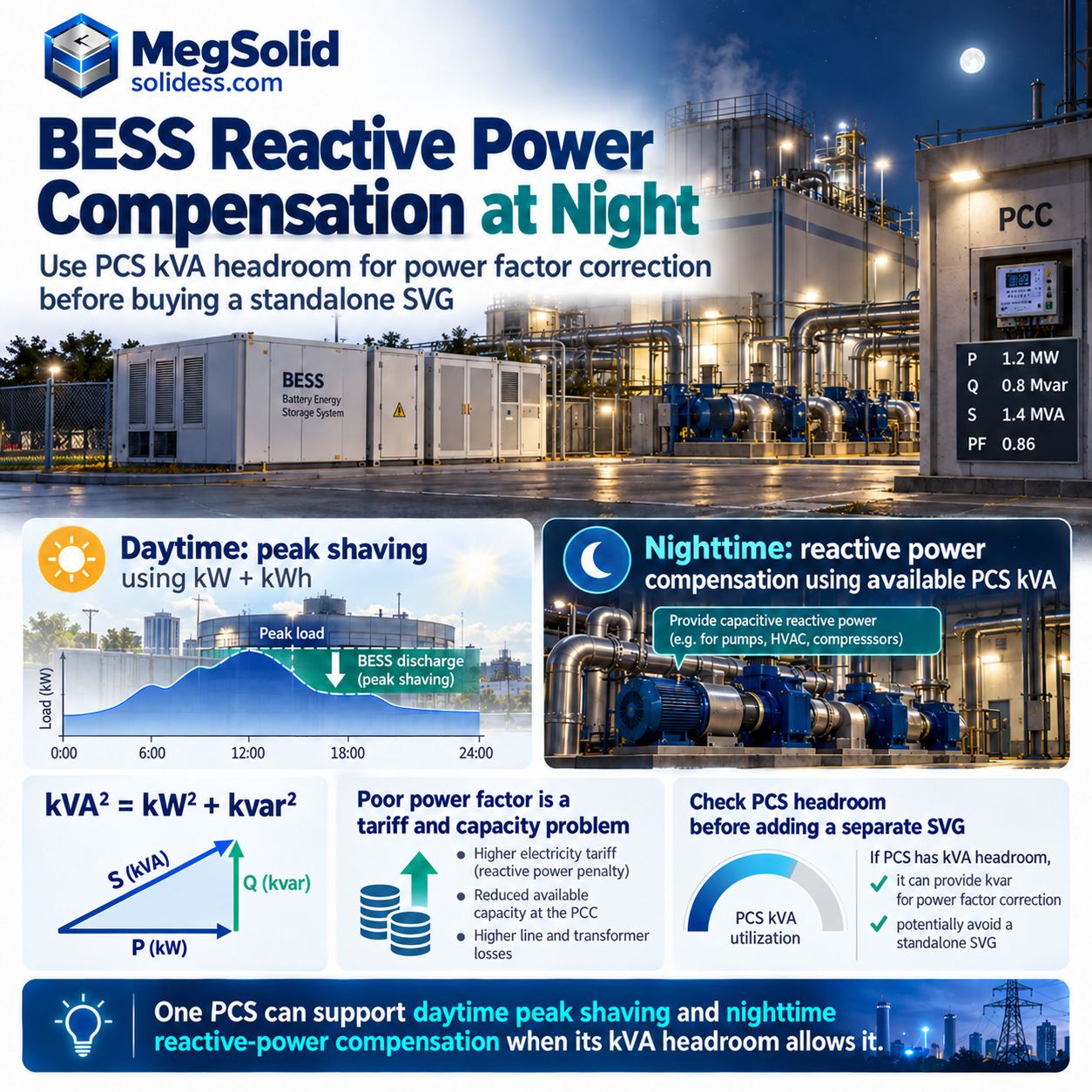
A grid-connected BESS PCS can compensate reactive power at night when the exact model supports that operating mode and has sufficient continuous kVA headroom.
Many industrial plants use the BESS for daytime demand control while nighttime operation exposes a different electrical cost: reactive demand.
Production may slow and peak-shaving duty may disappear, while chillers, refrigeration compressors, pumps, ventilation systems and other inductive loads continue running.
Active demand can fall faster than reactive demand, causing power factor to deteriorate.
The tariff then determines whether that poor power factor creates an added cost.
Before adding another power-electronics cabinet, check what the existing or planned BESS PCS can already provide.
MegSolid publishes active/reactive-power adjustment for its MEGA energy storage PCS. Confirm continuous nighttime operation for the exact model, firmware, DC-bus range and grid settings. A generic leading/lagging power-factor entry alone does not prove the available kvar at zero active-power output.
The same converter can then serve two commercial duties:
Daytime: move kW and kWh for peak shaving.
Nighttime: use available kVA for reactive-power compensation.
If the PCS has unused nighttime kVA, a separate SVG should be justified only after that available capacity is calculated.
One PCS can support daytime peak shaving and nighttime reactive-power compensation when its kVA headroom allows it.
Treat Poor Power Factor as a Tariff and Capacity Problem
Power factor describes the relationship between active power and apparent power at the measurement point.
Use the Apparent-Power Relationship
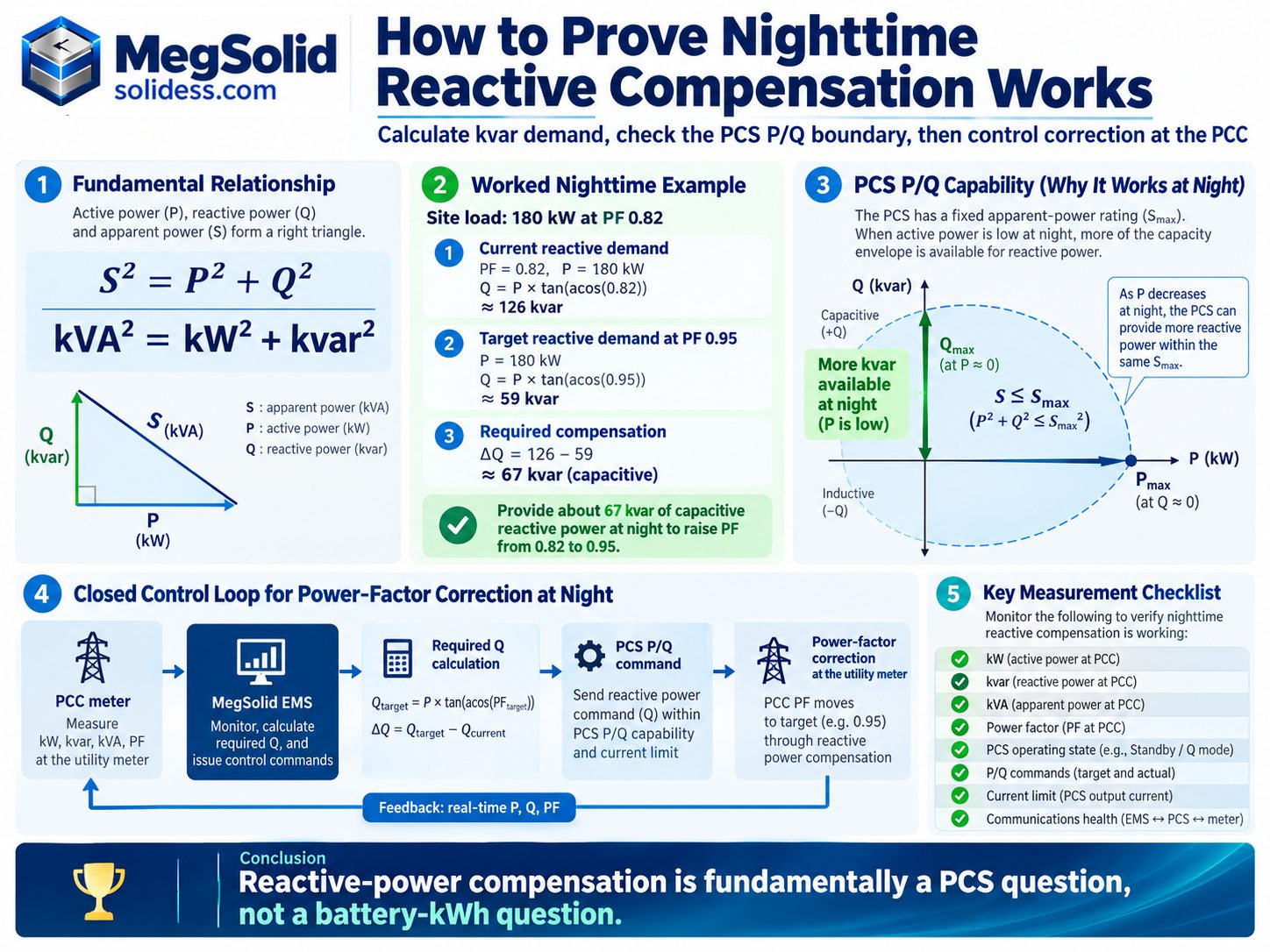
For balanced, sinusoidal operation: S² = P² + Q². Use kVA for S, kW for P and kvar for Q. Where harmonics are significant, distinguish total power factor from fundamental displacement power factor before applying this relationship.
Plants can consume moderate active power while still forcing transformers, cables and switchgear to carry substantial current because of reactive demand.
Utilities may charge for:
- poor power factor;
- excess kvar;
- excess kVA demand;
- or another tariff-specific reactive-power condition.
There is no universal penalty threshold.
Some tariffs react below 0.90.
Others use 0.95.
Others charge directly from kvar or kVA.
Read the tariff before buying the hardware.
MegSolid's C&I BESS design guide treats tariff structure and PCC operating conditions as project inputs, not assumptions.
Check Nighttime kW and kvar After Production Falls
The problem often becomes obvious after production stops.
Factories may shut down most process equipment while continuing to run:
- chilled-water pumps;
- refrigeration;
- HVAC fans;
- compressors;
- wastewater pumps;
- lightly loaded transformers.
The plant's kW can fall sharply while kvar remains significant.
That pushes power factor down.
The BESS may now have almost no peak-shaving work to do.
The PCS may have plenty.
Low battery-energy dispatch does not mean the PCS has no remaining electrical duty.
Use Available PCS kVA for Reactive-Power Compensation
The battery stores energy.
The PCS determines how the system interacts electrically with the AC bus.
This distinction creates the opportunity to use available PCS apparent-power capacity for reactive support.
Use P/Q Control Within the PCS Apparent-Power Envelope
Bidirectional PCS can control active and reactive power instead of only discharging battery kW.
MegSolid's energy storage inverter platform supports active/reactive power adjustment for C&I applications.
Check the PCS Capability Before Adding SVG Hardware
The published MEGA PCS platform includes:
- 30–500kW rated active-power classes
- Model-dependent maximum kVA entries — request the continuous kVA rating at the actual AC voltage, ambient temperature and operating mode.
- Leading/lagging power-factor control — obtain the model-specific P/Q capability curve and confirmation of nighttime operation.
- Published converter THDi limits — check the stated test conditions. An emission limit does not establish an active harmonic-filter duty for the whole facility.
- RS485 / TCP-IP communications
Battery kWh does not determine kvar capability. The DC-bus operating window, SOC limits, contactor state, auxiliary supply and the approved nighttime mode can still determine whether the PCS remains available.
The limiting quantity is available PCS kVA.
First-pass kvar headroom: Qmax = √(Savailable² − Prequired²). Use the magnitude of active power during charging or discharging, and the continuous available kVA after derating. The approved manufacturer P/Q curve and current limits take precedence over this ideal circular screen.
When active power is low, more of the apparent-power envelope is available for kvar.
Nighttime operation can leave substantial kvar headroom when active power is low.
The asset is already installed. The engineering question is whether its unused kVA can replace part or all of the reactive-power equipment you were about to buy.
Separate Reactive Current From Battery-Energy Throughput
A common procurement question is whether nighttime reactive support consumes battery life.
The answer depends on separating reactive current from battery-energy throughput.
Reactive power does not require the battery to continuously deliver chemical energy in proportion to the kvar command.
The PCS is exchanging reactive current with the AC system.
Nighttime reactive-power support does not cycle the battery in the same way as discharging stored kWh for peak shaving.
Include PCS and Auxiliary Losses
There are still real losses from:
- semiconductor switching;
- magnetics;
- cooling;
- controls;
- auxiliary loads.
Measure real AC import and battery DC power during the intended nighttime mode. Converter and auxiliary losses have a cost; their supply path and any SOC change depend on the actual design. Include those measured kWh in the operating-cost comparison.
The practical engineering conclusion is:
the PCS can provide substantial reactive-power support without consuming battery cycle life in proportion to the kvar being delivered.
The advantage is the ability to use PCS capability without cycling the battery in proportion to kvar output.
Calculate the Required Nighttime kvar Before Selecting an SVG
Calculate the Site kvar Requirement
Illustrative balanced-load example: the factory draws 180 kW at a displacement power factor of 0.82 lagging, with a target of 0.95 lagging. Confirm the tariff uses this quantity; a true-power-factor penalty involving harmonics needs a separate assessment.
- 180kW active load
- 0.82 power factor
- target power factor: 0.95
With 0.82 PF, the site is drawing roughly 126kvar.
With 0.95 PF, the same 180kW load requires only about 59kvar.
Required compensation is approximately:
Qc = P × [tan(arccos PFbefore) − tan(arccos PFtarget)].
180 × [tan(arccos 0.82) − tan(arccos 0.95)] = 66.5 kvar, or about 67 kvar. This is the required compensating amount, not the remaining reactive demand after correction.
The calculation changes the procurement discussion from product selection to available kvar headroom.
Procurement should not start by asking:
“Which SVG should we buy?”
The engineering question is:
Does the PCS retain at least 66.5 kvar at its simultaneous kW duty? For an illustrative 125 kVA continuous envelope, 100 kW leaves 75 kvar, but 110 kW leaves only 59.4 kvar. The second operating point cannot meet this example before any additional derating. These are screening calculations, not a guaranteed rating for a specific PCS.
When the PCS has that headroom, the standalone SVG scope may deserve serious reconsideration.
When it does not, the kvar shortfall can be quantified instead of guessed.
No kvar calculation, no credible SVG-replacement claim.
Coordinate Daytime Peak Shaving With Nighttime Power-Factor Correction
The BESS business case becomes stronger when daytime and nighttime duties use the same converter.
Use Battery Energy for Daytime Demand Reduction
During expensive demand periods, the BESS discharges active power.
The commercial variables are:
- kW
- kWh
- demand interval
- SOC
- recharge window
MegSolid's PCS kW, kVA and motor-load sizing guide explains why apparent power and active power must remain separate in industrial systems.
Use Available PCS kVA for Nighttime Power-Factor Correction
When active-power demand falls, the operating priority can change.
The site meter reports:
- kW
- kvar
- kVA
- power factor
The EMS reads those values.
The controller calculates the required reactive-power correction.
The PCS then injects or absorbs Q within its approved capability.
Close the Reactive-Power Control Loop at the PCC
PCC meter → MegSolid EMS → required Q calculation → PCS P/Q command → power-factor correction at the utility meter
That is the product logic.
Not a hidden checkbox.
Not a brochure feature.
A closed control loop tied directly to the point where the customer is billed.
Control Reactive Power From the PCC or Utility-Metering Boundary
Reactive compensation should not be controlled from a random inverter-terminal measurement.
It should be based on the agreed Point of Common Coupling or utility-metering boundary.
The EMS needs access to:
- three-phase voltage;
- three-phase current;
- kW;
- kvar;
- kVA;
- measured power factor;
- PCS operating state;
- P/Q commands;
- current limit;
- communications health.
The control system then decides how much reactive power is needed and whether P or Q gets priority when the converter approaches its apparent-power limit.
That priority matters.
PCS cannot deliver unlimited active and reactive power simultaneously.
MegSolid's BESS power-quality commissioning guide treats kW, kvar, kVA, leading/lagging power factor and P/Q priority as measurable acceptance items.
Include an acceptance test at the PCC: verify meter CT polarity and the import/export Q sign; test the required leading and lagging setpoints; repeat at the agreed charging and discharging kW limits; confirm P/Q priority and the response to meter or communications loss. Record voltage, kW, kvar, kVA, PF, SOC and auxiliary kWh against project-approved limits.
Compare PCS kvar Headroom With Standalone SVG Requirements
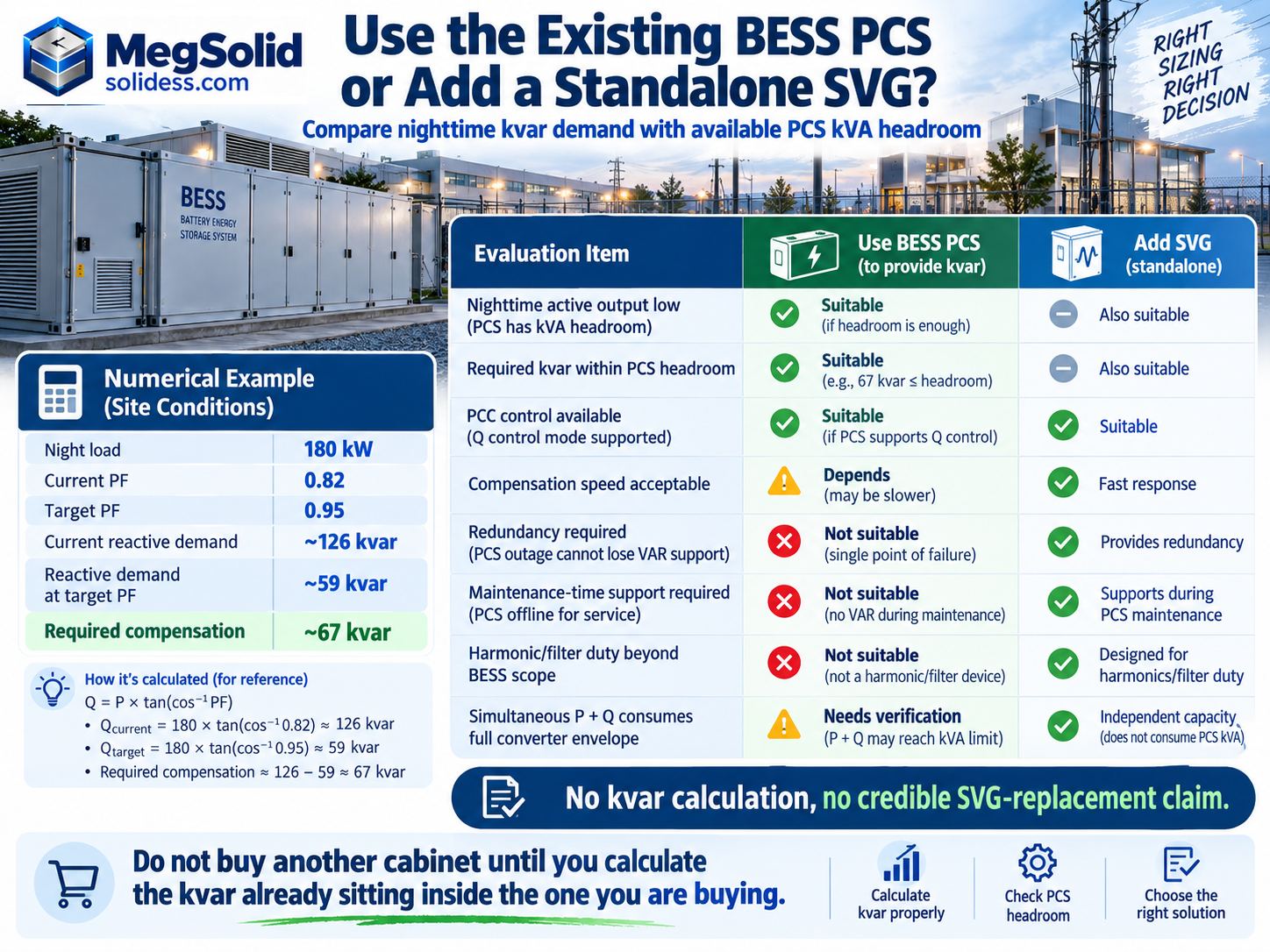
This is the CFO question.
And it should be answered with numbers, not slogans.
Use the BESS PCS When Its kvar Headroom Covers the Requirement
BESS PCS can be a strong SVG alternative when:
- nighttime active output is low;
- required kvar is within PCS headroom;
- compensation speed meets the site requirement;
- PCC control is available;
- the PCS can remain energized in the required operating state.
Keep a Dedicated SVG Where the PCS Boundary Is Insufficient
Dedicated SVG equipment can still make sense where:
- kvar demand exceeds PCS capability;
- compensation is required during BESS maintenance;
- redundancy is mandatory;
- harmonic-filtering duties exceed the BESS scope;
- fast dynamic compensation exceeds the configured PCS response;
- simultaneous P and Q requirements consume the full converter envelope.
The need for a dedicated SVG in some cases does not weaken the two-in-one argument.
It makes the comparison more defensible.
Compare the Full Cost Boundary
- Standalone SVG: purchase + installation + switchgear + maintenance
- BESS-based compensation: incremental integration cost + available PCS kvar + converter losses + any reserved capacity
Existing BESS with the required nighttime kvar capability can avoid separate hardware and materially improve project economics.
Do not buy another cabinet until you calculate the kvar already sitting inside the one you are buying.
Size Reactive Compensation From PCS kVA and kvar, Not Battery kWh
Reactive-power compensation is fundamentally a PCS question.
Sales discussions may focus on a:
215kWh battery
Electrical engineering should instead ask:
How many kvar are available at the required voltage while the PCS is delivering the required kW?
The second question determines whether the application works.
For integrated C&I projects, the Energon 261.24kWh / 125kVA system publishes adjustable power factor from -1 to +1, making reactive-power capability an explicit system-design parameter.
The project should be specified by separating these quantities:
kW for active-power duty.
kWh for stored energy.
kVA and kvar for reactive-power duty.
Mixing those numbers together makes the quotation technically ambiguous.
Measure the Tariff and Reactive Demand Before Selecting Hardware
Before choosing either an SVG or a BESS-based reactive-power strategy, collect:
- utility tariff;
- power-factor charging formula;
- interval kW;
- interval kvar or kVA;
- nighttime power factor;
- transformer rating;
- major inductive loads;
- existing capacitor-bank status;
- one-line diagram;
- planned BESS PCS rating.
Answer Three Questions Before Hardware Selection
- How much kvar does the site actually need?
- How much nighttime kVA does the PCS actually have available?
- How much money is the current reactive-power problem actually costing?
Those inputs are enough to determine whether a separate SVG belongs in the project.
No tariff data, no penalty calculation.
No kvar measurement, no SVG decision.
Approve SVG Replacement Only After the PCS Capability Is Proven
BESS should not be treated as a one-shift asset.
During the day:
battery kWh + PCS kW reduce peak demand.
At night:
available PCS kVA + EMS control can reduce reactive demand and improve power factor.
The commercial logic is powerful because the customer is not simply buying another battery feature.
The customer is increasing utilization of power electronics that are already being paid for.
Freeze the Operating Inputs Before Approving Separate SVG Hardware
MegSolid recommends defining:
- daytime peak-shaving kW;
- nighttime kvar;
- PCS kVA;
- utility tariff;
- target power factor;
- PCC measurement;
- P/Q priority;
- battery SOC requirement;
- acceptance criteria
before approving a separate SVG package.
Suitable projects can use MegSolid's MEGA PCS platform and EMS architecture to engineer peak shaving and reactive-power compensation around the same AC conversion hardware.
Do not keep paying power-factor charges while unused inverter capacity sits beside the switchboard.
Before removing the SVG from scope, obtain a signed capability schedule covering normal duty, high-temperature derating, nighttime restart, communications failure and planned BESS maintenance.
FAQ
Can a BESS PCS provide reactive power at night when the battery is not discharging active energy?
Yes, if the exact grid-connected PCS supports continuous nighttime reactive operation and remains within its approved P/Q, current, voltage and thermal limits. Confirm its DC-bus, SOC, contactor and auxiliary-supply requirements. Low battery discharge power alone does not prove that the PCS will remain available.
Why can power factor become worse after production slows at night?
Active power can fall sharply while pumps, compressors, HVAC, refrigeration and lightly loaded transformers continue drawing reactive power. kvar therefore remains significant while kW falls, which can reduce power factor.
What is the basic relationship between kW, kvar and kVA?
For balanced sinusoidal operation, S² = P² + Q², using kVA, kW and kvar. A first screen is Qmax = √(Savailable² − Prequired²), after derating. Use the manufacturer P/Q curve for final selection, and assess harmonic distortion separately where total and displacement power factor differ.
How is the required nighttime kvar compensation calculated?
For an inductive balanced load, Qc = P × [tan(arccos PFbefore) − tan(arccos PFtarget)]. Use kW for P and kvar for Qc, and confirm the power-factor definition matches the billing method. Use synchronized PCC measurements that include any operating capacitor bank or SVG. If PFbefore was measured with existing compensation active, Qc is the additional correction required; do not subtract that compensation again. Model a different switching state separately.
How much reactive compensation is required in the article's 180 kW example?
For the illustrative 180 kW load, 0.82 displacement power factor corresponds to about 125.6 kvar and 0.95 to about 59.2 kvar. The required capacitive compensation is 66.5 kvar, rounded to about 67 kvar. These are screening values under the stated balanced-load assumptions.
Does nighttime reactive-power support consume battery cycle life like active-power discharge?
Not in proportion to the kvar command. Reactive current is handled by the PCS without requiring chemical-energy throughput equivalent to the reactive-power output, although converter, cooling, magnetics, controls and auxiliary losses still exist.
What determines whether the existing BESS PCS can replace a standalone SVG?
The decision depends on required kvar, available PCS kVA headroom, response speed, PCC control, thermal limits, converter operating state, redundancy needs, maintenance requirements and simultaneous active and reactive power duty.
When is a standalone SVG still the better engineering choice?
A dedicated SVG remains appropriate when kvar demand exceeds PCS capability, compensation must remain available during BESS maintenance, redundancy is mandatory, harmonic-filter duties exceed the BESS scope, response requirements are faster, or simultaneous P and Q use the full converter envelope.
Where should reactive-power control be measured and closed?
The control loop should close at the agreed PCC or utility-metering boundary because that is where site power factor, kvar and the tariff consequence are determined.
What measurements should the EMS read for nighttime reactive compensation?
The article calls for three-phase voltage and current, kW, kvar, kVA, measured power factor, PCS operating state, P/Q commands, current limit and communications health.
What happens when active and reactive power together reach the PCS kVA limit?
The project must define P/Q priority. The PCS cannot supply unlimited kW and kvar simultaneously, so the control strategy has to decide which quantity is limited when the apparent-power boundary is reached.
Why should tariff data be checked before buying reactive-power hardware?
Utilities do not use one universal penalty rule. Some react to low power factor, some to excess kvar or kVA, and thresholds differ. The tariff determines whether the reactive-power problem creates a measurable cost and how large that cost is.
What data should be sent for a nighttime reactive-power and SVG-replacement review?
Send the utility tariff, power-factor charging formula, interval kW, interval kvar or kVA, nighttime power factor, transformer rating, major inductive loads, capacitor-bank status, one-line diagram and planned BESS PCS rating.