
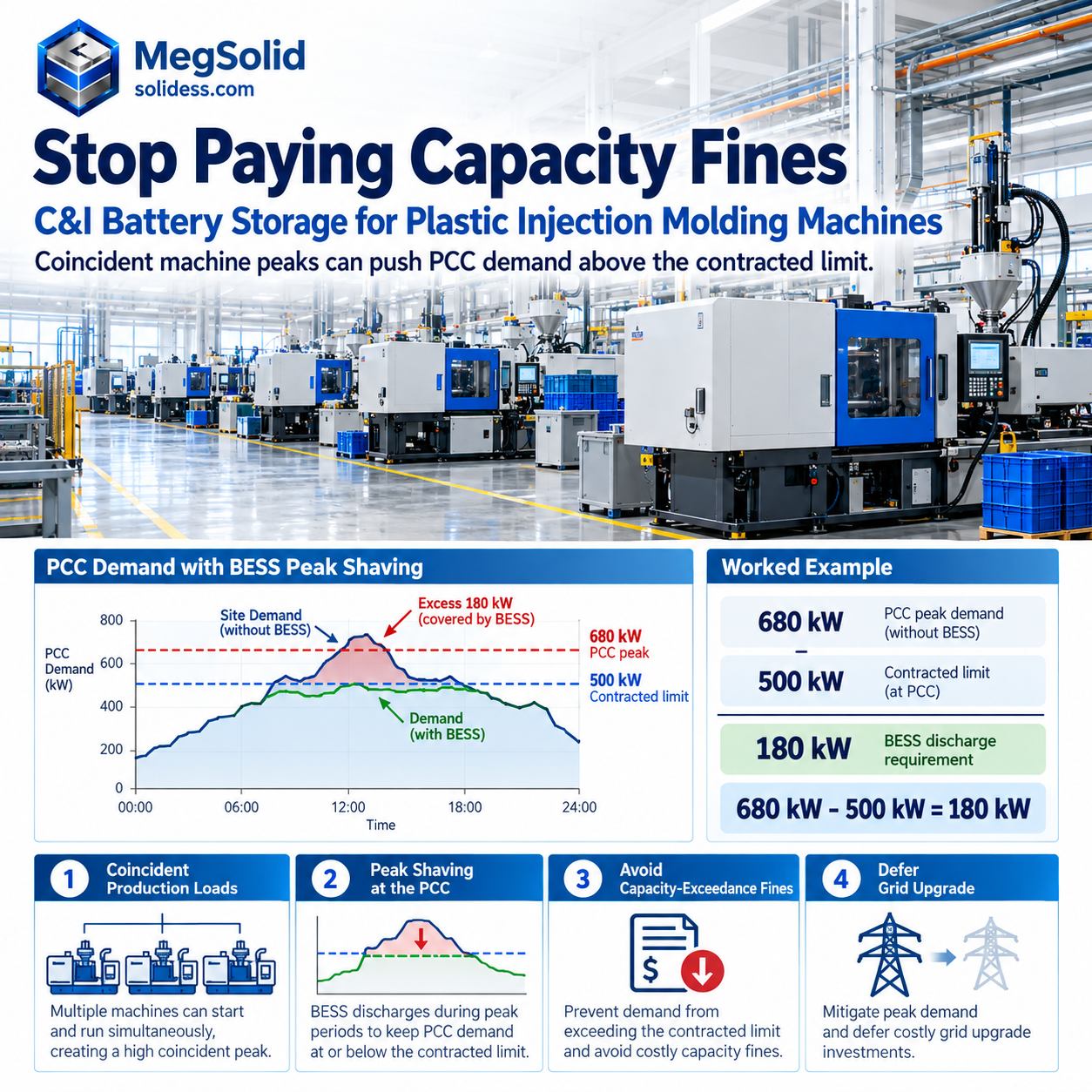
Plastic injection molding factories can reach an electrical-capacity limit long before they run out of production space. Multiple molding machines, hydraulic pumps, barrel heaters, chillers, dryers, and compressors can overlap during the same production window, pushing PCC demand above contracted capacity even when average consumption remains manageable. That can trigger capacity exceedance fines, higher maximum-demand charges, or pressure to upgrade the transformer and utility connection for peaks that last only part of the shift.
MegSolid C&I battery storage supplies that temporary gap behind the meter.
Calculate the Capacity Gap at the PCC
If the factory reaches 680kW against a 500kW contracted limit, it has a 180kW capacity-exceedance problem:
680kW − 500kW = 180kW BESS discharge requirement
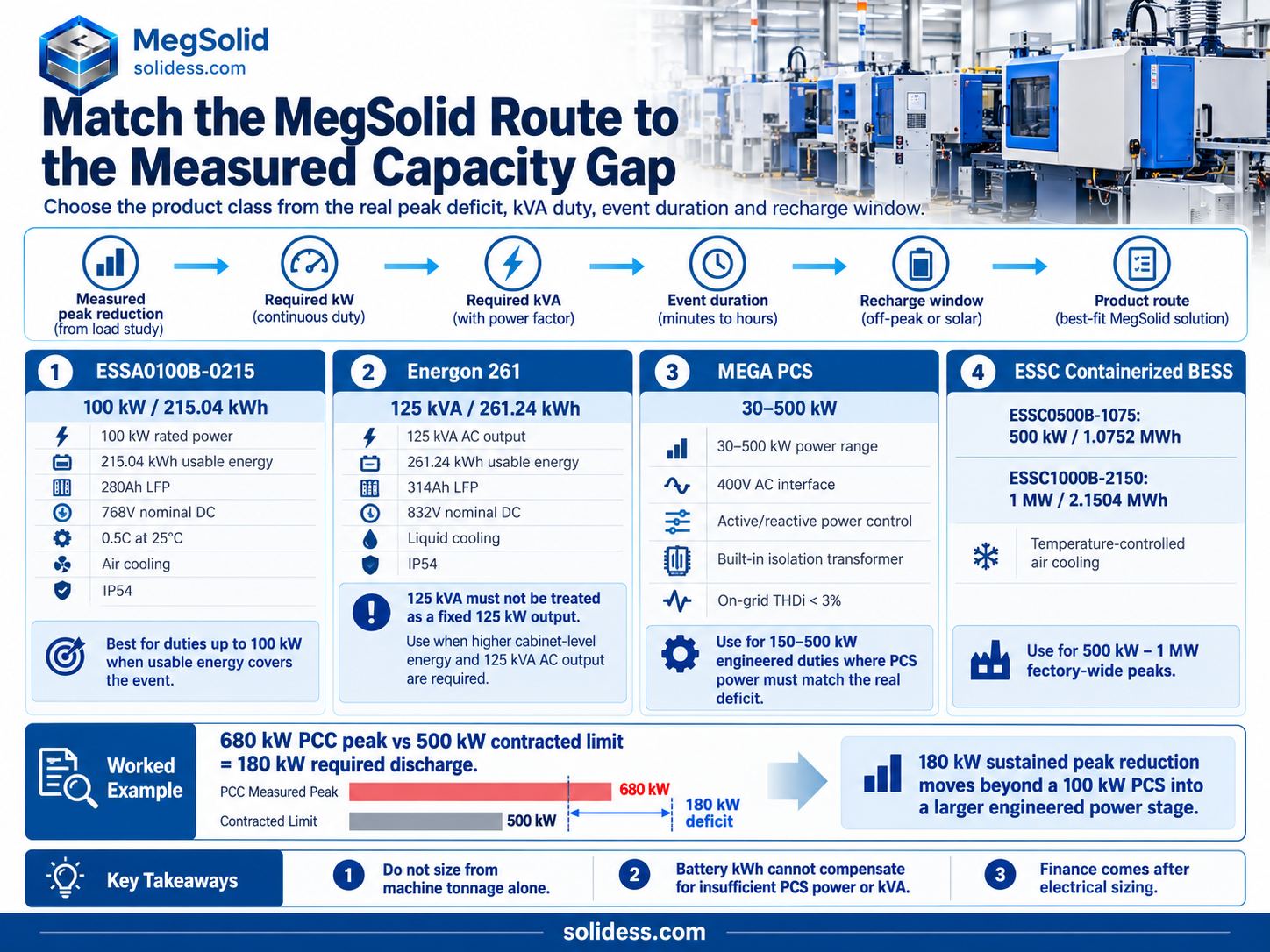
Match the MegSolid product class to the measured gap: ESSA0100B-0215 for up to 100kW peak reduction, Energon 261 for higher cabinet-level energy, MEGA PCS for 150–500kW duties, and ESSC containerized BESS for 500kW–1MW factory-wide peaks.
Capacity Fines Start With Coincident Production Loads
Injection molding machines do not draw constant power through every production cycle. Clamp movement, injection, holding pressure, screw recovery, barrel heating, hydraulic pumps, servo systems, chillers, dryers, and compressors create repeating peaks. The real cost appears when several of those peaks overlap and push total factory demand above the PCC limit.
Measure the Power Profile of the Injection Molding Cycle
Machine tonnage alone is not enough to size a BESS. Hydraulic, servo-hydraulic, and all-electric machines can have different electrical profiles even at similar clamping force.
Sizing sequence: machine cycle → combined plant load → PCC peak → contracted capacity gap → required BESS power.
If the plant rises from 450kW to 610kW against a 500kW limit, the BESS must remove about 110kW. Higher-resolution data can show which machines or auxiliaries created the peak.
Separate Motor-Start Transients From Demand and Capacity Charges
Energy charges follow kWh, while demand charges follow the highest measured kW or kVA over the utility's billing interval. Capacity-exceedance charges apply only where the tariff or connection agreement penalizes demand above the contracted limit.
Short motor inrush is not automatically a 15-minute demand event. The commercial problem is sustained or repeated high load. If the plant reaches 620kW against a 500kW limit, the BESS must supply about 120kW.
MegSolid PCC peak-shaving control targets that exact difference instead of discharging at an arbitrary fixed power.
Use C&I Battery Storage to Hold PCC Import Below the Contracted Limit
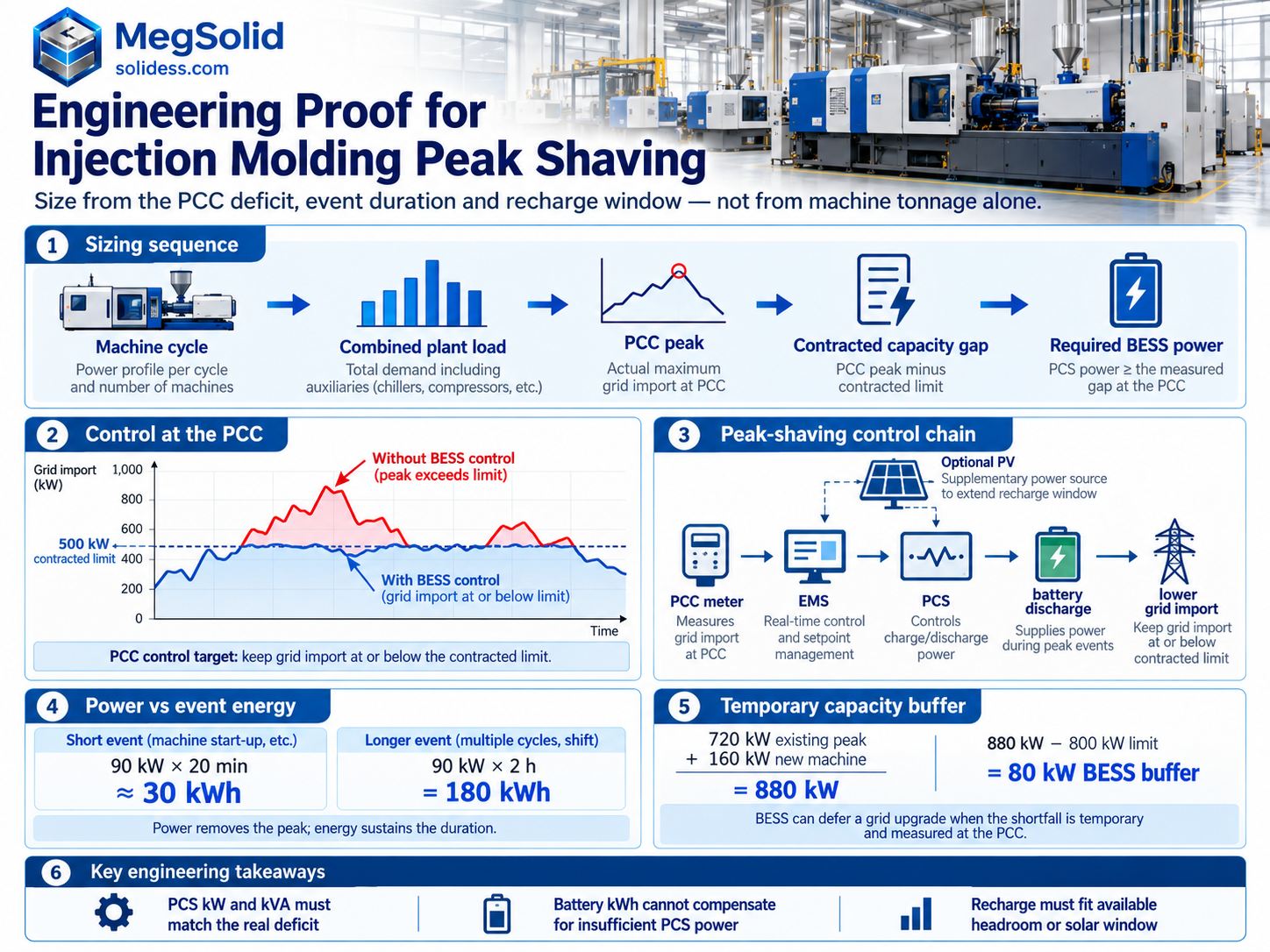
The BESS sits behind the meter and supplies the portion of factory demand above the selected grid-import limit. The exceedance then becomes a controlled power target at the PCC.
Control Peak Shaving From the PCC
Control chain: PCC meter → EMS → PCS → battery discharge → lower grid import.
As demand approaches the ceiling, the PCS increases discharge; as demand falls, output drops. Recharge must stay inside available grid headroom.
PCS power of 100kW cannot remove a sustained 170kW exceedance. MegSolid MEGA PCS power must match the real factory deficit, while EMS priority logic coordinates peak shaving, charging, SOC, and other operating limits.
Use BESS as a Temporary Capacity Buffer Before Upgrading the Grid
Assume an existing plant peaks at 720kW, has an 800kW contracted limit, and a new molding machine adds 160kW during the critical production window.
720kW + 160kW = 880kW
Resulting capacity gap: 880kW − 800kW = 80kW.
BESS discharge supplying that 80kW can hold PCC import near 800kW during the event and defer a utility-side upgrade.
BESS reduces grid import. Internal cables, busbars, breakers, and transformers must still support the actual factory load.
Size PCS Power, kVA and Battery Energy From the Factory Duty
Start With AC Duty Before Battery kWh
Start with four inputs: required kW, required kVA, peak duration, and recharge window. Battery nameplate kWh comes after those values.
MegSolid's C&I energy storage portfolio covers cabinet, PCS, and containerized power levels for these different duties.
Separate Peak-Shaving Power From Event Energy
Power defines how much of the peak the BESS can remove; energy defines how long it can maintain that reduction.
Peak reduction of 90kW for 20 minutes needs about 30kWh before margin; the same 90kW reduction for two hours needs about 180kWh.
| Cabinet | Published power / energy | Battery / cooling | Selection note |
|---|---|---|---|
| ESSA0100B-0215 | 100kW / 215.04kWh | 280Ah LFP, 768V nominal DC, 0.5C at 25°C, air cooling, IP54 | Direct cabinet class for duties up to 100kW when usable energy passes the event test |
| Energon 261 | 125kVA / 261.24kWh | 314Ah LFP, 832V nominal DC, liquid cooling, IP54 | 125kVA must not be treated as a fixed 125kW output |
Size PCS kW and kVA for Motor Loads
Injection molding plants include motors, pumps, chillers, and compressors, so PCS sizing must account for both kW and kVA.
MEGA PCS covers 30–500kW, with a 400V AC interface, active/reactive power control, built-in isolation transformer, and on-grid THDi below 3%.
Plants needing 180kW of sustained peak reduction move beyond a 100kW PCS into a larger engineered power stage. Battery kWh cannot compensate for insufficient PCS power or kVA.
Match Thermal Management and Safety Architecture to the Selected Product
ESSA0100B-0215 uses air cooling, Energon 261 uses liquid cooling, and ESSC containerized systems use temperature-controlled air cooling.
ESSC0500B-1075 provides 500kW / 1.0752MWh, while ESSC1000B-2150 provides 1MW / 2.1504MWh.
Project safety can reference IEC 62619, UL 9540, UL 9540A, and NFPA 855 where applicable to the destination market and authority having jurisdiction.
Build the Financial Case From the Actual Tariff and Upgrade Cost
The financial case should begin with a billable peak and the actual tariff.
Calculate Demand-Charge Savings From the Metered Peak
If a plant reduces a 500kW billed peak by 300kW at a demand rate of $20/kW, the worked result is:
- Monthly: 300kW × $20/kW = $6,000
- Twelve comparable billing periods: $6,000 × 12 = $72,000 per year
The $72,000 figure covers demand-charge reduction only. Add capacity-exceedance charges or deferred grid work separately where they actually apply, using the real tariff and billing interval.
Apply Incentives After the Electrical System Is Sized
Eligible U.S. projects can include the Clean Electricity Investment Credit under Section 48E and accelerated depreciation in the financial model.
Financial sequence: capacity problem → PCS power → battery energy → installed cost → operating savings → incentives.
This order keeps the financial model from driving the plant toward an oversized battery.
Use Secondary Services Only After Peak-Shaving SOC Is Protected
Peak shaving remains the primary duty. Backup and solar should support it, not consume the power or SOC needed to control the capacity limit.
Power Quality and Micro-Outage Protection
Short outages can interrupt PLCs, pumps, cooling, material handling, and process control, creating downtime much longer than the disturbance itself.
Backup requires deliberate grid separation, transfer equipment, a protected-load bus, suitable PCS operation, sufficient kVA, and reserved SOC.
Protecting controls, cooling, and controlled-shutdown loads can be more efficient than backing up every molding machine. MegSolid's grid-tied BESS outage guide explains this boundary.
Synergies with Rooftop Solar
Rooftop PV can reduce daytime grid import while the BESS stores surplus generation or preserves energy for the production peak.
Solar charging must not push the PCC above the contracted limit, and BESS sizing should still follow the real capacity deficit. PCC zero-export control can coordinate PV and battery operation where export is restricted.
Match the MegSolid Platform to the Measured Capacity Gap
Plastic injection molding factories should not keep paying capacity penalties or delay machine expansion because short production peaks exceed the grid limit.
Sizing path: measure the PCC → identify the contracted limit → calculate the excess kW/kVA → measure duration → verify recharge → select the MegSolid system.
Product Boundary by Measured Peak Reduction
- Up to 100kW: ESSA0100B-0215 when usable energy covers the event.
- Higher cabinet-level energy / 125kVA liquid-cooled platform: Energon 261.
- 150–500kW engineered duties: MEGA PCS with separately sized battery energy.
- 500kW–1MW factory-wide peaks: ESSC containerized systems.
Contact MegSolid With the Factory Load Data
Send the interval load data, contracted capacity, PCC peak, power factor, machine ratings, production schedule, planned additions, and single-line diagram to define PCS power, battery energy, recharge, and product route.
FAQ
Can C&I battery storage reduce capacity fines in a plastic injection molding factory?
Yes. PCC-controlled BESS operation can keep grid import below the contracted limit when the system is sized to cover the measured exceedance gap.
Is a 100kW BESS enough for an injection molding plant?
Yes, when the required peak reduction stays within 100kW and usable battery energy can sustain the event.
Should an injection molding plant use ESSA0100B-0215 or Energon 261?
Use ESSA0100B-0215 for up to 100kW peak reduction. Use Energon 261 when more cabinet-level energy, 125kVA AC output, and liquid cooling are required.
Can battery storage avoid a transformer or grid-capacity upgrade?
Yes, when the problem is a short-duration PCC peak rather than a continuous shortage of electrical capacity.
What data does MegSolid need to size BESS for injection molding machines?
Send interval load data, contracted kW or kVA, maximum PCC demand, power factor, major machine ratings, production schedule, planned expansion, and the electrical single-line diagram.