 Skip to content
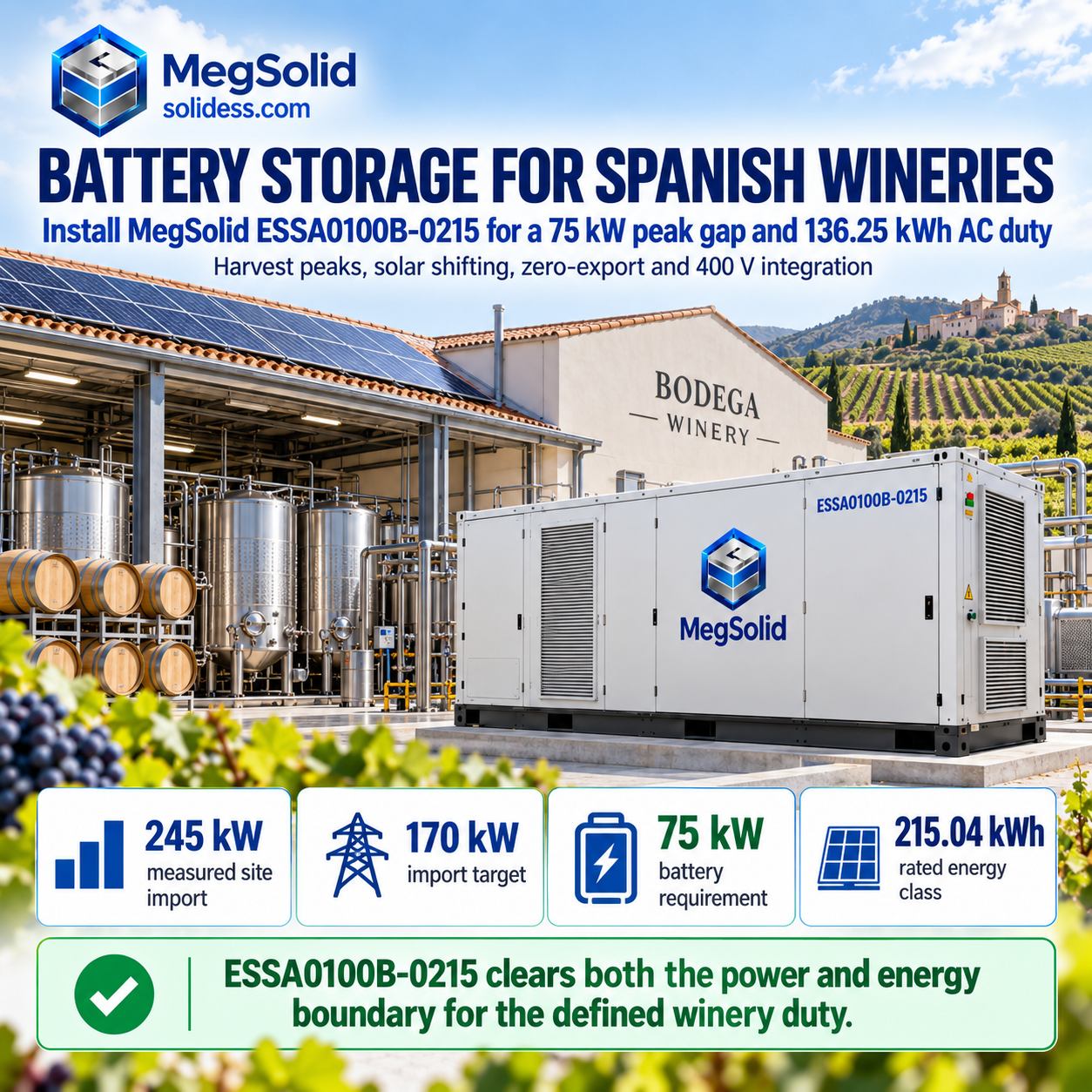
Spanish wineries facing a 75 kW import gap and a 136.25 kWh AC daily discharge duty should use the MegSolid ESSA0100B-0215 for the defined harvest-and-solar operating case. Its 100 kW rated AC power and 215.04 kWh rated energy clear both limits for this duty, while the 50 kW / 100.352 kWh cabinet does not.
The battery must cover the measured import gap and the full operating window; PV-array kWp does not set the BESS rating. ESSA0100B-0215 combines that power and energy with an integrated EMS, built-in isolation transformer and 400 V interface. The PCC peak-shaving control and AC-coupled solar retrofit then connect the cabinet to the existing winery system.
ESSA0100B-0215 Covers the Winery’s 75 kW / 136.25 kWh Duty
Processing demand reaches 245 kW against a 170 kW import target, creating a 75 kW battery requirement:
Required BESS power = 245 kW site import − 170 kW import target = 75 kW
ESSA0100B-0215 supplies 100 kW rated AC power, leaving 25 kW of rated power headroom above the measured deficit before site derating and operating limits. Its 215.04 kWh rated battery energy also gives the project enough nominal energy class to test the complete harvest-plus-evening duty.
The ESSA cabinet places the battery, power-conversion stage, built-in isolation transformer and EMS functions in one outdoor platform. The buyer receives a defined 400 V, 144 A, IP54 product boundary with RS485 and TCP-IP communications, rather than separate core storage functions with no single cabinet specification.
| Buying requirement | Winery duty | ESSA0100B-0215 result |
|---|---|---|
| Import-peak reduction | 75 kW | 100 kW rated AC power; 25 kW rated margin |
| Harvest peak energy | 75 kW for 45 min = 56.25 kWh AC | Included in the energy test |
| Evening production | 80 kWh AC | Combined duty reaches 136.25 kWh AC |
| Rated battery energy | More than 136.25 kWh AC is required before losses and SOC reserve | 215.04 kWh rated energy class |
The 50 kW Cabinet Cannot Meet the Defined Duty
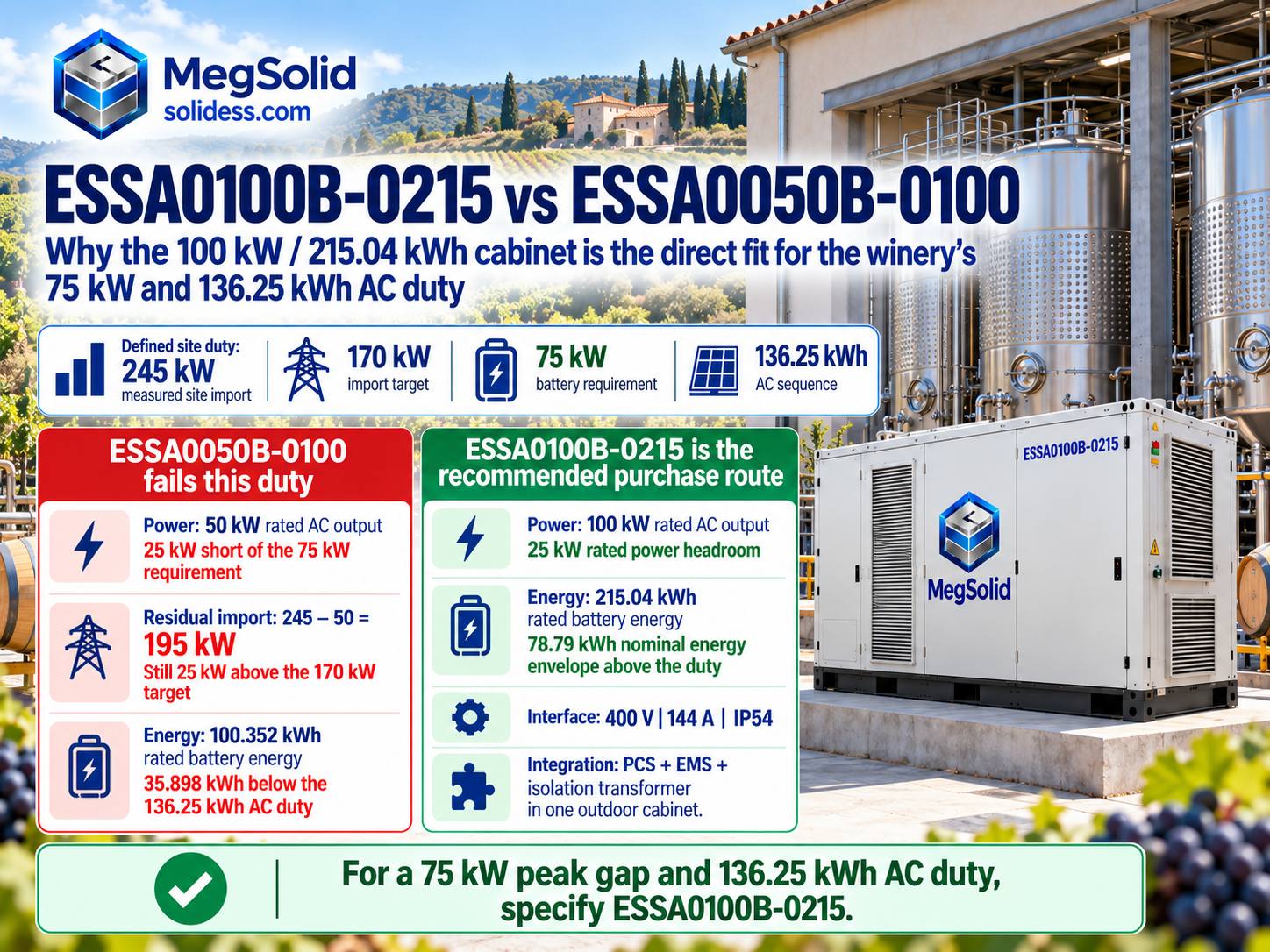
The ESSA0050B-0100 is an effective MegSolid product for smaller wineries, but it is undersized here for two independent reasons.
Its 50 kW rated AC power cannot deliver the 75 kW reduction. Even at nameplate output, grid import remains at 195 kW, which is 25 kW above the 170 kW target:
245 kW site import − 50 kW BESS output = 195 kW residual import
Its 100.352 kWh rated battery energy is also 35.898 kWh below the required 136.25 kWh AC sequence before conversion losses, auxiliary consumption or an operating SOC reserve are counted. No EMS setting can correct a physical shortage of PCS power or stored energy.
The 50 kW / 100 kWh cabinet class remains the right MegSolid route when the measured deficit stays within 50 kW and verified usable AC energy covers the full event. At 75 kW and 136.25 kWh AC, ESSA0100B-0215 is the direct fit for the defined duty.
The Full Discharge Window Proves the 215.04 kWh Advantage
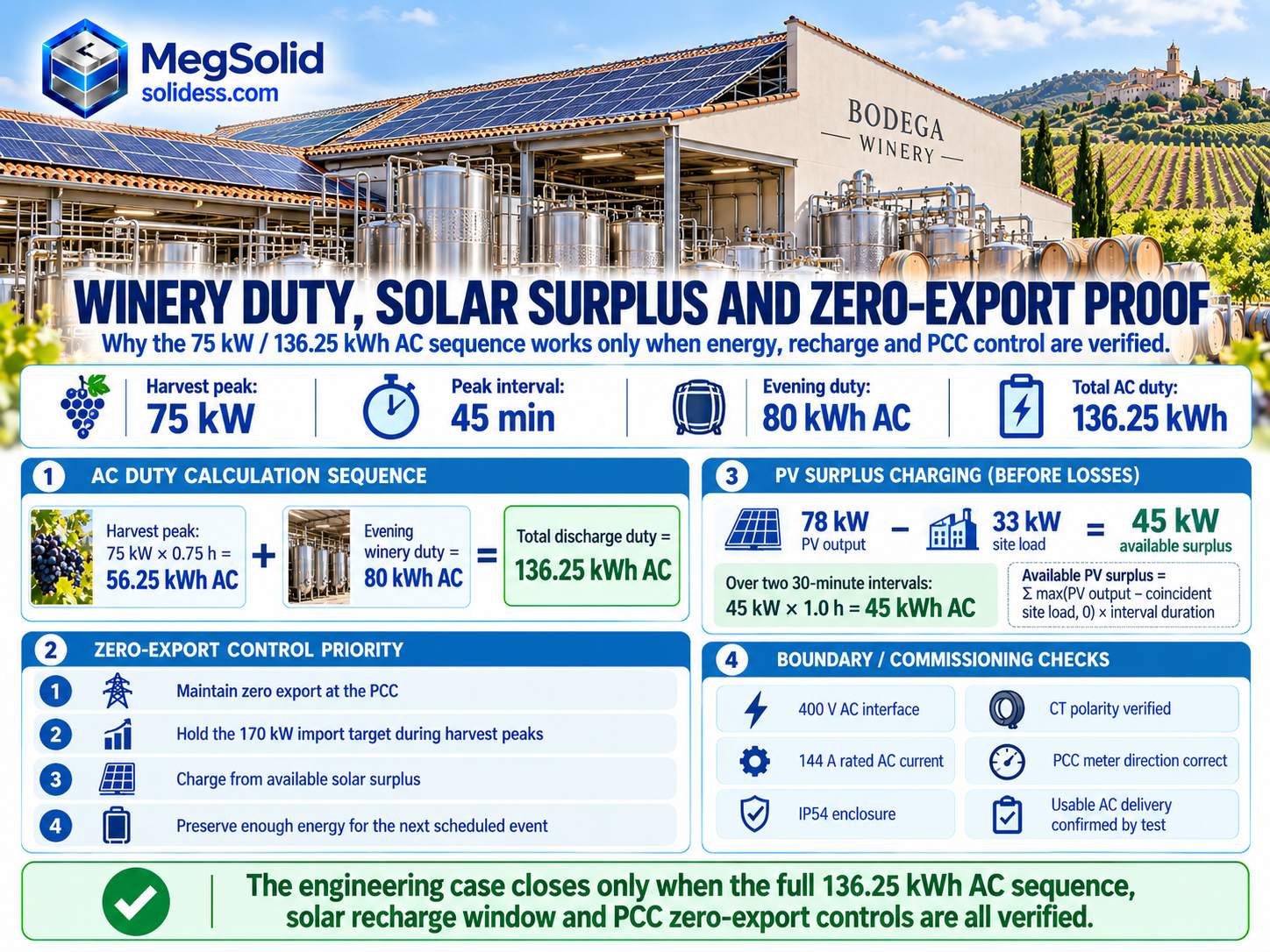
The winery’s 75 kW shortfall lasts for three 15-minute intervals. That peak-shaving interval requires 56.25 kWh AC. Evening pumping, cooling and processing then require another 80 kWh AC, bringing the measured sequence to 136.25 kWh AC.
Harvest peak: 75 kW × 0.75 h = 56.25 kWh AC
Evening duty: 80 kWh AC
Total discharge duty: 56.25 + 80 = 136.25 kWh AC
Keep Nominal Energy Separate From Verified AC Delivery
ESSA0100B-0215 has 114.688 kWh more rated battery energy than ESSA0050B-0100. Compared with the 136.25 kWh AC duty, its 215.04 kWh rating creates a 78.79 kWh nominal energy envelope for conversion losses, the agreed SOC floor and operating margin. The 78.79 kWh difference is not automatically deliverable AC energy; commissioning must verify usable AC output at the agreed power, temperature and SOC limits.
ESSA0100B-0215 can be commissioned against one complete production sequence; ESSA0050B-0100 fails both the power and energy screens before site testing. This avoids buying a cabinet that reduces the peak without reaching the target and empties before evening production finishes.
Use the Same ESSA100 Cabinet for Harvest Peaks and Solar Shifting
Harvest demand and non-harvest solar surplus create different jobs for the same cabinet. During grape processing, peak shaving protects the import target. Outside harvest, the battery stores usable midday PV surplus and releases it during later winery demand.
PV nameplate alone does not set the battery size. The relevant charging energy is the interval-by-interval surplus after winery load:
Available PV surplus = Σ max(PV output − coincident site load, 0) × interval duration
Calculate Solar Charging From Measured Surplus
At 78 kW PV output and 33 kW site load, 45 kW is available at the AC boundary. Two 30-minute intervals provide 45 kWh AC before conversion and operating constraints. The PV charging priority must reserve SOC room before that surplus arrives; filling the battery from the grid too early would block solar capture.
MegSolid’s integrated EMS functions, battery-capacity prediction and discharge-time prediction give the EPC a product platform for both duties. Simultaneous access to load, battery, grid, diesel generator and PV also supports a wider winery energy architecture. Outside harvest, available midday PV can be stored for later winery demand.
A Spanish Winery Project Shows the Same Peak-Shaving Pattern
CEGASA’s published Bodega Vega Tolosa project in Albacete combines 100 kWp of PV, 187.6 kWh of storage, peak shaving and zero injection. The project record reports €19,800 per year in energy-cost reduction and 10.2 tonnes of CO₂ savings for that installation. See the Bodega Vega Tolosa project record.
The published project documents storage, self-consumption, peak control and export management at one Spanish winery. They do not set the rating for another site. MegSolid’s advantage is that the ESSA range converts the new winery’s measured duty into a direct cabinet decision: 50 kW / 100.352 kWh for the smaller boundary or 100 kW / 215.04 kWh for the 75 kW and 136.25 kWh AC duty evaluated here.
Keep Published Project Savings Separate From the New Winery
Any commercial calculation still depends on the winery’s own tariff, avoided import cost, export value, peak-charge mechanism and operating schedule. The product recommendation does not depend on copying another project’s savings; it depends on the ESSA100 clearing both measured technical boundaries.
Zero Export, EMS Priority and Meter Direction Must Work as One System
Spain’s Real Decreto 244/2019 defines *autoconsumo sin excedentes* as self-consumption with a mechanism that prevents surplus energy from reaching the grid. The amended ITC-BT-40 under the Low Voltage Electrotechnical Regulation requires the non-export system to meet the applicable control and test requirements. These rules change the site acceptance test, not the ESSA nameplate.
Set Zero Export Above Economic Dispatch
Use this control priority:
- Maintain the mandatory export boundary at the point of connection.
- Protect the winery’s import target during harvest peaks.
- Charge from available solar surplus while respecting SOC and power limits.
- Preserve enough energy for the next scheduled production event.
MegSolid provides the integrated EMS functions and RS485/TCP-IP communication path inside the product boundary. The external PCC meter, site controller, existing PV inverter and protection scheme still require coordinated commissioning. The zero-export control boundary must be measured at the correct point, and the CT polarity test must prove that import and export are interpreted in the correct direction.
The EMS priority hierarchy prevents an economic charging command from overriding the approved export limit or creating a new import peak.
Define the 400 V Electrical and Civil Installation Boundary
Check the 400 V Feeder and Equipment Position
ESSA0100B-0215 provides a 400 V rated AC interface, 144 A rated AC current, intelligent air cooling and an IP54 enclosure. Its published dimensions are 2,450 × 1,550 × 2,400 mm, and its weight is 3,900 kg. The published values define the electrical and civil package to be accommodated on site.
| Installation boundary | ESSA0050B-0100 | ESSA0100B-0215 | Customer impact |
|---|---|---|---|
| Rated AC power | 50 kW | 100 kW | ESSA100 covers the 75 kW gap |
| Rated AC current | 72 A | 144 A | Feeder and protective-device rating changes |
| Rated battery energy | 100.352 kWh | 215.04 kWh | ESSA100 reaches the required energy class |
| Dimensions, W × D × H | 1,770 × 1,510 × 2,270 mm | 2,450 × 1,550 × 2,400 mm | ESSA100 needs the larger equipment position |
| Weight | 2,400 kg | 3,900 kg | Foundation and handling plan must carry 1,500 kg more |
| Cooling / enclosure | Intelligent air cooling / IP54 | Intelligent air cooling / IP54 | Ambient temperature and airflow remain acceptance inputs |
The existing 400 V switchboard connection must be checked for continuous current, protection coordination, fault level, isolation and cable route. The built-in isolation transformer is a MegSolid integration advantage, but it does not remove the need to verify the complete site protection design.
Plan Recharge Before the Next Harvest or Evening Event
Peak shaving can only repeat reliably when the cabinet begins each event with enough usable energy. After delivering 136.25 kWh AC, the system must recover more than 136.25 kWh at its charging boundary because conversion losses and auxiliaries consume part of the input.
Reconcile Recharge With the Next Event
The winery should compare three time-aligned records:
- available PV surplus before the next event;
- permitted grid-import headroom during charging;
- measured battery SOC and actual BESS AC power.
MegSolid’s battery-capacity and discharge-time prediction functions support that operating plan. The usable AC capacity test must then confirm that ESSA0100B-0215 can deliver the promised sequence under the site’s temperature, SOC and power conditions.
The cabinet must begin the next event with enough usable energy to repeat the 75 kW peak-control duty and the full production sequence. Without adequate recharge before the next event, the cabinet cannot repeat that benefit regardless of nameplate size.
Install the Smaller or Larger MegSolid System Only at the Correct Boundary
Keep ESSA0050B-0100 Below the 50 kW Boundary
MegSolid recommends ESSA0050B-0100 when the measured import reduction is no more than 50 kW and the verified usable AC energy covers the complete event. That duty can use the smaller 72 A, 2,400 kg cabinet without carrying unnecessary power and energy capacity.
MegSolid recommends ESSA0100B-0215 when the deficit exceeds 50 kW, the operating sequence exceeds the smaller cabinet’s usable-energy window, or both conditions occur. The evaluated winery crosses both boundaries at 75 kW and 136.25 kWh AC, so the 100 kW / 215.04 kWh cabinet is the correct purchase.
Move Above ESSA100 Only When the Measured Duty Requires It
Projects that exceed 100 kW or cannot fit the required usable-energy window inside ESSA100 need a larger architecture. MegSolid’s 261.24 kWh Energon platform provides a separate 125 kVA liquid-cooled product class; 125 kVA must not be treated automatically as 125 kW. Larger winery campuses should move into that engineering review before equipment is ordered.
Specify ESSA0100B-0215 for the 75 kW and 136.25 kWh AC Duty
Two measured limits settle the equipment class. ESSA0050B-0100 misses the import target by 25 kW and its rated battery energy is 35.898 kWh below the required AC duty before losses. ESSA0100B-0215 supplies the correct 100 kW rated AC class and 215.04 kWh rated-energy class in one outdoor cabinet.
ESSA0100B-0215 can be tested against the complete harvest duty, reused for non-harvest solar shifting and integrated with zero-export control through a defined EMS and communications boundary. Its 400 V, 144 A connection and 3,900 kg installation load are known before purchase, so the electrical and civil work can be designed around the actual cabinet.
FAQ
Which MegSolid battery is recommended for a Spanish winery with a 75 kW peak gap?
MegSolid recommends ESSA0100B-0215. Its 100 kW rated AC power exceeds the 75 kW measured deficit, while the 50 kW ESSA0050B-0100 remains 25 kW short.
Why is ESSA0100B-0215 better for the 136.25 kWh AC duty?
Its 215.04 kWh rated battery energy provides the appropriate nominal energy class for the full sequence. The smaller cabinet’s 100.352 kWh rating is already 35.898 kWh below the required AC duty before losses.
When is ESSA0050B-0100 the better MegSolid product?
It is the stronger fit when the measured import reduction stays within 50 kW and the complete event fits its verified usable AC energy window.
Does a 100 kWp PV array require a 100 kW BESS?
No. BESS power follows the measured import deficit and charging limit. BESS energy follows the discharge window, usable solar surplus and required SOC reserve.
Can rated battery energy be treated as usable AC energy?
No. Deliverable AC energy depends on the agreed SOC window, conversion losses, auxiliary loads, temperature and discharge power. Commissioning must verify the AC boundary.
Can ESSA0100B-0215 support existing winery solar?
Yes, an AC-coupled design can retain suitable existing PV equipment when the switchboard, protection, metering and controls support the arrangement.
Does the ESSA cabinet establish zero export by itself?
No. The cabinet provides EMS and communication functions, while the PCC meter, site controller, PV inverter, protection and anti-export mechanism must pass the coordinated site test.
What electrical interface does ESSA0100B-0215 provide?
MegSolid publishes a 400 V rated AC interface and 144 A rated AC current for ESSA0100B-0215. The existing switchboard and protection design must be verified for that boundary.
Is ESSA0100B-0215 liquid cooled?
No. MegSolid specifies intelligent air cooling for ESSA0100B-0215. The 261.24 kWh Energon system is the separate liquid-cooled product class.
How large and heavy is ESSA0100B-0215?
Its published dimensions are 2,450 × 1,550 × 2,400 mm, and its published weight is 3,900 kg.
How does the winery recharge before a second peak?
The EMS uses available PV surplus or permitted grid-import headroom while preserving the import and export limits. Matching SOC, PCC power, PV output and BESS power confirms whether the recharge window closes.
What Spanish rules affect a zero-export winery BESS?
Real Decreto 244/2019 defines self-consumption without surplus, and the amended ITC-BT-40 establishes requirements and tests for the mechanism that prevents export to the distribution grid.
What benefit does MegSolid ESSA100 give the winery?
It covers the defined 75 kW power requirement and provides the 215.04 kWh rated-energy class needed to test the full 136.25 kWh AC sequence, while integrating EMS functions, communications and an isolation transformer in one outdoor platform.
