
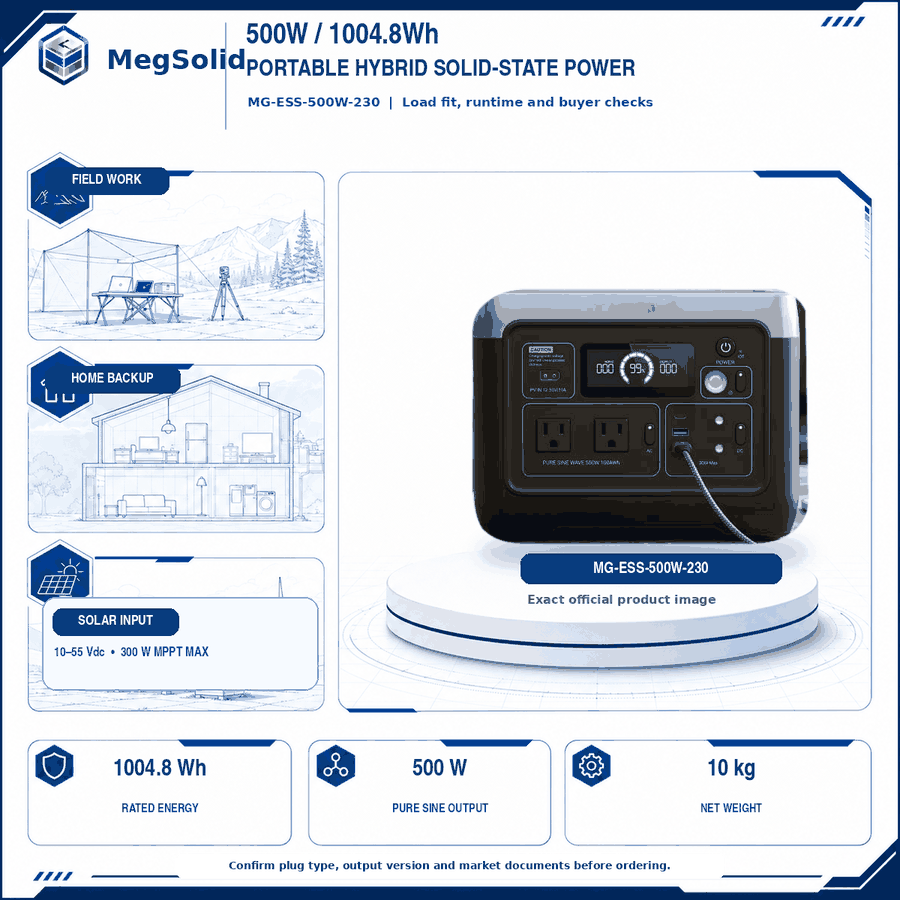
The MegSolid MG-ESS-500W-230 is a 500W portable power station with 1004.8Wh rated energy and a 10kg net weight. This article answers three buyer questions directly: which loads fit within the 500W limit, how long the battery may run them, and which technical documents and market-version details must be confirmed before ordering.
- Choose it when: the combined continuous load is 500W or less and the destination-market output version is suitable.
- Verify first when: the load has a motor, compressor, high inrush current or strict ride-through requirement.
- Do not select it when: the continuous load exceeds 500W or the required plug, voltage or compliance documents are unavailable.
Start with the Load: Is 500W Enough?
The official MG-ESS-500W-230 product page specifies 500W full-load power, 230Vac output and a pure sine wave. Add the continuous wattage of every device that will operate at the same time. If the total is above 500W, this model is not the correct selection.
- Good initial fit: laptops, communications equipment, LED lighting, fans, test instruments and other compatible low-power loads.
- Needs verification: refrigerators, pumps, compressors and power tools because starting current may exceed running watts.
- Generally not a fit: kettles, space heaters, hot plates and other loads rated above 500W.
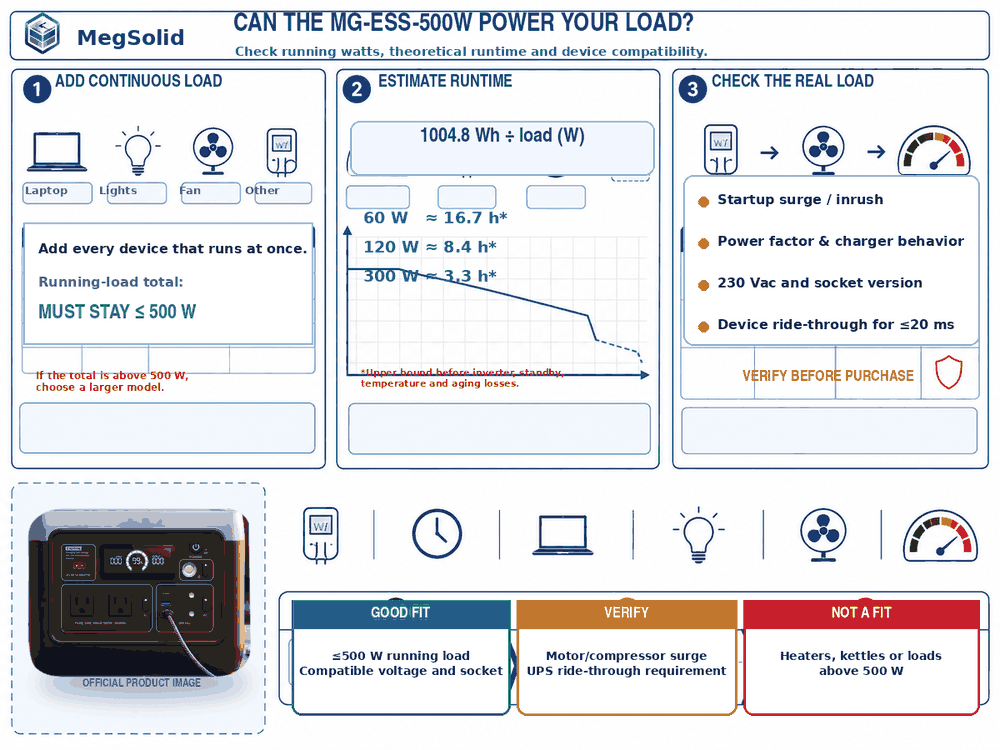
Theoretical runtime upper bound = 1004.8Wh ÷ load power. This is not a delivered-runtime guarantee. Inverter loss, standby consumption, temperature, battery age and the actual load profile reduce real operating time.
| Example Continuous Load | Theoretical Upper Bound | Buyer Interpretation |
|---|---|---|
| 60W | About 16.7 hours | Actual runtime will be lower after conversion and standby losses. |
| 120W | About 8.4 hours | Use this as a ceiling, not an 8–10 hour promise. |
| 300W | About 3.3 hours | Confirm temperature, inverter efficiency and reserve requirement. |
| Above 500W | Not applicable | Choose a higher-power model. |
What the Published Specification Confirms
| Procurement Point | Published Specification | What the Buyer Must Verify |
|---|---|---|
| Rated energy | 1004.8Wh | Required reserve and expected usable AC energy |
| AC output | 500W, 230Vac, pure sine wave | Socket type, frequency and destination-market version |
| Net weight / dimensions | 10kg / 276 × 185 × 199mm | Packed weight, accessories and shipping carton |
| Solar input | 10–55Vdc, 10A, 300W maximum | Panel Voc, current, connector and cold-weather Voc |
| UPS switching | ≤20ms | Whether the connected device can ride through that interval |
| Cycle life | Up to 8,000 cycles | DOD, temperature, C-rate, end-of-life threshold and test report |
| Warranty | Published as 5 years | Regional terms, exclusions, claim process and logistics |
For drawings, test records and current document versions, use the MegSolid technical resource center and request the model-specific package rather than relying on a general product-family statement.
Hybrid Solid-State Safety: State the Benefit Precisely
MegSolid describes the unit as using hybrid solid-state battery technology. The intended benefit is reduced liquid-electrolyte content and improved thermal stability compared with a conventional liquid-electrolyte design. The hybrid solid-state safety overview explains the material-level mechanism.
This benefit should not be rewritten as “zero risk” or “thermal runaway is impossible.” Safe deployment still depends on the BMS, enclosure, charger, operating temperature, transport condition and correct use. Procurement decisions should be based on model-specific safety reports and certificates.
1004.8Wh at 10kg: Portable, but Runtime Still Depends on the Load
The published 10kg net weight and 276 × 185 × 199mm dimensions make the unit suitable for single-person transport. That does not mean every 1kWh competitor is heavier, so the article avoids unsupported market-wide weight ranges and compares the unit only with the buyer’s own handling limit.
MegSolid also publishes an MG-ESS-500W performance-test overview covering solar input, full-load operation, temperature testing and cycle-life claims. Buyers should request the underlying, model-specific test documents when those claims affect a tender or distribution agreement.
Solar Charging and UPS Use Need Compatibility Checks
- Solar input: keep panel open-circuit voltage within 10–55Vdc, current within 10A and input power within the published 300W maximum.
- Cold-weather check: calculate the panel string Voc at the lowest expected temperature; do not use only the nameplate operating voltage.
- UPS check: ≤20ms is a switching specification, not a promise that every connected device will remain online.
- Load check: validate the connected device’s hold-up time, startup behavior and power-supply tolerance before calling the system UPS-compatible.
Buyer Verification Checklist
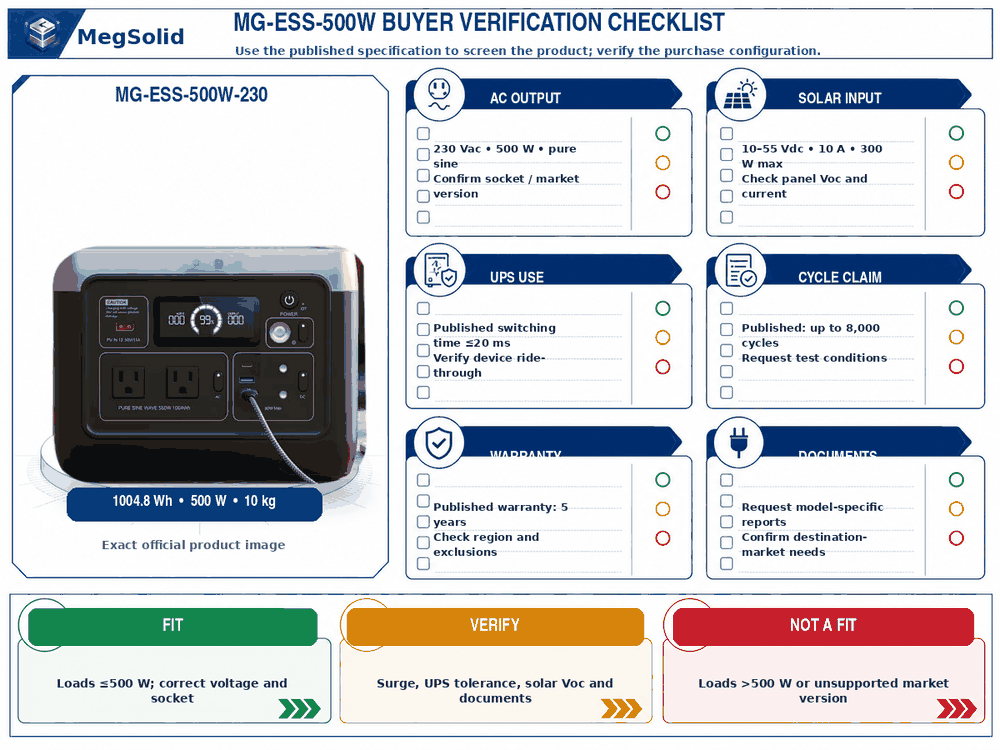
- Exact model and hardware revision on the quotation, nameplate and datasheet
- 230Vac output frequency, socket configuration and destination-market version
- Cycle-life test conditions and capacity-retention threshold
- Regional five-year warranty terms, exclusions and claim logistics
- Model-specific transport and compliance documents required by the destination market
- Included cables, solar connector, carton dimensions, net weight and gross weight
Review the wider MegSolid energy-storage product portfolio if the required continuous power is above 500W. For supplier background and manufacturing scope, see About MegSolid.
Who Should Choose This Model?
- Field teams: compatible laptops, test equipment, communications devices and lighting within 500W.
- Home backup users: selected low-power essentials after a verified load and runtime calculation.
- Outdoor users: compatible devices plus a correctly matched solar panel.
- Distributors: markets where the output, plug, label and certification package are confirmed before purchase.
- Choose another model: when continuous load, surge demand or required runtime exceeds this unit’s verified capability.
See MegSolid application cases for other storage use cases. For a model-specific quotation, plug configuration and document checklist, contact the MegSolid team.
FAQ
What is the rated energy of the MG-ESS-500W-230?
The published rated energy is 1004.8Wh. Usable AC energy will be lower because of inverter loss, standby consumption, temperature, battery age and reserve settings.
Can it power any device rated below 500W?
Not automatically. The combined continuous load must stay within 500W, and motor or compressor loads also require a startup-surge check.
How should runtime be estimated?
Use 1004.8Wh divided by the continuous load in watts as a theoretical upper bound, then reduce the result for conversion loss, standby consumption, temperature, aging and reserve.
Is the net weight really 10kg?
The official product page publishes a 10kg net weight and dimensions of 276 × 185 × 199mm. Confirm packed weight and included accessories for shipping.
Why is the product described as hybrid solid-state?
MegSolid describes the battery as a hybrid solid-state design intended to reduce liquid-electrolyte content and improve thermal stability. It should not be marketed as risk-free.
Does “up to 8,000 cycles” guarantee 8,000 identical cycles in every application?
No. Ask for the DOD, temperature, C-rate, end-of-life capacity threshold and applicable test report because cycle life depends on test and operating conditions.
What solar input does it support?
The published input range is 10–55Vdc, 10A maximum and 300W MPPT maximum. Confirm panel Voc, cold-weather Voc, current and connector compatibility.
Does ≤20ms switching guarantee uninterrupted operation?
No. It is a published switching-time specification. The connected device must be able to ride through that interval, so critical loads require an actual transfer test.
What output ports are published?
The official page lists two national-standard five-hole AC sockets, three USB ports and 5V/12V DC output. Confirm the exact socket version on the quotation for your destination market.
What warranty is published?
The product page publishes a five-year warranty. Request the regional warranty document, exclusions, claim process and freight responsibility before ordering.
What are the published operating and storage temperatures?
The product page lists −10°C to 50°C for operation and −15°C to 60°C for storage. Confirm any charging or output derating conditions in the current datasheet.
Is the unit suitable for medical equipment?
Do not assume so from the pure-sine-wave or switching-time specification. Medical use requires device-specific approval, risk assessment and applicable certification.
What should a distributor request before a volume order?
Request the current datasheet, product revision, plug and label version, cycle-test conditions, warranty terms, transport documents, destination-market certificates, packaging data and sample-acceptance plan.
Can North American buyers use this 230Vac version directly?
Do not assume direct compatibility. Confirm output voltage, frequency, socket configuration and the exact North American compliance documents before purchase.
Can European buyers run standard 230V appliances?
The published output is 230Vac, but buyers must still confirm socket type, frequency, appliance power, startup surge and destination-market compliance.
What should Australian or New Zealand buyers verify?
Confirm the AU/NZ socket and label version, output frequency, transport paperwork, applicable electrical approvals, warranty coverage and any importer obligations before ordering.
Product reference: Official MegSolid MG-ESS-500W-230 product page, checked 14 August 2026: 1004.8Wh rated energy, 500W pure-sine output, 10kg net weight, 276 × 185 × 199mm dimensions, 10–55Vdc / 300W MPPT solar input, published ≤20ms switching time, up to 8,000 cycles and a published five-year warranty.
Disclaimer: Published specifications are screening inputs, not a project guarantee. Actual runtime and service life depend on load, temperature, charge/discharge conditions, battery age and operating reserve. Always use the latest model-specific datasheet, test records, warranty terms and destination-market requirements for procurement.