
MegSolid helps Australian industrial teams turn site data into a commercial battery storage proposal that can be compared on a common financial and engineering basis. For a facility with recurring high-import intervals, the useful question is whether the BESS can reduce the measured exposure that drives cost while working inside the site’s PCC, transformer, switchboard and operating constraints. A credible answer requires the tariff, interval load profile, operating schedule and AC connection information before a supplier assigns a battery capacity or a return period.
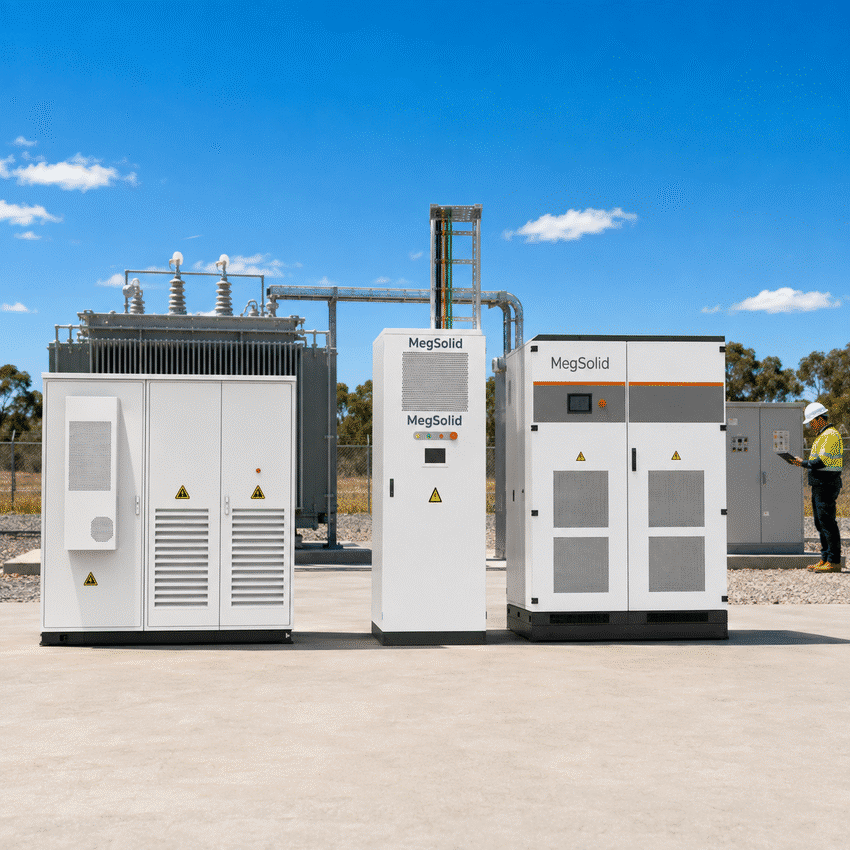
Commercial battery storage Australia searches usually come from a buyer who has passed the awareness stage. The site may be considering a new production line, EV charging, a constrained transformer, a recurring demand event or a wider energy-cost programme. The immediate decision is whether to allocate engineering time to a project assessment. This page sets the evidence boundary for that decision and explains the MegSolid product paths that can be reviewed once the duty is defined.
| Buyer decision | Evidence that supports it | Output expected from an initial review |
|---|---|---|
| Can this facility create a measurable financial benefit? | Electricity invoices, tariff schedule and 15-minute site data | Defined cost driver and an ROI-model boundary |
| What AC duty must the BESS cover? | Peak kW, kVA, power factor and event duration | Preliminary PCS power and energy window |
| Can the site accept the proposed connection? | Single-line diagram, PCC, transformer and switchboard details | Connection assumptions and balance-of-plant questions |
| Which product path merits engineering review? | Duty profile, ambient conditions and site footprint | Candidate system path with stated assumptions |
Set the ROI Boundary at the Meter That Governs the Bill
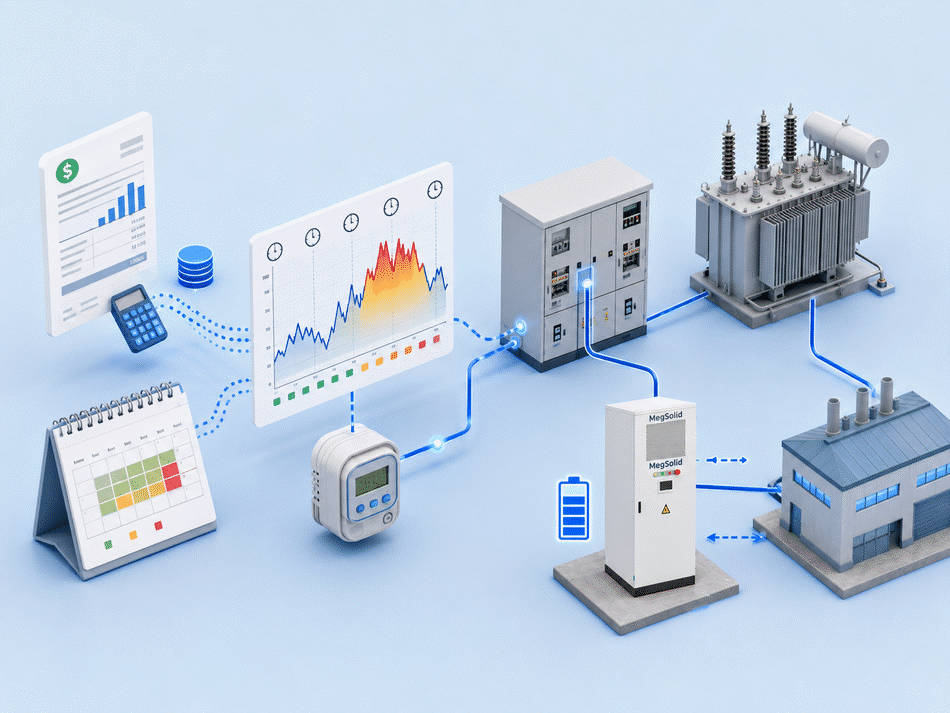
An industrial BESS ROI case starts at the meter and tariff component that creates the cost exposure. Some Australian commercial tariffs include a demand or capacity-related component, while others place the commercial pressure in time-based import charges, network periods or a combination of these structures. The project team should identify the actual invoice line, the meter used for settlement and the time window that determines the charge before calculating a dispatch benefit.
The load record must match that boundary. Monthly consumption describes total energy, while 15-minute data reveals the peaks, ramps, shift changes and repeated operating events that a BESS could address. A battery may discharge during a high-import event, yet the financial result depends on the meter interval, tariff rule, charging period, control logic and BESS availability. The commercial energy storage procurement review provides a useful internal framework for keeping this evidence consistent across supplier discussions.
Identify the event the BESS is intended to manage
The event should be written as an operating statement. For example: “During the weekday packaging-line ramp, keep measured import at or below the agreed target for the recorded duration.” This statement gives the finance team a traceable cost driver and gives the electrical team an AC control target. It also prevents a broad annual-consumption number from being used as a substitute for an actual dispatch duty.
| Metered item | What to collect | Why it changes the ROI model |
|---|---|---|
| Interval import | At least representative 15-minute kW records, including seasonal and shift variation | Defines recurring peak shape and candidate discharge periods |
| Interval kVA and power factor | Meter or power-quality records where available | Establishes apparent-power duty at the PCS boundary |
| Tariff schedule | Energy, demand/capacity, network and time-window components | Identifies the financial variable the model can address |
| Charging opportunity | Load troughs, operating hours and site control limits | Determines whether the BESS can restore energy between events |
| Planned load change | Approved charging, process or facility expansion | Keeps the assessment aligned with the future duty |
Build an Australian Industrial BESS ROI Data Pack
A commercial battery storage proposal becomes comparable when every bidder receives the same site evidence and commercial assumptions. The data pack needs far more than annual kWh. It should contain the current electricity bills, the applicable tariff schedule, interval data, the target operating limit and the drawings that define the electrical connection. Record the exact demand-charge window, the settlement or measurement interval and the meter that governs the charge. This allows each proposal to state where its model starts and ends.
For an industrial facility, collect a current single-line diagram showing the incoming supply, revenue meter or PCC, transformer, main switchboard, major load buses and the intended BESS point of connection. Add transformer nameplate data, loading history where available, protection information, cable route constraints and the site’s operating schedule. The industrial transformer-capacity review is relevant where storage is being considered alongside a load expansion or a deferred network upgrade.
Separate the financial assumptions from the equipment ratings
Financial assumptions belong in a visible model: tariff values, operating days, eligible dispatch events, charging losses, financing approach, service allowance and any local incentive status. Equipment ratings belong in the product data and site design: PCS kW and kVA, rated battery energy, temperature conditions, control interfaces and approved operating limits. Keeping these categories separate makes a revision easier when the tariff, shift pattern or connection condition changes.
An ROI forecast should show the value stream by period, the energy charged and discharged, the assumed availability window and the conditions that would change the result. It should also distinguish rated battery energy from usable dispatch energy and delivered AC energy. MegSolid can assess the project data and provide a preliminary configuration path; final commercial performance remains subject to the agreed project design, local connection conditions and contractual scope.
Translate the Load Profile Into PCS Power, kVA and Energy Duty
Every investment case needs three different electrical measures. Required kW describes active power. Required kVA describes the apparent-power envelope that includes reactive duty. Required kWh describes the energy required across an agreed event or dispatch period. Each value affects the system route, and a catalogue energy value cannot establish the full industrial duty by itself.
For each candidate event, the preliminary active-power gap is the measured site import above the agreed target. Event energy is the area under that gap over the measured duration. Apparent power follows the relationship S² = P² + Q², where S is kVA, P is kW and Q is kvar. The final design should use the approved meter point, control sign convention, power-factor requirements and network protection settings.
| Site condition | Preliminary engineering question | Candidate MegSolid path to review |
|---|---|---|
| A defined active-power gap up to 100kW, with a site duty consistent with the selected configuration | Can an outdoor cabinet cover the measured power and energy window? | ESSA0100B-0215: 100kW rated AC power and 215.04kWh rated energy; intelligent air cooling and IP54 are listed for this model |
| A site duty requiring a 125kVA AC envelope and a 261.24kWh rated-energy class | Does the apparent-power requirement, temperature condition and footprint suit the liquid-cooled cabinet? | Meg-SolidEnergon-261kWh: 125kVA rated AC capacity, 261.24kWh rated energy, liquid cooling and adjustable power factor from -1 to +1 |
| A larger engineered power requirement | Which PCS rating, battery configuration and AC interfaces satisfy the measured duty? | MEGA TS PCS: 30–500kW model range with built-in isolation transformer; battery and balance-of-plant scope require engineering confirmation |
| A multi-load or larger-site programme | Does a modular or containerised architecture fit the load aggregation, site access and connection plan? | Compare engineered PCS/battery paths with the modular and containerised BESS deployment options |
The ESSA0100B-0215 uses LFP cells and intelligent air cooling in the reviewed product data. A project-specific solid-state battery option requires confirmation in the agreed technical documents. The 261.24kWh liquid-cooled C&I system also uses LFP cells; its stated 90% value is maximum system efficiency, while delivered AC energy must be evaluated at the project boundary. The 100kW and 215kWh outdoor BESS selection page and the 261kWh liquid-cooled C&I energy storage system help procurement teams review the published product boundary before requesting a project configuration.
Test the ROI Case Against Real Operating Constraints
A financial model can look attractive while the actual site has insufficient charging windows, a transformer loading issue, a restricted feeder, an unsuitable switchboard position or a control boundary that cannot use the selected meter data. Each condition belongs in the assessment from the beginning. The resulting project case has a higher chance of surviving detailed design because its operating assumptions are visible.
| Constraint to test | Evidence required | Commercial impact |
|---|---|---|
| Transformer headroom | Nameplate, interval loading and planned-load information | Affects charging strategy and connection feasibility |
| PCC or revenue-meter control | Single-line diagram, CT/PT arrangement and setpoint point | Determines how performance and tariff exposure are measured |
| Process continuity | Shift plan, critical loads and maintenance periods | Defines available dispatch hours and service window |
| Power factor and reactive duty | Meter records, inverter duty and site requirement | Influences the PCS apparent-power margin |
| Ambient conditions and access | Site survey, clearance, temperature and lifting route | Shapes cabinet location, cooling choice and installation scope |
| Protection and communications | Relay information, EMS/BMS interface and network architecture | Sets the commissioning and control-integration work |
The EPC energy-storage evaluation process supports a controlled review of these interfaces. For a site that expects backup support or generator coordination, the duty statement should add essential-load priorities, restoration sequence, generator rating and the approved operating modes. These requirements can change the system design and the project cost boundary.
An outdoor-cabinet path also needs a heat and installation-access review before the location is fixed. Check ambient exposure, local clearance, service access, equipment foundations, lifting route and cable entry. ESSA0100B-0215 lists an operating temperature of 0°C to 45°C, so the project design should confirm the actual installation environment and any conditions that affect its rated operating duty.
Compare Commercial Battery Storage Quotes on Scope, Evidence and Control
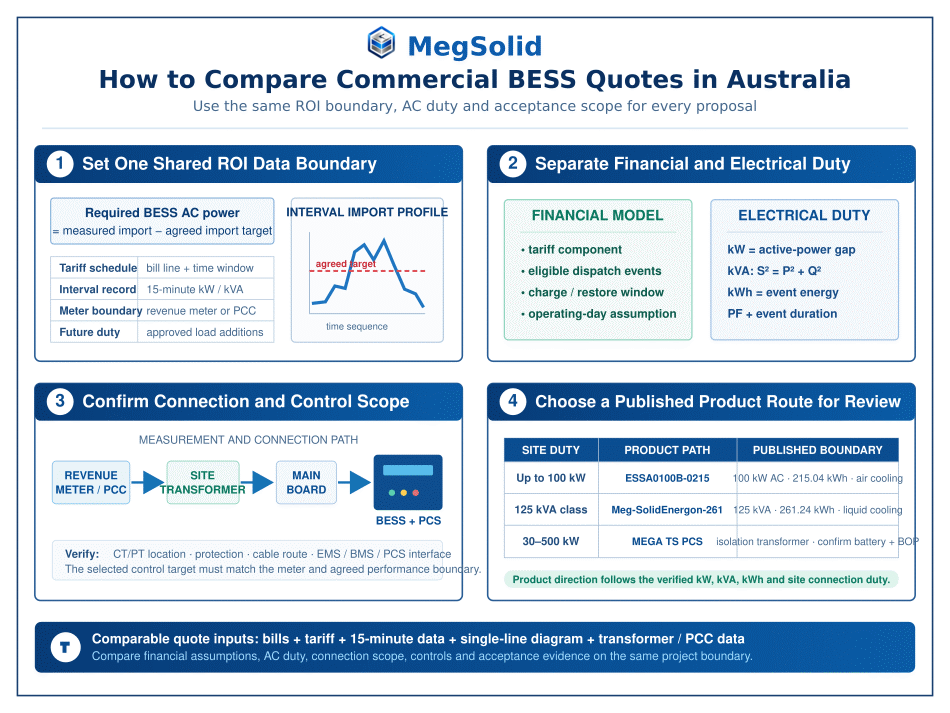
An industrial buyer can compare proposals more effectively when each supplier answers the same questions. The lowest equipment number alone says very little about the future project obligation. A transparent offer identifies the source of every ROI assumption, the AC power and energy boundary, the included interfaces, the test plan and the information still required from the site.
| Comparison point | Question for every supplier | Evidence that supports a decision |
|---|---|---|
| Financial model | Which bill components, time windows and operating days are included? | Assumptions table linked to interval data |
| AC duty | What kW, kVA, power factor and duration does the design cover? | Duty statement and PCS envelope |
| Battery energy | Is the value rated energy, usable energy or delivered AC energy? | Defined measurement boundary and control window |
| Connection scope | Which transformer, switchboard, cable, protection and civil items are included? | Single-line markup and responsibility matrix |
| Controls | Which meter drives dispatch, and how do EMS, PCS and BMS exchange data? | Interface matrix and control narrative |
| Acceptance | Which records demonstrate the agreed performance at handover? | Site acceptance plan and test data ownership |
This approach aligns with the C&I peak-shaving ROI engineering analysis, while giving the Australian site a separate regional page focused on its own tariff evidence and project quote boundary. Where a team also evaluates market-responsive dispatch, the existing Australian NEM battery-arbitrage article provides a separate scenario; it should remain distinct from a facility demand-management model.
Choose a Project Route That Can Be Reviewed and Delivered
MegSolid’s role is to translate an agreed project duty into an equipment and engineering path with stated boundaries. The first review can use the ESSA0100B-0215 for a 100kW/215.04kWh outdoor cabinet path, the Meg-SolidEnergon-261kWh for a 125kVA/261.24kWh liquid-cooled path, or MEGA TS PCS models from 30kW to 500kW for a larger engineered configuration. Selection follows the measured power, apparent-power requirement, duration, site environment and connection design.
For Australian projects, the working pack should include applicable local network requirements, the project location, installation environment, electrical drawings, product datasheet confirmation, communications matrix, protection and commissioning scope. The Australian BESS supplier evaluation page adds the factory and documentation checks that complement this ROI assessment. Together, these records give the buyer a clear basis for deciding whether to proceed with engineering and a project quotation.
FAQ
What data is needed to assess commercial battery storage ROI in Australia?
Start with at least 12 months of electricity invoices, the applicable tariff schedule, representative 15-minute interval load data, operating hours, target import limit and a current single-line diagram. Include transformer data, planned loads, PCC or revenue-meter location, protection information and site access constraints. This produces a defined financial and electrical boundary for an initial engineering review.
Can annual electricity consumption establish a BESS ROI case?
Annual kWh provides useful context, yet it cannot describe the duration or repeat frequency of the intervals that create demand exposure. Use interval kW and, where available, kVA and power-factor data. The BESS case should be based on an identified cost event and a measurement boundary that matches the actual tariff and control point.
Why must kW, kVA and kWh be reviewed separately?
kW is active power, kVA is apparent power and kWh is energy over time. A facility can require a modest energy duration while still needing a substantial apparent-power envelope at the PCS. Separating the three measures helps each bidder describe the same AC duty and reduces the chance of comparing equipment ratings that cover different operating conditions.
Does a demand-management BESS require a PCC review?
Yes. The project needs a documented control boundary, whether that is a revenue meter, PCC or another approved site measurement point. The single-line diagram, CT/PT arrangement, transformer, switchboard and protection architecture determine how the BESS sees the load and how the facility demonstrates the target result during commissioning.
Which MegSolid system fits an industrial demand-charge project?
The product path follows the verified project duty. ESSA0100B-0215 is rated at 100kW and 215.04kWh. Meg-SolidEnergon-261kWh is rated at 125kVA and 261.24kWh. MEGA TS PCS models cover 30kW to 500kW for engineered configurations. Load data, duration, apparent power, temperature and connection design determine whether any path is suitable.
Is the 261.24kWh system rated at 125kW?
The reviewed product table lists a 125kVA rated AC capacity and adjustable power factor from -1 to +1. Its kW duty depends on the operating power factor and the agreed design condition. The proposal should state the required kW, kVA and power-factor envelope instead of treating kVA as a universal kW value.
How should an ROI model treat BESS efficiency?
Use the product value with its correct boundary and document the calculation method. The 261.24kWh system lists 90% maximum system efficiency. This figure needs to remain separate from any round-trip, usable-energy or delivered-AC-energy assumption. A project model should disclose charging and discharging assumptions, dispatch window and performance-measurement point.
Can a BESS help a site considering a transformer upgrade?
A BESS can be evaluated where measured intervals show a recurring import event that drives the proposed upgrade. The assessment needs transformer nameplate data, loading history, proposed load additions, PCC target and the duration of the constrained event. The result should identify the engineering, protection and control requirements alongside the financial scenario.
What should a commercial BESS quote include?
Ask for the design duty, rated equipment values, battery-energy boundary, connection assumptions, PCS and control interfaces, balance-of-plant inclusions, communications matrix, protection scope, factory and site test plan, commissioning scope, documentation and commercial assumptions. This makes it possible to compare proposals on the same project definition.
Can MegSolid supply a PV system for an Australian BESS project?
MegSolid’s scope for this page is commercial battery storage and associated PCS/ESS engineering. PV procurement and local installation can be arranged through an Australian project partner where the site requires it. The BESS assessment can include the operational behaviour of existing or locally sourced PV when that information affects the site control and financial model.
How do Australian industrial tariffs affect commercial battery storage ROI?
The relevant tariff components, meter location and charging/discharging time windows determine whether a site has a suitable demand-management case. Australian electricity structures vary by network area, retailer arrangement and customer contract. Use the current invoices and tariff documents for the site rather than a generic market assumption.
Does an Australian commercial BESS project need local connection review?
Yes. The project location, network service provider requirements, connection level, protection approach, export conditions and applicable electrical standards must be reviewed for the actual site. Product selection and the site design should be confirmed against current project requirements before procurement and commissioning.
What site data should an Australian factory send before a BESS ROI review?
Send electricity bills, tariff documents, interval load data, a single-line drawing, transformer data, operating schedule, planned equipment additions, target demand limit, proposed BESS location and any site rules affecting access or commissioning. This gives the engineering team an efficient starting point and reduces later changes to the project scope.
How can an Australian warehouse compare BESS quotations fairly?
Give every shortlisted supplier the same data pack and ask each to state the tariff assumptions, power and energy duty, meter boundary, connection scope, controls, commissioning deliverables and exclusions. A lower equipment number can represent a narrower scope, so the comparison should include electrical interfaces, performance evidence and project responsibilities.
What is commercial battery storage in Australia used for?
Commercial battery storage can be assessed for demand management, load shifting, backup priorities, generator coordination, site expansion support and the operation of existing on-site generation. The relevant application depends on the site’s measured electrical behaviour, tariff exposure, connection conditions and desired operating outcome.
How does MegSolid prepare an Australian commercial battery storage proposal?
MegSolid reviews the submitted load and tariff data, electrical drawings, operating targets and site constraints, then identifies a preliminary PCS and energy-storage route with stated assumptions. The next project stage confirms the exact model, connection design, control logic, compliance scope, commissioning plan and commercial inclusions for the selected application.