 Skip to content
In a Riyadh industrial yard, the hard hour is when ambient heat, sun on the cabinet and factory load all hit together. MegSolid gives two cabinet starting points: ESSA0100B-0215 at 100 kW / 215.04 kWh with intelligent air cooling, and Energon 261 at 125 kVA / 261.24 kWh with liquid cooling.
The buy hangs on a temperature you can measure. ESSA publishes 0–45°C. Energon publishes −20–55°C, with derating above 45°C. A 55°C envelope tells the EPC the machine may stay on. You still need available power at each high-temperature duty point.
Send MegSolid the site design ambient, equipment-intake temperature and continuous full-load hours. The first pass can put the job in an ESSA window, an Energon window, or a project thermal test.
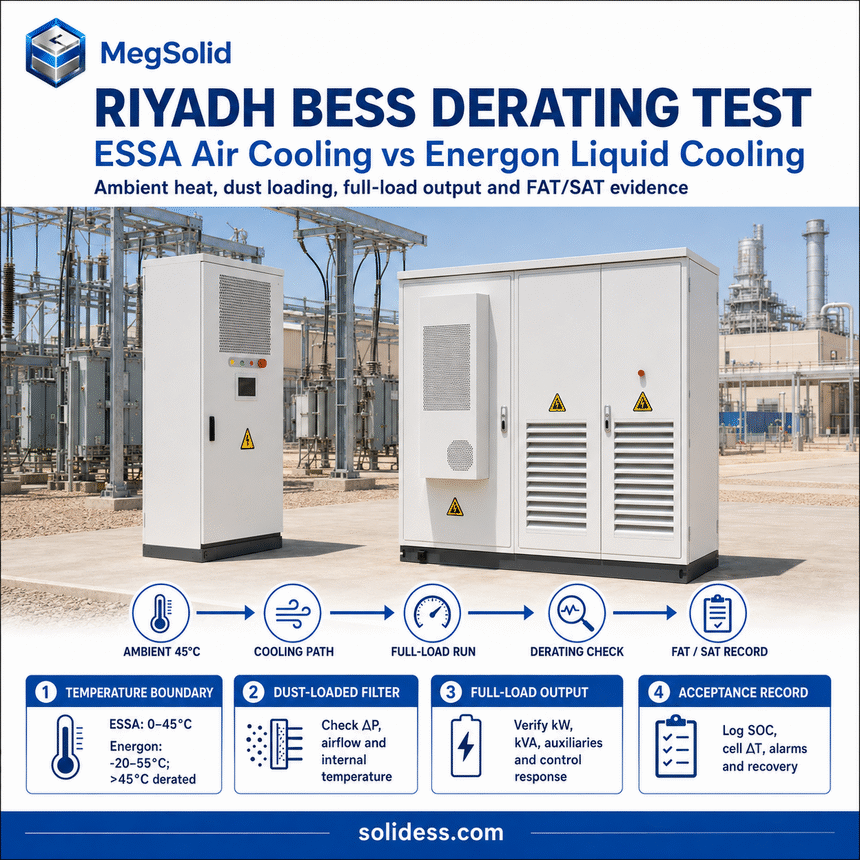
ESSA and Energon are screened against measured intake temperature, continuous duty and the declared derating boundary.
Fast-scan selection result
| Project condition | ESSA0100B-0215 review | Energon 261 review | Tender action |
|---|---|---|---|
| Equipment intake stays below 40°C | Strong first candidate | Use if other requirements pull that way | Confirm rated-power curve and filter interval |
| Intake hits 40–45°C on a long discharge | Depends on airflow, dust and full-duty evidence | Stronger thermal-control candidate | Witness the declared duty near the upper temperature |
| Planned operation above 45°C | Outside the published ESSA range | Inside the published range, with derating | Attach the Energon derating curve and active-power schedule |
| Heavy dust, filters actually get cleaned | Air cooling can work after a pressure-drop review | Liquid loop leans less on cabinet air for cell cooling | Write inspection, cleaning and replacement into the contract |
| Thin local cooling service | Simpler day-to-day path | Needs pump, coolant and leak response | Price tools, spares, training and response time |
| Load given only in kW | 100 kW AC is a clean screen | 125 kVA needs power-factor confirmation | Record kW, kVA, power factor and reactive duty separately |
Treat the table as a pre-tender screen. Final pick follows the signed load profile, usable energy, layout, sun, altitude, protection study and the controlled product revision.
For the wider Saudi buy: Saudi C&I BESS high-temperature procurement page. This page is narrower: how an EPC turns summer temperature into a witnessed derating call.
Compare the two published product boundaries first
| Published item | ESSA0100B-0215 | Energon 261 | Procurement meaning |
|---|---|---|---|
| Rated AC value | 100 kW | 125 kVA | Energon active kW follows the approved power-factor and thermal curves |
| Rated energy | 215.04 kWh | 261.24 kWh | Both are nominal energy; usable AC energy stays project-specific |
| Cell chemistry | LFP | 314 Ah LFP | Confirm the delivered BOM and datasheet revision |
| Cooling | Intelligent air cooling | Liquid cooling | Architecture changes maintenance and evidence |
| Enclosure | IP54 | IP54 | IP covers ingress; thermal output needs its own proof |
| Operating temperature | 0–45°C | −20–55°C | Energon states derating above 45°C |
| Main desert service item | Air path, filter, fans | Coolant loop, pump, leak response, heat rejection | Put each task in the O&M schedule |
ESSA rating and interfaces: ESSA0100B-0215 100 kW / 215.04 kWh product-selection page.
Energon data: 261.24 kWh / 125 kVA liquid-cooled product page. Listed maximum system efficiency is 90%. Keep that number off any project round-trip guarantee.
Use equipment-intake temperature as the controlling value
Weather-station air describes the region. The cabinet sees the air at its intake and heat-rejection surfaces.
Intake can run hotter because of:
- sun on the cabinet and the concrete pad
- hot air looping between cabinets
- nearby transformers, generators or process exhaust
- tight clearance at intake and discharge
- dust on filters, coils and heat exchangers
- a dark canopy with weak ventilation
- altitude limits on cooling and PCS
Write three temperatures into the tender:
| Temperature term | Definition for the tender | Required evidence |
|---|---|---|
| Site design ambient | Outdoor dry-bulb used for design | Approved meteorological basis and site location |
| Equipment-intake temperature | Air at the manufacturer-defined intake | Sensor location drawing and SAT trend |
| Internal control temperature | Cell, module, coolant or cabinet value used by BMS/EMS | Point list, alarm thresholds, event log |
Saudi Arabia’s National Center for Meteorology has logged national summer extremes above 50°C, including 51.3°C at Al-Ahsa in July 2024, per the Saudi Press Agency summary. That sets the regional climate. Each Riyadh job still needs its own design value, measurement point and exposure assumptions.
What a 55°C operating range actually defines
Energon can sit inside its published −20–55°C range. The same sheet states derating above 45°C. The number that belongs in a tender is a curve: available kW or kVA versus temperature.
Ask for these operating points:
- rated active and apparent power at 25°C
- declared continuous power at 40°C
- declared continuous power at 45°C
- available power at 50°C
- available power at 55°C
- charge and discharge limits at each point
- duration tied to each continuous rating
- auxiliary consumption at each thermal condition
- recovery logic after temperature falls
Published specifications from SolaX and CLOU show how suppliers separate operating-temperature limits from full-power capability. SolaX describes a comparable liquid-cooled platform with operation up to 55°C and derating above 45°C. CLOU markets desert-ready storage around 55°C operation and dust protection. Use those figures as tender benchmarks while keeping each rating tied to its own product and test conditions.
What filter loading does to an air-cooled cabinet
Air cooling moves heat through a controlled airflow path. Dust raises resistance along that path.
A dust-loaded air path typically develops in this sequence:
- Filter loading raises pressure drop.
- Airflow falls or fans spin harder.
- Internal temperature and spread climb.
- Cooling auxiliaries draw more power.
- The controller warns, restricts power or trips, per approved logic.
Thresholds belong to the delivered model and software revision. Tie any “dust ready” claim to measured airflow, temperature and control responses.
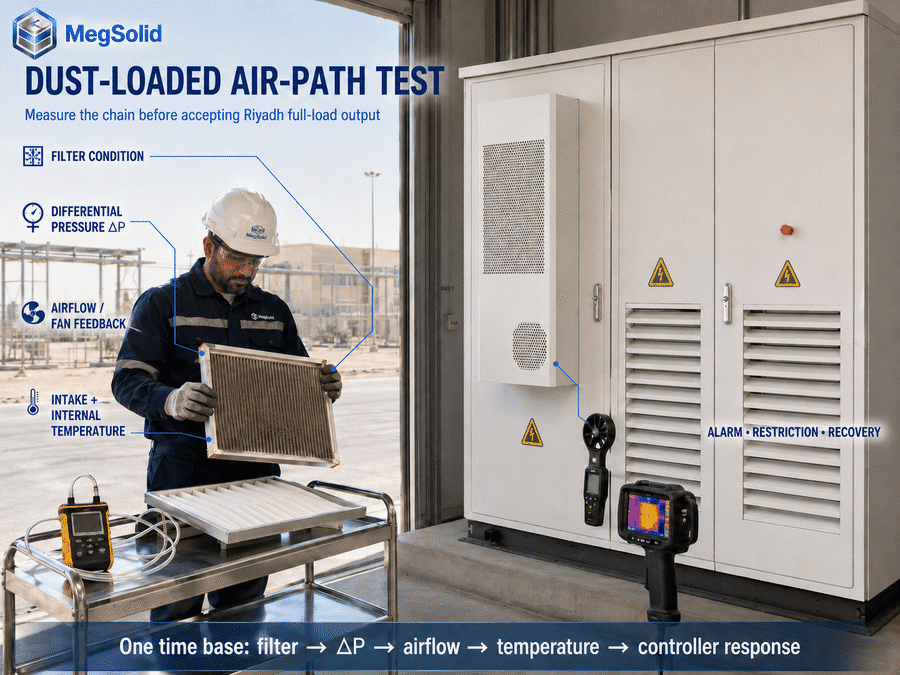
A restricted-airflow test links filter condition, pressure drop, airflow, internal temperature and controller response on one time base.
Air-cooling evidence to request
- clean-filter airflow or pressure reference
- maximum permitted filter pressure drop
- fan command, feedback and failure alarms
- intake, outlet and internal temperature sensors
- filter inspection and replacement interval
- alarm and derating sequence under restricted airflow
- spare-filter quantity and who holds stock
- safe cleaning method for site staff
- EMS event-log fields for fan and temperature events
ESSA’s IP54 rating still matters for enclosure ingress. The IEC explanation of IP ratings shows IEC 60529 classifies protection against solids and liquids. Continuous power at 45°C, filter life in Riyadh dust and the site service interval need their own evidence.
Liquid cooling changes the maintenance list
Energon moves coolant through the battery thermal path. Heat transfer at the cell side is tighter, and the pack leans less on bulk cabinet air.
The plant still dumps heat to the yard. Check the heat exchanger, radiator or chiller on the offered revision, plus fans and any surface that will collect dust.
Liquid-cooling evidence to request
- approved coolant type, concentration and fill quantity
- inspection and replacement interval
- pump status, speed feedback and failure alarm
- supply and return temperatures
- flow or pressure monitoring points
- leak-detection locations and alarm logic
- isolation after a confirmed leak
- heat-exchanger or radiator cleaning method
- spare pump, seals, coolant and tools
- local response time and technician qualification
Turn the list into a schedule with the liquid-cooled BESS maintenance and leak-detection checklist.
Start with the load profile, then look at battery nameplates
Cooling follows the duty you actually run.
Collect the finest load data you have and mark hours when summer temperature and BESS output overlap. A warehouse that dumps 20 minutes at sunset is a different thermal case from a plant holding full output through a four-hour afternoon.
| Duty input | Why it changes the cooling decision |
|---|---|
| Required active power in kW | Sets the heat-producing electrical duty |
| Apparent power in kVA | Captures power-factor and reactive-current headroom |
| Continuous full-load duration | Splits a short support event from a sustained thermal load |
| Charge duty before discharge | Adds heat before the critical window |
| Starting SOC | Changes available energy and cell current path |
| Minimum reserved SOC | Protects outage or generator-start reserve |
| Maximum intake temperature | Selects the product thermal envelope |
| Direct-sun period | Adds cabinet and pad heat during the duty |
| Dust condition | Changes airflow and heat-rejection performance |
Power-and-energy comparison: 215.04 kWh versus 261.24 kWh commercial battery storage.
Write the derating boundary into the tender
Use a schedule with named terms and evidence.
| Tender field | Recommended requirement | Acceptance evidence |
|---|---|---|
| Design ambient | State the project value and source | Approved design basis |
| Intake measurement point | Define location and shielding | Sensor-location drawing |
| Solar exposure | Full sun, canopy or enclosure | Layout and thermal assumptions |
| Rated output | Separate kW, kVA and power factor | Controlled datasheet and curve |
| High-temperature output | Required power and duration at each temperature | Manufacturer derating schedule |
| Dust condition | Clean-filter and service-condition checks | Pressure, airflow or maintenance record |
| Auxiliary consumption | Fans, pumps and thermal equipment | Metered FAT/SAT trend |
| Cooling failure | Alarm, restriction and shutdown sequence | Cause-and-effect test record |
| Recovery | Restart and power-restoration logic | Event log and witnessed run |
| Responsibility | Filters, coolant, spares, service | Contract responsibility matrix |
State whether required output is measured at PCS terminals, cabinet AC output or the point of connection. Each boundary carries different auxiliary and transformer losses.
For quotation gaps on thermal, power and scope: MegSolid framework for closing thermal, power and scope gaps before procurement.
Build a high-temperature FAT around the declared duty
FAT needs a stable start and a defined interval. A short cabinet energisation does not represent a multi-hour summer discharge.
Minimum FAT sequence
- 1. Confirm the tested model, BOM, firmware and cooling revision.
- 2. Stabilise the cabinet at the agreed temperature. If a full-cabinet chamber is unavailable, document the approved simulation and component evidence.
- 3. Set the agreed starting SOC and power factor, then run the declared charge or discharge for the specified duration.
- 4. Record AC kW, kVA, power factor, DC current, SOC, auxiliary power and cooling status.
- 5. Record maximum and minimum cell temperatures and the temperature spread.
- 6. Inject approved cooling alarms or sensor faults through a safe method.
- 7. Check warning, derating, shutdown, logging and recovery against the cause-and-effect matrix.
- 8. Export the original timestamped files and sign the pass/fail sheet.
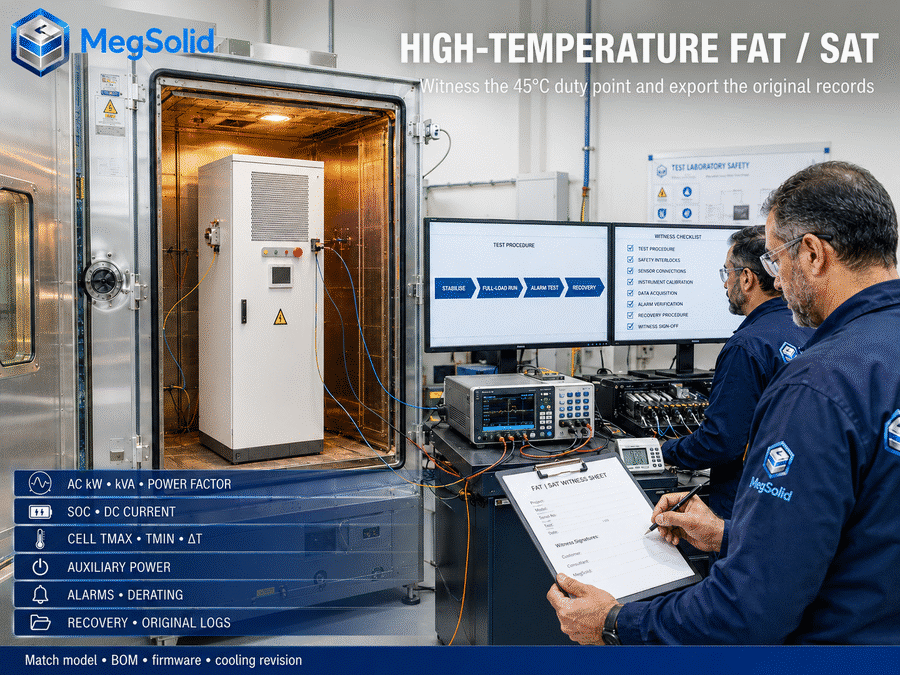
The witnessed run records electrical output, SOC, cell-temperature spread, auxiliaries, alarms, derating and recovery.
The acceptance line should quote the supplier’s declared tolerance. If the tender wants full output at 45°C, the signed curve and witnessed run must cover that condition. If you plan to run above 45°C, accepted Energon output follows the project derating schedule.
Matching tested BOM, protection logic and reports: BESS safety claim-to-evidence checklist.
Carry the same evidence into SAT
Factory data sets the product baseline. SAT confirms the installed heat-rejection path, clearances, sensors, controls and maintenance access.
Record during the site run:
- date, start time and end time
- site ambient and equipment-intake temperature
- solar condition and nearby heat sources
- cabinet number and software revision
- starting and ending SOC
- active power, apparent power and power factor
- charge or discharge duration
- maximum and minimum cell temperature
- fan or pump command and feedback
- coolant supply and return temperatures where applicable
- filter condition or pressure-drop observation
- cooling auxiliary energy
- alarm, derating and trip events
- recovery time after the duty ends
- operator and witness signatures
Trend data on one time base across BMS, PCS, EMS and the revenue meter. Mismatched clocks start arguments later.
When ESSA is the better starting point
Look at ESSA0100B-0215 when declared equipment intake stays inside 0–45°C, required AC output fits 100 kW, and the site can keep the airflow path clean.
Use ESSA when the project evidence confirms:
- measured intake margin below 45°C during the critical duty
- moderate full-load duration
- accessible filters and fans
- trained site technicians
- spare filters held locally
- layout that stops hot-air recirculation
- EMS logs for temperature, fan status and power restriction
You get a clear 100 kW / 215.04 kWh outdoor cabinet with intelligent air cooling and IP54. Routine work is simpler where the local team already runs industrial ventilation.
When Energon is the better starting point
Look at Energon 261 when design intake approaches or exceeds 45°C, the duty runs long, or the battery thermal path needs liquid cooling.
Use Energon when the project evidence confirms:
- a signed output-versus-temperature curve
- accepted derating above 45°C
- confirmed active-power capability at the required power factor
- defined coolant and leak-response procedures
- accessible heat-rejection surfaces
- pump, sensor and cooling-failure tests in FAT
- local spares and service support
Energon provides 261.24 kWh, 125 kVA, 314 Ah LFP cells, liquid cooling and IP54. Keep the kVA unit in every technical table until active-power duty and power factor are approved.
MegSolid can compare two cabinet architectures against the same measured duty. Select air cooling when intake temperature, dust service and continuous output stay within the ESSA boundary. Select liquid cooling when the duty requires Energon’s wider operating range and the site can maintain its coolant system. The technical review should align cabinet selection, EMS data, derating evidence and the acceptance record.
Full cabinet family: MegSolid C&I energy-storage product page.
Send these inputs for a cabinet recommendation
| Required input | Preferred format |
|---|---|
| Project location | City, industrial zone and coordinates |
| Design ambient | Maximum dry-bulb temperature and source |
| Equipment intake | Measured value or preliminary thermal model |
| Solar exposure | Full sun, canopy or equipment room |
| Load duty | kW and kVA time series |
| Full-load duration | Minutes or hours per event |
| Power factor | Minimum and target value |
| Energy duty | Required usable AC kWh |
| Dust condition | Site description and proposed service interval |
| Maintenance capacity | Filter, coolant, pump and leak-response capability |
| Grid interface | Voltage, frequency and on-grid/off-grid duty |
| Acceptance target | Required temperature, output, duration and measurement point |
The first reply should name the preliminary cabinet, the temperature evidence still missing, and the maintenance tasks that belong in the contract.
FAQ
Which temperature should control a Riyadh BESS selection?
Use the temperature at the manufacturer-defined equipment intake. Support it with the site design ambient, solar exposure, cabinet spacing, nearby heat sources and a recirculation assessment.
Does a 55°C operating limit mean full output at 55°C?
No. The limit defines the permitted operating envelope. Because Energon states derating above 45°C, the tender still needs available kW or kVA at 50°C and 55°C.
What happens when an air-cooling filter loads with desert dust?
Filter pressure drop rises and airflow can fall. Fans may draw more auxiliary power while internal temperature increases, leading to an alarm, power restriction or shutdown under the approved control logic.
Is liquid cooling free from desert-dust maintenance?
The liquid loop controls heat at the battery side, while the system still rejects heat to ambient. Inspect and clean the offered heat exchanger, radiator, fans and exposed heat-rejection surfaces.
Is 125 kVA the same as 125 kW for Energon 261?
125 kVA is apparent power. Available active kW depends on power factor, reactive duty, temperature and the approved PCS capability curve.
Which derating data belong in the tender?
Request charge and discharge capability at 25°C, 40°C, 45°C, 50°C and 55°C. Tie every point to duration, power factor, auxiliary consumption, measurement boundary and recovery logic.
What should a high-temperature FAT record?
Record AC kW, kVA, power factor, DC current, SOC, cell-temperature limits and spread, cooling status, auxiliary power, alarms, derating events and original timestamped logs.
What does SAT add to the factory test record?
SAT verifies the installed environment: actual intake temperature, solar condition, cabinet clearances, nearby heat sources, filter condition, heat-rejection performance and site-meter data.
When is ESSA0100B-0215 the better starting point?
Start with ESSA when intake remains inside 0–45°C, the duty fits 100 kW AC and the operator can keep filters, fans and the airflow path serviceable.
When is Energon 261 the better starting point?
Review Energon when intake approaches or exceeds 45°C, the duty runs longer or the battery thermal path needs liquid cooling. Accept its output through the signed derating curve and project test record.
What BESS fits a Riyadh industrial site that can exceed 45°C?
Energon 261 is the relevant MegSolid starting point because its published operating range extends to 55°C, with derating above 45°C. Final selection still follows the required output, duration and measured equipment-intake temperature.
How should a Saudi EPC compare air-cooled and liquid-cooled BESS for desert heat?
Compare both systems at the same intake temperature, continuous duty, power factor and dust-service condition. Require output-versus-temperature curves, cooling auxiliary data, alarm logic, maintenance tasks and witnessed FAT/SAT records.
What site data should a Riyadh factory send for a high-temperature BESS recommendation?
Send the project location, design ambient, measured or modelled intake temperature, solar exposure, kW and kVA load profile, full-load duration, power factor, usable-energy target, dust condition and maintenance capability.
What operating-temperature range is published for ESSA0100B-0215?
ESSA0100B-0215 publishes an operating-temperature range of 0–45°C. A project review must also confirm equipment-intake temperature, continuous output, airflow and filter-service conditions.
What operating-temperature range is published for Energon 261?
Energon 261 publishes −20–55°C operation and specifies derating above 45°C. The accepted project output should follow a manufacturer-issued temperature curve.
Does IP54 prove full BESS output in Riyadh heat?
No. IP54 addresses enclosure protection against solids and water under IEC 60529. Full output, temperature derating, dust loading and cooling maintenance require separate product and project evidence.
