
A reliable liquid-cooled BESS maintenance plan does not begin with a generic instruction to “check the coolant once a year.” MegSolid starts with the exact cabinet, the controlled O&M manual, the alarms and measurements available in that configuration, the site duty and the party authorized to open or service the cooling circuit. For the MegSolid Energon 261.24kWh / 125kVA C&I system, the public product boundary confirms liquid cooling and derating above 45°C, but it does not publish a universal coolant type, volume, pressure, flow setpoint or replacement interval.

- 💧 Coolant boundary: Confirm the approved fluid, concentration, compatible top-up material, fill quantity and service method from the signed manual—not from another supplier’s document.
- 🔎 Leak evidence: Preserve the first alarm, visible condition, photographs and time-aligned operating data before cleaning or repeatedly resetting the warning.
- 🌡️ Thermal evidence: Trend ambient or intake temperature, cell minimum and maximum temperature, temperature spread and cooling-system state at the same timestamp.
- 📉 Derating evidence: Compare commanded and delivered AC power with active BMS, PCS and thermal limits before deciding that the cooling loop has failed.
- 🧰 Service authority: Separate routine operator observation from intrusive work requiring isolation, PPE, specified tools and authorized technicians.
- 🧾 Contract proof: Define inspection records, response times, spare parts, return-to-service tests and warranty evidence before commercial operation.
Liquid-Cooled BESS Maintenance Starts With a Model-Specific Baseline
A maintenance checklist is only useful when each item is tied to the delivered model and revision. The MegSolid 261.24kWh / 125kVA product page identifies the system as a 314Ah LFP, liquid-cooled C&I cabinet. It must not be described as solid-state or hybrid solid-state unless the signed project BOM and datasheet explicitly identify a different cell configuration.
| Published product fact | Verified public value | O&M item still requiring project documents |
|---|---|---|
| Rated battery energy | 261.24kWh | Usable-energy basis, SOC window, auxiliary treatment and acceptance method |
| Rated AC power | 125kVA | Continuous kW, kvar duty and project-specific temperature/altitude derating curve |
| Battery | 314Ah LFP, 1P260S, 832V nominal, 676–936V DC | Exact cell, module, BMS and firmware revision in the delivered BOM |
| Cooling | Liquid cooling | Coolant specification, volume, concentration, fill/bleed method, pressure/flow limits and service tools |
| Temperature | −20–55°C; derating above 45°C | Sensor location, alarm thresholds, reset conditions, power curve and test tolerance |
| Enclosure and communications | IP54; RS485, LAN and 4G | Inspection points, data retention, remote access and alarm destination |
| Public-data caution | Humidity field is unresolved on the current page | Confirm the approved humidity range in the signed datasheet before fixing the site O&M envelope |
The 261kWh liquid-cooled BESS RFQ guide covers the purchase-stage specification. This article owns a different decision: what the owner, EPC and equipment supplier must inspect, record and prove after delivery. If the project is still deciding between cooling architectures, use the liquid-cooled versus air-cooled BESS comparison before fixing the maintenance scope.
Inspect the Coolant Circuit Without Turning Routine O&M Into Unsafe Repair Work
The operator’s first job is observation and evidence preservation. An external walkdown can identify fresh liquid, dried residue, staining, corrosion, unusual noise, repeated pump starts, blocked heat-rejection surfaces or a cabinet-base condition that changed since the previous inspection. It does not authorize an untrained person to open an energized cabinet, remove a connector, vent a loop or add fluid.
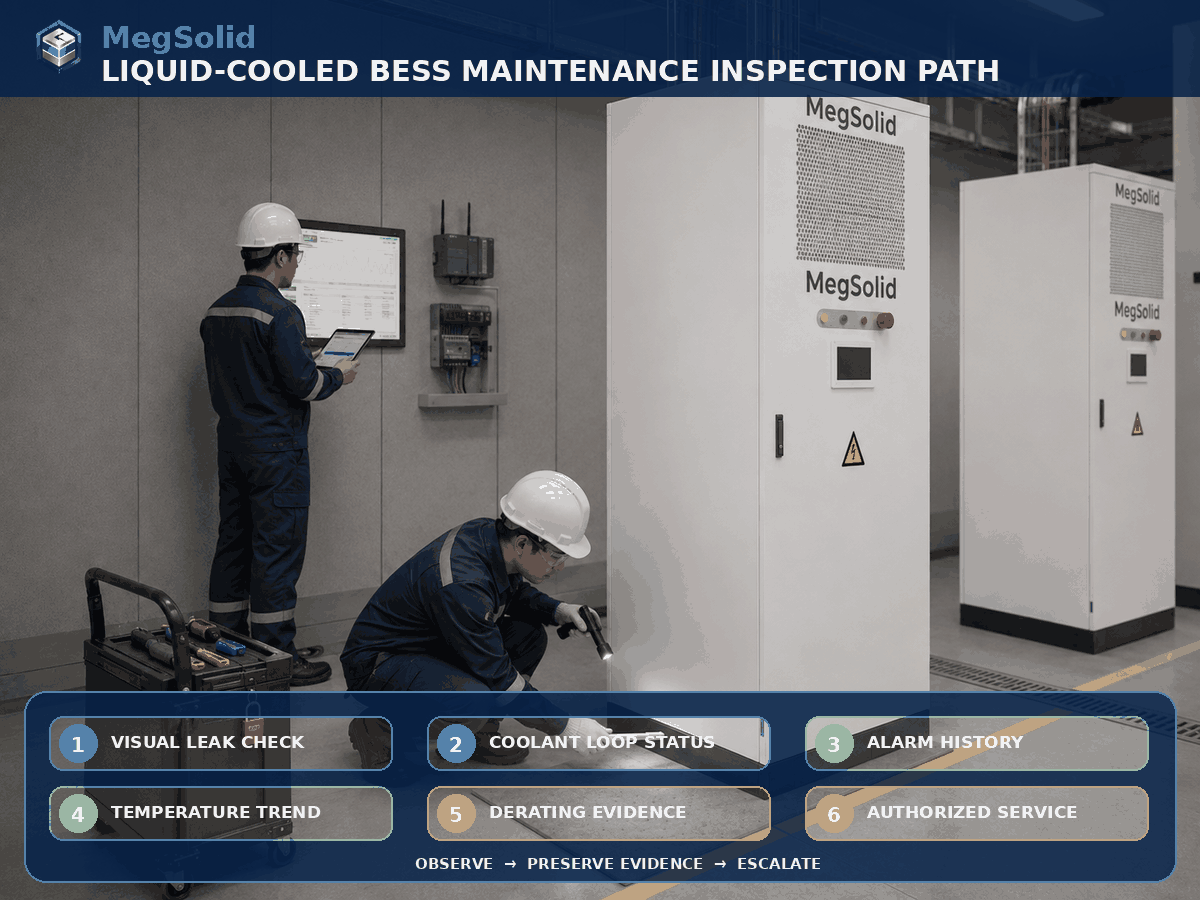
| Inspection layer | What to observe or retrieve | Evidence to retain | Escalation trigger |
|---|---|---|---|
| External condition | Cabinet base, nearby floor, accessible joints, residue, staining and corrosion | Time-stamped photographs and inspection record | Fresh liquid, growing stain, damaged fitting or unexplained residue |
| Thermal-management status | Pump, flow, level or pressure only where the delivered HMI or SCADA exposes them | Values with units, quality flag and timestamp | Unavailable, implausible or changing value; repeated thermal alarm |
| Battery temperatures | Cell or module minimum, maximum, spread and rate of change | Trend before, during and after the event | Persistent abnormal spread or rising maximum temperature |
| AC response | Commanded kW/kvar, measured output and active limits | Time-aligned PCS, EMS and BMS data | Output reduction without an explained grid, SOC, protection or temperature limit |
| Housekeeping | Access, drainage, debris, water ingress, heat-rejection clearance and unauthorized storage | Inspection checklist and closed corrective action | Condition affecting enclosure, airflow, drainage, access or fire response |
A public liquid-cooling ESS O&M manual from another manufacturer also treats coolant leaks, pack interfaces and pipeline work as specific maintenance subjects. It can support the inspection categories, but it cannot supply MegSolid’s coolant specification or interval. Use the public liquid-cooling ESS O&M instruction only as industry context, then return to the controlled Energon manual for execution.
What to Do When a BESS Coolant-Leak Alarm Appears
A leak alarm is not a request for repeated reset attempts. The response must protect personnel, preserve evidence and prevent a small service issue from becoming an electrical, thermal or warranty dispute. Exact shutdown and isolation actions remain model- and site-specific.
- 1️⃣ Preserve the event: Record the first alarm code, timestamp, operating mode, SOC, commanded power, actual power, cell temperatures and any cooling-loop values exposed by the system.
- 2️⃣ Apply the approved operating response: Reduce dispatch, enter standby or perform a controlled shutdown only as stated in the alarm-response matrix and site procedure.
- 3️⃣ Inspect externally: From a safe position, check the cabinet base and surrounding area for visible liquid, odor, residue, damage or environmental water ingress.
- 4️⃣ Control access: Prevent unqualified work, keep ignition and unrelated work away, and use the approved electrical isolation and LOTO process before any intrusive inspection.
- 5️⃣ Escalate with evidence: Send the equipment serial number, firmware, alarm export, photographs, thermal trends and recent maintenance record to the responsible service party.
- 6️⃣ Prove restoration: After authorized repair, complete the specified leak/pressure or functional check, alarm-clearance test, circulation verification and controlled return-to-service record.
| Observed condition | Immediate decision | Do not assume | Required owner |
|---|---|---|---|
| Alarm with no visible liquid | Preserve logs and follow the approved limited-operation or shutdown state | The alarm is false or safe to reset indefinitely | Operator plus designated technical support |
| Fresh liquid or expanding stain | Restrict access and use the approved shutdown/isolation process | The fluid is harmless or unrelated to electrical equipment | Site safety lead and authorized BESS service |
| High cell temperature with no leak evidence | Compare ambient, temperature spread, pump state and power limits | Every high-temperature event is a coolant leak | Controls/thermal specialist |
| Output below request above 45°C | Check active derating and the signed curve | The PCS or battery has permanently lost capacity | Supplier and commissioning/O&M engineer |
| Alarm returns after reset | Stop blind resets and open a controlled fault investigation | A cleared HMI banner proves the cause is removed | Authorized service provider |
Separate Cooling Faults From High-Ambient BESS Derating
The Energon public data states an operating range of −20–55°C with derating above 45°C. This does not mean the system must shut down at 45°C, and it does not publish a linear percentage reduction between 45°C and 55°C. A decision-ready investigation must identify which temperature is being used, which device imposed the limit and whether the delivered power matches the approved project curve.
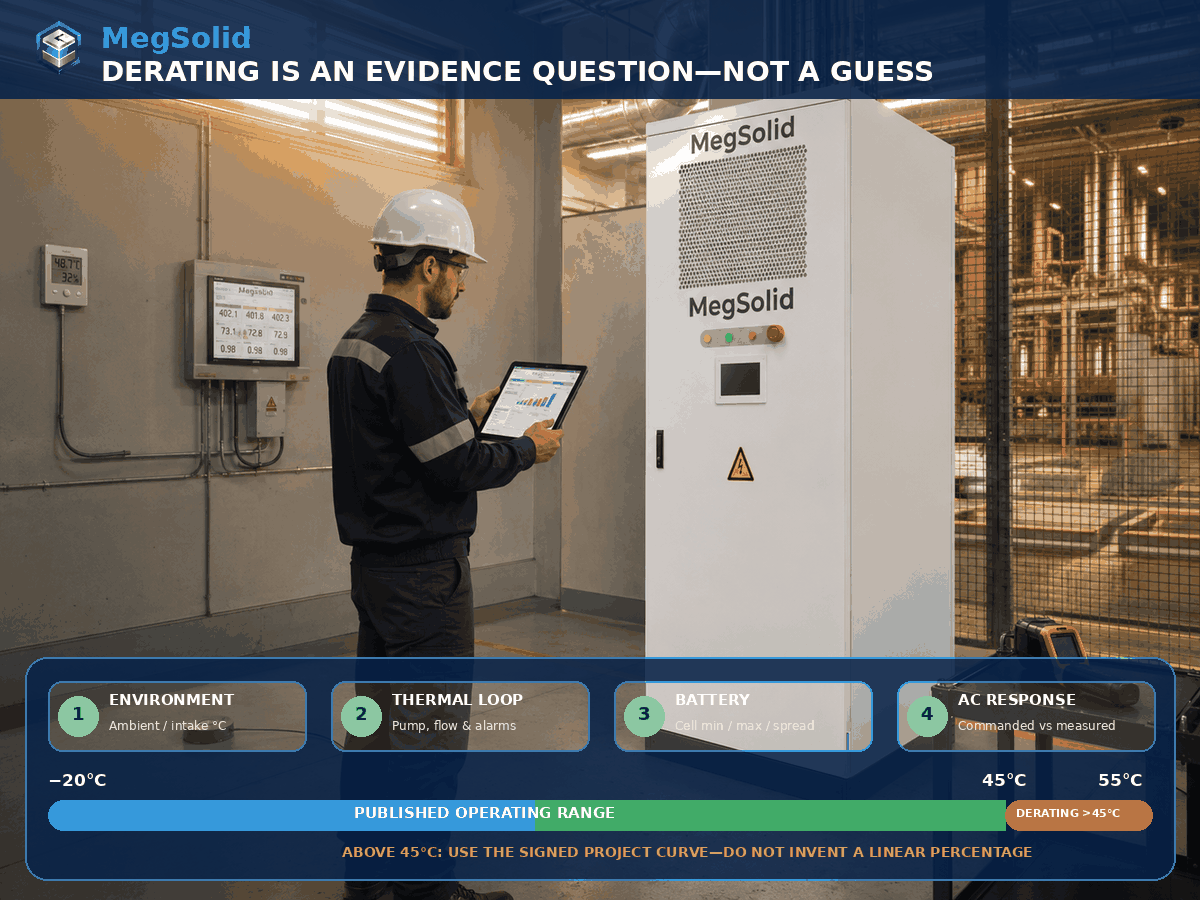
| Evidence field | Question it answers | Typical interpretation boundary |
|---|---|---|
| Ambient and equipment-intake temperature | Was the unit operating above the stated threshold? | Use the sensor and location defined in the project documents; nearby weather data may not equal cabinet intake |
| Cell minimum, maximum and spread | Is the battery uniformly controlled or is one area diverging? | Compare the trend with model-specific alarms; do not invent a universal acceptable spread |
| Pump/flow/pressure status | Is the cooling loop available and responding? | Use only delivered measurements and valid quality flags |
| BMS and PCS active limits | Which controller reduced available power? | Temperature, SOC, voltage, current, grid or protection limits can produce different remedies |
| Commanded versus measured AC power | Did the system follow the permitted command? | Evaluate kW, kvar, power factor, grid voltage and timestamp together |
| Signed derating curve | What power was contractually available at the recorded condition? | The public threshold is not a substitute for the project curve and test tolerance |
Long-term thermal and dispatch records also protect the commercial position. The C&I BESS warranty guide explains why temperature, throughput, DOD and maintenance evidence belong in the warranty envelope. If an energy test later shows a shortfall, use the BESS capacity-test diagnostic guide to separate SOC endpoints, auxiliaries, test power and temperature before treating the result as battery degradation.
Make the SCADA and Maintenance Log Prove the Same Event
A service engineer cannot diagnose a thermal event from an isolated screenshot. The owner should retain time-synchronized alarms, values, commands and maintenance records long enough to reconstruct the sequence. Each point needs a name, unit, timestamp, quality flag, update behavior and source.
- 📍 Asset identity: Cabinet serial number, battery/BMS/PCS/thermal-controller revisions and the applicable document revision.
- ⏱️ Event sequence: First occurrence, acknowledgement, reset, recurrence, dispatch change, shutdown, isolation and restoration times.
- 🌡️ Thermal data: Ambient or intake temperature, cell/module min-max-spread and coolant-loop status exposed by the delivered system.
- ⚡ Electrical data: SOC, DC voltage/current, AC kW/kvar, grid voltage/frequency, command and active limit.
- 🧰 Work record: Inspection findings, photographs, replaced parts, coolant batch/specification where applicable and technician authorization.
- ✅ Return-to-service evidence: Cleared cause, passed functional checks, monitored stabilization period and approval authority.
Use the BESS SCADA point-list guide to define data ownership and quality, and the BMS and EMS communication architecture guide to map battery limits and alarms into the site control layer. Maintenance records should identify data gaps instead of filling them with assumptions.
Assign Liquid-Cooling O&M Responsibility Before Handover
Liquid cooling adds a thermal circuit to the battery, but it does not make every inspection a supplier task or every repair an owner task. The contract should distinguish observation, access control, remote diagnosis, authorized service, consumables, freight, local labor, software access and final acceptance.
| O&M activity | Owner / site operator | Local EPC or service contractor | MegSolid / authorized equipment service |
|---|---|---|---|
| Routine walkdown | Perform and retain site-condition records | Support where included | Provide model-specific inspection criteria |
| Alarm preservation | Export logs and prevent repeated blind reset | Verify site communications and operating context | Interpret equipment alarms within the agreed support scope |
| Electrical isolation and access | Authorize site work and LOTO | Execute site isolation under appointed responsibility | State equipment access prerequisites |
| Coolant-loop intrusive work | Do not perform unless expressly trained and authorized | Provide qualified labor only if contracted | Approve procedure, fluid, tools, parts and competence requirements |
| Spare parts and consumables | Maintain agreed site stock and storage records | Manage local logistics if assigned | Identify part numbers, compatibility and replacement conditions |
| Return to service | Approve operating release | Confirm site interfaces and safety closure | Complete equipment checks and technical closure within scope |
The BESS factory acceptance test guide should include thermal-management alarms, pump or loop states available for simulation, sensor plausibility and data export before shipment. Site access and drainage must also remain consistent with the approved layout; the outdoor BESS foundation design checklist covers the civil boundary, while the 400 V BESS connection guide covers the electrical interface that must be safely isolated during service.
Put These Deliverables Into the Liquid-Cooling O&M Contract
- 📘 Controlled documentation: Model-specific O&M manual, alarm list, cause-and-effect matrix, approved coolant data, service bulletin process and revision control.
- 🗓️ Maintenance schedule: Tasks, intervals, operating-hour or condition triggers, responsible party, required outage and evidence form.
- 🚨 Response matrix: Severity, permitted operating state, remote response time, site attendance time, escalation path and parts logistics.
- 📦 Spares schedule: Part number, quantity, storage condition, shelf life where relevant, ownership, replenishment and obsolescence handling.
- 🔐 Access policy: Electrical authorization, LOTO, software roles, remote-access approval, cybersecurity and audit trail.
- 🧪 Acceptance after maintenance: Leak or functional checks, alarm verification, sensor plausibility, circulation stabilization, AC response and sign-off.
- 📊 KPI definition: Availability exclusions, planned outage treatment, alarm response, repeat-fault threshold and data completeness.
- 🛡️ Warranty linkage: Required records, approved consumables, unauthorized-work exclusion, claim process, investigation cost and remedy.
Send a Decision-Ready O&M Data Pack to MegSolid
MegSolid cannot produce a firm service scope from the energy rating alone. Send one package that identifies the exact cabinet, location, operating duty, site responsibility and required support outcome. This allows the quotation to distinguish remote support, scheduled visits, consumables, corrective maintenance and local EPC work.
- 🏷️ Equipment: Model, quantity, serial numbers if available, signed datasheet, BOM/configuration, firmware and commissioning date.
- 🌍 Site: Country, indoor/outdoor location, ambient and intake profile, altitude, humidity requirement, dust, salt, drainage and access constraints.
- 🔋 Duty: Application, daily cycles, kW/kvar profile, SOC reserve, expected operating hours and seasonal peaks.
- 📡 Data: SCADA/HMI points, log retention, remote-access policy, alarm destination and sample exports.
- 🧰 Service split: Owner capability, local EPC competence, required training, permitted outage windows and target response time.
- 📑 Commercial scope: Warranty, spares, consumables, travel, freight, local labor, tax, documentation language and contract term.
A bankable liquid-cooled BESS maintenance scope links the delivered product, coolant circuit, alarms, temperature data, derating curve, authorized work, spare parts and return-to-service evidence. Email [email protected] with the model, site conditions, operating duty, required response time and local service capability to request a model-specific MegSolid O&M boundary.
FAQ
What should a liquid-cooled BESS maintenance checklist include?
It should identify the exact model and document revision, external leak inspection, cooling-loop measurements exposed by the system, cell-temperature trends, alarm history, commanded versus delivered power, site housekeeping, authorized service tasks, spare parts and return-to-service evidence. Intervals and limits must come from the controlled model-specific manual.
What should an operator do after a BESS coolant-leak alarm?
Preserve the first alarm and time-aligned operating data, follow the approved limited-operation or controlled-shutdown response, inspect externally from a safe position, control access, and escalate with photographs and logs. Do not repeatedly reset the alarm or open an energized cabinet without the approved procedure and authorization.
Does derating above 45°C mean the BESS shuts down at 45°C?
No. The MegSolid Energon public page states an operating range of −20–55°C and derating above 45°C. It does not state that 45°C is a shutdown point or publish a universal linear power reduction. Use the signed derating curve, active controller limits and project acceptance method.
How often should liquid-cooled BESS coolant be replaced?
There is no responsible universal interval. Replacement depends on the approved coolant, loop materials, operating hours, temperature exposure, fluid condition, service bulletins and the delivered model’s manual. The O&M contract should name both the trigger and the responsible party.
Can a site operator top up BESS coolant?
Only when the controlled manual and training authorization explicitly permit it. The operator must use the approved fluid, concentration, tools and fill/bleed method. Mixing an unknown coolant or opening the loop without the specified process can create compatibility, electrical and warranty problems.
Which data should be recorded during a liquid-cooling alarm?
Record the equipment identity, alarm code and first timestamp, operating mode, SOC, cell-temperature minimum and maximum, ambient or intake temperature, cooling-loop values exposed by the system, commanded and measured AC power, active BMS/PCS limits, photographs and recent maintenance history.
Why is cell-temperature spread important in BESS maintenance?
A trend in minimum, maximum and spread helps determine whether the thermal system is controlling the battery uniformly or whether one area is diverging. The acceptable limit must be model-specific; a generic temperature-spread value should not be inserted into the contract without controlled evidence.
Can a BESS keep operating after a coolant warning?
Only the approved alarm-response matrix can answer that for the delivered configuration. Depending on severity and evidence, the permitted state may be continued limited operation, standby or controlled shutdown. Visible liquid, rising temperature or repeated alarms require escalation rather than assumption.
How does maintenance evidence affect a C&I BESS warranty?
Warranty eligibility may depend on operating temperature, throughput, DOD, approved consumables, scheduled inspections and authorized work. Time-synchronized logs and signed maintenance records help distinguish a product defect from site conditions, unauthorized intervention or an operating-envelope violation.
Which spare parts belong in a liquid-cooling O&M contract?
The supplier should issue a model-specific schedule covering critical sensors, pumps or thermal-management components, seals or connectors, filters or heat-rejection items where applicable, approved coolant/consumables and diagnostic tools. Do not invent part numbers or stock quantities before the delivered BOM and service strategy are confirmed.
What is liquid-cooled BESS maintenance?
It is the planned inspection, evidence capture, authorized servicing and post-work verification of the battery system’s liquid thermal-management circuit together with its battery temperatures, alarms, controls, AC response, enclosure and site conditions.
How can an EPC verify a liquid-cooled BESS service provider?
Ask for model authorization, trained personnel, the controlled procedure, approved coolant and parts, electrical-safety competence, diagnostic capability, response times, service-report examples, escalation access to the manufacturer and a defined return-to-service test.
What information should a buyer send MegSolid for a 261kWh O&M quotation?
Send the exact model and quantity, project country, site environment, duty profile, commissioning date, firmware/configuration, available logs, remote-access rules, local service capability, response-time target, spare-parts expectation, warranty request and responsibility split.