
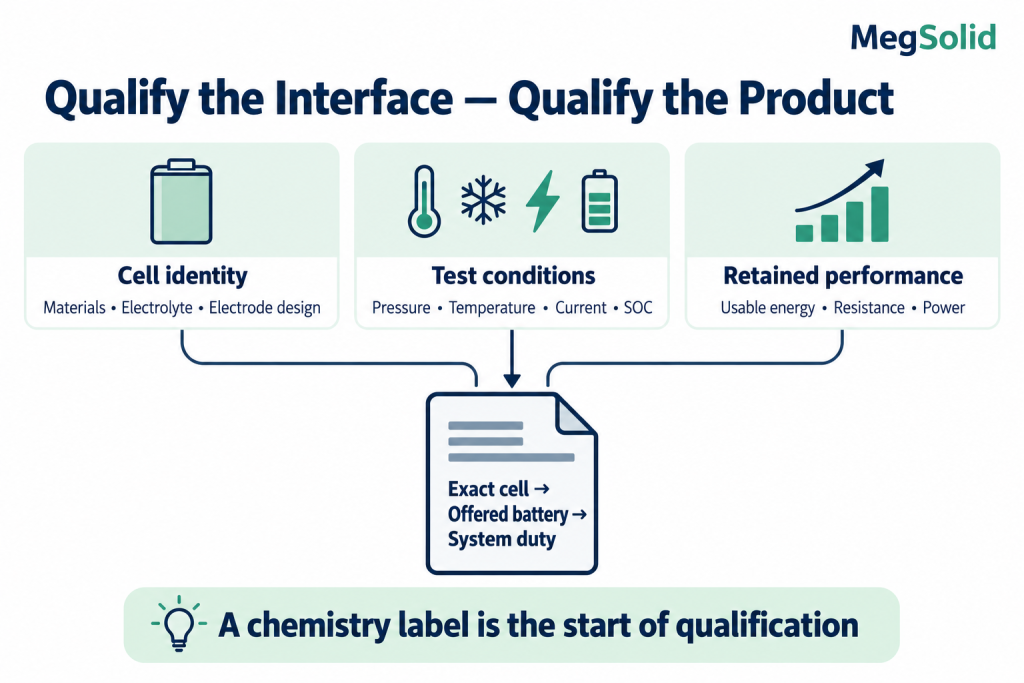
Solid-solid interface degradation is the loss of effective contact or ion transport between solid electrolyte and electrode materials through mechanical or chemical change. It can increase resistance, reduce usable capacity and, for some configurations, contribute to failure. For a buyer, the question is blunt: will the battery still deliver the power and energy you paid for after the specified cycling duty? Ask for test conditions, impedance and retained-capacity evidence for the actual cell and product.
Interface Stability Can Set the Service-Life Limit
Energy density attracts attention because it is easy to compare, but it does not show whether a battery can preserve ion transport and usable capacity through years of cycling. Datasheets for electric vehicles, residential batteries and commercial and industrial energy storage systems may also emphasize charge rate and cycle life without explaining the condition of the material interfaces behind those figures.
The practical question in hybrid solid-state battery engineering is whether the cell can maintain contact and ion transport at its material interfaces for the required operating life. A progressive loss of contact is one form of solid-solid interface degradation.
A laboratory result under controlled pressure and temperature is the start of qualification, not a system lifetime guarantee. Request the operating window, contact/pressure design where applicable, manufacturing consistency and retained-performance evidence that apply to the offered hybrid or solid-state cell. Then connect those limits to the BESS dispatch, cooling and warranty.
What Is Solid-Solid Interface Degradation?
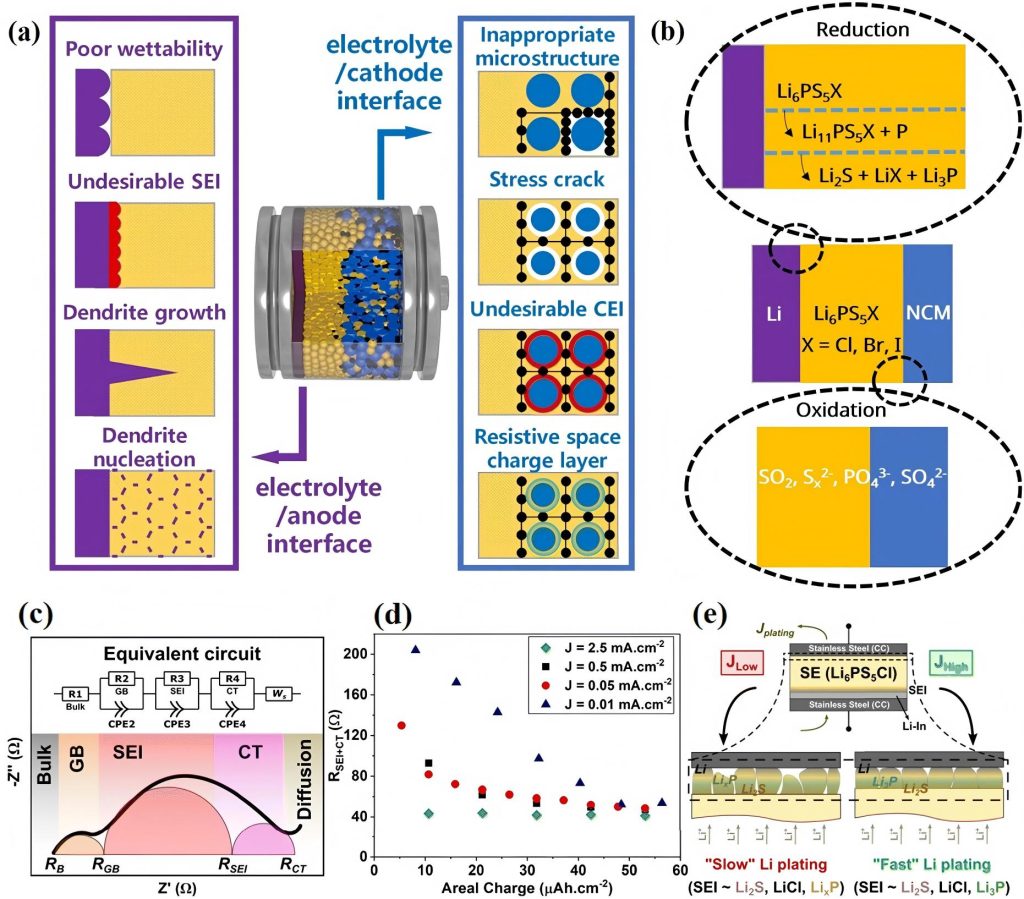
Liquid electrolyte can wet an electrode surface and enter small gaps. A solid-state battery uses a solid electrolyte to carry lithium ions between the cathode and anode, so adjoining solid materials must retain physical and electrochemical contact without the same gap-filling behaviour.
Over time, interfaces may experience:
- Mechanical separation
- Micro-crack formation
- Chemical side reactions
- Lithium dendrite penetration
- Increased interfacial resistance
These mechanisms collectively describe solid-solid interface degradation. Their relative importance depends on the electrolyte, electrode materials, pressure, temperature and current density used in the cell.
Possible system effects include:
- Reduced energy capacity
- Higher internal resistance
- Increased heat generation
- Lower charging efficiency
- Shortened cycle life
For energy storage investors, EPC contractors and project developers, these effects directly affect usable energy, efficiency and project returns. Their commercial consequences are examined in the ROI impact of solid-solid interface degradation analysis.
Four Major Mechanisms Behind Interface Degradation
1. Mechanical Delamination
Electrode volume changes depend on the material and state of charge. Repeated dimensional change can stress the adjoining solid electrolyte or composite electrode interface.
In solid-state batteries, even microscopic dimensional changes can create stress at the interface.
Over thousands of cycles:
- Contact pressure decreases
- Interfacial gaps appear
- Ion transport pathways become restricted
This loss of contact is delamination. It restricts ion transport, raises impedance and can reduce the power or energy available under the same operating conditions.
2. Lithium Dendrite Penetration
A solid electrolyte does not guarantee that lithium filaments cannot penetrate it. In lithium-metal solid-electrolyte cells, interfacial voids and uneven local current can contribute to filament growth and shorting. A Nature Materials study of lithium stripping and plating links contact loss to this failure route under its tested conditions. Do not transfer that cell result to every LFP or hybrid product.
If interfacial defects exist:
- Current density becomes uneven
- Localized lithium deposition develops
- Metallic filaments may grow through weak regions
Penetration of the electrolyte layer can create an internal short-circuit path, making the defect relevant to both performance and safety assessment.
Interface quality is relevant to both cell development and system approval. Chemistry remains only one safety layer; the solid-state battery thermal-runaway checklist covers propagation tests, BMS responses and shutdown logic for the exact system offered.
3. Interfacial Chemical Reactions
Cathode materials, solid electrolytes and anodes can react at their contact surfaces. The products of those reactions may not conduct lithium ions as effectively as the original materials.
These reactions may form:
- Resistive interphase layers
- Unwanted byproducts
- Reduced ion-conductive regions
As resistive layers grow, ion movement slows and additional voltage loss appears when the battery delivers power.
4. Thermal Stress Accumulation
Temperature can change reaction rates, transport and mechanical behavior; the direction and severity depend on the materials and duty. Uneven heating can also create:
- Local expansion
- Mechanical strain
- Material fatigue
Large ESS racks add temperature gradients between cells and modules. Repeated exposure to those gradients can accelerate uneven ageing, so cooling architecture must match the C-rate, ambient temperature and operating hours. The liquid-cooled versus air-cooled BESS comparison applies that choice at cabinet level.
Scaling Interface Stability from a Cell to an ESS
Laboratory prototypes can demonstrate the potential of a chemistry before its pressure control, manufacturing yield and long-term interface behaviour are ready for a multi-cell product.
Companies including QuantumScape and Toyota continue developing solid-state technology, while commercial ESS deployment adds the harder task of keeping thousands of cells within an acceptable resistance and capacity spread for thousands of cycles.
Commercial customers require:
- Predictable performance
- Long-term reliability
- Bankable project economics
Ask the supplier to turn its cell result into a delivery package: test identity and conditions, production/BOM mapping, acceptance limits, model-specific operating instructions and warranty remedies. Initial performance alone does not tell the owner what will be maintained or replaced later.
MegSolid's Hybrid Solid-State Commercial Path
MegSolid's current low-voltage hybrid solid-state battery uses semi-solid LiFePO4 chemistry in a manufacturable energy storage format. Product selection stays tied to the documented model and test conditions, not a chemistry label alone.
- 16.07kWh energy storage
- 314Ah capacity
- Up to 8,000 cycles at 80% DOD
- Request current model-specific safety/conformity documents and their scope
- Integrated BMS architecture
- Communication via CAN, RS485 and RS232
These values belong to the named low-voltage product and its stated test boundary. They should not be transferred to a cabinet or multi-MWh plant without model-specific evidence.
How Cell Design and System Controls Reduce Operating Stress
Advanced Thermal Management
Temperature consistency affects cell resistance and ageing spread. MegSolid C&I systems use model-specific thermal management, with the cooling method selected for the cabinet duty.
The 261.24 kWh liquid-cooled C&I energy storage system uses 314 Ah LFP cells and is a separate product architecture from the low-voltage hybrid solid-state battery. It demonstrates the system-level role of:
- Model-specific liquid-cooling circuit and operating limits
- Delivered monitoring signals, alarms and fault handling
- Temperature-spread definition and witness criteria
Ask for the offered model’s temperature-uniformity definition, measurement locations, duty and witness criteria. An unqualified ±5°C statement is not proof of interface stability or a guaranteed ageing outcome. Compare the recorded temperature spread and derating across the actual operating window.
Trend Monitoring and Early Warning
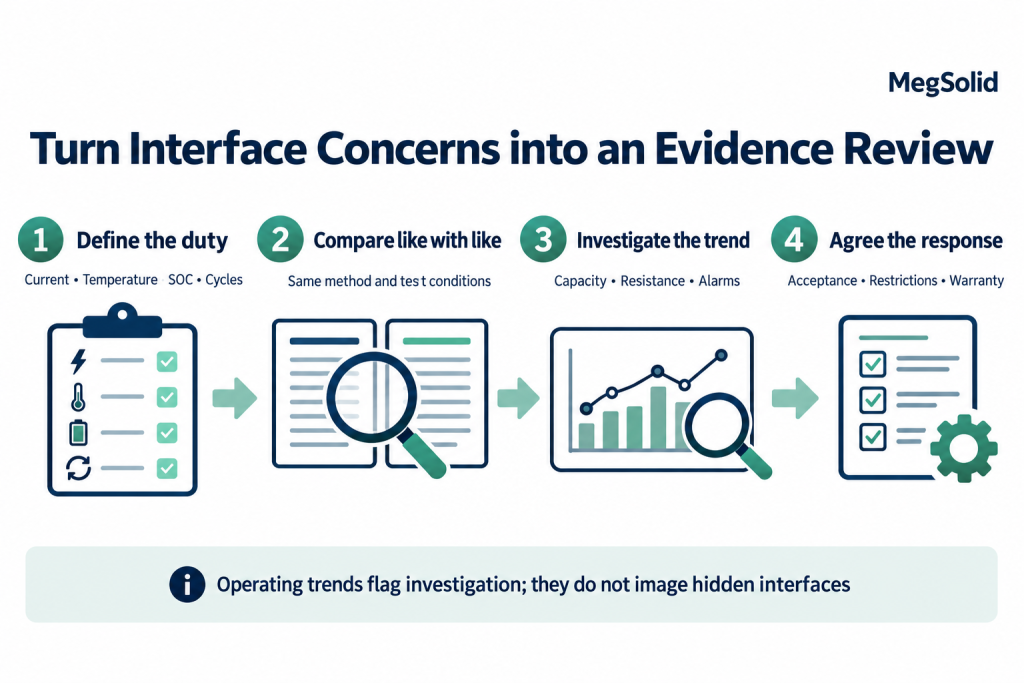
Trend cell voltage, current, temperature, alarms and available resistance/health indicators under comparable conditions. These records can identify an abnormal pack or operating pattern for investigation; they do not directly image buried material interfaces or prove a particular degradation mechanism. Escalate with the relevant controlled diagnostic and capacity tests.
That information supports:
- Defined inspection and maintenance triggers
- Fault investigation and operating restrictions
- Recorded duty and health trends
- Escalation to the specified diagnostic and safety review
Give the service team a usable trigger: which trend exceeds the agreed limit, which test confirms it, who can inspect it and what restriction applies while it is unresolved. That prevents the owner waiting for a major capacity shortfall before starting the warranty discussion.
System-Level Engineering
Long-term system performance depends on the coordination of:
- Battery packs
- BMS
- EMS
- PCS
- Thermal management systems
The BMS sets cell and rack limits, the EMS determines dispatch, the PCS applies current, and the thermal system removes heat. A mismatch at any of these boundaries can create operating stress even when the cell chemistry is suitable.
How Should Buyers Compare Different Battery Technology Routes?
Brand recognition does not show whether a battery will retain its required power, usable energy and safety margin over the project life. Buyers need model-specific evidence for cell chemistry, thermal limits, operating pressure where applicable, impedance growth, capacity retention and the complete-system warranty boundary.
Conventional LFP, hybrid solid-state and fully solid-state architectures do not share one degradation mechanism or one test boundary. The solid-state versus Tier 1 liquid LFP BESS comparison shows how to keep chemistry, cabinet design and lifecycle claims on separate lines during procurement.
Utility-scale platforms also differ in rated MW, MWh, duration, cooling and supply scope. Projects comparing Tesla with other large storage blocks should use the dedicated Megapack competitors and 5MWh utility BESS analysis; those system-level differences should not be used as proof of solid-solid interface stability.
MegSolid's Lifecycle Engineering Priorities
For the commercial owner, retained performance is the selling point. Put the required usable energy, power, thermal operating window, availability and degradation basis into the offer. Ask MegSolid which records describe the proposed cell/product and which system tests demonstrate the duty. A clear evidence and remedy schedule is more useful than a claim that one architecture always wins.
Cell research may target:
- Extremely high energy density
- Ultra-fast charging
- Aggressive material innovation
Commercial owners also need:
- Stable operation
- Predictable maintenance costs
- Long cycle life
- High system availability
- Lower safety risk
These requirements keep material development connected to a product that can be manufactured, controlled and maintained.
Commercial Decisions Depend on Retained Performance
An owner planning daily operation over ten years needs answers to practical service questions:
- Will my system still perform after 5 years?
- What is my maintenance cost?
- How often will downtime occur?
- How safe is the installation?
- What is the total lifecycle ROI?
Each answer depends partly on degradation control. Interface behaviour is one input, alongside cooling, controls, maintenance and the operating window.
System-Level Reference: ESSA0100B-0215
The MegSolid ESSA0100B-0215 outdoor cabinet is an air-cooled C&I system using LFP cells. It is not evidence for the cycle life of the separate 51.2V/314Ah hybrid solid-state battery product. It shows why any cell-level degradation result must be carried into the correct cabinet, cooling method and system boundary.
Published ESSA0100B-0215 specifications include:
- 215.04kWh capacity
- 100kW AC output
- 768V nominal system voltage
- ≥5000 cycle life
- Integrated fire suppression
- IP54 protection
For commercial facilities operating daily charge-discharge cycles, maintaining low internal resistance over time becomes critical.
Even small increases in interfacial resistance can affect:
- Round-trip efficiency
- Heat generation
- System availability
- Revenue generation
Retained performance depends on cell selection, thermal management, PCS loading, monitoring and system integration working within the same operating boundary. No single field establishes the result by itself.
What EPC Contractors Need to Evaluate
Basic EPC comparisons often start with:
- Battery capacity
- Price per kWh
- Warranty period
- ≥5000 cycle life
- Integrated fire suppression
- IP54 protection
A complete technical review also examines:
- Thermal consistency
- Cell architecture
- Safety strategy
- Degradation mechanisms
- Lifecycle economics
Make each evidence field lead to a buying decision: accepted operating duty, remaining gap, required witness test, warranty condition or scope item. If a supplier cannot connect the cell data to the offered system, the price comparison is incomplete.
A battery system that loses performance slowly often generates more value than one that starts with higher specifications but degrades rapidly. Cell-cycle figures still cannot be copied directly into the expected life of a multi-cabinet plant; the multi-cabinet BESS lifecycle analysis explains how temperature, SOC history, dispatch and warranty boundaries change the result.
Interface engineering belongs in this review because it influences resistance growth, thermal behaviour and capacity retention.
Interface Evidence Must Follow the Delivered Product
Bring MegSolid the application, candidate battery/BOM, voltage and current duty, SOC window, cycles per day, temperature range, usable-energy target and warranty requirements. Request available test conditions, retained-capacity/impedance evidence, the preliminary product route and any gaps needing validation. Keep cell qualification, system acceptance and warranty remedies in the same purchasing conversation.
FAQ
Q1: What exactly is Solid-Solid Interface Degradation in solid-state batteries?
Solid-solid interface degradation means loss of effective contact or ion transport at solid electrolyte/electrode interfaces. Mechanical separation, chemical interphases and, in relevant lithium-metal configurations, voids or filaments can raise resistance or reduce capacity. The important mechanism and severity depend on the actual materials, pressure, temperature and current duty; interface decline is not inevitable at one universal rate.
Q2: Why is interface degradation the key barrier for solid-state battery commercialization?
For a solid-state or hybrid cell, interface behavior can affect retained power and usable energy under the specified duty. It is one part of lifetime qualification alongside materials, manufacturing, cooling and control limits. Request the test conditions and retained-performance records instead of treating interface engineering as universally more important than every other cell factor.
Q3: How do different companies approach this problem differently (CATL vs BYD vs Tesla vs MegSolid)?
Compare CATL, BYD, Tesla Megapack and MegSolid at the correct product boundary. Conventional LFP systems, hybrid batteries and lithium-metal solid-state cells are not interchangeable test subjects. Ask each offered product for cell/BOM identity, operating conditions, retained energy, impedance/health evidence, integration and warranty. A brand-level ranking does not prove interface stability.
Q4: Why does higher energy density sometimes increase interface degradation risk?
Higher energy density does not automatically establish faster interface degradation. Material selection, electrode loading, pressure/contact design, current density and temperature can change the stress and transport conditions. Compare matched test conditions and retained performance for the actual cell rather than deriving a degradation rate from an energy-density headline.
Q5: Is Tesla Megapack affected by solid-solid interface degradation?
A conventional lithium-ion Tesla Megapack can experience electrode/electrolyte ageing, impedance growth and thermal ageing. Those effects are not the same evidence as solid-electrolyte contact loss in a lithium-metal cell. Review the exact Megapack configuration and published/warranted duty; do not attribute a specific hidden-interface mechanism or software remedy without product evidence.
Q6: Which technical route is more stable for long-term ESS operation?
For CATL, BYD, Tesla Megapack or MegSolid, lifetime suitability follows the offered model and duty. Compare usable-energy retention, power/thermal limits, dispatch, maintenance and contractual remedies on matching conditions. Avoid assigning a chemistry-wide or brand-wide degradation winner from brochure descriptions.
Q7: How does MegSolid reduce interface degradation in real systems?
MegSolid product routes must stay separate. MEG-Solid-512314FL1 is the documented 51.2V/314Ah/16.07kWh hybrid semi-solid LiFePO4 battery, listed with 8,000 cycles at 80% DOD. ESSA0100B-0215 is a separate air-cooled LFP cabinet, and the 261.24kWh liquid-cooled system is another architecture. Request each model’s cell/BOM and test scope. Do not combine those products’ cooling, AI, PCS-efficiency and cycle claims into one interface-stability result.
Q8: Why is thermal management so important for interface stability?
Temperature changes affect reaction, transport and mechanical behavior in material-dependent ways. A cell-to-cell gradient can create uneven ageing or constraints even when average temperature looks acceptable. Specify the actual measurement locations, duty, limit and thermal witness method; a generic ±5°C claim does not prove a lifetime result.
Q9: How does interface degradation impact ROI in C&I energy storage projects?
Degradation can change delivered energy, losses, thermal demand, maintenance and replacement timing. Put the measured or supported retention curve and warranty boundary into the dispatch/cash-flow model. The value depends on tariff, duty and installed scope; a claimed interface improvement alone does not establish an ROI percentage.
Q10: Which technology route is best for future solid-state energy storage?
There is no universal winning route for every ESS project. Select the actual cell and system from qualified duty, manufacturability, safety evidence, retained performance and service/warranty scope. Ask MegSolid to map its proposed hybrid or conventional product to those requirements, then compare competing offers on the same basis.