
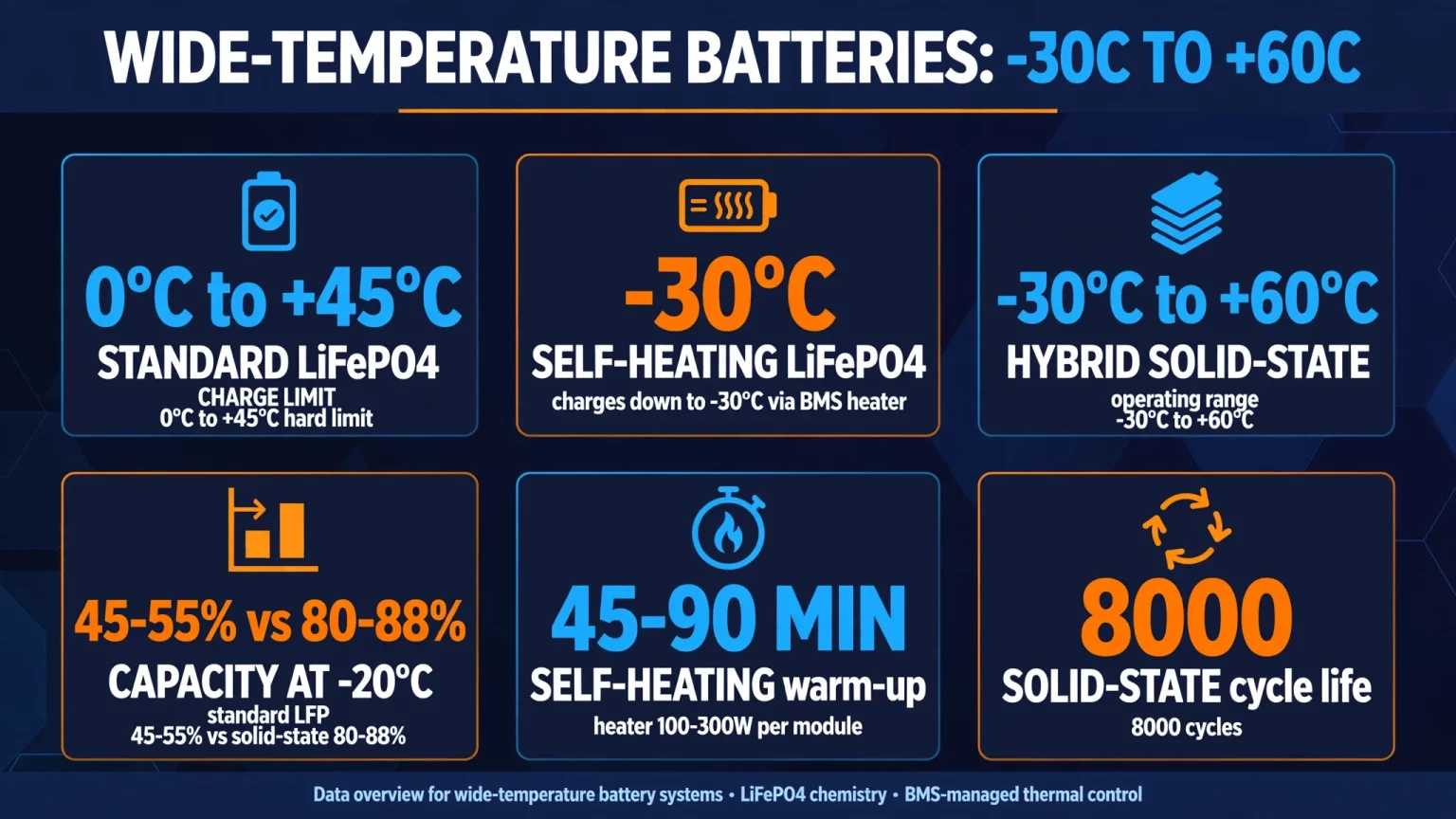
Standard commercial lithium iron phosphate cells have a lifepo4 temperature range of 0^°C to +45^°C (32^°F to 113^°F) for charging and -20^°C to +55^°C for discharging. For field deployments spanning sub-Arctic telecom towers (-30^°C) to Middle Eastern oilfields and African solar microgrids (+60^°C), B2B buyers sourcing from wide temp range battery manufacturers choose between two distinct engineering architectures:
- Self-Heating LiFePO4 Batteries: Standard LFP cells paired with BMS-triggered internal polyimide heating films. This architecture enables sub-zero charging down to -30^°C, though the liquid electrolyte still faces accelerated degradation if ambient heat exceeds +50^°C.
- Hybrid Solid-State (Semi-Solid) LFP Batteries: Cells engineered with an in-situ solidified polymer-oxide electrolyte matrix that operates from -30^°C to +60^°C, combining high sub-zero capacity retention with zero volatile solvent boiling in extreme desert heat.
Standard LiFePO4 vs. Self-Heating LFP vs. Hybrid Solid-State: Master Temperature Comparison
Procurement engineers evaluating a wide temp range battery vendor often face a trade-off between winter cold-cranking performance, summer high-temperature calendar life and cost per kWh. Table 1 compares standard liquid LFP against the four wide-temperature battery technologies used in commercial telecom, SCADA, defence and off-grid solar projects.
Table 1: Battery Chemistry Temperature Range & Performance Matrix
| Technical Metric | Standard Liquid LiFePO4 | Low-Temp Liquid LFP (Ester Co-Solvent) | Self-Heating LiFePO4 Pack | MegSolid Hybrid Solid-State (Semi-Solid LFP) | Lithium Titanate (LTO) |
|---|---|---|---|---|---|
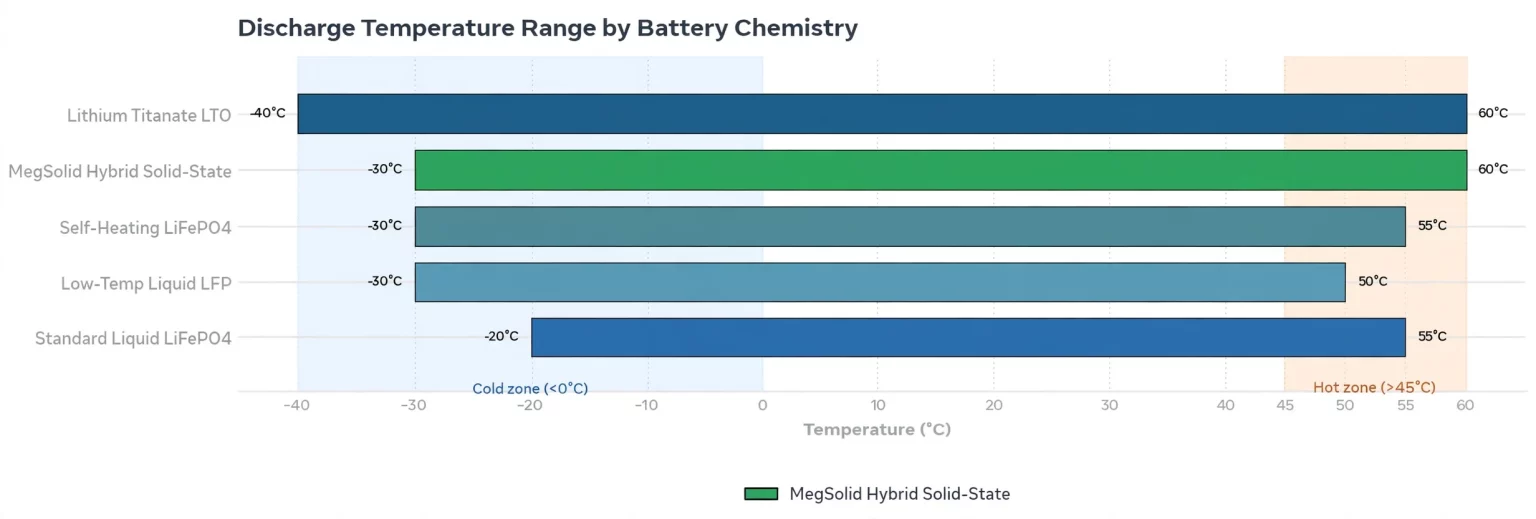
| Discharge Temperature Range | -20^°C to +55^°C | -30^°C to +50^°C | -30^°C to +55^°C | -30^°C to +60^°C | -40^°C to +60^°C |
| Charge Temperature Range | 0^°C to +45^°C (Hard limit) | -20^°C to +45^°C (≤ 0.1C) | -30^°C to +45^°C (Via BMS Heater) | -20^°C to +55^°C (Down to -30^°C w/ heater) | -40^°C to +55^°C |
| Capacity Retention at -20^°C (0.5C) | 45% – 55% | 70% – 75% | 80%+ (Once self-warmed) | 80% – 88% (Low interface impedance) | 85%+ |
| High-Temp Stability at +55^°C to +60^°C | Poor (Gas swelling & rapid SEI decay) | Very Poor (Volatile esters boil & swell) | Moderate (Heater does not cool heat) | High (No volatile free solvent to boil) | High |
| Gravimetric Energy Density | 140 – 165 Wh/kg | 130 – 150 Wh/kg | 135 – 160 Wh/kg | 180 – 280 Wh/kg (Cell level) | Low (65 – 85 Wh/kg) |
| Cycle Life (25^°C / 45^°C) | 6,000 / 2,500 cycles | 4,000 / 1,500 cycles | 6,000 / 2,500 cycles | 8,000 / 4,500+ cycles | 10,000+ cycles |
| Relative Cost per kWh () | “ (Baseline) | “ | ` – ` (Best Cold-Only Value) | “ (Best All-Climate TCO) | “ (3×–4× Cost & Bulk) |
Why Standard LiFePO4 Fails Outside 0°C to 45°C: The Electrochemical Physics
The Sub-Zero Trap (<0°C): Electrolyte Viscosity & Metallic Lithium Plating
Conventional LiFePO4 cells rely on a liquid solution of lithium hexafluorophosphate (LiPF_6) dissolved in cyclic and linear organic carbonates such as ethylene carbonate (EC) and dimethyl carbonate (DMC). Below 0^°C, two physical mechanisms restrict performance:
- Sluggish ion transport during discharge (-10^°C to -20^°C): As ethylene carbonate approaches its freezing point, electrolyte viscosity rises sharply and ionic conductivity drops. Charge-transfer resistance across the Solid Electrolyte Interphase (SEI) increases by 4× to 6×. When an inverter or motor load pulls a surge current at -20^°C, internal voltage sag (V_{drop = I × R_{internal) pulls terminal voltage below the inverter's low-voltage cutoff even when the battery holds 60% State of Charge.
- Metallic lithium plating during sub-zero charge (<0^°C): While a standard LFP cell can discharge at -20^°C with reduced capacity, charging below 0^°C causes permanent damage. During charging, solvated Li^+ ions migrate to the graphite anode faster than they can diffuse into the cold graphite crystal lattice. Excess lithium ions reduce on the surface of the graphite as metallic lithium dendrites. Those needle-like deposits consume cyclable lithium, permanently reduce capacity, and can puncture the polyolefin separator to trigger an internal short circuit.
The High-Temperature Trap (+45°C to +60°C): Arrhenius Degradation & Gas Swelling
At the upper end of the thermometer, uncooled outdoor battery enclosures in the Middle East, North Africa, Australia and the American Southwest regularly experience internal ambient temperatures of +50^°C to +60^°C.
In standard liquid LFP cells, chemical side reactions follow the Arrhenius equation, roughly doubling in rate for every 10^°C temperature rise above 25^°C:
- Organic carbonate solvents vaporize inside the cell casing, building internal pressure that causes prismatic aluminum housings and pouch cells to bloat and pop their vent membranes.
- Trace moisture reacts with LiPF_6 salt at elevated temperatures to generate hydrofluoric acid (HF), which corrodes the olivine LiFePO_4 cathode and dissolves Fe^{2+ ions into the electrolyte. Those iron ions migrate to the anode and accelerate SEI thickening, cutting a 6,000-cycle battery down to fewer than 2,000 cycles.
Solution 1: How a Self-Heating LiFePO4 Battery Conquers -30°C Winters
Intelligent BMS Thermal Loop Architecture
For sites where winter temperatures drop to -30^°C (-22^°F) but summer temperatures stay moderate, a self heating lifepo4 battery solves the sub-zero charging problem without changing cell chemistry.
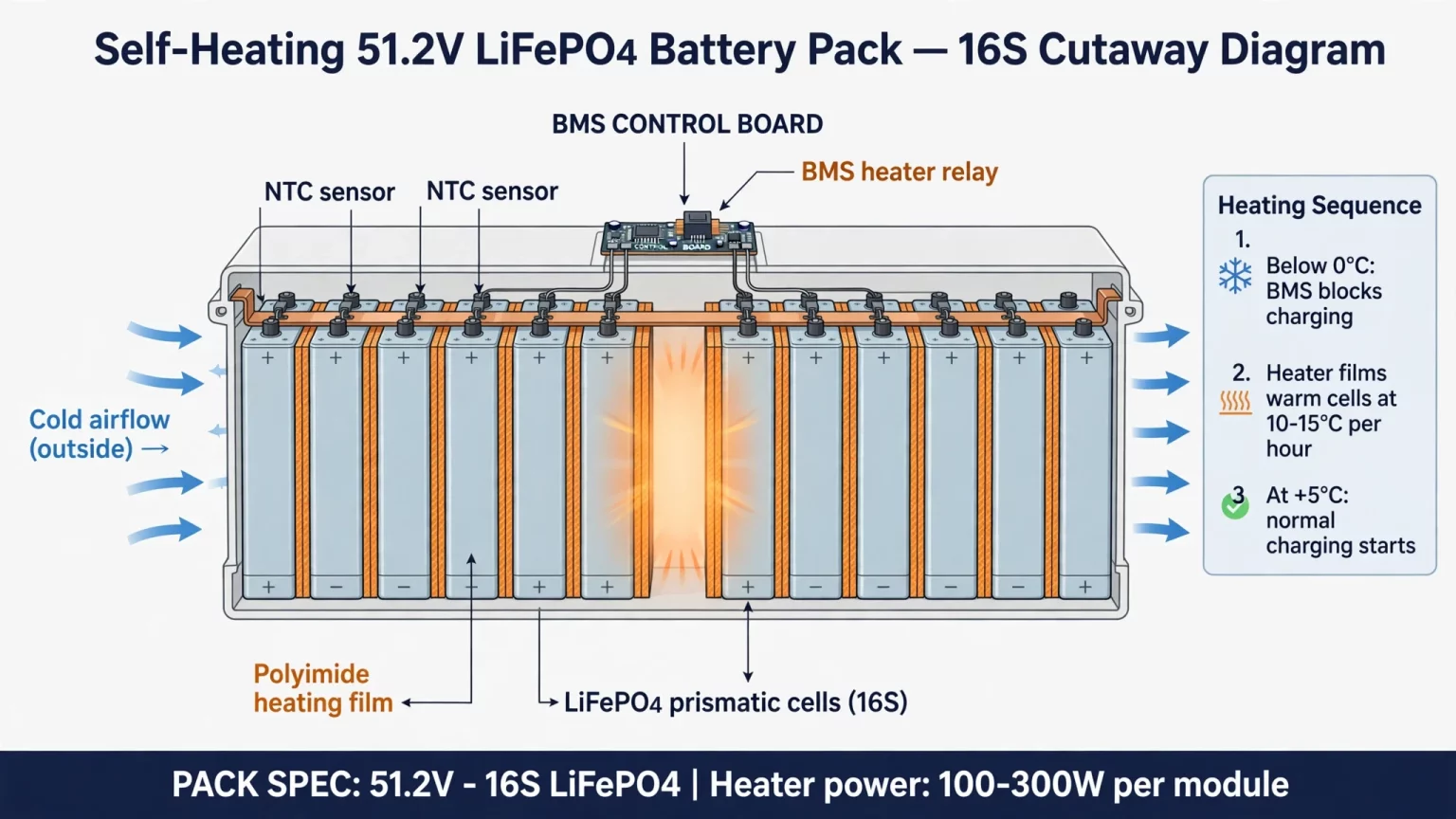
Inside MegSolid's cold-climate 48V (51.2V) battery packs, flame-retardant polyimide (Kapton) or silicone heating foils are laminated between the prismatic LFP cells and wired to a dedicated heater relay on the Battery Management System (BMS):
- Cold charge detection: When the solar MPPT controller or backup generator applies charging voltage and the cell-terminal NTC thermistors read below 0^°C, the BMS holds the main Charge MOSFET open so zero charging current enters the frozen cells.
- Internal film heating: The BMS closes the heater circuit, routing 100% of the incoming charger current (100W to 300W per module) into the inter-cell heating films. Because the foils sit in direct contact with the aluminum cell casings inside an insulated pack, core cell temperature rises at 10^°C to 15^°C per hour without draining the battery's own stored energy.
- Handover to normal charging: Once the coldest cell sensor reaches +5^°C (41^°F), the BMS opens the heater relay (or tapers heating up to +10^°C) and closes the Charge MOSFET to start standard 0.2C to 0.5C CC/CV charging.
When to Choose Self-Heating LFP vs. When It Falls Short
Self-heating LFP packs are a cost-effective choice for northern off-grid cabins, alpine telecom repeaters, winter backup systems where ambient temperatures stay below +35^°C in summer.
However, a heating pad only adds heat. It cannot protect liquid electrolyte from boiling in a +55^°C desert enclosure, and it requires 45 to 90 minutes of solar input each morning to warm the cells before charging begins, which limits energy harvest on short winter days with only 3 to 4 peak sun hours.
Solution 2: How Hybrid Solid-State Batteries Achieve True -30°C to +60°C Performance
In-Situ Solidification & Low-Impedance Ion Channels
To operate across both -30^°C winters and +60^°C summers without bulky Lithium Titanate (LTO) banks, MegSolid manufactures hybrid solid-state (semi-solid) LFP cells using an in-situ solidified polymer-oxide composite electrolyte.
Instead of filling the cell with free-flowing liquid carbonates, a precursor monomer and nano-oxide ceramic filler are injected into the assembled electrode stack and thermally cured in situ, forming a cohesive solid-gel interface anchored directly to the cathode and anode particles:
- At -20^°C to -30^°C (Extreme Cold): The polymer-oxide matrix prevents carbonate crystallization and provides continuous Li^+ hopping channels with lower desolvation energy at the electrode interface. MegSolid's MEGA-512314FL1 51.2V 314Ah (16.07 kWh) Hybrid Solid-State Battery maintains an internal impedance of ≤ 15 m\Omega, delivering over 80% usable discharge capacity at -20^°C while physically suppressing lithium dendrite growth.
- At +50^°C to +60^°C (Extreme Heat): Immobilizing the electrolyte eliminates volatile free liquid solvents. Even at +60^°C discharge temperatures, the cells exhibit zero solvent boiling, zero casing swelling and up to 8,000 cycles at 80% DoD under standard cycling conditions.
Cutting Telecom & Industrial Shelter HVAC Costs by 35%
In remote desert telecom base stations, pipeline SCADA skids and railway signalling huts, running compressor air conditioning 24/7 to keep standard batteries at 25^°C consumes 30% to 40% of total site energy, and if the AC unit fails in July, the battery bank cooks within weeks.
Replacing conventional liquid batteries with -20^°C to +60^°C hybrid solid-state modules allows outdoor telecom cabinets and solar shelters to use passive ventilation or simple heat-exchange fans rather than active refrigeration. Removing shelter air conditioners cuts solar array sizing, eliminates HVAC maintenance visits and extends battery replacement intervals from 3 years to over 10 years.
Explore our cell architecture, safety test data and cycle-life curves on the MegSolid Hybrid Solid-State Battery Technology Hub →
How to Vet Wide Temp Range Battery Manufacturers & Suppliers (B2B Buyer's Checklist)
When evaluating a wide-temp range battery supplier or OEM partner for an industrial tender, watch out for four common datasheet traps used by resellers:
- Trap 1 (Confusing storage temperature with operating charge temperature): Many trading companies print "Operating Temperature: -30^°C to +60^°C" at the top of a brochure while burying in a footnote that charging is restricted to 0^°C to +45^°C. Require separate Charge vs. Discharge thermal derating curves across -30^°C, -20^°C, 0^°C, +25^°C, +45^°C and +60^°C.
- Trap 2 (Low-temperature liquid ester additives that swell in summer): Ask how the supplier achieves -30^°C discharge. Many liquid-electrolyte factories blend low-boiling carboxylate esters (such as methyl acetate or ethyl propionate) into standard electrolyte to lower viscosity in winter. Those volatile esters boil above +45^°C, causing severe gas generation, pouch/prismatic swelling and rapid capacity fade during their first summer in the field. Always request +55^°C 1,000-cycle high-temperature aging reports alongside sub-zero discharge curves.
- Trap 3 (Single-point NTC temperature sensing): In a 16S 51.2V battery pack, a single thermistor mounted on the BMS circuit board does not reflect the core temperature of corner cells. Demand multi-point NTC thermistors bonded directly to cell busbars so the BMS never closes the charge relay while outer cells are still below 0^°C.
- Trap 4 (Missing UN 38.3 T.2 thermal-shock certification): Every wide-temperature battery must pass UN 38.3 Test T.2 (10 rapid thermal shock cycles between -40^°C and +72^°C) without leakage or voltage loss. Verify that the UN 38.3 Test Summary lists the exact factory and model name you are purchasing.
Table 2: MegSolid Wide-Temperature Product Lineup by Application
| Application Scenario | Ambient Temperature Profile | Recommended MegSolid Solution | Voltage & Capacity | Thermal Management Strategy |
|---|---|---|---|---|
| Residential, Off-Grid Cabin & Telecom Backup | -20^°C to +60^°C discharge (0^°C to +45^°C charge; -30^°C w/ optional heater) | MEG-Solid-512314FL1 51.2V Semi-Solid Pack | 51.2V 314Ah (16.07 kWh) · 200A · ≤ 15 m\Omega | Semi-solid LFP electrolyte + optional BMS polyimide heating film |
| Portable / Cold-Weather Field & Workshop Power | -20^°C to +60^°C | MEGA-512314 Wheeled Solid LFP Pack | 51.2V 314Ah (16.076 kWh) · Parallel up to 6 units (96.4 kWh) | Solid LFP matrix + CAN / RS485 closed-loop BMS control |
| Harsh Outdoor C&I Microgrids (Desert & Cold Climates) | -20^°C to +55^°C (Down to -30^°C with auxiliary chiller heater) | Energon 261 kWh Liquid-Cooled C&I BESS | 832 Vdc · 261.24 kWh / 125 kVA AC · Up to 4,000 m altitude | Sealed IP54 enclosure + closed-loop liquid cooling & heating |
| High-Altitude & Wide-Temp Modular PCS | -30^°C to +60^°C (>45°C derating) | PMA080–PMA0125 Modular Storage PCS | 80 kW / 105 kW / 125 kW · 400V AC · Up to 5,000 m altitude | Industrial wide-temp power electronics with <20 ms switching |
Browse our complete residential and commercial specifications on the 51.2V residential semi-solid battery page and commercial & industrial BESS catalog.
Frequently Asked Questions
What battery chemistry has the widest temperature range?
Among commercial rechargeable lithium chemistries, Hybrid Solid-State (Semi-Solid) LiFePO4 (-30^°C to +60^°C) and Lithium Titanate (LTO, -40^°C to +60^°C) provide the widest operating temperature windows. Because Hybrid Solid-State LFP delivers 2.5× to 3× higher gravimetric energy density at less than half the cost per kWh of LTO, it has become the preferred architecture for telecom, solar storage and industrial microgrids outside specialized -40^°C Arctic applications.
How much power does a self-heating LiFePO4 battery use to warm up?
Internal BMS heating films draw 100W to 250W per 5 kWh to 16 kWh module from the external solar charger or AC-DC rectifier rather than from the battery cells themselves. A cold battery sitting idle in winter never drains its own state of charge to run the heater; warming from -20^°C to +5^°C takes 45 to 90 minutes once charging power is applied.
Can MegSolid customize wide-temperature battery packs for OEM equipment?
Yes. As a direct manufacturer of both self-heating LiFePO4 and hybrid solid-state energy storage systems, MegSolid engineers custom voltage architectures (12V, 24V, 51.2V up to 1,500V DC), IP65 and C5 anti-corrosion enclosures, custom CANbus / RS485 / Modbus BMS protocols and private-label OEM/ODM production runs.
Partner Direct with a Wide-Temperature Battery Manufacturer
Deploying standard 0^°C to 45^°C liquid lithium batteries in sub-zero winters or +55^°C desert enclosures leads to premature capacity fade, swollen cells and mid-winter voltage lockouts. Sourcing from an engineering-led manufacturer with in-house semi-solid cell technology and closed-loop thermal management protects your field assets across every season.
Sourcing wide-temperature batteries for telecom towers, oil and gas SCADA, off-grid solar or industrial microgrids? Visit our Solid-State Energy Storage Systems Hub to review our full product portfolio, or contact MegSolid's engineering team to request -30^°C to +60^°C discharge curves, UN 38.3 T.2 thermal test reports and factory-direct OEM/B2B pricing.
FAQ
What is the difference between a self-heating LiFePO4 battery and a hybrid solid-state battery?
A self-heating LiFePO4 pack uses a BMS-controlled heater to raise cell temperature before charging in cold conditions. A hybrid solid-state or semi-solid battery uses a different electrolyte architecture. Compare the exact charge and discharge limits, heating arrangement, usable capacity and test reports for the model being purchased.
Can a standard LiFePO4 battery charge below 0°C?
Do not assume it can. Many standard LFP cells restrict charging below 0°C because lithium plating can damage the anode. A self-heating design must keep the charge path inhibited until the cell sensors confirm that the permitted charging temperature has been reached.
Does a self-heating battery operate at -30°C without an external power source?
The heater needs an energy source. The example architecture in this article uses incoming charger power to heat the cells while the BMS blocks normal charging. Confirm whether the ordered pack can heat from an external charger, its own battery, or either source, and request the heater's power and warm-up data.
How long does a 51.2V self-heating LiFePO4 battery take to warm up?
Warm-up time depends on starting cell temperature, heater power, insulation, cell mass and ambient conditions. The supplied cutaway illustration describes a 100–300 W heater module and a 10–15°C-per-hour example. Treat these as illustration values until the exact battery datasheet or test report confirms them.
Does a battery's discharge temperature range also apply to charging?
No. Charge, discharge and storage limits are separate specifications. For example, the MEG-Solid-512314FL1 product reference lists charging at 0–45°C and discharging at -20–60°C. Never use a discharge rating as proof of sub-zero charging capability.
What should buyers request from wide-temperature battery manufacturers?
Request separate charge and discharge temperature limits, power and capacity derating curves, multi-point temperature-sensor layout, heater power and control sequence, cycle-life test conditions, high-temperature ageing evidence, UN 38.3 test summary and model-specific certificates.
Can a battery heater solve overheating in a desert enclosure?
No. A heater adds heat and does not remove it. For hot sites, assess the cell's upper operating limit, enclosure solar gain, ventilation or cooling capacity, thermal derating, fire protection and the expected service temperature. A cold-weather heater is not a substitute for high-temperature thermal design.
How do I compare battery capacity at -20°C?
Compare usable discharge energy under the same cell temperature, discharge rate, starting SOC, cutoff voltage and test method. A headline capacity-retention percentage is not comparable if those conditions differ. Ask for the actual discharge curves and the AC energy available after PCS losses where relevant.
Is the MEG-Solid-512314FL1 rated for -30°C charging?
No such charging rating is listed in the current MegSolid product reference. It specifies 0–45°C charging and -20–60°C discharging. Any optional heater or special cold-weather configuration must be confirmed in a model-specific written specification before being included in a tender.
What is the difference between battery operating temperature and storage temperature?
Operating temperature defines the conditions under which the battery may charge or discharge. Storage temperature applies while the battery is not operating. They can differ substantially; check both limits and any SOC, humidity or duration requirements in the controlled datasheet.