
A cold storage warehouse should not size its BESS from total compressor nameplate power.
The correct design begins with product-temperature limits, measured room holdover time, critical refrigeration loads, compressor starting demand and the required electrical backup duration.
MegSolid evaluates cold storage projects by separating two ratings:
- PCS power: the maximum operating and starting demand the system must support
- Battery energy: how long the selected refrigeration loads must remain online
A BESS may support controls, evaporator fans, refrigerant pumps and selected compressors. It does not always need to operate every compressor, defrost heater and auxiliary load during an outage.
Request a Preliminary Cold Storage BESS Assessment
Submit the following data:
- Storage temperature zones
- Stored product categories
- Maximum permitted product temperature
- Room dimensions and insulation information
- Compressor, fan and pump load list
- Compressor starting method
- Existing generator capacity and start time
- Required backup duration
- Historical temperature-logger records
- Current single-line diagram
The preliminary review can return:
- Critical-load classification
- Recommended PCS power range
- Preliminary nominal battery capacity
- Generator-bridge strategy
- Compressor restart sequence
- Cabinet or containerized system direction
- Missing data required before quotation
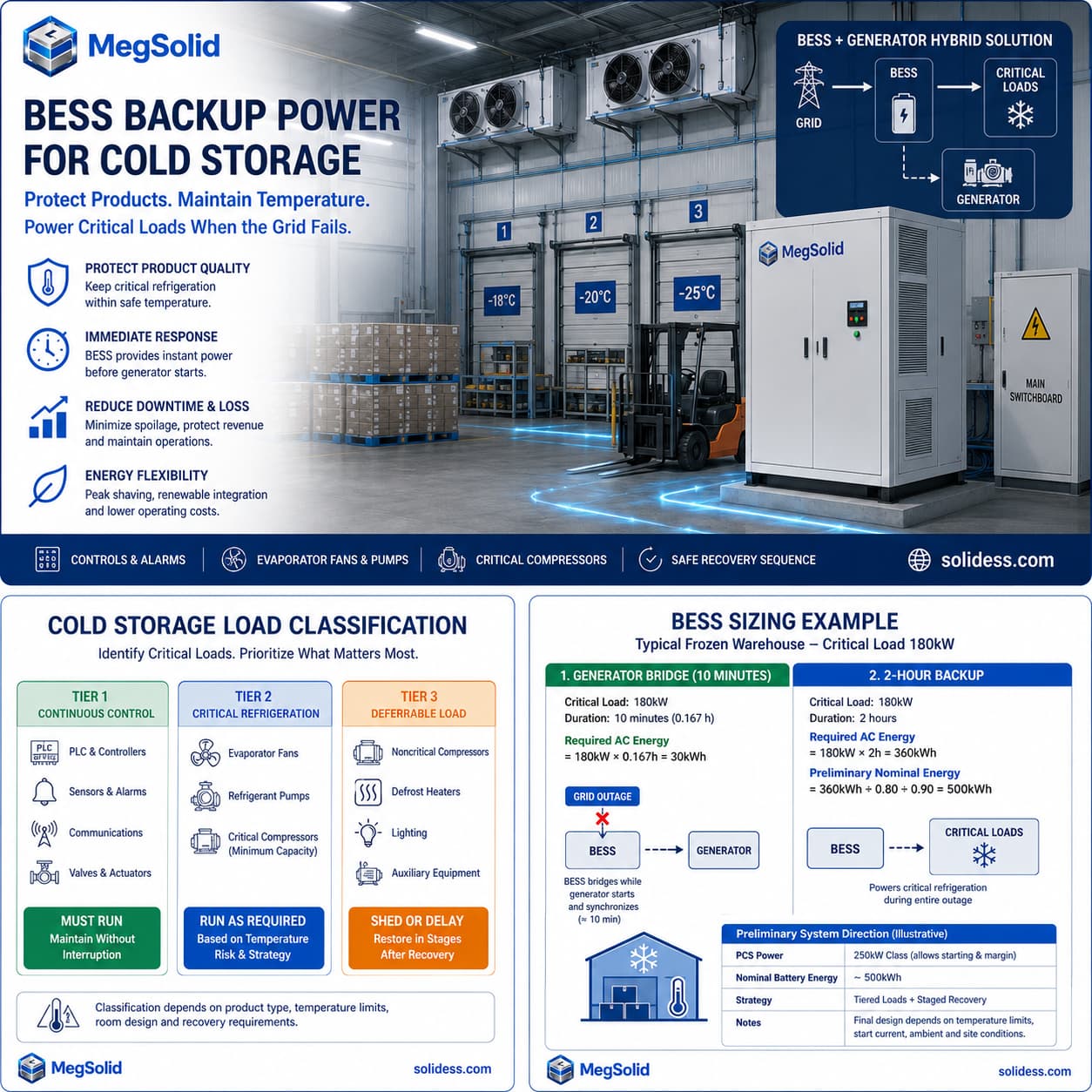
Is BESS the Right Backup Solution?
BESS is strongest when the refrigeration load can be divided into critical and deferrable groups.
| Project Condition | BESS Suitability | Recommended Direction |
|---|---|---|
| Generator requires 30 seconds to 10 minutes to accept load | High | Use BESS as a bridge |
| Frequent short grid outages | High | Battery-led critical backup |
| Critical refrigeration load can be reduced | High | Tiered-load BESS |
| Full refrigeration plant must run for 8–12 hours | Low as standalone | Generator or hybrid system |
| Existing generator is reliable but slow | High | BESS plus generator |
| Thermal storage is already installed | High | Coordinate electrical and thermal storage |
| Compressor starting exceeds PCS kVA | Configuration unsuitable | Add VFD, soft starter or larger PCS |
| No verified temperature limits or holdover data | Insufficient information | Complete thermal assessment first |
The selected energy storage system should protect the refrigeration process without unnecessarily backing up the entire facility.
The Cold Storage BESS Four-Layer Sizing Method
MegSolid does not size cold storage BESS from compressor kW alone.
The project is evaluated through four engineering layers.
| Sizing Layer | Engineering Question | Required Output |
|---|---|---|
| Thermal risk | How long can each room remain within its temperature limit? | Maximum permitted outage duration |
| Critical load | Which controls, fans, pumps and compressors must operate? | Critical operating power |
| Transient power | What is the highest compressor starting demand? | Required PCS kW and kVA |
| Energy duration | How long must the selected loads operate? | Required usable and nominal kWh |
This method prevents two common procurement errors:
- Oversizing the battery from the complete refrigeration nameplate
- Selecting adequate kWh with insufficient PCS starting power
Classify Refrigeration Loads Before Calculating Battery Capacity
Cold storage loads should be divided by operational priority.
| Load Tier | Typical Equipment | Backup Strategy |
|---|---|---|
| Tier 1: Continuous control | PLCs, sensors, alarms, communications and control panels | Maintain continuously |
| Tier 2: Critical refrigeration | Evaporator fans, refrigerant pumps and selected compressors | Support according to temperature risk |
| Tier 3: Deferrable load | Noncritical compressors, defrost heaters, lighting and auxiliaries | Shed or restore later |
The final classification depends on the stored product.
Frozen meat, pharmaceuticals, fresh produce and chilled dairy products have different temperature and recovery requirements.
USDA uses 40°F or below as a general refrigerated-food reference and 0°F or below for frozen food. Industrial projects must still apply product-specific regulatory, HACCP and customer limits rather than treating these general values as final warehouse design criteria.
Holdover Time Must Be Measured for the Actual Warehouse
Cold-room holdover time cannot be taken from a domestic refrigerator table or a generic industry assumption.
It depends on:
- Stored-product mass
- Room occupancy level
- Panel insulation and condition
- Air leakage
- Door-opening frequency
- Outdoor design temperature
- Lighting and internal heat sources
- Fan operation
- Product-temperature limits
The preferred evidence is temperature-logger data from a previous outage or controlled refrigeration shutdown.
Where measured data is unavailable, the refrigeration engineer should calculate a conservative temperature-rise curve from the room envelope and stored thermal mass.
The engineering submission should include:
- Normal room temperature
- Maximum permitted product temperature
- Time required to reach that limit without active cooling
- Minimum compressor capacity needed to slow the temperature rise
- Maximum acceptable recovery time after power restoration
BESS, Generator or Thermal Energy Storage?
These technologies perform different functions.
| Technology | Main Function | Main Limitation |
|---|---|---|
| BESS | Supplies immediate electrical power | Duration depends on battery capacity |
| Diesel generator | Supports long electrical outages | Requires startup, fuel and maintenance |
| Thermal energy storage | Stores cold for later use | Does not power controls, fans or pumps |
| BESS plus generator | Immediate response plus long-duration support | Requires coordinated controls |
| BESS plus thermal storage | Reduces electrical and cooling demand | More complex system integration |
DOE defines thermal energy storage as storing heat or cold for later use. It can discharge stored thermal energy directly for temperature control and reduce electrical demand during peak periods or outages.
BESS and thermal storage are therefore complementary.
A project requiring a hybrid solid-state battery configuration must identify the exact model and project BOM. Chemistry claims should not be transferred from one product family to another.
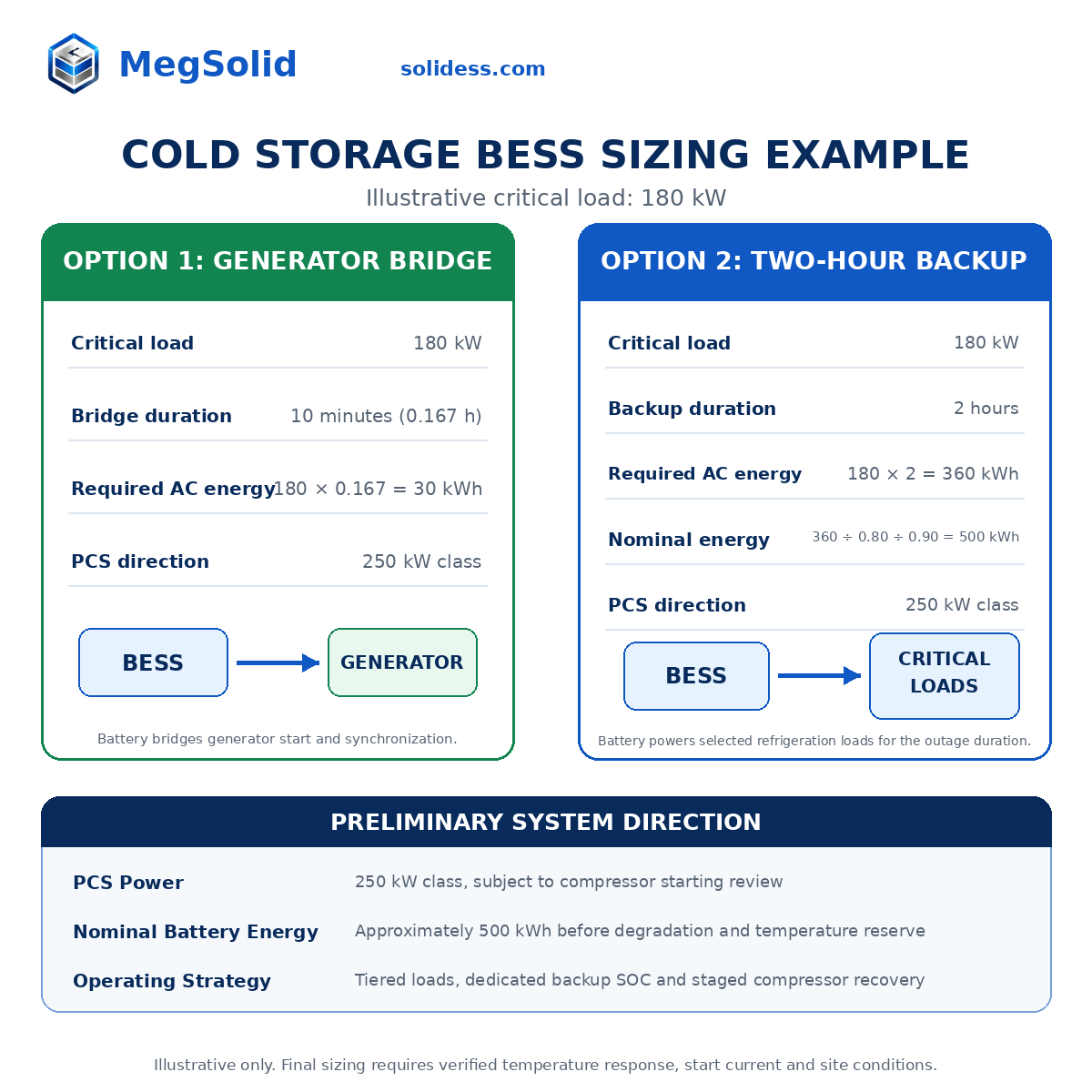
Cold Storage BESS Sizing Example
Assume a frozen-food warehouse has the following preliminary thermal conditions.
| Thermal Input | Illustrative Value |
|---|---|
| Normal frozen-room temperature | −18°C |
| Maximum project operating limit | −12°C |
| Modelled holdover without active refrigeration | 75 minutes |
| Required outage protection period | 2 hours |
| Selected strategy | Controls, circulation and one critical compressor |
These thermal values are illustrative.
Final sizing requires measured or modelled temperature response for the actual room, product and ambient conditions.
The refrigeration load classification is:
| Load Group | Illustrative Power |
|---|---|
| Controls, sensors and communications | 15kW |
| Evaporator fans and refrigerant pumps | 45kW |
| One critical compressor circuit | 120kW |
| Noncritical compressors and auxiliaries | 220kW |
| Total installed refrigeration load | 400kW |
| Selected critical backup load | 180kW |
The BESS supports 180kW rather than the complete 400kW plant.
Generator-Bridge Calculation
Assume the generator requires ten minutes to start, synchronize and accept the refrigeration load.
Required AC Energy = 180kW × 10 ÷ 60 = 30kWh
The energy requirement is small, but the PCS must still supply the full critical load.
The PCS must also tolerate:
- Compressor starting demand
- Fan and pump load steps
- Reactive-power demand
- Generator synchronization
- Temporary overload
A 250kW-class PCS may therefore be a more practical preliminary direction than a PCS rated at exactly 180kW.
Two-Hour Backup Calculation
For two hours of critical refrigeration support:
Required AC Energy = 180kW × 2h = 360kWh
Using an illustrative 80% usable SOC window and 90% conversion factor:
Preliminary Nominal Energy = 360kWh ÷ 0.80 ÷ 0.90 = 500kWh
The preliminary direction becomes:
- 250kW-class PCS
- Approximately 500kWh nominal battery capacity
- Additional degradation and temperature reserve
- Staged compressor restart
- Dedicated refrigeration-backup SOC
This is an initial engineering range, not a final quotation.
Compressor Starting Must Be Verified Separately
A compressor rated at 120kW may require substantially more than 120kVA during acceleration.
The project must review:
- Direct-on-line, soft-starter or VFD starting
- Locked-rotor current
- Starting power factor
- Acceleration time
- PCS apparent-power rating
- PCS overload capability
- Generator contribution
- Concurrent fan and pump loads
A large battery cannot correct an undersized PCS.
Cold storage EPCs can review the BESS motor-starting engineering guide before selecting converter power.
Prevent Simultaneous Compressor Restart
All compressor circuits should not restart immediately when grid or generator power becomes available.
A controlled recovery sequence is:
- Restore PLCs, sensors and communications.
- Confirm room and product temperatures.
- Start refrigerant pumps and evaporator fans.
- Start the highest-priority compressor.
- Verify voltage, pressure and refrigerant conditions.
- Add remaining compressors at controlled intervals.
- Restore defrost and auxiliary loads last.
- Recharge the BESS when sufficient grid headroom is available.
The selected energy storage inverter, BMS, EMS, refrigeration controller and generator controller must exchange operating status and power limits.
The detailed signal matrix can follow the BMS and EMS communication architecture guide.
Preliminary MegSolid Product Direction
Cold storage projects should use industrial systems rather than sizing from a Residential Energy Storage product intended for household loads.
The preliminary industrial direction is:
| Critical Backup Requirement | Preliminary Product Direction |
|---|---|
| Up to 100kW | Evaluate ESSA0100B-0215 |
| Around 125kVA | Evaluate 261.24kWh liquid-cooled system |
| 150–250kW | Evaluate MEGA0150TS or MEGA0250TS |
| 250–500kW | Evaluate MEGA0250TS or MEGA0500TS |
| 500kW–1MW or multi-hour backup | Evaluate ESSC containerized BESS |
| Multiple temperature zones | Compare distributed cabinets and centralized containers |
The C&I Energy Storage product category provides the relevant starting point for industrial refrigeration projects.
ESSA0100B-0215
The ESSA0100B-0215 is rated at 100kW AC and 215.04kWh. Its reviewed data identifies LFP cells, a 768V nominal battery and a 0.5C charge/discharge rate at 25°C.
The cabinet uses intelligent air cooling, has an IP54 enclosure and lists an operating range of 0–45°C.
It should be considered only when critical operating and starting requirements remain within the verified system capability.
Higher-Power Configurations
The 261.24kWh system is rated at 125kVA and uses 314Ah LFP cells with liquid cooling. The source lists an operating range of −20–55°C, with derating above 45°C.
MEGA PCS models include 150kW, 250kW and 500kW ratings. The platform lists grid-current THD below 3%, adjustable power factor and automatic on-grid/off-grid operation.
For larger warehouses and cold storage parks, the ESSC series includes 500kW/1.0752MWh and 1MW/2.1504MWh systems.
The Commercial and Industrial Energy Storage architecture should be selected from the verified critical-load profile rather than total installed refrigeration capacity.
Cold Storage BESS Sizing Data Sheet
The first inquiry should request only the data needed for preliminary viability assessment.
Required for Initial Review
- Room temperature zones
- Stored product categories
- Maximum permitted temperatures
- Critical load list
- Compressor starting methods
- Generator startup time
- Required backup duration
- Transformer nameplate
- Single-line diagram
Recommended for Detailed Engineering
- Temperature-logger records
- Room dimensions and insulation values
- Product loading level and thermal mass
- Door-opening schedule
- Compressor starting-current data
- Fifteen-minute facility load profile
- Generator transient-performance data
- Protection settings
- Ambient design conditions
The resulting engineering response should provide:
- Tier 1, Tier 2 and Tier 3 load classification
- Preliminary PCS kW and kVA
- Preliminary nominal battery capacity
- Required SOC reserve
- Generator-bridge sequence
- Compressor recovery sequence
- FAT and SAT data gaps
FAT and SAT Must Test the Refrigeration Sequence
A steady-state battery discharge test does not prove cold storage backup performance.
The FAT should simulate:
- Grid-loss command
- Critical-load transfer
- Compressor start request
- Load shedding
- Minimum SOC reserve
- Generator-ready signal
- Communication failure
- Controlled load restoration
The SAT should verify:
- Actual refrigeration loads
- Room-temperature response
- Compressor start sequence
- BESS power and SOC
- Generator transition
- Recovery charging
- Alarm and control communication
The acceptance scope can reference the BESS Factory Acceptance Testing guide.
Final Procurement Recommendation
A cold storage BESS should be sized from measured thermal risk, critical refrigeration power, compressor starting demand and the required operating duration.
The correct process is:
- Define product-temperature limits.
- Measure or model warehouse holdover time.
- Classify continuous, critical and deferrable loads.
- Determine whether BESS, generator or thermal storage will cover each period.
- Size PCS power for operating and starting demand.
- Size battery energy for the required duration.
- Preserve a dedicated refrigeration-backup SOC.
- Coordinate staged compressor recovery.
- Verify the complete sequence through FAT and SAT.
The objective is not to energize every refrigeration circuit.
It is to keep critical products within their approved temperature range using the smallest reliable MegSolid system that satisfies the verified project conditions.
FAQ
Q1: Should a BESS power every cold storage compressor?
Not necessarily. It should support the minimum compressor, fan, pump and control combination required to maintain the approved product-temperature range.
Q2: Can warehouse thermal mass reduce battery capacity?
Yes. Stored products and insulated rooms can slow temperature rise, but the actual holdover period must be measured or calculated.
Q3: Can BESS bridge diesel-generator startup?
Yes. PCS power covers the critical electrical load, while battery energy covers the generator starting and synchronization period.
Q4: Why are PCS power and battery energy calculated separately?
PCS kW and kVA determine how much load can be supplied. Battery kWh determines how long that power can continue.
Q5: Can one 215kWh cabinet support a cold warehouse?
Only when the critical load remains within 100kW and the verified usable energy covers the required duration.
Q6: Can BESS start refrigeration compressors?
Potentially. Starting current, starting power factor, acceleration time and PCS overload capability must be verified.
Q7: Should all compressors restart after power returns?
No. Compressors should normally restart in stages to avoid voltage sag, pressure problems and generator or transformer overload.
Q8: Can thermal energy storage replace BESS?
Not completely. Thermal storage supplies stored cooling, while BESS supplies electricity to controls, pumps, fans and compressors.
Q9: Can the same BESS perform peak shaving?
Yes, but the EMS must preserve the contracted refrigeration-backup SOC reserve.
Q10: What information is required for a quotation?
Provide temperature zones, product limits, refrigeration loads, compressor starting data, generator information, outage duration and the electrical single-line diagram.
Q11: How do you size BESS backup for cold storage?
Classify critical refrigeration loads, calculate PCS operating and starting power, define backup duration and adjust nominal battery energy for SOC limits, losses and degradation.
Q12: Which cold storage loads should receive priority?
Controls, alarms, refrigerant circulation, evaporator fans and the minimum compressor capacity required to protect product temperature should receive priority.
Q13: Is BESS or a generator better for refrigerated warehouses?
BESS provides immediate response and short-duration support. Generators are often more practical for long outages. Many warehouses require a coordinated hybrid system.